

Crypto World
UK Digital Gilt Push Could Help Unlock $44B in Annual Output



The United Kingdom could add as much as 33 billion British pounds ($44 billion) to its annual economic output by 2035 by becoming a leader in tokenized financial markets, according to a government-backed industry task force.
The estimate appears in the first report from Wholesale Digital Markets Champion Chris Woolard, who was appointed by HM Treasury to help implement the government’s digital markets strategy.
Developed with an industry task force, the report sets out a 12-month plan to test blockchain in a financial transaction where securities are used to borrow cash. It also calls for the UK to issue its first tokenized government bond by the first quarter of 2027.
The industry task force brings together more than 50 companies from traditional finance and crypto, including BlackRock, Goldman Sachs, JPMorgan, Morgan Stanley, HSBC, UBS, Coinbase, Circle, Ripple, Kraken, DTCC and Euroclear.
The roadmap attempts to move UK tokenization beyond isolated pilots and into live markets where securities can be traded, settled and used as collateral. The report said the task was now to move “from pilots to scale” and “from ambition to action.”
Ripple, which is listed among the task force’s industry members, backed the initiative on Monday. “Onchain funds, bonds and repo aren’t experiments,” the company said, adding that such instruments are already proving “cheaper, better and faster than their legacy equivalents.”
UK builds on digital gilt and settlement initiatives
The digital government bond, or gilt, itself is not a new proposal. The UK first announced the Digital Gilt Instrument pilot in November 2024.
This was followed by a July 2025 update outlining plans for onchain settlement, over-the-counter trading and secondary-market development. On Feb. 12, the government appointed HSBC’s Orion platform to support the pilot.
The new report adds a timetable and expands the intended role for the financial instrument. Beyond calling for issuance, the report seeks subsequent digital-gilt offerings, live secondary-market trading and eligibility for use as central bank collateral.
The report said tokenized securities have limited value unless they can be traded or used to raise cash, and urged the Bank of England to accept digital gilts as collateral.
Related: UK politicians mull permanent crypto donation ban in wake of Nigel Farage scandal
The UK also has a blockchain-based wholesale payment infrastructure that could support such markets. In December 2023, London-based Fnality launched a sterling-denominated payment system tied to central bank reserves, designed to support real-time repo, tokenized securities settlement and cross-currency payments.
Magazine: Has Bitcoin bottomed for this cycle? Analysts say ‘not yet’


A long-dormant Bitcoin wallet that last moved funds when BTC traded around the mid-$6,000s has re-entered the market, transferring a large amount of coins that may be nearing an eventual sale. Arkham blockchain data shows the wallet “356my” moved 2,931 BTC—worth roughly $188 million at current prices—into a new wallet address on Sunday.
The transaction stands out because it represents the whale’s first on-chain activity in seven years, and analysts link such moves to potential liquidation flows. The transfer also arrives as exchange-related inflows are being increasingly dominated by large holders rather than smaller investors.
Key takeaways
- A wallet last active near $6,500 BTC has transferred 2,931 BTC (about $188 million) for the first time in seven years, according to Arkham.
- Blockchain analytics from Onchain Lens suggests the holdings could be up nearly 10-fold, based on the wallet’s likely cost basis over the holding period.
- CryptoQuant data indicates exchange whale activity remains heavily concentrated, with whale-led deposits accounting for about 99% of BTC exchange inflows year-to-date.
- Large whale transfers into exchanges are often interpreted as sell-side preparation, potentially adding pressure to BTC while spot ETF flows remain mixed.
- Farside Investors data shows spot Bitcoin ETFs recorded net inflows leading into Friday, but June delivered $4.51 billion in net outflows—the worst month on record.
Seven-year-old Bitcoin wallet moves $188 million
Arkham’s explorer data attributes the move to a single whale wallet labeled “356my,” which sent 2,931 BTC to wallet address “bc1qn” on Sunday. The size is significant: at Bitcoin’s current trading level of around $64,000 per coin, the transfer values near $188 million.
What makes the transfer especially noteworthy is the wallet’s dormancy. The earlier activity dates back roughly seven years, when Bitcoin’s market price was around $6,500. While a dormant balance doesn’t guarantee future selling, the timing and magnitude have prompted fresh scrutiny from on-chain analysts.
Onchain Lens has framed the move as a near 10-fold gain scenario—an outcome consistent with buying or accumulating during the years when BTC traded far below today’s level. The implication for traders is straightforward: when long-held coins begin moving, it can signal a shift from accumulation to distribution, particularly if funds are routed toward exchange infrastructure.
Why exchange-linked whale inflows matter
Recent market flows suggest that whales are driving a disproportionate share of BTC entering exchange ecosystems. CryptoQuant’s exchange whale ratio chart—tracking the share of deposits tied to large transfers—stands at 0.99 at press time for the year-to-date window.
CryptoQuant interprets this high concentration as “historically a bearish signal.” The underlying logic is that whale deposits are more likely to be associated with substantial sell orders rather than routine retail behavior. In practice, when large holders move coins to exchanges, it often represents preparation for liquidity events—sometimes immediate, sometimes gradual.
Coinglass defines “whale transfers” as movements of at least $10 million, which helps contextualize why these transactions can carry more weight than smaller wallet activity. If the current pattern persists, BTC could face intermittent sell pressure even if broader demand remains steady.
ETF flows add another layer of selling pressure risk
The whale transfer also lands amid ongoing questions about spot Bitcoin ETF positioning. Farside Investors data shows US-traded spot Bitcoin ETFs registered $197 million in net weekly inflows leading up to Friday. However, the broader trend has not been supportive: Farside also reports that ETFs recorded $4.51 billion in net outflows in June, marking the worst month on record.
That mix—weekly inflows alongside a severely negative monthly performance—can translate into a more fragile price backdrop. Even when ETFs provide short bursts of buying, persistent outflows can reduce the market’s ability to absorb large sell-side catalysts.
As a result, the combination of (1) whale-led exchange inflows and (2) the lingering ETF outflow overhang may be one reason analysts keep pointing to “additional pressure” risk when large on-chain balances start to move.
What to watch next after the transfer
While the wallet-to-wallet transfer itself does not confirm a sale, the market’s next clues will likely come from whether the coins move again—especially if they transition from private wallets to major exchange addresses. Traders and investors will also want to monitor whether whale transfers continue at similar frequency and magnitude, and whether ETF flow momentum improves after June’s outflows.
For now, the key uncertainty is timing: long-dormant coins can sit for weeks or months after the first move, but repeated movements toward exchange liquidity typically strengthen the case for distribution. Readers should watch the on-chain follow-through alongside ETF flow data to gauge whether this whale activity turns into sustained selling pressure or fades into a one-off reshuffling.
Latest developments: CEO Stephen Gregory said Binance.US is focused on growth after what he described as a two-year “hibernation” tied to regulatory issues surrounding the broader Binance brand.
- Gregory said Binance.US is a separate U.S.-only entity with its own governance structure, though it shares a common beneficial owner and brand name with Binance.com.
- He said the exchange previously held roughly 20% of the U.S. crypto exchange market and is targeting a return to that level.
- Gregory said Binance.US is now licensed exclusively to serve U.S. customers.
What this means: Binance.US is trying to compete with exchanges such as Coinbase and Kraken by emphasizing lower trading costs and a broader product lineup.
- Gregory said the exchange has reduced fees to “essentially almost a no-fee exchange,” with 0% maker fees and 2-basis-point taker fees.
- He said the company has kept costs low by operating with a lean team and expects to generate revenue from services like custody alongside trading.
- Gregory said the exchange is rebuilding liquidity through incentives and direct outreach to retail customers, including personally contacting some of its top users for feedback.

A Duke University finance professor, Campbell Harvey, has said that a 51% attack on Bitcoin, long dismissed as a theoretical exercise that would only destroy value for whoever tried it, has quietly become something an attacker could profit from because of today’s derivatives markets.
However, many BTC supporters dismissed the claim made during the July 12 episode of Scott Melker’s Wolf of All Streets podcast, arguing that it ignores the practical economic barriers that would likely stop such an attack.
Derivatives Have Changed Bitcoin’s Risk Profile
According to Harvey, a 51% attack, where a single entity gains the majority control of the Bitcoin network’s hash power, has always been technically possible but made little economic sense. This is because an attacker would need to spend billions of dollars on mining hardware but would only end up destroying the value of the asset they had just compromised.
“Why would you spend billions investing in mining equipment, take over the network, but the price of Bitcoin collapses to zero?” Harvey posited. “So you spend all that money and get nothing?”
But now, he believes that equation has changed, given that derivative markets carry enough liquidity for an attacker to short BTC before launching an attack and profit as the price falls.
“The difference today is the derivatives markets,” he told Melker. “What you want to do is simultaneously during the attack take a short position on Bitcoin, and with a short the ideal outcome is if the asset goes to zero.”
The professor did point out that the trade would have to take place on offshore derivatives platforms since it amounted to blatant market manipulation. In his research paper titled “Gold and Bitcoin,” he estimated that such an operation would cost about $8 billion, which is roughly 50 basis points of BTC’s total market value, although he framed the scenario as a risk management exercise and not a prediction, arguing that investors should consider every credible threat instead of dismissing uncomfortable possibilities.
When asked the same question, Grok estimated that anyone looking to carry out such an attack would need to spend more than $10 billion on mining machines and about $1.3 million in electricity costs every hour. It also noted that any attempt would most likely be detected immediately.
Interestingly, Harvey does not think the same scenario can work on Ethereum. According to him, since Ethereum switched to proof-of-stake, an attacker has to acquire more than half of the liquid ETH supply to control one-third of all staked Ether, which would rapidly drive prices higher during the attempt and eliminate the short-selling opportunity he described for Bitcoin.
The educator’s criticism of Bitcoin went beyond its network security, as he argued that the OG cryptocurrency is too volatile to qualify as a safe haven asset or reliable store of value. He said that price swings have stayed high even after years of market growth and deeper liquidity. At the time of writing, BTC was trading near $62,000 after slipping to near $61,000 last week following the renewal of hostilities between the US and Iran.
Bitcoin Community Pushes Back
The response on X to Harvey’s interview was mostly dismissive, with market watcher David Levenson calling the professor’s take “a fundamental misunderstanding of how derivatives work.” Another listener, PrivateCoSaylor, argued that Bitcoin’s social consensus could reject blocks produced by an attacker, making the strategy economically self-defeating.
However, there were those who aired different concerns, including pseudonymous trader Toni, who noted that while the whole argument rested on profit being the motive, the same wouldn’t hold if a nation-state or short seller simply wanted Bitcoin to fail regardless of any losses they incurred.
The post Expert: Bitcoin Faces $8B Attack Risk, Ethereum More Secure appeared first on CryptoPotato.

Ripple secured full MiCA CASP authorization from Luxembourg’s CSSF last week, and the more consequential story isn’t what it achieved, but what every other crypto firm operating in Europe now has to replicate or exit.
Luxembourg’s VASP transitional period under MiCAR expired on July 1, 2026. That deadline was not a soft target, so firms that entered it without a completed CASP authorization must now stop serving EEA customers. Post-deadline, VASPs may only continue operating until they receive a final decision on their authorization, meaning the transitional buffer is gone and there is no further grace period to invoke.
The practical result is a hard bifurcation of the European crypto market. Ripple joined approximately 210 firms reported to have reached MiCA-compliant status ahead of the July 1 cutoff. The rest, exchanges, custodians, and payment processors, face an immediate choice between accelerating their authorization process and withdrawing from the region.

Don’t Miss Out on Our $1,000 USDT Airdrop on ByBit
Ripple Dual-License Architecture Every Serious Operator Needs
Ripple’s crypto compliance structure is more layered than a single authorization event. The company holds both an EMI license and the new CASP approval. That combination is not redundant; it maps directly to the two distinct regulatory tracks MiCAR creates for firms that want to offer complete crypto payment services in the EEA.
The EMI license governs fiat and e-money activity, covering the fiat on-ramp and off-ramp infrastructure that underpins any cross-border payments product. The CASP authorization covers the crypto-asset side: custody, transfers, exchange functions, and related services.
A firm offering only one without the other operates with a structural gap in its regulated product scope. Ripple’s press release described the combination as enabling “end-to-end regulated crypto payments” available to financial institutions, corporates, and businesses across all 30 EEA countries.
Cassie Craddock, Managing Director for UK and Europe at Ripple, framed the strategic logic:
“This CASP authorisation means Ripple enters the post-transitional MiCA era fully compliant and ready to scale. The institutions we work with across Europe are looking to build their digital assets services alongside regulated partners, and Ripple is licensed and ready to meet that demand.”
The Bar Is High, and the Field Is Thin

The competitive implications of the July 1 deadline are already visible. Ripple’s press release noted it is “one of a small number of digital asset firms to have full authorization under MiCA,” a description that is accurate given the reported figure of approximately 210 licensed firms out of a much larger pre-MiCA European crypto market.
Adding to a global portfolio of more than 75 regulatory licenses, Ripple brought substantial institutional compliance infrastructure to this process. That resource base is not available to most smaller operators.
The structural challenge for mid-tier exchanges and service providers is not simply the cost of licensing. It is the governance and operational depth that CSSF’s CASP regime requires: prudential capital requirements, organizational controls, senior management accountability, and ongoing supervisory obligations.
Firms that built their European presence on lighter-touch VASP registrations are now being asked to clear a substantially higher bar, and those that cannot meet it face the prospect of the kind of forced strategic contraction that reshapes competitive dynamics quickly.
— Coin Bureau (@coinbureau) July 1, 2026
 WATCH: TETHER CEO EXPLAINS WHY $184B USDT DID NOT APPLY FOR MICA
Paolo Ardoino said Tether did not apply for MiCA license because “it is very dangerous when it comes to stablecoins.”
He said the rules could force issuers to park 60% of reserves in “uninsured cash deposits” at… pic.twitter.com/hCbrNhFFhQ
The regulatory context reinforces why Europe crypto regulation is setting a global precedent. While MiCA tightens the EEA perimeter, parallel frameworks are developing elsewhere. This includes ongoing market debates about Ripple’s positioning in global payments infrastructure and, in the US, the CLARITY Act’s push toward a comparable digital asset classification framework.
Any crypto firm still operating in Europe without CASP authorization is either racing through an active application or managing a wind-down. There is no third option under MiCAR. The transitional period is closed, the CSSF has published its expectations, and the authorized-versus-unlicensed divide is now a permanent feature of the European crypto landscape.
Don’t Miss Out on Our $1,000 USDT Airdrop on ByBit
Discover: The Best Token Presales
The post Ripple CASP Approval Exposes the Compliance Gap Splitting Europe’s Crypto Market appeared first on Cryptonews.
Coinbase Ventures has completed 30 startup investments during the first half of 2026, maintaining the industry’s most active venture pace despite a sharp slowdown in overall crypto fundraising.
Summary
- Coinbase Ventures led crypto VC activity with 30 startup deals in H1 2026.
- DeFi, payments, and AI remained the top sectors attracting venture funding.
- Overall crypto fundraising stayed weak despite a modest recovery in June and July.
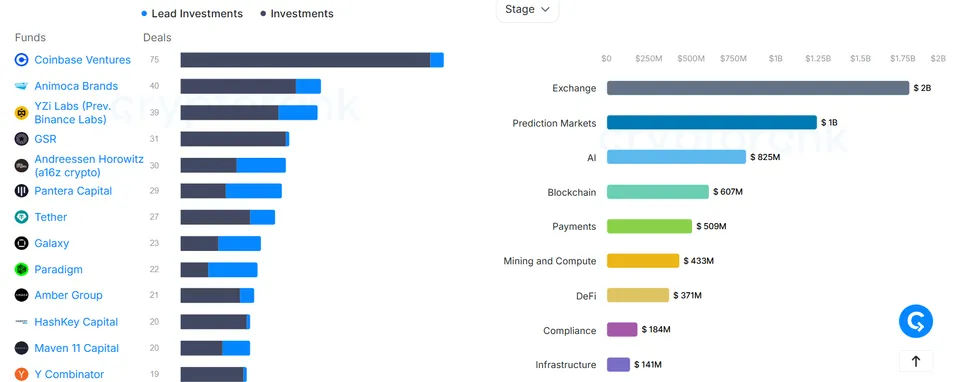
According to CryptoRank, the venture arm of Coinbase led all crypto-focused investors with 30 deals between January and June, ahead of Animoca Brands with 19 investments, venture capital firm a16z with 18, and stablecoin issuer Tether with 15. The latest rankings come as venture funding across the digital asset industry remains well below levels seen earlier this year.
Coinbase Ventures has stayed ahead despite weaker funding
CryptoRank’s data also shows Coinbase Ventures has widened its lead over a longer period. During the past 12 months, the firm completed 75 investments, compared with 40 for Animoca Brands, 39 for YZi Labs, formerly Binance Labs, 31 for GSR, and 30 for a16z.
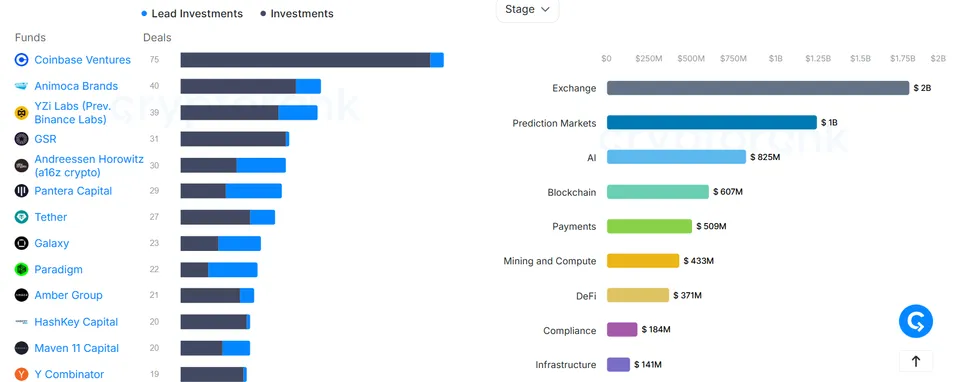
While investment activity from leading firms has remained steady, the amount of capital entering the sector has dropped sharply. CryptoRank reported that crypto companies raised $1.4 billion across 61 funding rounds in June, down from $3.8 billion in April. Fundraising rounds also declined from 89 in May to 61 in June.
Even so, June represented a modest improvement over April, when startups secured just $698 million through 71 fundraising rounds, the weakest monthly result in two years. Earlier reporting by crypto.news cited another dataset showing April funding at $659 million across 63 deals, a 74% decline from March that pushed monthly venture flows back to 2024 lows even as decentralized finance and AI projects continued attracting investors.
Early signs of recovery have appeared in July. According to CryptoRank, crypto companies have already raised $456 million through 12 funding rounds during the month.
DeFi, payments and AI continue attracting investors
Coinbase Ventures’ recent investments have centered on payment infrastructure, decentralized finance and blockchain infrastructure. CryptoRank said the firm participated in seven funding rounds involving payment protocols during the first six months of the year, alongside four DeFi investments and three rounds each focused on infrastructure and real-world asset tokenization.
Across the broader venture market, DeFi remained the busiest category over the past year with 216 fundraising rounds, according to CryptoRank. Payment startups followed with 131 rounds, while crypto projects focused on artificial intelligence secured 128 funding rounds. Infrastructure companies completed 110 fundraising rounds, with every other sector recording fewer than 100 deals over the same period.
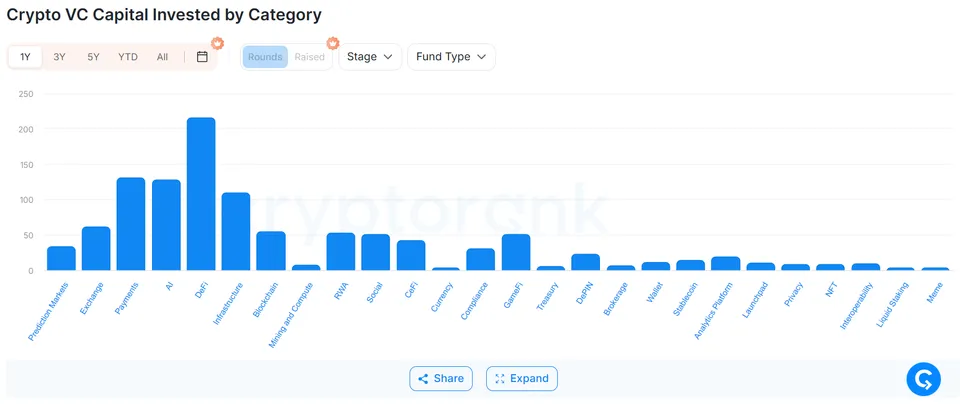
Investor participation has nevertheless narrowed. CryptoRank reported that the number of unique investors fell to 242 in June, compared with 452 recorded in October 2025, indicating fewer firms are actively backing new crypto startups despite continued investment from leading venture groups.
Regional data also highlights where venture money has been concentrated. According to CryptoRank, investors based in the United States deployed $5.8 billion during the past six months, while Australia-based investors contributed $3.6 billion. Another $11.6 billion of investment came from undisclosed locations, underscoring the continued role of unidentified capital sources in crypto venture funding.
Although the overall funding environment remains weaker than earlier this year, CryptoRank’s latest figures show that established venture firms, led by Coinbase Ventures, continue to back startups building payment systems, DeFi applications, AI products and blockchain infrastructure even as total capital flowing into the sector remains under pressure.
The cryptocurrency market has dipped once again over the past several hours, but Pi Network’s native token has taken this minor correction a lot worse, with a fresh dump to a new all-time low.
Moreover, nearly 130 million coins are scheduled to be unlocked in the following months, which could further worsen PI’s state.
Low After Low
It’s almost impossible to imagine now, but PI traded at $0.30 in March after its major listing on Kraken. The subsequent rejection, though, pushed it south to $0.20, where it managed to stand there for a while. Although that key support was breached briefly, the token challenged it in late April, only to be halted again.
The following few months have brought nothing but pain for the PI token holders. As the chart below will clearly demonstrate, the asset has been on a violent free-fall that has taken it to several consecutive all-time lows. The latest arrived earlier today when PI decisively lost the $0.10 support and even the $0.09 floor.
Another double-digit price dump pushed it south to $0.086, which became its new all-time low. PI is down by over 22% weekly, and a whopping 97.1% since its all-time high in February 2025.

What’s even more worrisome for investors is the fact that over 127 million coins are set to be unlocked in the next 30 days, according to data from PiScan. Such large token releases could increase the immediate selling pressure from investors who had been waiting for their coins for a long time. This is particularly true in bear markets when the distress is higher than usual.
Can New Updates and Products Help?
Although the recent price picture looks more than grim, the team behind the project has not stood still. They continue to outline new products, significant protocol updates, and celebrate the major milestones.
The latest was the Pi2Day (June 28), when the Core Team unveiled three major infrastructure products aimed at expanding the ecosystem beyond its existing user base. Namely, those were SoloHost, a framework for locally hosting AI apps and distributed computing; Pi Sign-in, which enables third-party websites and apps to authenticate users through Pi accounts; and PiVerify, a KYC and identity verification service for external businesses.
Despite the significance of some of those products, the timing remains a challenge. Such infrastructure improvements require months or even years to translate into measurable network activity and token demand. For now, the actual benefits are missing, and the protocol’s native token continues to dig new lows.
The post Pi Network’s PI Hits New ATL After 11% Crash as 130M Token Unlock Looms appeared first on CryptoPotato.


Aave has expanded its use of Chainlink’s Cross-Chain Interoperability Protocol (CCIP), making it the default infrastructure for cross-chain activity across its ecosystem.
Summary
- Aave has made Chainlink CCIP its default infrastructure for cross-chain operations.
- CCIP now powers deposits, withdrawals, Stable Vaults, GHO transfers, and governance.
- Chainlink continues expanding institutional adoption through Project Pangea and banking partnerships.
According to an announcement from Aave, the protocol has selected Chainlink CCIP to power cross-chain functions across the Aave App and Stable Vaults, extending an integration that already supports GHO stablecoin transfers and governance messaging.
The update places a single interoperability layer behind token transfers, vault management, and governance execution instead of relying on separate systems for different tasks.
Previously, CCIP was already responsible for moving Aave’s GHO stablecoin across supported networks and for handling cross-chain governance through the Aave Delivery Infrastructure, or a.DI. With the latest expansion, the same infrastructure will now process deposits, withdrawals, vault rebalancing, yield optimization, and asset transfers carried out through the Aave App.
Cross-chain operations now run through one infrastructure
Inside the Aave App, Stable Vaults automatically move deposits between Ethereum, Base, and Arbitrum to improve returns for users. Under the new setup, CCIP carries out those background transfers without requiring users to manually bridge assets before moving funds between supported networks.
Aave Labs introduced Stable Vaults as an infrastructure product that allows businesses to add fixed-rate stablecoin yield to their own applications. According to Aave, the same vault technology already supports savings products available through the Aave App.
GHO and Savings GHO also rely on CCIP through Chainlink’s Cross-Chain Token standard. According to Aave, GHO is now available across eight blockchain networks, with CCIP providing the infrastructure used to transfer the stablecoin between those supported chains.
The protocol explained that transfers from Ethereum to supported layer-2 networks use a lock-and-mint model. For transfers between other supported chains, CCIP switches to a burn-and-mint process designed to preserve GHO’s total supply while keeping the token interchangeable across networks.
Existing governance and institutional work expands
Cross-chain governance also continues to operate through the Aave Delivery Infrastructure. According to Aave, proposals approved on Ethereum can be executed across other blockchain networks where the lending protocol is deployed, allowing governance instructions and asset transfers to move through the same communication layer.
Aave added that the decision extends a relationship that began in January 2020, when the protocol adopted Chainlink Data Feeds as its oracle infrastructure. CCIP now operates alongside those services through Chainlink’s decentralized oracle network.
Security remains part of the design. According to Aave, every CCIP bridge lane used by the protocol is secured by at least 16 independent node operators spread across different organizations, geographic regions, and infrastructure providers. The system also applies rate limits that restrict the amount of value that can move between networks during abnormal conditions.
The announcement comes as Chainlink continues to expand its institutional footprint. As previously reported by crypto.news, the network joined Project Pangea in June alongside FairSquareLab, UniKA, and Qivalis to test stablecoin-based foreign exchange settlement between Europe and South Korea.
Chainlink said the initiative involves more than 50 banks representing over $10 trillion in assets under management, while Qivalis is backed by 37 European banks and UniKA represents more than 10 Korean commercial banks.
The context: Building AI data centers remains a multi-year effort with labor emerging as a key execution challenge.
- Prager said the Kentucky facility is expected to come online beginning in 2028 and that TeraWulf has hired Fluor to help construct the project.
- He said securing skilled labor and contractors is a bigger challenge than equipment procurement as hyperscale AI facilities become increasingly specialized.
- Prager said proximity to reliable power remains the most important requirement for AI customers.
Reading between the lines: TeraWulf says Bitcoin mining is no longer part of its long-term strategy.
- Prager said the company originally entered Bitcoin mining because it already owned power assets and mining provided a flexible electricity customer.
- He said Bitcoin’s commodity-driven revenue model did not provide the predictable, long-term cash flows the company prefers.
- “We’re not involved in Bitcoin,” Prager said, describing AI infrastructure as a more natural fit for TeraWulf’s business.
Worth watching: Prager argued the AI infrastructure boom is constrained by power quality rather than available land.
- He said the U.S. faces a shortage of electricity and warned investors that “not all megawatts are created equally.”
- Prager said successful AI campuses require reliable generation, redundant transmission, favorable regulation and strong community relationships.
- He added that TeraWulf focuses on redeveloping former industrial sites and, where needed, adding new power generation to support both AI facilities and the broader electric grid.
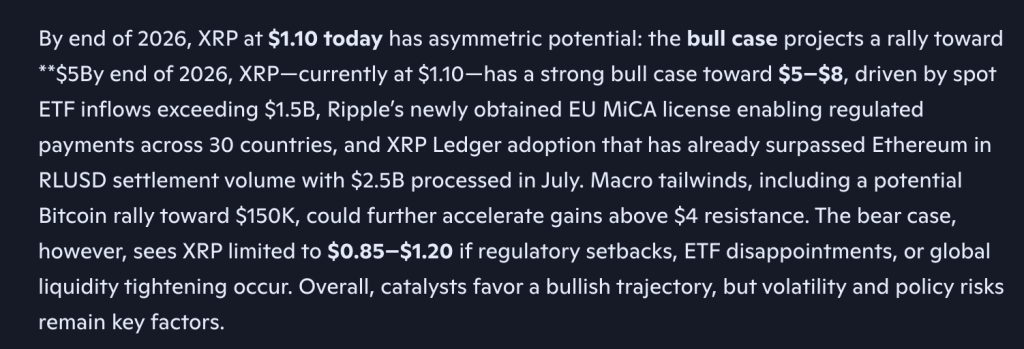
Microsoft Copilot AI just dropped one of the most updated rich XRP price predictions in this series, pulling in a July 2026 data point that puts real weight behind the bull case. The model predicts $5 to $8 by year’s end, calling the setup asymmetric from the current $1.10 level.
The bull case is built on 3 pillars, all of which are producing real numbers right now rather than projecting future possibilities. Spot XRP ETF inflows have already exceeded $1.5 billion, demonstrating that institutional demand is not hypothetical.
Ripple’s newly obtained EU MiCA license enables regulated payments across all 30 European Economic Area countries, opening an entire continent of institutional and retail payment infrastructure to XRP based settlement in a way that was not possible before.
The third pillar stands out most in this series because of its specificity. The XRP Ledger has already surpassed Ethereum in RLUSD settlement volume, processing $2.5 billion in July alone, which is a concrete on chain metric showing real utility rather than theoretical adoption.
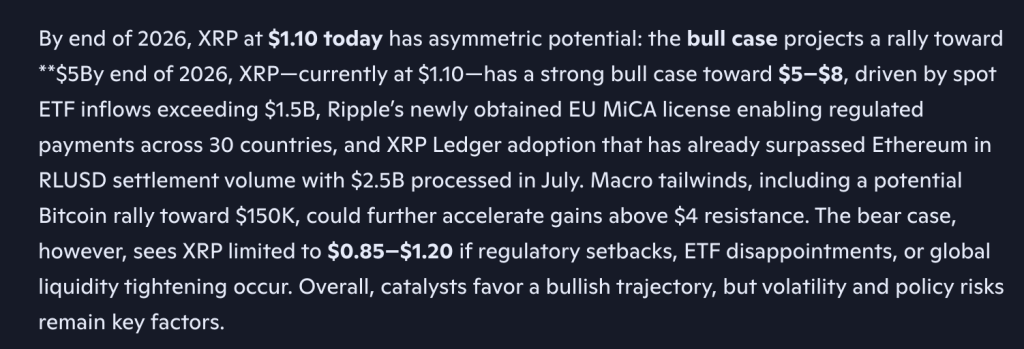
A potential Bitcoin rally toward $150,000 could further accelerate gains above the $4 resistance level, as altcoins tend to catch bid once Bitcoin dominance peaks and capital rotates.
Together the model frames this as genuinely asymmetric, with limited downside anchored by proven utility and significant upside if macro conditions cooperate.
The bear case is comparatively tight and specific. If regulatory setbacks emerge, ETF inflows disappoint, or global liquidity tightens further, the model sees XRP remaining stuck between $0.85 and $1.20, essentially grinding sideways right where it currently trades without achieving any real breakout.
The model acknowledges volatility and policy risks as the key factors that could keep prices in that range regardless of fundamentals.
XRP Price Prediction: XRP Holds Above $1.00 With Its Biggest Catalyst Stack Waiting On One Senate Vote
The daily chart shows XRP at $1.10049 after a long decline from highs above $3.65 set back in early August of last year.
That slide has been persistent and almost entirely one directional, with price spending the past several weeks consolidating in a tight range between $1.03 and $1.20, the exact zone the bear case names as the ceiling if catalysts fail to deliver.
The consistency of this range over the past month is actually a notable change from the steady lower highs pattern that defined the earlier part of this year, suggesting sellers may be losing the momentum they had during the steepest parts of the decline.
Resistance sits first at $1.20, the level that has capped every bounce attempt over the past 6 weeks, with a heavier ceiling near $1.60 where multiple rallies failed earlier in 2026.
Above that sits the $2.00 zone and then the $4.00 level that the model specifically names as the line that needs to break before the upper end of the bull case becomes technically realistic.
Support holds at $1.00, the psychological floor that has been tested and defended multiple times since late June. The broader structure still shows a series of lower highs stretching back to August 2025, so no confirmed reversal has appeared on this chart yet.
Momentum on the daily candles looks stabilized rather than reversing, with the tight range trading of the past month suggesting consolidation rather than distribution.
Given that the $2.5 billion RLUSD July settlement volume number just landed as a real data point, the question this chart is asking right now is simple: does XRP reclaim $1.20 and build from there, or does it slip back below $1.00 and open the door to the $0.85 bear case floor sitting just below.
Don’t Miss Out on Our $1,000 USDT Airdrop on ByBit
Discover: The best crypto to diversify your portfolio with
Here is What Copilot AI Predicts For LiquidChain Near Future
The market leaders are stuck. Waiting on them is not a position. It is a queue.
Bitcoin, Ethereum, and XRP have been testing the same ceilings for weeks. The catalyst is always one print away. The inflows are always next quarter. Every large-cap trader waiting for a breakout is waiting on someone else’s decision.
Copilot AI sees what smart money already knows. Capital that disappears as noise at Bitcoin’s scale can move a small undiscovered project by multiples.
The asymmetric return lives in one place: the gap between what something is genuinely worth and what the market has priced it at. That gap closes the moment the project gets found.
Cross-chain fragmentation has been extracting value from DeFi since the first bridge launched. Bitcoin, Ethereum, and Solana were built as separate systems with no intent to interoperate. Every transaction crossing those boundaries pays in fees, slippage, and execution failures. Bridges did not solve the problem. They monetized it.
LiquidChain eliminates the toll entirely. All 3 networks within a single execution layer. One deployment. No cross-chain tax anywhere.
Copilot AI flagged it as worth watching. The presale is at $0.01454 with just over $860,000 raised.
Execution is unproven. Adoption is unknown. Established assets offer a predictable ride toward a ceiling everyone can already see. LiquidChain is an entry point that disappears once the market finds it.
The post Microsoft Copilot AI Predicts Insane XRP Price by End Of 2026 appeared first on Cryptonews.
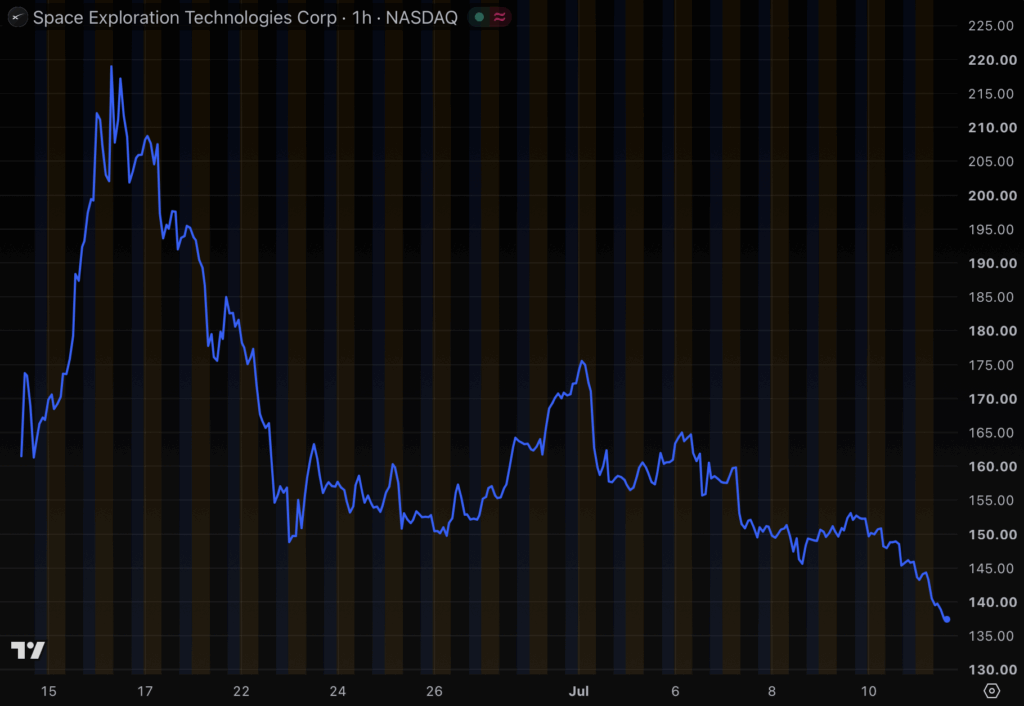
SpaceX slipped below $140 per share on Monday, wiping out $1 trillion from the peak market capitalization of Elon Musk’s IPO.
Since the manic peak three days into its life as a public company, SpaceX has declined from a market cap of $2.9 trillion to under $1.8 trillion today.
SpaceX priced the most expensive IPO in history at $135 per share on June 11, selling 555,555,555 shares to raise roughly $75 billion.
The stock opened at $150 the next morning and closed its first day at $160.95, a 19% gain over the offering price.
It kept going up for two more days but has crashed ever since.
$1 trillion vaporized
By June 16, its third day of trading, SpaceX closed at $201.80 and touched an intraday high of $225.64, a valuation of $2.95 trillion that briefly vaulted Musk’s company past Amazon, Microsoft, and other giants.
At time of writing, SpaceX has fallen to eighth place on the leaderboard of public companies.
Fueling SpaceX’s three-day run was excitement about futuristic plans to colonize Mars, acres of non-existent space data centers, and a $60 billion deal to buy AI coding startup Cursor — announced the same day the stock price peaked.
Back below $140 per share as of midday today, SpaceX now has a slightly more modest market capitalization near $1.8 trillion. Measured against its intraday peak on June 16, the company has lost $1.1 trillion in drawdown, a decline of roughly 38%.
To be fair, any insider who was able to buy at the IPO price of $135 is still about 3% in the green, although shares are 7% below its $150 debut open on public exchanges for ordinary investors.
Still, 7% is far more manageable than 38%. Those people, who waited until the third day to buy, are underwater at a concerning depth.
Read more: Hyperliquid SpaceX perp plummeted before Blue Origin explosion
Skeptical of SpaceX’s valuation
Michael Burry, skeptical investor of The Big Short fame, wrote that “nothing in that S-1 suggests it is worth $1 trillion let alone $2 trillion.” The filing showed 2025 revenue of $18.7 billion against a net loss of $4.9 billion.
In the end, Burry explored a short sale of SpaceX yet ultimately walked away, concluding that borrowing fees and options premiums made betting against the stock too costly.
Morningstar, meanwhile, pegged fair value at $63 a share at the IPO, less than half the offering price and well under a third of the June peak.
Unfortunately, none of that skepticism prevented the initial exuberance, and none of it stopped the dramatic reversal.
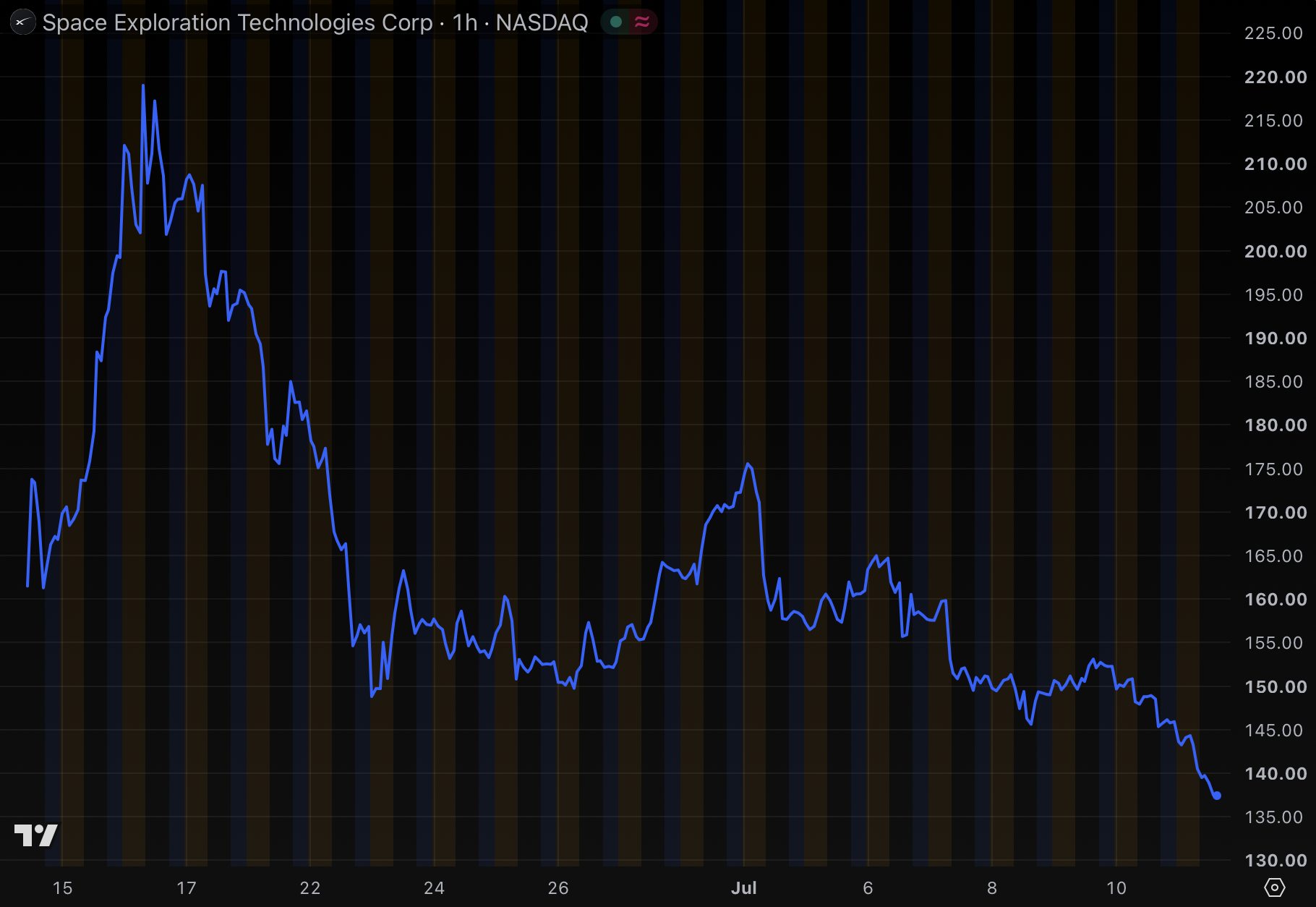
SpaceX fell 16% on June 22 to close at $154.60, its worst session since the debut. Its long-awaited addition to the Nasdaq 100 index on July 7, an event that hands a stock a wave of automatic passive buying, instead greeted it with a drop exceeding 6% as investors who had bought the rumor sold the news.
As usual, there are two sides to every story. Oppenheimer raised its target to $250, and other banks initiated coverage with targets ranging up to $300, including a $25 price target raise today from Jefferies.
Got a tip? Send us an email securely via Protos Leaks. For more informed news and investigations, follow us on X, Bluesky, and Google News, or subscribe to our YouTube channel.

Bitcoin Whale Transfers $188M for First Time in Seven Years
Daytime Emmys reveal first nominees for 2026, including Best Actor in a Drama

Man City lay down £150m transfer marker as Blues avoid chaos and confusion


-

 News Videos7 days ago
Whats Hidden Inside This Cash Register? #treasure #reselling #money
-

 Fashion4 days ago
Loro Piana Fall 2026 Enters Houston’s Art Scene
-

 Fashion3 days ago
Weekend Open Thread: Nutriplenish Leave-In Conditioner
-
 Tech7 days ago
Anthropic’s new “J-lens” reveals a silent workspace inside Claude that mirrors a leading theory of consciousness
-
 Sports4 days ago
2026 Genesis Scottish Open Thursday TV coverage: Round 1
-

 Sports6 days ago
Joshua Pacio ‘more complete’ ahead of ONE rematch vs Malachiev
-

 Tech6 days ago
Anthropic brings Claude Cowork to mobile and web as usage data shows most users aren’t coding
-

 Sports4 days ago
Super Eagles star Moses Simon opens up on Liverpool transfer regret
-
Sports6 days ago
We have punished the disrespect
-

 Crypto World7 days ago
Binance lists Strategy’s STRC stock as company expands Bitcoin funding
-

 Tech4 days ago
Character.AI enters the microdrama arena with its own productions, but there’s a twist
-
 Tech7 days ago
9 Best Keyboards (2025), Tested and Reviewed
-
 Business7 days ago
Enbridge: AI Tailwind Priced In (Rating Downgrade)
-
 Crypto World6 days ago
Claude AI Created Something Anthropic Never Designed
-

 News Videos7 days ago
“What’s going on?!” Carl Froch discusses Floyd Mayweather Jr financial issues
-

 Crypto World6 days ago
Nasdaq arthritis company holding Moshe Hogeg crypto hits all-time low
-
 Entertainment7 days ago
Taylen Biggs Reveals The Celebrity She Dreams Of Interviewing
-
 Crypto World7 days ago
Microsoft Cuts 4,800 Jobs as Xbox Loses 3,200 Roles in Reset
-

 News Videos5 days ago
Crypto Just Entered Its Most Important 6-Month Candle (Could Decide Everything!)
-
 Tech6 days ago
Keychron is stepping outside keyboards with a $349 Thunderbolt 5 dock aimed at power users
You must be logged in to post a comment Login