

Crypto World
Morgan Stanley Launches 0.14% Ethereum and Solana ETFs: Will Flows Follow?

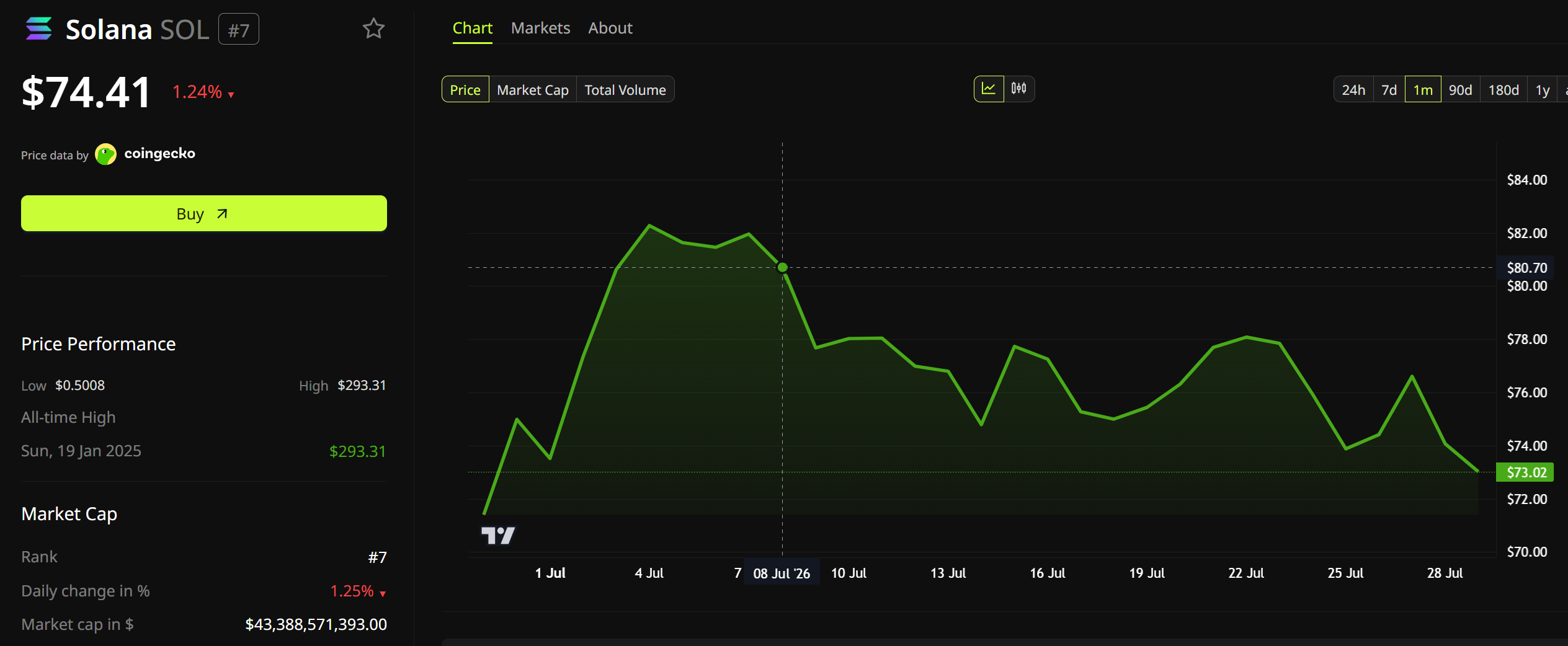
Morgan Stanley launched spot Ethereum and Solana exchange-traded products on Tuesday at a 0.14% fee. Prospectus filings show each trust opened with 50,000 shares and roughly $1 million in seed capital.
Ether sits 61% below its August 2025 peak. SOL trades 75% under its January 2025 high. Whether Morgan Stanley advisers allocate into that drawdown is the open question.
How Morgan Stanley’s Ethereum and Solana ETF Fees Compare
Morgan Stanley Ethereum Trust (MSSE) and Morgan Stanley Solana Trust (MSOL) began trading on NYSE Arca. Each accrues a 0.14% fee daily against net asset value. The previous floor for ether products was the 0.15% charged by Grayscale.
Bloomberg senior ETF analyst Eric Balchunas said the pricing bottoms out both categories.
“Morgan Stanley Ether and Solana ETFs are launching today.. both charge 0.14% instantly making them the cheapest in each category. Their bitcoin ETF is up to $400m in 4mo despite launching in middle of winter. Good sign,” wrote Balchunas.
Precedent supports him. Morgan Stanley Bitcoin Trust drew $34 million on its cheapest Bitcoin ETF debut in April, then reached $381 million by July 16. That is 11 times growth across 99 days, yet still only 2.7% of the firm’s $14 billion exchange-traded suite.
What the Prospectuses Reveal About the Staking Yield
Both trusts stake through Figment, Galaxy Blockchain Infrastructure, and Coinbase Canada. Those providers and the custodians take 5% of gross rewards. Morgan Stanley retains none, though its 0.14% fee applies separately.
The two funds are not symmetrical. MSOL intends to stake up to 100% of its SOL. MSSE targets 50% to 80% of its ether and caps staking at 80%.
Timing cuts deeper. The MSSE filing puts Ethereum’s validator activation queue at roughly 2.71 million ether as of July 6, an estimated 47-day wait. Queued ether earns nothing. Solana bonding takes two to three days, per the MSOL prospectus.
Holders receive rewards as monthly cash distributions, quarterly at minimum, funded by selling tokens.
Will Flows Follow? Three Things to Watch
Around 16,000 Morgan Stanley advisers oversee roughly $9.3 trillion, and the bank switched on spot trading through E*TRADE this month.
Ether funds absorbed lengthy ETF outflow streaks for much of 2026. Meanwhile SOL near $74 has slipped 3.8% since the prospectus priced it on July 8.

Watch creation baskets beyond the seed, the staked share of ether, which MSSE commits to publish daily, and the first distribution, which cannot land until validators clear the queue.
The post Morgan Stanley Launches 0.14% Ethereum and Solana ETFs: Will Flows Follow? appeared first on BeInCrypto.


Ten European financial institutions have launched Regulated Layer One (RL1), a permissioned blockchain cooperative aimed at supporting regulated capital markets and tokenized assets. The network was established as a European Cooperative Society in Luxembourg and has started operations with an initial group of founding members.
RL1 announced that its governance model gives each founding institution equal decision-making rights over the network’s development. The cooperative is positioned as shared infrastructure for institutional workflows that typically rely on separate distributed ledgers, with the stated goal of reducing fragmentation across financial networks.
Key takeaways
- RL1 has been incorporated in Luxembourg as a European Cooperative Society and is already operating with founding institutions.
- ABN AMRO, Cecabank, Chartered Investment, Crédit Mutuel Alliance Fédérale, DekaBank, DZ BANK, LBBW, Natixis CIB, SC Ventures, and Seturion are the initial members.
- The permissioned network is built on infrastructure developed by SWIAT, which transferred ownership to the cooperative.
- SWIAT said the underlying platform processed 50+ transactions worth more than €700 million during three years of production use.
- RL1 is designed to support institutional applications such as tokenized bonds, collateral, and blockchain-based settlement.
A cooperative built for regulated tokenization
According to RL1’s announcement, the initiative is intended to serve regulated financial markets and tokenized asset use cases. The cooperative’s structure is designed to align governance with participating institutions, with each member holding equal decision-making rights for RL1’s network direction.
Among the founding organizations named by RL1 are major banks and capital market entities across Europe, including ABN AMRO, DekaBank, DZ BANK, LBBW, Natixis CIB, and NatWest is mentioned as an institution RL1 is currently in discussions with regarding joining. The list also includes Cecabank and Chartered Investment, as well as SC Ventures and Seturion.
From SWIAT infrastructure to RL1 ownership
RL1’s technical foundation traces back to infrastructure developed by German fintech Secure Worldwide Interbank Asset Transfer (SWIAT). RL1 said SWIAT has transferred ownership of the network to the cooperative, moving the platform from a fintech-led build to an institution-led shared asset layer.
SWIAT also provided performance context for the underlying platform. The company said it has processed more than 50 transactions totaling over €700 million (about $808 million) during three years of production use. For investors and market participants, this kind of prior operational record matters because permissioned blockchain deployments in finance often face scrutiny around scalability, reliability, and throughput under real-world conditions—areas that are difficult to assess without production history.
Why RL1 is positioning itself as shared settlement infrastructure
RL1 described the network as permissioned and geared toward institutional workflows. The stated target applications include digital money, tokenized bonds, collateral management, and blockchain-based settlement.
A central theme in RL1’s framing is interoperability within regulated environments. RL1 said that having a shared network could help reduce fragmentation that can occur when different financial institutions operate separate distributed ledger systems. In practice, this addresses a common friction point in tokenization efforts: without shared standards or compatible infrastructures, value transfer and settlement can become siloed across networks, complicating liquidity and operational integration.
RL1’s coop governance structure is also designed to reinforce this “shared infrastructure” approach. Rather than relying on a single operator, the cooperative model gives participating institutions equal say in governance and ongoing development, which RL1 suggests is intended to support long-term adoption across a wider group of market players.
Leadership and funding support
RL1 named Henning Vollbehr, former SWIAT Managing Director, as the network’s leader. KfW and L-Bank will continue supporting the initiative, RL1 said, indicating that development backing is expected to remain in place as the cooperative transitions from launch to broader deployment.
RL1 also said it is discussing additional institutional partners, including NatWest, about joining the network. The ability to onboard more institutions will likely be a key checkpoint for the project: the value of a permissioned network grows with participation, and RL1’s ambition to support settlement and tokenized financial instruments depends on whether additional banks, investors, or market infrastructure providers choose to integrate.
As RL1 begins operations, market observers will likely watch for concrete milestones beyond launch—such as which tokenized asset workflows the network will prioritize first, how quickly new institutions join, and whether the cooperative can convert its production track record from SWIAT into expanding real-world use across regulated markets.


In eighteen months, the prediction market industry has assembled the surveillance apparatus that took stock exchanges decades: named detection engines, encrypted prohibited-person lists, league partnerships, forensic academics, and employment disclosure for high-risk traders. Here is the architecture, who is building it, and the cost nobody in the sector wants to price.
Summary
- Kalshi now runs a proprietary detection engine called Poirot alongside Solidus Labs for trade surveillance, IC360 for sports integrity screening, and the Wharton Forensic Analytics Lab for statistical detection methods.
- The screening moved from post-trade investigation to preemptive blocking: athletes, coaches, referees, and league personnel are screened against lists built with IC360 and the NHL, while candidates are blocked from trading their own races.
- Polymarket built differently, pairing multi-layered surveillance across its offshore and US platforms with a March partnership involving Palantir and TWG AI for sports market monitoring.
- The vendors are consolidating into a de facto standard, with IC360 and Eventus combining insider-risk lists and real-time trade surveillance into a package explicitly marketed as the sector’s emerging benchmark.
- The unpriced cost is participation: every identity check, employment disclosure, and prohibited-person list makes the regulated venues safer and pushes marginal volume toward platforms that ask for none of it.
Financial markets build their police forces after the scandal, not before it, and the construction usually takes a generation. The New York Stock Exchange operated for over a century before anything resembling modern trade surveillance existed; the systems that now watch equity markets for spoofing and insider activity accumulated in layers across decades of enforcement actions, statutes, and technology. The American prediction market industry has compressed that build into roughly eighteen months, and it has done so in public, under a congressional investigation, while growing volumes at a pace that makes each month’s controls obsolete by the next. The result is a surveillance stack with proper names: an in-house detection engine at Kalshi called Poirot, an encrypted prohibited-persons list called ProhiBet, an AI monitoring platform called HALO, a forensic academic partnership, a league relationship, a whistleblower button on market pages, and, as of last month, a requirement that traders in high-risk markets disclose their employer.
This piece maps that architecture, identifies who is actually building it, and examines the trade it embodies, because a category whose entire value proposition is open participation has spent a year and a half constructing the machinery of exclusion.
The stack, named
Kalshi has been the most public about its systems, and the components are worth listing individually because their origins tell you what the industry thinks it is defending against.
At the center sits Poirot, the platform’s proprietary monitoring engine, which runs continuous pattern recognition across every trade looking for anomalous timing, win-rate irregularities, and coordinated activity, following a detect, investigate, enforce sequence the company describes as modeled on the surveillance operations of major financial exchanges. Around it are three external layers. Solidus Labs supplies its HALO platform, an AI-driven trade surveillance system built originally for crypto venues to detect wash trading, spoofing, and layering, which is a revealing choice: the manipulation patterns the industry expects are the ones native to thin electronic order books, not to sportsbooks. IC360, the Las Vegas integrity firm that works with every major professional league, the NCAA, state gaming regulators, and the sportsbook industry, supplies the sports-specific layer, including its ProhiBet service, an encrypted list of individuals barred from participating. And the Wharton Forensic Analytics Lab contributes statistical methods for detecting insider trading and financial fraud, an academic partnership that reads as much like reputational armor as like a technical input, though the methods are real.
The most consequential change was procedural, not technological. For most of the sector’s history, prohibitions on insider participation existed in the rulebooks and were enforced after the fact, through investigation of completed trades. In March the platform shifted to preemptive blocking: after months of assembling screening lists across collegiate and professional leagues with IC360, and in partnership with the NHL directly, known athletes, officials, and league employees are now blocked from trading in associated markets before an order reaches the book. Political screening moved the same direction, extending an existing prohibition on elected officials to cover candidates trading their own campaigns. Identity verification underpins all of it, with names, addresses, and government identification collected before trading, and a whistleblower tool now sits on market pages so participants can flag suspicious activity directly. In June, reporting indicated the platform would begin requiring traders in markets flagged as high-risk to disclose their employer.
Read that list against the product’s marketing, which is about accessibility and putting your knowledge to work, and the tension is immediate. A market that asks for your government identification, your employer, and your absence from an encrypted list of prohibited persons is not a frictionless information venue. It is an exchange, in the full institutional sense, and that is precisely the point of the build.
Polymarket’s different architecture
The other major venue arrived at similar conclusions through a different route, shaped by a structural fact: it operates two platforms with different characters, an offshore blockchain-based book and a regulated US exchange.
Its public position describes multi-layered surveillance across both, combining the transparency of on-chain settlement with third-party monitoring, and its rule updates in March clarified prohibited categories of trading across the pair. The more significant move came earlier that month, when the US entity partnered with Palantir and TWG AI for integrity monitoring in sports markets, with the stated ambition of building tools that leagues and teams could use for their own competitive-integrity purposes. The choice of Palantir is not incidental. A company whose reputation rests on large-scale pattern analysis for government and defense clients signals a particular theory of the problem: that detecting coordinated abuse across a fragmented, pseudonymous participant base is a data-integration challenge, not a rules-enforcement one.
The asymmetry between the two venues is the part worth holding onto. Kalshi’s surveillance operates on a fully identified participant base inside a single regulated perimeter, which makes screening lists workable, because you can check a name against a list only if you have the name. Polymarket’s offshore book has historically been the less transparent half of its business regarding how suspicious activity is monitored, and on-chain transparency, while real, identifies wallets and not people. The industry’s screening model, built on identity, maps cleanly onto one architecture and awkwardly onto the other, and how that gap resolves as the US operation scales is one of the genuine open questions in the sector.
The vendors are writing the standard
Beneath both platforms, a supplier layer is consolidating fast enough to set the rules by default, which is how most financial-market standards actually form.
The clearest signal came in December, when IC360 and Eventus announced a combined offering pairing Eventus’s Validus platform, a multi-asset post-trade surveillance system already used by exchanges, designated contract markets, broker-dealers, and digital asset venues, with IC360’s event-integrity and insider-risk capabilities. The framing in the announcement was explicit about ambition: helping prediction market venues build trust with participants and regulators and set the standards that will support responsible growth. Vendors rarely state the standard-setting objective that plainly, and when two suppliers combine to offer a full-lifecycle package to an entire young sector, the package tends to become the baseline that regulators later reference and competitors later match.
That dynamic has a consequence the industry has not discussed publicly. If integrity infrastructure becomes a purchasable package from a small number of specialist suppliers, then compliance quality converges, which is good for the sector’s credibility and bad for any venue hoping to compete on trustworthiness. It also creates a dependency: a handful of firms will hold the screening lists, the detection models, and the case-management systems for an industry that regulators are actively deciding whether to permit. Concentration in the surveillance layer is not obviously safer than concentration anywhere else, and it has attracted none of the scrutiny that venue concentration receives.
What forced the build
None of this happened because the platforms woke up cautious. The pressure is documented and specific.
Congressional attention arrived in force: the House Oversight Committee opened an examination of insider trading risks in prediction markets in May, and its chairman requested documents from Kalshi’s chief executive covering the platform’s identity verification processes and its capacity to detect insider trading. Enforcement cases had already made the abstract concrete, with the platform disclosing actions in multiple matters including a fined video editor connected to a major creator and actions against political candidates who traded events in which they were directly involved. Investigative journalism amplified both, and a bipartisan bill in Congress would ban sports event contracts on federally regulated exchanges outright, which gives every venue an existential reason to show that its sports markets are policed.
The regulator supplied the frame. The Commodity Futures Trading Commission’s advisory earlier this year reminded designated contract markets that they are the frontline regulators of their own venues under the core principles, that event contracts sit fully under the Commodity Exchange Act, and that sports and similar real-world contracts face a higher bar to show they are not gambling in substance. Read alongside the build, the sequence is legible: the agency told exchanges the obligation was theirs, Congress threatened the most profitable product line, and the platforms responded by constructing visible, nameable, quotable infrastructure. The surveillance stack is a compliance program and a political argument at the same time, and its audience includes committee staff as much as traders.
The trade nobody wants to price
Which brings the piece to the part the announcements do not address, because it cuts against the industry’s founding pitch.
Prediction markets derive their forecasting value from broad, diverse participation. The calibration research this publication has examined finds prices well estimated precisely because many participants with different information bet real money, and thin markets with few participants produce prices carrying much less information. Every element of the integrity build reduces participation at the margin. Identity verification excludes anyone unwilling to hand over government identification. Employment disclosure excludes anyone whose employer’s name is itself sensitive. Prohibited-person lists exclude, by design, the participants with the most direct knowledge of the events being priced, which is both obviously correct as policy and a genuine subtraction from the information the market aggregates. A market on a game that bars everyone connected to the game has removed its best-informed potential traders in exchange for integrity, and that is a real trade rather than a free lunch.
The second-order effect is the sharper one. Barriers on regulated venues do not eliminate demand; they redistribute it. Volume that will not verify identity or disclose an employer migrates toward platforms that ask for neither, which in this sector means offshore books and decentralized venues operating outside the Commission’s direct reach. The integrity build therefore makes the regulated market cleaner and the unregulated market larger, which is precisely the pattern that decades of derivatives regulation have produced elsewhere, and it means the sector’s compliance success and its liquidity migration are the same event viewed from different angles.
Neither observation argues against the build. Markets on real-world events, priced by participants who may be able to influence those events, need policing more than most, and the case for preemptive screening of athletes and candidates is close to unanswerable. The argument is for pricing the cost honestly rather than presenting surveillance purely as an upgrade. The industry is buying legitimacy with liquidity, deliberately, and the exchange rate between the two is the number that will determine what this sector looks like in five years.
The precedent: how the older markets got policed
The compression is easier to appreciate against the timeline it is compressing, and the equity market’s version is instructive precisely because it took so long.
American stock exchanges operated for roughly a century and a half before anything resembling modern surveillance existed. Insider trading was not clearly illegal in the United States until case law developed through the middle of the twentieth century, systematic exchange-level market monitoring arrived later still, and the automated pattern-detection systems that now scan for spoofing, layering, and unusual pre-announcement activity are products of the last few decades, built in layers after specific scandals produced specific rules. Each layer arrived because something went wrong first: the 1929 crash produced the securities acts, later episodes produced the enforcement infrastructure, the flash crash produced consolidated audit trails. The pattern in financial regulation is almost invariably that the policing follows the harm.
Prediction markets have inverted that sequence, and the inversion is worth crediting instead of assuming cynicism. The surveillance being built now is largely preemptive: screening lists assembled before an athlete places a trade, candidate blocking before a race resolves, detection engines running against every order, not reconstructing a scandal afterward. Some of that reflects genuine intent, and some reflects that the technology exists off the shelf in a way it did not for earlier markets, which is the real reason eighteen months can substitute for eighty years. A modern venue can buy institutional-grade post-trade surveillance from a vendor and integrate a prohibited-persons list through an API. The 1930s could not.
But the borrowed timeline carries a borrowed weakness. Equity market surveillance evolved alongside the case law, the enforcement precedents, and the definitions of what actually constitutes abuse in that market, and each system was built to catch behaviors regulators had already defined. Prediction markets are installing detection infrastructure ahead of the doctrine: nobody has authoritatively defined what insider trading means in a market on a football game, whether a coach’s spouse is an insider, whether a campaign staffer trading a rival’s race is abuse, or how foreknowledge differs from expertise when the subject is a real-world event and not a company’s earnings. The tools are institutional-grade. The rules they enforce are, in places, the platforms’ own interpretations, written fast, under pressure, and awaiting a regulator or a court to confirm or discard them. That gap between capability and doctrine is the most interesting thing about the entire build, and it will be filled the ordinary way, one contested case at a time.
What to watch
Whether the standard becomes mandatory. If the Commission’s rulemaking or a future advisory references specific surveillance capabilities, the vendor package effectively becomes a licensing requirement, and the cost of entry for new venues rises accordingly. Watch the comment filings for exactly this.
The employment-disclosure rollout. How broadly high-risk markets are defined, and what share of volume sits inside them, determines whether the requirement is a narrow safeguard or a material participation barrier. Any published data on abandonment rates would be the most informative number the sector could release.
Polymarket’s identity gap. How the offshore book’s monitoring evolves as the US entity scales is the sector’s most consequential unresolved architecture question, and the Palantir partnership is the first serious attempt at an answer.
Migration evidence. Comparative volume growth between fully identified regulated venues and less restrictive alternatives is the cleanest available measure of whether the integrity build is costing the regulated market its liquidity, and it will show up first in the sports categories where screening bites hardest.
Disclaimer: This article is for information and educational purposes only and does not constitute financial, investment, or legal advice. It describes compliance systems and regulatory proceedings based on company statements and reporting available at the time of writing, and these arrangements change frequently. Nothing here is a recommendation regarding any platform or contract. Always do your own research. Information is accurate as of July 27, 2026.
Frequently Asked Questions
What surveillance systems do prediction markets actually use?
Kalshi runs a proprietary detection engine called Poirot for continuous pattern recognition, alongside Solidus Labs’ HALO platform for AI-driven trade surveillance, IC360 for sports integrity screening including its ProhiBet prohibited-persons list, and a partnership with the Wharton Forensic Analytics Lab for statistical detection methods. Polymarket uses multi-layered surveillance across its platforms and partnered with Palantir and TWG AI for sports market monitoring.
What changed in March 2026?
Screening moved from post-trade investigation to preemptive blocking. After months of building lists with IC360 and in partnership with the NHL, athletes, officials, and league employees became blocked from trading in associated markets before orders reach the book, and political screening extended from elected officials to candidates trading their own campaigns. Both platforms also expanded prohibitions covering spoofing, wash trading, and front-running.
Why did the platforms build this now?
Regulatory and congressional pressure. The House Oversight Committee opened an examination of insider trading risk in May and requested documents on identity verification and detection capability, enforcement cases had become public, and a bipartisan bill would ban sports contracts on regulated exchanges. The CFTC separately reminded exchanges that they are the frontline regulators of their own markets under the core principles.
What is ProhiBet?
An encrypted list of individuals prohibited from participating in prediction markets or sports betting, operated by IC360 and used across regulated sports betting. It allows a venue to block a prohibited person without the venue itself holding the underlying list in readable form, which is how screening operates across the regulated gambling industry.
Are the surveillance vendors becoming a standard?
Effectively, yes. IC360 and Eventus combined their offerings in December, pairing real-time trade surveillance used by exchanges and designated contract markets with insider-risk and event-integrity capability, and described the goal as setting standards for the sector. When a small number of suppliers provide full-lifecycle integrity packages to a young industry, that package tends to become the baseline regulators reference.
Does more surveillance make prediction markets better?
It makes them more defensible and less open, and both effects are real. Screening the participants most able to influence outcomes is sound policy and removes the best-informed potential traders from those markets. Identity verification and employment disclosure improve accountability while excluding participants unwilling to provide them, which reduces the diverse participation that gives these markets their forecasting value.
Where does volume go when barriers rise?
Toward venues with fewer barriers, which in this sector means offshore and decentralized platforms outside direct US oversight. This is the standard pattern in derivatives regulation: tightening the regulated perimeter improves conditions inside it and enlarges the market outside it. The regulated venues’ compliance success and any liquidity migration are the same development seen from different sides.
What should participants take from this?
That the regulated venues now operate genuine exchange-grade surveillance, which is a meaningful protection, and that the identity, disclosure, and screening requirements attached to it are permanent features, not temporary responses. Anyone weighing a regulated venue against an offshore alternative is trading privacy and access against monitoring and recourse, and that is the actual choice on offer. This is educational analysis, not investment advice.


Cointelegraph is committed to providing independent, high-quality journalism across the crypto, blockchain, AI, and fintech industries.
All news, reviews, and analyses are produced with full journalistic independence and integrity. For more details on our standards and processes, please read our Editorial Policy.


USAT went from $22 million to $140.8 million in a single month, the fastest growth of any regulated dollar token this year. In the same window, its offshore parent shed roughly six billion. One of those numbers is a rounding error on the other, and the gap between them is the most interesting structure in stablecoins.
Summary
- USAT, Tether’s US-regulated stablecoin, launched in January with a $10 million initial supply, reached $17.6 million by January 31, $22 million in March, and $140.8 million by April 30, a 540% month-over-month expansion confirmed in a Deloitte-signed reserve report.
- It remains minuscule in context: roughly 0.08% of USDT’s circulation, about 8% of Ripple’s RLUSD, 2.5% of PayPal’s PYUSD, and under 0.2% of Circle’s USDC.
- The parent moved the other way, with USDT contracting from a May peak near $190 billion to roughly $184 billion in late July, a drawdown of about $6 billion over sixty days.
- The structure is unusual: Anchorage Digital Bank issues the token, Cantor Fitzgerald custodies reserves as primary dealer, and the US entity is led by the former executive director of the White House Crypto Council.
- The disclosure runs backwards from expectations, with the small compliant twin publishing Deloitte-signed reserve reports while the $184 billion parent, whose reserves do not currently meet the federal standard, operates on attestations.
There is a specific kind of corporate structure that appears when a very large business decides it may eventually need to be a different business, and Tether built one in January.
USAT is a dollar token issued through a federally chartered bank, designed from the ground up to satisfy the American stablecoin statute, run by a separate US entity with its own chief executive, and it is, by any measure of scale, almost nothing. It launched at $10 million. By the end of its first week, it held $17.6 million. Six months later, after the fastest month of growth any regulated dollar token has posted this year, it holds roughly $141 million, which is about eight hundredths of one percent of the $184 billion its parent has in circulation. Read one way, that is a failure to launch. Read another, it is a 540% month, faster growth than Circle, PayPal, or Ripple managed at any point this year, off a base small enough that the percentage means less than it appears. The interesting reading is the third one: USAT is not primarily a product. It is an option, written on a regulatory outcome, held by a company whose main business currently sits outside the perimeter the option would let it enter. This piece takes the numbers seriously, examines the structure that produced them, and asks what the twin is actually for.
The numbers, in order
Start with the sequence, because the growth story and the scale story are both true and point in opposite directions.
USAT launched on January 27 with a $10 million initial supply as an ERC-20 token, immediately available on several major exchanges. Anchorage Digital Bank’s first reserve attestation, dated January 31, reported 17,501,391 tokens outstanding against $17,604,716 in reserves, roughly 0.6% overcollateralized. By the end of March, circulation stood near $22 million. Then April: the Deloitte-signed reserve report published in late May showed circulating supply at $140.8 million as of April 30, an increase of about 540% in a single month, which the US entity’s chief executive attributed to institutional treasury operations, settlement flows, and regulated dollar liquidity management.
Now the context that the percentage conceals. Circle’s USDC sits around $75 billion. PayPal’s PYUSD is roughly $5.5 billion. Ripple’s RLUSD, itself a young institutional token, is about $1.7 billion. USAT at $141 million is therefore under a fifth of one percent of USDC, roughly two and a half percent of PYUSD, and about eight percent of RLUSD, which makes it the smallest meaningful entrant among the regulated dollar tokens competing for American institutional use. Against its own parent, the ratio is starker still: USDT’s circulation of roughly $184 billion makes USAT about 0.08% of the group’s outstanding dollar liabilities.
One further number completes the picture and is the reason this is a story instead of a launch update. While the twin grew, the parent shrank. USDT peaked near $190 billion in May and stood at approximately $184.1 billion on July 21, a decline of roughly $5.4 to $6 billion over sixty days, alongside a broader stablecoin market contraction of about $10 billion from its May high. The compliant American token is growing quickly from nothing while the offshore token it exists alongside is contracting by amounts larger than the twin’s entire supply, several times over, every month.
The structure, and who is in it
The corporate architecture explains more about the strategy than any growth figure, and each participant is worth naming.
Anchorage Digital Bank, N.A. is the issuer. It holds a national trust bank charter granted conditionally by the Office of the Comptroller of the Currency in 2021, well before the current administration, and describes itself as the first federally regulated crypto bank. Its chief executive has framed USAT as evidence of what stablecoin issuance looks like inside the US banking system, under supervision, with accountability. That is the structural core of the arrangement: Tether does not issue USAT. A chartered American bank does, under federal supervision, which is precisely the arrangement the offshore parent cannot currently replicate.
Cantor Fitzgerald serves as designated reserve custodian and preferred primary dealer, the same firm that has handled Tether’s Treasury holdings, and its former chief executive is now the sitting Commerce Secretary. The US entity is led by Bo Hines, previously executive director of the White House Council of Advisers on Digital Assets, appointed in September to run the American vehicle. Neither fact implies impropriety, and both were reported at launch. Together they describe something worth stating plainly: the compliance vehicle for the world’s largest offshore stablecoin issuer is staffed and served at the precise intersection of the policy network that wrote the framework it is designed to satisfy. In an industry where our own reporting has documented the crypto sector supplying more than a third of all corporate election money this cycle, that adjacency is part of the strategic picture, not a curiosity.
Distribution has been assembled in parallel: availability across major exchanges from day one, a payments integration with a commerce platform announced in February, and, in the chief executive’s framing, a stated ambition that Tether could become one of the largest buyers of US Treasury bills as demand for its dollar tokens grows.
The disclosure inversion
The most revealing detail in the entire structure is one almost nobody has commented on, and it runs opposite to what anyone would predict.
USAT, at $141 million, publishes reserve reports signed by Deloitte. USDT, at $184 billion, has operated for its entire existence on attestations rather than a full audit, a gap this publication has documented repeatedly and which S&P cited when it downgraded the token to the weakest grade on its stablecoin scale in December, alongside the rising share of higher-risk assets in the reserves. The small token has the stronger disclosure regime. The enormous one does not.
That inversion is not an accident; it is the whole design. USAT exists inside the federal framework, which imposes reserve composition, custody, and reporting requirements, and satisfying them is the token’s entire purpose. USDT operates outside that framework by choice and by history, with reserves that, as reported at USAT’s launch, do not currently align with the statute’s standards, while the company describes itself as progressing toward compliance. The group therefore runs two dollar tokens with opposite regulatory postures: one built to the American rulebook and audited to it, one built for global liquidity and disclosed on its own terms.
For anyone assessing Tether, this is the most useful lens available. The twin is proof that the group can meet the standard when it chooses to, on a token small enough that meeting the standard costs almost nothing. Whether the $184 billion business ever moves onto that footing is a different question, involving reserve composition changes at a scale that would reshape the company’s economics, and nothing in USAT’s existence answers it.
What the twin is actually for
Three readings compete, and the honest answer is that all three are partly right.
The product reading takes the growth at face value: institutions want a regulated dollar token from an issuer with unmatched global distribution, USAT supplies it, and 540% in a month is what early product-market fit looks like. Its supporters can point to a real gap in the market, since the regulated field is dominated by one incumbent and the alternatives are small, and to Tether’s distribution as an advantage no startup can match.
The option reading treats USAT as insurance. If American regulation eventually forces offshore dollar tokens out of US-facing channels, or if institutional counterparties increasingly require a federally issued instrument, the group already holds a functioning, chartered, audited vehicle it can scale instead of building under pressure. The cost of maintaining that option is trivial against $1.04 billion in quarterly profit, and the value if the perimeter tightens is enormous. On this reading the size is the point: an option does not need to be large until it is exercised.
The hedge reading is the least flattering and the hardest to dismiss. A company earning float income on $184 billion of offshore liabilities faces exactly one existential risk, which is that the regulatory environment turns against the structure generating those liabilities. A compliant American subsidiary, staffed by the people who wrote the rules and served by a firm with the deepest ties to the administration, is a hedge against that risk purchased in the most direct way available. Nothing about it is improper. It is simply what a rational company with Tether’s exposure would build.
The three readings imply different things to watch, and they are separable in the data. A product would keep compounding across a broad institutional user base. An option would plateau at a level sufficient to keep the machinery live. A hedge would scale only when the perimeter moved. The next two quarterly reserve reports will begin to distinguish them, which makes USAT’s supply curve one of the more informative small numbers in stablecoins.
The field the twin entered
USAT’s numbers only mean something against the market it is competing in, and that market changed shape considerably in the eighteen months before it launched.
The regulated American dollar-token field is dominated by one incumbent and populated by a widening set of challengers with different theories. Circle’s USDC, at roughly $75 billion, holds around a quarter of all stablecoin supply and has spent years building exactly the compliance-first, publicly listed profile that the federal framework rewards, which is why its leadership has argued the legislation makes it a primary beneficiary. PayPal’s PYUSD, near $5.5 billion, represents the consumer-platform theory: distribution through an existing payments network with hundreds of millions of accounts. Ripple’s RLUSD, around $1.7 billion, is the institutional-settlement theory, aimed at treasury and cross-border flows and, as this publication has documented, increasingly embedded in that company’s own product stack. Bank consortium tokens and fintech issuers occupy the remainder.
USAT entered against all of them with a distinct pitch: the compliance profile of a chartered bank issuer combined with the distribution of the world’s most widely held stablecoin. That combination is genuinely unmatched on paper, since no competitor has both a national bank issuing its token and a sibling instrument used by hundreds of millions of people in emerging markets. It is also, so far, mostly potential. Distribution is not transferable by announcement; the users who hold USDT hold it for reasons, principally dollar access in markets where dollars are hard to obtain, that have nothing to do with American regulatory compliance and are not served by a token designed for US institutional treasury operations. The two customer bases barely overlap, which is why the parent’s global scale does not automatically become the twin’s American scale, and why the growth that matters is the institutional adoption the US entity’s chief executive describes rather than any migration from the existing user base.
That reframes the competitive question usefully. USAT is not competing for USDT’s users. It is competing with USDC, PYUSD, and RLUSD for American institutional balances, in a market where the incumbent has a five-hundred-fold size advantage, a public listing, years of relationships, and a compliance record predating the statute. Against that, $141 million after six months is neither the failure the absolute number suggests nor the triumph the percentage implies. It is an entrant with an unusual parent, roughly where a well-funded entrant would be, in a market that has not yet decided how many regulated dollar tokens it actually needs.
What to watch
The May and June reserve reports. One 540% month off a $22 million base proves little. Whether growth compounded through the second quarter, or April was a single institutional allocation, is the difference between the product reading and the option reading, and the Deloitte-signed reports will show it plainly.
USDT’s own compliance path. Any concrete move to bring the $184 billion token’s reserves into alignment with the federal standard would change everything about this structure, because it would make the twin redundant. Silence is equally informative.
The parent’s contraction. USDT shedding roughly $6 billion in sixty days is a far larger phenomenon than USAT’s entire existence, and whether that reflects market-wide stablecoin contraction, competitive loss, or regulatory friction determines how urgent the American vehicle becomes.
The Treasury claim. The stated ambition of becoming a top-ten buyer of US government debt is checkable against public data as it develops, and it is the clearest available test of whether the group’s American strategy is operational or aspirational.
A closing note on what the twin reveals about the parent, because that is ultimately the more consequential subject. Tether’s global business is built on a structure that American law is steadily making harder to operate from outside: an offshore issuer, reserves disclosed on the company’s own terms, a token used by hundreds of millions of people for reasons no regulator designed. Every element of that structure has been a competitive advantage for a decade, and every element is now a liability inside a jurisdiction writing rules for regulated dollars. The company’s response has been neither to restructure the parent nor to abandon the market, but to build a small, clean, fully compliant version of itself and let it grow on its own timetable while the large version continues as it is.
That is a genuinely sophisticated answer to a hard problem, and it has one obvious failure mode. Options expire. If the American perimeter tightens faster than USAT scales, the group holds a compliant vehicle a thousand times too small to absorb the business that would need to migrate into it, and building capacity under regulatory pressure is the most expensive way to build anything. If the perimeter never tightens, the twin remains a modest business inside a company earning billions elsewhere, which costs almost nothing. Between those poles sits the actual question worth watching over the next year, and the reserve reports will answer it faster than any announcement.
Disclaimer: This article is for information and educational purposes only and does not constitute financial or investment advice. Supply figures, reserve reports, and market data reflect information available at the time of writing and change continuously. Nothing here is a recommendation to buy, sell, or hold any asset. Always do your own research. Information is accurate as of July 27, 2026.
Frequently Asked Questions
What is USAT?
Tether’s US-regulated dollar stablecoin, launched January 27, 2026 and designed to operate within the federal stablecoin framework. It is issued by Anchorage Digital Bank, a nationally chartered bank, with Cantor Fitzgerald as designated reserve custodian and preferred primary dealer, and is run by a separate US entity led by Bo Hines, formerly executive director of the White House Council of Advisers on Digital Assets.
How large is USAT now?
Roughly $141 million. Circulating supply was $17.6 million at the end of January, about $22 million in March, and $140.8 million as of April 30 per a Deloitte-signed reserve report, representing 540% growth in a single month. In context, that is approximately 0.08% of USDT’s circulation, about 8% of Ripple’s RLUSD, 2.5% of PayPal’s PYUSD, and under 0.2% of Circle’s USDC.
Why does Tether need a second dollar token?
Because USDT’s reserves do not currently align with the federal stablecoin statute’s requirements, while the company describes itself as progressing toward compliance. USAT is purpose-built to satisfy that framework through a chartered bank issuer, giving the group a compliant American instrument without restructuring the reserves behind its $184 billion global token.
Why does the smaller token have better disclosure?
Because the federal framework requires it. USAT publishes Deloitte-signed reserve reports as a condition of operating inside the American regime, while USDT has historically operated on attestations rather than full audits, a gap S&P cited when downgrading the token to the weakest grade on its stablecoin stability scale in December. The inversion is a design consequence, not an oversight.
Is USAT growing or stalling?
Both, depending on the frame. Its growth rate is the fastest among regulated dollar tokens this year, but from a base so small that the percentage flatters it, and it remains the smallest meaningful entrant in the US institutional market. Whether April’s jump was the start of compounding adoption or a single large allocation should become clear in subsequent reserve reports.
What is happening to USDT itself?
It is contracting. Circulation peaked near $190 billion in May and stood at approximately $184.1 billion on July 21, a decline of roughly $6 billion in sixty days, against a broader stablecoin market that shed about $10 billion from its May high. Tether reported $1.04 billion in first-quarter profit and a reserve buffer above token obligations of roughly $8.2 billion.
Who runs USAT, and why does that matter?
Bo Hines, previously the executive director of the White House crypto council, leads the US entity, and Cantor Fitzgerald, whose former chief executive is the sitting Commerce Secretary, custodies the reserves. Nothing about the arrangement is improper and both facts were public at launch, but the compliance vehicle for the largest offshore issuer being staffed and served at the center of the policy network that wrote the framework is a material part of the strategic picture.
What should observers actually watch?
The next two reserve reports, since compounding growth, a plateau, or a reversal distinguishes a product from an option from a hedge; any concrete step toward bringing USDT’s own reserves into federal alignment, which would make the twin redundant; and the trajectory of the parent’s contraction, which determines how urgently the American vehicle is needed. This is educational analysis, not investment advice.


Some economists want Federal Reserve Chair Kevin Warsh to raise interest rates at today’s meeting. They argue the central bank’s 2025 cuts left policy too loose, even as inflation sits above target.
Joe Lavorgna makes that case directly. He serves as chief economist for the Americas at SMBC Nikko Securities America. Lavorgna says the Fed should reverse part of last year’s easing now that the labor market has stabilized.
The Case for a Hike
Lavorgna points to core Personal Consumption Expenditures (PCE) inflation, the Fed’s preferred gauge. It has held more than a percentage point above the 2% target for years.
He argues policy isn’t tight anywhere except housing, and that sector makes up only about 3% of the economy, in his view.
Lavorgna also expects the neutral rate, or r-star, to climb. Artificial intelligence-driven capital spending is lifting demand for credit, he says, which makes current rates look less restrictive than policymakers assume. Dallas Fed President Lorie Logan has echoed that hawkish tilt.
“Modestly higher interest rates would better balance the outlook.”
Logan made the remark last week. She holds a voting seat on the Federal Open Market Committee (FOMC).
A Hike, But Is It a Surprise?
CNBC’s Steve Liesman frames the debate as two separate questions. First, should the Fed hike? Second, should it do so without warning? Traders on the CME FedWatch tool priced hike odds near 38% heading into the decision. That’s well below a coin flip, and it matches what most economists still expect: a hold.
Warsh took over the Fed in May and has since pulled back on forward guidance. That leaves markets with fewer hints before today’s 2 p.m. ET announcement and his 2:30 p.m. press conference.
Warsh himself predicted this meeting could bring open dissent among policymakers. A hike would make that prediction look prescient, and it would mark his most consequential test yet.
The post Why Some Economists Want Fed Chair Warsh to Hike Rates Today appeared first on BeInCrypto.


Ten European financial institutions have launched Regulated Layer One (RL1), a jointly owned blockchain cooperative designed for regulated financial markets and tokenized assets.
On Tuesday, the group announced that RL1 had been established as a European Cooperative Society in Luxembourg and had begun operations with founding members including ABN AMRO, Cecabank, Chartered Investment, Crédit Mutuel Alliance Fédérale, DekaBank, DZ BANK, LBBW, Natixis CIB, SC Ventures and Seturion.
RL1 said each member will have equal decision-making rights over the network’s governance and development.
The private, permissioned network is based on infrastructure developed by German fintech Secure Worldwide Interbank Asset Transfer (SWIAT), which has now transferred ownership of the network to the cooperative.
SWIAT said the platform has processed more than 50 transactions worth over 700 million euros (about $808 million) during three years of production use.
The blockchain is designed to support institutional use cases including digital money, tokenized bonds, collateral and blockchain-based settlement. RL1 said the shared network could reduce fragmentation caused by financial institutions operating separate distributed ledger systems.
Former SWIAT Managing Director Henning Vollbehr will lead RL1. KfW and L-Bank will continue supporting the initiative, while RL1 said it is in discussions with additional institutions, including NatWest, about joining the network.
Related: CoinShares debuts Bitcoin mining ETF in Europe entrance


Everyone covering the prediction market legal war has been watching states. The more dangerous case is being argued in the Ninth Circuit by three California tribes under a different statute entirely, and at oral argument this month a judge told Kalshi’s lawyer that its contracts sound like a bet.
Summary
- Three California tribes, Blue Lake Rancheria, Chicken Ranch Rancheria, and Picayune Rancheria, sued Kalshi arguing its sports event contracts constitute unlicensed Class III gaming on tribal lands under the Indian Gaming Regulatory Act.
- A federal district judge denied their preliminary injunction in November, finding that the compacts and secretarial procedures did not prohibit Kalshi’s conduct and that federal internet gambling law excludes transactions on entities registered under the Commodity Exchange Act.
- The Ninth Circuit heard argument this month, and the panel questioned Kalshi sharply, with one judge stating the contracts sound like a bet subject to Native American gambling law and another suggesting it would not be unreasonable to exclude tribes from federal preemption here.
- This is analytically distinct from the state cases dominating coverage: it turns on IGRA and tribal sovereignty, not on state police powers, and more than sixty federally recognized tribes have filed amicus briefs across related proceedings.
- The stakes are the exclusivity bargain itself, under which tribes accepted regulation and revenue sharing in exchange for gaming rights, with a Brookings analysis describing prediction markets as an existential threat and California tribes planning a 2028 ballot initiative in response.
The prediction market industry has spent two years describing its legal problem as a fight with the states, and the coverage has followed: Nevada, New Jersey, Massachusetts, a dozen gaming regulators issuing orders, appellate arguments over whether federal derivatives registration preempts state police powers. That framing has produced a blind spot, and it is a large one. The most consequential case now pending against Kalshi was brought by three small California tribes, it runs on an entirely different federal statute, and at oral argument in the Ninth Circuit this month the panel appeared considerably less friendly to the exchange than the district court had been, with one judge saying flatly that the contracts sound like a bet subject to Native American gambling laws and another suggesting it would not be unreasonable to exclude tribes from the federal framework the industry is relying on. Sixty-plus federally recognized tribes have filed amicus briefs across the related proceedings. A Brookings analysis calls the sector an existential threat to Indian gaming. And virtually none of this has been covered in the crypto press, which has been reading the state docket. This piece corrects that, because the tribal front asks a question the state cases do not, and the answer reaches further.
The case
The facts are narrow, and the theory is not.
Blue Lake Rancheria, Chicken Ranch Rancheria of Me-Wuk Indians, and Picayune Rancheria of the Chukchansi Indians sued Kalshi in California federal court in 2025, arguing that its sports event contracts function as unlicensed sports betting accessible on tribal lands, in violation of the Indian Gaming Regulatory Act. Their argument, as their counsel framed it at argument, turns on location: the moment a user opens the platform while physically on a reservation, the tribes contend, Kalshi is conducting Class III gaming on Indian lands without the tribal ordinances, compacts, or regulatory approvals that federal law requires of anyone doing so. They sought declaratory judgment and injunctive relief.
Kalshi’s response is textual and, at the district level, it worked. Its counsel argued that the exchange is not a party to any compact or set of secretarial procedures, that those documents govern what the tribes themselves may offer, not what an independent federally regulated exchange may make available online, and that IGRA has never previously been deployed against an unrelated private company in this way.
District Judge Jacqueline Scott Corley denied the preliminary injunction in November. Her reasoning is worth precision because it defines the appeal. She found that secretarial procedures are functionally equivalent to compacts under IGRA, a point favorable to the tribes, but concluded that the relevant provisions did not prohibit Kalshi’s conduct, since the documents address internet games offered by the tribes and are silent about outside companies. She then held that the Unlawful Internet Gambling Enforcement Act governed the disputed transactions, and that statute’s definition of a bet or wager excludes transactions conducted on an entity registered under the Commodity Exchange Act, which placed Kalshi within the exclusion. She further concluded that the Commodity Futures Trading Commission holds exclusive jurisdiction to determine what qualifies as a covered contract.
That chain of reasoning is the industry’s entire defense in compressed form: we are a registered derivatives exchange, the statutes carve us out, and the agency that licenses us decides what we may list.
The Ninth Circuit, this month
Appellate panels do not decide from the bench and questions are not rulings, but the tenor of argument was materially different from the district court’s disposition.
The panel pressed Kalshi’s counsel on why the contracts are not simply bets. One judge stated directly that they sound like a bet subject to Native American gambling laws. Another suggested it would not be unreasonable to exclude tribes from federal oversight in this area, which, if it became the holding, would carve a sovereignty exception into precisely the preemption argument on which the sector’s American operations rest.
Counsel for the tribes pressed the point that ordinances cannot be separated from the compacts and secretarial procedures, because those agreements require gaming to comply with the tribes’ regulatory frameworks, and that IGRA would offer little protection if an outside company could conduct unauthorized gaming on tribal lands while escaping suit merely because its name appears in none of the governing documents.
The panel gave no timeline. The underlying district court case is stayed pending the decision. And the hearing followed a separate Ninth Circuit argument earlier this year in Nevada’s enforcement attempt against Kalshi, Robinhood, and Crypto.com, where the same court was similarly skeptical of the preemption arguments, which means one appellate circuit is now weighing two distinct challenges to the same legal foundation.
Why this is not the state fight
The distinction matters and is easy to miss, because both sets of cases involve sports contracts and the same defendants.
The state cases ask whether federal registration under the Commodity Exchange Act preempts state gaming law, a classic federalism question about whether Congress displaced state police powers. The tribal cases ask something different: whether one federal statute, the Commodity Exchange Act as amended in 2010, silently displaced another federal statute, the Indian Gaming Regulatory Act of 1988, along with the compacts negotiated under it. That is not federal-versus-state. It is federal-versus-federal, with a sovereign third party whose rights derive from treaties, statutes, and a body of law that courts have historically read protectively.
The argument that gives this its force was put sharply in international gaming law commentary: if the CFTC’s position prevails, then when Congress amended the Commodity Exchange Act in 2010, it silently erased decades of Indian gaming law without a single reference to tribes or to IGRA anywhere in the text. Courts are generally reluctant to find implied repeals, and especially reluctant where Indian law is concerned, given the canon that ambiguities are construed in favor of tribes. Kalshi’s counter is that its position requires no repeal at all, because the exchange is simply not conducting gaming under IGRA’s definitions, and that the tribes’ theory would make any nationally available financial product a per-jurisdiction licensing question the moment a user carried a phone across a boundary.
There is a third federal thread running in parallel: the Sixth Circuit is separately considering whether these contracts qualify as swaps under the Commodity Exchange Act, a definitional question with implications for everything above. Three circuits, three theories, one product.
What is actually at stake
For the tribes, the stakes are the bargain that Indian gaming rests on, and the arithmetic behind it is why the language has hardened.
Under IGRA, tribes negotiate compacts with states that grant exclusivity over certain gaming in exchange for regulatory compliance and, in many states, substantial revenue sharing. That exclusivity is the consideration; it is what tribes purchased with decades of negotiation and what funds government services, healthcare, education, and infrastructure across Indian Country. If federally licensed exchanges may offer functionally identical sports wagering nationwide, including to users on reservations, without negotiating a compact or complying with IGRA, then the exclusivity tribes bargained for has been rendered worthless without anyone renegotiating anything. The Indian Gaming Association’s chairman put the functional argument plainly: open the app and you see the same bets offered in every legal sportsbook. A Brookings analysis by a legal scholar described the development as an existential threat to American Indian gaming.
The response has been organized, not rhetorical. Tribal organizations and more than sixty federally recognized tribes have filed amicus briefs across the relevant cases. At this year’s Indian Gaming Association convention, leaders described a parallel path of litigation and federal lobbying, pressing Congress to require the CFTC to enforce its own rules and arguing that the agency has permitted gambling to operate under a financial label. And California’s broader tribal coalition has reaffirmed plans for a 2028 ballot initiative for tribally led sports betting, framed partly as a response to prediction markets operating in what they characterize as a regulatory gray area.
For the industry, the stakes are equally direct. Sports contracts generate the majority of retail prediction market volume, a Massachusetts court found nearly seventy percent of Kalshi’s volume tied to sports when it moved to block the app there in January, and an adverse tribal ruling would not merely add a compliance burden. It would introduce geographic carve-outs into a product whose entire architecture assumes nationwide uniformity under a single federal license, in a country with hundreds of reservations.
The honest reading
Both sides hold a genuinely strong argument, which is why this is being litigated in three circuits instead of settled.
The tribes’ best case is not the functional similarity to sportsbooks, appealing as that framing is to a panel. It is the implied-repeal problem: a 2010 amendment to a commodities statute, containing no mention of tribes, should not be read to nullify a 1988 statute and the compacts negotiated under it, particularly given the interpretive canon favoring tribes. That is a structural argument about how Congress legislates, and it does not depend on characterizing event contracts as gambling at all.
Kalshi’s best case is not the sportsbook comparison’s inadequacy either. It is Judge Corley’s chain: UIGEA expressly excludes transactions on CEA-registered entities from its definition of a bet, the compacts and procedures govern what tribes may offer rather than what third parties may, and Congress assigned the CFTC exclusive authority over what counts as a covered contract. Each link is textual, and textual arguments travel well in appellate courts.
What neither side can claim is that the current arrangement was designed. Nobody in 1988 or 2010 contemplated a federally licensed exchange offering yes-or-no contracts on football games to a phone sitting on a reservation, and the courts are being asked to allocate an authority that Congress never consciously assigned. That is the honest description of every question in this sector, and the tribal case is simply the version where the party with the strongest historical claim to the disputed ground was not at the table when the statute that may override it was written.
The exclusion that decides the case
One statutory provision is doing more work in this litigation than any argument either side has made, and it deserves its own examination because it was written for an entirely different purpose.
The Unlawful Internet Gambling Enforcement Act, passed in 2006 to attack offshore online poker and sports betting by cutting off payment processing, defines a bet or wager and then carves out exceptions. One of those exceptions covers transactions conducted on an entity registered under the Commodity Exchange Act. The purpose in 2006 was mundane: Congress did not want a statute aimed at internet gambling to accidentally sweep in the legitimate commodity futures markets, where contracts on future prices are a normal financial activity, and so it excluded regulated derivatives venues from the definition. Nobody drafting that exclusion contemplated a CFTC-registered exchange offering contracts on football games to retail customers, because no such thing existed or was seriously proposed.
Twenty years later, that carve-out is the load-bearing element of the district court’s ruling in the tribal case, and functionally the strongest single sentence in the industry’s legal position. If transactions on a CEA-registered entity are not bets or wagers under federal internet gambling law, then a federally licensed exchange listing sports contracts is not conducting internet gambling as Congress defined it, whatever it resembles in practice.
The reasoning is textually sound and it is also a textbook example of a provision applied far outside the circumstances that produced it.
Which is why the tribes’ implied-repeal argument and this exclusion are really the same fight from opposite ends. The industry says two federal statutes, read together, plainly exclude it from gambling law. The tribes say those statutes were never written with prediction markets or Indian gaming in mind, and that reading an incidental carve-out to nullify a negotiated sovereign framework attributes to Congress an intention it never formed. Appellate courts resolve exactly this kind of dispute by choosing between text and purpose, and the Ninth Circuit’s questions this month suggested at least some appetite for the second. That choice, more than any characterization of what an event contract feels like to a user, is what the panel is actually deciding.
What to watch
The Ninth Circuit’s opinion. No timeline was given, and the panel’s questions ran against the exchange. A reversal returns the case to Judge Corley for reconsideration and immediately raises the possibility of geographic carve-outs; an affirmance largely closes the tribal theory and strengthens preemption across the board.
The Sixth Circuit’s swaps question. Whether these contracts are swaps under the Commodity Exchange Act is upstream of everything, and a ruling there could reshape both the tribal and state cases before either concludes.
Congressional lobbying. Tribal organizations are pressing Congress directly, and tribal interests have historically been effective when compact rights are threatened. Any legislative language addressing tribal lands specifically, whether in the pending sports-contract bill or elsewhere, would be the fastest route to resolution.
The 2028 California initiative. A tribally led sports betting measure would change the competitive landscape in the largest state regardless of how the litigation ends, and its drafting will reveal how tribes intend to coexist with, or exclude, federally licensed event contracts.
One last observation for readers following the broader sector. The three legal challenges now running against prediction markets, the state preemption cases, the tribal sovereignty cases, and the Sixth Circuit’s swaps definition question, look like three versions of one dispute and are actually three separate bets on how a single ambiguity gets resolved. The ambiguity is that Congress created a category, event contracts on a federally licensed exchange, without deciding whether that category displaces the gambling law built around the same activity by states and tribes over decades. Each set of plaintiffs has picked the doctrine most favorable to their position, and the industry’s defense is identical in all three: we are a registered derivatives venue, the statutes say what they say, and the Commission decides what we may list.
The consequence is that the sector’s legal exposure is not additive but structural. A loss in any one forum does not merely add a compliance requirement; it proves that the federal registration defense has a limit, and every other plaintiff then argues for their own version of that limit. Which is why the industry’s compliance build, its data partnerships, and its political spending are all running in parallel rather than sequentially, and why the coming months matter more than the volume charts suggest. The category is not waiting for one verdict. It is waiting to learn whether its foundational legal claim survives contact with three different sovereigns at once.
Disclaimer: This article is for information and educational purposes only and does not constitute legal, financial, or investment advice. It describes pending litigation whose outcome is unknown, and characterizations of oral argument reflect contemporaneous reporting rather than rulings. Nothing here predicts any judicial result. Always do your own research. Information is accurate as of July 27, 2026.
Frequently Asked Questions
Who is suing Kalshi, and on what theory?
Blue Lake Rancheria, Chicken Ranch Rancheria of Me-Wuk Indians, and Picayune Rancheria of the Chukchansi Indians, three California tribes, argue that Kalshi’s sports event contracts constitute unlicensed Class III gaming conducted on tribal lands under the Indian Gaming Regulatory Act, because users can access the platform while physically located on reservations without Kalshi holding any tribal authorization.
What did the district court decide?
Judge Jacqueline Scott Corley denied the tribes’ preliminary injunction in November. She found secretarial procedures functionally equivalent to compacts under IGRA but concluded the relevant provisions did not prohibit Kalshi’s conduct, since they address gaming the tribes offer and are silent about outside companies. She also held that federal internet gambling law excludes transactions on Commodity Exchange Act registrants and that the CFTC has exclusive jurisdiction over covered contracts.
What happened at the Ninth Circuit?
The panel heard argument this month and questioned Kalshi closely, with one judge stating the contracts sound like a bet subject to Native American gambling laws and another suggesting it would not be unreasonable to exclude tribes from federal oversight in this area. No ruling issued from the bench and no timeline was given, and the district case remains stayed.
How is this different from the state lawsuits?
Different statutes and different sovereigns. The state cases ask whether federal derivatives registration preempts state gaming law, a federalism question about state police powers. The tribal cases ask whether the 2010 amendments to the Commodity Exchange Act silently displaced the Indian Gaming Regulatory Act of 1988 and the compacts negotiated under it, which is a federal-versus-federal question involving tribal sovereignty.
Why do tribes consider this existential?
Because exclusivity is the consideration in the IGRA bargain. Tribes accepted regulation and, in many states, substantial revenue sharing in exchange for exclusive gaming rights that fund government services across Indian Country. If federally licensed exchanges can offer functionally identical sports wagering nationwide, including on reservations, without compacts, that bargained-for exclusivity is effectively voided without renegotiation.
How organized is the tribal response?
Considerably. More than sixty federally recognized tribes have filed amicus briefs across the related cases, tribal organizations described a parallel litigation and lobbying strategy at this year’s Indian Gaming Association convention, and California’s tribal coalition has reaffirmed plans for a 2028 ballot initiative for tribally led sports betting in response to prediction markets.
What is the strongest argument on each side?
For the tribes, the implied-repeal problem: a commodities amendment mentioning neither tribes nor IGRA should not be read to nullify a 1988 statute and its compacts, especially given the canon construing ambiguity in favor of tribes. For Kalshi, the textual chain the district court accepted: federal internet gambling law excludes CEA registrants, the compacts govern tribal conduct and not third parties, and the CFTC holds exclusive definitional authority.
What would an adverse ruling mean for the industry?
Potentially geographic carve-outs in a product built for nationwide uniformity under one federal license, across a country with hundreds of reservations. Sports contracts generate the majority of retail volume, with one court finding nearly seventy percent of Kalshi’s volume tied to sports, so the commercial exposure is substantial regardless of how compliance would be implemented. This is educational analysis, not legal or investment advice.
Crypto World
South Korea’s Stock Market Triggered 8th Circuit Breaker of 2026: Bitcoin Liquidated 3 Times Near $64,000

Bitcoin News: BTC price is trading at $63,582 on July 28, down 2.12% in the past 24 hours, and the level that keeps breaking traders this week just did it again.
The asset slipped back below $64,000 as a fresh wave of liquidations hit, and there’s a broader macro story behind the move that matters more than the headline number.
Roughly $100 million in leveraged positions were wiped out across crypto in a single hour on Monday, the third flush around the $64,000 zone in less than a week. The prior two episodes were not minor: an $87 million liquidation event late last week (split $70M long / $17M short) was followed by $75 million in 24-hour liquidations after three failed attempts to clear $65,500.
Today’s episode was faster than both. The trigger this time was a sharp selloff in South Korean equities; the KOSPI dropped 8.02% (542.24 points) to 6,213.51, triggering the index’s eighth circuit breaker of 2026, driven by a plunge in U.S. semiconductor stocks.

Crypto and semis have traded in close correlation for most of the year, with BTC increasingly behaving as high-beta tech exposure.
The macro overhang is compounding that dynamic: the Federal Reserve, under Chair Kevin Warsh, opened its two-day July 28 meeting with the federal funds rate at 3.50%–3.75% for a fourth consecutive hold, and projections for rate-cut timing are being pushed further out across multiple forecasts.
Can Bitcoin Price Break $65,500 Resistance or Is a Retest of $59,000 Coming?
Bitcoin is sitting at $63,582 inside a range that has rejected three breakout attempts this week. The intraday high touched $64,955 before sellers stepped in, and the session low printed at $63,108.
A roughly $1,800 band that tells the full story of current indecision.
Resistance runs from $64,000 up through $65,500, the level that has capped every recovery attempt this week. Above that, the next meaningful zone is $71,000 to $72,000, where the market broke down in prior weeks. A daily close above $71,000 is the signal that momentum buyers are waiting for.
Until then, every rally into resistance is a potential entry for shorts. On the downside, $61,500 is the pivot where a daily close reactivates downside pressure toward $59,100, with $58,000 as the next structural floor below that.

Fed language turning softer than expected on July 29, semis stabilizing, and BTC reclaiming $65,500 targets $68,000 to $70,000 in the near term.
Continued chop between $62,500 and $64,500 with no clean resolution until the Fed statement and macro data provide direction is the base case. A daily close under $61,500 opens the door to a retest of $59,100 to $58,000, especially if the KOSPI selloff spreads to broader risk-off positioning overnight.
Posted their largest net inflow since May at roughly $266 million, a signal that institutional demand hasn’t evaporated despite the chop. That’s the floor argument. Whether it holds under continued macro pressure is the open question.
Bitcoin Hyper Targets Early-Mover Upside as Bitcoin Tests Critical Infrastructure Limits
Here’s the read that traders anchored to spot BTC may be missing: every time Bitcoin congests around a resistance level, the conversation shifts to the same structural limitations, slow settlement, high fees, and zero native programmability. That’s not a bug in the current price action; it’s the use case for what’s building on top of the base layer.
(The irony is that Bitcoin’s own volatility keeps highlighting the gap between what it is and what it needs to be.)
Bitcoin Hyper (HYPER) is positioned directly at that gap. The project is building the first-ever Bitcoin Layer 2 with Solana Virtual Machine (SVM) integration, sub-second finality, and low-cost smart contract execution atop Bitcoin’s security layer, featuring a decentralized canonical bridge for BTC transfers.
The pitch isn’t that it replaces Bitcoin; it’s that it makes Bitcoin’s liquidity actually usable at speed.
Presale metrics as of July 28: $32,984,682.35 raised at a current token price of $0.0136838. Staking is live with a high APY structure, and the SVM architecture is explicitly designed to outperform Solana’s own throughput benchmarks.
The post South Korea’s Stock Market Triggered 8th Circuit Breaker of 2026: Bitcoin Liquidated 3 Times Near $64,000 appeared first on Cryptonews.

Core Scientific has reported a sharp rebound in its second-quarter financial performance as its data-center colocation business—built to support artificial intelligence (AI) and high-performance computing (HPC)—continues to drive results after the miner’s shift away from a Bitcoin-only model.
In earnings released Tuesday, the company said Q2 revenue rose to $164.2 million, compared with $78.6 million in the same quarter a year earlier. Colocation revenue made up the overwhelming majority of that figure, climbing to $136.7 million from $10.6 million, while gross profit increased to $70 million from $5 million.
Key takeaways
- Core Scientific’s revenue more than doubled in Q2, with colocation now the dominant earnings engine.
- AI- and HPC-oriented infrastructure appears increasingly central to the company’s profit trajectory, as gross profit jumped alongside colocation revenue.
- Despite strong topline growth, Core Scientific posted a large net loss driven largely by a non-cash accounting impact tied to warrant valuation.
- The company’s newly announced AMD partnership could support up to 2.5 GW of leasable capacity, with initial multi-site agreements beginning in 2027.
Revenue surge driven by colocation, not mining
The company’s results highlight how quickly Core Scientific’s operating profile has changed. According to the earnings figures, colocation revenue—rather than mining-related activity—accounted for $136.7 million of the quarter’s total $164.2 million. In the year-ago period, colocation contributed only $10.6 million, underscoring the scale of the pivot and the speed at which the business ramped.
Gross profit also rose substantially, reaching $70 million from just $5 million. While revenue growth alone can sometimes reflect mix effects or transitional capacity, the gross profit jump suggests Core Scientific’s shift is beginning to translate into a more favorable economics profile for its core infrastructure operations.
Core Scientific is no longer positioning itself as a pure-play Bitcoin miner. Earlier coverage from Cointelegraph noted that it generates the bulk of its revenue from colocation services while holding a comparatively small Bitcoin treasury of fewer than 1,000 BTC, based on industry data compiled by bitcointreasuries.net.
The net loss: accounting effects, not necessarily cash stress
Even as revenue and gross profit climbed, Core Scientific still recorded a $1.15 billion net loss. The company attributed the result primarily to a non-cash accounting charge connected to the rising value of outstanding warrants as its share price increased.
This matters for readers because the market often interprets net losses as immediate operational distress. Here, the earnings disclosure frames the loss as largely accounting-driven rather than a direct signal that the business is consuming cash faster than it generates it. In the context of a company transitioning to longer-term infrastructure contracts, that distinction can influence how investors evaluate near-term headlines versus underlying demand and contracted capacity.
Following the earnings release, Core Scientific’s shares reportedly fell by more than 4%, trimming its year-to-date gains—an indication that some investors may have focused on the net loss headline before digging into what drove it.
An AMD deal aims to lock in large-scale AI compute capacity
Alongside its quarterly results, Core Scientific announced a partnership with Advanced Micro Devices (AMD). AMD designs CPUs and AI-oriented graphics processors that compete with other major chip vendors.
The agreement is structured to support up to 2.5 gigawatts of leasable data-center capacity. The initial phase is anchored by 15-year agreements covering 530 megawatts across multiple US sites starting in 2027, with the ability to expand over time.
Core Scientific said the broader AMD partnership could generate more than $14 billion in contracted base revenue. The company also stated that its total leased customer power capacity is now roughly 1.1 GW, representing more than $24 billion in potential contracted revenue.
From an investor perspective, this type of power-and-capacity contracting is often viewed as a way to stabilize revenue in infrastructure businesses, especially when the demand side is tied to large compute requirements from AI training and inference workloads. For traders and equity holders, the key question becomes how quickly these longer-dated commitments translate into actual utilization and incremental margins—especially as the market moves from “plans” to “running load.”
Broader AI data-center competition signals shifting priorities across crypto infrastructure
Core Scientific’s quarter and its AMD partnership arrive as other infrastructure providers tied to the crypto era also expand into AI compute. Earlier this month, IREN disclosed $2.8 billion in cloud contracts with AI developers. Separately, Hut 8 unveiled a $9.8 billion lease agreement with an unnamed customer for capacity at its AI data campus.
Set against those moves, Core Scientific’s results look less like a standalone turnaround story and more like part of a sector-wide reallocation of resources. Bitcoin mining companies that secured data-center assets and power access during the mining buildout are increasingly competing on hosting, leasing, and compute-adjacent services rather than relying solely on block rewards.
Still, uncertainty remains. While contracted capacity figures and partnership announcements can support a longer-term growth narrative, the market continues to watch for execution details: how fast customers ramp usage, whether contracted power translates into sustained gross margins, and how balance-sheet dynamics—such as the accounting treatment of warrants—can affect headline profitability.
Investors should watch Core Scientific’s next reporting period for two things: whether the revenue mix continues to lean further into colocation and how management’s guidance and utilization metrics evolve as AMD-linked capacity approaches the initial 2027 ramp-up window.
Zcash researchers published more than 2,700 machine-checked theorems designed to rule out undetectable counterfeiting bugs in Ironwood.

Nolan Teasley Makes First Major Move as Vikings GM, Hands Out $96 Million Contract

Tile Tracker Vs AirTag Battery Life: How Does It Compare?

Keep your home cool during a heatwave without a fan or air conditioning in 3 easy steps


-

 Fashion4 days ago
Weekend Open Thread: Brooks Brothers
-
 Business7 days ago
New Jersey voter registration controversy explained: How 6,600 noncitizens got on the rolls, and what happens next
-
 Sports2 days ago
Commonwealth Games boxing: Jadumani Singh seals dominant 5-0 win over Pakistan’s Sumama Rehman to enter quarter-finals | Commonwealth Games News
-

 Tech2 days ago
Intel is reversing course and bringing hyper-threading back to its server chips
-

 Crypto World6 days ago
Ethics, other provisions in crypto Clarity Act to be further discussed
-

 Politics2 days ago
Luke Littler dismantles Gerwyn Price to retain title in Blackpool
-

 Sports5 days ago
2026 3M Open leaderboard: Scottie Scheffler finds putter in Round 1, sits three back
-

 Politics18 hours ago
The Part of the Electric Transition Nobody Wants to Discuss
-

 Fashion5 days ago
16 Dresses for the High Summer Event
-
 Entertainment5 days ago
A New Post-Apocalyptic Gundam Anime Series Blasts Into SDCC
-

 News Videos2 days ago
BITCOIN JUST ENTERED THIS CRITICAL ZONE…
-

 Politics3 days ago
Spain sweeps the board at 2026 World Cup with individual awards
-

 News Videos5 days ago
The Peugeot Family: How 200 Years of an “Old Money” Dynasty Died in A Boardroom
-

 Crypto World3 days ago
Ripple bought a bank in pieces. The $4 billion audit
-

 Crypto World3 days ago
XRP Ledger adds $2.6B as RWA inflows rank second
-

 Crypto World6 days ago
Uniswap (UNI) pushes deeper into tokenized RWAs with permissioned trading pools
-

 Tech4 days ago
Anthropic launches Claude Opus 5, a cheaper AI model for coding, agents and enterprise workflows
-
 Entertainment7 hours ago
‘Stargate’ Creator’s New Sci-Fi Series Returns for Season 3 Tomorrow
-

 Crypto World7 days ago
Sablier Labs Enters Maintenance Mode, Halts Development
-
Crypto World6 days ago
SEC Agrees to Overhaul Recordkeeping After Settling Coinbase Lawsuit Over Gensler’s Lost Texts
You must be logged in to post a comment Login