

Connect with us

NewsBeat

Six things to consider before buying annual travel insurance

Published

on

Six things to consider before buying annual travel insurance

Ravi Ghelani, a finance expert at consumer group Which?, has outlined six key checks to make sure policies still offer adequate cover, especially for those taking out annual policies.

Annual cover can save money for those who travel frequently throughout the year, but changes in health, destination, or planned activities could affect whether the policy still meets a traveller’s needs.

Depending on where you are going on holiday and how often, it might be cheaper to buy other travel insurance. (Image: Getty)

How to check if annual travel insurance is worth it

Mr Ghelani said: “A single-trip policy may work out cheaper if you do not expect to travel again.

“But do not rule out annual cover too quickly – if you are taking one big trip, check how much more an annual policy would cost.

Advertisement

“The difference may be smaller than you expect, and if you travel again later in the year, annual cover could work out better value.”

Which? reviewed 138 travel insurance policies, considering factors such as cancellation limits, baggage cover, and requirements for medical disclosure, to assess whether annual policies deliver value across multiple trips.

Changes to your health

According to Mr Ghelani, 90 per cent of annual policies reviewed required policyholders to declare any new medical information before travelling.

Advertisement

The Government website Money Helper explains that insurers may define pre-existing medical conditions differently, but they typically include conditions awaiting surgery or test results, any health issue discussed with a doctor in the past year, or serious conditions such as cancer or heart problems.

Cancellation limit

A Government website lists cancellation cover as essential, recommending at least £2,000 in protection.

However, policyholders should review the terms carefully as not all policies cover every scenario leading to cancellation.

Advertisement

Coverage for baggage and belongings

Baggage cover also varies by policy, and Mr Ghelani advises travellers to pay close attention to individual limits.

He said: “Also look out for any separate single-item, valuables or gadget limits, as these may be lower than the overall baggage limit.”

The government recommends that a good policy should offer at least £1,500 in baggage cover.

Advertisement

Activities

Adventure travellers should also check what activities are included.

All 138 annual policies reviewed by Which? covered hiking as standard, but not at the same altitude.

Mr Ghelani explained: “Altitude limits varied from 1,000 metres to 5,000 metres, with a median limit of 3,000 metres.

Advertisement

“Some providers may offer higher altitude limits as an optional extra.

“So, before you strap on your walking boots, check whether your route falls within the limit of your policy.

“For example, Mount Toubkal in Morocco reaches 4,167 metres, which would exceed the standard hiking limit in many of the policies we analysed.”

Winter sports are another area to consider.

Advertisement

The Government website recommends winter sports cover as a valuable add-on for activities such as skiing and snowboarding.

Money Helper advises that a good policy should cover personal or hired winter sports equipment and include benefits such as cover for lost ski packs or slope closures.

Where you are travelling

Travellers should confirm which countries are included in their annual policy, especially when travelling outside of Europe.

Advertisement

Some insurance companies categorise global regions differently, and not all destinations may be covered under standard “worldwide” policies.

Additionally, there may be no cover for travel to countries where the Foreign, Commonwealth and Development Office advises against all or all but essential travel.

How many holidays you are going on

For those who only plan one trip, single-trip cover may be more cost-effective.

Advertisement

Citizens Advice said that for travellers planning multiple holidays in a year, an annual policy could still offer better value than several single-trip policies.

Do you buy annual travel insurance? Let us know in the comments.

Source link

Advertisement
Continue Reading
Click to comment

You must be logged in to post a comment Login

Leave a Reply

NewsBeat

Forget stacking the dishwasher, this is the kitchen habit that can easily lead to divorce. There’s a tiny thing that I always do – but one day it led to the biggest row in our 12-year relationship. This is how we saved our marriage

Published

on

Flic Everett is a vegetarian and the former editor of a plant-based food magazine, while her husband, Andy, eats meat every day. In the kitchen, they are 'totally incompatible'...

The kitchen worktop is piled with dirty pans as we finally sit down to eat. My food mixer is encrusted with shredded carrot, there’s an empty chickpea tin that needs rinsing and the baking tray is still covered in hot sauce from the chicken wings.

Meanwhile, the sous-vide machine in the utility room is cooling down.

You might assume we’ve been laboriously crafting a celebratory dinner party for 12, but no – it’s an ordinary week night, and it’s just the two of us eating a quick meal before we slump in front of Netflix, like every other mid-life couple.

My husband Andy and I, both 55, live in a small cottage in the West Highlands of Scotland and share a kitchen that boasts a gas stove with three working burners, a single worktop, and a kitchen table usually covered in work detritus, bills and a sleeping cat.

Advertisement

In some ways, we’re very well suited when it comes to food – we both love cooking, and both enjoy buying ingredients, consulting recipes and experimenting with new tastes.

The only problem is, we have completely different diets. I am a veggie – with occasional reluctant forays into fish – and a former vegan, who once edited a plant-based food magazine.

He loves nothing more than to craft his supper from a haunch of venison or a whole oxtail. 

I eat salad, beans, peas; he eats meat every day. The nearest I come to a burger is in large cap mushroom form; he is severely allergic to fungi. I cook like the Swedish Chef from The Muppets, flinging bits of parsley to the floor and discarding vegetable peelings as I go.

Advertisement

Flic Everett is a vegetarian and the former editor of a plant-based food magazine, while her husband, Andy, eats meat every day. In the kitchen, they are ‘totally incompatible’…

He assembles all his ingredients beforehand, dices everything into perfect cubes and immediately clears away any debris. You could easily perform an emergency tracheotomy on any surface where he’s recently prepared food.

No, when it comes to kitchen and dietary habits, we are totally and utterly incompatible – Jack Sprat and his wife – to the extent that in four years of marriage and a decade of living together, we have almost never eaten the same dinner.

Advertisement

I often find myself musing about how on earth we’ve made it work without nightly shouting matches.

Plenty of people can’t. Earlier this year a study found that 20 per cent of Britons consider it a relationship deal-breaker if their partner’s diet doesn’t fit with their own, rising to 47 per cent – almost half! – if one’s a vegan and the other isn’t.

We all know that dishwasher stacking habits can fuel relationship problems, and that the dirty cup by the sink can even prompt divorce.

But as unusual diets increase in popularity – from ‘mindful’ to fibremaxxing to carnivore to anti-UPF – the kitchen wars have surely moved into the fridge, oven and larder, where completely different food philosophies compete for precious shelf space.

Advertisement

When Andy and I met via a mutual friend 12 years ago, I was a long-term vegetarian. I was used to eating vegetable pasta, plant-based curries and occasionally supplementing dishes with veggie mince.

I wasn’t a total purist: I didn’t mind roasting a turkey at Christmas as long as I didn’t have to eat it.

My main concern was for animal welfare, but I also loved the healthy tastes and textures of vegetarian food, and felt I was doing my bit for the planet.

Andy, meanwhile, grew up in the depths of rural Scotland, where managing deer populations, cattle auctions and even shooting parties are entirely normal.

Advertisement

The first time I went to stay with him at the remote cottage where we still live, we had a heated debate about vegetarianism. For me, an animal-loving liberal from urban Manchester, his brisk, practical attitude towards consuming the flesh of other creatures was an outrage.

I didn’t understand how, like most country folk, he could adore his dogs yet happily eat pigs, which are generally considered to have equivalent intelligence.

Luckily, Andy is both thoughtful and calm, so rather than allowing our debate to descend into a full-on row, he carefully explained his views (we evolved to eat meat, we need protein and iron, and without animal husbandry there’d be no bovine or ovine animals at all) and added that he respected mine. Our positions haven’t changed much since.

Andy also has a well-managed auto-immune condition that means he can’t digest much fibre and eats meat daily, whereas my rigorously wholesome diet contains more fibre than a straw hut.

Advertisement

Between 2016 and 2019 I even went entirely vegan while I edited that vegan food magazine – until a belatedly diagnosed severe nickel allergy (nickel is found in significant quantities in vegan staples like pulses, soy and nuts) meant I had to dial down the roughage, return to dairy and reluctantly add some fish to my diet.

What all this means is that shopping, cooking and eating in our household has become a rather complex dance.

Buying food is a process that generally takes at least two hours. We live 15 miles from the nearest shops, and visit twice a week. At the excellent deli, Marmalade, Andy will treat himself to good coffee, blue cheese and fancy crisps while I might invest in giant olives and re-stock my dried grain supplies.

He’ll then head to the butcher for salami, steak, venison mince and chicken while I might buy a salmon fillet. We generally buy seasonally and prefer the quality of the deli over the supermarket.

Advertisement

At the Co-op he’ll get broccoli and cabbage and I’ll buy peppers and mushrooms. If we shop separately, as we often do, we’ll message one another what we need, and as we’re both self-employed – I’m a writer and he runs a holiday house – whoever has more money in the bank that week will pay.

Of course, the grocery bill would be a great deal cheaper if we ate the same things. But while we inevitably overspend, we don’t take many holidays, we haven’t redecorated in more than a decade and good food brings us both joy.

I don’t object to visiting the butcher for him as long as the meat is tightly wrapped and I don’t have to touch it – fortunately, it’s not the kind of shop where carcasses dangle from the ceiling or violent dismembering is carried out in plain sight.

In truth, the real problems start not at the shops but when it comes to the planning, prep and post-meal cleaning up.

Advertisement

‘It’s just… your timing,’ Andy says wearily. ‘You never know what you’re going to cook, so we hardly ever eat at the same time.’

Flic says she didn¿t understand how Andy could adore dogs, yet happily eat pigs. But he calmly explained that without animal husbandry there¿d be no bovine or ovine animals at all

Flic says she didn’t understand how Andy could adore dogs, yet happily eat pigs. But he calmly explained that without animal husbandry there’d be no bovine or ovine animals at all

Vegetarian and pescatarian meals often require lots of different components, as well as using several pans, so Flic tends to make a mess in the kitchen

Vegetarian and pescatarian meals often require lots of different components, as well as using several pans, so Flic tends to make a mess in the kitchen 

I can’t argue. I was recently diagnosed with ADHD, which might explain why most days I don’t decide what I want to eat until around seven, usually by staring into the fridge and summoning inspiration.

Advertisement

Andy, by contrast, plans his meals several days ahead. Always interested in kitchen gadgets, he acquired a sous-vide a few years ago – a water-bath machine, used in restaurants to keep food at a consistent temperature. He uses it to safely slow-cook meat for hours, which suits his digestion and palate.

It also means he’ll invest in huge cuts of meat and live off the resulting stew or ragu for days, and can warm up a meal in ten minutes. Sometimes, he’ll keep his food hot and wait to sit down with me. At others, it results in me standing at the stove, my back to him, while he eats his dinner half a foot away (it really is a small kitchen).

Then there’s the mess. My mess. Vegetarian and pescatarian meals often require lots of different components and, as well as using several pans, I end up doing a lot of travelling to and fro between the cupboard, fridge and spice-rack as I cook, inevitably getting in Andy’s way as he neatly stirs his pan.

Generally, before we begin, he’ll ask, ‘Which hob do you need? Are you using the oven?’, and I will attempt to guess my answer and then we’ll dance around each other negotiating kitchen appliances. We often run into trouble when I’m planning to cook something at 170C and he needs the heat blasting at 220. Usually, he’s already told me and I’ve forgotten, so he wins and I change my plan at the last minute.

Advertisement

It’s perhaps little wonder that we don’t always manage to finish cooking at the same time.

At least twice a week, though, we do somehow synchronise and sit down to eat together. I’ve often been asked if I mind Andy cooking and eating meat opposite me, but the truth is I don’t. The only meal of his that genuinely traumatises me is the one he requested for his birthday last month: steak and kidney pie. Kidneys remind me of inedible school dinners, I can’t bear the smell and their bloody appearance horrifies me.

In the end, I made him deal with the kidney part and I handled the pastry, shuddering at the proximity of offal. In our food Venn diagram there’s a tiny handful of dishes in the centre that we will both eat, including a Portuguese fish stew that Andy makes and a paella – though mine is, of course, meat-free.

We also share the excellent sourdough loaves that Andy trained himself to make in lockdown – and we’re not above going halves on a large bag of chilli crisps, though usually not at the same time, which leads to extreme disappointment when it becomes clear the other one finished it earlier.

Advertisement

As for entertaining, we’ve found ways around the issue. When we have friends over for dinner – which living in a small rural community, we often do – we either take turns to cook, or Andy does the main course and I make the starter and pudding. Naturally, being rural people, many of our friends are meat-eaters, but they generally don’t object to my lavish Lebanese mezze or spreads of vegetarian curries.

Andy tends to serve restaurant-standard meat and veg, however, so for me, he’ll often craft a vegetarian version of the lamb, beef or chicken everyone else is having, with porcini mushrooms and seitan flour. I’ve never been disappointed.

When we mention this, people stare at us as though we’re certifiable, but we are also the couple who catered for 50 guests at our own wedding, so it’s fair to say we enjoy complicated cookery – albeit not together.

It’s not all a vision of marital harmony and acceptance.

Advertisement

‘Oh God, the sink,’ Andy groans when I mention this. The washing-up is where it all falls apart.

Andy may leave pots and pans on the worktop, but generally, they’re stacked in an orderly fashion, ready for him to wash up later via his usual military regime of cutlery, glasses, china and pans.

Unlike him, I grew up with a perfectly good dishwasher and loathe washing up with every atom of my being.

I hate the sound of scraping plates, I despise the little bits of vegetable matter that congregate in the plughole, and the dish rack is too high for me to reach easily, so I generally end up smashing crockery while water drips down my sleeve.

Advertisement

As a result of this aversion, I tend to abandon used mugs wherever I finish my tea, leave my encrusted pans on the stove and heap everything else into a tottering Jenga pile. Yes, I am the woman who leaves the cup/plate/glass by the sink. When I do get round to it, I have occasionally committed the mortal sin of leaving a cloth in the sink, too, rather than rinsing it and hanging it up to dry (of course, after Andy’s washed up, there’s a series of pristine white squares neatly clipped over the sink).

This led to one of our most passionate rows, which began when he emitted a groan worthy of Scotland crashing out of the World Cup.

‘What?’ I asked, with some panic.

‘The cloth,’ he said, teeth gritted, voice barely controlled. ‘It’s in the sink again. How many times do I have to –’

Advertisement

At that point, my feminist rage ballooned. ‘Don’t speak to me as if I’m your chattel!’ I shrieked, and it continued from there:

‘Bacteria!’

‘Patronising!’

‘Slovenly!’

Advertisement

‘Captain von Trapp!’

We didn’t speak for several hours, during which time I Googled ‘cloth, sink, bacteria’ and realised he was right.

I now do not leave cloths in the sink and we still don’t have a dishwasher because, where we live, the water runs straight into a stream and destroys the fish.

We even use special eco washing up liquid. I’ve got used to it.

Advertisement

Over the years, friends have occasionally asked if we’ve ever considered simply giving in and giving the other’s diet a whirl?

That way, we could eat the same things, cook together, save money, create less washing up… and yet despite all the positives, I can safely say no, we never have, for many reasons.

Firstly, Andy’s inability to digest much fibre, secondly, my love of animals and hatred of modern farming practices (and yes I worry about dairy and fish too) and thirdly – perhaps most importantly – we simply like different things.

Andy doesn’t eat breakfast, mindlessly absorbs a cheese and ham sandwich for lunch and drinks coffee. I do eat breakfast, usually a bowl of yoghurt and fruit.

Advertisement

I’ll have a salad or a baked sweet potato for lunch, and I drink decaf tea. I used to drink alcohol but I barely bother now, while he hugely enjoys a bottle of good red to accompany his red meat.

He generally hates puddings unless they involve poached pears, while I’ve never met a dessert I didn’t like.

We’re lucky we didn’t get together until our early forties, when my child-rearing, family-meal era was over, so we’re able to indulge our own tastes.

In fact, we’re so used to running entirely different personal restaurants from the same tiny kitchen, it never strikes us as odd.

Advertisement

And thankfully, when we head for the living room and flick the TV on after dinner, we almost always agree on what to watch.


Source link

Continue Reading

NewsBeat

Forecasters say strong El Nino could boost heat, drought and rain

Published

on

Forecasters say strong El Nino could boost heat, drought and rain

Seasonal models are predicting an El Nino climate pattern that could be the strongest on record, bringing with it more extreme weather.

“I think we’re going to see weather events that we’ve never seen in modern history before,” WFLA-TV Chief Meteorologist and Climate Specialist Jeff Berardelli, in Tampa, Florida, said Friday.

An El Nino event is expected to develop from the middle of this year, impacting global temperature and rainfall patterns, according to the World Meteorological Organization. While the models indicate that this may be a strong event, the WMO cautioned that the models also have a harder time making accurate forecasts in the spring.

What El Nino is

El Nino is a cyclical and natural warming of patches of the equatorial Pacific that then alters the world’s weather patterns. Its counterpart, La Nina, is marked by waters that are cooler than average.

Advertisement

Berardelli said an El Nino event essentially redistributes heat on Earth. Currently, the subsurface heat in the Pacific is moving east across the ocean and ascending to the surface from the deep waters, the initial stages of El Nino.

The WMO’s Global Seasonal Climate Update showed that sea-surface temperatures are rising rapidly. There is high confidence in the onset of El Nino, followed by further intensification in the months to follow, according to Wilfran Moufouma Okia, chief of climate prediction at WMO.

El Nino typically occurs every two to seven years and lasts around nine to 12 months, WMO said.

Why it’s causing alarm

It looks like the predictive models are onto something, said California Institute for Water Resources climate scientist Daniel Swain. That is because the volume and the intensity of the subsurface warm water anomalies — or pulses of unusually warm water that are a key part of El Nino physics— are about as large as we’ve seen in the historical record, he added.

Advertisement

The very strongest events are called “super El Ninos.”

“One of the key building blocks to make it fully materialize is, in fact, occurring,” Swain said Friday. “We still don’t know exactly what’s going to happen. It’s not guaranteed it’ll be a super El Nino. But the potential is there for something genuinely remarkable.”

If the Pacific releases a lot of heat, it supercharges the climate system and wreaks havoc weather-wise, Berardelli said. With more heat, there will be stronger heat waves, worsening drought in some areas, but also more moisture in the air that leads to more intense floods, he said.

El Nino also subdues the hurricane season in the Atlantic because there is so much heat in the Pacific that outcompetes the Atlantic, Berardelli added. Places like the Caribbean will be extra dry this summer and likely have fewer tropical systems, he said.

Advertisement

Where we may see the impacts

El Nino has global impacts. Across the United States, it looks like this summer will be hotter than normal, with significant heat waves, Berardelli said. While the specifics are hard to pinpoint this far out, Berardelli is also expecting to see more frequent daily thunderstorms in the Southwest U.S.

Advertisement

Forest degradation, driven by wildfires, logging and drought, affects about 40% of the Amazon. This could be exacerbated in 2026 with a strong El Nino.

The excess heat brought to the surface by El Nino, combined with the planet’s warming due to climate change, will lead to record-breaking global warmth, Swain said. He expects to see record global warm temperatures later this year, next year or both.

“All indicators are, at this point, that the next year is going to be a pretty wild year from a global climate perspective,” Swain said.

Michael Mann, a University of Pennsylvania climate scientist, said that while El Nino boosts global temperatures a bit for a year or two, it’s basically a “zero-sum game.” It typically oscillates back toward La Nina, which in turn lowers global temperatures for a year or two, he added. The thing to worry about is the longer-term, steady warming trend that will continue as long as people continue to burn fossil fuels, Mann said Friday.

Advertisement

___

Associated Press News Director Peter Prengaman contributed to this report.

___

The Associated Press’ climate and environmental coverage receives financial support from multiple private foundations. AP is solely responsible for all content. Find AP’s standards for working with philanthropies, a list of supporters and funded coverage areas at AP.org.

Advertisement

Source link

Advertisement
Continue Reading

NewsBeat

From desperate break-ins to record deaths: Inside the fight to tackle Belfast’s drug crisis

Published

on

Belfast Live

A charity working directly with drug users in Belfast said we “can’t police our way out” of an escalating drugs crisis in the city. For many living and working in the city centre, the sight of scattered needles and intraveneous drug use is becoming more common.

There have been recent calls for more to be done to support those suffering with addiction who find themselves on the city’s streets, particularly in the wake of a rise in burglaries committed out of desperation, as drug users attempt to get money to buy more drugs.

Throughout Northern Ireland, official figures point to an escalating problem. In 2024, there were 251 drug-related deaths registered here, the highest recorded level.

The figures from the Northern Ireland Statistics and Research Agency show 219 of those were classified as deaths from drug misuse, with numbers more than doubling that recorded a decade ago.

Advertisement

The charity Extern operates a needle exchange service in the city among other support and outreach services.

Speaking to Belfast Live, Iain ‘Buff’ Cameron from the charity said on the ground they can see a rise in drugs-related harm, with cocaine injecting “substantially increasing.”

He said more joined up thinking is needed between organisations operating in the city to tackle the crisis head-on.

“The partnerships we have working together in the city centre – we work closely with the PSNI and Belfast City Council – I think we have a very good response to the problem on the ground,” Buff explained.

Advertisement

“But there are not enough of us, and that’s right across the board. We need more policing, although that’s not to say we’re going to police our way out of this problem, it needs a multi-organisational response to try and get on top of this.

“We definitely need a safer injection facility, in the likes of Dublin and now Glasgow the facilities there are working extremely well. The evidence tells us that safe injection facilities can dramatically reduce our overdose figures.

“They can reduce our HIV, hepatitis C, and rates of infection, but it’s also a first point of contact for people who are all too often stigmatised within our community. It’s very important we have engagement with those people at as early a stage as possible, to try and help and support them as much and as quickly as we can, to support them into treatment and recovery.”

Following a break-in at The Pocket café in the city centre on July 18, its owner Richard Evans said the incident is reflective of a rise in the “scale and severity of drug-related activity” within the city centre.

He said: “This is somebody smashing through a window, desperately trying to get anything they possibly can to sell for drugs.

“I’m deeply worried about the frequency, the aggression, and how the type of crime itself is escalating. The issue itself and why people are in the position they’re in, whether drug debt, abuse, not having anywhere to go for a home, it’s just getting progressively worse. We’re seeing a systematic failure across the board for all of us as citizens.”

Advertisement

On a recent patrol with the Central Neighbourhood Policing Team, Buff said they have trained over 100 police officers in the administration of naloxone, a life-saving medication to reverse overdoses.

“The officers volunteered to become trained in the administration of naloxone,” he said.

“Around 100 officers throughout the city and country have been trained in its administration, which will save someone’s life if theyr’e experiencing an opiate or heroin overdose.

“Prior to the PSNI being trained in the delivery of that, they would have had to ring an ambulance or contact us. I remember before they were trained we would often get calls asking us to run to an emergency site to administer naloxone. So it’s amazing they came forward and voluntarily wanted to do that.”

Advertisement

Buff said five years ago he would not have believed the charity would be working alongside the PSNI. However, he said the support from officers has been invaluable in trying to make the city a safer place.

He added: “We have a very positive relationship, we work together literally everyday on the ground, just looking after people and trying to make the city centre a safer place for everyone, and particularly for those who are homeless and suffering with addiction.”

Sgt Dave McKinley, from the PSNI Central Neighbourhood Policing Team, said: “You get to know the majority of service users and the most vulnerable people as you see them every day.

Advertisement

“These people are human beings, it can be very easy to dehumanise someone with addiction issues or trauma issues, or someone who is rough sleeping; we need to be very careful not to do that, and police don’t do that.

“Police are emotionally aware we’re dealing with these folk, we’re aware of trauma in the past. You get to know these people and signpost them to services.”

For all the latest news, visit the Belfast Live homepage here and sign up to our daily newsletter here.

Source link

Advertisement
Continue Reading

NewsBeat

Most dangerous place in Cambridgeshire named as crime rates rise

Published

on

Cambridgeshire Live

The most dangerous place has experienced an increase in crime over the last 12 months

The most dangerous places in Cambridgeshire have been revealed, with the county experiencing an increase in crime over the last year. The latest Home Office figures have revealed there has been a two per cent increase in crime in Cambridgeshire over the last year up to March 2026.

Advertisement

Out of all of the towns and cities in Cambridgeshire, Peterborough has been revealed as the more dangerous place to live with the highest rates of crime.

Detective chief inspector Fiona Bail of Cambridgeshire Police said it is “always concerning” to see crime rates rise. However, she added: “It is also encouraging that members of the community and victims are reporting these incidents to us.

“Tackling violent crime is a force priority and we use a variety of tactics, including dedicated operations, working closely with partner agencies, and taking part in national initiatives. Our acquisitive crime teams (ACT) are committed to tackling burglaries and work hard to arrest those responsible and put them before the courts.”

She continued: “Drug dealing and associated criminality remains a priority for our policing teams across Peterborough. While it’s always concerning to see more drugs offences, the rise could be the result of two factors – proactive policing work and a change in recording practices.

Advertisement

“Police across the city have been carrying out proactive stop-searches in hotspot areas, executing warrants, and arresting suspects. Furthermore, we always encourage anyone with information about drug dealing in their area to report it.

“In addition, a change in recording practices has been implemented across the country, with all reports from border forces of drugs being intercepted on their way into the county, now being recorded as crimes rather than intelligence items.”

Why is Peterborough the most dangerous place to live?

  • There were 106 crimes per 1,000 people reported over the last 12 months.
  • The city has experienced a six per cent increase of crimes recorded from the previous year – 23,770 non-fraud crimes in the last 12 months.
  • Peterborough is ranked as the most dangerous place to live in the East of England.

DCI Bail added: “Since the formation of our spree offender team last year and the introduction of a dedicated officer in the city centre, their hard work and dedication to tackling retail crime across Peterborough has resulted in an increase in the number of positive outcomes, and we are consistently detecting more than 50 per cent of crimes reported for shoplifting.

“The team, along with our city centre NPT, have been working closely with partner agencies and local retailers to encourage the reporting of retail crime so we can get a true indication of the number of offences. This has been successful as we have introduced direct reporting from systems that retailers use, so they are not having to duplicate their reports.

“We take all reports of crime seriously and continue to work tirelessly to keep Peterborough as safe as possible for residents.”

Advertisement

Cambridge was recorded with the second-highest crime rate in the county, and the seventh highest in the East of England. Cambridge experienced 92 crimes per 1,000 people in the last 12 months.

The data also revealed there has been a rise of serious types of offending in Cambridgeshire over the last year. Sexual offences increased by four per cent; stalking and harassment increased by four per cent; robbery increased by 10 per cent; drug crime increased by 12 per cent; possession of weapons increased by eight per cent.

While Peterborough and Cambridge are the most dangerous places to live in the county based on crime rates, the data showed that East Cambridgeshire is the safest place to live in the county. East Cambridgeshire recorded a crime rate of 46 crimes per 1,000 people.

In England, the data showed the highest volume of offences were committed in bigger cities including Birmingham, Leeds, and Manchester.

Advertisement

Source link

Continue Reading

NewsBeat

Cornwall summer break chaos: The fightback against the ’emmets’ as tourists trash Airbnbs, block streets with selfish parking and litter beaches as holiday season hots up

Published

on

One St Ives resident shared a video of cars parked by 'emmits' on double yellow lines, blocking the narrow and winding road

Residents in Cornwall have shared images of tourists parking their cars on double yellow lines, blocking roads, and even driving the wrong way as they make their way down south for the school summer holidays. 

Frustrated residents have said they are fed up of ‘Emmits’ – a Cornish slang term for outsiders – blocking the streets with selfish parking and driving the wrong way down one-way roads. 

Others wrote of their fury at living next door to noisy Airbnbs, of which there are nearly 25,000 in Cornwall, complaining of ‘screaming kids’ and ‘loud families’. 

It comes as a change to parking rules is set to throw the county, one of Britain’s most popular holiday hotspots, into further chaos this weekend. 

Advertisement

Almost all council-run car parks in Cornwall will stop accepting cash on August 1, despite it being the height of the busiest tourist season. 

One mother who lives in the area gained much empathy from other frustrated residents when she shared online her experience of living next door to a holiday rental.

She wrote on social media on Wednesday: ‘Live in a tourist area. Every morning without fail, the house at the back of us being rented for holidays is seemingly awake and outside from 6.30am. 

‘Two small children who talk incessantly, cry and scream…I get up every summer when I’m off to have a peaceful coffee in the garden.

Advertisement

One St Ives resident shared a video of cars parked by ’emmits’ on double yellow lines, blocking the narrow and winding road

Long queues for car parks in St Ives are a common sight in the peak summer season

Long queues for car parks in St Ives are a common sight in the peak summer season

Cornwall is one of Britain's most popular holiday spots, with nearly 25,000 active holiday rentals. Pictured: St Ives

Cornwall is one of Britain’s most popular holiday spots, with nearly 25,000 active holiday rentals. Pictured: St Ives

Advertisement
Another shared an image of a car parked with its doors open. Parking is one of the many summer flashpoints

Another shared an image of a car parked with its doors open. Parking is one of the many summer flashpoints

‘They’re very annoying! And there’s no intervention from the parents. I think they couldn’t do this in their own neighbourhood, but probably aren’t a**ed as they’re on holiday and won’t see anyone again?!’ 

Another sympathetic local commented on the post: ‘Add to that the dumped rubbish including dirty nappies and the tourists who drive at 5mph when I am trying to get to work!’

One woman added: ‘I absolutely hated it when my next door neighbours Airbnb’ed their house for the summer a few years ago so you have my sympathy.

Advertisement

‘Although for me it’s more the drunk tourists shouting down the street at 1-2am that annoy me – kids will always be kids but seriously even when I’ve been drunk on holiday I know how to be quiet!’

With an estimated 24,800 active short-term rental and Airbnb listings in Cornwall averaging £164 a night according to recent data from AirDNA, it’s no surprise locals are fed up of ‘Londoners’ invading their county. 

This is despite attempts last year to clamp down on second homes in Cornwall being used as rentals. 

On April 1, 2025, Cornwall Council introduced an additional 100 per cent council tax premium on second homes.

Advertisement

The chaos in Cornwall has spread to the roads too, as locals on Facebook shared images of badly parked four-by-fours and videos of queues to get into one of the county’s few crammed car parks. 

One woman shared an image to a Facebook page titled ‘St Ives Moaning Forum’ of a tourist moving road traffic cones out of the way so that he could park there. 

Another local caught a man moving traffic cones out of the road so that he could park there

Another local caught a man moving traffic cones out of the road so that he could park there 

She wrote last Sunday: ‘Six cars parked all along leading up to the bus stop, the sixth actually moving the cones laid out where construction starts. Not small cars either.’ 

Advertisement

One man captured a five-door vehicle parked on double yellow lanes along a narrow winding road, writing: ‘Bloody Emmits are back, how can someone think it’s logical to park there?! Silly season is upon us!’ 

The post, shared with the reaction ‘feeling furious’ got over 100 likes and 344 comments. 

Another posted a photo of a car parked with its front right passenger door wide open – as if to deter someone parking next to it. 

They shared the image last weekend as schools broke out for the summer holidays, with the caption: ‘If you are going to park in a space that you have absolutely no right at all to be in – maybe consider closing all your doors?’ 

Advertisement

One man had a direct confrontation with a tourist, sharing on Facebook on Monday: ‘Holidaymaker hit my mirror yesterday at market place shouting I shouldn’t be on the road. 

‘Wonder what he would think if I stood on his road shouting at him that he shouldn’t be driving to where he lives. 

‘Some of these think St Ives is a theme park like Disney, they just don’t seem to realise people actually live here. Morons.’   

St Ives (pictured) has about 10,000 permanent residents but 760,000 annual visitors

St Ives (pictured) has about 10,000 permanent residents but 760,000 annual visitors 

Advertisement

Cornwall is set to be thrown further into parking chaos on Saturday, as a change to parking rules could make it even more difficult for tourists and locals alike to find a spot. 

St Ives – which has repeatedly been awarded the best seaside town in the UK – is an old fishing port with narrow winding streets. But every summer it is blighted with parking that blocks roads and causes long traffic queues.

Locals say that banning cash and only accepting contactless and app payments – alongside a major hike in car park prices earlier this year – could force even more people to illegally park on the road instead or see visitors avoid the town altogether.

Just one car park on the edge of town will continue to accept cash with people having to walk close to a mile to reach the beach, town centre shops and the Tate gallery.

Advertisement

Campaigners say this will disproportionately affect older people who are more likely to choose to pay by cash.

Martin Quinn from the Campaign for Cash UK said: ‘When we have power outages and the internet goes down what are we going to do?

‘One car park per town in Cornwall – everybody is going to be driving there so it’s going to be full up. It’s an ill-thought-out idea to save £80,000 per year.

‘There will be gridlock because people will drive around and if you can’t get a car parking space what are you going to do, drive around again?

Advertisement

‘Not everybody has a smartphone, in rural areas the internet can be very patchy and we are trying to get more people into the high street.’

Cornwall Council Conservative group leader Connor Donnithorne argued: ‘There is absolutely no need to do this. The revenue saving is minuscule when you look at a £1.2bn budget at Cornwall Council.

‘That money can be found from efficiencies elsewhere which won’t make it more difficult for people to go in and support local businesses and high streets across Cornwall.

‘It is undeniable that the majority of people use card and contactless to park their vehicles, but there’s a significant chunk of people who can’t or won’t use it.

Advertisement

‘There are lots of people who are digitally excluded in Cornwall. There are a lot of people who just want to use cash.

‘Local councils shouldn’t be making life unnecessarily more difficult for people.’

St Ives has about 10,000 permanent residents but 760,000 annual visitors with the vast majority arriving during the summer.

One resident complained that the actions of antisocial tourists are getting worse and branded them ‘narcissistic knobs’.  

Advertisement

They said: ‘The town needs to get a grip on antisocial behaviour of all sorts, unfortunately the type of tourists have changed. 

‘Now we have so many basic, entitled, do-as-I-like attitude people. St Ives needs to get a reputation where it has a no-nonsense approach, traffic wardens, dog wardens, police, the reputation would soon get around. 

‘You wouldn’t lose tourists you would get rid of the entitled narcissistic knobs.’

But holidaymaker Vince Berry said: ‘Not all tourist are like this, when I come into St Ives we get a bus in from Hayle or park up by leisure centre, also we spend a lot of money in local shops and establishments.

Advertisement

‘A small amount of tourists are giving a bad name to all us law-abiding ones.’

Last month, locals were outraged when a holidaymaker grabbed a seagull and allegedly punched it to death in the town centre after it tried to steal his fish burger.

Rosie Reynolds, who witnessed the attack, told the Daily Mail: ‘He was walking with his wife and child and the gull just swooped down. 

‘He just grabbed it and had its head in his hand and punched it hard in the chest. It was sort of held in his arm so it couldn’t escape.

Advertisement

‘After three or four punches the bird went limp then he threw it to the ground where it just lay there, it was still alive but its chest cavity was caved in and I think it just went off to die.

‘I went over and berated him as did some other people, I said ‘you can’t do that, its illegal’ and his wife said the same, I think she was shocked, I asked if he’d do the same to a child who stole an ice cream but he just called me a cow and told me to f*** off.

‘I’m just so shocked, tourists sometimes kick out at the seagulls but this is the worst I’ve ever seen.’

The man was later identified as hard-Left activist Jonathan ‘Jonny’ Mr Roberts who spoke about the incident in a video on X saying: ‘A lot of seagulls swooped down and stole my f*****g fish butty. So I f*****g knocked one out. That was it.

Advertisement

‘I literally punched it right on the f*****g head. I fully admit that. People are making out I stamped on its f*****g head.’

Herring gulls are a protected species under the Wildlife and Countryside Act, offenders can face unlimited fines and up to six months in prison.

Devon and Cornwall Police this week confirmed investigations are ongoing but no arrests have been made. 

Source link

Advertisement
Continue Reading

NewsBeat

Diplomacy after death at Senator Lindsey Graham’s funeral

Published

on

Diplomacy after death at Senator Lindsey Graham’s funeral

Ukraine’s president, Volodymyr Zelensky, and Israeli prime minister, Benjamin Netanyahu sat on the same row in Washington National Cathedral this week to bid farewell to Republican US senator Lindsey Graham. But, for the two leaders, Graham’s funeral was also an opportunity for private talks at the White House with Donald Trump.

Graham was a passionate supporter of both Ukraine and Israel. A notable foreign policy hawk when it came to Vladimir Putin’s Russia, Graham was instrumental in pushing through the latest round of sanctions, which the Senate passed in his honour on the day of the funeral.

If he was hawkish on Russia he was positively militant in his support for Israel. “I’ll stand with Israel until the day I die. It is our greatest ally,” Graham told the Jerusalem Post in an interview just a few months before his death. Video footage released this week showed him reacting rapturously to the bombardment of Iran on February 28. “Look what we’ve done here,” he said. “I almost cried. I mean, how long have we been pushing this?”

As David Dunn and Stefan Wolff, international affairs experts at the University of Birmingham, put it: “Summit meetings on the fringes of funerals … have a long and useful tradition.” It was a meeting on the sidelines of Pope Francis’ funeral in April 2025 that enabled Zelensky to reset his relationship with Donald Trump, just two months after their notorious Oval Office confrontation.

Advertisement

White House press secretary Karoline Leavitt said the two leaders’ meetings with the US president were “positive and productive”. But, as Dunn and Wolff observe, the atmosphere in the Oval Office was likely to be far chillier for Netanyahu than for Zelensky.


À lire aussi :
Two meetings and a funeral: diplomacy on the sidelines of Lindsey Graham’s memorial service


The Ukrainian president’s stock has risen considerably in America in recent months, while Trump has been openly disparaging about Netanyahu lately. As we’ve observed before, the US president and Israeli prime minister have sharply divergent war aims.

Trump is looking for an off-ramp that will enable him to end the conflict, which is deeply unpopular in the US. Netanyahu, meanwhile, sees the war with Iran as unfinished business.

Advertisement

There was no post-meeting press conference, but Netanyahu emerged with the message: “This was one of the best conversations I have had with our friend, US President Donald Trump.” He would say that, though wouldn’t he, notes Christian Emery, an expert in international affairs at UCL. If Netanyahu is increasingly unpopular in the US, Trump is still very much in favour in Israel.

Emery believes Netanyahu would have needed to be particularly persuasive to get Trump to see his point of view over the Iran conflict. But it may be that Iran’s increasingly assertive conduct of the war, most recently hitting a US-owned tanker in Egypt as well as attacking a US base in Jordan, look as if they might be doing that job for him.


À lire aussi :
Is Netanyahu’s star waning in Washington? His latest meeting with Trump suggests it may be


West Bank and Gaza

Israel’s conduct in Palestinian territories might be earning Netanyahu widespread opprobrium globally, but it reportedly plays well with an increasingly right-leaning Israeli electorate. And, with elections looming in October and the prime minister trailing in the polls, his government is escalating the expansion of settlements on Palestinian land in the West Bank while taking control of an ever larger portion of the Gaza Strip.

Advertisement

Irit Katz of the University of Cambridge, who has spent years studying conflict and displacement in Palestine, sees two motives behind this escalation. One is the aforementioned appeal to right-wing Zionist voters. The other, particularly for the more extreme elements in Netanyahu’s government, is to establish the facts on the ground before October’s election.

With international momentum growing for the designation of Israel’s conduct in Palestinian territories as genocide, Katz believes this land grab is yet another reason to support this argument. The 1948 UN convention, she argues, “defines genocide not only as killing members of a protected group but also as deliberately inflicting conditions calculated to bring about the group’s physical destruction, in whole or in part, when accompanied by the requisite intent”.


À lire aussi :
As Israel prepares for October election the government is accelerating its land grab in the West Bank and Gaza


Autocrats, elections and a new ‘Red Scare’

Nicaragua’s former revolutionary-turned-autocratic leader, Daniel Ortega, announced recently that he was planning to scrap elections. Ortega, who has spent 30 years in two stints in the presidential palace, said on July 21 there would be no more elections in Nicaragua to prevent the opposition from seizing power (the logic of which statement is hard to fault).

Advertisement
Job for life? Nicaraguan president Daniel Ortega with his wife and co-president, Rosario Murillo, in 2024.
Nicaragua Government/Handout via Xinhua

Ortega has since rowed back on this, saying on July 29 he wanted to extend terms limits to from six to seven years while barring members of the opposition seen by his government as “traitors” or “coup plotters” from running for office.

Felix Wiebrecht, an expert in authoritarian politics at the University of Liverpool notes, that while autocrats have a range of things they tend to do to ensure they stay in power – many, such as Vladimir Putin in Russia – consider elections to be useful in establishing legitimacy. Even if they are as clearly rigged as Russia’s last few have been.


À lire aussi :
Daniel Ortega of Nicaragua plans to scrap elections – what that says about today’s autocrats


Donald Trump, meanwhile, has hit the campaign trail ahead of the US elections with a new warning to voters that America is threatened by an “enemy within”: communists. As historian David Bryden from King’s College London notes, it’s an old favourite of the political right.

Advertisement

Not just in the US, either. Bryden points to the rise of fascism in the early decades of the 20th century, which was largely fuelled by a widespread fear of communism. While clearly justified, as any historian of the Soviet Union will tell you, European fascist leaders used the tactic to target any section of society they hated or feared: in Germany’s case, the Jewish people, for example.

Bryden believes the US president is using the tactic to target immigrants and warns that anti-communist rhetoric is “powerful, persuasive and dangerous, and we need to take it seriously”.


À lire aussi :
Donald Trump has launched another ‘Red Scare’ in the US – it’s a favourite tactic of the right


Selling the World Cup

If you want to know why Fifa boss Gianni Infantino’s plan, revealed this week, to turn the World Cup into an investment vehicle is so unpopular, Josh Bland, who researches football culture at the University of Cambridge, is here to explain.

Advertisement


À lire aussi :
Gianni Infantino wants to sell the World Cup – but it’s not his to sell


Source link

Continue Reading

NewsBeat

Maryland General Assembly to vote on redistricting amendment

Published

on

Maryland General Assembly to vote on redistricting amendment

Maryland lawmakers will kick off a special session Monday to consider a first step in a partisan redistricting initiative that could help Democrats pick up an additional U.S. House seat by 2028.

The General Assembly will begin debate on a proposed constitutional amendment intended to give Democrats greater latitude to draw congressional maps favoring their party, which currently represents seven of the state’s eight House districts. The proposal would have to be approved by voters before lawmakers could begin considering new district lines.

Deep blue Maryland’s move, which the state’s minority Republicans have called a blatant power grab, is the latest turn in the national battle over redistricting, which kicked off a year ago and has reshaped the U.S. House map ahead of this year’s midterms.

Democratic state Senate President Bill Ferguson blocked a different redistricting initiative earlier this year that could have put new maps in place before the fall elections, worried the move could backfire upon judicial review. But he has said his views shifted after the U.S. Supreme Court weakened the Voting Rights Act in late April. That decision offered new grounds for Republicans to swiftly reconfigure districts in Southern states with large minority populations that have elected Democrats, moves that Ferguson called “painful” to watch.

Advertisement

“It felt like the unwinding of any type of democratic norms in the blink of an eye,” Ferguson said in an interview.

Deep blue Maryland could gain one seat

Maryland’s lone Republican representative in Congress is Rep. Andy Harris, chairperson of the House Freedom Caucus. Harris’ 1st District is centered on the mostly rural Eastern Shore, part of a scenic peninsula separated from the rest of the state by the Chesapeake Bay.

In 2021, lawmakers tried to remake the maps in a way that made Harris’ district more competitive for a Democrat to win, drawing in communities across the bay. But a judge struck down those districts in 2022, calling them a “product of extreme partisan gerrymandering.”

In light of that decision and in hopes of avoiding future adverse legal rulings, lawmakers will consider legislation to amend the state constitution to make clear that the parameters the judge cited — including that districts be compact in form and have regard given to “natural boundaries” — apply only to General Assembly districts, not congressional ones.

Advertisement

If approved by a three-fifths vote of both chambers, the amendment would go before voters in the Nov. 3 general election. If approved there, lawmakers could revisit the congressional maps for the 2028 election cycle under the constitution’s new guidance.

Republicans say the move sets up a gerrymander

In advance of the special session, Republicans criticized the move by Democrats and raised concerns about limits set on testimony for the special session.

“We are very concerned with the significant limitations on witnesses, and the reality that any bill hearing is obviously intended to be a brief and meaningless formality,” House Minority Leader Jason Buckel said in a statement.

Harris, in an interview, said the “gerrymandering that this constitutional amendment sets up” would break up areas of common interest into districts predominated by urban and suburban areas, disenfranchising rural voters. Such a move would “of course” face a court challenge, he said.

Advertisement

Gov. Wes Moore, a Democrat who has expressed frustration over lawmakers’ refusal to redistrict earlier this year, cast the move as an urgent necessity in light of Republican moves elsewhere. The proposal currently before lawmakers will ultimately give voters, not “party bosses” the final say, he said.

“And if the people determine that there’s nothing to do, then there’s nothing to do. But if the people determine that we move, we move,” he said in an interview as he became chair of the National Governors Association.

Redistricting reverberates around the country

Maryland’s special session is part of a new phase in a national redistricting battle that began a year ago, when President Donald Trump urged Republican-led states to redraw congressional districts to help the party hold on to its slim House majority in the midterm elections. Republicans think they could win as many as 16 additional seats from new House maps enacted in eight states — Texas, Missouri, North Carolina, Ohio, Florida, Tennessee, Louisiana and Alabama. Democrats, whose counterattack faced several setbacks, think they could win up to six additional seats from new districts in California and Utah.

Now some states, such as Maryland and New York, are taking steps to redraw congressional districts ahead of the 2028 elections. New York’s Democratic-led Legislature has approved a proposed constitutional amendment to authorize mid-decade redistricting, repeal prohibitions on partisan gerrymandering and make it easier for lawmakers to bypass an independent redistricting commission in the future. The measure needs another round of legislative approval next year before it can appear on a statewide ballot.

___

Associated Press reporters David A. Lieb in Jefferson City, Missouri, and Steven Sloan in Oklahoma City contributed to this report.

Advertisement

Source link

Advertisement
Continue Reading

NewsBeat

easyJet and British Airways flight warning as Gatwick Airport ‘running out of fuel’

Published

on

Daily Mirror

Brits have been warned of disruption at a major UK airport as airlines face the risk of ‘running out of fuel’ in coming days

Thousands of Brits heading on their summer holidays from a major UK airport could face disruption over the coming days due to a fuel shortage.

Gatwick Airport has sent out a jet fuel warning to pilots as the UK’s second-largest airport faces supply issues.

The potential shortage could affect easyJet and British Airways flights from the airport during the peak of the season, as well as other major carriers like Wizz Air, TUI, and Jet2.

Advertisement

The memo sent out by Gatwick warned airlines: “For the attention of all crews: Gatwick has a shortage of fuel for the next two days.

“Please uplift max possible fuel at outstations.”

Another document warned of a “potential disruption to the Gatwick fuel supply”.

Advertisement

An airline source told The Sun: “Pilots will try and take on as much fuel as they can from their foreign destinations to bring back to the UK, but they will be limited by factors such as the maximum take-off weight and the maximum landing weight back at Gatwick.”

The issue is likely to cause “disruption” from Monday, according to the source.

In the event of an airport fuel infrastructure crisis, major short-haul operators like easyJet can partially insulate themselves by carrying extra fuel from inbound European flights to bypass Gatwick’s pumps entirely.

But the airline’s sheer flight volume will still put the operation under strain.

Advertisement

Meanwhile, British Airways and other long-haul flight carriers, which cannot tanker fuel and remain entirely dependent on Gatwick’s local supply to get off the ground, are more culnerable

It is believed that the shortage is not connected to the blockade of the Strait of Hormuz, but rather to a technical issue at one of Gatwick’s fuel farms.

A spokesperson for Gatwick Airport said: “Following a technical issue impacting fuel supply to the airport, airlines have been advised to monitor fuel availability.

“We are working closely with external suppliers to resolve the issue as quickly as possible and minimise any potential disruption. All airlines are operating as normal.”

Advertisement

The Mirror has contacted easyJet and British Airways for further comment.

Source link

Continue Reading

NewsBeat

Glasgow councillor ‘deserves support’ in free speech battle over cuts

Published

on

Daily Record

Fiona Higgins was correct to question public cuts, says Record View.

Glasgow Labour councillor Fiona Higgins took to social media in 2024 to accuse a local authority official of misleading the public on cuts to teacher numbers.

Advertisement

An official complaint about Higgins was made to the council ethics body and a probe was launched.

The saga will go to court this week over claims the watchdog did not allow relevant information to be introduced by the councillor during the investigation.

The judicial review is important on a number of levels that go beyond the merits of this individual case.

Councils have been cut to the bone in recent years and have had to make painful cuts.

Advertisement

Local councillors have been the last line of defence for communities in stopping service cuts.

It is therefore essential that there is transparency in where the axe falls locally.

It is even more vital that councillors can speak freely if they feel town hall chiefs are not being open.

The complaint against Higgins appears to have been an over-reaction and also ill-judged.

Advertisement

She had a duty to speak up for parents and pupils alike and should not have faced a probe by a watchdog.

Her judicial review is one aspect of this investigation and it will be watched with interest by observers.

But we fear this row could already have had a chilling effect on free speech in local authorities.

Higgins deserves the support she has received and we wish her every success.

Advertisement

Race must widen to save the party

Scottish Labour are about to embark on a contest to elect their 11th leader of the devolution age.

This comes on the back of five defeats in a row to the SNP and shedding support at every Holyrood election.

To say the party of John Smith and Donald Dewar is in the last chance saloon is the understatement of the year.

With so many issues to debate, Scottish Labour should have a contest that includes candidates on all wings of the party.

Advertisement

It now seems that left-winger Monica Lennon will not make the ballot and it may become an all-male battle between Joe Fagan and Michael Marra.

This would be a shame because Lennon, unlike many in her party, is popular among the wider electorate.

The upcoming contest has to end with a divided party uniting to put forward a bold vision of change.

Lennon’s exclusion would make it harder for Scottish Labour to come together.

Advertisement

Get more Daily Record exclusives by signing up for free to Google’s preferred sources. Click HERE.

Source link

Continue Reading

NewsBeat

Chinese scientists reveal most effective way to destroy doomsday asteroid

Published

on

Chinese scientists reveal most effective way to destroy doomsday asteroid

Chinese scientists claim to have found the most effective way to bury and detonate a nuclear device inside a large asteroid to prevent a potentially cataclysmic collision with the Earth.

Asteroids pose a major threat to human civilisation, having caused catastrophic environmental changes and mass extinctions in the past.

In recent years, astronomers have routinely flagged asteroids measuring tens to hundreds of metres across that have frequently made close flybys of the Earth.

A vast number of large asteroids near our planet also remain undiscovered, with warning times for potential collisions often ranging from a few days to weeks. For large asteroids that are hundreds of metres wide, methods like the one tested by Nasa’s 2021-22 Dart mission cannot achieve effective deflection within short timeframes.

Advertisement
Illustration of a giant asteroid collision in outer space
Illustration of a giant asteroid collision in outer space (Don Davis, Southwest Research Institute, via Eurekalert)

To directly destroy or rapidly deflect large asteroids from their orbits, scientists at the China Academy of Launch Vehicle Technology note, nuclear detonation is the most effective method.

In extreme cases, it may be the only feasible approach for dealing with large space rocks or asteroids with short warning times, the researchers argue in a study published in Space: Science & Technology.

In the methods theorised so far, however, the impact and position of nuclear detonation on an asteroid cannot be autonomously selected.

The latest study outlines a new approach to detonate a nuclear device on a large near‑Earth asteroid.

The researchers simulated a spacecraft releasing a penetration device to excavate a deep crater on the asteroid and then guiding a nuclear device into it for detonation.

Advertisement

They assessed the damage caused to the rock by nuclear explosions of various sizes and burial depths.

They also examined the effects of factors like launch-vehicle characteristics and impact velocity.

The researchers found that an explosion the size of 200 Hiroshima bombs could completely blast apart an asteroid about 100m across.

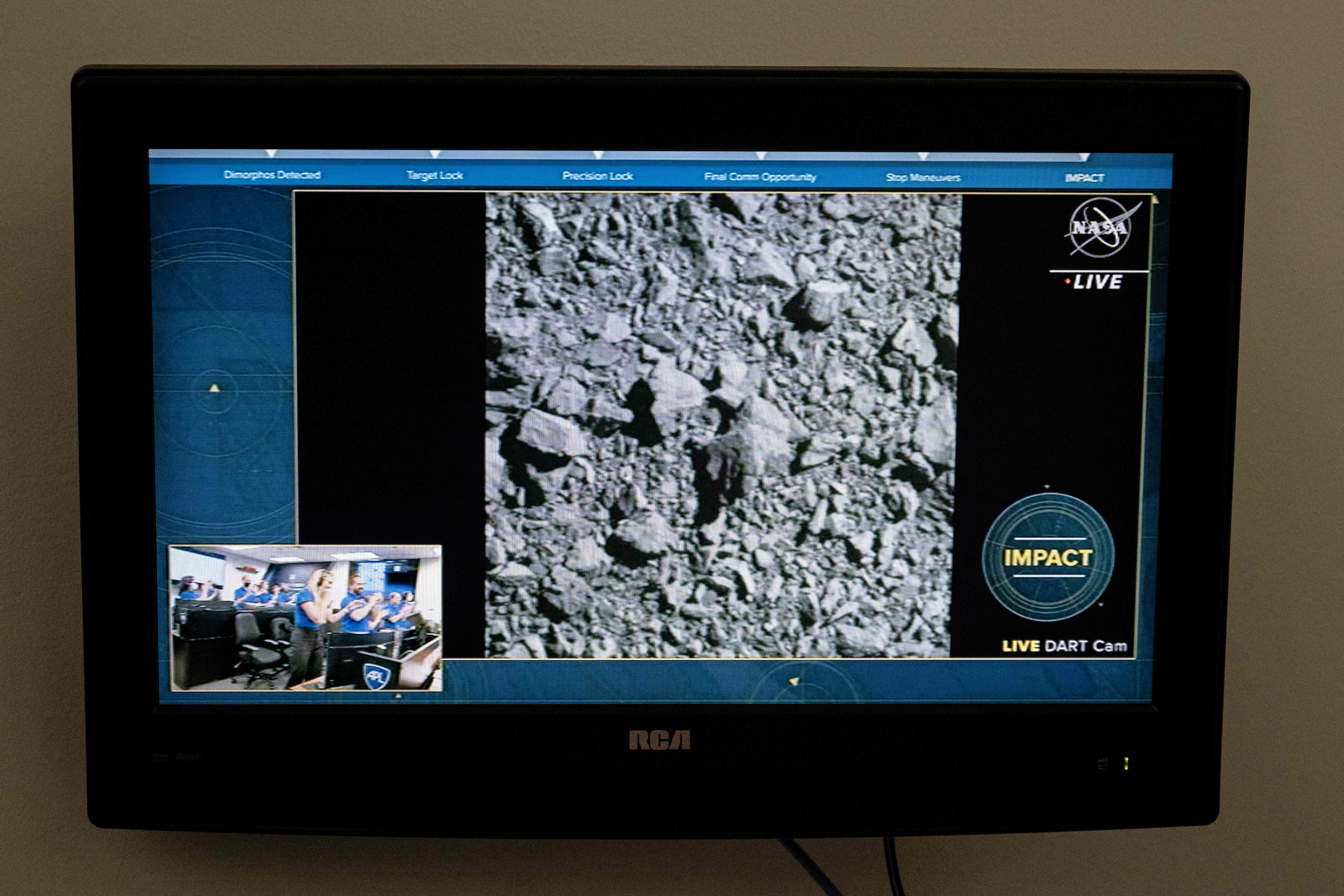
A TV at Nasa’s Kennedy Space Center in Cape Canaveral, Florida, captures the final images from the Dart test
A TV at Nasa’s Kennedy Space Center in Cape Canaveral, Florida, captures the final images from the Dart test (AFP/Getty)

They further found that burying the bomb about 30 metres beneath the surface tripled the change in the asteroid’s speed compared with a more shallow explosion.

For instance, a kilometre-scale asteroid with a deep crater detonation at 20 meters could achieve a velocity increment exceeding 30cm per second away from the Earth.

Advertisement

The findings provide an important foundation for planning and designing defences against large-sized or short-warning-time asteroids headed for the Earth, the scientists said, adding that nuclear blasts could be the most effective means of dealing with large asteroids with short warning times.

“This study can provide references for the engineering design of defence against large near-Earth asteroids,” the scientists wrote.

Source link

Advertisement
Continue Reading

Trending

Copyright © 2025