
Business
Megaport Shares Surge 6.58% to $19.12 as ASX Tech Stocks Rally on Strong Wall Street Overnight Gains


SYDNEY — Shares in Megaport Ltd jumped 6.58% Tuesday, adding $1.18 to trade at $19.12, as the Brisbane-based network infrastructure provider rode a broader rally across Australian technology stocks fueled by a strong overnight session on Wall Street.
The move puts Megaport among the standout performers on the ASX 200 Tuesday, extending a run that has seen the stock climb sharply over recent months as the company repositions itself as a player in artificial intelligence infrastructure. The gain came as the ASX Information Technology sector broadly outperformed, tracking gains offshore after the Nasdaq Composite rose 2.13% overnight on the back of broad strength across megacap technology and semiconductor names.
A dramatic run higher
Tuesday’s advance is the latest chapter in what has been an extraordinary run for Megaport shares. The stock, which trades on the ASX under the ticker MP1, has a 52-week trading range spanning from roughly $6 to a high of $22.22, reflecting just how volatile the past year has been for the company. Shares have surged well over 100% over the past three months alone, according to market data, as investors reassessed the company’s role in AI and cloud connectivity following a series of major contract wins and a large capital raise.
Megaport, founded in 2013 and headquartered in Fortitude Valley, operates a software-defined network platform that allows businesses to connect to cloud service providers such as Amazon Web Services, as well as to data centers, internet exchanges and compute capacity around the world. The company says its platform now reaches more than 1,000 enabled data center locations across more than 160 cities in 26 countries, giving it access to roughly 10% of the world’s public data centers.
The AI pivot behind the rally
Much of the recent momentum in Megaport shares traces back to the company’s push into artificial intelligence infrastructure through its subsidiary Latitude.sh. In May, Latitude.sh secured three binding contracts with two U.S.-based AI technology companies for GPU, CPU, network and storage services, with a combined contract value of roughly $254 million and annualized recurring revenue of about $90.6 million.
That was followed in June by an even larger announcement: four new AI infrastructure contracts worth a combined $458.9 million in total contract value, alongside the launch of an on-demand GPU Pool aimed at meeting enterprise demand for AI compute. To fund the buildout — which requires an estimated $369.5 million in capital expenditure, largely for Nvidia GPUs, networking gear and storage infrastructure — Megaport launched a fully underwritten entitlement offer to raise $827.3 million, priced at $14.30 per new share.
The scale of the pivot has reshaped the company’s revenue base. On a pro forma basis, Megaport’s Compute division annual recurring revenue has climbed to roughly $385.2 million, now making up the majority of total group annual recurring revenue of about $662.9 million. Network annual recurring revenue, the company’s more established business, rose 25% year-on-year to $277.7 million, with net revenue retention running at 113%.
Reaffirmed guidance, eyes on August results
Megaport has reaffirmed its full-year 2026 revenue and earnings guidance for the combined group following the contract announcements, with revenue guidance tightened to a range of $307 million to $315 million. Group capital expenditure guidance of $90 million to $100 million remains unchanged, excluding the new AI customer contracts, though the company has cautioned that capex could rise by as much as $140.3 million depending on how quickly hardware for the new deals is delivered.
The company is scheduled to report its full-year results in August, an update investors are watching closely for a detailed breakdown of how the network and compute divisions are performing separately, and for confirmation of how quickly the newly signed AI contracts are converting into recurring revenue.
Mixed signals from analysts
Despite the sharp rally in the share price, sentiment among analysts covering the stock has been mixed. Canaccord Genuity holds a Buy rating on Megaport with a price target of $15.85, a level that was set relative to a late-May closing price and implies limited upside from current trading levels. Other consensus estimates have shown analyst price targets moving higher over recent months as growth expectations improve, even as some fair-value models have flagged that the stock’s rapid appreciation has outpaced underlying earnings forecasts.
Megaport remains unprofitable on a trailing basis, with earnings per share in negative territory, and the stock’s price-to-earnings ratio sits at an elevated level typical of high-growth technology names still investing heavily in infrastructure buildout. The company does not currently pay a dividend.
Part of a broader tech rally
Tuesday’s gain in Megaport shares came against the backdrop of a broader rally across Australian equities, with the S&P/ASX 200 climbing more than 1% in morning trade as Wall Street’s overnight strength flowed through to local markets. Communication services and technology stocks led gains in the U.S. session, with Meta Platforms and Alphabet among the standout performers, while Amazon’s market capitalization pushed above $3 trillion for the first time on strong cloud growth — a data point directly relevant to companies like Megaport that sit at the center of cloud and AI infrastructure buildouts.
Analysts have cautioned that daily share price swings, particularly in a stock as volatile as Megaport, should not automatically be read as a signal of changes in the underlying business. Equity prices can move on shifts in investor sentiment, sector-wide rotations and broader macroeconomic developments even when there is no company-specific news on a given day.
What comes next
With Megaport’s full-year results due in August, investors are likely to keep a close eye on the stock in the coming weeks for further volatility. Key metrics likely to draw scrutiny include the pace of AI contract conversion into recurring revenue, progress on the GPU Pool rollout, capital expenditure trends tied to hardware delivery timelines, and whether the company’s traditional network business can continue growing alongside its rapidly expanding compute division.
For now, Tuesday’s 6.58% gain adds to a share price recovery that has transformed Megaport from a laggard trading in single digits earlier in the year to one of the more closely watched momentum stories on the ASX technology board.


Surplus government land in the western suburbs is attracting developers’ attention.

The U.S. soybean industry is working to meet the demands of other countries despite having less farmland and fewer farmers. The USDA says U.S. farmland has shrunk by 7% since 2000.
CADIZ, Ky. – The U.S. soybean industry is working to meet growing global demand despite operating with less farmland and fewer farms.
According to the Department of Agriculture, the U.S. had about 943 million acres of farmland in 2000. That figure has since fallen about 7% to 874 million acres. The USDA also reported that the country lost approximately 307,000 farms over the same period.
Meanwhile, global demand for American agricultural products, particularly soybeans, has surged. Farmers are seeking new markets for their crops while working to produce more from each acre.
Barry Alexander is a seventh-generation farmer in Cadiz, Kentucky. Soybeans account for about half of the crops grown at Cundiff Farms during the summer.
TRUMP DECLARES FOOD SUPPLY EMERGENCY, SUSPENDS TARIFFS ON KEY FERTILIZER IMPORTS

Barry Alexander is a seventh-generation farmer in Kentucky who ships a chunk of his soy crop overseas. (FOX / Fox News)
Alexander said he has not lost farmland to urban development, but he has noticed farms shrinking as cities expand into rural areas.
“Land is going away every day, and that’s one commodity they’re not going to reproduce,” Alexander said. “Whenever that land is gone and gone out of production, it’s no longer going to be farmland. The population is increasing, and the demand for food is increasing.”
TRUMP DEFENDS TARIFFS AHEAD OF LOOMING MIDTERMS, SAYS THEY HAVE MADE THE US ‘A FORTUNE’
Kentucky’s soybean harvest begins in September and runs through October. A portion of Alexander’s crop is shipped overseas, including to China, the top customer for U.S. soybeans.
“A lot of our product is actually for export. We put it on the rivers here nearby, and it ships down to the Gulf of Mexico to New Orleans and is actually shipped overseas,” Alexander said.

According to the USDA, the amount of farmland in the United States has shrunk about 7% since 2000. (FOX / Fox News)
In 2025, China agreed to purchase 25 million metric tons of U.S. soybeans annually. The country initially failed to meet that benchmark as President Donald Trump’s trade war escalated.
The American Soybean Association said China later began purchasing more American soybeans as prices rallied.
“We’re on a positive trend, but we still got a long ways to go to completely hit the targets that they’ve agreed to,” Caleb Ragland, chairman of the American Soybean Association, said. “Obviously, we’ve had some bumps in the road in our relationship, but they’re too big of a customer to just write off.”
Ragland said China consumes more soy than any other country combined. Much of it is processed into soy protein used to raise pigs and poultry, two major staples in Chinese cuisine.
“They need our soy protein to help grow and produce their meat protein that their people want,” Ragland said.
TRUMP DECLARES FOOD SUPPLY EMERGENCY, SUSPENDS TARIFFS ON KEY FERTILIZER IMPORTS
China currently has a 10% tariff on all U.S. agricultural products. Chinese officials have discussed removing the tariff, which Ragland said would make American soybeans more competitive with South American producers.
South America remains a major force in the global soybean trade.
“I mean, that’s been a 10% tax that has made us uncompetitive when it comes to the cash price that the Chinese customers would pay for soybeans,” Ragland said.

Farmers are working to pack in more soy production with less land as global demand for American soy increases. (FOX / Fox News)
A portion of soybean profits goes into a checkoff program that the United Soybean Board uses to research and develop new markets for the crop.
Since the Soy Checkoff was established under the 1990 Farm Bill, annual American soybean production has increased from 2 billion bushels to about 4 billion bushels.
“We treat every acre individually, and we treat it to produce the most it possibly can,” Alexander said.
GET FOX BUSINESS ON THE GO BY CLICKING HERE
Brent Gatton, chairman of the United Soybean Board, said checkoff investments have helped open new fuel markets and supported U.S. soybean trade with more than 90 countries.
“Because of the checkoff, there are thousands of new uses we get. Soy oil is in Goodyear tires and artificial turf, and soy foam is a great success story,” Gatton said.
Farmers hope this year’s higher soy prices mixed with larger purchases could help them at least break even after years of high input costs.

Why is WuXi AppTec stock surging today?
Shein targets $30-$40 billion valuation for Hong Kong IPO- Reuters

Promoters bought shares worth ₹36,336 crore during the quarter, the most in four years since June 2022, showed data from primeinfobase.com.
Read more: FPI inflows into Indian G-Secs dry up as US rate hike looms
At the end of the quarter, 41.36% of stock was held by private promoters, 8.83% by the government of India, 15.88% by FIIs, 19.15% for domestic institutional investors (DIIs), and 9.51% by retail and HNI investors. “There is no one who knows more or better about the business and its valuation than the promoters. Thus, their decision to buy shares is always a positive signal,” said Pranav Haldea, managing director, Prime Database Group.
Attractive Valuations
“After continuously selling during the market highs in 2023 and 2024, their return is a telling sign that valuations had become attractive and that the market may have bottomed out,” said Haldea.

 ET Bureau
Shripal Shah, MD & CEO, Kotak Securities, said the increase in stakes by promoters is generally a sign of confidence in the business and its long-term prospects, but should always be evaluated alongside company-specific fundamentals and the broader industry outlook before any conclusions are drawn.
During the quarter, the Nifty 50 rose 5.2% despite the ongoing US-Iran conflict, which drove crude oil prices to nearly $120 a barrel.
Feroze Azeez, joint CEO, Anand Rathi Wealth, said that decline in FII shareholding was largely driven by lack of appetite for global risks due to a series of uncertainties in recent times, such as tariff tensions, and geopolitical escalations.
“From the market sentiment perspective, this trend should be viewed as constructive, as promoter buying reflects confidence from management, while declining FII ownership should not be viewed as a negative as it is driven by multiple global factors, and they eventually come back to markets once uncertainties settle,” Azeez said.
Deep Pockets
DIIs, retail investors and HNIs have absorbed much of the foreign sell-off, as their combined ownership share reached an all-time high of 28.66% as on June 30, showed primeinfobase’s data.
“While FPI ownership has continued to decline due to sustained foreign selling, this has largely been absorbed by domestic investors, including mutual funds, PMS investors and, in some cases, promoters themselves,” said Shah of Kotak. “The trend highlights the growing strength of domestic participation in Indian markets.”
Overseas funds have remained heavy sellers during this year, and net sold shares worth Rs 1.5 lakh crore in the first quarter.
Sectorally, while domestic institutions increased their allocation most to industrials, they decreased their allocation the most to information technology stocks, which was also the least favoured sector by foreign investors. Other than that, the FIIs increased their allocation most to financial services companies.

Mitsui profit beats estimates as trading house unveils buyback, return policy


I’m an individual investor who has been actively managing my own portfolio for over a decade. I hold an MBA from the University of Illinois Urbana-Champaign with concentrations in Finance and Marketing, and a Master’s in Industrial and Operations Engineering from the University of Michigan, Ann Arbor. My investing journey began in early 2015 with a position in Starbucks (SBUX), which I bought on valuation. This first buy sparked a lasting interest in long-term, fundamentals-driven investing. My approach combines fundamental analysis with technical insights, with a particular focus on “pick and shovel” businesses — companies that supply the essential tools, infrastructure, and services behind major growth trends. I’ve found this strategy lucrative from a risk/reward perspective.I write on Seeking Alpha to share my thoughts, research, and perspective on the markets — not to provide investment advice. My goal is simply to contribute ideas and analysis that my fellow investors can weigh as part of their own due diligence.
Analyst’s Disclosure: I/we have a beneficial long position in the shares of BBY either through stock ownership, options, or other derivatives. I wrote this article myself, and it expresses my own opinions. I am not receiving compensation for it. I have no business relationship with any company whose stock is mentioned in this article.
Seeking Alpha’s Disclosure: Past performance is no guarantee of future results. No recommendation or advice is being given as to whether any investment is suitable for a particular investor. Any views or opinions expressed above may not reflect those of Seeking Alpha as a whole. Seeking Alpha is not a licensed securities dealer, broker or US investment adviser or investment bank. Our analysts are third party authors that include both professional investors and individual investors who may not be licensed or certified by any institute or regulatory body.
Business
MV Electrosystems IPO allotment expected today; GMP signals 24% listing gain. Here’s how to check your allotment status
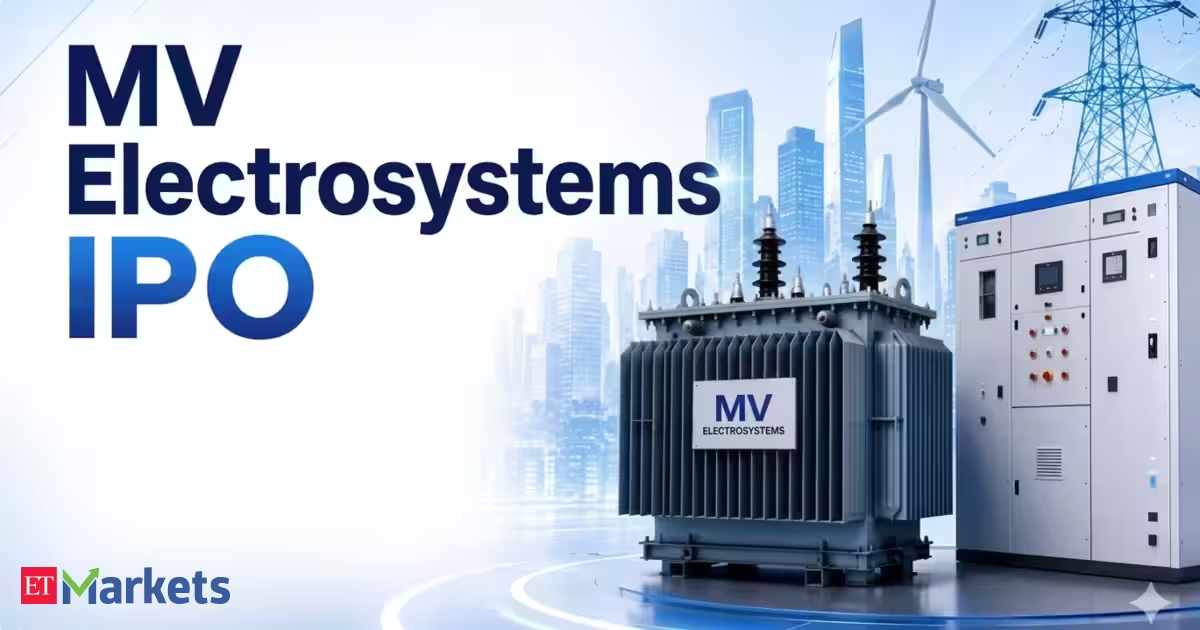
The company’s shares are slated to make their stock market debut on August 6. Ahead of the listing, the IPO continues to enjoy strong traction in the grey market, with a Grey Market Premium (GMP) of around Rs 100 per share. This suggests a potential listing gain of nearly 24% over the upper issue price of Rs 425. However, investors should note that the GMP is an unofficial indicator of market sentiment and can fluctuate before the listing.
The IPO, which was open for subscription from July 30 to August 3, witnessed overwhelming demand across investor categories. Overall, the issue was subscribed 188.85 times. The Non-Institutional Investors (NII) segment led the charge with a subscription of 374.58 times, followed by Retail Individual Investors (RII) at 205.42 times, while the Qualified Institutional Buyers (QIB) portion was subscribed 90.47 times.
The Rs 290 crore IPO was entirely a fresh issue of 0.68 crore equity shares, priced at Rs 425 per share.
Sundae Capital Advisors Pvt. Ltd. is the book-running lead manager for the issue, while KFin Technologies Ltd. is serving as the registrar.
How to check Manipal Health Enterprises IPO allotment status
Investors can check their allotment status through any of the following platforms:
1. KFin Technologies (Registrar)
- Visit the KFin Technologies IPO allotment page (https://ipostatus.kfintech.com/)
- Select MV Electrosystems from the drop-down menu.
- Enter your PAN, application number, or DP/Client ID.
- Click Submit to view your allotment status.
2. NSE
3. BSE
- Visit BSE IPO allotment link: https://www.bseindia.com/investors/appli_check
- Now tick Equity under issue type.
- Choose MV Electrosystems from the dropdown menu.
- Enter your application number or PAN.
- Complete the captcha verification and click Search to view your allotment details.
MV Electrosystems IPO GMP Today
The grey market premium (GMP) for the MV Electrosystems IPO is currently around Rs 100 per share, indicating a potential listing premium of nearly 24% over the upper issue price of Rs 425.
Based on the prevailing GMP, the estimated listing price of MV Electrosystems shares is around Rs 525 per share. However, investors should note that the GMP is an unofficial market indicator and is subject to change before the listing. It can fluctuate depending on investor sentiment, subscription demand, and overall market conditions.
IPO Proceeds to Fund Expansion and R&D
MV Electrosystems plans to use the IPO proceeds to strengthen its operations and support future growth.
The company has earmarked Rs 180 crore to meet its long-term working capital requirements, while Rs 21 crore will be invested in research and development for new power electronic equipment. The remaining funds will be used for general corporate purposes.
Given the company’s presence in large-scale manufacturing and railway infrastructure, the additional working capital is expected to support production, project execution, and business expansion.
About MV Electrosystems
Established in 2009, MV Electrosystems Ltd. designs, develops, assembles, and manufactures electrical and power electronic equipment primarily for railway rolling stock applications.
Its product portfolio includes IGBT-based three-phase drive propulsion systems for electric locomotives, switchgear panels for railway coaches and EMUs, cable protection and management solutions, along with a range of electrical systems and sub-systems.
The company operates in a sector benefiting from India’s railway modernization drive, including broad-gauge electrification, Make in India initiatives, network expansion, and increasing investments in high-speed rail infrastructure. These trends are expected to drive demand for advanced railway electrical systems and power electronics, positioning MV Electrosystems for long-term growth.
(Disclaimer: Recommendations, suggestions, views and opinions given by the experts are their own. These do not represent the views of Economic Times)

Why is Sumitomo Pharmaceutial stock falling today?
Business
Juniper Green Energy IPO allotment likely today; GMP signals 4% listing premium. Here’s how to check your status

Ahead of its stock market debut on August 6, the company’s shares are commanding a Grey Market Premium (GMP) of around Rs 10 per share. Based on the upper end of the IPO price band at Rs 225, the GMP indicates a potential listing gain of nearly 4%.
However, investors should note that the grey market is unofficial, and GMP is only a sentiment indicator. It can change significantly before the stock lists on the exchanges.
Strong institutional demand drives IPO subscription
The IPO, which remained open for subscription from July 30 to August 3, received healthy investor interest, largely driven by institutional buyers.Overall, the issue was subscribed 7.97 times. The Qualified Institutional Buyers (QIB) category saw an overwhelming subscription of 24.94 times, while the Non-Institutional Investors (NII) portion was subscribed 1.82 times. The Retail Individual Investors (RII) segment was subscribed 93%.
The Rs 1,800 crore IPO comprised an entirely fresh issue of 8 crore equity shares, with a price band of Rs 214-225 per share.
ICICI Securities is the book-running lead manager to the issue, while KFin Technologies is the registrar.
How to check Manipal Health Enterprises IPO allotment status
Investors can check their allotment status through any of the following platforms:
1. KFin Technologies (Registrar)
- Visit the KFin Technologies IPO allotment page (https://ipostatus.kfintech.com/)
- Select Juniper Green Energy from the drop-down menu.
- Enter your PAN, application number, or DP/Client ID.
- Click Submit to view your allotment status.
2. NSE
3. BSE
- Visit BSE IPO allotment link: https://www.bseindia.com/investors/appli_check
- Now tick Equity under issue type.
- Choose Juniper Green Energy from the dropdown menu.
- Enter your application number or PAN.
- Complete the captcha verification and click Search to view your allotment details.
How Will the IPO Proceeds Be Used?
Juniper Green Energy plans to utilise a substantial portion of the IPO proceeds to strengthen its balance sheet by reducing debt. Of the total funds raised, Rs 683.24 crore will be used to repay or prepay certain borrowings of the company, while Rs 728.69 crore will be invested in its material subsidiaries to help them repay or prepay their outstanding loans.
The remaining proceeds will be allocated towards general corporate purposes. Overall, the company aims to deploy around Rs 1,411.92 crore towards debt reduction, a move that is expected to lower financing costs, improve its leverage profile, and enhance its overall financial health.
About Juniper Green Energy
Founded in 2011, Juniper Green Energy is one of India’s leading renewable energy independent power producers (IPPs). The company develops, builds, owns, operates and maintains utility-scale renewable energy projects across solar, wind, hybrid, and Firm & Dispatchable Renewable Energy (FDRE) segments, supported by Battery Energy Storage Systems (BESS).
Its revenues are backed by long-term power purchase agreements (PPAs) with central and state government-backed entities, providing stable and predictable cash flows.
As of June 30, 2026, the company had a diversified renewable energy portfolio of 7,910.20 MW (10,247.06 MWp) across operational, under-construction, contracted and awarded projects, placing it among the top 10 renewable energy IPPs in India by installed and pipeline capacity.
With allotment expected today and listing scheduled for August 6, investors will now closely watch whether the current GMP translates into gains on the stock’s market debut.
(Disclaimer: Recommendations, suggestions, views and opinions given by the experts are their own. These do not represent the views of Economic Times)

Angel Reese Fans Pumped After Star’s 23-Point, 16-Rebound Effort in “Barbie Night” Loss

AWS is helping vibe-coding startup Superblocks, and the implications are big

Wales breaking news plus weather and traffic updates (Tuesday, August 4)


-

 Business5 days ago
Why Trees Belong on the Risk Register
-

 Fashion3 days ago
Weekend Open Thread: Wit & Wisdom
-

 Politics3 days ago
Meta enters AI-training agreement with far-right ‘propaganda rag’ Newsmax
-
 Entertainment6 days ago
‘Stargate’ Creator’s New Sci-Fi Series Returns for Season 3 Tomorrow
-

 Crypto World3 days ago
MicroStrategy Post-Earnings CLARITY Act Push Could Add New Catalyst for Its Stock
-

 Politics7 days ago
The Part of the Electric Transition Nobody Wants to Discuss
-

 Business6 days ago
Major shareholder moves on Canyon
-

 Crypto World3 days ago
XRP Ledger v3.3.0 brings five institutional features
-

 News Videos5 days ago
Bitcoin Enters the 3rd Stage of the Bear Market
-

 Crypto World6 days ago
Kraken Enables Retail Access to Jersey Mike’s IPO via Tokenized Shares
-

 Politics6 days ago
Reform UK betrays West Mids residents by running from party pledges
-

 Politics5 days ago
Luke Littler’s dominance sparks GOAT debate
-

 News Videos6 days ago
Claude: Build Financial Dashboards in Minutes (2026)
-

 Sports4 days ago
Seema Kaliramna Wins Discus Throw Bronze, Takes India’s CWG Medals Tally To 17
-

 Crypto World3 days ago
New York sues Kalshi over prediction market gambling
-

 Business6 days ago
Johnson & Johnson agrees to $5.5B settlement over talc cancer claims
-

 Crypto World2 days ago
Crypto PAC spending tops $2M in Michigan House race
-

 Business4 days ago
Trump Announces Hamas Disarmament Agreement as Iran Strikes Kuwait Air Base and US Attacks Pause Overnight
-

 Tech6 days ago
Gemini can now summarize the messiest comment threads in Google Docs
-

 Tech2 days ago
ESET tracks rise in malicious AI skills and adaptable malware
You must be logged in to post a comment Login