
Crypto World
Coldcard Bitcoin Theft Tops $100M Across 3 Waves



Cointelegraph is committed to providing independent, high-quality journalism across the crypto, blockchain, AI, and fintech industries.
All news, reviews, and analyses are produced with full journalistic independence and integrity. For more details on our standards and processes, please read our Editorial Policy.



Boltz suspended its Bitcoin swap services indefinitely on Aug. 3 after reporting months of automated, AI assisted probing and several contained exploits.
Summary
- Boltz suspended swaps indefinitely after reporting months of automated, AI-assisted probing and several contained exploits.
- The company says attackers now adapt faster than its team can identify and patch flaws.
- No user funds were at risk, while Boltz says it absorbed all operational losses itself.
- Refund APIs and support remain available, but the protocol has provided no reopening date yet.
- Bull Bitcoin, Aqua and ZEUS reported service disruptions tied to their reliance on Boltz swaps.
The noncustodial swap provider said the attacks had accelerated sharply in recent days, leaving its development team unable to deploy fixes as quickly as attackers adapted their methods.
The team said it could not responsibly restore swaps while it remained under active attack and reviewed findings from recent security scans. Boltz described the suspected attackers as “multiple resourceful groups,” although it did not identify them or provide evidence independently confirming who conducted the attacks.
Boltz swap shutdown followed an earlier EVM warning
The wider shutdown followed an Aug. 1 notice concerning a bug in Boltz’s Ethereum Virtual Machine integration. The service initially disabled swaps involving assets such as USDT, USDC, WBTC, TBTC and RBTC while stating that Bitcoin, Lightning and Liquid swaps remained operational. Two days later, it stopped all swap services.
Boltz operates infrastructure connecting Bitcoin mainnet with the Lightning Network, Liquid and other supported networks. Its public API powers the main web application and outside integrations. Official documentation advises developers to use supported software development kits because they manage swap cryptography, recovery procedures and transaction states.
Moreover, Boltz said no customer funds were exposed during the incidents because users retain control of their assets throughout its atomic swap process. The company also said it absorbed the losses associated with the contained exploits because it operates as a fully bootstrapped business. Those statements remain company claims because Boltz has not published a technical incident report or independent security review.
The service’s API remains online for cooperative refunds. Users can also complete unilateral refunds without relying on Boltz infrastructure, according to the company. Its support team remains available for customers with unfinished transactions.
The distinction shows how noncustodial architecture can limit custody losses without preventing operational disruption. Users may retain their Bitcoin, but they cannot initiate new swaps through the affected service until operations resume or integrated wallets introduce alternative providers.
Wallets are seeking replacements for Boltz infrastructure
Bull Bitcoin said the shutdown temporarily disabled Lightning payments and conversions between Liquid Bitcoin and onchain Bitcoin within its wallet. Standard Bitcoin transfers, Liquid transfers, wallet restoration and storage functions continued operating normally.
The company said it was evaluating several replacement options and promised a separate mechanism for customers wishing to convert Liquid Bitcoin into onchain Bitcoin. It added that its Liquid Federation membership allows it to conduct conversions without depending on a third party.
ZEUS also disabled its own deployment of the open source Boltz stack, while Aqua notified users that the service suspension affected its swap functions. Neither wallet reported customer asset losses.
As crypto.news previously reported, Blockstream had integrated Boltz into its mobile wallet to support Lightning and Liquid swaps. The shutdown shows how applications that use shared swap infrastructure can face service interruptions even when their core wallet functions remain available.
Boltz has not provided a reopening date
Boltz warned users not to expect swap services to resume soon. It has not published a remediation timetable, detailed vulnerability list or conditions that must be met before operations restart. The team said it would provide another update after assessing its options.
The company’s attribution to AI assisted activity also remains difficult to verify without technical indicators. Automated scanning can increase the speed and volume of attacks, but Boltz has not explained how it determined artificial intelligence played a role.
In related coverage, crypto.news reported that Solana Foundation security chief Michael Coates expects artificial intelligence to strengthen both attackers and defensive systems. Boltz’s next update is expected to clarify whether it will introduce automated monitoring, outside audits or changes to its open source infrastructure before restoring swaps.
Initial support stands at 24.94 million SOL, or 5.8% of the 432.65 million staked, roughly 38% of the way to the 15% threshold a proposal must clear before it reaches an actual vote. That leaves 39.95 million SOL to find, or about $2.9 billion, before signaling closes on Aug. 18.
Sixteen validators have signaled so far, 2.3% of the set. Helius accounts for 16.03 million SOL of the running total on its own, close to two-thirds of everything gathered, with Blueshift next at 3.6 million and Temporal Emerald at 1.24 million before the list thins out.
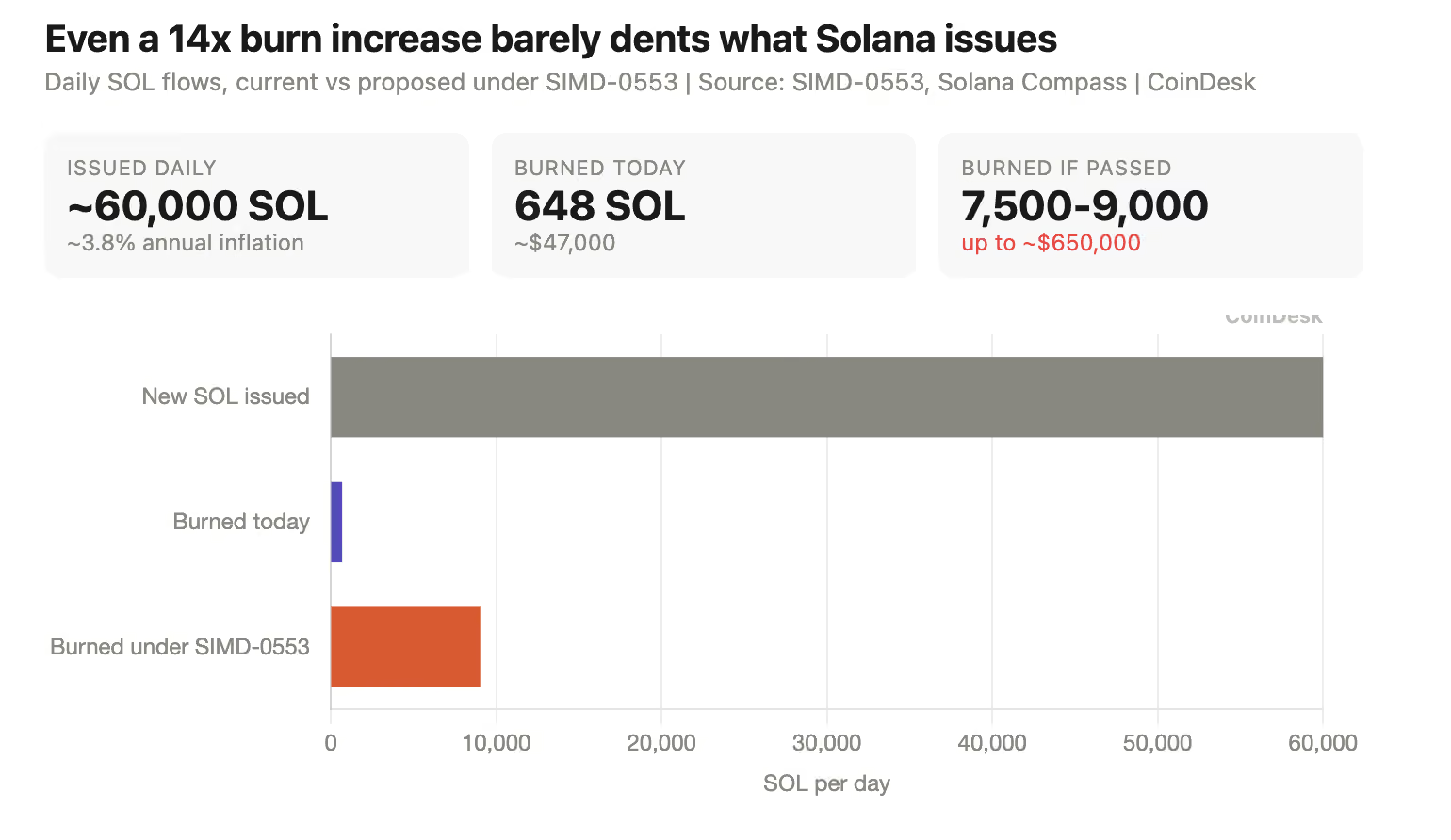
As such, the burn increase is smaller than it sounds against what Solana issues. Even at the top of the projected range, 9,000 SOL a day sits against roughly 60,000 SOL of daily inflation, so the fee change alone does not turn SOL deflationary. That is part of why the two proposals travel together, with SIMD-0550 cutting issuance while SIMD-0553 raises what gets destroyed.

Meanwhile, Helius, which supplied 16.03 million SOL of the 24.94 million gathered, employs the engineer behind SIMD-0550.
But the 15% gate exists precisely to test this. Solana Foundation set it in July so the validator set would only vote on questions enough stake actually cares about, leaving routine technical work inside the SIMD process.
NEAR Protocol co-founder and NEAR Foundation CEO Illia Polosukhin proposed creating a protocol sovereign fund on Aug. 3, using roughly 30 million NEAR as its initial capital base.
Summary
- 30 million NEAR would seed the sovereign fund, worth roughly $57 million at current prices.
- Fund yield would finance validators, MPC providers and other ecosystem public goods under governance oversight.
- Polosukhin wants protocol revenue converted into NEAR rather than burned for temporary supply reductions alone.
- House of Stake delegates would participate through existing mechanisms, but no formal vote is scheduled.
- Stakeholders have two weeks to comment before supporters consider formal governance steps or implementation details.
At the token’s price of about $1.8 at press time, the proposed treasury would be worth approximately $57 million.
The plan would direct current and future protocol revenue into a NEAR denominated fund. Part of the yield would pay for network security, validator support, multiparty computation providers and other public goods. Polosukhin described the forum post as a discussion proposal, not an approved mandate.
NEAR sovereign fund would begin with 30 million tokens
The proposed fund would combine the existing protocol treasury, revenue already earned and future revenue selected through governance. Rather than immediately spending or burning incoming assets, the treasury would hold NEAR and seek returns through strategies that governance would later define.
Polosukhin compared the structure with sovereign wealth funds in Norway and Singapore and with university endowments. Those models preserve a capital base while using part of its returns for recurring costs. Unlike those examples, the proposal says NEAR’s fund would hold the network’s native token and measure returns in NEAR.
In addition, the proposal forms part of NEAR’s broader tokenomics changes. The network cut its inflation rate from about 5% to roughly 2.5% in late 2025. It also activated an Intents fee switch in February 2026 that directs revenue toward NEAR purchases.
Polosukhin argued that burning revenue offers only a temporary reduction in supply. He instead wants revenue used to acquire NEAR, generate yield and create a continuing funding source. “If this proves to be successful,” he said, the network could gradually reduce inflation and potentially move toward a fixed token supply. That outcome remains conditional and has not been approved.
The fund’s returns could support the Validator Support Program, MPC providers and other services. House of Stake delegates could participate through existing delegation systems, while governance would set revenue scope, spending percentages and operating parameters.
Governance must still define investment risks
The proposal does not specify which yield strategies the fund would use. Early forum responses asked whether the treasury would rely on staking, lending, protocol owned liquidity, stablecoins or other assets. One commenter warned that NEAR’s decentralized finance markets may not absorb such a large treasury without compressing returns or increasing risk.
Those questions matter because staking rewards largely come from token issuance rather than external revenue. Lending, liquidity provision and leveraged strategies could add counterparty, smart contract, liquidation or market risks. The discussion called for exposure limits, independent oversight and transparent performance reporting against a NEAR denominated benchmark.
House of Stake is positioned as NEAR’s economic governance body. Its mandate covers treasury management, inflation, fees and incentive design. However, the sovereign fund post has not entered a confirmed vote or execution process.
Consultation lasts two weeks before any formal decision
Polosukhin invited validators, tokenholders and other stakeholders to comment for two weeks. After that period, supporters could develop detailed governance parameters and decide whether to advance a formal proposal. No launch date, target yield, asset allocation or final spending formula has been announced.
The proposal follows other attempts to connect network usage with demand for NEAR. As crypto.news reported, the protocol recently introduced staking based payments that convert locked tokens into monthly AI compute credits.
In related coverage, NEAR has also positioned its network and Intents system as settlement infrastructure for cross chain activity and autonomous AI agents. Those initiatives provide additional sources of fees or token utility, although their future revenue remains uncertain.


Proof of Attendance Protocol, commonly known as POAP, is winding down after more than five years, co-founder Isabel Gonzalez announced on Aug. 3.
Summary
- POAP is winding down after more than five years, co-founder Isabel Gonzalez announced publicly Monday.
- Nearly 7.6 million POAP badges were minted by more than 46,000 issuers before closure plans.
- Existing collectibles remain onchain, but the company has not published a detailed shutdown timetable yet.
- POAP entered maintenance mode in March, ending active development and blocking new issuer onboarding access.
- The company raised $10 million in 2022 before struggling to build a sustainable business model.
The decision closes the company behind one of Web3’s best-known digital attendance badge systems after millions of collectibles were issued for conferences, online events and community milestones.
Gonzalez blamed the closure on a business model that could not remain sustainable without weakening the project’s original purpose. She wrote that “crypto’s funding cycles and distribution dynamics made it hard to build a sustainable company without cannibalizing the ethos that made POAP mean something.” The statement did not provide a final service date, employee details or a complete migration plan.
POAP shutdown follows months in maintenance mode
The Proof of Attendance Protocol shutdown did not arrive without warning. The company placed its existing platform into maintenance mode on March 16. It stopped onboarding new issuers and ended active development, while allowing approved issuers, collector tools, APIs and existing integrations to continue operating.
At the time, the team said previously created POAPs would remain intact. It also warned that some operations could slow as fewer resources were assigned to the service. The August announcement now goes further by confirming that the company is winding down rather than simply pausing expansion.
Moreover, Proof of Attendance Protocol turned attendance at physical and online events into blockchain collectibles. Organizers typically distributed claim links or QR codes, allowing participants to mint a badge tied to a particular event. As crypto.news previously explained, Proof of Attendance Protocol badges use the ERC-721 NFT standard and moved from Ethereum to Gnosis Chain to reduce transaction costs.
Figures displayed by the project and cited in reporting show nearly 7.6 million collectibles created by more than 46,000 issuers. Gonzalez said organizations including Coinbase, American Express, Warner Music Group and Bayer had used the service, alongside many crypto communities.
Because the badges were minted on public blockchains, the company’s closure does not automatically erase them. Existing tokens should remain linked to their holders’ wallet addresses. However, continued access through POAP’s gallery, applications and metadata services may depend on how long the company maintains its supporting infrastructure.
POAP struggled to turn cultural reach into revenue
The protocol began at ETHDenver in 2019, when roughly 100 badges were issued to hackathon participants. POAP Inc. later developed the idea into a wider platform for preserving digital memories and raised $10 million in January 2022. Archetype and Sapphire Sport led the seed round.
Proof of Attendance Protocol later introduced charges for some commercial issuers after years of largely free distribution. The company hoped fees could support long term operations while keeping personal and community use accessible. Gonzalez’s latest statement indicates that those efforts did not produce a model the team considered sustainable.
The closure follows other Web3 products that built loyal communities but struggled to fund continued operations. In related coverage, crypto.news reported that Uncharted and Fishing Frenzy closed after failing to find a workable business model. Crypto.news also reported that Nike sold RTFKT after announcing the end of its Web3 services during a prolonged NFT downturn.
No final shutdown timetable has been published
As of Aug. 4, POAP’s main website, collector pages and developer documentation remained accessible. In the statements reviewed, neither Gonzalez nor the company announced a final cutoff date for those services. They also did not explain whether another organization would maintain the interfaces, APIs or metadata after the wind down.
Collectors therefore retain their onchain tokens, but the future of POAP’s hosted tools remains uncertain. The next verified update should clarify service deadlines, data preservation arrangements and whether the proposed open collectibles standard will continue under another structure.
https://x.com/poapxyz/status/2032182456481202614?s=20
Gonzalez said strong customer communities and lasting brand recognition remained among POAP’s most valuable achievements. Her assessment reflects the company’s view of its legacy, but it does not guarantee that POAP’s applications, infrastructure or brand will continue under new ownership.
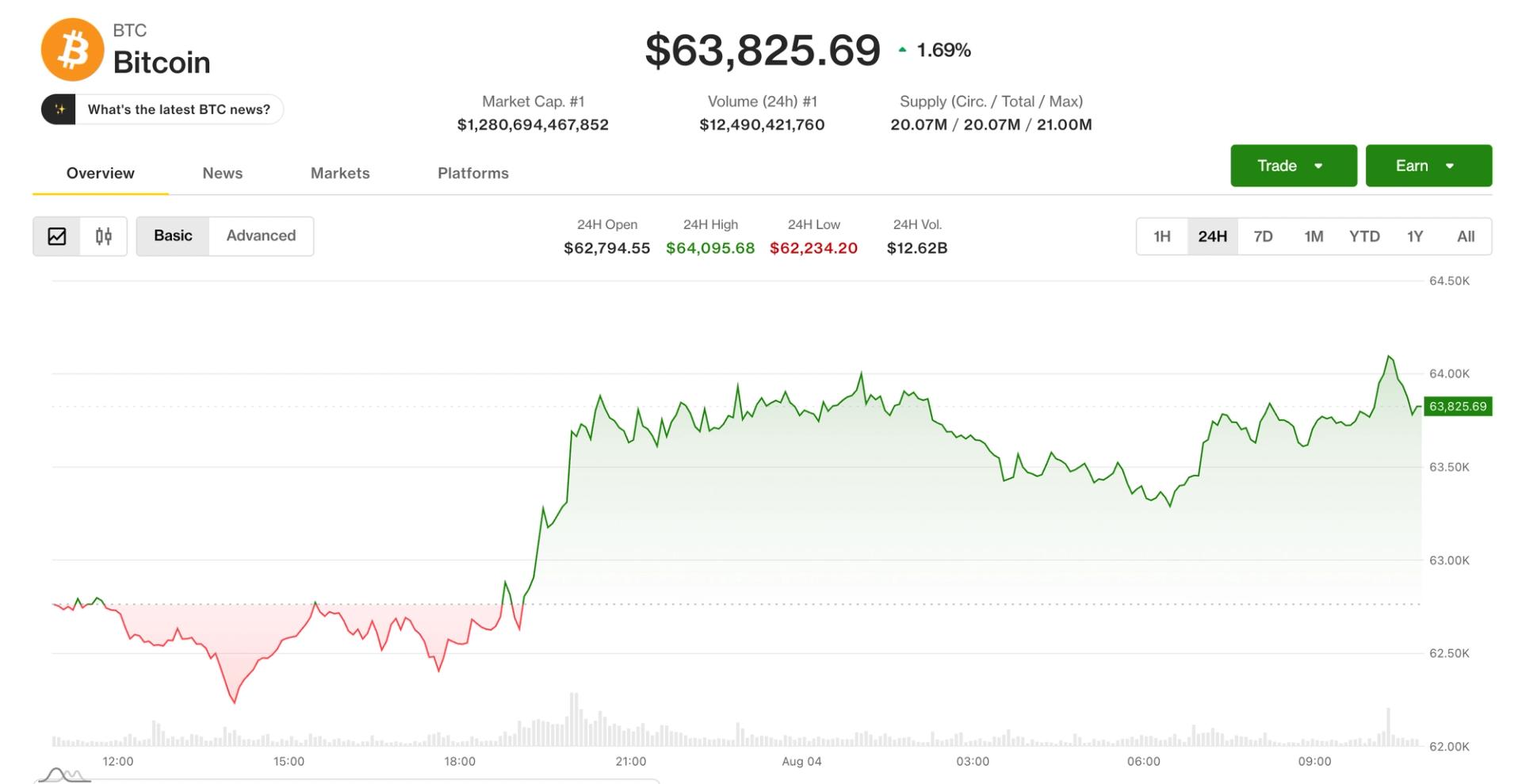
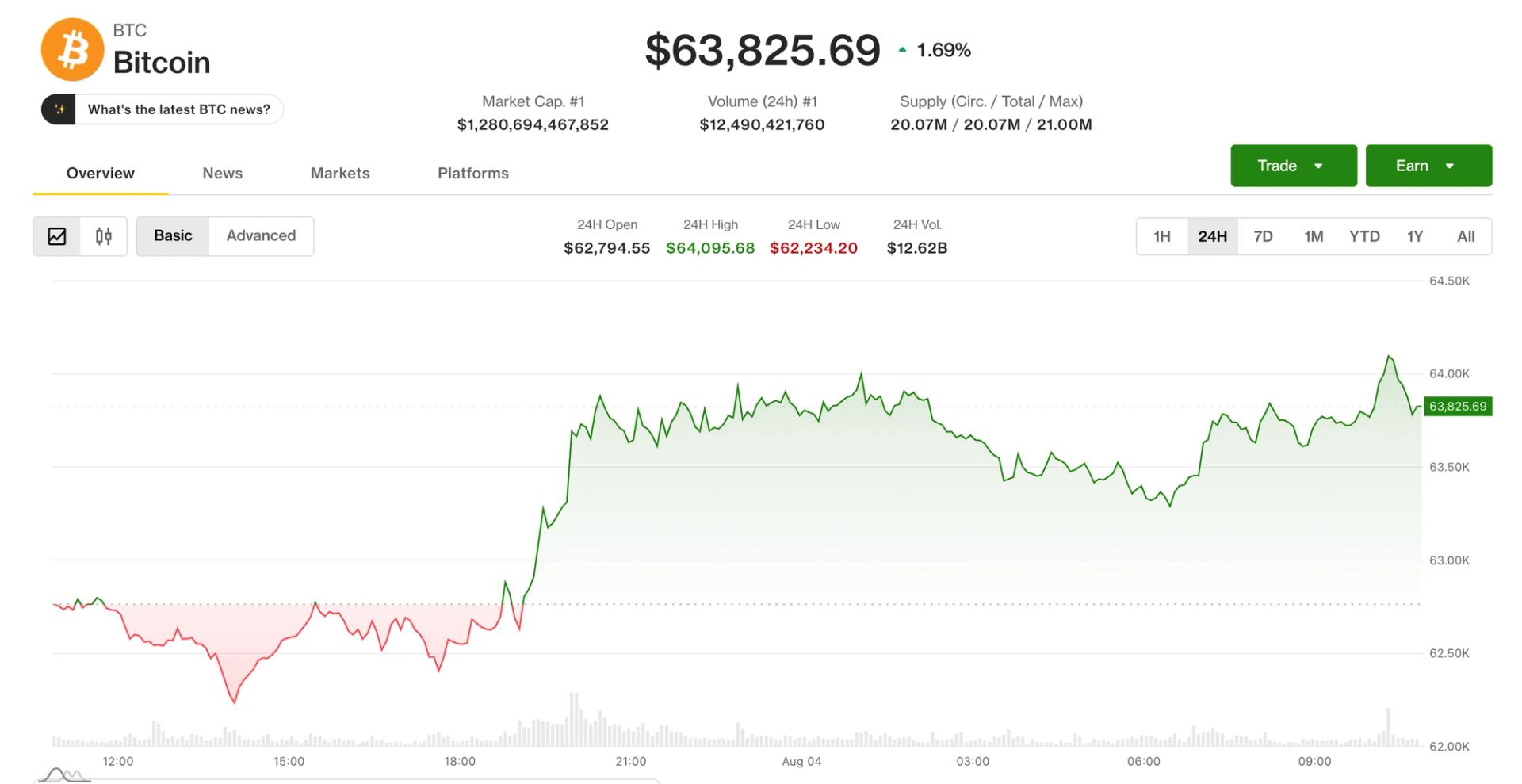
Bitcoin neared $64,000 in Asian morning hours Tuesday, up 2% over 24 hours and 1% on the week, recovering the $63,000 level it lost during Monday’s session. The low came near $62,250 before a steady bid carried it to just above $64,100 overnight.
Ether lagged near $1,865, up marginally on the day but still down 1% over seven days, the only major in the red on the weekly view. XRP rose almost 1% to $1.08 and is up 2% on the week. BNB added 1.5% to nearly $591 and leads the majors over seven days at almost 5%.
Solana gained over 1% to nearly $74, tron 1% to 33 cents and dogecoin the same to 7 cents. Hyperliquid’s HYPE bounced over 4% to $54 after last week’s slide, though it remains down 3% over seven days.
The recovery came without any resolution to the Coldcard situation. A fourth wave of sweeps against addresses generated by the affected firmware ran through Monday, taking roughly 449 bitcoin from 709 addresses on the revised count, and Galaxy Research has not confirmed whether the same operator is behind it.
Ripple said it has made two strategic investments aimed at expanding the infrastructure behind tokenized financial assets on its XRP Ledger (XRPL). In an announcement released Monday, the company disclosed funding into Zilo, a global transfer agency provider for wealth managers, and Licuido, a tokenization solutions firm regulated by the UK’s Financial Conduct Authority.
While Ripple did not provide deal sizes or investment terms, the move signals a continued effort to reduce friction in tokenized markets—particularly around how collateral can move and be reused across issuance and settlement.
Key takeaways
- Ripple announced strategic investments in Zilo and Licuido to support tokenized asset workflows on XRPL.
- The company expects the partnerships to improve regulated transfer agency, issuance, and collateral mobility on its ledger.
- Ripple’s stated focus is addressing “idle collateral” by enabling tokenized funds to be used as collateral from issuance.
- The announcements follow recent XRPL-related product and adoption milestones, including Aviva Investors’ tokenized fund launch and Ripple Mint for RLUSD.
Why Ripple is tying tokenization to regulated market plumbing
For institutional tokenization to scale, networks need more than smart-contract functionality—they require operational layers such as issuance controls, transfer agency services, and mechanisms that support compliance and collateral management. Ripple framed its investments as part of that broader stack.
According to the company’s announcement, Ripple expects the Zilo and Licuido investments to bring “regulated transfer agency, issuance, and collateral mobility” to XRPL infrastructure. That positioning matters because the capital markets bottlenecks that slow adoption are often less about token mechanics and more about how assets move through regulated processes.
Zilo and Licuido: transfer agency and FCA-regulated tokenization
Ripple said it invested in Zilo, which provides global transfer agency asset solutions for wealth managers. The UK-based company has reportedly raised $58.7 million in total equity funding, based on data compiled by Traxcn.
Ripple also announced an investment in Licuido, a tokenization solutions provider based in the UK and regulated by the Financial Conduct Authority. The combination of Zilo’s transfer agency orientation and Licuido’s regulated tokenization role suggests Ripple is targeting multiple stages of a tokenized asset’s lifecycle—from issuance through custody-related and operational handling.
Collateral mobility and the “idle collateral” problem
Ripple’s announcement tied the investments to a specific market issue: collateral that sits unused. The company said that by combining the investments, it aims to help address problems related to idle collateral by enabling tokenized funds to be used as collateral from the point of issuance.
In practical terms, this is the type of improvement that could reduce inefficiencies in leveraged trading, structured financing, or other institutional strategies where capital availability matters. If tokenized instruments can be deployed as collateral more directly, it may reduce the need to lock value in separate pools for different steps of the workflow.
However, the company did not provide implementation timelines or technical details in the announcement, leaving open questions about exactly how quickly these partnerships translate into new product capabilities on XRPL. Investors and ecosystem participants will likely want to watch for concrete rollout plans or integrations that demonstrate the promised shift from token issuance to usable collateral.
XRPL adoption momentum: RLUSD tooling and tokenized fund activity
Ripple’s investment news arrives shortly after other XRPL-related developments highlighted momentum in institutional tokenization.
One week prior to the announcement, London-based asset manager Aviva Investors launched a tokenized share class of its US Dollar Liquidity Fund on XRPL after receiving approval from the Central Bank of Ireland, according to earlier coverage from Cointelegraph. That example illustrates how regulatory clearance and asset-manager participation are becoming central to XRPL’s institutional narrative.
In addition, Ripple last month introduced Ripple Mint, a platform designed to give institutions new ways to access, mint, redeem, and manage its US dollar-pegged stablecoin, Ripple USD (RLUSD). By building tools around stablecoin operations and management, Ripple has been advancing the practical infrastructure institutions need for on-chain settlement and token issuance workflows.
Taken together, these efforts point to a broader strategy: pair ledger-level capabilities with real-world finance counterparts—asset managers, transfer agency providers, and regulated tokenization services—so that tokenized assets can be issued, moved, and operationally managed under compliance expectations.
Tokenized assets onchain: growth, concentration, and what to watch
The broader tokenized real-world assets (RWA) market has continued to expand, reinforcing why firms are investing in infrastructure. According to data compiled by RWA.xyz, XRPL is the 11th-largest blockchain network with $368 million in tokenized RWAs. Ethereum ranks first with $17.1 billion in tokenized RWAs.
RWA.xyz data also showed that total RWA holders increased by 50% to 1.57 million over the past 30 days, while the total value of tokenized assets rose by 1.5% to $37.3 billion. Those figures suggest that, despite concentration at the top, the sector is not standing still—participation and capital have both been trending upward.
For XRPL participants, the key takeaway is that growth in tokenization demand may increasingly depend on the maturity of the operational layer. Ripple’s stated goal—improving collateral mobility and transfer agency and issuance capabilities—directly targets a set of constraints that can limit institutional use even when tokenization technology exists.
Next, market observers will likely focus on whether Ripple can translate these investments into measurable product outcomes on XRPL—especially around regulated issuance workflows and the ability for tokenized funds to function as collateral from issuance, as Ripple described. Concrete integrations, pilot deployments, and partner announcements will be the clearest indicators of how quickly the strategy moves from concept to capability.


Kalshi CEO Tarek Mansour defended the prediction market operator on Aug. 3 after New York filed a lawsuit seeking at least $36 billion in damages, penalties and related relief.
Summary
- New York seeks at least $36 billion while alleging Kalshi operates an unlicensed gambling platform.
- Kalshi removed the case to federal court, temporarily sidelining New York’s immediate preliminary injunction request.
- Tarek Mansour compared Kalshi with Nasdaq, saying the exchange matches traders and charges transaction fees.
- Federal courts previously refused Kalshi’s bid to block New York from enforcing gambling laws locally.
- The next court fight concerns federal jurisdiction, remand, and whether state gambling rules can coexist.
During a CNBC interview, Mansour compared Kalshi’s structure to Nasdaq and argued that the state’s allegations threaten the wider event contract business.
The legal case also moved away from New York state court. The prediction market platform removed the proceeding to the U.S. District Court for the Southern District of New York shortly after Attorney General Letitia James filed it on July 31.
New York Supreme Court Justice Melissa A. Crane then treated the state’s preliminary injunction request as moot because the case was no longer before her court, according to court records shared by gaming law attorney Daniel Wallach. The decision was procedural and did not reject New York’s allegations.
Kalshi lawsuit moves into federal court
New York’s verified petition accuses the firm of repeatedly violating state gambling laws by offering event contracts without a New York State Gaming Commission license. The state wants a permanent injunction, an accounting of customer activity, restitution, disgorgement and civil penalties. It also seeks $100,000 for each alleged unauthorized sports wagering offer. Those requests remain allegations and have not resulted in a final judgment.
The company transferred the case to federal court about eight hours after the state filing, arguing that New York was attempting to regulate a derivatives exchange overseen by the Commodity Futures Trading Commission. As crypto.news reported, the state had initially asked for immediate restrictions while the wider case proceeded.
Justice Crane’s order temporarily removes that state court request from consideration. Wallach said New York could file the motion again if a federal judge sends the case back to state court. A remand decision would determine the forum, not whether Kalshi’s products are lawful.
Mansour says Kalshi resembles Nasdaq
Mansour rejected New York’s description of Kalshi as an unlicensed sportsbook. He said users trade with other participants while the prediction market platform matches positions and earns transaction fees. He added that officials could “copy and paste that lawsuit and file it against Nasdaq,” extending his defense beyond sports markets.
The comparison reflects Kalshi’s central argument that event contracts are financial instruments rather than conventional wagers. The firm is registered with the CFTC as a designated contract market, and its contracts generally allow customers to take opposing positions on whether an event will occur. New York argues that this structure does not change the products’ gambling character under state law.
Mansour also compared Kalshi’s regulatory battles with earlier disputes involving Uber and Airbnb. He portrayed the state action as resistance from established gaming businesses facing a new competitor. That remains Kalshi’s interpretation. New York has said its case concerns licensing, consumer safeguards, tax obligations and access by users below the state’s minimum sports betting age.
The CEO claimed New Yorkers had collectively earned more than $200 million on Kalshi during 2026. He also said the company proposed a system that could produce almost $10 billion in state tax revenue over five years. Mansour did not publish supporting calculations during the interview, so those figures should be treated as company claims rather than verified totals.
New York says event contracts are illegal gambling
The attorney general’s office alleges that the company allows customers to risk money on future events outside their control, meeting New York’s definition of gambling. The petition cites contracts covering professional sports, college games, elections and entertainment programs. It also alleges that Kalshi charges customers fees for entering those positions.
New York further claims that people aged 18 to 20 can use the platform even though state law sets the minimum age for mobile sports betting at 21. The state says licensed operators must follow local consumer protection requirements and contribute gaming taxes. The prediction market operator disputes the state’s authority to apply those rules to a federally registered exchange.
The petition refers to a reported $22 billion company valuation and annualized transaction volume of $178 billion. Those figures appear as the firm reported numbers in the state filing. They are not findings by the court, and the final monetary exposure cannot be known before an accounting and judgment.
Federal and state regulators remain divided
The new removal follows an earlier setback for the prediction market operator. On July 7, U.S. District Judge Analisa Torres refused to block the New York State Gaming Commission from applying state gambling laws to Kalshi’s sports contracts. She found that Kalshi had not shown at the preliminary stage that the Commodity Exchange Act displaced New York’s rules. Kalshi appealed, but its requests for emergency protection were also rejected.
The CFTC takes the opposite position. In an April federal complaint, the regulator argued that Congress gave it exclusive authority over swaps and other contracts traded on registered derivatives exchanges. New York maintains that states retain their traditional power to police gambling within their borders.
Courts have not applied one consistent approach nationwide. In related coverage, a Washington judge blocked Kalshi sports contracts after finding that state gambling laws could apply. A Minnesota federal judge reached a different early conclusion and temporarily blocked that state’s prediction market ban.
The federal judge assigned to New York’s newly removed case must now consider whether federal jurisdiction exists and whether the proceeding should remain in federal court. A remand would allow New York to renew its injunction request in state court. Keeping the case in federal court would move the immediate dispute into the same court system already handling related questions about CFTC authority and federal preemption.
Since July 30, attackers have drained thousands of BTC from Coldcard-generated wallets, exploiting a flaw dating back to March 2021. According to researchers at Galaxy, total damage so far is about $130 million in BTC.
Over the weekend, some analysts pointed to increased inflows of BTC onto exchanges as the hack dented confidence in self-custody safety.
The 500 BTC isn’t an isolated case
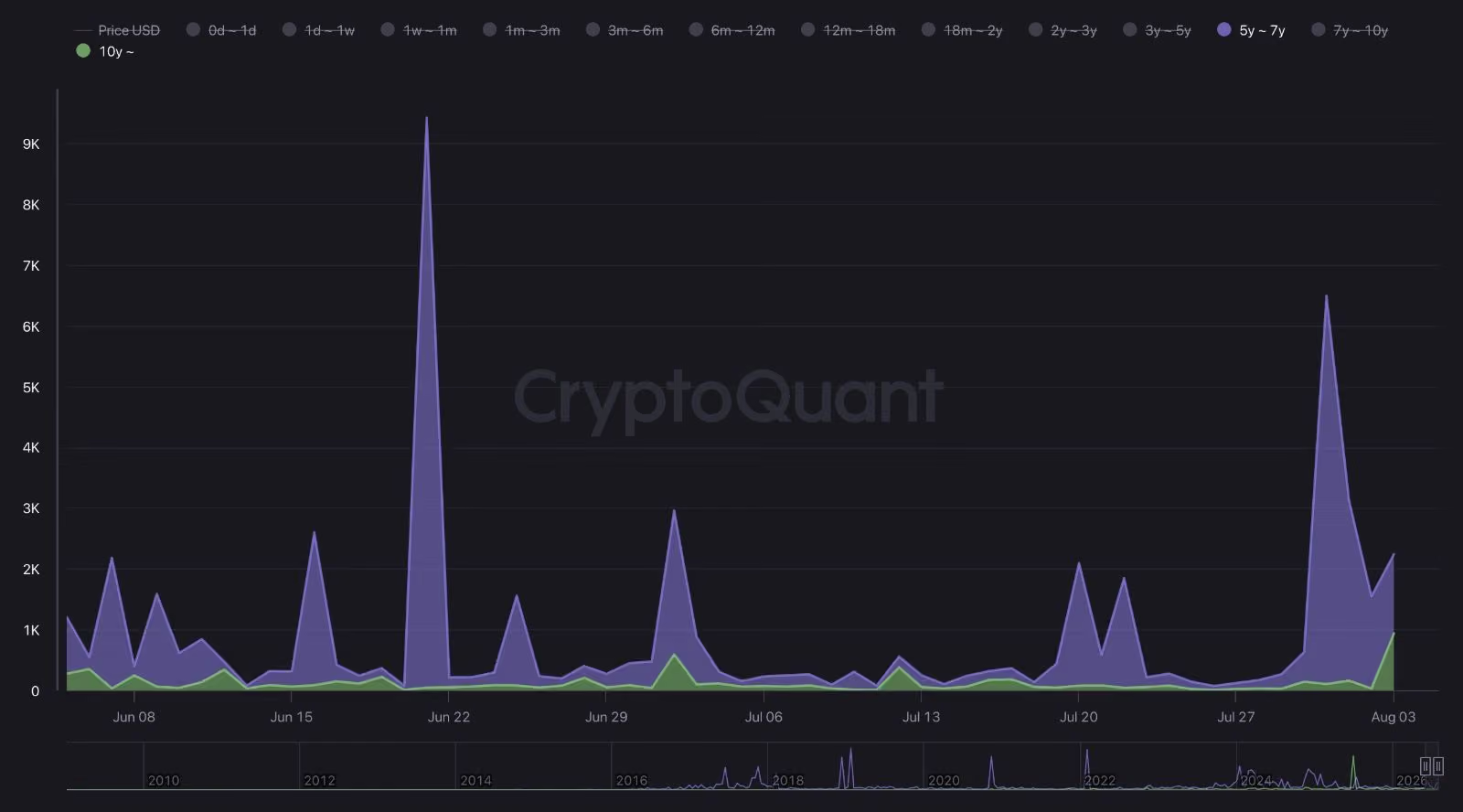
On-chain data from CryptoQuant tracking the so-called spent output age bands, an indicator which groups all bitcoin moved on a given day by how long each coin had sat dormant before being spent, reveals a clear spike in old-coin movement around the same window.

Coins that had been dormant for 10 years or longer saw roughly 935 BTC move on Aug. 3, the largest single-day total since March 20. Separately, coins dormant for five to seven years saw a much larger spike, with roughly 6,388 BTC moving on July 31.
Old coins move for all kinds of reasons, such as estate transfers, exchange consolidations, custodial migrations that have nothing to do with any single hack.
But the clustering of large, long-dormant movements in the days immediately following the Coldcard incident gives the impression of holders proactively migrating funds for security reasons.


Tom Lee’s BitMine Immersion Technologies staked another 150,120 Ethereum (ETH) tokens, worth roughly $278 million. The move deepens one of the largest corporate bets on Ethereum’s proof-of-stake network.
Blockchain analytics account Lookonchain flagged the transaction hours after it happened on August 4. It lifts BitMine’s total staked ETH to 5,067,309 tokens, worth about $9.38 billion. That figure equals 87.4% of the company’s entire ether stack.
Why Staking This Much Signals Conviction
Staking locks tokens into Ethereum’s validator network instead of leaving them idle in a wallet. Validators earn rewards for helping secure the chain. In exchange, they accept withdrawal queues and full price exposure for as long as the tokens stay locked.
A company that stakes nearly nine-tenths of its holdings is not hedging. It is committing to hold the position for years rather than trade around short-term price swings.
BitMine runs its staking through the Made in America Validator Network (MAVAN), an institutional platform the company built to generate yield on its own Ethereum treasury. It eventually plans to open MAVAN to outside clients too.
An Ethereum ‘Supercycle’
Chairman Tom Lee, who also co-founded research firm Fundstrat, has repeatedly framed the buildup as a wager on a multiyear “supercycle” for Ethereum.
The timing fits a broader institutional tilt toward ether. Ethereum ETFs recently posted their best month since October 2025, even as Bitcoin funds kept bleeding assets. BitMine’s own stock has rallied on the strategy, as investors reward the treasury bet.
Staking nearly 90% of a multibillion-dollar position leaves little room to reverse course quickly if sentiment turns. Ethereum needs to keep attracting institutional demand for that bet to pay off. BitMine has staked its balance sheet on exactly that outcome.
The post BitMine Stakes 87% of Its Ethereum Holdings in Fresh Conviction Bet appeared first on BeInCrypto.
Blockchain Association sent Senate Majority Leader John Thune and Minority Leader Chuck Schumer an eight page response on Aug. 3, disputing the National Sheriffs’ Association’s objections to the latest CLARITY Act draft.
Summary
- Blockchain Association says the CLARITY Act regulates intermediaries while protecting developers who lack asset control.
- The group says registered crypto brokers, dealers and exchanges would face Bank Secrecy Act duties.
- Section 10604 protects noncontrolling developers but leaves criminal money laundering and sanctions laws fully intact.
- The bill authorizes $600 million yearly for digital asset investigations from fiscal 2027 through 2031.
- Senate leaders ended Monday without scheduling CLARITY, while continuing resolution business occupied the floor instead.
The trade group argued that the July 22 Senate text does not give decentralized finance platforms, software developers, mixers or bridges a “blanket exemption” from anti money laundering and sanctions laws. It said the bill separates financial intermediaries that control assets or transactions from developers who only create neutral software.
The exchange arrived during a narrowing legislative window. The Senate ended Monday without acting on H.R. 3633. It invoked cloture on a continuing resolution vehicle and scheduled further work on that measure for Tuesday, leaving the market structure bill without a publicly announced vote.
CLARITY Act dispute turns on who controls transactions
The sheriffs’ group told Senate leaders on July 31 that the bill’s developer protections were too broad and could make financial crime investigations harder. Its attachment argued that Congress should regulate “everyone who receives revenue” from the digital asset marketplace and asked lawmakers to remove or narrow Section 10604.
Blockchain Association rejected that approach. It said revenue alone does not determine whether a person is a financial institution under the Bank Secrecy Act. FinCEN’s 2019 guidance says money transmitter status depends on a business model’s facts and circumstances. FATF guidance also focuses on whether a person performs covered financial functions for another party.
According to the association, brokers, dealers and exchanges registered or required to register under the bill would face anti money laundering programs, customer identification, suspicious activity reporting, recordkeeping and sanctions compliance. The sheriffs’ group disputes whether the framework reaches enough participants.
Developer protections leave criminal laws in place
Section 10604 would protect a noncontrolling developer from being treated as a money transmitting business merely for creating software, offering self custody tools or supplying infrastructure. To qualify, the person must lack the legal right and unilateral ability to control transactions involving users’ assets.
The Blockchain Association said the provision leaves laws covering money laundering, wire fraud, sanctions violations, terrorism financing, conspiracy, theft and aiding and abetting intact. A developer who knowingly handles criminal proceeds, controls customer funds or assists an offense could still face prosecution, according to the letter.
The draft also directs the SEC, working with Treasury, to write rules for people controlling protocols that are decentralized in name but perform intermediary functions. The association said this answers claims that controlled platforms could avoid oversight by calling themselves DeFi.
Law enforcement groups remain divided
The dispute does not represent one law enforcement position. Blockchain Association cited support from the Fraternal Order of Police, the National Organization of Black Law Enforcement Executives, the Major Cities Chiefs Association and the Federal Law Enforcement Officers Association. Major County Sheriffs of America is neutral, while 160 former law enforcement, intelligence and national security officials previously urged Senate action.
In related coverage, crypto.news examined how the law enforcement divide centers on developer protections and investigative authority. Supporters view a control based standard as necessary to avoid treating software writers like banks. Critics argue broad language could make responsible parties harder to identify when illicit funds move through decentralized systems.
The July 22 draft proposes $600 million annually from fiscal 2027 through 2031 for state and local digital asset investigations and prosecutions. It would fund training, blockchain analytics and a Digital Asset Cyber Innovation Center. FinCEN would receive another $30 million annually for five years.
Senate calendar leaves no CLARITY vote scheduled
The latest verified Senate floor update shows the chamber adjourned Monday after invoking cloture on H.R. 6500 by an 89 to 4 vote. Senators were due to resume that continuing resolution vehicle Tuesday. The official update did not list H.R. 3633 or announce a CLARITY Act cloture filing.
As crypto.news previously reported, an ordinary cloture filing by Wednesday, Aug. 5 could preserve a possible Friday procedural vote. This timing follows Senate Rule XXII rather than a leadership commitment. A petition requires at least 16 signatures, while ending debate on legislation normally requires three fifths of senators duly chosen and sworn.
Even a successful motion to proceed would not pass the bill. Senators would still need to debate the text, consider amendments and approve final passage. Any Senate changes would also require House approval before the measure could reach the president.
The Senate calendar places its state work period from Aug. 10 through Sept. 11. Leaders could still negotiate faster action or extend floor time, but no arrangement had been announced by Monday’s adjournment. The next confirmed signal would be a cloture filing, leadership notice or formal scheduling agreement.

Could heatwaves make your supermarket shop more expensive?

Boltz halts swaps as AI attacks outpace its team

Behind the scenes of the Hong Kong leg of Man City tour – rocky arrival, Maresca bonus and Silva surprise


-

 Business5 days ago
Why Trees Belong on the Risk Register
-

 Fashion4 days ago
Weekend Open Thread: Wit & Wisdom
-

 Politics3 days ago
Meta enters AI-training agreement with far-right ‘propaganda rag’ Newsmax
-
 Entertainment6 days ago
‘Stargate’ Creator’s New Sci-Fi Series Returns for Season 3 Tomorrow
-

 Crypto World3 days ago
MicroStrategy Post-Earnings CLARITY Act Push Could Add New Catalyst for Its Stock
-

 Politics7 days ago
The Part of the Electric Transition Nobody Wants to Discuss
-

 Business6 days ago
Major shareholder moves on Canyon
-

 Crypto World3 days ago
XRP Ledger v3.3.0 brings five institutional features
-

 News Videos5 days ago
Bitcoin Enters the 3rd Stage of the Bear Market
-

 Crypto World6 days ago
Kraken Enables Retail Access to Jersey Mike’s IPO via Tokenized Shares
-

 Politics6 days ago
Reform UK betrays West Mids residents by running from party pledges
-

 Politics5 days ago
Luke Littler’s dominance sparks GOAT debate
-

 News Videos6 days ago
Claude: Build Financial Dashboards in Minutes (2026)
-

 Sports4 days ago
Seema Kaliramna Wins Discus Throw Bronze, Takes India’s CWG Medals Tally To 17
-

 Crypto World3 days ago
New York sues Kalshi over prediction market gambling
-

 Business6 days ago
Johnson & Johnson agrees to $5.5B settlement over talc cancer claims
-

 Crypto World2 days ago
Crypto PAC spending tops $2M in Michigan House race
-

 Business4 days ago
Trump Announces Hamas Disarmament Agreement as Iran Strikes Kuwait Air Base and US Attacks Pause Overnight
-

 Tech6 days ago
Gemini can now summarize the messiest comment threads in Google Docs
-

 Tech2 days ago
ESET tracks rise in malicious AI skills and adaptable malware
You must be logged in to post a comment Login