
Entertainment
‘Twin Peaks’ Officially Returns With Its Original Cast in a Big Way

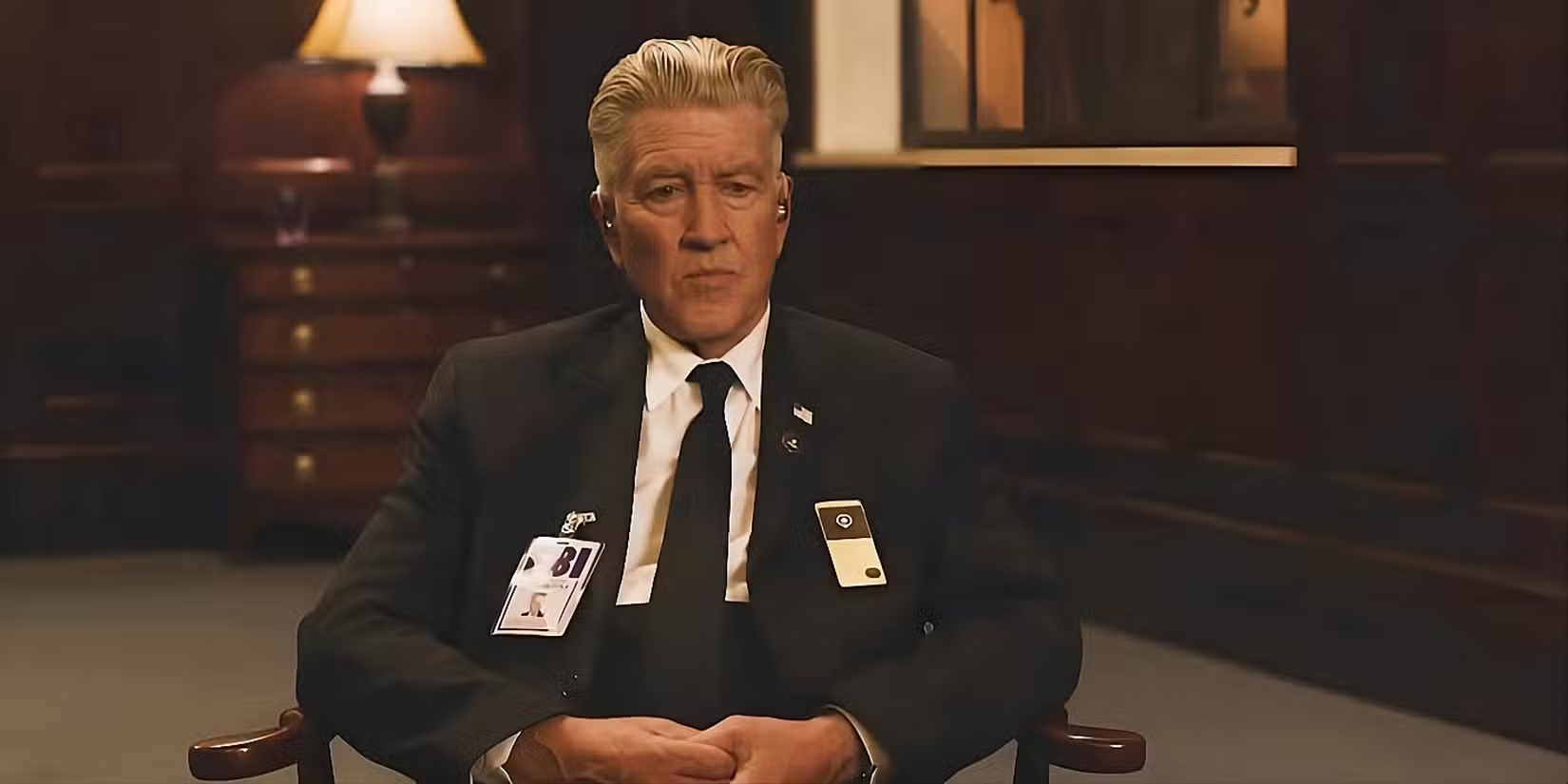
For most television shows, the end is easy to define. The finale airs, the cast moves on, and years later, fans gather for the occasional reunion panel to reminisce about what once was. Twin Peaks has never worked like that. More than three decades after David Lynch and Mark Frost first introduced audiences to the town of Twin Peaks, the series is still creating entirely new experiences for the people who love it. That’s what makes the newly announced David Lynch birthday celebration in Los Angeles so remarkable. On the surface, it’s a reunion featuring many of the show’s original stars. In reality, it’s proof that Twin Peaks has evolved beyond a television series into something much harder to define: a living community sustained by the people who made it, the fans who continue embracing it, and the creative legacy Lynch left behind.
The David Lynch Birthday Celebration Is More Than a Cast Reunion

Taking place on January 20, 2027, at the United Theater on Broadway in Los Angeles, the celebration reunites Sheryl Lee (Laura Palmer), Ray Wise (Leland Palmer), Michael Horse (Deputy Hawk), Dana Ashbrook (Bobby Briggs), Kimmy Robertson (Lucy Moran), Harry Goaz (Andy Brennan), and Twin Peaks: The Return executive producer Sabrina S. Sutherland for an evening dedicated to both the series and the filmmaker who made it possible. Fans can expect cast conversations, behind-the-scenes stories, live musical performances, autograph sessions, VIP photo opportunities, and an after-show gathering with the guests. The evening will also feature a tribute celebrating Lynch’s life and work.
Individually, none of those activities are especially unusual. Television reunions happen all the time, but it’s the combination that makes this event different. This isn’t an evening built around replaying favorite scenes or celebrating a milestone anniversary. Instead, it recreates the experience that has kept Twin Peaks alive for decades. Fans will be talking with the people who made the show they love rather than just rewatching it, listening to the music that defined it, sharing the experience with hundreds of other fans, and collectively celebrating the artist whose imagination made all of it possible.
‘Twin Peaks’ Doesn’t Survive Because People Rewatch It

Plenty of classic television series remain popular because people continue streaming them, while Twin Peaks has endured because people have continued building a culture around it. No matter how many years pass, Twin Peaks fans continue to introduce the series to new viewers, creating new debates about the symbolism that they continue to take part in as they revisit the series. They travel to attend conventions and retrospective screenings or to visit filming locations, where they then spend hours discussing scenes that still refuse to offer definitive answers. The cast has become part of that culture, too. Instead of distancing themselves from a project they completed decades ago, many of the performers have continued showing up for fans through conventions, interviews, festivals, and special events. Their relationship with Twin Peaks didn’t end when production wrapped and, in many ways, it evolved alongside the audience’s own relationship with the series.
That ongoing connection is what separates Twin Peaks from so many other influential shows. The series no longer exists only as the episodes Lynch and Frost created. It also exists in the conversations that continue to be sparked, in the friendships built through a shared love of the show, and in events like this one that give fans another opportunity to celebrate something that holds such a special place in media history for so many people.
Lynch’s death last year understandably changed the way fans think about the future of Twin Peaks. Whatever stories remained untold now seem destined to stay that way. Yet this celebration makes something equally important clear: Lynch’s greatest creation never depended solely on new episodes to continue to live on. One of the evening’s defining moments will undoubtedly be its tribute to Lynch, but placing that tribute alongside conversations with the cast, live music, and direct fan interaction says something powerful about the legacy he leaves behind. His work is doing more than being memorialized in a museum or reflected upon in a retrospective, because it’s still bringing people together. That may be the most remarkable thing Twin Peaks has accomplished.
More than three decades after it premiered, the series continues creating new memories instead of simply asking audiences to relive old ones. Fans who attend this celebration will leave with entirely new stories connected to the series, whether that’s hearing Wise recall an unforgettable day on set, listening to the music performed live, meeting Lee for the first time, or simply spending an evening surrounded by hundreds of people who understand why this strange little town has never been easy to leave, and that’s how communities survive. Television shows eventually become history, but communities continue growing. The upcoming David Lynch birthday celebration is proof that Twin Peaks has become the latter.

- Release Date
-
1990 – 1991-00-00
- Directors
-
Lesli Linka Glatter, Caleb Deschanel, Duwayne Dunham, Tim Hunter, Todd Holland, Tina Rathborne, Diane Keaton, Graeme Clifford, James Foley, Jonathan Sanger, Mark Frost, Stephen Gyllenhaal
- Writers
-
Mark Frost, David Lynch, Harley Peyton, Robert Engels, Barry Pullman, Scott Frost, Tricia Brock

Continue Reading
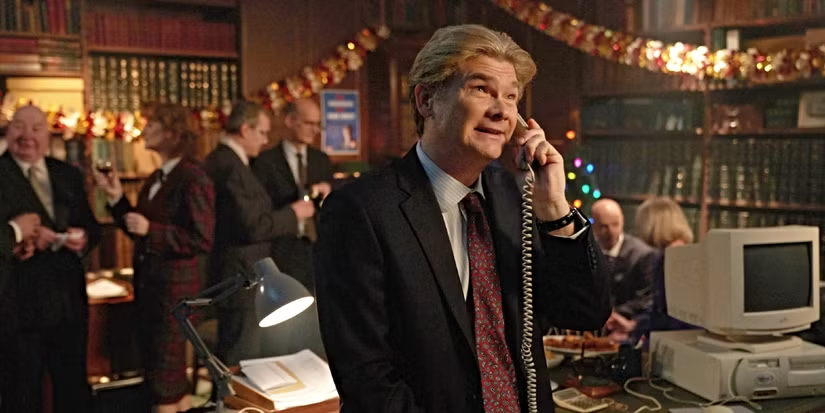
The original Ghosts is coming back one last time, and for once, a TV movie feels like exactly the right idea. Ghosts: The Possession of Button House reunites the creators, writers, and cast behind one of Britain’s funniest sitcoms for a feature-length adventure arriving this October. After five seasons and a Christmas finale that gave the series a satisfying sendoff, there’s room for one more visit to Button House.
That doesn’t mean every version of Ghosts should follow suit. The CBS adaptation has become one of network television’s most reliable comedies in its own right, but it’s also in a completely different place creatively. While the BBC series is returning after a deliberate ending, the American version is still building new stories, expanding its mythology, and finding fresh combinations for its ensemble. A movie would feel like it was trying to keep up with the original.
The BBC’s Movie Feels Like a Reunion, Not a Franchise Obligation

One reason the British film immediately feels justified is the people making it. Ghosts was never the product of a rotating writers’ room chasing the next season. It came from the comedy troupe behind Horrible Histories and Yonderland, with Mathew Baynton, Simon Farnaby, Martha Howe-Douglas, Jim Howick, Laurence Rickard, and Ben Willbond writing the series while also playing many of its most memorable ghosts. That same creative team is returning for The Possession of Button House, making the film feel less like a corporate extension of a successful brand and more like old friends getting the band back together.
Plenty of television shows outstay their welcome because they keep going even after their stories have already ended. Ghosts did the opposite. It bowed out on its own terms, giving Alison (Charlotte Ritchie), Mike (Kiell Smith-Bynoe), and the residents of Button House a heartfelt farewell before stepping away. A movie now is simply revisiting that ending.
The American Series Still Works Best as a Weekly Sitcom

CBS’s Ghosts doesn’t need that kind of encore because it hasn’t reached its finale. With another season on the way and more already planned, the American adaptation is still introducing characters, developing relationships, and expanding the rules of its supernatural world. Pete’s (Richie Moriarty) ability to travel beyond the property, Alberta’s (Danielle Pinnock) murder mystery, Isaac’s (Brandon Scott Jones) romance, Jay’s (Utkarsh Ambudkar) restaurant, Trevor’s (Asher Grodman) family, and the show’s ever-growing collection of ghosts all point to a sitcom that’s still finding new stories inside its premise.
Both versions revolve around people from wildly different eras being forced to share the same house, but the comedy rarely comes from enormous supernatural events. It comes from arguments over chores, awkward dinner parties, weddings gone wrong, business problems, and centuries-old personalities refusing to compromise. The ghosts are eccentric roommates who happen to be dead, and stretching that formula to feature length risks solving a problem the series doesn’t actually have.
Possession Isn’t Enough To Justify a Feature Film

The British movie’s title naturally raises questions about possession, and it’s easy to imagine the American version borrowing a similar idea if it ever headed to theaters. The problem is that CBS has already explored that territory, as possession has appeared multiple times throughout the show’s run, particularly during its holiday episodes, so building an entire movie around that concept wouldn’t feel like a major evolution. Bigger stakes don’t automatically make a better Ghosts story, especially when the series has consistently delivered its funniest episodes through smaller, character-driven conflicts.
A feature film also creates pressure to justify its own existence. Suddenly, there has to be a threat larger than anything seen on television, a mystery grander than any in previous seasons, or emotional stakes that somehow top everything before it. The charm of Ghosts has always been watching centuries of history collide over everyday inconveniences. Trying to inflate that formula could easily strip away the intimacy that makes the sitcom so consistently funny. The BBC version has earned the chance to say goodbye one more time because it already knew how to say goodbye once. The CBS series hasn’t reached that point, and that’s a good thing. It’s still one of broadcast television’s strongest ensemble comedies because it isn’t running on nostalgia. Every season adds another relationship, another piece of ghost lore, or another reminder that the mansion is full of people whose stories are far from over.
If the American adaptation eventually reaches a natural conclusion years from now, maybe a reunion movie will make just as much sense as Button House’s final adventure. Right now, though, it would feel less like an organic continuation and more like an attempt to mirror the original’s next move. The British Ghosts deserves one last haunting because it finished the story first. The American version should keep doing what it already does better than almost anyone else on network television: inviting viewers back every week instead of asking them to buy a movie ticket.

The fantasy genre continues to thrive in the 2020s, especially in the realm of literature. Great books keep coming out, many of them indebted to the classics and many breaking new ground through inventive worldbuilding, compelling characters, rich prose, and exhilarating action. Still, some books are better than others, that much is true, and in the last decade or so, no fantasy book has been better than The Will of the Many.
Written by Australian author James Islington, The Will of the Many is fantasy on a truly epic scale. The worldbuilding borrows from the real-world Roman Republic to construct its dystopian vision, and the result is truly fascinating. Powered by Islington’s detailed, evocative, atmospheric prose, a complex but creative power system, and one of the most intriguing and layered protagonists we’ve seen in a minute, The Will of the Many is a genuine treat for fantasy lovers that ranks among the best genre books of the 21st century.
What Is ‘The Will of the Many’ About?
The Will of the Many is set in a world reeling from a devastating cataclysm that took place 300 years before the start of the story. Over the last century or so, the Catenan Republic has conquered most of the known world using technology from the ancient civilizations. The Hierarchy is a structure that uses people’s physical and mental energy, known as Will. The structure ranges from the Octavi, the lowest class where each individual cedes half of their Will and receives none in return, to the Princepts, the upper echelon that benefits from the Will of about 400 men and cedes none of it.
Our story centers on Vis, a tortured teenager of about 17 and a runaway hiding in the Catenan Republic, working in the brutal prisons while living in an orphanage. To save money, Vis also participates in underworld fights, hoping to escape from the Hierarchy altogether. One fateful night, he attracts the attention of Magnus Quintus Ulciscor, a powerful Senator who offers Vis a chance to not only escape his situation but also potentially, albeit eventually, evade having to cede any of his Will. Thus, Vis embarks on a dangerous assignment that will throw him into a world of conspiracy and danger. That’s the gist of it, at least without giving any major plot points away, and believe me, there’s a lot to give away regarding Ulciscor’s motives and Vis’ backstory.
‘The Will of the Many’ Has the Best Worldbuilding in Modern Fantasy

From the get-go, what traps you about The Will of the Many is Islington’s intricate and careful worldbuilding. The author opts for a slow and deliberate approach, introducing new bits of lore as the story progresses rather than doing it all at once. Yes, there are a few info dumps, especially in the early chapters, but it’s understandable: the world that Islington is building here is layered, made up of several moving parts, each with a specific reason behind it. Crucially, it’s never complicated to understand; even at its most technical, the worldbuilding of The Will of the Many is compelling and, above all, interesting.
By dosing the details of the Hierarchy’s larger operation and institutions, Islington compels you to learn more about its dynamics and subtleties, questioning its many moving parts and where they fit in Vis’ overarching story. For example, from early on, you know there’s a Senate, but you don’t get to see it or learn of its purpose until well past the book’s first act. Similarly, you discover the existence of a rebel group, but its motives and role in the plot don’t become clear until halfway through the book. This approach also fits thematically, as the book raises questions about the nature of oppression and what people are willing to accept and ignore in favor of a sense of belonging.
The inspiration in the Roman Republic also makes The Will of the Many stand out above the many other great fantasy books out there. The Republic laid the foundation for so much of contemporary civilization, so it’s actually kind of shocking that few previous books have used it as an inspiration. Here, Islington embraces the visual language of what we commonly relate to the Republic — columns, pillars, togas, tunics, specific constructions, and even gladiators — with the tropes and archetypes typical to its organization — titles, an emphasis on military and religion, and heavy inequality.
Lastly, there’s the book’s main gimmick and attraction: the Will, Islington’s equivalent of magic that adds the more mystical aspect of what would otherwise be a tense political thriller. The idea of Will is not only creative but suitably ruthless for this unforgiving world. It’s not exactly magic per se; rather, it features aspects of science through the Aurora Columnae, the pre-Cataclysm artifacts that allow people to cede their Will. On a certain level, Will also adopts conventions from the superhero genre — not by using traditional notions of good-versus-evil but rather in the way it’s used and the numerous applications it can have.
‘The Will of the Many’ Is Epic Fantasy Done Right

The Will of the Many is probably the most creative and atmospheric fantasy novel of the last decade. The plot itself is quite riveting, offering a classic coming-of-age tale against a background of political intricacies, lies, and changing allegiances — think of it as John Le Carré meets Rome with a dash of Prince of Thorns and a hint of The Secret History. It’s such a unique mix of elements that shouldn’t work in theory, and the fact that Islington managed to pull it off is nothing short of spectacular considering how easily it could’ve failed; just ask Francis Ford Coppola.
If you’re a lover of political fantasy in larger-than-life worlds that defy the imagination, then The Will of the Many is the book for you. The plot is streamlined but detailed and atmospheric, and Vis is an intriguing protagonist with a rich inner world that’s often in conflict with his ruthless surroundings. Few fantasy novels, much less movies or TV shows, of the last decade come close to the level of bold creativity here. There’s already a movie adaptation in the works, but as we all know, the book is almost always better.
Entertainment
‘True Detective’ Meets ‘Supernatural’ in This 33-Year-Old Classic Sci-Fi Thriller Series
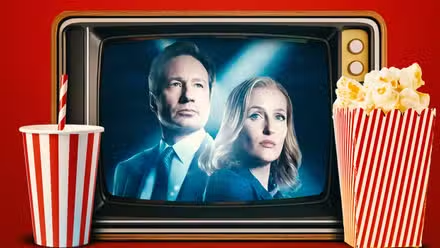
In the streaming age, traditional TV dramas have embraced all genres, with dark, gritty detective shows and supernatural thrillers among the most popular. Since the anthology series’ debut, True Detective has been lauded as one of the best shows of recent years, with the first season starring Matthew McConaughey and Woody Harrelson being widely regarded as one of the greatest seasons of television ever. Elsewhere, Supernatural, starring Jensen Ackles and Jared Padalecki, with its 15-season run, embraced the monster-of-the-week formula, building a massive fanbase along the way. While both of these shows are successful in their own right, one popular series that premiered before them and feels like a combination of the two helped pave the way: The X-Files.
Helping to launch the mainstream careers of Gillian Anderson and David Duchovny, The X-Files brings the moody, noir investigations, philosophical themes, and sense of dread of True Detective and combines them with the paranormal stories of Supernatural and creates something truly memorable. More than 30 years after it first debuted, The X-Files remains one of the most popular and influential series ever made, and the perfect watch for anyone looking to scratch that sci-fi thriller itch. With a reboot from Ryan Coogler on the way, there’s no better time to watch.
‘The X-Files’ Is a Detective Series Before It’s Science Fiction
Despite its sterling reputation as a pillar of science fiction, The X-Files works best as a detective show. With nearly every episode beginning with a mysterious disappearance, murder, or unexplained phenomenon, Mulder and Scully are brought in to investigate after the local authorities cannot crack the case. As members of the FBI’s X-Files division, they investigate cases that seem impossible to explain, which are often supernatural in nature. Much like True Detective, The X-Files tackles not just criminal investigations but also much larger questions about faith and morality. These themes are anchored by a pair of detectives with opposing ideas of right and wrong.
The opposing philosophies of Mulder and Scully help elevate every case, taking it beyond a police procedural. As part of a larger narrative about alien life, Mulder is keen to believe in the extraordinary, while Scully insists every mystery has a logical solution. Some of the more memorable moments of True Detective were the discussions between Rust Cohle and Marty Hart, with their style mirroring Mulder and Scully in many ways. Cohle looks beyond the rational, while Hart is more grounded. The X-Files knew that developing their detective characters and refining how the investigations unfold was of the utmost importance even before showcasing what that week’s villain would be.
‘The X-Files’ Perfected the Monster-of-the-Week Formula
While True Detective took inspiration from Mulder and Scully, Supernatural embraced the Monster-of-the-Week episodic strategy that The X-Files perfected. As a part of The X-Files‘ overarching narrative of government conspiracies and alien invasion, Mulder and Scully would investigate mysterious and paranormal happenings including shape-shifters, parasitic creatures, curses, and ancient legends. Every week brought forth a new nightmare for the audience. It’s easy to see how comparisons to Supernatural became impossible to ignore.
Like Sam and Dean Winchester, Mulder and Scully’s cross-country travels investigating the impossible became part of both shows’ charm. Every town hides a new horror, every abandoned building conceals a mystery, and every episode continues to build on the shows’ rich lore. However, the major difference between the two shows is in the perspective. The X-Files leans heavily on the mystery of the causes, with Mulder believing the weird and Scully remaining cautious. On Supernatural, Sam and Dean know that evil lurks everywhere; they expect to encounter the strange every episode. On the other hand, The X-Files proves that the mystery of what lies in the dark is part of the terror. Not knowing what the reason behind the “monster-of-the-week” only heightens the tension and ups the horror.
It’s difficult to overstate the influence that The X-Files has had on modern television. It’s not just True Detective and Supernatural that have taken hints from it, but other series like 24, Fringe, Evil, and numerous others have utilized the roadmap that The X-Files created. It’s especially relevant in the modern TV landscape, given that conspiracy and mythology-heavy narratives on television have become more popular. While this storytelling style didn’t begin with The X-Files, the series showed that horror television could be smart without sacrificing entertainment.
Fans of True Detective will appreciate those haunting investigations and existential themes, and Supernatural fanatics will immediately latch onto the monster-of-the-week narratives. Both series feel like descendants of The X-Files, a show that continues to stand the test of time years since it went off the air.

- Release Date
-
June 19, 1998
- Runtime
-
121 minutes
- Director
-
Rob Bowman
-

-

-

Mitch Pileggi
Assistant Director Walter Skinner
-

William B. Davis
The Cigarette-Smoking Man

Taylor Swift’s homemade sourdough left an impression on Tate McRae before she even took a bite. The “Sports Car” singer revealed that Swift previously sent her a freshly baked loaf, continuing the pop superstar’s growing tradition of gifting bread to her famous friends. However, it was not only the sourdough that caught McRae’s attention. The entire basket smelled so good that it left her wondering what perfume Swift wears.

Tate McRae and Justin Bieber reportedly headed to the private Manhattan club following the New York Knicks’ historic Game 4 victory. The pair spent the evening socializing with Swift, Sombr and sisters Este, Danielle and Alana Haim. By that point, McRae had already received one of Swift’s increasingly famous homemade sourdough loaves.
“The basket smelled amazing,” McRae told Variety, leaning forward as though she was sharing a secret. “I don’t know what perfume she wears, but I was like, ‘She must smell incredible.’”
McRae did not identify the fragrance or confirm whether the scent came directly from Swift’s perfume, the bread, or something else included in the basket. The gift nevertheless offered another glimpse into Swift’s habit of using baking to connect with the people in her inner circle. Swift has also reportedly baked for Sombr, the Haim sisters, and Selena Gomez.
Taylor Swift Says Sourdough Has ‘Taken Over’ Her Life

Fans learned more about Swift’s passion for baking during her August 13, 2025, appearance on “New Heights,” the podcast hosted by Travis Kelce and his brother, Jason Kelce.
Travis opened up about seeing the singer’s interests at home, including the hobby that had begun occupying a considerable amount of her time. “It’s been so fun to see what Taylor actually gets into around the house,” the Kansas City Chiefs tight end said.
Swift admitted that bread had become one of her most frequent conversation topics. “I’m really talking about bread 60% of the time now,” she joked.
Her baking experiments have reportedly included traditional sourdough, blueberry lemon, cinnamon swirl and cinnamon raisin varieties. “We’re very deep in a sourdough obsession that has taken over my life,” Swift said.
The singer acknowledged that her culinary interests tend to rotate, admitting she has “a different baking obsession every six months.” That prompted an appreciative response from Kelce, who declared, “I am the luckiest man in the world.”
Travis Kelce Supported Taylor Swift’s Baking Habit

Kelce later revealed that one of his most successful gifts to Swift was directly connected to her sourdough fixation. Rather than buying something flashy, the NFL star gave his future wife a practical tool that made it easier to enjoy her homemade creations. “I will say one of Tay’s favorite gifts that I got her was the bread slicer,” he shared.
Kelce joked that the appliance was necessary because of the amount of bread Swift had been making at home. “[I bought it] because she’s been throwing together so much f-cking sourdough,” he said. “Gosh, they’re the best gut healers. I love you, Tay.”
Tate McRae Attended Swift And Kelce’s Wedding

McRae’s friendship with Swift extended beyond bread baskets and celebrity nights out. In July, she joined the approximately 1,000 guests who watched Swift and Kelce exchange vows at Madison Square Garden in New York City. The superstar couple married on July 3 during an elaborate ceremony that brought together family members, musicians, actors and professional athletes.
Just weeks later, McRae returned to Los Angeles for another major sporting event, delivering the match ball at the opening of a FIFA World Cup game. She also attended Justin Bieber’s Skylrk World Cup party with Hailey Bieber following Spain’s title victory on July 19.
Hailey praised McRae’s ability to command attention as a performer while remaining grounded away from the stage. “I think she just stands out so distinctly,” Bieber said, per the Variety report. “You can’t help but want to listen and watch her. She works her a-s off. She’s making a clear mark.”
The model added that McRae’s personality makes her equally memorable in private. “Tate is as sweet as they come. I may be biased when I say I love a Canadian,” like her husband, “but I really do. She is salt of the earth, grounded and always fun to be around.”
Panera Celebrated Taylor Swift’s Wedding With Free Sourdough

Swift’s love of sourdough became part of the public celebration surrounding her marriage to Kelce. Days after their Madison Square Garden wedding, Panera announced a limited promotion called “The Loaf Story.”
On July 9, participating restaurants offered 13 complimentary sourdough loaves on a first-come, first-served basis. Only 13 were available at each participating location. Customers could also receive free bread-themed stickers featuring “cheeky loaf-inspired sayings.”
The promotion played off both Swift’s baking hobby and the massive attention surrounding her wedding. “Panera knows all too well that no loaf story is complete without sourdough,” the restaurant chain said in its release.
Between Kelce’s bread slicer, Panera’s giveaway and McRae’s fragrant gift basket, Swift’s sourdough obsession has continued to make headlines.

Get a rundown of Us‘ top stories making headlines in celebrity news, sports and entertainment on August 3, 2026. Here are the key takeaways:
• Stassi Schroeder addressed TikTok rumors regarding her husband Beau Clark‘s past financial issues and age discrepancies, replying in the comments that “a lot of people had to file for bankruptcy back then” and “yes we are both terrible.” The couple’s marriage challenges are front and center in their new Hulu series House of Stassi, in which Beau opens up about feeling detached and resentful.


• Alabama Barker fired back at body-shamers in a TikTok video, declaring she is “gonna get on the highest dose of Ozempic” and become “so skinny.” The daughter of Travis Barker and Shanna Moakler called the body-shaming “f***ing disgusting” as her followers rushed to defend her in the comments.
• Amy Schumer stunned in a white corset top and embellished shorts in a rare group photo with Friends stars Jennifer Aniston and Courteney Cox during a yacht day, shared on Instagram August 2. The comedian has been open about using GLP-1 medications to treat her Cushing syndrome diagnosis.
Edited by Samantha Benitz. Story produced with AI assistance
One of the greatest genres is the detective novel. People continue to read them and get into a new detective story, despite many critics and audiences declaring them exhausted once every few years. Every time we think we’ve read it all, the detective novel returns in a new coat, whether in the Nordic noir crime thriller format, an Agatha Christie homage format, or a procedural format that begins as a courtroom drama and ends up being a supernatural thriller.
The modern detective novels on our list span decades and continents, and they all present a case that is compelling on its own but is ultimately wrapped around detectives who will entice readers to follow them into any kind of mess they end up in. With these compelling detectives and their creators, you never know what they’re going to do next—or you’ve read enough about them to feel like you’ve known them forever. Here are modern detective books that are perfect from the first page to the last.
‘Watching You’ (2016)

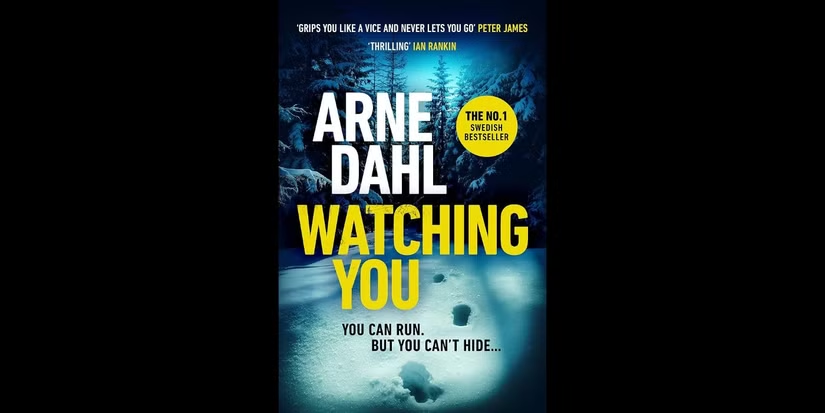
Every now and then, a crime writer decides that the ongoing series they’ve been gracing our eyes with is no longer what they want to write about—and opens the Word doc to write a brand-new series of even better works. That’s essentially what Jan Arnald, aka Arne Dahl, did with Watching You, the book that launched his Sam Berger series after years of directing the ensemble-driven Intercrime novels. In the first installment, Berger begins to receive messages that appear to be aimed solely at him, tiny metal cogs left at crime scenes linked to missing teenage girls. As more girls go missing, Berger must persuade his own department not to dismiss the cases as unrelated, all while an old wound from his early days on the force resurfaces at the worst possible time.
What makes Watching You so enjoyable is its lean, mean, and more akin to hard-boiled American noir style than the procedural sprawl of his previous work, and it seems as if it knows exactly what kind of tension it’s creating. This is an introduction to Berger and his eventual partner, Molly Blom, one of Nordic noir’s most quietly compelling duos, and the kind of first chapter that makes you eager for the sequel. Dahl writes the Berger & Blom novels in the style of a movie, with close-up shots, tense storytelling that feels like he’s editing a film on the fly, and just enough introspection to make readers feel like they’re right there with Sam Berger and Molly Blom.
‘The Snowman’ (2007)

Jo Nesbø‘s seventh Harry Hole novel, The Snowman, features a brilliant, alcoholic character—Harry Hole—who is allergic to authority and happiness, making him one of crime fiction’s greatest walking disasters. The Snowman may be known to wider audiences because of its (disastrous) adaptation into a film starring Michael Fassbender; the novel deserved more, because it’s genuinely a great detective book. In The Snowman, Harry Hole connects the disappearance of a woman to a taunting letter addressed to him personally and then to a decade-long pattern of women disappearing on the first snowfall of the season.
The book’s genius is more than just the atmosphere, which does a lot of heavy lifting, with all the Norwegian winter darkness pressing in around every scene. It’s also that the killer views the entire situation as a private game with Harry, breaking his own carefully constructed pattern solely to keep his opponent off guard. Nesbø has openly credited Michael Connelly‘s Harry Bosch as a formative influence on Hole, and The Snowman is the book where that lineage pays off hardest, pairing genuinely upsetting set pieces with a detective whose slow-motion collapse feels just as urgent as the murders he’s pursuing.
‘In the Woods’ (2007)

Few book openings in the genre are as unsettling as this one: in 1984, three children go into the woods outside a Dublin suburb, and only one returns, clutching a tree trunk, blood-soaked, and unable to recall a single second of what happened. Twenty years later, that survivor, Rob Ryan, works as a detective in the Dublin Murder Squad and has never revealed his true identity to anyone. When a twelve-year-old girl is found murdered in the same woods, Ryan and his partner, Cassie Maddox, are called in, and Ryan is forced to work a crime scene that is also, quietly, the site of his own unresolved trauma.
Tana French isn’t interested in providing a tidy solution to the childhood disappearance that opens In the Woods, and she never does. For nearly two decades, readers have been divided on this choice, with some seeing it as a genuinely brave statement about the unreliability of memory and others feeling as if the rug was pulled out from under them. In the Woods is the first novel in the Dublin Murder Squad series, but it’s this first novel that emphasizes Ryan and Maddox’s partnership, making it one of the most emotional and pulling-in in the genre. If you’re a fan of unreliable narrators and procedural novels, this one’s a (hidden) treasure.
‘Bluebird, Bluebird’ (2017)

Bluebird, Bluebird, by Attica Locke, begins with a man, Darren Mathews, arriving in the small town of Lark, Texas, in truly bad shape. He’s been suspended from the Texas Rangers and estranged from his wife, and his drinking habits are worsening with each sip. After a Black lawyer from Chicago and a local white woman are discovered dead within days of each other, Mathews, despite the fact that he is not supposed to be on the case, is unable to walk away from this murder; it’s the kind of case that comes with the specific racial history of the place he grew up trying to escape.
Locke is a Texas native and a writer on When They See Us and Little Fires Everywhere, and she built this novel around Highway 59, a road her own family actually traveled, winning both the Edgar Award and the Anthony Award. And for good reason: Bluebird, Bluebird never views its whodunit plot and social conscience as competing interests. The mystery is solved with great satisfaction, but what remains is Mathews himself, a Black lawman working within a system that was never designed with him in mind, who continues to do the job regardless. This detective novel comes with layers of race, discrimination, and self-discovery, and Mathews could be a brilliant protagonist in a well-made detective film, soaked in the Texas sun and full of clever dialogue.
‘The Outsider’ (2018)

Stephen King‘s The Outsider appears to be a tight procedural at first, but it gradually reveals that it’s actually something a lot more sinister and even out of this world. Terry Maitland, a well-liked Little League coach, is publicly arrested by Detective Ralph Anderson for the brutal murder of an eleven-year-old boy. The arrest is supported by DNA, fingerprints, and eyewitness accounts that all point to Maitland’s presence at the scene. But an issue arises when it’s revealed that Maitland has a solid alibi, as multiple witnesses and video footage place him in a completely different city at the very moment of the crime. Reluctantly, Anderson brings in Holly Gibney, who was previously a supporting character in King’s Bill Hodges trilogy and is now finally getting her own moment in the spotlight as a private investigator.
King constructs the emotional core of the book around Anderson’s professional faith in hard evidence, watching a lifelong empiricist be dragged, kicking and doubting, toward a truth that defies every rule he’s built his career on. What begins as a rigorous “impossible alibi” mystery gradually reveals an entity feeding on life around it. It is both horror and detective fiction at the same time, and King does a remarkable job of balancing the two genres. If you had any doubts about King’s ability to write gripping detective fiction, The Outsider is proof—the HBO adaptation is every bit as good as the book, and Holly Gibney subtly establishes herself as a detective fiction mainstay.
‘Dead Lions’ (2013)

Dead Lions is Mick Herron‘s second Slough House novel, and it demonstrates that he isn’t writing a series as much as he is creating a world, specifically the bleakest corner of British intelligence anyone has thought to depict on the page—Slough House. It is where MI5 sends its failures: agents who have burned sources, had affairs with the wrong people, or simply become old and inconvenient. They’re called “slow horses,” and their primary function is to generate paperwork until they quit. Jackson Lamb, their leader, is a breathtakingly rude former field agent who may or may not be very dangerous and is the most compelling character in modern spy fiction.
Dead Lions revolves around an old Cold War ghost named Dickie Bow, who is discovered dead on a bus to Oxford in circumstances that appear to be a heart attack but, to Lamb, are something else entirely. Meanwhile, two Slough House agents are assigned to babysit a visiting Russian oligarch, a job that proves to be far less boring than expected. Herron writes with the passion of someone who has deeply internalized John le Carré, but Dead Lions hides something unique—a darkly comical heart that will make you laugh out loud and fall in love with the slow horses.
‘Magpie Murders’ (2016)

Magpie Murders is a small miracle in terms of structure: it features two complete mysteries being woven into one book, and both of them work perfectly. The first is a Golden Age-style whodunit, reportedly written by bestselling crime novelist Alan Conway, in which detective Atticus Pünd, a Holocaust survivor turned celebrated sleuth, solves two murders in the sleepy English village of Saxby-on-Avon. The second story follows Susan Ryeland, Conway’s real-life editor, who discovers that the manuscript’s final chapters, which reveal the killer, have gone missing, just as Conway himself is found dead in what appears to be a suicide.
Horowitz is a veteran mystery screenwriter, and he’s best known for Foyle’s War and Midsomer Murders, two of the most compelling mystery series on British television. Horowitz arranges his clues so that the two mysteries complement each other, implying that solving Conway’s death and Pünd’s fictional case are, cleverly, the same act that warrants paying attention. Magpie Murders feels like a heartfelt tribute to Agatha Christie that also successfully manages to be totally unique, showing that even the most worn-out area of the genre still has space for a truly brilliant trick.

Magpie Murders
- Release Date
-
2022 – 2022-00-00
- Network
-
PBS
- Directors
-
Peter Cattaneo
- Writers
-
Anthony Horowitz, Tim Morris

Emily Ratajkowski is all about a nude moment.
Ratajkowski, 29, showed off her curves while taking a nighttime dip via Instagram on Sunday, August 2. In the pic, the model stripped down to her birthday suit while posing on a rock in front of a body of water. She gave the camera a pout as she held a wine glass in front of her chest.
The Gone Girl actress went makeup-free in the pic and wore her brown hair, which was still wet from swimming, in an updo with strands poking out.
Elsewhere in her photo dump, Ratajkowski flaunted her bikini body in an orange suit featuring a white-and-black pattern. Her set featured triangle cups, which she tied tight enough to expose her underboob, and long straps that crisscrossed over her abs. Ratajkowski completed her look with string bottoms.

The Victoria’s Secret angel made her look even hotter with gold cuff bracelets and a coin necklace. For glam, she donned blush on the tip of her nose, black eyeliner, long lashes and lined lips. She parted her hair down the center and wore her mane down.
“julio/Ιούλιος/july,” she captioned the post. Her friends and fans went wild over her thirst trap in the comments section.

Emily Ratajkowski is ringing in the end of August with her best swimwear yet. The model, 34, proved to have no shortage of sexy looks while soaking up the sun on Monday, September 1. In a carousel of photos she shared via Instagram, Ratajkowski flaunted her bikini body and washboard abs, first posing in a […]
“🔥🔥🔥🔥🔥🔥🔥🔥🔥🔥🔥🔥,” Irina Shayk wrote, while Wildflower Cases cofounder Sydney Lynn Carlson added, “Mammaasaaacita.” One of her fans praised, “I loveeeeee vacation Emily.” Another gushed, “There is no summer without your summer posts ♥️♥️♥️.”
This isn’t the first time Ratajkowski has shown off her toned figure. In June, she went topless underneath a red crochet dress featuring long sleeves and a flowy skirt. She styled the piece with high-cut bikini bottoms.
While posing in the number, Ratajkowski shared a hilarious reel of herself tripping and falling off a stone wall. “Back on my favorite island (Mallorca!) and trying out some new ones too (🇬🇷)!” she captioned the post.
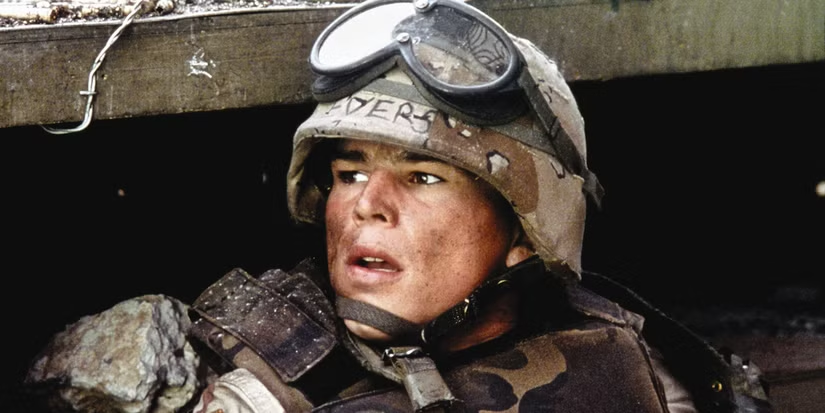
War cinema can lose its nerve in two opposite directions. Some films turn combat into clean hero worship. Others pile on misery until soldiers become symbols instead of people. The masterpieces stay close to the confusion. Orders clash with instinct, courage sits beside terror, and survival often depends on choices nobody should have to make.
These eight films understand that war changes shape depending on where a person stands. It can be a street full of gunfire, a muddy trench, or a bomb hidden under rubbish. None of them let the audience leave with an easy answer. Let’s figure why they’re widely regarded as masterpieces, and how we’ve chosen to rank them. Scroll down slowly.
8
‘Black Hawk Down’ (2001)

A United States military operation in Mogadishu is supposed to capture senior figures connected to warlord Mohamed Farrah Aidid and end quickly. But that doesn’t happen in Black Hawk Down. Two Black Hawk helicopters are shot down, trapping American soldiers across a hostile city while rescue teams struggle through blocked streets and relentless fire. The film is adapted from Mark Bowden’s nonfiction book and is helmed by Ridley Scott.
It follows the 1993 Battle of Mogadishu through overlapping squads rather than one traditional hero. That choice turns the mission into a constantly shifting map of injuries, wrong turns, radio calls, and men trying to reach one another before ammunition runs out. The sound is overwhelming. The geography remains clear enough to understand how one failed movement creates another crisis. Eversmann (Josh Hartnett) begins with confidence and ends the night carrying the weight of people he could not save. Hoot (Eric Bana) treats danger with professional calm, though his closing thoughts strip away any illusion that soldiers fight for speeches delivered far from the street. They keep moving for the person beside them. The film has been criticised for narrowing the Somali perspective, and that limitation deserves attention. But overall, it’s brilliant.
7
‘1917’ (2019)

In 1917, two young British soldiers receive an order that sounds impossible even before they leave the trench. Blake (Dean-Charles Chapman) and Schofield (George MacKay) must cross abandoned enemy territory and reach another battalion before dawn, warning them that a planned attack is a German trap. Blake’s brother is among the men preparing to advance, so the mission is urgent long before the first bullet appears. It’s said that Sam Mendes drew partly from stories told by his grandfather, Alfred Mendes, and built the film around the feeling of a journey unfolding almost without interruption.
That visual approach could have become a technical showpiece with little underneath it. Instead, the camera keeps forcing the audience to experience distance the way Schofield does. Mud slows him down. A collapsed tunnel steals time. A burning town destroys every clear route. Blake’s death arrives with shocking speed, leaving Schofield to finish a mission that began as someone else’s family emergency. His run across the battlefield is unforgettable partly due to the accidents left in the take, including soldiers colliding with him as explosions continue. He reaches Colonel Mackenzie (Benedict Cumberbatch), delivers the warning, then finds Blake’s brother. The victory is real, painfully small, and surrounded by thousands of lives that could still disappear the next day. 1917 is undoubtedly a masterpiece.
6
‘The Hurt Locker’ (2008)

The Hurt Locker’s premise follows an Army bomb disposal team serving in Baghdad during the Iraq War, where every pile of rubbish, parked vehicle, and watching civilian could conceal a device. Staff Sergeant William James (Jeremy Renner) takes command after the death of the previous team leader and quickly unsettles Sanborn (Anthony Mackie) and Eldridge (Brian Geraghty) with his appetite for risk. He removes protective gear, ignores protocol, and approaches bombs with an intimacy that looks close to addiction. And the film comes from Kathryn Bigelow (Vikings).
The Hurt Locker avoids turning James’ recklessness into uncomplicated bravery. James is exceptional at the job, and the job has damaged his ability to exist anywhere else. The tension, instead, comes from waiting beside the team while ordinary surroundings become impossible to trust. A man holding a phone may be frightened, curious, or preparing to detonate a bomb. A dead child may have been turned into a weapon. A deserted street can contain dozens of eyes and no reliable information. Beautiful hooks all the way till the end.
5
‘The Thin Red Line’ (1998)

American soldiers land on Guadalcanal with orders to take a heavily defended hill from Japanese forces. The military objective is simple enough to explain on a map, yet Terrence Malick approaches the campaign through fragments of thought, memory, fear, nature, and spiritual doubt. Witt (Jim Caviezel) sees beauty in the island and wonders whether violence comes from one shared darkness. Welsh (Sean Penn) trusts nothing beyond immediate survival. Captain Staros (Elias Koteas) refuses to throw his men into a frontal assault that he believes will destroy them. Colonel Tall (Nick Nolte) sees the hill as the opportunity that may finally justify his career.
The Thin Red Line keeps asking what war looks like beside a world that continues growing, swimming, nesting, and shining around it. Grass moves while soldiers crawl through it. Birds scatter after gunfire. A captured Japanese soldier laughs and cries in the same breath while armed men stare back without knowing what to do with his grief. Malick returned to filmmaking after a twenty-year absence for this adaptation of James Jones’s novel, and the result rejects the usual rhythm of combat drama. Victory on the hill brings relief, shame, rage, and no permanent understanding. Witt eventually dies distracting enemy soldiers so others can escape.

Full Metal Jacket, is based on The Short-Timers by Gustav Hasford. Before the Marines reach Vietnam, they are rebuilt inside Parris Island. Gunnery Sergeant Hartman (R. Lee Ermey) strips the recruits of privacy, language, and identity, reducing them to bodies that must obey before they can think.
There are two parts to this film. It is divided between training and war. It shows that the violence overseas begins with a system designed to break civilian instincts. And all that has consequences on the soldiers and duty officers. Joker (Matthew Modine) protects himself through humour. Cowboy (Arliss Howard) learns the rhythm of command. Leonard Lawrence (Vincent D’Onofrio), renamed Gomer Pyle, falls behind and becomes the target of Hartman’s humiliation as well as the platoon’s anger. The soldiers march away singing the Mickey Mouse Club song, and childhood sounds obscene after everything required to make them men.
3
‘Platoon’ (1986)

Platoon follows Chris Taylor (Charlie Sheen) who drops out of college and volunteers for Vietnam. He’s convinced that serving beside working-class soldiers will give his life purpose. The jungle quickly destroys that romantic idea. Exhaustion, insects, fear, racism, drug use, and poor leadership divide the platoon long before the enemy can finish the job. Sergeant Elias (Willem Dafoe) still believes a soldier can retain some moral boundary. Sergeant Barnes (Tom Berenger) sees mercy as a weakness that gets people killed. Oliver Stone based the screenplay on his own service in Vietnam, and the conflict between those two men becomes the battle for Chris’s conscience.
The village raid is where that struggle becomes unbearable. Frustrated soldiers terrorise civilians after finding weapons and suspected collaborators. Chris lashes out, then recoils from what he is becoming. Barnes kills an unarmed woman and later murders Elias during a chaotic withdrawal, knowing the jungle will hide the truth. Willem Dafoe’s raised arms as Elias is shot from behind became the film’s defining image, but its power comes from everything leading there. Chris eventually kills Barnes after the climactic battle and survives long enough to understand that neither side of the platoon has left him. The war may be fought against an external enemy, but his closing reflection admits the harder fight was always among themselves.
2
‘Saving Private Ryan’ (1998)

Captain John Miller (Tom Hanks) and a small group of Rangers survive the Normandy landings, then receive an order to find Private James Ryan (Matt Damon) after his three brothers are killed in combat. The Army wants to spare one family from losing every son, but the men sent to retrieve him immediately question the cost. Why should several soldiers risk their lives for one stranger simply because his grief has become politically visible? Steven Spielberg places that argument after the Omaha Beach landing, where survival already feels random and every order carries bodies behind it.
The opening assault remains horrifying due to its refusal to organise death into inspiring images. Men drown under the weight of their equipment. A medic tries to hold a wounded soldier together. Miller’s hearing fades while chaos continues around him. The later journey gives each member of the squad enough personality for the mission’s arithmetic to become more painful. Wade (Giovanni Ribisi) dies calling for his mother. Mellish (Adam Goldberg) is slowly stabbed while Upham (Jeremy Davies) freezes nearby. Miller reaches the bridge and tells Ryan to earn what others spent for him. Decades later, the older Ryan asks whether he became a good man. The question has no fair answer, which is exactly why it breaks him, and the viewers. This is what makes it a masterpiece.
1
‘Apocalypse Now’ (1979)

In Apocalypse Now, Captain Benjamin Willard (Martin Sheen) is sent upriver through Vietnam and Cambodia to assassinate Colonel Walter Kurtz (Marlon Brando), a decorated officer who has rejected military command and built his own violent kingdom. Willard studies Kurtz’s record during the journey, reading evidence of brilliance, disobedience, and growing horror while the war around him becomes more surreal. The best part? It comes from Francis Ford Coppola (The Godfather).
Lieutenant Colonel Kilgore (Robert Duvall) orders a helicopter assault so his men can surf. A USO show turns women into objects before the crowd loses control. The Do Lung Bridge is rebuilt each night even though nobody knows who commands it. The photojournalist (Dennis Hopper) worships Kurtz through broken sentences, while Kurtz speaks about terror with the calm of someone who believes he has passed beyond ordinary judgment. There is no clean triumph waiting downriver. The film only reflects the knowledge that the system calling Kurtz insane created the road that led to him.

Apocalypse Now
- Release Date
-
August 15, 1979
- Runtime
-
147 minutes
- Director
-
Francis Ford Coppola
- Writers
-
Joseph Conrad, John Milius, Francis Ford Coppola, Michael Herr
Dallas Cowboys owner Jerry Jones has thrown his full and unapologetic support behind his former quarterback, Tony Romo, in the wake of his July arrest on suspicion of operating a vehicle while under the influence.
“Been talking to him,” Jones, 83, told Fox 4 Dallas-Fort Worth’s Mike Doocy on Saturday, August 1. “I love him. I love what he’s about. I love his love of sport. He’s a very, very unique talent.”
Jones continued, “The real question is, and I don’t even have to think what the answer is: ‘Do you think Tony Romo knows how to get up when he gets knocked down?’ He’s had a life of that. And absolutely, that’s one of his greatest attributes is that he can handle adversity. This is something that he will work through.”
Romo, 46, was arrested on July 23 in Milwaukee after participating in the Wisconsin Amateur Championship golf tournament earlier that day. In addition to the DUI charge, the color commentator received a citation for “refusing to take a test for intoxication after arrest,” according to court documents obtained by Us.
Surprising new details have emerged surrounding the arrest of former Dallas Cowboys quarterback Tony Romo. Romo, 46, has been issued a citation for “refusing to take test for intoxication after arrest,” according to court records viewed by Us. Us has reached out to Romo’s attorney for comment. The former NFL star was arrested on Thursday, […]
He was also issued citations for having an “open bottle of an alcoholic beverage” on the passenger’s side of his Jeep and for passing vehicles in a “gore area,” which separates interstate traffic from cars entering from an on-ramp.
Romo allegedly failed field sobriety tests, as shown in body cam footage obtained by Us, and was taken into custody. An officer told the former NFL star that she believed he was intoxicated due to his “red glassy eyes” and an “odor of an intoxicating alcoholic beverage.”
Romo played for the Cowboys his entire NFL career, from 2003 to 2016, and was named to the Pro Bowl four times.
“He is a unique talent. His vision was just mesmerizing when he was a player,” Jones said on Saturday. “But he sees things and can articulate it so instantly. He’d walk out under center at a practice and the defense would have 12 people out there and it would take him about a second to say, ‘Coach, we’ve got 12 guys out here, get one of them off.’ He just sees it and then he has that skill. It’s made him a great, great portrayal of the story of football games.”

Former Dallas Cowboys quarterback Tony Romo had an open bottle of alcohol in his vehicle when he was arrested for suspicion of driving under the influence in Wisconsin, according to police. An “open bottle of an alcoholic beverage” was found on the passenger’s side of Romo’s Jeep on July 23, according to one of three […]
After his arrest, Romo pulled out of his next scheduled golf tournament, the M&P Group Texas State Open in Tyler, Texas, held last week. He has a court date set for September 21.
The CBS NFL analyst has not commented publicly on his arrest. Us has reached out to his team for comment. CBS has since put him on leave.
“Tony Romo is on leave from his role at CBS Sports until further notice,” a CBS representative said in a statement to Us on Friday, July 31.
NFL Network insider Ian Rapoport reported later that day that JJ Watt would take Romo’s place on CBS and that the network would release its full roster of talent for the upcoming season at a later date.
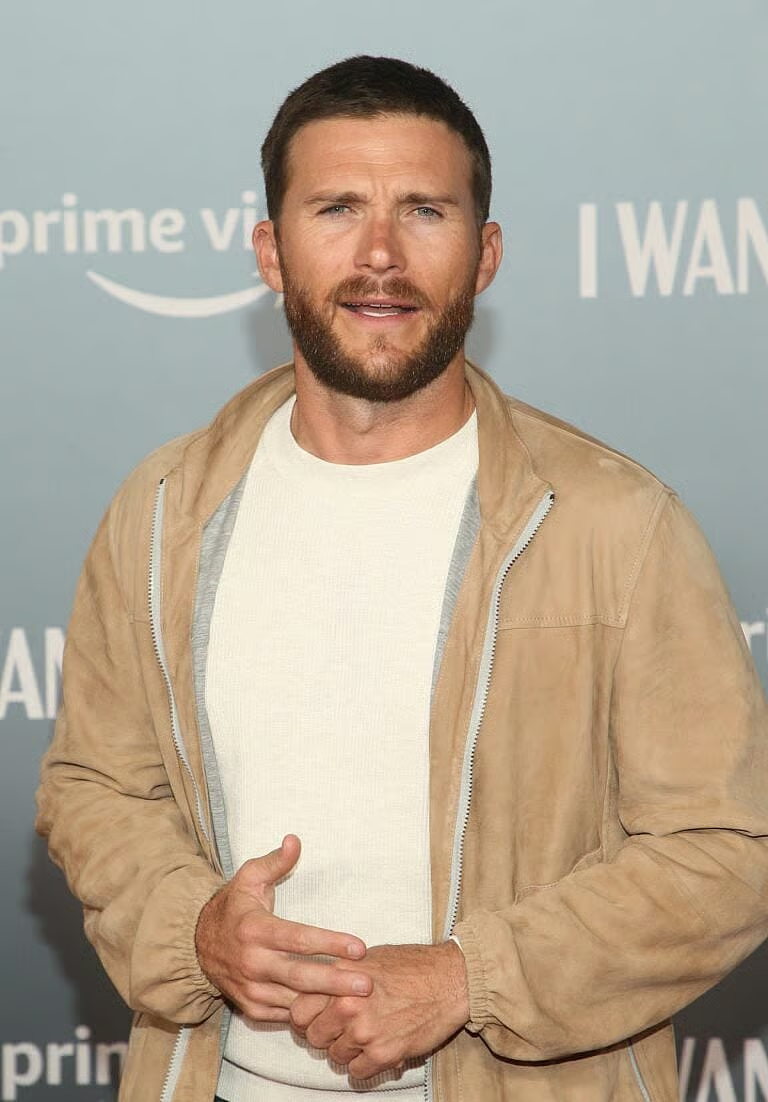
Scott Eastwood is looking back on a tense moment from the set of “Fury.” In an interview, the actor recalled a confrontation with co-star Shia LaBeouf while filming a scene for the war movie, sharing how a misunderstanding escalated before it was brought under control. His remarks come after he called out an A-lister for backing out of a project at the last minute.

The 2014 war movie “Fury” was the first and only time Scott Eastwood and Shia LaBeouf worked together. They starred alongside other big names, including Brad Pitt, Jon Bernthal, Logan Lerman, and Michael Peña.
During the movie’s promotions, the tension between Eastwood and LaBeouf was widely reported, with co-stars sharing details of what went down behind the scenes. More than 10 years after the incident, Eastwood is sharing his recollection of the heated encounter with his co-star.
In an appearance on the podcast “Armchair Expert,” Eastwood told hosts Dax Shepard and Monica Padman that he was steered clear of LaBeouf after witnessing the lengths he went to to get into the character of a tank gunner, such as pulling out a tooth, cutting his cheek, and avoiding bathing.
“I remember thinking, ‘Okay. This guy’s crazy. I’m just gonna keep clear from this guy. I don’t play this game’,” Eastwood said. It was difficult to stay away from a co-star while working on a movie, though, and the dispute unfolded after filming a scene.
The Actor Claims His Co-Star Was ‘Having An Episode’
Eastwood acknowledged that LaBeouf was “clearly tormented,” and during the incident, he said the actor was “having an episode.”
LaBeouf called Eastwood out for “spitting tobacco” in the tank, and that was the latter’s breaking point. “I said, ‘F-ck you. Stop pulling your sh-t.’ I said, ‘I’m gonna whoop your a-s’,” Eastwood said, noting that afterward, LaBeouf became even more heated. Fortunately, their co-stars, including Pitt, managed to break up the fight before it escalated further.
Unbeknownst to LaBeouf, spitting tobacco was included in the script.
Eastwood said he understood LaBeouf’s process of method acting. However, he also said making a film is a collaborative effort. “Everyone’s doing a thing, but you can’t stop the train… And grow the f-ck up, you know?” he said.
The actor further said that everybody on set had “moments with Shia,” adding the entertainment industry “attracts psychopaths.”
Brad Pitt Shared Context To The Story In 2014
Pitt, who portrayed U.S. Army Staff Sergeant Don “Wardaddy” Collier in “Fury,” discussed the altercation in a 2014 interview, admitting that it may have started with him.
During the scene, he saw Eastwood spit into the tank, which irked him. “I’m starting to get hot, because this is our home, he’s disrespecting our home, you know?” Pitt told GQ. He called out Eastwood while the cameras were rolling and, in character, said, “You’re going to clean that sh-t up.” LaBeouf shared his sentiment, which sparked the dispute.
After the scene, Pitt said he approached Eastwood to explain what happened, only to later find out that he was in the wrong. The actor read the script that night and noticed it specifically stated Eastwood’s character was “chewing tobacco and spitting it on the back of the tank.”
“He was just doing as instructed in the script! So we were the knobs in the end,” Pitt said.
Shia LaBeouf Has A Reported History Of Friction With Co-Stars

LaBeouf has been involved in a few on-set tensions with co-stars, driven by clashes in personality or his extreme method acting. As The Blast previously reported, the actor was let go from “Orphans” due to his erratic behavior.
The former Disney star also had a conflict with Tom Hardy on the set of “Lawless,” with reports saying LaBeouf knocked out Hardy with a punch. The film’s director, John Hillcoat, confirmed that a physical altercation occurred, but nobody was knocked out. Years later, LaBeouf dismissed it as playful roughhousing rather than a real fight.
LaBeouf has been the subject of headlines in recent months due to a physical altercation in New Orleans. He was charged with three counts of battery and took a plea deal in June.
Scott Eastwood Called Out Another A-Lister

Eastwood’s comments about LaBeouf came after he went on “The Joe Rogan Experience” and called out an actor who pulled out of a project at the last minute, as The Blast reported.
He didn’t name the A-list actor, but noted that the production had to bear the financial burden of the decision simply because the actor didn’t want to work with someone else. “People get too famous for too long and think the world owes them something,” he noted.

Sports29 seconds ago
Strength in numbers: The pipeline behind India’s boxing success at CWG 2026 | Other Sports News

Tech1 minute ago
EE launches its fastest fibre broadband ever – 8GB per second speeds should appeal to home workers, gamers and AI developers alike

News Videos2 minutes ago
Blood Money If It Was Real Life (Animation)


-

 Business5 days ago
Why Trees Belong on the Risk Register
-

 Fashion4 days ago
Weekend Open Thread: Wit & Wisdom
-

 Politics3 days ago
Meta enters AI-training agreement with far-right ‘propaganda rag’ Newsmax
-
 Entertainment6 days ago
‘Stargate’ Creator’s New Sci-Fi Series Returns for Season 3 Tomorrow
-

 Crypto World3 days ago
MicroStrategy Post-Earnings CLARITY Act Push Could Add New Catalyst for Its Stock
-

 Politics7 days ago
The Part of the Electric Transition Nobody Wants to Discuss
-

 Business6 days ago
Major shareholder moves on Canyon
-

 Crypto World3 days ago
XRP Ledger v3.3.0 brings five institutional features
-

 News Videos5 days ago
Bitcoin Enters the 3rd Stage of the Bear Market
-

 Crypto World6 days ago
Kraken Enables Retail Access to Jersey Mike’s IPO via Tokenized Shares
-
 Politics6 days ago
Reform UK betrays West Mids residents by running from party pledges
-

 Politics5 days ago
Luke Littler’s dominance sparks GOAT debate
-

 News Videos6 days ago
Claude: Build Financial Dashboards in Minutes (2026)
-

 Sports4 days ago
Seema Kaliramna Wins Discus Throw Bronze, Takes India’s CWG Medals Tally To 17
-

 Crypto World2 days ago
Crypto PAC spending tops $2M in Michigan House race
-

 Crypto World3 days ago
New York sues Kalshi over prediction market gambling
-

 Business6 days ago
Johnson & Johnson agrees to $5.5B settlement over talc cancer claims
-

 Business4 days ago
Trump Announces Hamas Disarmament Agreement as Iran Strikes Kuwait Air Base and US Attacks Pause Overnight
-

 Tech6 days ago
Gemini can now summarize the messiest comment threads in Google Docs
-

 Tech2 days ago
ESET tracks rise in malicious AI skills and adaptable malware
You must be logged in to post a comment Login