Connect with us

Business

Hints and Full Solutions for the August 4, 2026 Puzzle #1150 Revealed

Published

on

Nancy Guthrie

Puzzle fans looking to sort out Tuesday’s New York Times Connections grid have a mix of everyday objects, city landmarks and clever visual wordplay to untangle in puzzle #1150. Below are spoiler-free hints for anyone still working through today’s board, followed by the full confirmed solution for those ready to check their answers.

What is NYT Connections?

Connections is a daily word-association puzzle published by The New York Times, in which players are presented with a 4-by-4 grid of 16 seemingly unrelated words and asked to sort them into four hidden groups of four. Each group shares a common theme, ranging from straightforward categories to trickier wordplay-based connections. The puzzle, created in 2023 and overseen by the Times’ crossword editor, Wyna Liu, has become one of the paper’s most popular daily games alongside Wordle, Strands and the Mini Crossword.

Categories are typically color-coded by difficulty, running from the most straightforward grouping to the most conceptually challenging, with the trickiest category often relying on wordplay, double meanings or unexpected associations between words that appear to have nothing in common at first glance. Part of the puzzle’s appeal, and its difficulty, comes from the Times’ deliberate use of overlapping words designed to mislead players into grouping items incorrectly before the true categories become clear.

Advertisement

Hints for today’s puzzle

For players who want a nudge before jumping straight to the answers, here are some spoiler-light clues for each of today’s four categories:

  • One category involves items that are long and cylindrical in shape.
  • Another focuses on sights closely associated with New York City.
  • A third groups together objects and instruments that share a common mechanical feature: pedals.
  • The final and trickiest category ties together things that form a distinctive V shape.

If those hints aren’t quite enough, a few additional pointers: think of something you might chew on the sidewalk, a familiar city bird, an instrument played with the feet as well as the hands, and a hand gesture recognizable around the world.

Today’s Connections answers

For those ready to see the full solution, here is how puzzle #1150 breaks down for Tuesday, August 4, 2026:

Advertisement

Long Cylindrical Things: Cigarette, Foam Roller, Pool Noodle, Pretzel Rod

Iconic NYC Sights: Bodega, Pigeon, Subway Station, Taxi Cab

Things With Pedals: Piano, Sewing Machine, Swan Boat, Unicycle

V-Shaped Things: Angle Bracket, Chevron, Goose Formation, Peace Sign

Advertisement

The puzzle’s most challenging group is likely to be the V-Shaped Things category, which requires players to move beyond literal object categories and instead recognize a shared visual shape across items as varied as a hand gesture, a punctuation mark, a flying formation of geese and a chevron pattern. That kind of abstract, shape-based grouping is a hallmark of Connections’ hardest category on any given day, often tripping up players who initially try to sort those words by what they are rather than what they resemble.

The Things With Pedals category also carries a bit of a twist, linking together items that don’t obviously belong in the same group at first glance. A piano and a sewing machine share pedals used for different mechanical purposes, while a swan boat, the pedal-powered paddle boats found on lakes in parks, and a unicycle round out a category built around a shared physical feature rather than a shared purpose or setting.

Strategy for solving Connections

Players tackling Connections are often advised to start with the category they feel most confident about, typically the most literal or straightforward grouping, before moving on to trickier associations. Because the puzzle intentionally seeds decoy words designed to fit multiple categories, jumping to conclusions on category groupings can be costly, since an incorrect guess can quickly use up the limited number of mistakes allowed before the puzzle is considered unsolved for the day.

Advertisement

A common approach involves first identifying words that only seem to fit one obvious category, then working outward from there, saving the most ambiguous or abstract-seeming words for last. In today’s puzzle, several items could plausibly overlap between categories at first glance, for instance, a pretzel rod might initially seem more closely tied to a food-based group rather than a shape-based one, while a taxi cab could be mistaken for fitting a category built around modes of transportation rather than New York City sights specifically.

A companion puzzle: Connections Sports Edition

Alongside the main Connections puzzle, the Times also publishes a separate Connections: Sports Edition, developed in partnership with The Athletic, which challenges players to apply knowledge of baseball, basketball, football and hockey to a similarly structured grid. Tuesday’s sports edition, puzzle #680, tested players on categories built around team names, franchise history and sports terminology, offering a parallel challenge for fans of both word games and sports trivia.

Why Connections has become a daily habit

Advertisement

Since its debut, Connections has grown into one of the Times’ most widely played daily puzzles, prized for the way it rewards lateral thinking over rote vocabulary knowledge. Unlike Wordle, which tests spelling and letter placement, Connections leans on pattern recognition and cultural familiarity, often requiring players to reconsider their first instinct about a word’s meaning once a puzzle’s true structure starts to emerge.

The puzzle resets daily at midnight local time, with a new 16-word grid and four categories waiting for players each morning. For those who missed Tuesday’s puzzle or want to track their progress over time, the Times maintains an archive of past Connections puzzles, allowing solvers to catch up on previous days’ boards or revisit puzzles they weren’t able to finish.

With today’s #1150 solved, players can look ahead to Wednesday’s edition, #1151, which will bring an entirely new set of 16 words and four fresh categories to untangle.

Advertisement
Continue Reading
Click to comment

You must be logged in to post a comment Login

Leave a Reply

Business

Elon Musk Faces Tough Investor Scrutiny as SpaceX Shares Plunge 50% Ahead of First Public Earnings Call

Published

on

Tesla CEO Elon Musk speaks at an event in Hawthorne, California April 30, 2015.

NEW YORK — Elon Musk faces investors Tuesday for the first time since taking SpaceX public, a closely watched call coming after the rocket company’s shares have lost roughly half their value since peaking in June, raising questions about whether Musk oversold the company’s near-term prospects.

SpaceX is scheduled to release its second-quarter 2026 financial results after markets close Tuesday, followed by a live audio-only webcast at 4:30 p.m. Eastern time, marking the company’s first earnings report and shareholder call since going public. The event comes just two days ahead of a major insider lock-up expiration that could add further pressure to the stock.

A dramatic reversal since the IPO

SpaceX priced its initial public offering at $135 per share on June 11, raising $85.7 billion in what became the largest IPO in history. Shares began trading on the Nasdaq the following day and climbed as high as $225.64 by June 16, before beginning a steady decline that has continued for much of the summer. The stock has since fallen more than 45% from that peak, with some measures putting the drop closer to 50%, leaving shares trading in the range of $113 to $123 in recent sessions.

Advertisement

The decline has erased hundreds of billions of dollars in market value and fueled concerns among analysts that investors, caught up in the excitement surrounding one of the most anticipated public offerings in Wall Street history, may have pushed the stock’s valuation well beyond what SpaceX’s underlying financial performance could support.

Mounting losses

Much of the scrutiny facing Musk on Tuesday centers on SpaceX’s financials, which have shown a pattern of widening losses even as the company’s revenue continues to grow. SpaceX posted a net loss of roughly $4.9 billion for all of 2025. That figure was nearly matched in just the first quarter of 2026 alone, when the company reported a net loss of $4.28 billion on revenue of $4.69 billion. Combined first-half losses for 2026 are expected to exceed the company’s entire loss total from the prior year.

Wall Street analysts surveyed by FactSet are projecting a second-quarter net loss of approximately $1.9 billion, or 23 cents per share. While some analysts believe SpaceX’s financial results could improve later in the year, the company currently trades at roughly 49 times its expected revenue, a valuation multiple that leaves little room for disappointment and places enormous weight on Tuesday’s numbers.

Advertisement

What investors want to hear

Analysts expect management to address three core business segments during the call: Space, which includes SpaceX’s launch operations and the long-delayed Starship rocket program; Connectivity, centered on the company’s Starlink satellite internet service; and a newer artificial intelligence infrastructure push that includes a proposed orbital data center project.

Starlink remains one of the few bright spots in SpaceX’s business. As of March 31, the service had grown to 10.3 million subscribers across 164 countries, more than double the 5.0 million subscribers it had a year earlier. The service generated $11.4 billion in revenue in 2025, and investors will be watching for updated subscriber figures as one of the clearest indicators of the company’s underlying growth trajectory.

Investors are also expected to press Musk on the progress of Starship, the massive rocket system central to NASA’s plans to return astronauts to the moon, following a series of recent setbacks, including an aborted test and an imperfect booster recovery during the vehicle’s most recent flight. Questions about a possible future business tie-up between SpaceX and Tesla, as well as SpaceX’s expanding role in artificial intelligence infrastructure through partnerships with hyperscale computing providers, are also likely to come up, though Musk has historically avoided detailed comments on such topics during earnings calls, citing securities regulations.

Advertisement

A lock-up expiration adds urgency

Compounding the pressure on SpaceX shares is an insider lock-up expiration set for Thursday, Aug. 6, just two days after the earnings call. The expiration will allow a significant portion of insider-held shares, an unconditional tranche representing roughly 20% of total shares, or more than 900 million shares, to become eligible for trading for the first time since the IPO.

A separate, larger tranche tied to the stock trading above $175.50 for five of 10 consecutive sessions has not been triggered, since shares have remained well below that threshold since mid-June. Musk’s own controlling stake, along with shares held by key executives, remains restricted under a separate one-year lock-up that runs until June 2027.

Analysts widely view Tuesday’s earnings report as the company’s best opportunity to stabilize investor sentiment before the lock-up expiration potentially floods the market with new sellers. A strong report could help offset some of the anticipated selling pressure; a disappointing one could accelerate it.

Advertisement

A test of the Musk premium

Unlike other trillion-dollar technology companies, SpaceX’s roughly $1.4 trillion market capitalization is not currently supported by traditional financial metrics such as profitability or free cash flow. Much of the investment case for the company rests instead on confidence in Musk’s track record and his stated ambitions, including plans to build data centers in space and eventually establish a human presence on Mars.

That dynamic has drawn comparisons to Tesla, where Musk faced a similarly rocky earnings call two weeks earlier that sent shares of the electric automaker falling further amid concerns over rising costs and negative free cash flow. With both of Musk’s flagship companies under pressure simultaneously, Tuesday’s SpaceX report is being closely watched as a broader referendum on investor confidence in Musk’s ability to deliver on ambitious, capital-intensive projects across multiple companies at once.

Whether SpaceX’s first earnings report as a public company can reverse the stock’s slide, or simply confirm investors’ concerns about an overheated valuation, is likely to become clear within hours of Tuesday’s release. With the lock-up expiration looming just two days later, analysts say the company has a narrow window to reassure shareholders before a new wave of insider selling tests the stock’s ability to find a floor.

Advertisement
Continue Reading

Business

What the Growing Uber and Lyft Driver Movement Means for Riders

Published

on

Uber

A wave of state laws allowing Uber and Lyft drivers to unionize is spreading across the country, marking one of the most significant shifts in labor rights for gig workers since ride-hailing apps first launched more than a decade ago.

Massachusetts became the first state to open the door to rideshare unionization in 2024, when voters approved a ballot measure creating a framework that lets drivers organize and bargain collectively while remaining classified as independent contractors rather than employees. California followed in January, giving an estimated 800,000 rideshare drivers in the state the right to form a union. Illinois became the third state to pass such legislation on June 1, extending similar rights to the state’s roughly 100,000 Uber and Lyft drivers.

A historic certification in Massachusetts

The movement reached a major milestone this spring when Massachusetts drivers organized what labor advocates are calling one of the most significant labor wins for independent workers in decades. The certification, made possible under the state’s 2024 framework, could ultimately represent nearly 70,000 drivers statewide through the newly formed App Drivers Union.

Advertisement

For drivers who backed the effort, the moment carried deep personal significance. Jean Fredo, who has driven for Uber for more than seven years, said he hopes the union will bring better pay, stronger protections against sudden deactivations and greater overall stability for drivers. “With the union, it will not feel like we’re working for nothing,” Fredo said, speaking through a translator.

Fellow driver Alfred Potter, who took part in organizing efforts, described the years-long push toward unionization as “still no more than a dream” for much of the process, reflecting how long the effort took to reach certification after the 2024 ballot measure passed.

California drivers see a similar path

In California, the nation’s second state to grant rideshare drivers union rights, organizing is still in its early stages, with the earliest possible vote on unionization set for May. Sangar Khan, who drives for Uber and Lyft out of the Bay Area, said he believes unionization could benefit drivers financially. “I think the union is good for drivers, and maybe they pay more,” Khan said, describing frustration with what he sees as a large gap between what riders pay for trips and what drivers ultimately take home.

Advertisement

Uber and Lyft did not agree to interviews on the California law, though Uber has previously said its support for expanding union rights in the state was tied to separate legislation that reduced the company’s insurance costs by lowering requirements for underinsured drivers.

A pattern with deep roots

The current wave of state-level unionization laws traces back to Seattle, which in 2015 became the first city in the country to pass an ordinance allowing rideshare drivers to organize, a move city officials framed at the time as an effort to protect workers and balance bargaining power between drivers and ride-hailing companies. Uber and Lyft challenged that ordinance in court, arguing that federal labor law prohibited cities from regulating collective bargaining and that allowing drivers to collectively negotiate rates could violate federal antitrust law.

More than a decade later, the legal and political landscape has shifted considerably, with state legislatures and voters, rather than individual cities, now driving the expansion of union rights for gig workers, sidestepping some of the legal challenges that stalled earlier municipal efforts.

Advertisement

Critics warn of rising costs

Not everyone views the trend favorably. Critics, including some free-market policy researchers, argue that sector-wide labor rules risk increasing costs for both drivers and riders alike, warning that expanded bargaining rights could push ride-hailing companies to raise fares to offset higher labor costs, similar to price increases seen following minimum wage mandates in the food delivery industry.

Opponents of mandatory unionization have also raised concerns about drivers who prefer to remain fully independent, arguing that collective bargaining agreements could bind drivers to terms they did not personally support and potentially reduce the flexibility that has long been a defining feature of gig work. Some critics have specifically warned that the expansion of gig worker unionization moves the industry incrementally closer to traditional employment classification, even as most current laws are structured to preserve independent contractor status.

Automation adds urgency

Advertisement

The push toward unionization is also unfolding against the backdrop of rapid advances in autonomous vehicle technology, which some labor organizers view as an additional reason to secure stronger protections for drivers now, before self-driving technology potentially reshapes the ride-hailing industry. Advocates argue that unionized drivers will be better positioned to negotiate protections, or transition support, if autonomous vehicles begin displacing significant numbers of human drivers in the coming years.

With Massachusetts, California and Illinois now serving as models for rideshare unionization, labor organizers say they expect additional states to consider similar legislation in the coming years, particularly as ride-hailing companies continue to expand their footprint across the country. Whether the trend ultimately benefits drivers through improved pay and job security, or raises costs for riders and limits flexibility for the independent contractors who make up the rideshare workforce, remains a central point of disagreement between labor advocates and industry-aligned critics.

For now, the expansion of union rights for gig workers marks one of the most closely watched labor developments in the ride-hailing industry since it first emerged more than a decade ago, with millions of drivers across the country now positioned to weigh in on whether collective bargaining becomes a permanent fixture of gig work.

Advertisement
Continue Reading

Business

NANR: A Proven Inflation Hedge

Published

on

Commodities: Oil Slumps As The U.S. And Iran Pause Strikes

NANR: A Proven Inflation Hedge

Continue Reading

Business

Wiltshire brewer Wadworth first to trade on Asset Match’s new PISCES platform

Published

on

Business Live

Market would allow existing shareholders to sell part of their vested equity to buyers

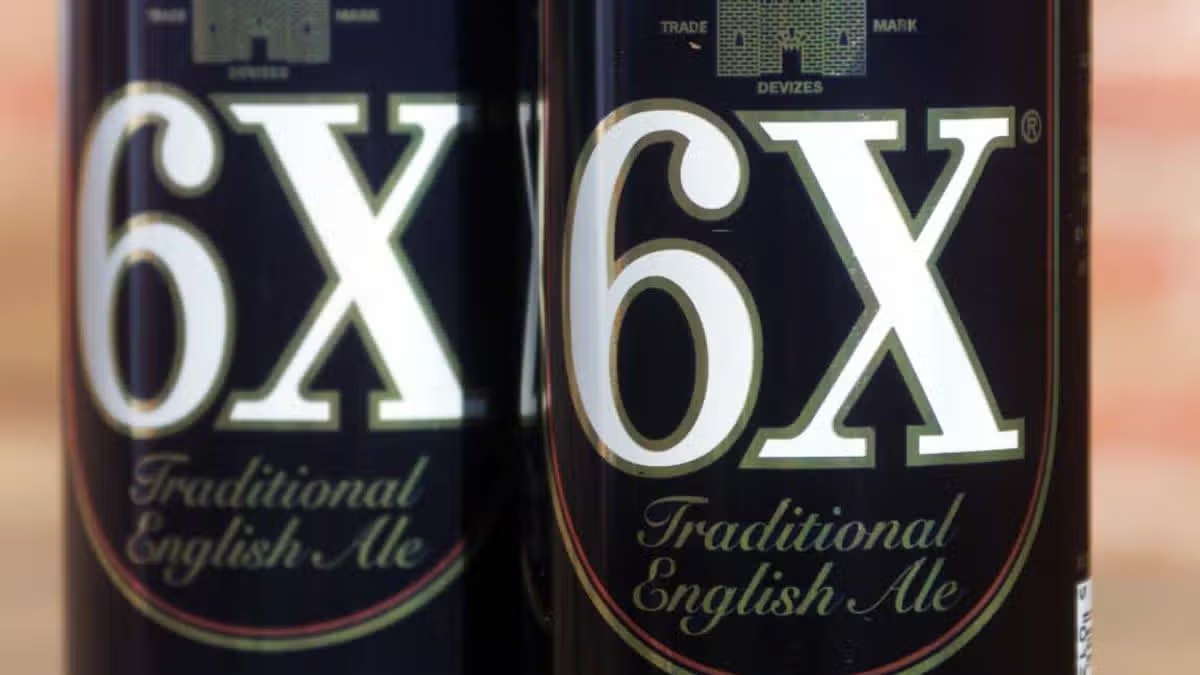
Wadworth's famous 6X beer

Wadworth’s famous 6X beer

A British brewery has drawn up plans to become the first company to join Asset Match’s new private markets platform as it continues to look to attract unlisted firms.

The online private stock market has welcomed Wiltshire-based brewer and pub operator Wadworth to its Private Intermittent Securities and Capital Exchange System (Pisces), enabling existing shareholders to offload a portion of their equity stake to prospective buyers.

Participants will be able to access company reports and auction details on August 4. Buyers and shareholders can submit orders during Wadworth’s first trading window of 11 August to 30 September, as reported by City AM.

Established in 1875, Wadworth has traded its A ordinary shares, a class of company equity which typically carries voting rights, on the Asset Match platform since February 2023.

Advertisement

The brewer, renowned for its range of traditional ales such as 6X, has traded more than 300,000 shares to date.

Ben Weaver, business development director at Asset Match, said the PISCES auction “represents the first opportunity” for a broader pool of investors to acquire shares in Wadworth.

Weaver said: “We believe there is strong investor appetite for established private companies with recognised brands, tangible assets and long-term growth potential.

“We expect Wadworth inaugural PISCES auction to attract significant interest.”

Advertisement

Simon Townsend, chairman of Wadworth, said the transaction would “broaden awareness of the company” among investors. Gaining traction.

Asset Match received its Pisces approval from the Financial Conduct Authority in April, and the flotation of Wadworth represents the first real test of whether the exchange can deliver liquidity to shareholders.

The platform must now persuade other firms seeking to unlock value without a full listing to choose their service over rivals JP Jenkins, Vestd and London Stock Exchange Group.

London’s platform welcomed fintech Moneybox last month, confirming a £45m employee share sale, alongside autonomous driving company Wayve in a substantial £63m employee share sale.

Advertisement

JP Jenkins has similarly onboarded just one company under its framework to date, completing the transaction of digital board game developer QPLAY in March. Vestd is yet to attract a single company to list on its framework.

Continue Reading

Business

Bending Spoons makes first post-IPO acquisition with $1.3 billion Airtable deal

Published

on


Bending Spoons makes first post-IPO acquisition with $1.3 billion Airtable deal

Continue Reading

Business

Hastings weighs in on Wyloo sale

Published

on

Hastings weighs in on Wyloo sale

Hastings Technology Metals boss Vince Catania says the plan by Andrew Forrest’s Wyloo to exit the Yangibana joint venture is a positive for his ASX-listed rare earths company.

Continue Reading

Business

Tetra Tech: Market Leadership In Water

Published

on

Tetra Tech: Market Leadership In Water

Tetra Tech: Market Leadership In Water

Continue Reading

Business

EverQuote, Inc. (EVER) Q2 2026 Earnings Call Transcript

Published

on

OneWater Marine Inc. (ONEW) Q1 2026 Earnings Call Transcript

Operator

Hello everyone. Thank you for joining us and welcome to the EverQuote Second Quarter 2026 Earnings Call. [Operator Instructions] I will now hand the conference over to [ Sara Buda ], Vice President of Investor Relations. Please go ahead.

Sara Buda

Advertisement

Thank you. Good afternoon, and welcome to EverQuote’s Second Quarter 2026 Earnings Call. We will be discussing the results announced in our press release issued today after market close. With me on the call this afternoon are Jayme Mendal, EverQuote’s CEO; and Joseph Sanborn, EverQuote’s CFO and Chief Administrative Officer.

During this call, we may make statements related to our business that may be considered forward-looking statements under federal securities laws, including statements considering our financial guidance for the third quarter of 2026. Forward-looking statements may be identified with words and phrases such as aim, expect, believe, intend, anticipate, plan, will, may, continue, upcoming, and similar words and phrases. These statements reflect our views only as of today and should not be considered our views as of any subsequent date. We specifically disclaim any obligation to update or revise these forward-looking statements except as required by law.

Forward-looking statements are subject to a variety of risks and uncertainties that could

Advertisement
Continue Reading

Business

Kevin Durant Says LeBron James’ New-Look 76ers Are Better Than His Legendary 2017 Warriors Superteam

Published

on

Kevin Durant, Brooklyn Nets

Kevin Durant has weighed in on one of the NBA’s most talked-about roster overhauls, saying he believes the newly reshaped Philadelphia 76ers, now led by LeBron James, are a stronger team than the historic Golden State Warriors squad he helped build nearly a decade ago.

Durant shared his assessment in a series of comments on Instagram, comparing the Sixers’ revamped roster — which now includes James, Joel Embiid, Tyrese Maxey and Jaylen Brown — to the 2017 Warriors team that featured Durant alongside Stephen Curry, Klay Thompson and Draymond Green. That Golden State squad went on to dominate the league, winning back-to-back championships and beating James’ Cleveland Cavaliers in both the 2017 and 2018 NBA Finals.

A superteam comparison a decade in the making

Durant’s comments arrive roughly 10 years after his own move sent shockwaves through the league. In 2016, Durant left the Oklahoma City Thunder to join a Warriors team that was already coming off a record-setting 73-win regular season, a decision that drew heavy criticism at the time for what many viewed as an unfair concentration of talent. With Durant added to the mix, Golden State became nearly unbeatable, reaching three straight NBA Finals and claiming back-to-back titles while cementing the group as one of the most dominant runs in modern NBA history.

Advertisement

Now, with James stunning the basketball world by signing with Philadelphia for his 24th NBA season, Durant has drawn a direct line between that historic Warriors run and the Sixers’ newly assembled roster, suggesting the current Philadelphia group may have even more talent on paper than the team he once helped construct.

Durant pushes back on critics

Durant’s comments were not limited to praising the 76ers. He also addressed how his own basketball opinions are often received by fans, particularly those who remain critical of his decision to join Golden State in 2016. Durant suggested that a segment of James’ fan base reacts emotionally to his commentary regardless of its substance, saying that “yall never pay attention to what I say, just respond emotionally.”

The remark reflects a familiar tension in Durant’s public relationship with James’ fan base, which has often accused him of undermining James’ legacy by teaming up with a rival superteam rather than building a championship roster independently. Durant has periodically addressed those criticisms throughout his career, and his latest comments suggest he continues to view much of the reaction to his basketball opinions through that lens.

Advertisement

A roster built around aging stars and new pieces

Philadelphia’s roster overhaul this offseason has been one of the most significant in the league, anchored by James’ decision to leave the Los Angeles Lakers and sign with the Sixers alongside Embiid, who has struggled with knee injuries in recent seasons. The team also added Brown via a trade with the Boston Celtics, giving Philadelphia a third proven scorer and playoff performer to pair with Maxey, the team’s rising All-Star guard, and VJ Edgecombe, a young player the organization has increasingly built around.

On paper, the combination of James’ scoring and playmaking, Embiid’s interior presence when healthy, Brown’s two-way ability and Maxey’s speed gives Philadelphia one of the most talented rosters in the Eastern Conference heading into the 2026-27 season. Whether that talent translates into the kind of dominance Durant’s Warriors teams displayed remains an open question, particularly given James’ age and Embiid’s injury history.

Not the first time Durant has drawn the comparison

Advertisement

This is not the first time Durant has compared the new-look Sixers to his old Warriors squad. In earlier remarks, Durant similarly likened Philadelphia’s roster to the Golden State superteam, suggesting the comparison has been on his mind since James’ decision to join the 76ers became official. The repeated comparison has added another layer to the ongoing discussion around James’ move, with fans and analysts continuing to debate whether the pairing of James, Embiid, Brown and Maxey can realistically contend for a championship this season.

A question mark hanging over the season

Despite Durant’s assessment, significant uncertainty remains around Philadelphia’s ability to live up to the lofty comparison. James, now 41 years old, enters the season having played more NBA games than any player in league history, while Embiid’s recent seasons have been repeatedly interrupted by knee problems that have limited his availability and effectiveness. Whether the Sixers can keep their new core healthy and cohesive through an 82-game season and a demanding playoff run will likely determine whether Durant’s prediction holds up.

The comparison also raises broader questions about roster construction in today’s NBA, where aging superstars increasingly join forces with existing contenders late in their careers in pursuit of one more championship run, echoing the dynamic that defined Durant’s own move to Golden State nearly a decade ago.

Advertisement

As the 2026-27 season approaches, Philadelphia’s roster will face intense scrutiny from analysts and fans alike, many of whom remain skeptical that a team built around James at this stage of his career, alongside an oft-injured Embiid, can match the sustained dominance of Durant’s Warriors dynasty. Others have pointed to the Sixers’ depth of talent as reason for optimism, arguing that the addition of Brown and the continued development of Maxey and Edgecombe give Philadelphia a more balanced roster than some of James’ previous title contenders.

For now, Durant’s comments have added another storyline to what was already shaping up to be one of the most closely watched seasons in recent NBA memory, with James’ arrival in Philadelphia continuing to generate debate across the league even before the Sixers have played a single regular-season game together.

Continue Reading

Business

GE Shipping shares rally 9% as Q1 net profit surges 160% YoY, revenue up 67%

Published

on

GE Shipping shares rally 9% as Q1 net profit surges 160% YoY, revenue up 67%
Shares of The Great Eastern Shipping Company (GE Shipping) witnessed strong buying interest on Tuesday, climbing 9% to Rs 1,523.40 after the company reported robust financial performance for the first quarter of FY27. The shipping major posted a sharp jump in profitability, with consolidated net profit more than doubling year-on-year, supported by strong revenue growth.

GE Shipping’s consolidated net profit for Q1FY27 increased 160% to Rs 1,309 crore, compared with Rs 505 crore in the corresponding quarter last year. Revenue from operations also recorded a significant 67% year-on-year growth, rising to Rs 2,005 crore from Rs 1,201 crore in Q1FY26.

The company’s strong quarterly performance reflects improved operating momentum and a favourable environment for the shipping sector.

Dividend announcement adds to investor sentiment

Along with its quarterly results, GE Shipping announced an interim dividend of Rs 14.40 per share for FY27. The company has fixed August 7, 2026, as the record date to determine eligible shareholders for the dividend payout. The interim dividend will be distributed to shareholders on or after August 27, 2026.

Advertisement

Stock performance and key technical indicators

Following the earnings announcement, GE Shipping shares rallied 9% during Tuesday’s trading session. The stock has delivered an impressive return of around 51% over the past one year. The company currently commands a market capitalisation of approximately Rs 19,964 crore, while its 52-week high stands at Rs 1,798.


From a valuation standpoint, GE Shipping continues to trade at attractive levels, with the stock currently commanding a Price-to-Earnings (P/E) ratio of 6.55, a Price-to-Sales (P/S) ratio of 3.73, and a Price-to-Book (P/B) ratio of 1.14. These valuation metrics indicate that the stock is available at relatively reasonable multiples compared with its earnings, revenue, and book value.
On the technical front, the stock’s 14-day Relative Strength Index (RSI) stands at 48.3. An RSI below 30 generally indicates oversold conditions, while levels above 70 suggest overbought territory. The stock is currently trading above all eight key Simple Moving Averages (SMAs), indicating a positive technical trend.The company witnessed increased participation from foreign institutional investors (FIIs) during the June 2026 quarter. FII holding in GE Shipping rose to 31.03% from 28.44% in the previous quarter. Meanwhile, mutual fund ownership declined to 11.98% from 14.72% during the same period.

With strong earnings growth, improving investor sentiment, and positive technical signals, GE Shipping remains among the stocks attracting market attention after its Q1FY27 performance.

(Disclaimer: Recommendations, suggestions, views and opinions given by the experts are their own. These do not represent the views of The Economic Times)

Advertisement
Continue Reading

Trending

Copyright © 2025