
Crypto World
Taiwan Plans Crypto Travel Rule Rollout in October



Cointelegraph is committed to providing independent, high-quality journalism across the crypto, blockchain, AI, and fintech industries.
All news, reviews, and analyses are produced with full journalistic independence and integrity. For more details on our standards and processes, please read our Editorial Policy.



Taiwan has proposed mandatory customer information sharing for all domestic crypto platform transfers, with new Travel Rule requirements scheduled to begin in October.
Summary
- Taiwan has proposed mandatory customer information sharing for all domestic crypto platform transfers starting in October.
- Transfers above NT$30,000 would require additional sender identification, while receiving platforms must verify beneficiary details.
- The Financial Supervisory Commission plans to extend the Travel Rule requirements to cross border VASP transfers by the end of 2027.
- The proposal builds on Taiwan’s new Virtual Asset Service Act, which introduced a full licensing framework for crypto businesses in July.
According to Taiwan’s Financial Supervisory Commission (FSC), draft amendments released on Tuesday would require virtual asset service providers (VASPs) to exchange customer information for every transfer between domestic crypto platforms, regardless of transaction value.
The regulator said transfers above 30,000 New Taiwan dollars (about $930) would face additional identification requirements before they could be processed.
The proposal would also require receiving VASPs to verify that beneficiary details provided by the sending platform match the information held in their own records. The FSC said the amendments will enter a 30-day public consultation before any final rules are adopted.
Taiwan expands Travel Rule requirements
Under the proposed framework, platforms handling transfers above the NT$30,000 threshold would need to transmit more detailed customer information.
For individual senders, the FSC said platforms must provide the customer’s date of birth and residential address alongside existing transfer information. Corporate senders would instead need to disclose their official identification number and registered business address.
Receiving platforms would no longer be limited to accepting transmitted information. The proposal requires them to compare beneficiary information received from the originating VASP against their own customer records before completing the transaction.
The regulator also outlined the next phase of the rollout. While the October changes apply to transfers between Taiwanese crypto platforms, the FSC said it intends to extend the same framework to transactions involving domestic and overseas VASPs by the end of 2027.
Taiwan’s crypto rules have moved beyond AML registration
The latest proposal follows Taiwan’s recent overhaul of its cryptocurrency regulatory framework.
In July 2026, Taiwan passed the Virtual Asset Service Act, replacing the country’s previous anti-money laundering registration model with a licensing system covering exchanges, trading platforms, custodians, transfer providers and other crypto businesses. The legislation also introduced operational standards covering cybersecurity, customer asset segregation, internal controls, financial reporting and market conduct.
Under the law, crypto firms must obtain approval from the FSC before operating, while businesses already registered under Taiwan’s earlier AML regime were given a transition period to secure full licenses.
The legislation also introduced dedicated rules for stablecoin issuers. Before issuing tokens in Taiwan, companies will need approval from both the FSC and Taiwan’s central bank while maintaining fully backed reserves held in trust and subject to audits and public disclosure requirements.
Alongside licensing, the Virtual Asset Service Act established criminal penalties for unlicensed crypto activity, illegal stablecoin issuance, fraud and market manipulation, replacing what had been a largely AML-focused compliance framework.
Earlier Travel Rule plans faced implementation hurdles
Taiwan had already incorporated Travel Rule provisions into its anti-money laundering regulations in 2021, but the requirements were never implemented.
The FSC said differences in regulatory approaches across jurisdictions, incompatible information-sharing standards and technical challenges in connecting cross-border systems prevented authorities from putting the framework into practice at the time.
The regulator now plans to introduce domestic requirements first before extending them to international transfers over the next year.
Separately, the Financial Action Task Force (FATF) reported in July that implementation of the Travel Rule has continued to expand worldwide. According to the international standard-setting body, 83% of surveyed jurisdictions have now enacted Travel Rule legislation, up from 73% in 2025.
Despite the increase, the FATF said implementation remains uneven because many jurisdictions still face enforcement and operational challenges after adopting the legal framework.
Crypto oversight has become a larger policy focus
Taiwan’s crypto policy has expanded well beyond licensing and anti-money laundering requirements over the past year.
In December 2025, the Ministry of Justice disclosed that it was holding 210.45 BTC and other cryptocurrencies seized during criminal investigations, including stablecoins, Ether, BNB, Tron and Livepeer. The ministry said the assets remain under government custody while authorities evaluate options such as public auctions, with no final decision having been made on their disposal.
The disclosure also prompted debate inside Taiwan’s legislature after lawmaker Ko Ju-Chun urged policymakers to study whether Bitcoin could serve as part of the country’s strategic reserve assets.
At roughly the same time, Taiwan’s central bank called for a formal role in supervising stablecoin issuers, arguing that reserve management and payment system risks required direct oversight alongside the FSC. Many of those proposals were later incorporated into the Virtual Asset Service Act passed in July, giving the central bank responsibility over stablecoin approvals together with the financial regulator.
Bitcoin price-metric basket sees longest capitulation since FTX blow-up: Glassnode
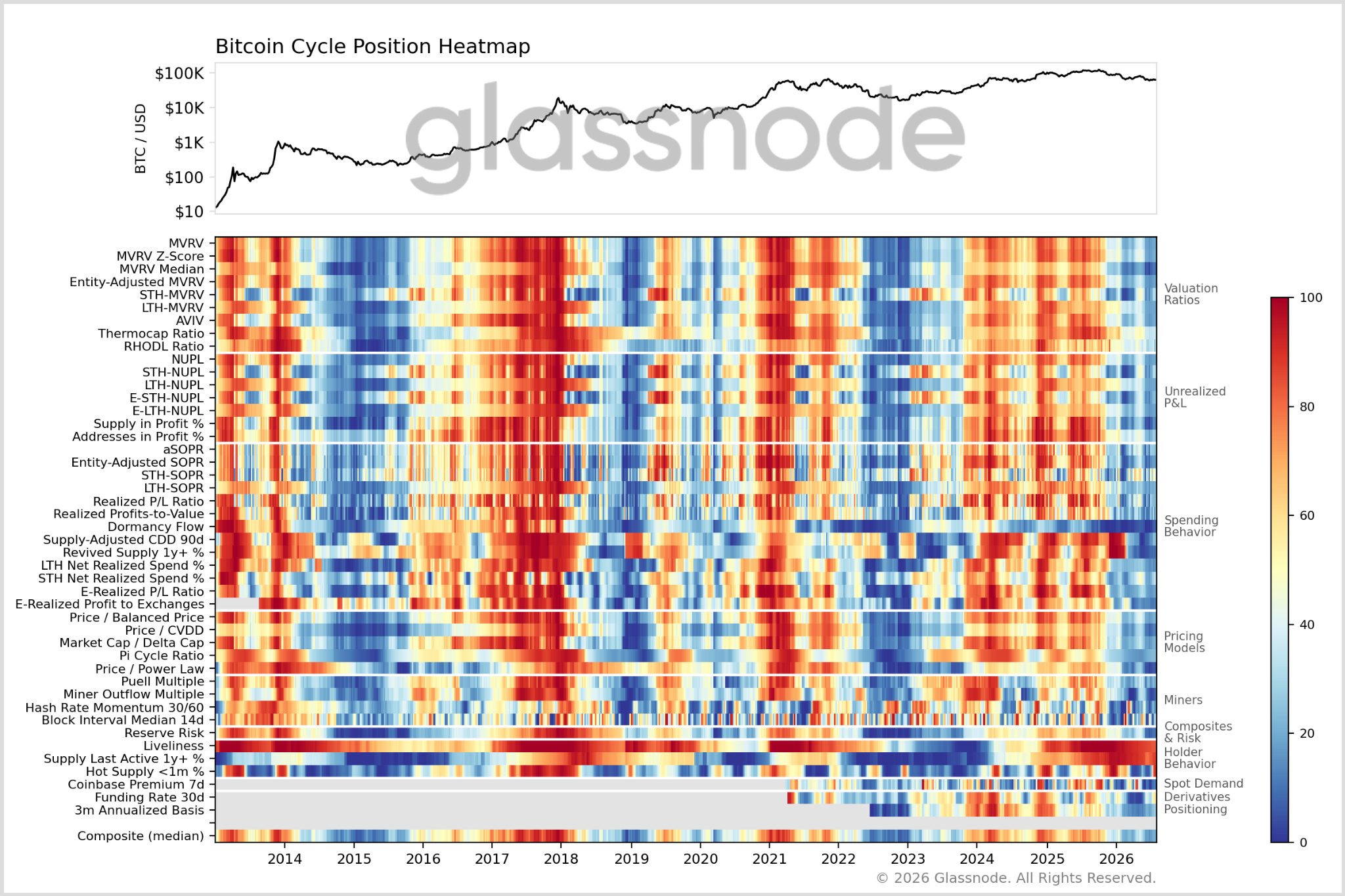
Bitcoin (BTC) is seeing its longest capitulation since the end of the 2022 bear market, onchain analytics platform Glassnode reported on Monday.
Key points:
- 45 Bitcoin price metrics tracked by Glassnode are in their longest “capitulation” phase since the collapse of FTX in late 2022.
- Aggregate readings still have to turn colder to match areas that marked previous bear-market bottoms, says creator Rafael Schultze-Kraft.
45 Bitcoin price metrics spend 2026 in “capitulation” zone
Glassnode’s Bitcoin Cycle Position Heatmap, a composite BTC price metric overview tool, has signaled capitulation throughout 2026.
The tool, created by the platform’s co-founder, Rafael Schultze-Kraft, combines data from 45 indicators to present an overall picture of market health as Bitcoin price cycles repeat. A majority blue heatmap indicates a period of “capitulation” within the cycle, with red pointing to the euphoria characteristic of momentum toward cycle peaks.
After a euphoric phase in November 2021, the heatmap flipped to blue for the majority of 2022. In November that year, cryptocurrency exchange FTX collapsed, an event that coincided with Bitcoin’s last bear-market bottom of $15,600.
“Today it sits in its coldest stretch since FTX: late in the bear, but not yet the unanimous deep blue that previously marked a floor,” Schultze-Kraft commented on the Heatmap’s latest readings.
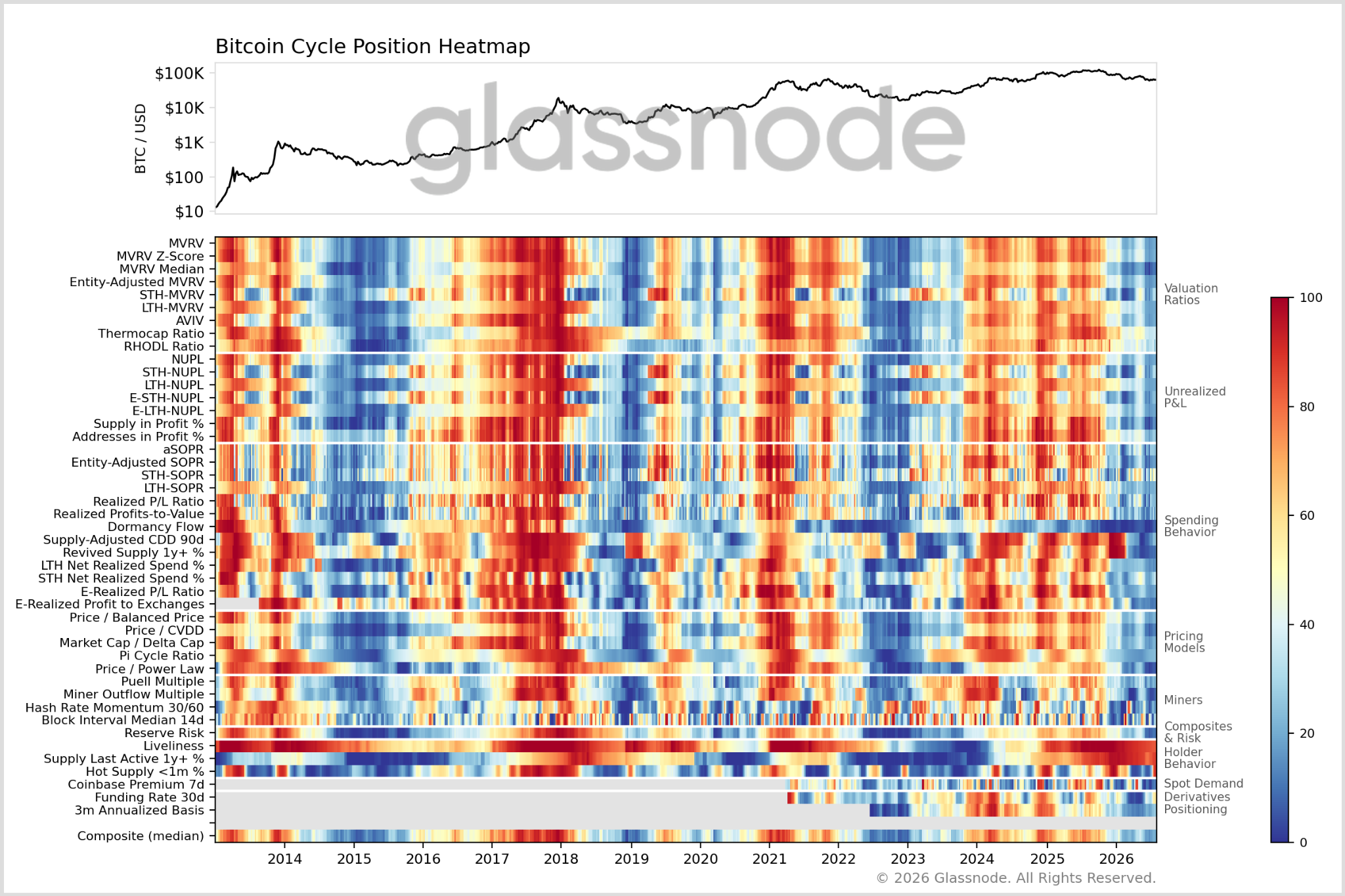
Bitcoin Cycle Position Heatmap. Source: Rafael Schultze-Kraft on X.com
In addition to basic price gauges such as market cap, the heatmap puts a considerable focus on the profitability of the Bitcoin investor base, dividing it into short-term (STH) and long-term (LTH) holders.
Certain metrics, Schultze-Kraft notes, change their behavior over time, requiring a more nuanced reading when used for cycle signals. Among these is dormancy — the number of days a unit of BTC has spent idle when used in an onchain transaction. Here, the ageing investor base means that dormancy increases over time, differing between cycles.
Coldcard hack spikes sub-1 BTC transactions
In its latest Market Pulse report released on Monday, Glassnode was complimentary regarding the resilience of market participants.
Related: US yen intervention puts Bitcoin, risk assets on notice for liquidity flux
“On-chain activity strengthened materially. Daily active addresses and entity-adjusted transfer volumes moved above their upper statistical bands, indicating a notable increase in network engagement and economic throughput,” it reported.
Stabilization of capital outflows remained despite a knee-jerk reaction by certain investors in the wake of the low-entropy bug exploit in Coldcard hardware wallets.
Data from analytics platform CryptoQuant likened the uptick in onchain transactions of 1 BTC or less to the aftermath of the FTX implosion. On July 31, the daily tally reached 39,600 BTC, compared with 39,900 on Nov. 16, 2022.
Crypto World
Swan Bitcoin CEO Cory Klippsten sees users embracing stronger safeguards after $100 million Coldcard exploit


A week on, nearly 90% of the stolen coins remain unmoved onchain, confirmed attacker addresses have been shared with U.S. federal law enforcement and Toronto-based Coinkite has patched every affected device line. A volunteer team funded by OpenSats scanned more than 150 open-source repositories and found no evidence the problem extended beyond Coldcard.
The exploit led some in the industry to question the value of self-custody, suggesting investors should consider buying bitcoin through, for example, exchange-traded funds rather than holding it themselves.
Klippsten, however, said clients are not retreating from self-custody. Instead, they’re examining ways of making their bitcoin harder to access.
“People are moving into Swan Vault right now,” he said, referring to the firm’s collaborative multisig product, where no single device can put a user’s funds at risk. “Instead of abandoning self-custody, many are upgrading it.”
His verdict on the week is measured optimism.
“It is awful that people lost coins, and they did everything right according to what a lot of well-known people in the industry told them. But Bitcoin is antifragile and the tools are getting stronger by the hour. This might end up being the best thing that ever happened to self-custody.”




Former LAPD reserve officer Eric Halem has been sentenced to life in prison plus 15 years for kidnapping and robbing a teenager of a hard drive containing about $350,000 worth of Bitcoin during a 2024 home invasion in Los Angeles.
Summary
- Former LAPD reserve officer Eric Halem has been sentenced to life plus 15 years for a Bitcoin related kidnapping and robbery.
- Prosecutors said a teenager was forced to hand over a hard drive containing about $350,000 worth of Bitcoin during the 2024 attack.
- Halem still faces separate criminal cases, while his alleged co defendants have yet to stand trial.
- The sentencing comes as U.S. authorities continue pursuing multiple violent cases involving the targeting of cryptocurrency holders.
According to the Los Angeles Times, Los Angeles County Superior Court Judge Mildred Escobedo imposed the sentence on Tuesday after rejecting Halem’s request for a new trial in the December 2024 robbery targeting a 17-year-old in Koreatown.
Bitcoin robbery case has resulted in life sentence
Court records cited by the publication show Halem received concurrent life sentences for kidnapping and robbery, along with an additional 15-year prison term. During the hearing, Judge Escobedo dismissed defense arguments that Halem’s original lawyers had failed to call witnesses and examine important evidence.
The judge said the trial evidence showed Halem acted out of “sheer and utter greed,” adding there could have been no other conclusion based on the facts presented in court.
A spokesperson for the Los Angeles County District Attorney’s Office told the newspaper that Halem must complete most of the 15-year sentence before serving the concurrent life terms. The spokesperson also said he will become eligible for parole after seven years.
The sentence follows Halem’s conviction in March, when a jury found him guilty after a two-week trial.
Prosecutors said teenager was forced to surrender Bitcoin hard drive
Prosecutors told the court that Halem and three alleged co-conspirators entered a high-rise apartment in Los Angeles and threatened to kill the victim unless he handed over a hard drive containing approximately $350,000 in Bitcoin.
The teenager, identified during the proceedings only as Daniel, surrendered the device after being threatened, according to evidence presented during the trial.
Although Halem had left the Los Angeles Police Department nearly two years before the robbery, the Los Angeles Times reported that he was still serving as a reserve officer when the crime took place.
The newspaper also reported that Halem continues to face separate criminal cases involving alleged insurance fraud and another crypto-related robbery. His three co-defendants have not yet gone to trial.
Crypto-related home invasions have continued across the US
The sentencing comes as U.S. authorities continue pursuing several violent cases involving cryptocurrency holders.
Earlier this month, federal prosecutors in Connecticut announced charges against three Missouri men accused of planning a home invasion to force a victim to transfer Bitcoin. According to the U.S. Department of Justice, Sedric Louis, John Davis and Martel Williams allegedly traveled to Connecticut in August 2024, rented vehicles, obtained air rifles and walkie-talkies, and watched their intended target and his parents before abandoning the plan after becoming concerned they had been captured by security cameras.
The Justice Department said the conspiracy case forms part of a larger investigation linked to a later kidnapping in Danbury, where another group allegedly targeted the parents of a person connected to the theft of hundreds of millions of dollars in Bitcoin. The three Missouri defendants have pleaded not guilty, while prosecutors have already secured guilty pleas from Adam Iza and Saif Faiq over related Hobbs Act conspiracy charges.
Several months earlier, federal prosecutors also charged three Tennessee men over another alleged cryptocurrency robbery operation in California.
According to the Justice Department, Elijah Armstrong, Nino Chindavanh and Jayden Rucker posed as delivery workers to enter or attempt to enter homes in San Francisco, San Jose, Sunnyvale and Los Angeles. Prosecutors alleged the group restrained victims with firearms, duct tape and zip ties before demanding access to cryptocurrency accounts.
In one alleged incident, authorities said a victim was forced to log into crypto accounts while another participant transferred about $6.5 million in digital assets to a wallet controlled by the group. All three defendants have pleaded not guilty and remain entitled to the presumption of innocence unless proven guilty in court.
Investigators have tracked more attacks targeting crypto holders
The California and Connecticut prosecutions have been among several recent cases in which investigators say cryptocurrency investors were selected because of their digital asset holdings rather than traditional valuables.
Federal prosecutors have increasingly relied on Hobbs Act robbery charges in cases involving alleged kidnappings and forced cryptocurrency transfers, while state prosecutors have pursued separate robbery and kidnapping charges where the facts support them.
Outside the United States, authorities have also reported an increase in physical attacks targeting crypto holders. French prosecutors have charged dozens of suspects in separate investigations involving alleged kidnappings and attempts to force victims to surrender access to cryptocurrency wallets, while investigators have continued warning that organized groups are using violence alongside digital theft methods.


Arthur Hayes thinks everyone has the AI trade filed under the wrong category.
In a new essay, the co-founder of crypto exchange BitMEX and crypto fund Maelstrom said the ongoing infrastructure buildout is a credit story like 2008, not an earnings story like the 2000 dot-com bust.
Hyperscalers, or computing frms borrow against their massive data centers, are stuffed with chips that depreciate fast, and lenders bankroll it believing they are financing technology when the underlying asset is closer to real estate.
The break comes when announced capex stops accelerating, which he pegs for late 2027 into 2028. Credit keeps flowing well past that point, the way mortgage lending did into 2007, until the weakest AI debt cracks and drags down whoever is over-levered on it.
Hayes expects Washington and Beijing to backstop the wreckage in the name of national security, printing more than they did in 2008, and that flood of liquidity is what bottoms bitcoin and drives it toward $1 million.
The nearer-term call is that the recent AI selloff, Korea’s leveraged unwind included, is a dip inside a bull market.
Bitcoin traded near $64,200 on Wednesday, flat on the week and still stuck in the range it has held since May.
“I don’t think the 500-day rule will be as relevant in the current cycle. BTC is now primarily institutionally driven. ETF inflows have dwarfed the halving supply shock.”
Following the April 2024 halving, bitcoin miners produced about 450 BTC per day, worth about $35 million to $40 million, Fernandes said. By comparison, the daily spot bitcoin ETF flows in 2024 and 2025 ranged from about $100 million to $1 billion, he added.
The contrast suggests ETF flows now outweigh the new supply created by miners, blunting the halving’s direct impact. Additionally, those flows can also reverse, adding selling pressure on the price of bitcoin, as seen recently, making these ETF moves a dominant force in price moves.
Aryan Sheikhalian, investor and head of research at CMT Digital, agreed with Greenspan and Fernandes, saying the mechanism and fundamentals that have historically driven the bitcoin halving cycle are fading.
“New supply from miners is de minimis next to spot bitcoin ETFs and corporate U.S. Treasury flows, and those flows set both the top and this year’s unwind,” Sheikhalian said.
There are, however, still some believers in this four-year cycle of halving, and its historical impact and miner economics remain fundamental mechanics of the bitcoin market.


Shaw Walters, founder of Eliza Labs and the open-source ElizaOS framework, has declared the Eliza token “dead” and confirmed the foundation has begun winding down after settling a lawsuit by transferring its remaining treasury and available funds.
Summary
- Eliza founder Shaw Walters has declared the project’s token dead and said the foundation is winding down after a legal settlement.
- Walters said the remaining treasury was transferred to settle a lawsuit brought by Burwick Law because the project could not afford to fight the case.
- Foundation support, buybacks and other token backing have ended, with Walters saying he will not launch another Eliza linked token.
- Development of the open source ElizaOS AI agent framework will continue independently under Walters despite the token’s shutdown.
According to a post published by Walters on X, the settlement followed a lawsuit brought by Burwick Law, which he said the project could not afford to contest despite believing the claims lacked merit. He added that the agreement transferred “the rest of the treasury and all the money” the foundation had to a group of token holders.
The announcement ends foundation support for the token while separating its future from the Eliza open-source software project, which Walters said will continue under his control because he owns the underlying intellectual property. He said he has no intention of supporting another token tied to Eliza.
Burwick lawsuit led to treasury settlement
Burwick Law filed a federal class action lawsuit in April in the U.S. District Court for the Southern District of New York against Walters, Eliza Labs and affiliated parties. The complaint accused the project of false advertising, deceptive acts and practices, negligent misrepresentation and unjust enrichment.
According to the lawsuit, the project promoted itself as an autonomous AI-managed venture fund governed by an independent AI agent while allegedly remaining under the control of Walters and other insiders. The filing also challenged the project’s token migration from ai16z to ElizaOS, claiming the process diluted existing holders after venture capital firm Andreessen Horowitz objected to the original ai16z branding.
Walters said on X that the project lacked the financial resources to continue the legal fight and instead settled by handing over the remaining treasury.
He also rejected suggestions that he personally profited from the project, saying he never sold his ai16z holdings and received only what he described as a modest salary comparable to other engineers on the team.
Eliza token support has ended
Alongside confirming the foundation’s closure, Walters said holders should not expect buybacks, treasury support or any mechanism designed to support the token’s price.
He wrote that the token is “dead” and described it as “completely ngmi,” adding that he no longer owns any tokens and will not back the asset in the future. Walters advised holders to either sell their tokens or manage them independently because, according to him, there is no foundation left to provide financial support.
His post also blamed what he described as speculative trading culture and constant criticism from parts of the crypto community for influencing his decision to leave token-related projects behind. Walters argued that much of the criticism came from investors unwilling to accept losses from speculative trading rather than from people interested in the technology itself.
According to the statement, he has ruled out launching another token connected to Eliza and said any future work around the project will remain separate from crypto assets.
ElizaOS development will continue without a token
While ending support for the token, Walters said development of ElizaOS itself will continue.
He said his long-term focus remains building open-source AI agent software capable of giving users greater control over their own data and enabling locally operated, crypto-enabled AI agents. He added that Eliza would continue building independently even if another open-source project eventually surpassed it, saying the team would contribute to whichever open-source effort best advanced the technology.
The comments are consistent with the direction the project outlined earlier. In January 2025, ElizaOS released a technical whitepaper describing the platform as an open-source operating system for AI agents capable of interacting with blockchain networks, smart contracts and decentralized applications.
The paper said the framework was built with a modular architecture consisting of a Runtime, Adapter, Character, Client and Plugin system, allowing developers to customize AI agents without modifying the core software. It also outlined support for ecosystems including Solana, Ethereum and TON, alongside integrations with AI models from OpenAI, Llama and Qwen.
At the time, the roadmap also included Hierarchical Task Networks, a planning system intended to help AI agents break complex objectives into smaller executable tasks.
Eliza project has changed since the ai16z launch
The project first launched on Solana in October 2024 as ai16z, presenting itself as an AI-managed decentralized autonomous organization and venture-style investment fund where an autonomous AI agent would help guide investment decisions and governance.
Its identity expanded during the rebrand to ElizaOS in early 2025, when the project repositioned itself as a platform for creating, deploying and managing AI agents rather than focusing on a single AI-managed investment vehicle.
The migration also increased the token supply from 6.6 billion to 11 billion units, with circulating supply rising to about 7.4 billion tokens, according to project documentation released during the transition. Developers said the expanded platform would allow AI agents to be created, tokenized and deployed across different use cases while continuing development of the underlying open-source framework.
Although the foundation is now being wound down, Walters said the engineering work will continue. In his post, he described artificial intelligence development as more constructive than the current crypto environment and said his team would keep building Eliza every day without returning to a foundation-backed token model.


MEXC, a pioneer in 0-fee digital asset trading, today unveiled MEXC 0808: Stock Season, the inaugural edition of its annual brand celebration centered on 0 Fees and Infinite Opportunities. Early bird registration is now open, ahead of the main campaign launch on August 8, offering participants the opportunity to compete for a share of a $500,000 prize pool.
The launch establishes MEXC 0808 as an annual brand milestone built around 0 Fees and Infinite Opportunities. Zero fees are not limited to a single campaign period. They represent a value that MEXC continues to deliver throughout the year by reducing trading costs and making more markets accessible. Each August 8, MEXC will bring this commitment into focus through new products, market opportunities and user rewards. In 2025 alone, MEXC’s 0 Fee strategy saved 3.44 million users a total of more than 1.1 billion USDT in trading fees.
This year, MEXC introduces Stock Season as the first 0808 theme, reflecting the rapid growth of stock trading on crypto exchange infrastructure. A recent report jointly released by MEXC and CoinGecko found that U.S. stock trading volume across six major centralized exchanges rose 337.4% month over month to $189.84 billion in June 2026. U.S. stocks accounted for 48.3% of total TradFi trading volume and became the market’s largest traditional asset category for the first time.
“0808 brings together the two values at the center of MEXC, 0 Fees and Infinite Opportunities. It represents more than a campaign. It is a celebration of the values that define MEXC,” said Vugar Usi Zade, CEO of MEXC. “Our commitment to 0 Fees is about removing barriers, while Infinite Opportunities is about helping users access more markets, more products and more ways to participate in the global financial system. Every year, MEXC 0808 will showcase how we continue delivering on those commitments. Through Stock Season, we are giving users more ways to discover and participate in opportunities across the global equity market.”
MEXC has expanded its stock offering to provide access through different product formats and investment stages. Alongside RealStocks, which provides access to more than 7,000 U.S. stocks and ETFs, MEXC offers over 200 stock and index futures products, more than 200 tokenized U.S. equities, and Pre-IPO Launchpad opportunities. Together, these products provide users with access to real shares, derivatives, tokenized exposure and early stage investment opportunities through a single account. In June 2026, MEXC’s stock and index futures trading volume increased approximately 261% month over month, highlighting growing demand for stock related products among crypto investors.
To celebrate Stock Season, MEXC will offer 0 Fees across Stock Futures, Tokenized Stocks and RealStocks, helping users participate in global stock opportunities at lower cost during one of the year’s most active market periods. Early bird registration runs from August 5 at 08:08 UTC to August 8 at 08:07 UTC. During this period, users can invite friends to join MEXC through referral actions such as registration or an initial deposit. Each successful referral earns one raffle ticket, with a maximum of three tickets available per user.
The main campaign runs from August 8 at 08:08 UTC to August 28 at 23:59 UTC. Participants can explore an Opportunity Map featuring eight tasks, including sharing the campaign page, trading stock related products and inviting friends. Completing these tasks earns additional raffle tickets, which can be used together with tickets collected during the early bird period. Participants can then use their tickets to draw from a range of rewards, including an ∞ Dream Fund reward of up to $3,888, an $88 Stock Futures position, APR boosters of up to 888%, and other exclusive campaign prizes.
For more details and to participate, please visit here.
About MEXC
MEXC is one of the world’s fastest-growing cryptocurrency exchanges, trusted by more than 40 million users across 170+ markets. Built on a user-first philosophy, MEXC offers industry-leading 0-fee trading and access to over 3,000 digital assets. As the Gateway to Infinite Opportunities, MEXC provides a single platform where users can easily trade cryptocurrencies alongside tokenized assets, including stocks, ETFs, commodities, and precious metals.
MEXC Official Website| X | Telegram |How to Sign Up on MEXC
Risk Disclaimer:
This content does not constitute investment advice. Given the highly volatile nature of the cryptocurrency market, investors are encouraged to carefully assess market fluctuations, project fundamentals, and potential financial risks before making any trading decisions.
The post MEXC 0808 Debuts as an Annual Brand Event With Stock Season and a $500,000 Prize Pool appeared first on BeInCrypto.
After testing the $62,000 support on a couple of occasions since August began, bitcoin has managed to weather the storm and now sits above $64,000 as markets expect a Strait of Hormuz deal to be announced today.
Most larger-cap alts have produced contracting performances over the past day. XMR, XRP, and XLM are in the red, while HYPE and ZEC have posted notable gains.
BTC Reclaims $64K
The US Federal Reserve FOMC meeting brought some intense volatility to the crypto market, as BTC slumped from $65,600 to $62,800 before the event, and then jumped back to over $65,000 a day after it. However, the predominantly bearish market sentiment prevailed, and the asset was rejected at $65,300 on Friday morning.
The subsequent rejection was quite painful, as bitcoin dropped to $62,400 within hours. Its rebound attempt on Saturday was halted at $63,200, and it fell to $62,200 on Saturday evening for the first time in about a month. A more successful recovery took place on Sunday morning after US President Donald Trump called off the planned strikes against Iran.
However, another leg down followed on Monday with a fresh dip to $62,200. The bulls finally intervened at this point and helped BTC surge to $64,000 by the end of the day. Its recovery continued in the past 24 hours as it now sits above $64,000, as reports suggested an upcoming deal for the reopening of the Strait of Hormuz.
Its market cap has neared $1.290 trillion, while its dominance over the alts has climbed to over 57% on CG.

HYPE, ZEC Jump
ETH, BNB, and SOL are slightly in the green daily, while XRP, TRX, DOGE, RAIN, ADA, XMR, and XLM are all in the red. XMR and XLM stand out as the tokens with the most substantial losses.
In contrast, ZEC and HYPE have outperformed all other larger-cap alts. Zcash has risen by over 6.5% to $520, while Hyperliquid’s token has tapped $58. PUMP is the only double-digit gainer today, soaring by 12% to $0.0025. LIT, ONDO, and PI are also in the green.
The total crypto market cap has added another $30 billion daily, and is up to $2.260 trillion on CG.

The post Big Gains From ZEC and HYPE, BTC Price Stable Above $64K: Market Watch appeared first on CryptoPotato.

At Close of Business podcast August 5 2026

Taiwan moves to enforce Travel Rule across domestic crypto platforms

8 Most Universally Beloved Movie Trilogies of All Time


-

 Business7 days ago
Why Trees Belong on the Risk Register
-

 Fashion5 days ago
Weekend Open Thread: Wit & Wisdom
-

 Politics5 days ago
Meta enters AI-training agreement with far-right ‘propaganda rag’ Newsmax
-

 Politics7 days ago
Reform UK betrays West Mids residents by running from party pledges
-

 Politics3 days ago
Zack Polanski: an incitement to murder Nigel Farage?
-

 Crypto World4 days ago
MicroStrategy Post-Earnings CLARITY Act Push Could Add New Catalyst for Its Stock
-

 Crypto World4 days ago
XRP Ledger v3.3.0 brings five institutional features
-

 News Videos6 days ago
Bitcoin Enters the 3rd Stage of the Bear Market
-

 Politics6 days ago
Luke Littler’s dominance sparks GOAT debate
-

 Sports5 days ago
Seema Kaliramna Wins Discus Throw Bronze, Takes India’s CWG Medals Tally To 17
-

 Crypto World4 days ago
New York sues Kalshi over prediction market gambling
-

 Crypto World3 days ago
Crypto PAC spending tops $2M in Michigan House race
-

 Tech7 days ago
Gemini can now summarize the messiest comment threads in Google Docs
-

 Business5 days ago
Trump Announces Hamas Disarmament Agreement as Iran Strikes Kuwait Air Base and US Attacks Pause Overnight
-

 Tech3 days ago
ESET tracks rise in malicious AI skills and adaptable malware
-

 Business2 days ago
DTCR: Deleveraging And A Hedge Fund Collapse Point To A Possible AI Bottom
-

 Tech5 days ago
Gemini Spark can now use Chrome logins and saved passwords to run errands on your behalf
-
 Tech5 days ago
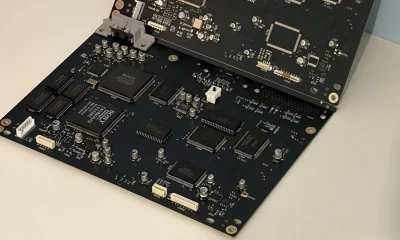
Building A Reproduction PlayStation Motherboard
-

 Sports7 days ago
Sakshi, Arundhati Enter Boxing Semi-Finals. India Assured Of 18 Medals At CWG 2026
-

 NewsBeat6 days ago
Four people die trying to cross Channel in small boats
You must be logged in to post a comment Login