
Crypto World
Ngozi Okonjo-Iweala




S&P Global Ratings assigned its highest principal stability fund rating to BlackRock’s new tokenized money market fund.
The ratings provider assigned an “AAAm” rating to the BlackRock Daily Reinvestment Stablecoin Reserve Vehicle (BRSRV) on Monday, citing the creditworthiness of its investments and counterparties, its maturity structure and management’s ability to maintain a stable net asset value.
S&P said it identified “no weaknesses” in its qualitative assessment of BlackRock Advisors’ management and organization, credit research and analysis, risk management and compliance.
The ratings provider also described the fund’s tokenization framework as operationally resilient, citing controls intended to mitigate cyber, smart contract and blockchain network risks. The fund uses a permissioned architecture that restricts transactions to whitelisted wallets.
BRSRV launched on Monday as an open-end management investment company, which seeks to operate so that its shares qualify as eligible reserve assets for payment stablecoin issuers under the GENIUS Act.
The fund will hold cash, US Treasury securities maturing in 93 days or less and overnight repurchase agreements secured by Treasury instruments. It will maintain a weighted average maturity of no more than 60 days and a weighted average life of no more than 120 days.
Related: Jim Cramer plans to sell his Bitcoin over quantum fears as BTC rises 1.6%
USDT remains among S&P’s lowest-rated stablecoins
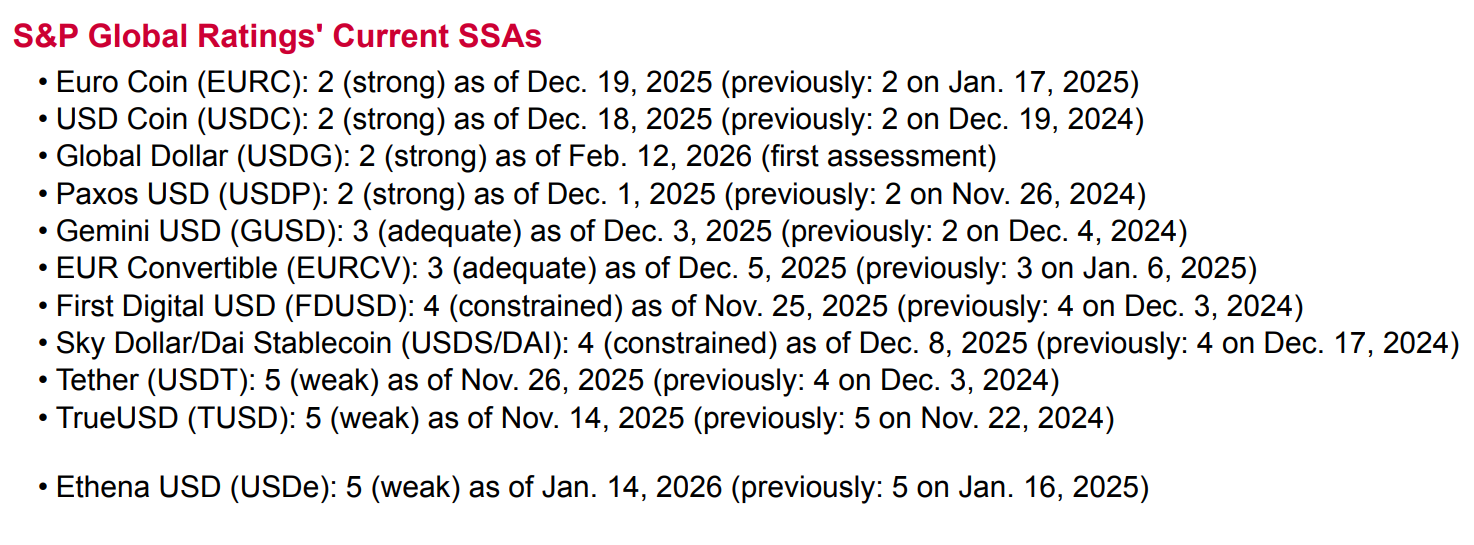
Separately, S&P Global on Tuesday published a summary of its current Stablecoin Stability Assessments, saying six of the 11 stablecoins it covers have an “adequate” or stronger ability to maintain their pegs to fiat currencies.
S&P said two assessments had been revised lower over the previous three quarters, while the other nine remained unchanged.
Tether’s USDt (USDT) remains at 5, or “weak,” after S&P lowered its assessment from 4, or “constrained,” in November 2025. TrueUSD (TUSD) and Ethena USD (USDe) are also assessed at 5.
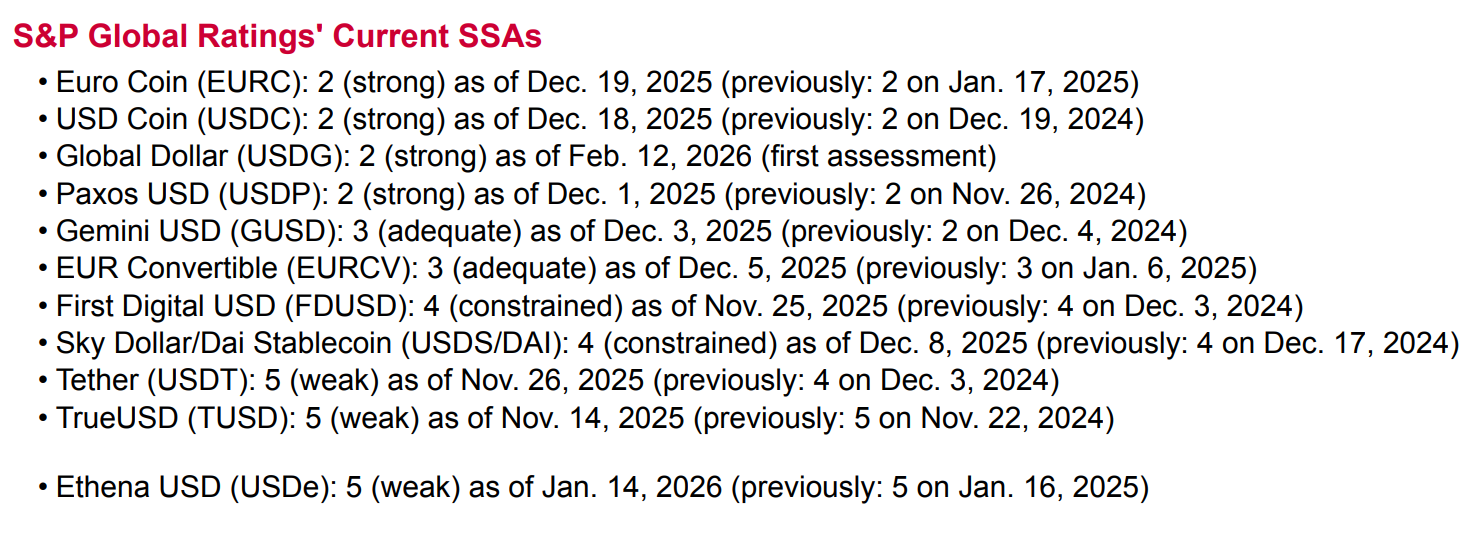
S&P Global Ratings’ current SSAs. Source: S&P Global Ratings
Euro Coin (EURC), USD Coin (USDC), Global Dollar (USDG) and Paxos USD (USDP) are assessed at 2, or “strong.” Gemini USD (GUSD) and EUR Convertible (EURCV) are assessed at 3, or “adequate.”
First Digital USD (FDUSD) and Sky Dollar/Dai (USDS/DAI) are assessed at 4, or “constrained.”
S&P launched the assessment framework in December 2023. Its analysis considers the assets backing a stablecoin, liquidity, governance, redemption arrangements, legal and regulatory protections, technology dependencies and the issuer’s track record. Assessments range from 1, or “very strong,” to 5, or “weak.”
The AAAm rating assigned to BlackRock’s fund is separate from S&P’s stablecoin assessments. Principal stability fund ratings measure a fixed-income fund’s capacity to maintain a stable net asset value and limit exposure to principal losses due to credit risk.
Magazine: Why Peter Thiel’s Founders Fund walked away from an Ether treasury bet

Eric Halem, a former Los Angeles Police Department officer with 13 years of experience, was sentenced for orchestrating a fake police raid that ended with the theft of $350,000 in BTC from a teenage crypto investor.
Halem was sentenced to life in prison plus another 15 years for his role in the violent home invasion, which became one of the most high-profile crypto-related robbery cases in recent years.
Halem remained a reserve officer at the time of the crime and was convicted of kidnapping and robbery after a jury found that he and several accomplices impersonated actual police officers to gain access to the victim’s apartment in late 2024.
Prosecutors argued that the group entered a high-rise apartment in Los Angeles’ Koreatown while wearing police-identifying vests and carrying LAPD-issued handcuffs. They restrained the teenager and his girlfriend and threatened to shoot them if they didn’t give access to a hard drive containing $350,000 worth of bitcoin.
“It is not that I have a higher standard for Mr. Halem (because he used to be a police officer); it is the facts of this case that are an affront to the court and should be an affront to the public,” commented Los Angeles County Superior Court Judge Mildred Escobedo.
Interestingly, the victim admitted during the process that his BTC earnings came from fraudulent activity, which was the defense’s main counterargument. Escobedo, on the other hand, responded that this doesn’t excuse Halem’s actions and must still be held accountable.
The post Ex-LAPD Officer Gets Life in Prison After Posing as Police to Steal $350K Worth of BTC appeared first on CryptoPotato.


US prosecutors have charged three Missouri men for allegedly joining a 2024 plot to rob a Connecticut man of hundreds of millions of dollars in stolen Bitcoin (BTC) by threatening his family.
The US Attorney’s Office for the District of Connecticut announced the indictment on August 4. Sedric Louis, 32, John Davis, 34, and Martel Williams, 27, are all from St. Louis.
Robbery Plot Sought to Force Bitcoin Transfer Through Family
Prosecutors say the intended target had participated in the theft of hundreds of millions of dollars in Bitcoin. According to the indictment, the plot’s coordinators allegedly recruited the trio to steal some of the Bitcoin.
Between August 21 and August 24, 2024, the men traveled to Connecticut. They obtained rental vehicles and supplies, including air rifles and walkie-talkies.
The group then stalked the target and his parents over two days. They planned to force their way into the family home and demand the transfer of the stolen cryptocurrency. The funds would move into accounts controlled by the scheme’s coordinators.
However, the three men abandoned the plan and left the state. Prosecutors say they feared home security cameras had captured them and grew frustrated by poor communication with co-conspirators.
Follow us on X to get the latest news as it happens
Kidnapping Followed Days Later
Shortly afterward, another crew from Florida arrived to carry out the plan. On August 25, 2024, Danbury Police arrested six Florida men over a violent carjacking of a Lamborghini Urus. The attackers allegedly beat and kidnapped the target’s parents during the carjacking.
Alleged coordinators James Schwab, Adam Iza, and Saif Faiq were charged earlier. A grand jury in New Haven returned the second superseding indictment against the Missouri trio on May 22, 2026. Each man faces a Hobbs Act robbery conspiracy charge carrying up to 20 years in prison.
Louis and Davis have remained in custody since their arrests on June 25, 2026. Both pleaded not guilty in Bridgeport federal court on July 30. Williams entered a not guilty plea on July 17 and was released on bond.
Meanwhile, US Attorney David X. Sullivan stressed that an indictment is not evidence of guilt. The six Florida men arrested over the kidnapping have already pleaded guilty, according to earlier statements from the authorities.
Subscribe to our YouTube channel to watch leaders and journalists provide expert insights
The post US Charges 3 Men in Failed Bitcoin Robbery Tied to Crypto Theft appeared first on BeInCrypto.
Kansas City Federal Reserve President Jeff Schmid said Tuesday that monetary policy is not restrictive and that returning inflation to 2% will require tighter policy.
His remarks came less than a week after the Fed held interest rates at 3.50%-3.75%, a decision that three officials opposed, favoring a quarter-point hike.
Schmid Sees No Restriction in Current Policy
Speaking at a Kansas City Fed event in Omaha, Schmid said inflation remains his primary concern. This comes as price growth has exceeded the Fed’s target for more than five years.
“Given the strength of demand and investment, I do not see the current stance of monetary policy as restrictive. As such, I believe that bringing inflation down to the Fed’s 2% objective will require tighter policy,” he said.
Schmid also cautioned against treating supply-driven price inflation pressures as temporary. He argued that such shocks produce larger inflation surges when demand stays strong.
Schmid does not vote on rate decisions this year. However, his stance echoes the three dissenters who split the FOMC 9 to 3 last week. The decision has already rattled investors, sending the Dow sliding and 30-year Treasury yields to 2007 highs.
Follow us on X to get the latest news as it happens
Paulson Holds the Line as Markets Price a September Hike
Meanwhile, Philadelphia Fed President Anna Paulson took a different stance, telling CNBC that policy is already mildly restrictive. She estimated underlying inflation between 2.4% and 2.8% once tariff and energy shocks are stripped out.
Still, Paulson left no room for easing. Without further progress, she said, recalibration could mean higher rates or the same rates for longer.
“I’m keeping an open mind about what’s going to be appropriate,” she mentioned.
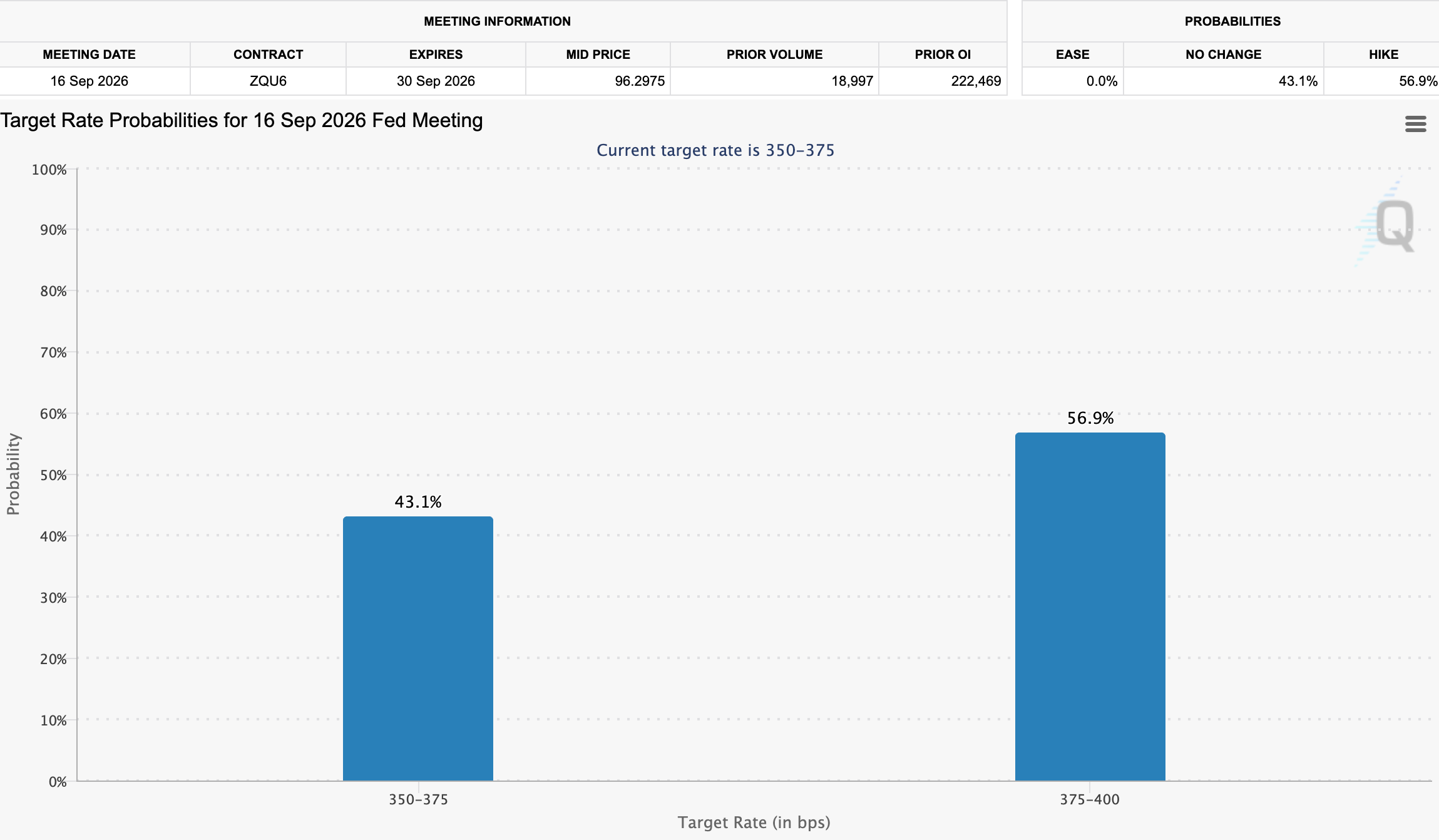
Traders lean toward the hawks. CME FedWatch data show a 56.9% probability of a quarter-point hike in September, rising to 83.2% odds of at least one increase by December.

Whether the hawks prevail may hinge on the next inflation prints. Hotter readings would strengthen Schmid’s case and deepen pressure on rate-sensitive assets, including crypto.
Subscribe to our YouTube channel to watch leaders and journalists provide expert insights
The post Fed’s Kansas City President Says Rates Aren’t High Enough to Beat Inflation appeared first on BeInCrypto.

Ripple XRP price is trading at $1.0648 with a –1.22% drawdown over the last 24 hours, and the chart is not sending any signals worth buying ahead of.
The token has spent weeks grinding near the bottom of a range that stretches all the way down from highs above $2.50, with each attempted recovery fading before $1.10. What happens at the $1.05–$1.06 support band over the next 48 hours will likely define the next meaningful move.
XRP has printed a narrow consolidation near the lows with no confirmed reversal structure. Derivatives markets offer little conviction either way: funding rates are close to neutral, leverage has pulled back, and liquidation activity has been relatively balanced.

That’s not a recipe for a quick squeeze, in either direction. Broader crypto sentiment and market cap data show XRP holding sixth place overall, with a market cap of roughly $66B and 24-hour volume near $977 million.
The Ripple-SEC regulatory overhang remains the macro backdrop; there have been no new filings in the past 48 hours, but final resolution uncertainty continues to cap institutional enthusiasm. If broader risk appetite turns, XRP will feel it first.
Discover: Everyone’s Got a Take. Get Free $25 to Actually Trade Yours
Can XRP Price Recover Above $1.10 This Week?
XRP price is trading at $1.0648, sitting uncomfortably close to the support zone that has held since late June. The $1.05 to $1.06 band has attracted buyers on multiple tests, including a brief violation on July 28 that reversed quickly.
That bounce did not stick above $1.10, the level that actually matters for any bullish narrative to gain traction.
Daily RSI stands at 43.71, below both the neutral 50 level and its own moving average of 44.87. Not oversold. Just weak. MACD tells a similar story.

The MACD line is printing near -0.0110, barely below the signal line at -0.0101, with a histogram reading of roughly -0.0009. Momentum is soft rather than collapsing, which is arguably the more frustrating setup for traders looking for a clear directional entry.
XRP holding $1.06 on a daily close, volume picking up to signal genuine buying interest, and price reclaiming $1.10 reopens the $1.18 to $1.20 range, with the likely catalyst being a macro risk-on shift or a Ripple-SEC development.
Continued range trading between $1.05 and $1.10, with low conviction on both sides, is the more likely near-term path, given neutral derivatives and fading volume. A daily close below $1.05 exposes the psychological $1.00 level and the late-June lows near $1.01. The July 28 wick showed buyers exist there, but a second test of that area rarely holds as cleanly as the first.
The setup favors patience. AI-driven price models for XRP’s 90-day trajectory have also flagged this consolidation zone as a decision point, aligning with what the raw chart is showing. XRP price could resolve either way. But the burden of proof is on the bulls.
Discover: Your Market Calls Are Worth Something. Start With Free $25 on Kalshi
Maxi Doge Targets Early Mover Upside as XRP Tests Key Levels
XRP at $1.06 with RSI sub-45 and no fresh catalyst is a holding pattern, not a conviction trade. For capital that’s already sitting on the sidelines while waiting for a directional break, early-stage presale exposure has been attracting attention, particularly from traders who’ve watched large-cap altcoins underperform while sub-$1M mcap launches run multiples in the same window.
Maxi Doge (MAXI) is a meme token built on Ethereum that has carved out a distinct lane: it targets the overlap between leverage-trading culture and meme-coin community mechanics (a niche that, frankly, has more overlap than most analysts want to admit).
The project has raised $4,835,662.79 at a current presale price of $0.0002832, with a dynamic staking APY available to presale participants. Features include holder-only trading competitions with leaderboard rewards, a Maxi Fund treasury allocated to liquidity and partnerships, and a meme-first marketing approach that’s generated organic traction without paid distribution.
Tokenomics and launch execution still carry standard presale risk; this is early-stage capital, not a liquid position, but the raised figure and community-driven structure give it more infrastructure than most meme launches at this stage. Traders looking for asymmetric setups while XRP consolidates should research Maxi Doge at MaxiDogeToken.com.
Discover: Get Paid to Be Right, $25 to Start on Kalshi
Don’t Miss Out on Our $1,000 USDT Airdrop on ByBit
The post XRP Price Is Stuck Grinding Near Multi-Week Lows: What Happens at $1.05 Next? appeared first on Cryptonews.


Taiwan has proposed mandatory customer information sharing for all domestic crypto platform transfers, with new Travel Rule requirements scheduled to begin in October.
Summary
- Taiwan has proposed mandatory customer information sharing for all domestic crypto platform transfers starting in October.
- Transfers above NT$30,000 would require additional sender identification, while receiving platforms must verify beneficiary details.
- The Financial Supervisory Commission plans to extend the Travel Rule requirements to cross border VASP transfers by the end of 2027.
- The proposal builds on Taiwan’s new Virtual Asset Service Act, which introduced a full licensing framework for crypto businesses in July.
According to Taiwan’s Financial Supervisory Commission (FSC), draft amendments released on Tuesday would require virtual asset service providers (VASPs) to exchange customer information for every transfer between domestic crypto platforms, regardless of transaction value.
The regulator said transfers above 30,000 New Taiwan dollars (about $930) would face additional identification requirements before they could be processed.
The proposal would also require receiving VASPs to verify that beneficiary details provided by the sending platform match the information held in their own records. The FSC said the amendments will enter a 30-day public consultation before any final rules are adopted.
Taiwan expands Travel Rule requirements
Under the proposed framework, platforms handling transfers above the NT$30,000 threshold would need to transmit more detailed customer information.
For individual senders, the FSC said platforms must provide the customer’s date of birth and residential address alongside existing transfer information. Corporate senders would instead need to disclose their official identification number and registered business address.
Receiving platforms would no longer be limited to accepting transmitted information. The proposal requires them to compare beneficiary information received from the originating VASP against their own customer records before completing the transaction.
The regulator also outlined the next phase of the rollout. While the October changes apply to transfers between Taiwanese crypto platforms, the FSC said it intends to extend the same framework to transactions involving domestic and overseas VASPs by the end of 2027.
Taiwan’s crypto rules have moved beyond AML registration
The latest proposal follows Taiwan’s recent overhaul of its cryptocurrency regulatory framework.
In July 2026, Taiwan passed the Virtual Asset Service Act, replacing the country’s previous anti-money laundering registration model with a licensing system covering exchanges, trading platforms, custodians, transfer providers and other crypto businesses. The legislation also introduced operational standards covering cybersecurity, customer asset segregation, internal controls, financial reporting and market conduct.
Under the law, crypto firms must obtain approval from the FSC before operating, while businesses already registered under Taiwan’s earlier AML regime were given a transition period to secure full licenses.
The legislation also introduced dedicated rules for stablecoin issuers. Before issuing tokens in Taiwan, companies will need approval from both the FSC and Taiwan’s central bank while maintaining fully backed reserves held in trust and subject to audits and public disclosure requirements.
Alongside licensing, the Virtual Asset Service Act established criminal penalties for unlicensed crypto activity, illegal stablecoin issuance, fraud and market manipulation, replacing what had been a largely AML-focused compliance framework.
Earlier Travel Rule plans faced implementation hurdles
Taiwan had already incorporated Travel Rule provisions into its anti-money laundering regulations in 2021, but the requirements were never implemented.
The FSC said differences in regulatory approaches across jurisdictions, incompatible information-sharing standards and technical challenges in connecting cross-border systems prevented authorities from putting the framework into practice at the time.
The regulator now plans to introduce domestic requirements first before extending them to international transfers over the next year.
Separately, the Financial Action Task Force (FATF) reported in July that implementation of the Travel Rule has continued to expand worldwide. According to the international standard-setting body, 83% of surveyed jurisdictions have now enacted Travel Rule legislation, up from 73% in 2025.
Despite the increase, the FATF said implementation remains uneven because many jurisdictions still face enforcement and operational challenges after adopting the legal framework.
Crypto oversight has become a larger policy focus
Taiwan’s crypto policy has expanded well beyond licensing and anti-money laundering requirements over the past year.
In December 2025, the Ministry of Justice disclosed that it was holding 210.45 BTC and other cryptocurrencies seized during criminal investigations, including stablecoins, Ether, BNB, Tron and Livepeer. The ministry said the assets remain under government custody while authorities evaluate options such as public auctions, with no final decision having been made on their disposal.
The disclosure also prompted debate inside Taiwan’s legislature after lawmaker Ko Ju-Chun urged policymakers to study whether Bitcoin could serve as part of the country’s strategic reserve assets.
At roughly the same time, Taiwan’s central bank called for a formal role in supervising stablecoin issuers, arguing that reserve management and payment system risks required direct oversight alongside the FSC. Many of those proposals were later incorporated into the Virtual Asset Service Act passed in July, giving the central bank responsibility over stablecoin approvals together with the financial regulator.
Bitcoin price-metric basket sees longest capitulation since FTX blow-up: Glassnode
Bitcoin (BTC) is seeing its longest capitulation since the end of the 2022 bear market, onchain analytics platform Glassnode reported on Monday.
Key points:
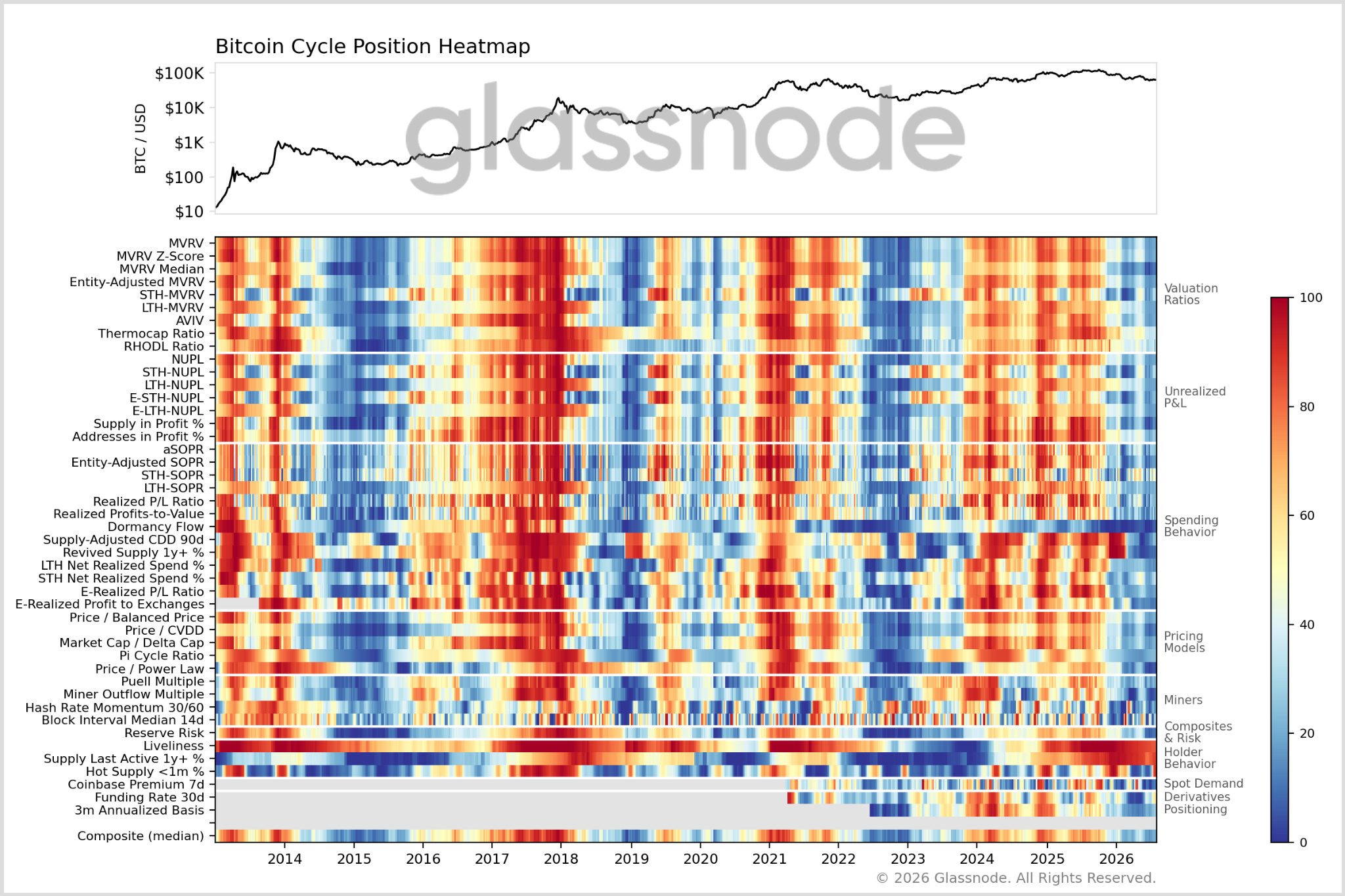
- 45 Bitcoin price metrics tracked by Glassnode are in their longest “capitulation” phase since the collapse of FTX in late 2022.
- Aggregate readings still have to turn colder to match areas that marked previous bear-market bottoms, says creator Rafael Schultze-Kraft.
45 Bitcoin price metrics spend 2026 in “capitulation” zone
Glassnode’s Bitcoin Cycle Position Heatmap, a composite BTC price metric overview tool, has signaled capitulation throughout 2026.
The tool, created by the platform’s co-founder, Rafael Schultze-Kraft, combines data from 45 indicators to present an overall picture of market health as Bitcoin price cycles repeat. A majority blue heatmap indicates a period of “capitulation” within the cycle, with red pointing to the euphoria characteristic of momentum toward cycle peaks.
After a euphoric phase in November 2021, the heatmap flipped to blue for the majority of 2022. In November that year, cryptocurrency exchange FTX collapsed, an event that coincided with Bitcoin’s last bear-market bottom of $15,600.
“Today it sits in its coldest stretch since FTX: late in the bear, but not yet the unanimous deep blue that previously marked a floor,” Schultze-Kraft commented on the Heatmap’s latest readings.
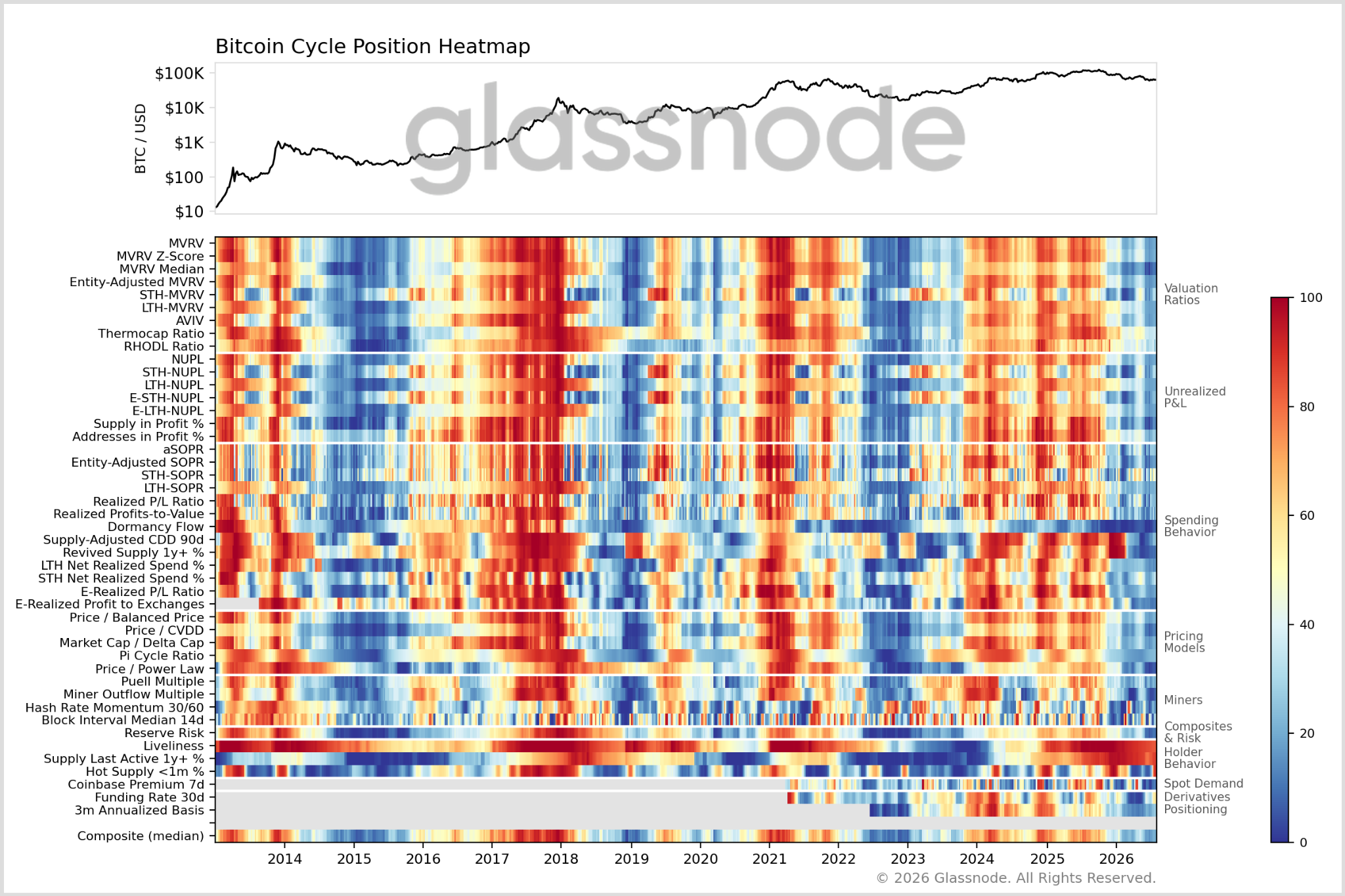
Bitcoin Cycle Position Heatmap. Source: Rafael Schultze-Kraft on X.com
In addition to basic price gauges such as market cap, the heatmap puts a considerable focus on the profitability of the Bitcoin investor base, dividing it into short-term (STH) and long-term (LTH) holders.
Certain metrics, Schultze-Kraft notes, change their behavior over time, requiring a more nuanced reading when used for cycle signals. Among these is dormancy — the number of days a unit of BTC has spent idle when used in an onchain transaction. Here, the ageing investor base means that dormancy increases over time, differing between cycles.
Coldcard hack spikes sub-1 BTC transactions
In its latest Market Pulse report released on Monday, Glassnode was complimentary regarding the resilience of market participants.
Related: US yen intervention puts Bitcoin, risk assets on notice for liquidity flux
“On-chain activity strengthened materially. Daily active addresses and entity-adjusted transfer volumes moved above their upper statistical bands, indicating a notable increase in network engagement and economic throughput,” it reported.
Stabilization of capital outflows remained despite a knee-jerk reaction by certain investors in the wake of the low-entropy bug exploit in Coldcard hardware wallets.
Data from analytics platform CryptoQuant likened the uptick in onchain transactions of 1 BTC or less to the aftermath of the FTX implosion. On July 31, the daily tally reached 39,600 BTC, compared with 39,900 on Nov. 16, 2022.
Crypto World
Swan Bitcoin CEO Cory Klippsten sees users embracing stronger safeguards after $100 million Coldcard exploit


A week on, nearly 90% of the stolen coins remain unmoved onchain, confirmed attacker addresses have been shared with U.S. federal law enforcement and Toronto-based Coinkite has patched every affected device line. A volunteer team funded by OpenSats scanned more than 150 open-source repositories and found no evidence the problem extended beyond Coldcard.
The exploit led some in the industry to question the value of self-custody, suggesting investors should consider buying bitcoin through, for example, exchange-traded funds rather than holding it themselves.
Klippsten, however, said clients are not retreating from self-custody. Instead, they’re examining ways of making their bitcoin harder to access.
“People are moving into Swan Vault right now,” he said, referring to the firm’s collaborative multisig product, where no single device can put a user’s funds at risk. “Instead of abandoning self-custody, many are upgrading it.”
His verdict on the week is measured optimism.
“It is awful that people lost coins, and they did everything right according to what a lot of well-known people in the industry told them. But Bitcoin is antifragile and the tools are getting stronger by the hour. This might end up being the best thing that ever happened to self-custody.”


Former LAPD reserve officer Eric Halem has been sentenced to life in prison plus 15 years for kidnapping and robbing a teenager of a hard drive containing about $350,000 worth of Bitcoin during a 2024 home invasion in Los Angeles.
Summary
- Former LAPD reserve officer Eric Halem has been sentenced to life plus 15 years for a Bitcoin related kidnapping and robbery.
- Prosecutors said a teenager was forced to hand over a hard drive containing about $350,000 worth of Bitcoin during the 2024 attack.
- Halem still faces separate criminal cases, while his alleged co defendants have yet to stand trial.
- The sentencing comes as U.S. authorities continue pursuing multiple violent cases involving the targeting of cryptocurrency holders.
According to the Los Angeles Times, Los Angeles County Superior Court Judge Mildred Escobedo imposed the sentence on Tuesday after rejecting Halem’s request for a new trial in the December 2024 robbery targeting a 17-year-old in Koreatown.
Bitcoin robbery case has resulted in life sentence
Court records cited by the publication show Halem received concurrent life sentences for kidnapping and robbery, along with an additional 15-year prison term. During the hearing, Judge Escobedo dismissed defense arguments that Halem’s original lawyers had failed to call witnesses and examine important evidence.
The judge said the trial evidence showed Halem acted out of “sheer and utter greed,” adding there could have been no other conclusion based on the facts presented in court.
A spokesperson for the Los Angeles County District Attorney’s Office told the newspaper that Halem must complete most of the 15-year sentence before serving the concurrent life terms. The spokesperson also said he will become eligible for parole after seven years.
The sentence follows Halem’s conviction in March, when a jury found him guilty after a two-week trial.
Prosecutors said teenager was forced to surrender Bitcoin hard drive
Prosecutors told the court that Halem and three alleged co-conspirators entered a high-rise apartment in Los Angeles and threatened to kill the victim unless he handed over a hard drive containing approximately $350,000 in Bitcoin.
The teenager, identified during the proceedings only as Daniel, surrendered the device after being threatened, according to evidence presented during the trial.
Although Halem had left the Los Angeles Police Department nearly two years before the robbery, the Los Angeles Times reported that he was still serving as a reserve officer when the crime took place.
The newspaper also reported that Halem continues to face separate criminal cases involving alleged insurance fraud and another crypto-related robbery. His three co-defendants have not yet gone to trial.
Crypto-related home invasions have continued across the US
The sentencing comes as U.S. authorities continue pursuing several violent cases involving cryptocurrency holders.
Earlier this month, federal prosecutors in Connecticut announced charges against three Missouri men accused of planning a home invasion to force a victim to transfer Bitcoin. According to the U.S. Department of Justice, Sedric Louis, John Davis and Martel Williams allegedly traveled to Connecticut in August 2024, rented vehicles, obtained air rifles and walkie-talkies, and watched their intended target and his parents before abandoning the plan after becoming concerned they had been captured by security cameras.
The Justice Department said the conspiracy case forms part of a larger investigation linked to a later kidnapping in Danbury, where another group allegedly targeted the parents of a person connected to the theft of hundreds of millions of dollars in Bitcoin. The three Missouri defendants have pleaded not guilty, while prosecutors have already secured guilty pleas from Adam Iza and Saif Faiq over related Hobbs Act conspiracy charges.
Several months earlier, federal prosecutors also charged three Tennessee men over another alleged cryptocurrency robbery operation in California.
According to the Justice Department, Elijah Armstrong, Nino Chindavanh and Jayden Rucker posed as delivery workers to enter or attempt to enter homes in San Francisco, San Jose, Sunnyvale and Los Angeles. Prosecutors alleged the group restrained victims with firearms, duct tape and zip ties before demanding access to cryptocurrency accounts.
In one alleged incident, authorities said a victim was forced to log into crypto accounts while another participant transferred about $6.5 million in digital assets to a wallet controlled by the group. All three defendants have pleaded not guilty and remain entitled to the presumption of innocence unless proven guilty in court.
Investigators have tracked more attacks targeting crypto holders
The California and Connecticut prosecutions have been among several recent cases in which investigators say cryptocurrency investors were selected because of their digital asset holdings rather than traditional valuables.
Federal prosecutors have increasingly relied on Hobbs Act robbery charges in cases involving alleged kidnappings and forced cryptocurrency transfers, while state prosecutors have pursued separate robbery and kidnapping charges where the facts support them.
Outside the United States, authorities have also reported an increase in physical attacks targeting crypto holders. French prosecutors have charged dozens of suspects in separate investigations involving alleged kidnappings and attempts to force victims to surrender access to cryptocurrency wallets, while investigators have continued warning that organized groups are using violence alongside digital theft methods.


Arthur Hayes thinks everyone has the AI trade filed under the wrong category.
In a new essay, the co-founder of crypto exchange BitMEX and crypto fund Maelstrom said the ongoing infrastructure buildout is a credit story like 2008, not an earnings story like the 2000 dot-com bust.
Hyperscalers, or computing frms borrow against their massive data centers, are stuffed with chips that depreciate fast, and lenders bankroll it believing they are financing technology when the underlying asset is closer to real estate.
The break comes when announced capex stops accelerating, which he pegs for late 2027 into 2028. Credit keeps flowing well past that point, the way mortgage lending did into 2007, until the weakest AI debt cracks and drags down whoever is over-levered on it.
Hayes expects Washington and Beijing to backstop the wreckage in the name of national security, printing more than they did in 2008, and that flood of liquidity is what bottoms bitcoin and drives it toward $1 million.
The nearer-term call is that the recent AI selloff, Korea’s leveraged unwind included, is a dip inside a bull market.
Bitcoin traded near $64,200 on Wednesday, flat on the week and still stuck in the range it has held since May.

2 lucky North West postcodes win in today’s Postcode Lottery draw

Next hikes profit targets as heatwave boosts sales

BlackRock Tokenized Stablecoin Reserve Fund Gets Top S&P Rating


-

 Business7 days ago
Why Trees Belong on the Risk Register
-

 Fashion5 days ago
Weekend Open Thread: Wit & Wisdom
-

 Politics5 days ago
Meta enters AI-training agreement with far-right ‘propaganda rag’ Newsmax
-

 Politics7 days ago
Reform UK betrays West Mids residents by running from party pledges
-

 Crypto World4 days ago
MicroStrategy Post-Earnings CLARITY Act Push Could Add New Catalyst for Its Stock
-

 Politics3 days ago
Zack Polanski: an incitement to murder Nigel Farage?
-

 Crypto World4 days ago
XRP Ledger v3.3.0 brings five institutional features
-

 News Videos6 days ago
Bitcoin Enters the 3rd Stage of the Bear Market
-

 Politics6 days ago
Luke Littler’s dominance sparks GOAT debate
-

 Sports5 days ago
Seema Kaliramna Wins Discus Throw Bronze, Takes India’s CWG Medals Tally To 17
-

 Crypto World4 days ago
New York sues Kalshi over prediction market gambling
-

 Crypto World3 days ago
Crypto PAC spending tops $2M in Michigan House race
-

 Tech7 days ago
Gemini can now summarize the messiest comment threads in Google Docs
-

 Business5 days ago
Trump Announces Hamas Disarmament Agreement as Iran Strikes Kuwait Air Base and US Attacks Pause Overnight
-

 Tech3 days ago
ESET tracks rise in malicious AI skills and adaptable malware
-

 Business2 days ago
DTCR: Deleveraging And A Hedge Fund Collapse Point To A Possible AI Bottom
-

 Tech5 days ago
Gemini Spark can now use Chrome logins and saved passwords to run errands on your behalf
-

 Tech5 days ago
Building A Reproduction PlayStation Motherboard
-

 Sports7 days ago
Sakshi, Arundhati Enter Boxing Semi-Finals. India Assured Of 18 Medals At CWG 2026
-

 NewsBeat6 days ago
Four people die trying to cross Channel in small boats
You must be logged in to post a comment Login