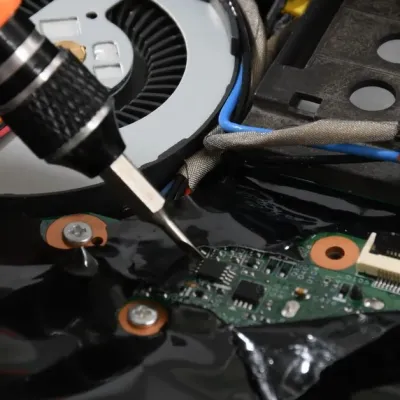
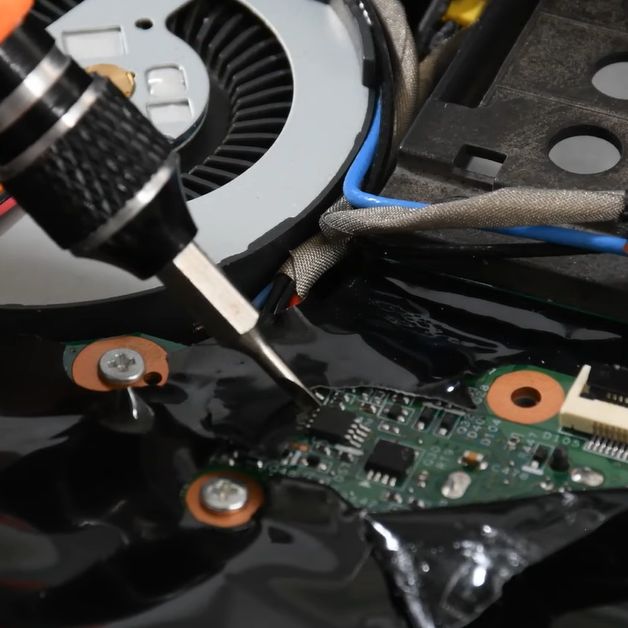
This would be a bad time to slip. (Credit: onionboots, YouTube)

In the olden days, an administrator password on a BIOS was a mere annoyance, one quickly remedied by powering off the system and pulling its CMOS battery or moving a jumper around. These days, you’re more likely to find a separate EEPROM on the mainboard that preserves the password. This, too, is mostly just another annoyance, as [onionboots] knew. All it takes is shorting out this EEPROM at the right time to knock it offline, with the ‘right time’ turning out to be rather crucial.

While refurbishing this laptop for a customer, he thought it’d be easy: the guide he found said he just had to disassemble the laptop to gain access to this chip, then short out its reset pin at the right time to make it drop offline and keep it shorted. Important here is that you do not short it when you are still booting the system, or it won’t boot. This makes for some interesting prodding of tiny pins with a metal tool.
What baffled him was that although this method worked, and he could now disable the password, on the next boot, it would be enabled again. As it turns out, to actually save the new supervisor password status to the EEPROM, you should stop shorting its pin, else you cannot write to it. Although the guide said to keep shorting it, this was, in hindsight, a clear case of relying too much on instructions and less on an obvious deduction. Not like any of us are ever guilty of such an embarrassing glitch, natch.
At any rate, it was still infinitely faster than trying to crack such a password with a brute-force method, even if helped by an LLM.
The UAE Tour is the finale of the early season stage races held in the Middle East and is the longest, hardest and most prestigious. Three time winner Tadej Pogačar isn’t on the start list but 2023 winner Remco Evenepoel rides and in the Slovenian’s absence will assume the role of favourite.
Read on and we’ll show you how to watch a 2026 UAE Tour live stream from anywhere with a VPN, and potentially for FREE.
2026 UAE Tour event preview
Advertisement
The UAE Tour returns for its 8th edition without World Champion Tadej Pogačar but with a whole host of top talent ready to take his title. With the Slovenian choosing to start his season at Strade Bianche, Team UAE, in their home race, are pinning their hopes on the young Mexican Isaac del Toro. UAE’s heir apparent certainly has the talent to take the race but with have to deal with a rampant Remco Evenepoel who already has an incredible six wins under his belt this year.
Also in the mix will be the likes of Adam Yates, Felix Gall, Michael Storer, Ilan Van Wilder, Ben Tulett and favourite for the flat time trial, Josh Tarling.
The race kicks off with a sprint stage then heads into the 12.2 km time trial on stage 2 where Evenepoel will be looking to take time on all his GC rivals. Up next is the first of two giant summit finishes, the 15km ascent to Jebel Mobrah on stage 3, followed by a pair of sprint stages before the final showdown on stage 6. The legendary slopes of Jebel Hafeet will certainly decide the winner before proceedings are wrapped up with a final sprint showcase along the Abu Dhabi Breakwater on stage 7.
Aside from the big name GC favourites there are plenty of top sprinters looking for bragging rights lead by the giant Italian Jonathan Milan who will be looking to add to his tally of wins this year.
Advertisement
Read on for everything you need to know to watch a 2026 UAE Tour live stream from anywhere.
How to watch the 2026 UAE Tour for FREE
You can watch the whole of the 2026 UAE Tour for FREE on SBS On Demand in Australia and VRT Maxin Belgium.
Advertisement
Use a VPN to watch a 2026 UAE Tour live stream
How to watch a 2026 UAE Tour live stream in the US
(Image credit: Other)
Cycling fans in the US can watch the 2026 UAE Tour on FloBikes.
A subscription to FloBikes will set you back US$149.99 for the year or US$29.99 on a monthly basis.
If you’re out of the US but still want to watch the 2026 UAE Tour then don’t forget to explore the VPN route set out above, which will help you access your subscriptions from anywhere.
Advertisement
How to watch a 2026 UAE Tour live stream in the UK
Cycling fans in the UK can watch the 2026 UAE Tour on TNT Sports. To access this you’ll either need to add it to your TV package, or you can take out a standalone subscription via Discovery+ which will set you back £30.99 per month, though BT Broadband customers can get a discounted rate.
You will also have access to Premier League, Champions League and Europa League football plus Tour de France cycling, rugby, wrestling, UFC, and MotoGP.
If you’re traveling overseas, don’t worry, as you can use NordVPN to watch your usual service from abroad.
Advertisement
How to watch a 2026 UAE Tour live stream in Canada
(Image credit: Other)
Cycling fans in Canada can watch the 2026 UAE Tour on FloBikes. A subscription will set you back CAN$203.88 for the year or CAN$39.99 on a monthly basis.
Not at home? Use NordVPN or another VPN service to make your device think you’re still in Canada.
Advertisement
How to watch a 2026 UAE Tour live stream in Australia
Australian cycling fans are in luck as they can watch the whole of the 2026 UAE Tour for FREE via, SBS On Demand .
SBS also has the rights to the Tour de France, Vuelta a España, Strade Bianche, Gent-Wevelgem, Paris-Roubaix, Flèche Wallonne, Liège-Bastogne-Liège, Eschborn-Frankfurt and Paris-Tours, as well as many more.
Outside of Australia? Use a VPN to watch coverage of the UCI World Tour.
Advertisement
UAE Tour 2026 stages
Stage 1 | Monday, Feb 16 | Madinat Zayed Majlis – Liwa Palace, 144km
Stage 2 | Tuesday, Feb 17 | Hudayriyat Island – Hudayriyat Island (ITT), 12.2km
Stage 3 | Wednesday, Feb 18 | Umm al Quwain – Jebel Mobrah, 183km
Stage 5 | Friday, Feb 20 | Dubai Al Mamzar Park – Hamdan Bin Mohammed Smart University, 166km
Stage 6 | Saturday, Feb 21 | Al Ain Museum – Jebel Hafeet, 168km
Stage 7 | Sunday, Feb 22 | Zayed National Museum – Abu Dhabi Breakwater, 149km
We test and review VPN services in the context of legal recreational uses. For example: 1. Accessing a service from another country (subject to the terms and conditions of that service). 2. Protecting your online security and strengthening your online privacy when abroad. We do not support or condone the illegal or malicious use of VPN services. Consuming pirated content that is paid-for is neither endorsed nor approved by Future Publishing.
Lightning is MSI’s highest-end GPU series, with the Z suffix indicating the top-tier variant of the lineup, aimed at extreme overclockers and enthusiasts. Read Entire Article Source link
After the Justice Department released a trove of new documents tied to infamous sex offender Jeffrey Epstein, journalists digging through them have found extensive connections to Silicon Valley.
On the latest episode of the Equity podcast, Kirsten Korosec and I talk to Sean about what he learned, and we discuss whether the Epstein revelations will lead to broader fallout in Silicon Valley.
Advertisement
You can read a preview of our conversation, edited for length and clarity, in the transcript below.
Sean: There are always people at the edges who don’t necessarily want to be front and center in the investment scene. And that was why I started looking through these files, in part because a long time ago, flashback 10 years ago on my beat especially, there was just a ton of Chinese investment in the space.
This was before even the rush of EV startups in China that we see today […] In autonomous vehicles, but electric vehicles especially, there was this moment where Chinese investors and Chinese companies, state-owned automakers, all they wanted to do was to be looked at like Silicon Valley startups. So they came here and they invested in companies and helped get them off the ground, or in some cases even set up offices in Silicon Valley.
And it was in that environment that a lot of the companies that I’ve covered for a long time popped up. There was just never a full picture of how a lot of them were funded.
Advertisement
Techcrunch event
Boston, MA | June 23, 2026
Advertisement
One in particular, this company called Canoo, which is now bankrupt and out of business, had maybe the most mysterious set of investors of all of them. They really were not upfront about it when they first sort of came out of stealth in early 2018. And it frankly took until there was a lawsuit between some people who ran the company near the top that the investors were revealed.
At the time, it was this businessman in China who was relatively close, the son-in-law of the former sort of like the fourth most senior CCP official under the previous leader of China and a giant electronics magnate from Taiwan. And then there was this really strange guy named David Stern, who was the third founding investor. And there was so little information about this guy.
I could tell, back then, that he was some sort of German businessman, that he had some connections to China, but it wasn’t really clear how he had gotten involved. The only thing I really remember hearing at the time was that he was close with Prince Andrew, which I just thought was very strange, this idea that someone had even told me a long time ago, probably in 2018 or 2019, that Prince Andrew was involved with this company Canoo in some way, maybe not invested, but advising or something.
It was something that stuck in my head for a very long time, clearly, because I went looking for that information as more of these files came out, assuming that proximity to Prince Andrew means proximity to someone like Epstein.
Advertisement
And that was the case here, more so than I could have imagined, because this guy Stern turned from an enigma or a ghost into someone who was present through all this dealmaking 10 years ago, where we see him pitching, in the span of about a year and a half, investments in Faraday Future, trying to convince Epstein to maybe throw a couple hundred million dollars into that company, trying to buy the 30% stake that Faraday Future’s founder had bought or acquired in Lucid Motors arrival at the time, which I feel is an overlooked dynamic [in] how those companies grew around then — and then also in Canoo.
Epstein never invested in any of those companies despite that proximity, but it was just such a revealing thing. And I get into it in the story that I wrote last week, but we get this sweep of a decade of relationship that Stern had with Epstein from approaching him initially in 2008, kind of hat in hand, and introducing himself and saying, “Hey, I want to invest in China. Will you throw in some money?” to being someone who was seemingly very close to him by the end.
Kirsten: The whole thing is really interesting, and it goes back to my initial comments about how sometimes when you get a chance to look back at with new information at how deals were unfolding, it really just changes your perception and perspective of the time.
And for those who didn’t follow quote-unquote “mobility,” think of it as how we’re thinking about physical AI these days. Everyone was talking about it. Every automaker wanted to have a piece of quote-unquote “the future of transportation” or “mobility.” And so it makes a lot of sense that some of these more secretive types were also jumping in.
Advertisement
Sean, one of the points you made to me as I was working on the story with you, in terms of editing it, you were [saying], it was very clear that Epstein and David Stern weren’t really about investing and building companies. It was all about how to make the most money the fastest. And that, I think, is really historically important and interesting and gives you a little bit of an insight into — in addition to all the horrible, horrifying, terrible things he did to human beings, [Epstein] was a complete operator as well, in order to make money as quickly as possible. And you see that in these emails and exchanges between David Stern and Epstein.
Sean: Yeah, to both of those points really, I open the story with a moment in time where Lucid Motors […] they had been basically a battery supplier for a long time and then they pivoted into the passenger vehicle startup that we know them as today, but they were really struggling to raise their Series D at the time, and they really needed that money to start production of their first electric sedan.
They were struggling, behind the scenes in large part because the founder of Arrival quietly amassed this major stake and was kind of pushing people away and making it look like an uninvestable company in some ways, but the hype around all of that at the time was creating opportunities for people like Stern and Epstein, and we see them talk in these emails about, you know, Stern comes to Epstein and basically says, “I heard that they’re raising. Can you get information from Morgan Stanley?”
Epstein turns around and passes that information back, and then you see this discussion about, okay, well, Morgan Stanley says Ford — which was reported at the time — had kind of an investment offer, potential acquisition offer, on the table for Lucid Motors [and] was going to come in in that Series D. And they’re chopping up — do we invest in this and maybe get a big return down the road? Or is it something that we sell as Ford comes in a couple months later, if we can get this stake now at fire sale prices?
Advertisement
Ultimately, they didn’t go through with that, but Stern did eventually invest in Canoo and help get that company off the ground.
Anthony: One thing — maybe pulling back a little bit from the specific industries or investments — that’s also an important piece of context that generally gets mentioned in any of these stories about Epstein in Silicon Valley, but is worth repeating here, is that he [pleaded] guilty to soliciting prostitution from a minor in 2008.
Almost all the emails that we’re talking about with these stories [and] in pretty much any other story about Epstein in Silicon Valley comes after that. So it’s also partly a story about how people get comfortable with the idea that, okay, this guy has a pretty shady past already. He wasn’t the infamous criminal that he eventually [became], but there were things that were already known about him, and because he was a source of connections to power, to famous names, to money, a lot of people were just willing to look past that.
Neysa, an Indian AI infrastructure startup, has secured backing from U.S. private equity firm Blackstone as it scales domestic compute capacity amid India’s push to build homegrown AI capabilities.
Blackstone and co-investors, including Teachers’ Venture Growth, TVS Capital, 360 ONE Asset, and Nexus Venture Partners, have agreed to invest up to $600 million of primary equity in Neysa, giving Blackstone a majority stake, Blackstone and Neysa told TechCrunch. The Mumbai-headquartered startup also plans to raise an additional $600 million in debt financing as it expands GPU capacity, a sharp increase from the $50 million it had raised previously.
Neysa operates in this emerging segment, positioning itself as a provider of customized, GPU-first infrastructure for enterprises, government agencies, and AI developers in India, where demand for local compute is still at an early but rapidly expanding stage.
Advertisement
“A lot of customers want hand-holding, and a lot of them want round-the-clock support with a 15-minute response and a couple of our resolutions. And so those are the kinds of things that we provide that some of the hyperscalers don’t,” said Neysa co-founder and CEO Sharad Sanghi.
Nesya co-founder and CEO Sharad SanghiImage Credits:Neysa
Ganesh Mani, a senior managing director at Blackstone Private Equity, said his firm estimates that India currently has fewer than 60,000 GPUs deployed — and it expects the figure to scale up nearly 30 times to more than two million in the coming years.
That expansion is being driven by a combination of government demand, enterprises in regulated sectors such as financial services and healthcare that need to keep data local, and AI developers building models within India, Mani told TechCrunch. Global AI labs, many of which count India among their largest user bases, are also increasingly looking to deploy computing capacity closer to users to reduce latency and meet data requirements.
Techcrunch event
Boston, MA | June 23, 2026
Advertisement
The investment also builds on Blackstone’s broader push into data center and AI infrastructure globally. The firm has previously backed large-scale data centre platforms such as QTS and AirTrunk, as well as specialized AI infrastructure providers including CoreWeave in the U.S. and Firmus in Australia.
Neysa develops and operates GPU-based AI infrastructure that enables enterprises, researchers, and public sector clients to train, fine-tune, and deploy AI models locally. The startup currently has about 1,200 GPUs live and plans to sharply scale that capacity, targeting deployments of more than 20,000 GPUs over time as customer demand accelerates.
Advertisement
“We are seeing a demand that we are going to more than triple our capacity next year,” Sanghi said. “Some of the conversations we are having are at a fairly advanced stage; if they go through, then we could see it sooner rather than later. We could see in the next nine months.”
Sanghi told TechCrunch that the bulk of the new capital will be used to deploy large-scale GPU clusters, including compute, networking and storage, while a smaller portion will go toward research and development and building out Neysa’s software platforms for orchestration, observability, and security.
Neysa aims to more than triple its revenue next year as demand for AI workloads accelerates, with ambitions to expand beyond India over time, Sanghi said. Founded in 2023, the startup employs 110 people across offices in Mumbai, Bengaluru, and Chennai.
These days, rather than showing you the traditional list of links when you run a search query, Google is intent on throwing up AI Overviews instead: synthesized summaries of information scraped off the web, with some word-prediction magic added, and packaged together in a way to sound as accurate and reliable as possible.
We’ve written before about some of the problems with these AI Overviews, which regularly contain mistakes or nonsense, and of course rip off the work of the human writers who actually know the answers to the questions you’re putting into Google. There’s another problem though—these AI answers can actually be dangerous.
As with every other new technology through history, scams are now making their way into AI Overviews as well, apparently injecting Google’s AI answers with fraudulent phone numbers that you shouldn’t trust. Here’s what’s happening, and how you can make sure you stay safe.
How AI Overview Scams Work
It’s a good idea not to trust AI for contact details.David Nield
It doesn’t seem to be a completely new problem, but the way Google Search works now, it’s been given a new twist.
Here’s what happens: The unfortunate victim Googles a company name looking for a contact number, then calls the number thrown up by AI. This doesn’t actually lead to the company in question, but rather to someone pretending to be that company, who then tries to take payment information or other sensitive details from the caller.
It’s not clear exactly how these fake numbers are being planted, but the best guess is that they’re being published in multiple low-profile places online, alongside the names of major companies. AI Overviews then comes along and scoops them up, without running the proper checks to verify the information.
The planting of misleading phone numbers by bad actors is not a completely new danger of course; misinformation has been a part of the web for a long, long time. But the design of AI Overviews, which picks out information from the web and presents it as fact rather than encouraging you to do the research yourself, is making people much more susceptible to this kind of con.
You’ll want to read our extensive guide on How to Choose the Right Laptop, but for the basics, you’ll want to decide what category of laptop you need. Most people should buy a 13-inch or 14-inch laptop, and spending around $750-$1,000 is a good place to start. You should expect a laptop around this price to get good battery life, have a decent screen, perform well enough for basic tasks, and have a comfortable keyboard and touchpad. You should also expect at least 16 GB of RAM and 512 GB of storage. Anything more than that gets into premium territory where you’re paying for higher specs, more performance, or extra features. If you want something with a discrete GPU for either gaming or creative workflows, you’ll need to spend more than this.
A laptop like the Dell 14 Plus is the ideal example of what you can get while shopping in this price range. You can even find laptops with OLED panels, up to one terabyte of storage, depending on how good the discounts happen to be. I would consider anything under $750 to be a cheap laptop, and it will therefore come with some significant compromises, especially around the quality of the panel and the touchpad. Fortunately, laptops that use the Qualcomm Snapdragon X chip get great battery life, despite often falling under $750 in price.
Here’s a list of important specs to consider:
CPU: For thin and light laptops, I would recommend one of the Snapdragon X, X Plus, or X Elite chips. They get the best battery life and performance for their class of laptop. As an alternative, the Intel Core Ultra 7 258V is also quite good. The next generation is coming soon though, with all eyes on Intel’s Core Ultra Series 3 (also known as Panther Lake, which is rolling out now and is really great) and Qualcomm’s Snapdragon X2 chips.
Advertisement
GPU: As of now, Intel’s Lunar Lake chips, such as the Core Ultra 7 258V, have the best integrated graphics. For discrete options, you’ll want to pick something with one of the latest Nvidia RTX 50-series GPUs, such as the RTX 5060. The biggest leap in performance is between the RTX 5070 and the RTX 5070 Ti, which increases VRAM to 12 GB.
RAM (or memory): Stick with at least 16 GB if you can. Since the advent of the Copilot+ designation, it has become the new standard. You’ll even find laptops as cheap as $600 that have 16 GB of memory. Gamers and content creators should upgrade to 32 GB if possible, though the ongoing memory shortage may make this more expensive in the near future.
Storage: Similar to memory, many laptops have moved to 512 GB as the new standard, and you’ll find lots of affordable laptops with 512 GB as the base configuration. Upgrading to one or two terabytes, where possible, will make your life that much easier, especially since many laptops don’t offer expandable storage.
Display: Laptops are usually categorized by screen size, with 13-inch, 14-inch, and 16-inch being the most common. You’ll want to consider size, resolution, refresh rate, and panel type here.
Advertisement
Portability: Outside of display size, the thickness of the chassis and weight are the primary factors here, determining how portable a laptop is to travel with. Other dimensions are important too, but more often than not, that is determined by the screen size.
Ports: Many laptops are limited to just USB-C and headphone jack these days, with some exceptions where USB-A or HDMI are included. Make sure your laptop has what you need, or else you’ll need a USB Hub or laptop docking station to get more ports or to increase external display support.
Power, rather than compute, is fast becoming the limiting factor in scaling AI data centers. That shift has prompted Peak XV Partners to back C2i Semiconductors, an Indian startup building plug-and-play, system-level power solutions designed to cut energy losses and improve the economics of large-scale AI infrastructure.
C2i (which stands for control conversion and intelligence) has raised $15 million in a Series A round led by Peak XV Partners, with participation from Yali Deeptech and TDK Ventures, bringing the two-year-old startup’s total funding to $19 million.
The investment comes as data-center energy demand accelerates worldwide. Electricity consumption from data centers is projected to nearly triple by 2035, per a December 2025 report from BloombergNEF, while Goldman Sachs Research estimates data-center power demand could surge 175% by 2030 from 2023 levels — the equivalent of adding another top-10 power-consuming country.
Much of that strain comes not from generating electricity but from converting it efficiently inside data centers, where high-voltage power must be stepped down thousands of times before it reaches GPUs. This process currently wastes about 15% to 20% of energy, C2i’s co-founder and CTO Preetam Tadeparthy said in an interview.
Advertisement
“What used to be 400 volts has already moved to 800 volts, and will likely go higher,” Tadeparthy told TechCrunch.
Founded in 2024 by former Texas Instruments power executives Ram Anant, Vikram Gakhar, Preetam Tadeparthy, and Dattatreya Suryanarayana, along with Harsha S. B and Muthusubramanian N. V, C2i is redesigning power delivery as a single, plug-and-play “grid-to-GPU” system spanning the data-center bus to the processor itself.
C2i co-founders Vikram Gakhar, Preetam Tadeparthy, Ram Anant, and Dattatreya Suryanarayana (Left to right)Image Credits:C2i
By treating power conversion, control and packaging as an integrated platform, C2i estimates it can cut end-to-end losses by around 10% — roughly 100 kilowatts saved for every megawatt consumed — with knock-on effects for cooling costs, GPU utilisation and overall data-center economics.
Techcrunch event
Boston, MA | June 23, 2026
Advertisement
“All that translates directly to total cost of ownership, revenue, and profitability,” Tadeparthy said.
For Peak XV Partners (which split from Sequoia Capital in 2023), the attraction lies in how power costs shape the economics of AI infrastructure at scale. Rajan Anandan, the venture firm’s managing director, told TechCrunch that after the upfront capital investment in servers and facilities, energy costs become the dominant ongoing expense for data centers, making even incremental efficiency gains highly valuable.
Advertisement
“If you can reduce energy costs by, call it, 10 to 30%, that’s like a huge number,” Anandan said. “You’re talking about tens of billions of dollars.”
The claims will be tested quickly. C2i expects its first two silicon designs to return from fabrication between April and June, after which the startup plans to validate performance with data-center operators and hyperscalers that have asked to review the data, according to Tadeparthy.
The Bengaluru-based startup has built a team of about 65 engineers and is setting up customer-facing operations in the U.S. and Taiwan as it prepares for early deployments.
Power delivery is one of the most entrenched parts of the data-center stack, long dominated by large incumbents with deep balance sheets and years-long qualification cycles. While many newer companies focus on improving individual components, redesigning power delivery end-to-end requires coordinating silicon, packaging, and system architecture simultaneously — a capital-intensive approach that few startups attempt and one that can take years to prove in production environments.
Advertisement
Anandan said the real question now is execution, noting that all startups face technology, market, and team risks when betting on how industries evolve. In C2i’s case, he said, the feedback loop should be relatively short. “We’ll know in the next six months,” said Anandan, pointing to upcoming silicon and early customer validation as the moment when the thesis will be tested.
The bet also reflects how India’s semiconductor design ecosystem has matured in recent years.
“The way you should look at semiconductors in India is, this is like 2008 e-commerce,” said Anandan. “It’s just getting started.”
He pointed to the depth of engineering talent — with a growing share of global chip designers based in the country — alongside government-backed design-linked incentives that have lowered the cost and risk of tape-outs, making it increasingly viable for startups to build globally competitive semiconductor products from India rather than operate only as captive design centers.
Advertisement
Whether those conditions translate into a globally competitive product will become clearer over the coming months, as C2i begins validating its system-level power solutions with customers.
Looking for the most recent Connections answers? Click here for today’s Connections hints, as well as our daily answers and hints for The New York Times Mini Crossword, Wordle, Connections: Sports Edition and Strands puzzles.
Today’s NYT Connections puzzle has some really unusual categories. Read on for clues and today’s Connections answers.
The Times has a Connections Bot, like the one for Wordle. Go there after you play to receive a numeric score and to have the program analyze your answers. Players who are registered with the Times Games section can now nerd out by following their progress, including the number of puzzles completed, win rate, number of times they nabbed a perfect score and their win streak.
Here are four hints for the groupings in today’s Connections puzzle, ranked from the easiest yellow group to the tough (and sometimes bizarre) purple group.
Yellow group hint: Good joke!
Advertisement
Green group hint: They all sound like Homer Simpson.
The journey takes Aurora’s autonomous trucks roughly 15 hours, or about half the time a human operator could legally drive under federal hours-of-service rules. Existing regulations limit truck drivers to 11 hours of driving within a 14-hour window, require a 30-minute break after eight hours, and mandate a 10-hour rest… Read Entire Article Source link
Threat actors are abusing Pastebin comments to distribute a new ClickFix-style attack that tricks cryptocurrency users into executing malicious JavaScript in their browser, allowing attackers to hijack Bitcoin swap transactions and redirect funds to attacker-controlled wallets.
The campaign relies on social engineering that promises large profits from a supposed Swapzone.io arbitrage exploit, but instead runs malicious code that modifies the swap process directly within the victim’s browser.
It could also be the first known ClickFix attack to use JavaScript to alter a webpage’s functionality for a malicious purpose.
Promoted through Pastebin
In the campaign spotted by BleepingComputer, threat actors are iterating through Pastebin posts and leaving comments that promote an alleged cryptocurrency exploit, with a link to a URL on rawtext[.]host.
The campaign is widespread, with many of our posts receiving comments over the past week claiming to be “leaked exploit documentation” that allows users to earn $13,000 in 2 days.
Advertisement
Phishing comment on Pastebin Source: BleepingComputer
The link in the comment redirects to a Google Docs page titled “Swapzone.io – ChangeNOW Profit Method,” which claims to be a guide describing a method to exploit arbitrage opportunities for higher payouts.
“ChangeNOW still has an older backend node connected to the Swapzone partner API. On direct ChangeNOW, this node is no longer used for public swaps,” reads the fake guide.
“However, when accessed through Swapzone, the rate calculation passes through Node v1.9 for certain BTC pairs. This old node applies a different conversion formula for BTC to ANY, which results in ~38% higher payouts than intended.”
At any given time, these documents typically show between 1 and 5 active viewers, suggesting the scam is circulating.
People viewing the Google Doc Source: BleepingComputer
The fake guide provides instructions to visit Swapzone.io and manually load a Bitcoin node by executing JavaScript directly in their browser’s address bar.
The instructions tell victims to visit a URL on paste[.]sh and copy a JavaScript snippet hosted on the page.
Advertisement
First stage JavaScript code used in ClickFix attack Source: BleepingComputer
The guide then tells the reader to go back to the SwapZone tab, click on the address bar, type javascript:, and then paste the code. When the code has been pasted into the address, they state to press Enter on your keyboard to execute it, as explained below.
ClickFix attack instructions in fake SwapZone exploit guide Source: BleepingComputer
This technique abuses the browser’s ‘javascript:’ URI feature, which allows users to execute JavaScript from the address on the currently loaded website.
By convincing victims to run this code on Swapzone.io, attackers can manipulate the page and alter the swap process.
BleepingComputer’s analysis of the malicious script hosted at paste[.]sh shows that it loads a secondary payload from https://rawtext[.]host/raw?btulo3.
This heavily obfuscated script is injected directly into the Swapzone page, overriding the legitimate Next.js script used for handling Bitcoin swaps to hijack the swap interface.
The malicious script includes embedded Bitcoin addresses, which are randomly selected and injected into the swap process, replacing the legitimate deposit address generated by the exchange.
Advertisement
Because the code executes within the Swapzone.io session, victims see a legitimate interface but end up copying and sending funds to attacker-controlled Bitcoin wallets.
In addition to replacing the deposit address, BleepingComputer was told that the script modifies displayed exchange rates and offer values, making it feel like the alleged arbitrage exploit is actually working.
Unfortunately, as Bitcoin transactions cannot be reversed, if you fell for this scam, there is no easy way to recover your money.
A novel ClickFix variant
This campaign is a variant of the ClickFix attacks, a social engineering technique that tricks users into executing malicious commands on their computer, typically to install malware.
Advertisement
Normally, ClickFix attacks target operating systems by telling victims to run PowerShell commands or shell scripts to fix alleged errors or enable functionality.
In this case, instead of targeting the operating system, the attackers instruct victims to execute JavaScript directly in their browser while visiting a cryptocurrency exchange service.
This allows the malicious code to modify the page and intercept transaction details.
This may represent one of the first reported ClickFix-style attacks specifically designed to use JavaScript in the browser and steal cryptocurrency.
Advertisement
Modern IT infrastructure moves faster than manual workflows can handle.
In this new Tines guide, learn how your team can reduce hidden manual delays, improve reliability through automated response, and build and scale intelligent workflows on top of tools you already use.