
Crypto World
SEC and CFTC Hit Goliath Ventures With Parallel Crypto Fraud Complaints



Two US financial regulators sued Goliath Ventures and its CEO, Christopher Delgado, this week, two months after he pleaded guilty to charges in the same crypto Ponzi scheme.
The Securities and Exchange Commission (SEC) noted that the multi-year operation raised at least $425 million from more than 1,300 investors.
Inside the Alleged Goliath Ventures Scheme
Goliath pitched investors on partnering to fund crypto asset liquidity pools, which it claimed to manage. The company promised monthly profit distributions of 3% to 10%, according to the SEC.
The regulator alleges that the accused invested none of the money and instead paid earlier investors with funds from newer ones.
The SEC said that Delgado misappropriated at least $51 million for personal spending. This included purchasing residential properties, luxury vehicles, and a yacht, as well as travel.
According to the complaint, the firm also hired sales agents on commission and issued fake account statements and investment performance metrics. The move was meant to show investors that they were earning profits.
Finally, by November 2025, Goliath could no longer recruit fast enough to cover payouts, and the scheme collapsed.
Follow us on X to get the latest news as it happens
Two Regulators Move in Parallel
The SEC says the operation raised at least $425 million from more than 1,300 investors. The CFTC complaint cites roughly 1,600 customers and at least $397 million.
The SEC charged both defendants under the Securities Act and the Exchange Act. Delgado agreed to a bifurcated settlement. The CFTC seeks restitution, disgorgement, civil penalties, and permanent trading and registration bans. Chairman Michael Selig framed the action as part of a broader enforcement push.
“We will continue to aggressively police fraud, abuse, and manipulation in the crypto asset markets to ensure that bad actors are punished, while developing clear rules of the road so that good actors have the opportunity to build on American soil,” he said.
Delgado had already pleaded guilty to charges of conspiracy to commit wire fraud, wire fraud, and money laundering. His sentencing is scheduled for October 8.
Subscribe to our YouTube channel to watch leaders and journalists provide expert insights
The post SEC and CFTC Hit Goliath Ventures With Parallel Crypto Fraud Complaints appeared first on BeInCrypto.


The U.S. Commodity Futures Trading Commission (CFTC) has invoked emergency authority to keep prediction market operator Kalshi running, arguing that New York’s efforts to restrain the platform amount to a market emergency. In an order issued Tuesday, the regulator said the federal government must ensure continuity in derivatives markets and prevent a “patchwork” of state rules from disrupting national price discovery.
The move keeps Kalshi operating while a separate legal fight continues over whether federal law—specifically the Commodity Exchange Act—preempts state gambling enforcement when event contracts are traded on federally regulated venues.
Key takeaways
- The CFTC ordered Kalshi to continue operating, citing an emergency created by New York’s request for a temporary restraining order.
- New York argues Kalshi is operating an illegal, unlicensed gambling business tied to sports, elections, culture, and other events, seeking substantial damages.
- The CFTC says the Commodity Exchange Act requires a uniform national derivatives market and gives it exclusive jurisdiction over certain transactions involving swaps on designated contract markets.
- The dispute is ongoing and does not resolve whether federal law preempts New York’s gambling enforcement.
- The CFTC said it is litigating similar jurisdictional questions beyond New York, including cases involving eight other states.
CFTC emergency order keeps Kalshi live
In the order, the CFTC said New York’s enforcement action and the state’s request for a temporary restraining order together triggered what the agency characterized as a market emergency. The regulator directed Kalshi to keep operating under its normal practices and in line with the Commodity Exchange Act’s core principles.
Importantly, the CFTC emphasized continuity in trading. It argued that major disruptions can undermine orderly markets and impede price discovery—especially in derivatives markets meant to function as a cohesive national system.
CFTC Chair Michael Selig said Congress did not intend derivatives exchanges to face a fragmented set of state gaming rules. The commission tied its emergency authority to concerns that a state-by-state approach could destabilize federal derivatives oversight.
New York’s restraining order seeks nationwide operational limits
New York’s request, as described by the CFTC, would bar Kalshi from operating in connection with contracts tied to sports, culture, elections, and other events in or from New York or directed to people in the state. The CFTC warned that because Kalshi is based in New York, the restrictions could effectively prevent the platform from offering all event contracts nationwide.
According to the CFTC, New York is seeking at least $36 billion in compensatory damages pending an accounting. The underlying state lawsuit, filed July 31, alleges Kalshi runs an illegal, unlicensed gambling business through its event-linked contracts. New York seeks restitution, disgorgement, damages, and penalties, including a penalty equal to three times Kalshi’s alleged gains and $100,000 for each unauthorized sports wagering offer or attempt in New York.
New York’s case reflects a broader theory that state gambling law applies to prediction-market style contracts—an issue that has become a central legal battleground for the emerging event-contract space.
Federal preemption and the jurisdiction fight
Kalshi has argued that states cannot shut down a federally licensed exchange. The CFTC, by contrast, maintains that the Commodity Exchange Act gives it exclusive jurisdiction over transactions involving swaps traded on designated contract markets, including event contracts that Kalshi lists as swaps.
This is not a new legal question. In a separate New York case, a federal judge denied Kalshi’s request for a preliminary injunction on July 7. At that stage, the judge found that New York gambling laws were not preempted by the Commodity Exchange Act as applied to Kalshi’s sports-event contracts.
Previously, the CFTC also sued New York in federal court in April, seeking to block the state from applying its gambling laws to CFTC-registered contract markets. In that earlier action, Judge Jed Rakoff denied without prejudice the agency’s emergency request for a temporary restraining order. The court found the CFTC had not shown a high likelihood of success on the merits or a likelihood of irreparable harm.
While Tuesday’s order directs Kalshi to continue operating, it does not decide the underlying jurisdictional dispute. The CFTC itself characterized the order as separate from a final judicial determination on whether federal law preempts state enforcement.
A nationwide regulatory dispute across multiple states
The Kalshi controversy is also being framed by the CFTC as part of a broader effort to defend federally granted authority. The agency said in its order that it has sued eight other states in addition to New York to protect what it views as congressionally granted jurisdiction.
That means the outcome of the Kalshi litigation could carry implications beyond a single company. If courts ultimately endorse the CFTC’s preemption theory, state regulators may face tighter limits when attempting to apply gambling statutes to event contracts traded on designated contract markets. If courts reject that position, enforcement could become more decentralized, potentially pushing operators to navigate divergent state regimes.
For market participants—exchanges, traders, and institutions—the practical stakes are straightforward: disruptions to listings, contract availability, or trading access can directly affect liquidity and price formation. The CFTC’s focus on “orderly trading and price discovery” suggests the regulator is trying to prevent a compliance or shutdown cascade while the legal questions play out.
For Kalshi and similarly structured platforms, the key uncertainty remains judicial. Tuesday’s CFTC order preserves operations in the short term, but it does not substitute for a court ruling on the scope of federal preemption versus state gambling enforcement.
Readers should watch next for how courts handle the preemption question on the merits and whether any additional federal or state rulings narrow (or expand) what event-contract platforms can offer during the litigation. The emergency posture may keep the platform running for now, but the core jurisdictional disagreement is still unresolved.

Strategy CEO Phong Le says the firm plans to resume adding Bitcoin later this year, even after recent asset sales that have triggered renewed scrutiny from investors and market observers.
In a Monday interview with FOX Business, Le said Strategy purchased about 175,000 BTC since the start of the year while selling roughly 7,000 BTC, describing the activity as “about 25 times more” buying than selling. He also said Strategy has moved from being the world’s second-largest institutional Bitcoin holder to the largest.
Key takeaways
- Strategy says it intends to restart accumulating Bitcoin later this year, after a year-to-date pattern of heavy net buying.
- According to Le, Strategy bought ~175,000 BTC since January and sold ~7,000 BTC year-to-date—netting a large imbalance toward accumulation.
- The company has sold Bitcoin on four occasions since May, with the latest reported sale totaling 1,690 BTC.
- BitcoinTreasuries.NET data suggests public companies collectively hold more BTC than exchange-traded products and other funds, but the treasury “premium” financing model is under strain.
A pledge to buy more, after sales drew questions
Le told FOX Business that Strategy expects to “get back to buying more Bitcoin throughout the course of the year.” That statement comes after the firm shifted part of its approach—at least temporarily—from its long-standing narrative of avoiding Bitcoin sales whenever possible.
While Strategy’s sales have remained small relative to its total stash, the decision to sell has been closely watched because it represents a departure from the “never sell” stance that helped establish its credibility with long-term Bitcoin-focused shareholders.
Strategy has accumulated more than 840,000 BTC, but it has reportedly sold Bitcoin on four occasions since May. The most recent sale, according to the interview context, totaled 1,690 BTC. Le’s broader argument appears to be that the company can still prioritize net accumulation while meeting other corporate obligations.
Why Strategy’s sales matter to investors
Even limited selling can have outsized signaling effects for a company built around a Bitcoin treasury strategy. The concern is not only about the immediate numbers, but about what the sales suggest regarding internal trade-offs.
The proceeds from Strategy’s recent Bitcoin sales have been used to support preferred stock dividends, share repurchases, and its U.S. dollar reserve. That mix highlights a core tension for any public company holding large BTC reserves: management must balance capital preservation and growth with shareholder payouts, equity-market expectations, and liquidity requirements.
Le’s “25 times more” framing underscores that Strategy’s year-to-date behavior still leans toward accumulation. However, the very fact that the company has made multiple sales since May suggests conditions have required more flexibility than the firm’s earlier messaging implied.
Earlier coverage from Cointelegraph noted that Strategy’s earlier capital and balance-sheet approach aimed to preserve Bitcoin exposure while also addressing returns to shareholders, including through a capital framework designed to fund dividends. The latest remarks reinforce that Strategy is trying to maintain that direction while navigating the pressures of public-company financing constraints.
The broader corporate treasury model faces a tougher environment
Strategy’s challenge fits into a larger pattern across the corporate Bitcoin treasury sector. Corporate holdings have continued to grow, but weaker market conditions make the traditional economics of the model harder to sustain.
According to BitcoinTreasuries.NET, public companies hold more than 1.26 million BTC, while trailing exchange-traded funds and other funds hold more than 1.6 million BTC. The size of the holdings suggests institutional accumulation remains active, but it does not automatically solve the capital question that determines how quickly companies can keep buying.
NOVAQUE Research has previously described the financing cycle that powered rapid expansion: when Bitcoin treasury companies traded at premiums to the net asset value of their BTC holdings, they could raise capital through equity or debt and then deploy proceeds to purchase more Bitcoin. That premium effectively reduced the dilution cost for shareholders because the market was valuing the companies above the value of their BTC.
In more difficult market regimes, that cycle becomes harder to maintain. When shares trade below net asset value, new fundraising can dilute existing holders more than it would in a premium environment—making continued aggressive accumulation financially less straightforward. Cointelegraph previously noted this shift in market dynamics in an analysis of how trade and holdings trends have changed for funds and BTC-holding entities.
What to watch next for Strategy
Strategy’s stated plan to resume accumulating Bitcoin later this year will likely be judged against two practical signals: whether future BTC purchases appear to outweigh any continued liquidity needs, and whether management’s willingness to sell—however small—persists as market conditions evolve. With the corporate treasury model sensitive to share-price-to-NAV dynamics, investors may also watch whether Strategy can keep access to capital on terms that don’t force meaningful dilution.


Bitwise Asset Management now employs around 155 people after cutting about 14% of its workforce amid a crypto market downturn.
The reduction takes the San Francisco firm down from a headcount of nearly 180.
Bitwise Trims Workforce to 155 as Crypto Market Weakens
According to Bloomberg, Chief Executive Hunter Horsley said that even after the cuts, the workforce remains at a high level for Bitwise’s eight years in business.
Horsley framed the move around future growth rather than retreat. He said Bitwise expects expansion to continue as crypto becomes more woven into the global economy.
That optimism echoes recent comments from Bitwise Chief Investment Officer Matt Hougan. He argued that Bitcoin’s (BTC) muted response to bad news may signal the bear market is near its floor.
Follow us on X to get the latest news as it happens
A Year of Crypto Job Cuts
The reductions fit a pattern that ran through the industry across 2026. Firms trimmed staff as market conditions weakened, and many even leaned harder into artificial intelligence (AI).
Coinbase cut about 700 jobs, roughly 14% of its staff, in May, with CEO Brian Armstrong citing the market and AI as factors. Gemini reduced headcount by about 30% earlier this year.
The list runs quite long. Bitcoin miner MARA cut 15% of staff in April. The Algorand Foundation and the Optimism team both trimmed their teams in March, while Crypto.com cut about 12% of its staff.
Data platform Dune cut 25% of workers, and Polygon Labs ran a second round of cuts in July. Robinhood also reduced its workforce by 10% in June.
Subscribe to our YouTube channel to watch leaders and journalists provide expert insights
The post Bitwise Cuts 14% of Its Workforce While CEO Predicts Future Growth appeared first on BeInCrypto.
The euro and pound are holding their ground against the US dollar, although the momentum in European currencies has become more subdued following their previous gains. Market participants are reluctant to establish new positions ahead of the release of the July US inflation report, which could alter expectations for the Federal Reserve’s future policy. Recent labour market data is also encouraging caution: a weak ADP report and a decline in the ISM employment component have added to signs of a gradual cooling in the US labour market.
Today, the main focus will be on the US Consumer Price Index (CPI). According to forecasts, annual inflation may slow to 3.4% from 3.5%, while monthly prices are expected to rise by 0.1% after falling 0.4% a month earlier. Core CPI is forecast at 2.5% year-on-year and 0.2% month-on-month. Weaker-than-expected figures could strengthen expectations of monetary policy easing by the Fed and put additional pressure on the dollar. If inflation comes in above forecasts or proves more persistent, the US currency could receive fresh support. Final inflation figures for Germany and Italy will also be released in Europe, although their impact is likely to remain limited in the absence of significant deviations from preliminary estimates. Therefore, US inflation data is likely to be the main driver for EUR/USD and GBP/USD during today’s session.
EUR/USD
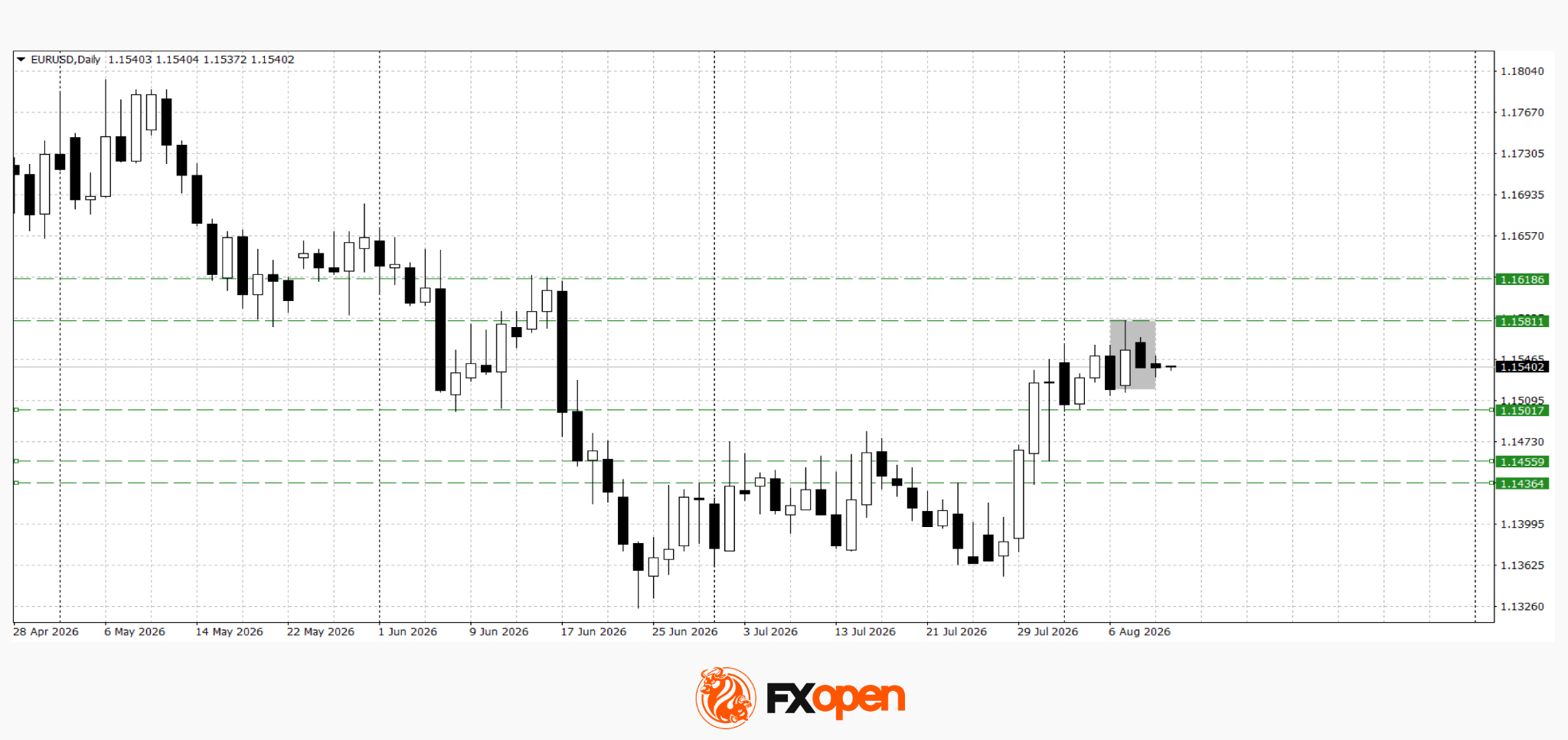
In recent trading sessions, EUR/USD has been moving within a relatively narrow range of 1.1500–1.1580. Technical analysis suggests the possibility of another test of the lower boundary, as a Dark Cloud Cover pattern has formed on the daily timeframe. If sellers manage to establish a position below 1.1500, the pair could resume its downward move towards 1.1430–1.1460. Conversely, weaker-than-expected US inflation data could push the price towards 1.1600–1.1620.
Key events for EUR/USD:
- today at 09:00 (GMT+3): German Consumer Price Index (CPI);
- today at 11:00 (GMT+3): Italian Harmonised Index of Consumer Prices (HICP);
- today at 15:30 (GMT+3): US Consumer Price Index (CPI).
GBP/USD
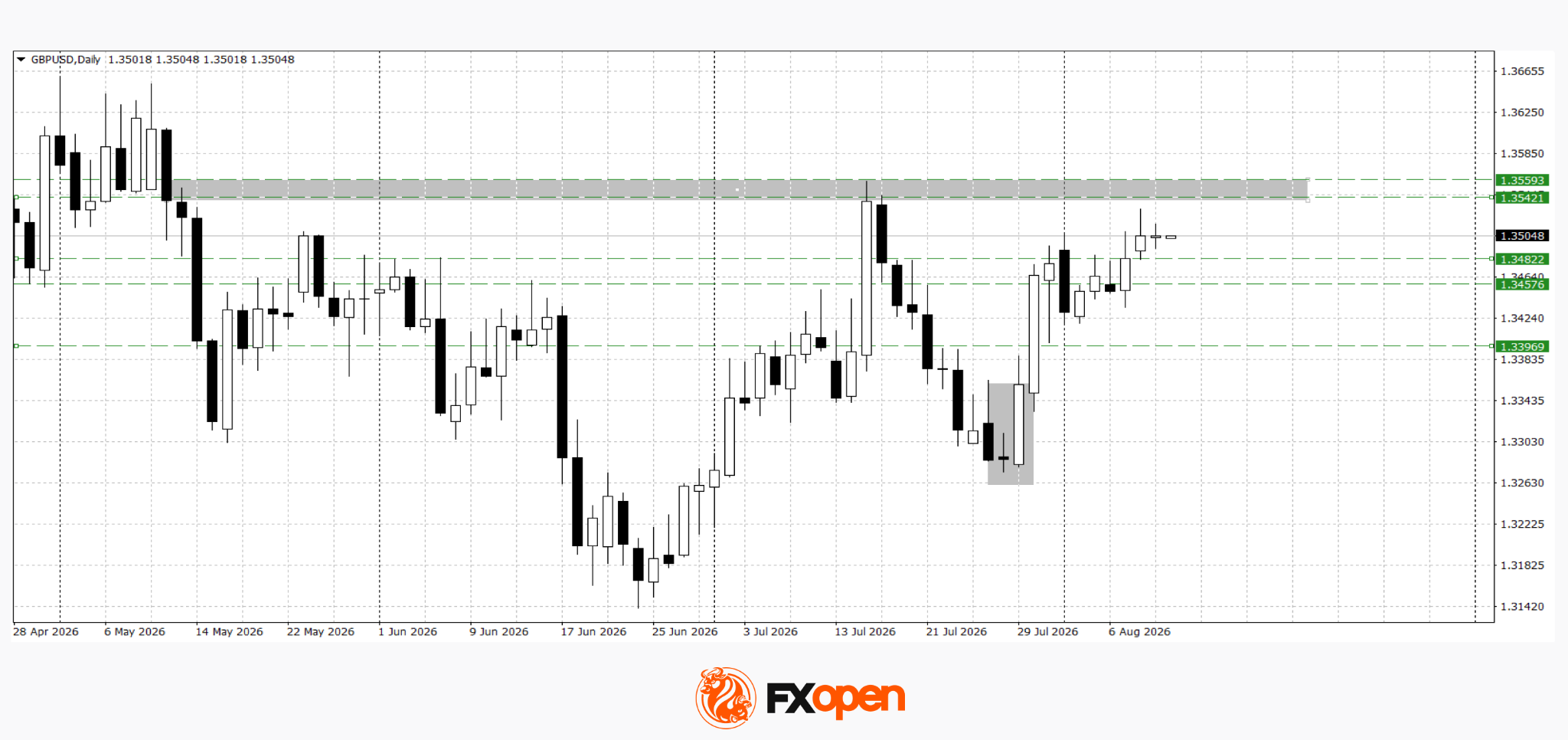
GBP/USD buyers managed to push the pair to a new local high around 1.3500. Technical analysis indicates the possibility of further gains towards 1.3540–1.3560 if the 1.3480–1.3500 area is established as support. Stronger-than-expected US inflation data could support the dollar and trigger another test of the 1.3400 level in GBP/USD.
Key events for GBP/USD:
- tomorrow at 09:00 (GMT+3): UK GDP;
- tomorrow at 14:00 (GMT+3): NI’s monthly GDP tracker;
- tomorrow at 21:00 (GMT+3): US federal budget execution report.
Overall, EUR/USD and GBP/USD are holding their ground after their previous gains, but their next direction will largely depend on today’s US inflation report. Weaker CPI data could strengthen expectations of Fed easing and put additional pressure on the dollar, creating room for further gains in European currencies. If inflation comes in above forecasts, however, the US currency could receive fresh support, increasing the likelihood of EUR/USD and GBP/USD returning to their nearest support levels.
Trade over 50 forex markets 24 hours a day with FXOpen. Take advantage of low commissions, deep liquidity, and spreads from 0.0 pips (additional fees may apply). Open your FXOpen account now or learn more about trading forex with FXOpen.
This article represents the opinion of the Companies operating under the FXOpen brand only. It is not to be construed as an offer, solicitation, or recommendation with respect to products and services provided by the Companies operating under the FXOpen brand, nor is it to be considered financial advice.


Binance’s top security executive says quantum computing is not an immediate threat to crypto holders today. Instead, he points to phishing, malware, and stolen credentials as the attacks stealing funds now.
Jimmy Su, chief security officer at Binance, made the comments in a company Q&A on quantum computing.
What Binance Says Actually Threatens Crypto
Su addressed a common fear that quantum computers can already break the cryptography securing blockchains. He said the technology is not yet advanced enough to pose an immediate threat to users’ crypto holdings.
“Quantum computing is a real long-term security issue, but it’s not an immediate threat to your crypto today. The important thing is that we prepare before that changes,” he said.
According to him, the biggest risks are the ones users already face day to day.
“The threats most likely to steal your crypto today are still things like phishing, malware, social engineering, compromised credentials, and poor wallet security – not quantum computers,” Su mentioned.
Follow us on X to get the latest news as it happens
Where Crypto Losses Came From in 2026
Data from the first half of 2026 broadly reflects Su’s assessment. Attackers continue to exploit operational weaknesses, compromised infrastructure, and human error rather than quantum vulnerabilities.
Blockchain analytics firm TRM Labs recorded about $972 million stolen across 207 hacks in the first half of 2026.
Most of the money came from infrastructure and operational compromises. These drove roughly 76% of losses despite making up about 15% of incidents.
SlowMist’s data also shows where crypto attacks are occurring most often. It found that contract and logic vulnerabilities accounted for the most incidents, with private key and credential compromises ranking second. Supply chain attacks followed in third place.
The data points to the same everyday threats Su named, not quantum machines. For now, he recommended that users continue following basic crypto security practices, including:
- Keeping recovery phrases and private keys secure.
- Using reputable wallet software.
- Installing software and security updates promptly.
- Limiting unnecessary address reuse where applicable.
Subscribe to our YouTube channel to watch leaders and journalists provide expert insights
The post Binance Security Chief Says Quantum Computers Are Not What Steals Crypto Today appeared first on BeInCrypto.


Bitget, the world’s largest Universal Exchange (UEX), has expanded its CFD business with the launch of Institutional-Grade Liquidity Solutions, a dedicated offering for quantitative trading teams, proprietary trading firms (Prop Firms), funds, retail brokers, and high-net-worth professional traders. The solution brings together 100% Straight-Through Processing (STP), deep multi-tier liquidity, sub-millisecond order matching, and FIX API connectivity for clients managing large-volume and automated trading strategies.
The launch comes as automation plays a growing role in global trading. Quantitative strategies, high-frequency trading, futures-spot arbitrage, and Expert Advisor (EA) models place different demands on execution compared with typical retail activity. At higher volumes and frequencies, market depth, order routing, latency, and connectivity to proprietary systems can have a direct impact on execution quality.
Bitget has built the new offering around a 100% STP execution model. Orders are routed directly to external liquidity pools without manual dealing intervention, giving clients a clear path from order submission to the underlying liquidity provider. The model is designed for firms running sustained order flow and strategies that require consistent market access across different conditions.
Bitget aggregates liquidity across institutional sources, including Tier-1 banks and non-bank market makers, with multiple levels of market depth available to clients. For firms placing larger orders or executing continuously, deeper order books can help reduce slippage and market impact when the liquidity available at the top of the book cannot absorb the full trade at a single price. Bitget’s trading servers are deployed in major financial data centres, including London (LD4) and Tokyo (TY3), with dedicated networks and direct fibre connectivity supporting sub-millisecond order matching. The solution also supports FIX API, allowing quantitative teams, brokers, and other institutional clients to connect existing proprietary systems, bridges, and liquidity aggregators directly to Bitget’s CFD environment.
“As trading becomes more automated and sophisticated, the quality of the infrastructure behind every trade becomes increasingly important,” said Gracy Chen, CEO of Bitget. “Professional traders need consistent execution, deep liquidity and reliable connectivity to run their strategies effectively at scale. With our institutional liquidity offering, we are strengthening the foundation of our CFD business to serve these clients better and support the next stage of Bitget’s growth across global markets.”
Client assets are segregated from Bitget’s operational funds and held through independent custody accounts, alongside compliance reviews and third-party auditing standards. This framework provides institutional clients with greater visibility into how assets are managed as they scale their activity on the platform.
The launch broadens Bitget’s CFD offering as the company continues to develop its multi-asset trading ecosystem. Retail users will be able to access Bitget’s standard CFD environment through the App, Web, and MT5, while institutional clients can use a dedicated setup built for higher-volume strategies, deeper liquidity requirements, and direct system connectivity. The expansion allows Bitget to serve a wider range of trading activity as its CFD business grows globally.
About Bitget
Bitget is the world’s largest Universal Exchange (UEX), serving over 125 million users and offering access to over 2M crypto tokens, 500+ tokenized stocks, ETFs, commodities, FX, and precious metals such as gold. The ecosystem is committed to helping users trade smarter with its AI agent, which co-pilots trade execution. Bitget is driving crypto adoption through strategic partnerships such as MotoGP™. Aligned with its global impact strategy, Bitget has joined hands with UNICEF to support blockchain education for 1.1 million people by 2027. Bitget currently leads in the tokenized TradFi market, providing the industry’s lowest fees and highest liquidity across 150 regions worldwide.
For more information, visit: Website | X | Telegram | LinkedIn | Discord
Risk Warning: Digital asset prices are subject to fluctuation and may experience significant volatility. Investors are advised to only allocate funds they can afford to lose. The value of any investment may be impacted, and there is a possibility that financial objectives may not be met, nor the principal investment recovered. Independent financial advice should always be sought, and personal financial experience and standing carefully considered. Past performance is not a reliable indicator of future results. Bitget accepts no liability for any potential losses incurred. Nothing contained herein should be construed as financial advice. For further information, please refer to our Terms of Use.
The post Bitget Expands CFD Business with Institutional-Grade Liquidity Solutions appeared first on BeInCrypto.


Crypto friendly Erebor Bank is nearing a roughly $1.5 billion funding round at an $8 billion pre-money valuation, according to people familiar with the discussions cited by the FT.
Summary
- Financial Times reports Erebor is nearing a $1.5 billion raise at $8 billion pre-money valuation.
- Regulatory data show Erebor held $4.06 billion in deposits by June 30, according to filings.
- The Financial Times reported deposits rose further to $4.6 billion by the end of July.
- Erebor led a $200 million Valar Atomics credit facility alongside JPMorgan and two other lenders.
- Regulators require Erebor to maintain at least 12% Tier 1 leverage ratio for three years.
The talks come only six months after the Columbus, Ohio lender received final approval to open as a U.S. national bank. Erebor has not announced the financing and declined to comment to the newspaper, meaning the size, valuation and investor commitments remain subject to change.
Lux Capital, Human Capital, Valor Equity Partners, Andreessen Horowitz and SV Angel are expected to make commitments, while existing investors 8VC and Haun Ventures are also reportedly participating. The $8 billion figure is before the proposed new capital is added. If the full $1.5 billion closes on those terms, the resulting valuation would be about $9.5 billion.
Erebor Bank deposits have climbed above $4 billion
Regulatory figures give some support to the growth behind the fundraising talks. Erebor’s latest call report showed about $4.06 billion in deposits and roughly $4.66 billion in assets at the end of June, compared with around $1.1 billion in deposits at March 31.
The FT reported that deposits increased further to $4.6 billion by the end of July, citing a person familiar with the figures. That July total has not yet appeared in a quarterly regulatory filing. The same source said Erebor had surpassed $100 million in annualized recurring revenue, another figure that has not been independently confirmed through public filings.
As previously reported, Erebor’s deposits had already climbed above $4 billion by early July, up sharply from its first quarter level. The earlier fundraising discussions were already targeting a valuation of at least $8 billion, making the latest reported $1.5 billion round an extension of talks that were underway before August.
U.S. charter gave Erebor room to pursue crypto clients
Erebor began operating after receiving its national bank charter on Feb. 6. The FDIC’s public records list the bank as established on that date, while the agency had approved its deposit insurance application in December 2025.
The bank was created to serve what its charter application called the U.S. innovation economy, including companies involved in digital assets, artificial intelligence, defense and advanced manufacturing. Erebor also planned to provide services to high and ultra high net worth individuals connected to those sectors. The OCC granted preliminary conditional approval in October 2025.
As previously reported, Erebor secured preliminary approval for its national bank charter after the OCC said legally permissible digital asset activities could be conducted by federally chartered banks when handled safely.
That policy direction has continued. The OCC said this week that digital asset firms engaged in permissible activities should have a route into the national banking system, as Comptroller Jonathan Gould pushes to revive de novo bank formation.
Erebor faces stricter capital requirements during early growth
Erebor’s rapid deposit expansion also raises the importance of its regulatory capital obligations. The FDIC approval requires the bank to maintain at least a 12% Tier 1 leverage ratio during its first three years, a higher threshold than many established banks operate under.
That requirement means fresh equity can support balance sheet growth as Erebor moves beyond deposits into lending. The bank has already appeared in a large industrial financing. Valar Atomics said on Aug. 3 that it closed a $200 million credit facility led by Erebor as administrative agent and JPMorgan, alongside Crescent Cove and Hercules Capital.
The facility accompanied Valar’s $1 billion Series B financing and gives an early example of Erebor targeting capital intensive companies outside conventional software startups. That fits its stated strategy of serving defense, energy, AI infrastructure and other sectors that often require larger credit facilities.
What happens next for Erebor’s $1.5 billion round
The financing has not closed. People familiar with the discussions told the FT that demand was strong and the transaction could be completed within weeks, but no final date has been announced. Erebor has also not publicly confirmed the investors, valuation or amount.
If completed at the reported terms, the round would mark another rapid valuation increase after Erebor was valued at about $4.35 billion in an earlier financing. For now, the more verifiable measure of its expansion is the balance sheet: deposits grew from roughly $1.1 billion in March to more than $4 billion by June, while lending has begun to expand into large technology and industrial projects.


Metaplanet shifted 3,881 BTC, worth about $247 million, across several transactions over three hours on Wednesday, per Arkham data.
The move went from the company’s cold wallets to new addresses it also controls, not to an exchange.
Transfers to fresh self-custody wallets don’t add to tradable supply the way deposits to an exchange do, so on their own they aren’t selling.
Metaplanet has done this before. It moved nearly 5,000 BTC in March in the same pattern, test transactions followed by larger amounts into new wallets, and analysts then read it as internal custody reshuffling rather than distribution. Nothing in Wednesday’s on-chain data points anywhere different.
Metaplanet bought its roughly 43,000 BTC at an average of about $96,000, so with bitcoin near $63,600 the company is sitting on an unrealized loss of about $1.4 billion, down 34%.
Metaplanet has been one of the most aggressive corporate buyers since April 2024, with a stated target of 210,000 BTC.
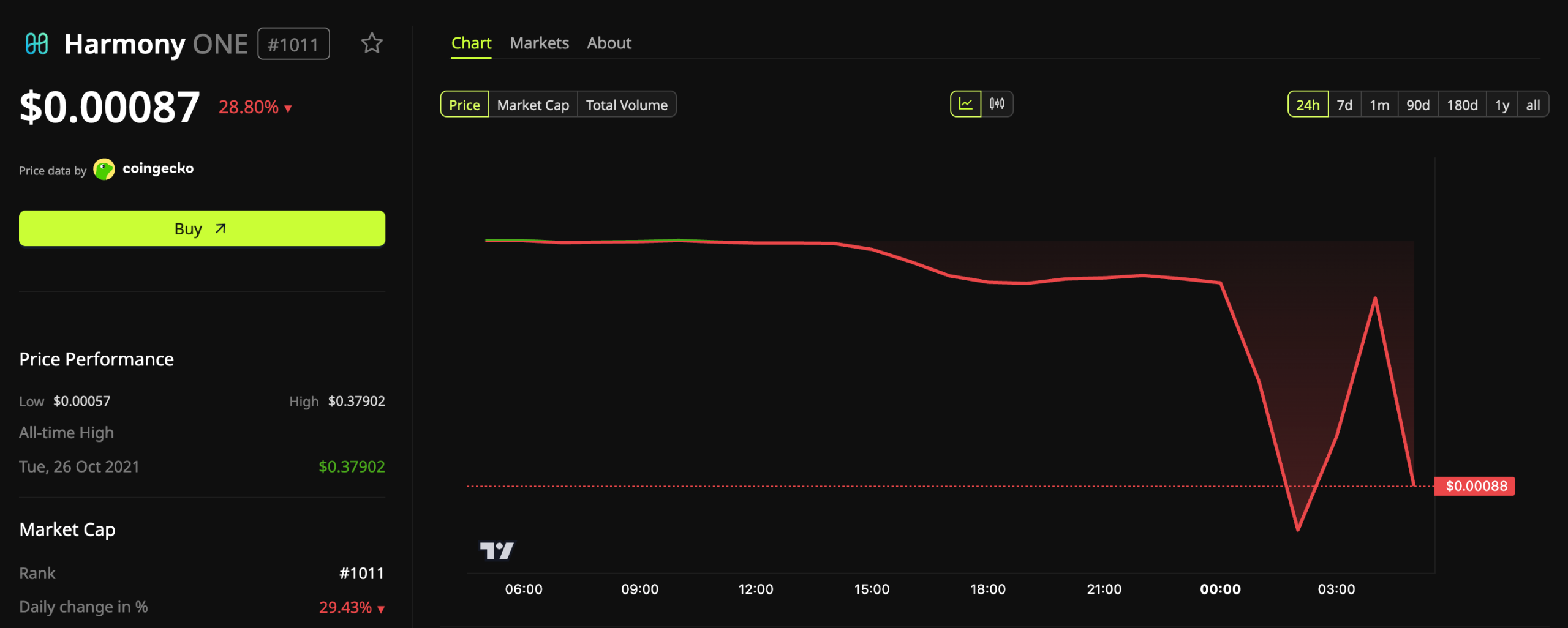
Harmony (ONE) fell to an all-time low of $0.0005735 during early Asian trading on Wednesday after a reported exploit minted roughly 4 billion tokens without authorization.
The minted amount equals about 26% of ONE’s total supply. Harmony said it is coordinating with exchanges to freeze funds while it develops a patch and evaluates rollback options.
Harmony Exploit and the Price Collapse
On-chain analyst Juiceberg reported that the supply was minted through empty blocks. Around 2.8 billion of those tokens moved quickly to exchanges, according to the analysis.
The sell pressure sent ONE tumbling. The token traded near $0.00087 at press time, down about 29% on the day, after touching its record low earlier in the session.
Follow us on X to get the latest news as it happens

Harmony later named four wallet addresses tied to the incident. The team asked all exchanges to block and freeze funds traced to them:
- one1uap8dx2z0qsjxqthm5flgcxkeepsz3gsrghnfn (0xe7427699427821230177dd13f460d6ce43014510)
- one17u300a40ll5wphd8kj5hktryhdjq3ml9f4phy4 (0xf722f7f6afffe8e0dda7b4a97b2c64bb6408efe5)
- one1a5hur07z5vtvzhr35zkw8tfqedemkz8t88xgd7 (0xed2fc1bfc2a316c15c71a0ace3ad20cb73bb08eb)
- one1h56hkxmua0uzfv07fu04cudvtrl35u96pq47vy (0xbd357b1b7cebf824b1fe4f1f5c71ac58ff1a70ba)
“We are working with our team and appropriate exchanges to stop and freeze the funds. We are working on a patch and rollback options. Will update when we have new information,” the post read.
The event marks the network’s second major security breach. In 2022, its Horizon Bridge lost roughly $99.6 million in an attack linked to North Korea’s Lazarus Group.
Harmony has not disclosed the root cause of the incident yet. BeInCrypto has reached out to Harmony for comment.
Subscribe to our YouTube channel to watch leaders and journalists provide expert insights
The post Harmony Token Falls to Record Low After Exploit Mints 4 Billion ONE appeared first on BeInCrypto.


The $116 million Coldcard hack rattled Bitcoin holders last week. Ledger’s top security executive says the headline missed the point entirely.
Speaking to Bloomberg, Ian Rogers, Ledger’s Chief Human Agency Officer, argued the attack was not evidence that self-custody or hardware wallets are inherently risky. The real story, he said, is what AI lets attackers do to systems built on weak randomness.
Why Ledger Was Not Affected
The Coldcard vulnerability traced back to a 2021 firmware bug that routed seed generation through a software pseudorandom number generator instead of the device’s hardware chip.
That produced entropy of roughly 40 to 72 bits, a small enough address space for an AI-powered attacker to scan systematically and locate private keys. TRM Labs traced 1,082 BTC drained in the first wave’s 41-minute sweep on July 30.
Ledger generates entropy entirely in hardware, Rogers told Bloomberg, using a certified secure chip with no software fallback. The resulting address space is, in his words, “the number three with 67 zeros behind it.” No attacker can brute-force that.
It is not the first time Ledger has caught this kind of flaw. In 2022, the company identified a similar bug in Trust Wallet and worked through responsible disclosure to help users move funds to safety. BeInCrypto’s coverage of Coldcard’s ongoing theft waves shows how fast and systematic the exploitation became once the vulnerability was known.
3 Ways AI Has Changed the Threat
Rogers laid out three compounding threats.
First, AI gives attackers more firepower to find vulnerabilities in any system, not just crypto. He cited attacks on US water infrastructure as part of the same trend, since the underlying tools are general purpose.
Second, AI-assisted development means more code ships faster across the industry, expanding the attack surface for everyone. BeInCrypto reported on how AI-powered smart contract exploits now outpace the tools built to detect them.
Third, and this is where Rogers goes beyond the Coldcard story, enterprises are deploying agents that hold access to internal secrets like email, Slack, and credentials. Bloomberg framed the Coldcard exploit as a hardware story. Rogers frames it as an early signal of a much broader AI-era security problem.
The Agentic Threat Rogers Warned About
At the end of last year, Rogers described a future where people hand AI agents their passwords, credit cards, and identities as a dangerous, unmanaged risk. Few people understood what he meant at the time. They do now.
His analogy compares AI agents and secrets to a teenager and car keys. The keys do not live in the teenager’s room. A parent decides, based on context, when access is appropriate. A Monday morning drive to school is fine. A Friday night after a party is not. The same logic, Rogers argues, must govern what any agent can access and when.
Ledger already offers tools that let an agent hold a wallet without holding the private keys. The principle is the same one that has always governed hardware security: protection by design, not by policy.
Wherever your assets are stored, you should be interested in the level of security that’s protecting them.
Rogers told Bloomberg.
The post Hardware Wallets Aren’t the Problem, Says Ledger Exec. AI Attackers Are appeared first on BeInCrypto.

Sonos Plans September Launch Event and Deeper Push Into Home AI
![Bitcoin is in Serious Trouble Again! [Warning]](https://wordupnews.com/wp-content/uploads/2026/08/1786521469_maxresdefault-80x80.jpg)
Bitcoin is in Serious Trouble Again! [Warning]

Farmers and fire crews join to tackle Bridlington blaze


-

 Fashion5 days ago
Weekend Open Thread: Mattifying Sunscreen
-

 Fashion5 days ago
Frugal Friday’s Workwear Report: Cap-Sleeve Pointelle Crewneck Sweater
-

 Sports6 days ago
Jordan Coyle & Cordiamo take Laya Arena Stakes at RDS
-

 News Videos4 days ago
Can Astrology Help Find Gold and Silver Trends? A Financial Astrology Guide
-
 Business6 days ago
US stocks: Dow closes at record on Mideast optimism; SpaceX, AMD drag Nasdaq
-

 Politics6 days ago
Reform UK And Greens Sink To Lowest Favourability Ratings To Date
-

 Business6 days ago
Supply chain issues impact Ingredion
-

 Tech4 days ago
Rinn Pharma & Biopharma to join NordicPharmaTrain network
-

 Business3 days ago
How to Start a Cleaning Business: A Step-by-Step Guide
-

 Business3 days ago
Datadog: Best Of Breed For Multiple Reasons
-

 Business3 days ago
BDC Weekly Review: Private BDC Q2 Numbers Are Strong
-
 NewsBeat8 hours ago
Communication cards help banking customers access services or report scams
-
Sports6 days ago
Spider-Man: Brand New Day ending explained: Is Peter Parker alive?
-

 Fashion7 days ago
Suit of the Week: Me + Em
-

 Crypto World7 days ago
Robinhood files $200M second venture fund focused on YC startups
-

 Tech5 days ago
Price Hikes May Be Coming for PC Motherboards Next
-
 Fashion7 days ago
Birthstone pendant necklaces for women by ottomanhands – 18ct gold plated
-
 Crypto World6 days ago
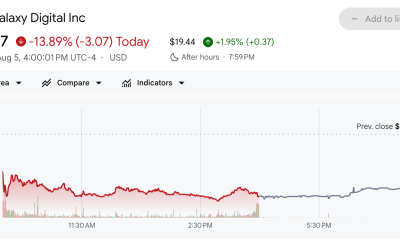
Galaxy Digital Stock Slides 14% as Crypto Prices Hit Earnings
-

 Business5 days ago
Brightwater secures funding for WA-first dementia projects
-

 Politics6 days ago
Comedian Jimmy Cricket Has Died, Aged 80
You must be logged in to post a comment Login