
Crypto World
Solana Cuts Blockchain Slot Time to 350 Milliseconds



Cointelegraph is committed to providing independent, high-quality journalism across the crypto, blockchain, AI, and fintech industries.
All news, reviews, and analyses are produced with full journalistic independence and integrity. For more details on our standards and processes, please read our Editorial Policy.


Coinkite has rolled out a major security firmware upgrade for its Coldcard hardware wallets, aiming to harden seed phrase generation against a class of failures that can leave private keys more guessable than they should be. The company says the updates—Coldcard firmware 5.6.1 for Mk4 and Mk5 and 1.5.1Q for the Coldcard Q—change how new wallet seeds are created by requiring user-supplied entropy and combining it with multiple onboard sources of randomness.
The move comes as confirmed losses from the Coldcard exploit continue to be tallied. According to an Aug. 14 report by Galaxy Research, confirmed theft reached 1,778 BTC (about $112 million). Galaxy’s reporting also places the incident among the year’s largest crypto hacks, with DefiLlama’s aggregated data ranking it as the third-largest exploit of 2026.
Key takeaways
- Coinkite’s firmware updates require new seed phrases to include user-supplied entropy collected through interactive user actions.
- Coinkite says the collected entropy is mixed with device randomness from secure elements and the hardware RNG to reduce the impact of any single randomness failure.
- Users are instructed to upgrade immediately, but must also replace existing seed phrases before migrating funds, because old seeds are still considered vulnerable.
- The update adds additional protections around USB data handling and transaction signing by re-verifying transactions immediately before signing.
- As the ecosystem responds to “weak seed” risks, Coinspect has launched a free tool intended to detect addresses generated from known weak seed phrase datasets.
User entropy becomes a required ingredient for new seeds
The most significant change in Coinkite’s release is in the mechanics of seed phrase generation. The firmware requires that newly generated seeds incorporate user-supplied entropy through at least 65 keypresses with deliberately unpredictable timing, plus one of two additional interaction-based inputs: 50 rolls of a six-sided die or 128 coin flips. The company pairs this user input with randomness sourced from multiple hardware components, including secure elements and the wallet’s hardware random-number generator (RNG).
Coinkite’s stated goal is straightforward: even if one entropy source fails or behaves unexpectedly, the seed creation process should still produce private keys that remain hard to predict. That “defense in depth” matters for users because seed phrases are the single critical root of control in Bitcoin self-custody—if their generation is weakened, an attacker may be able to brute-force likely keys rather than needing to break cryptography.
Importantly, Coinkite stresses that upgrading the firmware does not automatically immunize existing wallets. The company told users that previously generated seed phrases remain vulnerable after the update and must be replaced with new seeds before any funds are migrated. In practice, this means the security benefit applies to future seed creation, not past ones.
Seed protection continues after a prior fix
The Thursday release follows a broader security review and extends protections that were already introduced in a July 31 firmware update. Coinkite previously said that update addressed the seed-generation failure for wallets created after that point. The new 5.6.1 and 1.5.1Q releases build on that foundation by strengthening how entropy is gathered and validated, and by adding safeguards beyond seed generation alone.
Coinkite also characterizes the new approach as closing a theoretical gap involving a compromised computer USB port. Rather than assuming the external host is trustworthy—or assuming that checks performed earlier in a workflow are sufficient—the firmware is designed to re-verify transactions immediately before signing. This reduces the chance that altered transaction data could survive earlier checks and make it onto the signing path.
Additional enhancements include hardware RNG checks and a boot-time test intended to confirm that the wallet is using the intended hardware randomness path. Coinkite further restricts how USB transfers occur by limiting downloads to the device’s most recent output and requiring an encrypted session.
Finally, certain Bitcoin signature hash modes that can allow transaction outputs to be modified are now blocked by default, tightening the rules around which transaction forms the device will sign.
Coldcard losses remain material while upgrades roll out
Even as Coinkite issues new defenses, the fallout from the Coldcard exploit continues to be quantified. Galaxy Research’s Aug. 14 report, cited in the coverage of this firmware update, put confirmed losses at 1,778 BTC (about $112 million). The same reporting context notes the incident’s scale relative to other 2026 hacks, using DefiLlama’s aggregated exploit rankings.
For users, the critical implication is that remediation must be more than “patch and hope.” The requirement to generate new seed phrases underscores that the security model is tied to how a wallet was originally initialized. In other words, if a wallet was created under weaker randomness assumptions, the safest path is typically to replace the root of control rather than rely on later software fixes.
Given the confirmed-loss magnitude, these upgrades also carry practical urgency for anyone who used affected wallets and has not yet assessed whether their seed phrase was produced under the vulnerable conditions. The firmware update provides a clearer security story for new wallet initialization, but it does not undo exposure retroactively.
Software tools emerge to identify weak-seed exposure
Alongside firmware changes, the security ecosystem is increasingly focused on detection. Coinspect announced Unlukey, described as a free public tool for identifying wallet addresses generated from weak seed phrases. In a Friday post on X, Coinspect said the initial version aims to reproduce known weak seed generation behavior and then check whether public addresses fall into an affected dataset.
This kind of tooling matters because it moves the conversation from “what might be vulnerable” to “is this specific wallet address likely connected to weak-seed generation.” While such tools cannot replace operational security measures—such as upgrading, re-seeding, and moving funds—their role is to help users triage and focus on wallets most likely to be impacted.
The broader context for weak-seed risks includes claims from TRM Labs, which stated that a firmware bug from March 2021 weakened seed randomness on some Coldcard wallets. TRM Labs said this reduced key strength from 128 bits to 40 bits, making affected keys “brute-forceable without physical access.” Those figures are particularly relevant because they illustrate how far a randomness failure can go beyond a small quality-of-randomness issue—potentially changing the feasibility of an attacker’s search.
For builders and traders alike, the evolving response highlights a pattern seen across major wallet incidents: security upgrades address the technical causes going forward, while independent detection tools attempt to quantify exposure in the wild. Investors should watch how these tools perform in practice—especially whether they gain broader validation and whether they help more users act quickly and correctly.
Next, users running older Coldcard firmware should confirm they are using the latest releases and follow Coinkite’s guidance on re-seeding before moving funds, while the wider community will likely keep evaluating how detection tools like Unlukey map to real-world exposure. The remaining uncertainty is how comprehensively the weak-seed issue affected wallets in circulation—and whether further forensic work will refine estimates as additional data comes in.


Binance’s employees were cleared and released after providing statements to UAE authorities about third-party fund flows through a company client account, a spokesperson told Cointelegraph.
Crypto World
Stock Market Rally Buckles; Moderna, Gold, Bitcoin Surge While Walmart Tumbles: Weekly Review

The stock market had a bad week, with the key indexes all falling below their 21-day moving averages on Thursday while the Nasdaq composite closed below its Aug. 4 follow-through day low, a bearish signal that its rally will ultimately fail. A Treasury Department move to buy some long-dated bonds didn’t have much lasting impact on yields, which are around…
Copyright ©2026 Investor’s Business Daily, LLC. All rights reserved. 87990cbe856818d5eddac44c7b1cdeb8
Coinkite has released a major security upgrade for its Coldcard hardware wallets aimed at strengthening seed-phrase generation by forcing users to contribute unpredictable entropy. The change is designed to ensure private keys remain hard to predict even if one of the device’s randomness sources underperforms.
In a Thursday blog post, Coinkite announced firmware 5.6.1 for the Coldcard Mk4 and Mk5, and 1.5.1Q for the Coldcard Q. The company said affected users must upgrade immediately and—critically—replace any existing seed phrases before moving funds.
Key takeaways
- Coinkite’s new firmware changes how Coldcard generates seed phrases by mixing user-supplied entropy with multiple device randomness sources.
- For newly generated wallets, the firmware requires user input via at least 65 keypresses with unpredictable timing (or equivalent die/coin-rolling actions).
- Even after upgrading, previously generated seed phrases remain vulnerable and must be replaced with new seeds before migrating funds, Coinkite says.
- The update also adds safeguards around USB handling, transaction verification timing, hardware RNG checks, and boot-time integrity testing.
- Separately, Coinspect launched Unlukey, a free tool intended to help detect wallet addresses potentially linked to weak-seed generation.
Seed phrases now rely on more user unpredictability
At the center of Coinkite’s update is a shift in seed generation. According to the company, newly generated seeds must incorporate user-supplied entropy through interactive actions, including at least 65 keypresses with intentionally unpredictable timing. Coinkite also describes alternative entropy contribution methods: 50 rolls of a six-sided die or 128 coin flips.
That input is then combined with randomness from several parts of the device, including secure elements and the wallet’s hardware random-number generator (RNG). Coinkite frames the redesign as defense-in-depth: by requiring user entropy and mixing it with internal sources, the resulting private keys should remain unpredictable even if one device entropy source fails or is otherwise compromised.
Importantly, Coinkite’s guidance is not limited to upgrading. The company warns that existing seed phrases do not become safe just because the firmware is updated; users must generate new seeds and replace the wallet’s backing recovery phrase before migrating funds.
Coinkite adds transaction and USB safeguards
The new firmware follows an earlier July 31 update that Coinkite says already corrected the seed-generation failure for newly created wallets. In its Thursday announcement, Coinkite describes the latest release as the result of additional security review over the subsequent weeks, expanding protections beyond seed generation.
One element targets how transactions are processed when a Coldcard is connected to a potentially compromised computer. Coinkite says the firmware re-verifies transactions immediately before signing—an approach intended to counter a theoretical attack involving a compromised USB port. In other words, the device aims to confirm that what it signs is still what it expects, right up to the moment it produces a signature.
Coinkite also describes new hardware RNG checks and a boot-time test designed to confirm the wallet is using the intended hardware pathway. Beyond randomness integrity, the update restricts USB downloads to the device’s most recent output and requires an encrypted session, reducing opportunities for manipulated data to be fed to the wallet during the workflow.
Finally, the firmware blocks certain Bitcoin signature hash modes by default—specifically those that could allow transaction outputs to remain modifiable under the affected conditions Coinkite references.
Impact from the Coldcard exploit remains significant
While Coinkite focuses on preventing additional exposure, the ongoing consequences of the Coldcard exploit continue to shape the security landscape. Galaxy Research reported that confirmed losses associated with the exploit reached 1,778 Bitcoin, worth about $112 million, in an Aug. 14 report. Galaxy’s assessment is linked to a broader figure compilation, and DefiLlama data aggregated in the same context ranks the Coldcard hack as the third-largest cryptocurrency exploit of 2026.
These figures underline why seed-generation hardening and secure transaction flows matter to users: even hardware-wallet protections can be undermined if randomness used for key material is weak or if signing operations can be influenced through connectivity or timing issues.
Weak-seed detection tools enter the ecosystem
Alongside firmware fixes, at least one blockchain security firm is working on software approaches to identify potential victims of weak seed generation. Coinspect revealed Unlukey, a free public tool for identifying wallet addresses that may have been generated from weak seed phrases.
In a Friday X post, Coinspect said the first iteration of Unlukey focuses on reproducing known weak seed generation patterns and checking whether public addresses appear in the affected dataset. While this does not automatically prove that any given address belongs to an exposed wallet, the tool is positioned as a way to narrow down exposure for individuals and analysts who are investigating risks related to the Coldcard incident.
Context on the underlying weakness comes from TRM Labs, which said in an analysis that a firmware bug from March 2021 weakened seed randomness on some Coldcard wallets. TRM Labs reported that the issue reduced key strength from 128 bits to 40 bits, making keys “brute-forceable without physical access.”
Coinspect’s decision to build an address-level detection method suggests the broader industry takeaway from the Coldcard episode: even when hardware vendors issue patches, secondary tooling can help the ecosystem identify which wallet outputs and addresses may be most at risk based on how seed generation was implemented in the past.
Readers should watch how users apply Coinkite’s guidance—especially the requirement to replace existing seed phrases before moving funds—and whether address-detection tools like Unlukey continue to expand coverage as more information about weak-seed generation patterns is validated.


A federal judge in San Francisco on Thursday kept TRON founder Justin Sun's individual claims against World Liberty Financial in a public courtroom, declining the Trump family crypto venture's request to route the whole dispute into private arbitration. The forum decides how much of the dispute… Read the full story at The Defiant
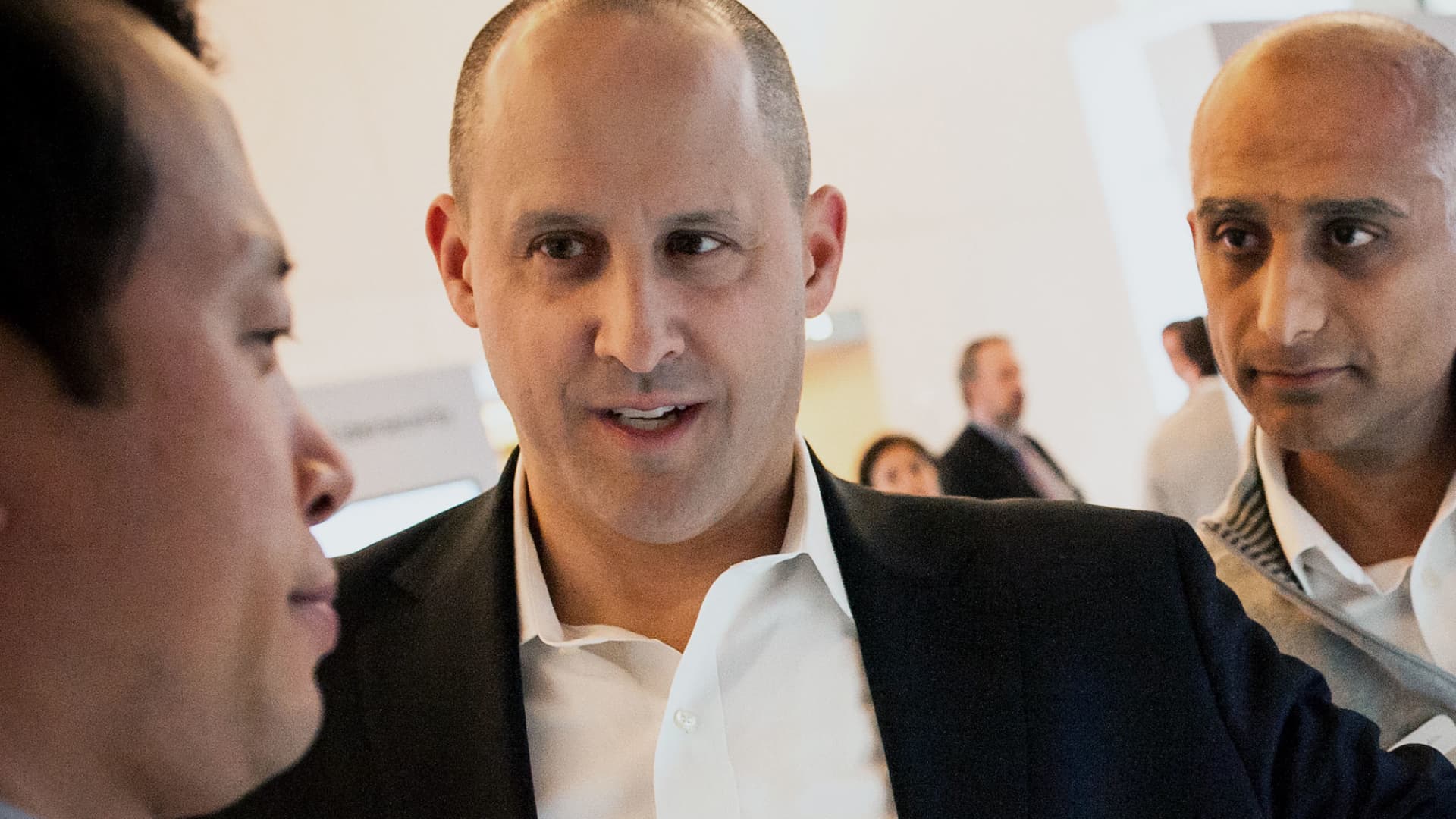
Matt Zames, then-chief operating officer of JPMorgan Chase, center, in New York, Feb. 27, 2017.
Kholood Eid | Bloomberg | Getty Images
Former JPMorgan Chase executive Matt Zames will join the Trump administration as an advisor to the Social Security agency, CNBC has learned.
Zames is taking an unpaid position to help his former JPMorgan colleague Frank Bisignano, who became Social Security Commissioner last year, tackle modernization of the agency, said people with knowledge of the move.
He starts Monday at Social Security Administration headquarters in Baltimore, Maryland, where an office placard bearing his name has already been installed, said one of the people familiar. CNBC’s sources spoke on the condition of anonymity because they weren’t authorized to discuss the move publicly.
Zames, a former hedge fund trader who rose to prominence at JPMorgan after helping clean up the bank’s $6 billion “London Whale” mess, was its chief operating officer for about five years. He spearheaded technology and cost-cutting projects at the lender and was seen as a top contender to succeed CEO Jamie Dimon until his departure in 2017.
The next year, Zames became president of private equity firm Cerberus, where he oversaw tech investments and helped turn around the firm’s Deutsche Bank stake. After leaving Cerberus in 2021, Zames started an advisory and restructuring firm.
Zames — who has also had positions on key Treasury and Federal Reserve advisory groups tied to the debt markets — is joining an agency that relies on decades-old technology systems.
Beyond the technology issues, the SSA is projected to exhaust its retirement trust fund in less than a decade, which could require benefit cuts to millions of Americans.
As a special government employee, Zames can hold his new position for 130 days, but that could be spread over a longer period of time because he won’t be working full-time, said one of the sources.
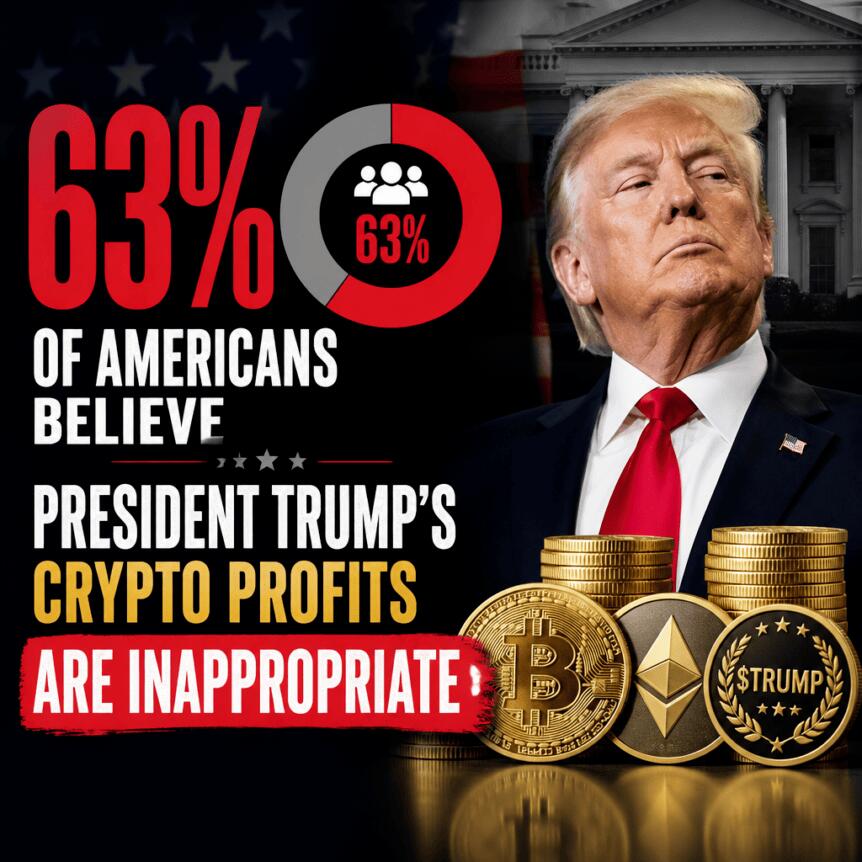
A Reuters survey found that 63% of respondents believe President Trump and his family profiting from crypto is inappropriate, while 32% believed it was appropriate. Breaking down the respondents further, 69% of Republicans considered the profits appropriate, while an overwhelming 92% of Democrats believed they were inappropriate.
Survey Results
The nationwide survey was conducted between August 14 and August 17 by Reuters and Ipsos, and interviewed 1,166 adults. The survey has a margin of error of around three percentage points. The survey reignited the ethical debate around President Trump and his family’s crypto investments while he is in office. Understandably, views were divided by political leanings, as Republican supporters found the earnings appropriate, while Democratic Party supporters called them inappropriate.
“New Reuters/Ipsos poll: 69% of Americans, including 48% of Trump’s own voters, say his business interests are influencing his presidential decisions. His crypto ventures alone pulled in $1.4B last year.”
The poll also asked respondents about President Trump’s private commercial interests and found that 69% believed the president’s business interests have influenced his decisions. The survey only gauges public opinion about President Trump’s business interests and does not state or establish whether he violated laws or influenced government policy. The White House has also consistently rejected allegations of a conflict of interest. White House spokesperson Anna Kelly stated:
“There are no conflicts of interest. The President only acts in the best interests of the American public.”
Over $1.4 Billion in Crypto Income
President Trump’s annual financial disclosure was published in June. An analysis by Reuters revealed President Trump reported over $1.4 billion in income tied to cryptocurrency ventures in 2025. However, the figure is the reported income, not the current value of President Trump’s cryptocurrency holdings. According to a report by crypto.news, the disclosure included over $1 billion in crypto-related income, including World Liberty Financial and the Trump memecoin.
Trump-family linked companies have received nearly $800 million from World Liberty Financial, including over $520 million linked to token sales and over $250 million linked to the sale of various business interests. President Trump also reported $635 million from licensing agreements linked to the TRUMP token. The revenue went through several companies, and some of the proceeds were distributed among Trump family members and business partners.
Ethical Debate Rages On
The survey comes as lawmakers remain divided over whether crypto legislation should restrict officials and their families from investing in crypto-related businesses. The ethics provisions have become a significant stumbling block during negotiations to advance crypto legislation through Congress. Adding to the debate is the conditional approval given to World Liberty Financial to establish the World Liberty Trust Company as a national trust bank. Congressional scrutiny and conditions for the proposed trust bank will be a significant test of the separation of President Trump’s duties as President of the USA and family business interests.
Disclaimer: This article is provided for informational purposes only. It is not offered or intended to be used as legal, tax, investment, financial, or other advice.
Yesterday, an influencer pretended to suffer a $6 million short liquidation on bitcoin (BTC) to attract followers and clout. The stunt fizzled after some basic fact-checking.
Crypto trader Laanie posted fake evidence of a leveraged wipeout long enough to attract a few hundred thousand views, then deleted the claim a few hours later.
The engagement farmer then hosted a social audio space on X to discuss the non-existent trade, which attracted over a thousand attendees amidst a particularly bullish day for crypto markets.
Indeed, BTC was enjoying one of its steepest, single day gains of the year, rallying from $64,000 to $75,000 in under 24 hours.
A proposed Community Note on X challenged the $6 million loss. It explained that the trading display Laanie shared had Bybit’s Demo mode enabled, a subtle yet unmistakable label for the crypto exchange’s simulated trading view.
One skeptic explained the difference between a real Bybit trading account and Laanie’s paper money account. Another trader noted that Laanie’s screenshots cropped out the webpage tab, indicating their use of Bybit’s Demo mode.
The intraday, 17% rally in BTC made the claim plausible at first glance, especially due to Bybit’s large leverage offerings that would have amplified losses for short-sellers.
As unsophisticated observers happily engaged with the post and reposted across social media for clout, the engagement farmer won the prize of attention.
This short bitcoin liquidation never happened
Replies to Laanie’s follow-up post called the trader a LARPer, short for Live Action Role Player. Another skeptic wrote that Laanie is a “liar with a demo account.”
‘QE Lite,’ a multi-billion dollar expansion of US Treasury buybacks, plus positive BTC commentary from Donald Trump’s crypto meeting in Washington DC, drove the rally on August 19 and the dramatic follow-through yesterday.
Read more: Jim Chanos is calling for another MSTR short
Bybit’s Demo Trading feature auto-creates a simulated account for every user. Its demo mode seeds all customers with a fixed portfolio of virtual assets. Demo mode traders can adjust the funds in that account and flip to live trading with a single toggle.
A large enough leveraged position inside that sandbox produces the same liquidation math and shareable screenshot as a genuine trade. However, the underlying capital never exists, and trades never fill.
Got a tip? Send us an email securely via Protos Leaks. For more informed news and investigations, follow us on X, Bluesky, and Google News, or subscribe to our YouTube channel.
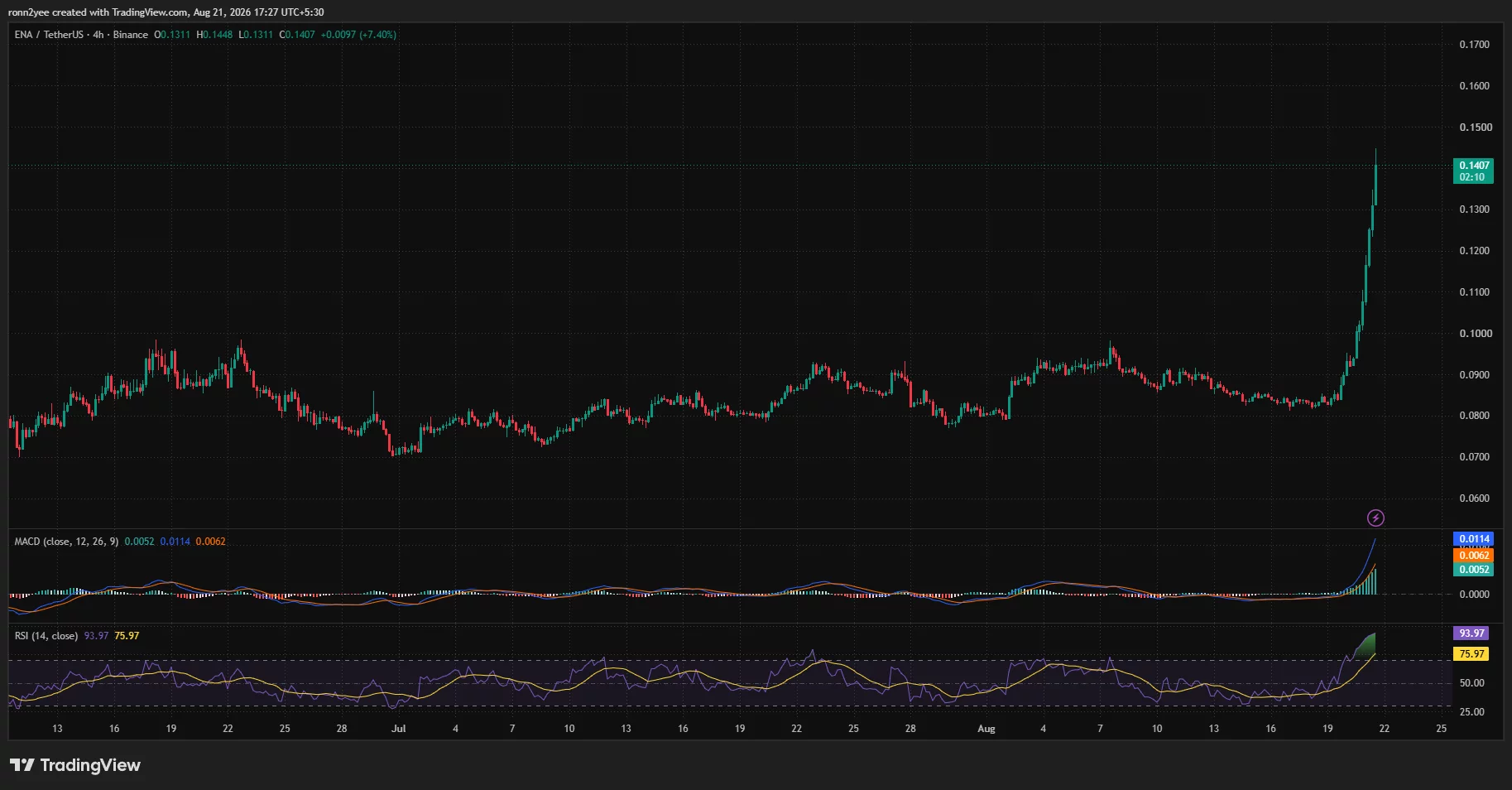
Ethena price extended its weekly gain to about 65% on Aug. 21, reaching $0.142 after a $1 billion lending deal with FalconX and bullish calls from Arthur Hayes fueled demand for ENA.
Summary
- Ethena price gained about 65% in seven days and reached an intraday high near $0.145.
- A $1 billion FalconX facility will fund overcollateralized loans using assets backing USDe.
- 4-hour RSI reached 93.97, warning that the near-vertical rally is overheated.
- A break above $0.1465 could expose $0.1587, while $0.1343 is the first support.
Ethena price action today
According to data from crypto.news, Ethena (ENA) price traded near $0.140 at press time, up about 20% on the daily chart. The token briefly reached $0.1448 after opening the session at $0.116, extending a rally that began near $0.082 on Aug. 18.
The move carried ENA through several resistance levels in less than three days. Buyers first reclaimed $0.10, which had limited previous recovery attempts, before breaking through $0.1099, $0.1221, and $0.1343.
ENA’s 4-hour chart shows that most of the advance occurred through consecutive large green candles. The token has gained more than 70% from its Aug. 18 low, leaving little consolidation between the previous trading range and its current price.
The breakout also reversed a longer period of weakness. ENA had fallen from above $0.21 at the start of 2026 and spent much of June through mid-August between $0.07 and $0.10.
What is driving the ENA rally?
The immediate catalyst was a $1 billion secured warehouse facility announced by FalconX and Ethena.
Under the arrangement, assets backing Ethena’s USDe synthetic dollar can fund overcollateralized loans to institutional borrowers. FalconX will originate and service the loans while also managing the collateral, which will be held with qualified custodians.
Ethena will hold a first-priority security interest over the assets in the lending vehicle. The structure gives the protocol another potential source of returns beyond crypto basis trades, whose yields can weaken when demand for leveraged futures positions declines.
The $1 billion figure describes the facility’s total capacity rather than confirmed capital deployed on its first day. Interest rates, eligible collateral, borrower requirements, and the initial amount drawn have not been disclosed.
Bullish commentary from BitMEX co-founder Arthur Hayes added to the momentum. Hayes wrote in an Aug. 21 X post that an “$ENA 5 bagger is just too easy,” alongside a chart pointing toward roughly $0.50.
Hayes had previously argued that stronger US dollar liquidity could lift Bitcoin, improve derivatives basis yields, and attract capital back into USDe. On-chain reports earlier in August also linked him to purchases totaling 22.64 million ENA worth about $2 million.
Trader Daan Crypto Trades separately identified $0.14 as an important level after ENA gained more than 30%.
“Could see some resistance there. If it breaks higher we’re off to the races,” the trader said in an Aug. 21 X post.
ENA has now reached that area, making its reaction around $0.14–$0.1465 central to the next move.
ENA indicators warn the rally is overheated
Momentum remains strongly bullish, although the 4-hour indicators show a growing risk of short-term profit-taking.
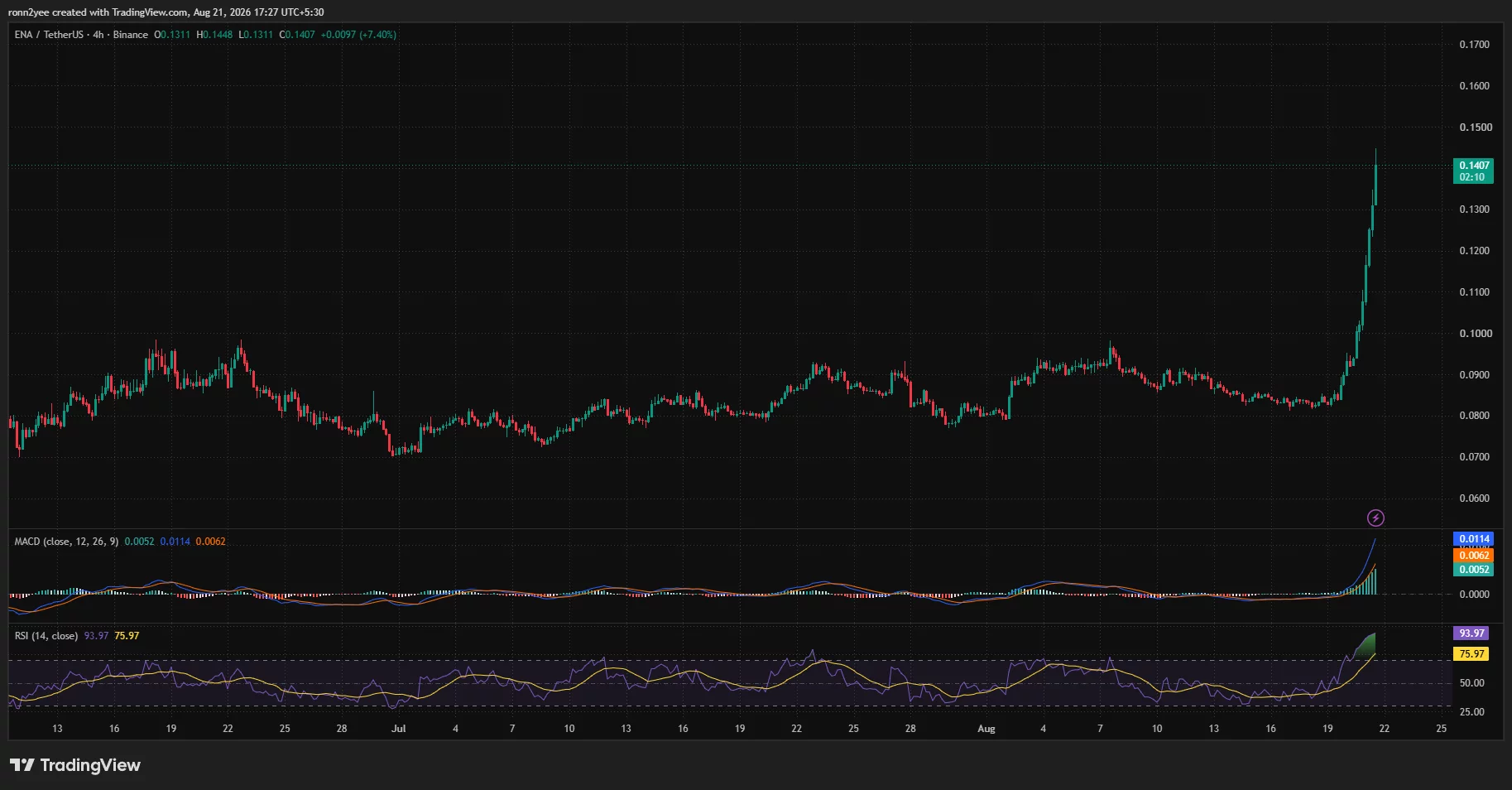
ENA’s 4-hour Relative Strength Index reached 93.97, far above the 70 level commonly associated with overbought conditions. Its RSI moving average stood at 75.97, confirming that momentum has remained elevated across several candles rather than during one brief spike.
The Moving Average Convergence Divergence indicator also supports the uptrend. The MACD line rose to 0.0114, above the 0.0062 signal line, while the positive histogram expanded to 0.0052. The widening gap shows that buying momentum was still accelerating when the chart was captured.
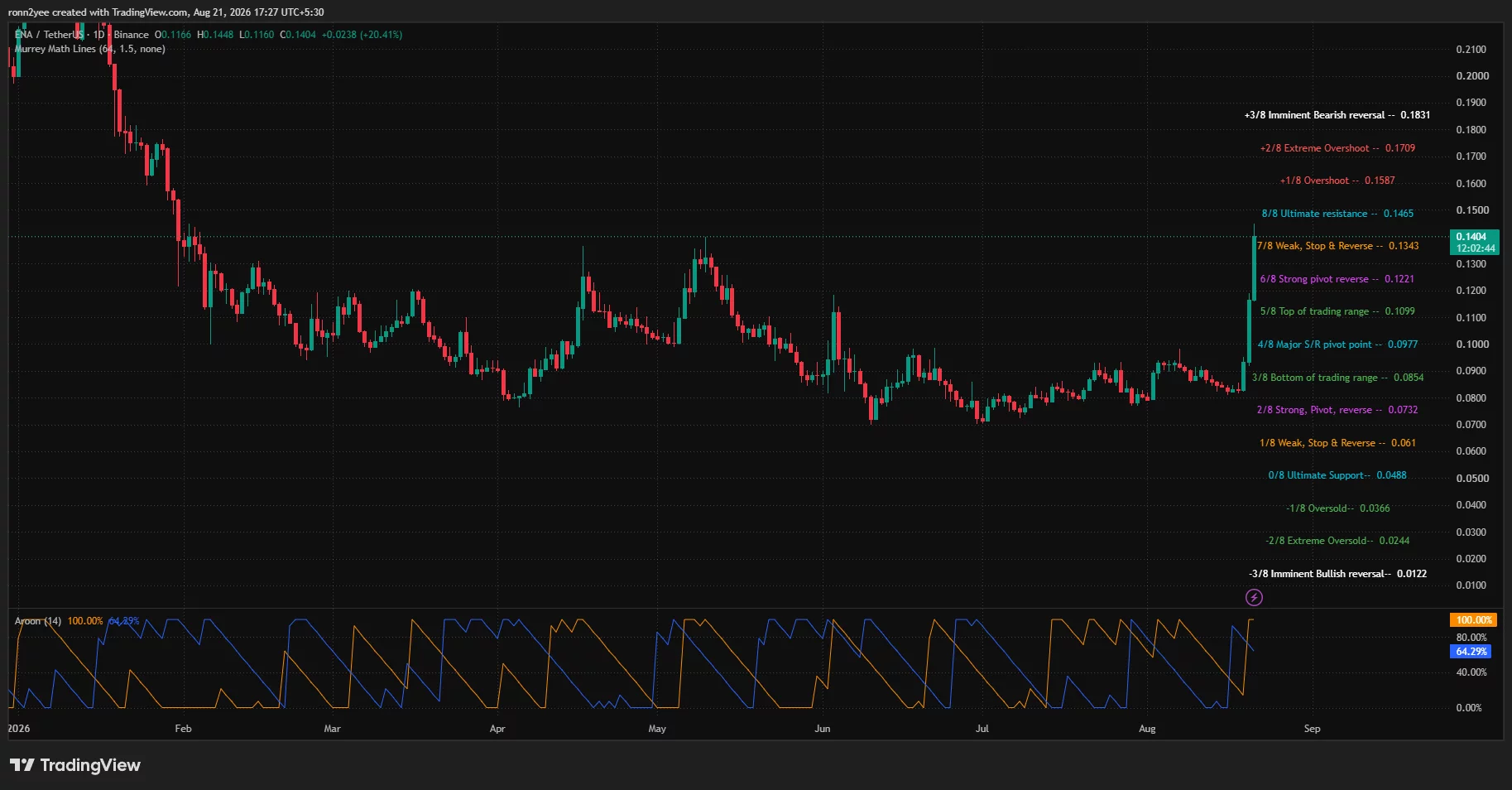
Daily Aroon readings provide another bullish signal. Aroon Up stood at 100%, consistent with ENA recording a fresh high, while Aroon Down was at 64.29%. The readings favor buyers but also reflect the speed and volatility of the reversal from ENA’s earlier lows.
Overbought readings do not guarantee an immediate decline. However, an RSI near 94 means traders entering after the vertical move face a greater risk if momentum slows or early buyers begin taking profits.
ENA price targets $0.1587 if $0.1465 breaks
The daily chart places $0.1465 at the next major resistance. ENA traded just below that level after its intraday high reached approximately $0.1448.
A daily close above $0.1465 would confirm a breakout from the current trading range. The next technical targets would be $0.1587 and $0.1709, followed by $0.1831 if momentum remains strong.
Failure to clear $0.1465 could produce a retest of $0.1343, which previously acted as a reversal level. Lower support sits at $0.1221, followed by $0.1099 and the former breakout area around $0.0977–$0.10.
CoinGlass’ three-day liquidation heatmap shows substantial leverage concentrations below the current price. The strongest nearby clusters appear around $0.118–$0.120, with additional liquidity between $0.104 and $0.116.
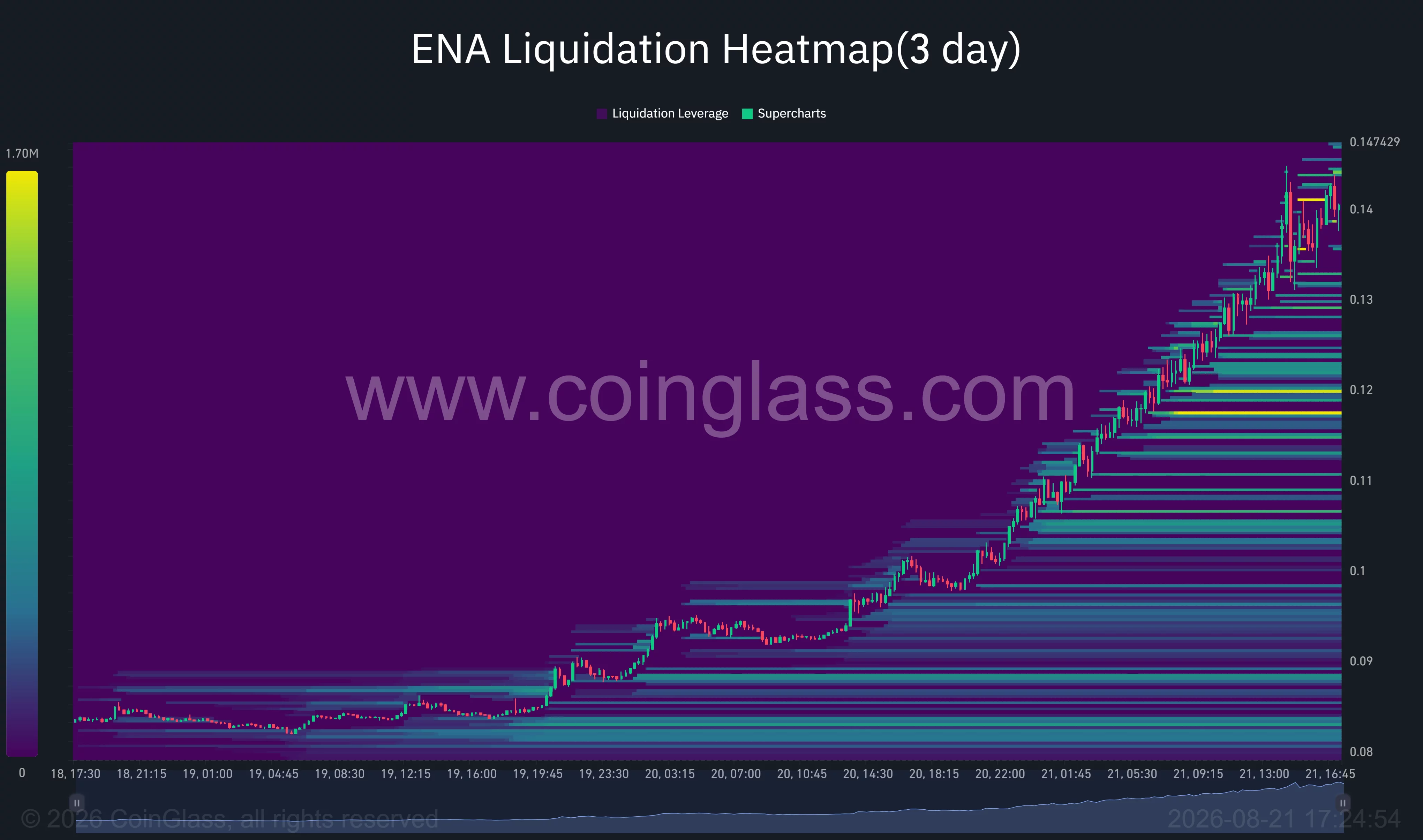
A decline through $0.1343 could therefore accelerate as leveraged long positions face pressure. Holding that level would allow ENA to consolidate without breaking the short-term bullish structure.
US market context remains tied to risk appetite
ENA’s rally has also benefited from a broader recovery across the crypto market as Bitcoin moved toward multi-month highs. Rising demand for higher-risk DeFi tokens often follows strength in Bitcoin and Ether, although such assets can also record sharper losses when market sentiment reverses.
FalconX’s US presence gives the lending agreement an institutional connection for American markets. FalconX Bravo, an affiliate of the prime broker, is registered with the Commodity Futures Trading Commission as a swap dealer focused on crypto derivatives.
The warehouse facility does not remove the risks attached to USDe or ENA. Borrower defaults, collateral declines, custody arrangements, smart-contract exposure, changing derivatives yields, and future token unlocks could still affect the protocol and its governance token.
For now, ENA’s breakout remains intact above $0.1343. A close above $0.1465 would support another leg toward $0.1587, while a rejection combined with the extreme RSI reading would raise the probability of a pullback toward $0.1221.
Disclosure: This article does not represent investment advice. The content and materials featured on this page are for educational purposes only.
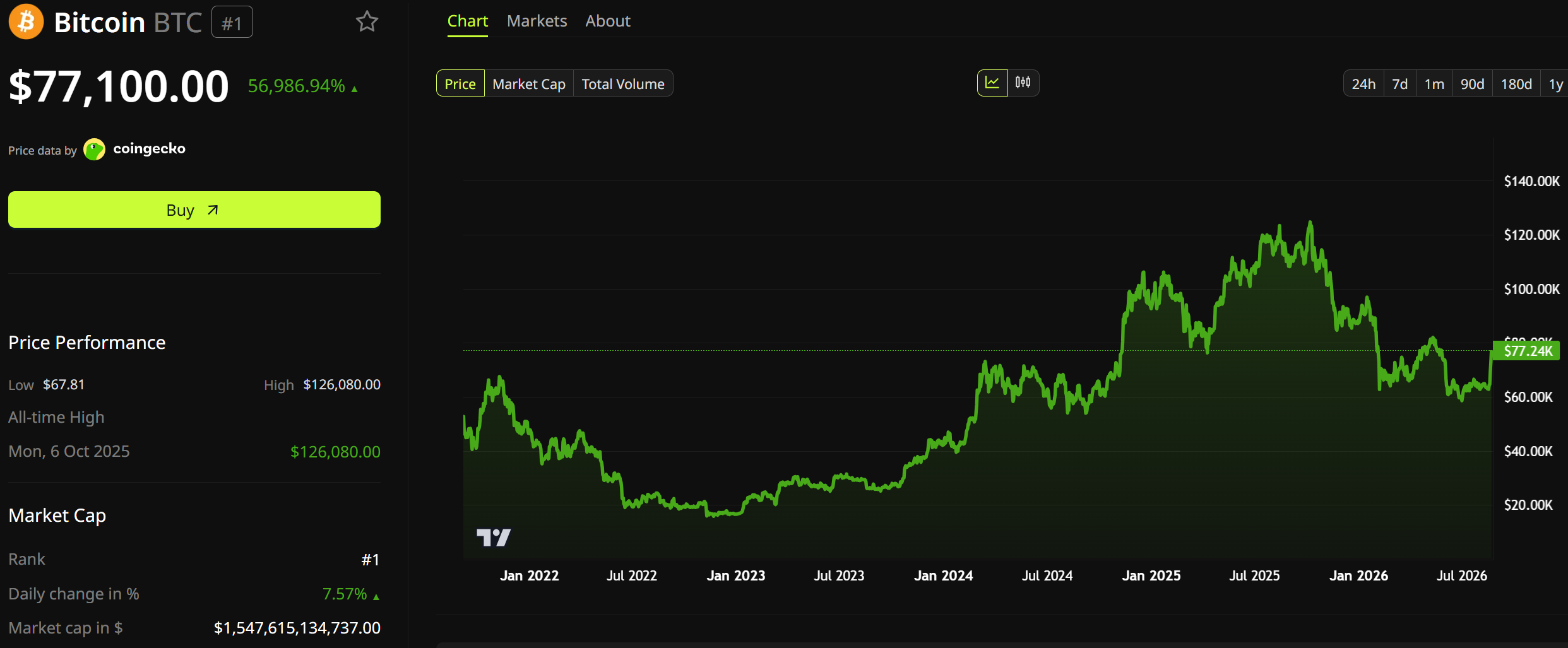
Bitcoin (BTC) gained more than 20% in five days, delivering the stock market’s average annual return about 140 times faster. The run then stalled at $79,500, just 0.6% short of $80,000.
BTC traded near $76,750 on Friday, up 6.6% on the day. That leaves $80,000 about 4% away. The daily relative strength index (RSI) sits at 84.64, its highest reading of 2026.
How Bitcoin Outran the Stock Market by 140 Times
The math is simple. Since 1928 the S&P 500 has compounded at 10.02% a year, dividends included, per New York University’s Stern School dataset.
Spread across five days, that yearly gain works out to 0.137%. Bitcoin did 20% in the same window. Call it 140 times the pace.
Low to high, the run reached 27%. BTC is heading for its strongest weekly close in two years.

Speed is not recovery. BTC still trades 39% below its record $126,080, set in October 2025.
Washington lit the fuse. The Treasury said on August 19 it would at least double its long-end bond buybacks, from $2 billion per operation to $4 billion.
The purchases cover 10-year to 30-year debt and run from September 9 through November 4. Long yields had just touched 20-year highs. Bond desks read it as a backstop.
Leverage did the rest. Bearish traders lost $1.06 billion in a day as short positions unwound.
Spot buyers showed up too. US spot Bitcoin exchange-traded funds (ETFs) took $517.2 million on August 19, then $606.3 million on August 20. That was August’s biggest day, per Farside Investors.
Three Resistance Layers Block Bitcoin’s Path to $80,000
Friday’s candle opened at $73,027 and ran to $79,500. Then sellers took over. That high hit the rising trendline drawn off February’s lows. Bitcoin climbed it all spring. June’s slide to $58,000 broke it.
Friday’s rally returned to the line from below and failed. Old support now works as resistance.

Two more walls sit in the same pocket. A shelf at $79,427 capped May’s high. The round $80,000 sits just above.
Bitcoin’s current price has to clear all three. Support starts at Friday’s $73,027 open.
Follow us on X to get the latest news as it happens
Weekend Odds Favor Digestion Over a Breakout
Jamie Coutts of Helios Analytics weighed the jump against how calm the market had been. It ranks fifth since 2018.
He found 14 comparable moves. Bitcoin sat higher 71% of the time 30 and 90 days later. The median gain was near 10%. A random day since 2018 returned 1.2%.
The extremes run wide. A similar jump in April 2019 led to a 118.7% gain over 90 days. One in October 2019 led to a 23% drop in 30.
Coutts calls 14 examples a thin sample. His own significance tests came back short of proof.
His table prices the pain too. In the median case BTC dipped 8.4% below entry within 90 days.

“There is a wall of overhead supply at the low $80k range it needs to work through,” wrote Coutts, chartered market technician at Helios Analytics.
On-chain data leans the other way. CryptoQuant shows spot and futures demand positive together for the first time since October 2025.
A separate quicktake ties the bounce to MVRV, which compares price with what holders paid.
Analyst Darkfost put net new demand at a 2026 high of 25,000 BTC. That weighs new coins against coins idle over a year.

“BTC looking strong here. Rallies like this in bear markets usually signal the bottom is in. Might see a dip, but the bear phase is pretty much done imo,” said Ki Young Ju, founder and chief executive of CryptoQuant.
So can Bitcoin reach $80,000 this weekend? Possible, but not likely.
Weekend books run thin. Fewer large buyers trade Saturday and Sunday. Clearing three walls with RSI at 84.64 (overbought) takes size.
A slide back toward $73,000 would cool that reading without wrecking the week. Bitcoin’s longer-term outlook now rests on whether the low $80,000s give way.
The post Bitcoin Moved 140x Faster than Stocks This Week: $80,000 this Weekend? appeared first on BeInCrypto.

Coldcard Firmware Update Improves Seed Generation Security

Blue Eye Samurai Renewed for Third and Final Season at Netflix

Australia’s leadership spill history might still teach the UK what not to do

Weekend Open Thread – Corporette.com

Weekend Open Thread: Brooks Brothers

London Mayor Sadiq Khan handed a peerage by Keir Starmer alongside 15 other Labour figures… just days before the PM leaves No10

Financial Empowerment Workshop

Crypto Live Trading| 21 AUG #vinbullindia #livetrading #vinbulllive #live #trading #cryptotrading

Neeye Punchiri | | Lokah | Hanan Sha | Reyan | Jakes Bejoy | Kalyani | Naslen | Dominic | Nimish
-

 Fashion7 days ago
Weekend Open Thread: Ann Taylor
-

 Sports7 days ago
Birmingham 2026: Day 6 Timetable for Irish Athletes
-
 NewsBeat6 days ago
Myanmar says over 300,000 Rohingya refugees verified for repatriation as exodus enters ninth year
-

 Business3 days ago
SMA Solar Technology AG (SMTGY) Q2 2026 Earnings Call Transcript
-

 Politics6 days ago
SEQ Code: The Three Letter Boarding Pass Code That Could Give You The Worst Seat
-

 Crypto World7 days ago
Pi Network Protocol 27 endgame: last upgrade before what?
-

 Tech3 days ago
Qwen3.8-27B runs frontier-class coding agents and reasoning locally, no cloud API required
-

 Crypto World4 days ago
OCC Greenlights Trump Family Crypto Firm for Trust Charter
-
 Tech6 days ago
Every fusion startup that has raised over $100M
-
 Entertainment6 days ago
Marvel Studios Reveals New X-Men Cast Including Adam Driver and Sadie Sink
-
 Business6 days ago
Monarch Mutual Fund set to enter MF space with maiden overnight fund; files draft with Sebi
-

 Fashion7 days ago
Weekly News Update, 8.14.26 – Corporette.com
-

 Business6 days ago
Facebook Down Now? Users Report Login And Loading Problems As Outage Trackers Monitor Ongoing Issues
-

 Business6 days ago
Cristiano Ronaldo’s Secret Wedding Deepens As Presenter Claims Family Learned ’30 Seconds’ Before
-

 News Videos1 day ago
Don’t Leave Your Financial Future To Chance | August 19, 2026
-

 Crypto World5 days ago
Data of 54K Wallet Users Leaked, Clarity Odds Just 10%: Hodler’s Digest, Aug. 16
-

 Fashion7 days ago
Cart Confidential Vol. 44 – Julia Berolzheimer
-

 Crypto World4 days ago
NAVI Prime launches institutional lending framework on Sui
-

 Politics5 days ago
Britain is facing a housing disaster
-

 Business6 days ago
New Avengers Doomsday Trailer Drops at D23 Showing Robert Downey Jr as Doctor Doom
You must be logged in to post a comment Login