

Connect with us

NewsBeat

CrossCountry hopes to operate all train services today

Published

on

CrossCountry hopes to operate all train services today

Services were severely affected after a power outage affecting its control centre resulted in major disruption across the network on Sunday, August 23.

The power outage in Birmingham started on Saturday and resulted in many of the systems used to manage the railway being unavailable, the operator said.

“Almost all” services were cancelled on Sunday, including popular routes linking Glasgow to Edinburgh, Manchester to Birmingham, Cheltenham to Cardiff and Newcastle to Edinburgh.

Advertisement

CrossCountry trains services should return to normal today

A CrossCountry spokesperson said: “Our key priority is now to restore as close to a normal service as possible for our customers tomorrow.

“With most facilities now reinstated, we are planning to operate a very limited number of services from around 18:00 this evening, primarily on routes towards Leicester and Derby.

“Planning is underway to support a full train service on Monday and we are working closely with National Grid and industry partners as recovery efforts continue.

“We would like to thank our customers for their patience and understanding during today’s disruption.”

On Sunday, Transport Secretary Heidi Alexander, said: “Following earlier disruption on CrossCountry services, I am pleased to hear some trains are set to run tonight, and a full timetable expected to resume tomorrow.

“While passengers should continue to check their journeys before they travel, I’d like to thank engineers who are working tirelessly to minimise disruption as much as possible.

Advertisement

“We are setting up Great British Railways and nationalising services, including CrossCountry next year, to end decades of fragmentation and vulnerability on our network.

“We are determined to give passengers the reliability they deserve.”

Passengers are being advised to check their journeys before travelling.

CrossCountry said tickets will continue to be accepted by other train operators across its network.

Advertisement

9 of the most scenic rail routes in the UK


You can get the latest travel updates via the CrossCountry website.

Can CrossCountry passengers get a refund for tickets?

Whether you have been on the train and experienced delays or you’re finding alternative travel arrangements, you might be able to ask for a refund.

Customers delayed by 30 minutes or more may be eligible for Delay Repay compensation.

Advertisement

Those who decide not to travel can claim a refund from their original point of purchase.

Are you affected by the power cut? Let us know in the comments below.

Source link

Advertisement
Continue Reading
Click to comment

You must be logged in to post a comment Login

Leave a Reply

NewsBeat

Andy Burnham arrives in Kyiv for first foreign visit as he hands over top secret Storm Shadow missile plans

Published

on

Andy Burnham laid a wreath and flowers at the graves of Ukrainian soldiers at the National Military Cemetery, as part of events marking the country's independence from the Soviet Union in 1991

Advertisement

Andy Burnham arrived in Kyiv for his first foreign visit today – as he hands over top secret missile plans.

The PM is in the Ukrainian capital for the country’s independence day after travelling overnight by train.

He is announcing that European defence firm MBDA has been given permission to share information on UK components for the long-range Scalp missile.

This means the ‘deep precision’ Scalp, a French-produced version of the UK’s Storm Shadow using both countries’ technology, could now be produced locally in Ukraine.

Advertisement

The weapons are critical for long-range strikes reaching targets in Russia. 

Andy Burnham laid a wreath and flowers at the graves of Ukrainian soldiers at the National Military Cemetery, as part of events marking the country’s independence from the Soviet Union in 1991

The PM is in the Ukraine capital for the country's independence day after travelling overnight by train

The PM is in the Ukraine capital for the country’s independence day after travelling overnight by train

Advertisement

Mr Burnham laid a wreath and flowers at the graves of Ukrainian soldiers at the National Military Cemetery, as part of events marking the country’s independence from the Soviet Union in 1991.

During the ceremony, he spoke to Finnish President Alexander Stubb, who told the Prime Minister ‘we are in a war period’ and warned of Ukraine’s difficulties repelling Russian ballistic missile attacks.

Later, Mr Burnham will chair his first meeting of the ‘coalition of the willing’, and accept an award on behalf of the British people recognising the UK’s support.

He is also set to meet Ukrainian President Volodymyr Zelensky, who was the first foreign leader to visit 10 Downing Street after Mr Burnham took over from Keir Starmer.

Advertisement

It follows the Kremlin warning of ‘consequences’ over UK drones being used by Ukraine to strike far into Russia.

Moscow said the deeper Britain became involved, ‘the higher price it will pay’.

Mr Burnham said: ‘On Ukraine’s 35th anniversary of independence, its people should be in no doubt: The UK is behind you.

‘In the fight and the rebuilding to come, we stand with Ukraine. Russia should be in no doubt of our resolve. We will not back down till there is a lasting peace.’

Advertisement

But Russia said relations with Britain are at ‘an unprecedentedly low level’ as it ordered its ambassador Andrey Kelin back to Moscow after seven years in post.

Mr Kelin has accused the UK of choosing ‘a path of confrontation’ with Russia.

Mr Burnham said: ‘Russia should be in no doubt of our resolve.

‘We will not back down until there is a just and lasting peace.’

Advertisement

But his visit comes as Mr Zelensky faces domestic political strife caused by a rift with his former defence minister, Mykhailo Fedorov, who was sacked last month after reportedly falling out with the head of Ukraine’s armed forces.

Mr Fedorov, whose sacking triggered weeks of mass protests, has called for Mr Zelensky to hold elections, arguing democracy ‘should not be the hostage of Putin’.

During the ceremony, he spoke to Finnish President Alexander Stubb (second from left)

During the ceremony, he spoke to Finnish President Alexander Stubb (second from left)

He has also called for Mr Zelensky to face questions over what he knew about alleged corruption in his inner circle.

Advertisement

Last week, Ukraine’s anti-corruption authorities said they had uncovered a money-laundering plot, leading Mr Zelensky to sack one of his senior officials over their alleged involvement.

The president has denied any involvement, telling reporters over the weekend: ‘The heads of anti-corruption agencies have zero questions for me.

‘They understand perfectly well that I am not involved in anything like that.’

Advertisement

Advertisement

Source link

Continue Reading

NewsBeat

Reform Wants To Prioritise British-Born Workers For Social Housing

Published

on

Reform Wants To Prioritise British-Born Workers For Social Housing

Reform UK’s new pledge to prioritise British-born workers for social housing has been torn apart and described as “desperate”.

The right-wing party will today unveil plans to restrict eligibility for social housing on top of its past commitment to fully evict foreign nationals from such accommodation.

The plans mean it will be more difficult for single parents, unemployed people or those born outside of the UK to access social housing.

The party said it “believes social housing should not be a reward for welfare”, and will put British-born workers under the age of 35 at the front of the queue – with priority for married couples with children.

Advertisement

It also claims their existing pledge to evict foreign nationals entirely will free up around 540,000 social homes.

Reform UK’s business, energy and trade spokesperson Richard Tice said: “There are now 1.3 million people waiting for social housing in Britain.

“The vast majority of them do not have jobs. In terms of the social houses we have, less than half of households are in work and over half a million social homes are currently occupied by foreign nationals.

“Meanwhile, young British men and women, who are working hard, can’t afford to move out of their family home, and when they do often find themself sharing a house with strangers, with no realistic prospect of forming a family or getting on.

Advertisement

“It is time for us to prioritise young British workers, and that is what our policy is about.”

He added that he would help “generation rent onto the housing ladder” and “get Britain building”.

However, the Ministry of Housing, Communities and Local Government said in January that nearly nine in 10 social homes go to UK nationals.

Sarah Elliott, chief executive of the housing justice charity Shelter, said Tice’s plans were “designed to stoke division” and would only “disrupt the lives of thousands of families, tear communities apart and put even more people at risk of homelessness”.

Advertisement

“We need politicians to stop scoring cheap political points and get on with building the 90,000 social rent homes a year for the next ten years that we desperately need,” she added.

Francesca Albanese, the director of policy and social change at homelessness charity Crisis, also said the idea risks “scapegoating people who are already facing housing insecurity”.

A Labour spokesperson slammed the announcements as a distraction from the ongoing scrutiny around the party’s finances.

They said: “These unserious and unworkable plans are a desperate bid to shift headlines away from Reform’s sleaze, scandals and infighting.

Advertisement

“Access to social housing is already tightly controlled.

“Illegal migrants, asylum seekers and migrants on student or work visas are not eligible for social housing.

“This policy would go after long-term UK residents that have contributed to our country but are not British citizens, including NHS staff.

“It would leave more families at risk of homelessness and drive up use of temporary accommodation at the taxpayers’ expense. It would also mean renegotiations with the EU, resulting in years of wrangling.

Advertisement

“While Reform push gimmicks and division, Labour is doing the hard yards to build more homes and bring back hope across our country.”

The Conservatives’ shadow home secretary James Cleverly said: “This is yet another unfunded announcement from Reform and shows they have not done the hard work needed and is so often the case their maths simply doesn’t stack up.”

He added: “The Conservatives have already set out comprehensive plans to ensure British nationals are at the front of the queue for social housing. Now Reform are trying to catch up.”

Listen to Commons People, the podcast that makes politics easy. Every week, Kevin Schofield and Kate Nicholson unpack the week’s biggest stories to keep you informed. Join us for straightforward analysis of what’s going on at Westminster.

Advertisement

Source link

Continue Reading

NewsBeat

Child Benefit warning for millions of parents as payments could stop after August 31

Published

on

Daily Mirror

To claim Child Benefit, your child normally has to live with you, or you pay at least the same amount as Child Benefit toward looking after them

Millions of parents have just one week left to renew their Child Benefit payments before they stop.

Child Benefit is worth £27.05 a week for your first child, then £17.90 for any additional child. You can claim it if you are responsible for a child under the age of 16, or if they are under the age of 20 and they stay on in education or training.

But you must notify HMRC if your child is continuing with education or training – and the deadline for doing this is August 31. It comes after thousands of students picked up their GCSE results last week.

Advertisement

Child Benefit continues for children in full-time, non-advanced education, including A levels, T levels, Scottish Highers, NVQs up to level 3, and certain approved training schemes.

It cannot be claimed for children doing a university degree, a standard apprenticeship in England, or a course that forms part of a job contract.

You can update your Child Benefit claim through the HMRC app or GOV.UK, or by phone or post. Once your child has finished their education or training, Child Benefit payments will continue until whichever of these comes first: the end of February, May 31, August 31 or November 31.

Advertisement

You must inform HMRC if your child leaves education or training before the course is complete, otherwise you risk being paid money that you are not entitled to.

Myrtle Lloyd, HMRC Chief Customer Officer, said: “Exam results season is a big moment for teenagers deciding their next steps, and it’s the perfect time for parents to confirm those plans with us.

“Child Benefit is a vital source of support for many families and we don’t want anyone to miss out. It only takes a few minutes using the HMRC app or GOV.UK, so make sure you’re receiving the payments you’re entitled to.”

You can claim the full amount of Child Benefit if you, or your partner, earn under £60,000 a year. If you earn more than this, then the High Income Child Benefit Charge will apply.

If either you earn over £60,000, you have to pay back 1% of your Child Benefit for every £200 you earn over £60,000. Child Benefit is effectively wiped out once you earn over £80,000.

To claim Child Benefit, your child normally has to live with you, or you pay at least the same amount as Child Benefit toward looking after them.

Advertisement

There is no limit for how many children you can claim Child Benefit for – but only one person can make a claim for Child Benefit for any individual child.

Source link

Continue Reading

NewsBeat

UK’s rarest bird of prey rears new chicks in secret location

Published

on

A handout photograph of a small fluffy harrier chicks, with a curved yellow and black beak.

These slender, long-winged raptors make an epic annual migration to Africa in winter and return to Europe to nest over summer, often setting up home in agricultural fields.

But little is known about the behaviour of juvenile harriers once they leave the nest. This year, for the first time, the RSPB has fitted two of the chicks with satellite tags in the hope of providing the birds with better protection.

“It will allow us for the first time ever to work out where they’re going, what migration route, how long they’ll spend there, and will they come back to the UK in the first year or the second year,” said Mark Thomas, head of investigations at the RSPB.

“All of that information is the bit that’s missing from the jigsaw.”

Advertisement

It is also hoped the tagging can better protect the rare birds from having their nests, on the ground, hidden among crops, inadvertently destroyed.

“This is a species right on the brink, and climate change is not helping that. The harvest here, for example, this year, was like a month earlier than in previous years. So it almost puts any Montagu’s harrier nest at the peril of inadvertently being destroyed by farm machinery,” said Thomas.

Source link

Advertisement
Continue Reading

NewsBeat

Excessive noise from new station ruining ‘peace and calm’ of allotments

Published

on

Cambridgeshire Live

Cambridge South opened as the city’s newest station in June, but residents have said the announcements are too loud

Cambridge residents living near to the city’s latest train station have said platform announcements are so loud it has ruined the “peace and calm” of their allotments. Cambridge South opened to passengers at the end of June, linking Addenbrooke’s Hospital, the biomedical campus and Trumpington to the rail network.

Advertisement

But residents on nearby Clay Farm say the announcement system is so loud they can hear it from their homes and, especially from the allotments in Hobson’s Park. Philippa Slatter, a resident and former councillor, said there was a lot of concern from residents who go to their allotments for peace and quiet.

The 75-year-old said: “I should not be able to know where the next train is going to, but I can hear it from the allotments and I can hear it from my back garden.”

She said many use the area for a much-needed break from high-pressure jobs on the biomedical campus and the noise has interrupted the peace and tranquility.

She said: “I personally just try to ignore it, but if somebody is feeling stressed it may be even more distressing for them.”

Advertisement

One of the plots was set up by the local GP practice, called Gardening for Health, where patients and staff meet to grow vegetables.

Ms Slatter said: “For some of the people coming to that, on some days it is very distressing, and I’m particularly concerned about them. We never know what other people’s lives are like, we never know what people have left in the ward when they came off duty and for them that bit of stress is quite strong.”

A volunteer from the Gardening for Health plot said: “Some of our volunteers specifically come for the peace and calm of being in nature, and then we hear the station announcements and it completely ruins the vibe!”

One resident, who did not give their name, said their allotment “is no longer a tranquil, peaceful escape”, but another said they will “get used to the noise” and are pleased to have a station “so close to home”.

Advertisement

Cllr Olaf Hauk, of Trumpington, said Cambridge City Council’s officers investigated after concerns were raised but found the noise “did not constitute a statutory noise nuisance”. But, they found some announcements were “clearly audible several hundred metres from the station” and “could potentially cause problems, particularly during evenings and at night”.

The Lib Dem councillor said: “We and council officers have raised this directly with Greater Anglia, who acknowledged that there are still ‘teething problems’ with the station’s sound system and agreed that further work is needed. Their engineers are reviewing the system and individual announcement settings to identify and reduce excessively loud announcements.

“We are delighted to have Cambridge South station in Trumpington and recognise the enormous benefits it brings to the Biomedical Campus and sustainable transport for the wider community. However, a new station of this scale will inevitably have some teething problems.

Advertisement

“As local Lib Dem councillors, we will continue to push hard to make sure these are resolved and that Cambridge South works well for everyone – in particular the residents who live around it.”

A spokesperson for Greater Anglia said they were aware of the concerns and have been in contact with the council’s environmental health team and residents.

They said: “We have met with Cambridge City Council’s environmental health team and local residents, and we are also in contact with Clay Farm residents. We will continue to monitor the announcements and make any appropriate adjustments accordingly.”

Source link

Advertisement
Continue Reading

NewsBeat

Pensioners’ urgent warning over State Pension payment date

Published

on

DWP refunds claimants after admitting fraud penalty errors

Millions of people who receive payments from the DWP for Universal Credit, State Pensions, PIP and other benefits have been reminded ahead of payment date changes due to the August bank holiday next Monday.

While it may be a welcome boost for some people, it will mean the payment has to last longer, and some charities have said it can place extra pressure on already tight budgets.

Why are pension payments changing this week?

Monday, August 31, is a bank holiday when payments from the Department for Work and Pensions (DWP) won’t be made.

Advertisement

If you are due to receive a DWP benefit payment that day, you will now receive it this week – on Friday, August 28.

If your payment is due on a different day, it will arrive in your account as normal, and the amount you are due to be paid will remain the same.

Why does this happen?

When a payment date falls on a weekend or a bank holiday, the Department for Work and Pensions says the claimant is generally paid on the working day before, but this can vary.

In a new statement, Minister for Social Security and Disability Sir Stephen Timms said: “We’re pleased to confirm that benefit payments due on the August bank holiday will be paid earlier.

Advertisement

“This will help ensure families and older people receive their money without disruption over the bank holiday period.”

He added: “This Government is determined to ensure people up and down the country have the support and breathing room they need, which is why we’ve acted to take money off energy bills, increase the National Minimum Wage and lift half a million children out of poverty, as well as supporting people into good, secure jobs.”

These are the benefits that will be affected by the bank holiday weekend:

  • Attendance Allowance
  • Carer’s Allowance
  • Child Benefit 
  • Disability Living Allowance
  • Employment and Support Allowance 
  • Income Support
  • Jobseeker’s Allowance 
  • Pension Credit 
  • Personal Independence Payment (PIP)
  • State pension 
  • Tax Credits 
  • Universal Credit

While you may be paid earlier in some cases, the money will also have to last you longer, as payment dates will return to normal afterwards.


Recommended reading :


Why do payments change in areas that don’t have a bank holiday?

Even when a bank holiday doesn’t fall in all areas of the UK, such as different holidays in Scotland, DWP payments will still be paid earlier. This is because payments are made centrally.

The two remaining bank holidays for 2026 fall on Christmas Day and December 28, as Boxing Day falls on a Saturday this year. 

Advertisement

Will you be impacted by the payment date change? Let us know in the comments.

Source link

Advertisement
Continue Reading

NewsBeat

Transfer news LIVE: Arsenal FC medical, Alvarez twist; Man Utd boost; Barcola to Liverpool update; Chelsea latest

Published

on

Transfer news LIVE: Arsenal FC medical, Alvarez twist; Man Utd boost; Barcola to Liverpool update; Chelsea latest

The summer window is set for a lively finish as Arsenal, Chelsea, Manchester United, Tottenham and Liverpool all push for further signings before the deadline. Arsenal continue to chase a deal for Julian Alvarez, who is apparently open to a Premier League return. The Gunners also remain interested in the likes of Victor Osimhen, Kenan Yildiz and Matias Fernandez-Pardo as Gabriel Martinelli heads for the exit, while they could swoop for Eli Junior Kroupi in January. Igor Tyjon has undergone an Arsenal medical and should be followed by Manchester United duo James Scanlon and Habeeb Ogunneye.

Source link

Continue Reading

NewsBeat

M60 LIVE as huge delays after all motorway traffic stopped amid crash

Published

on

Manchester Evening News

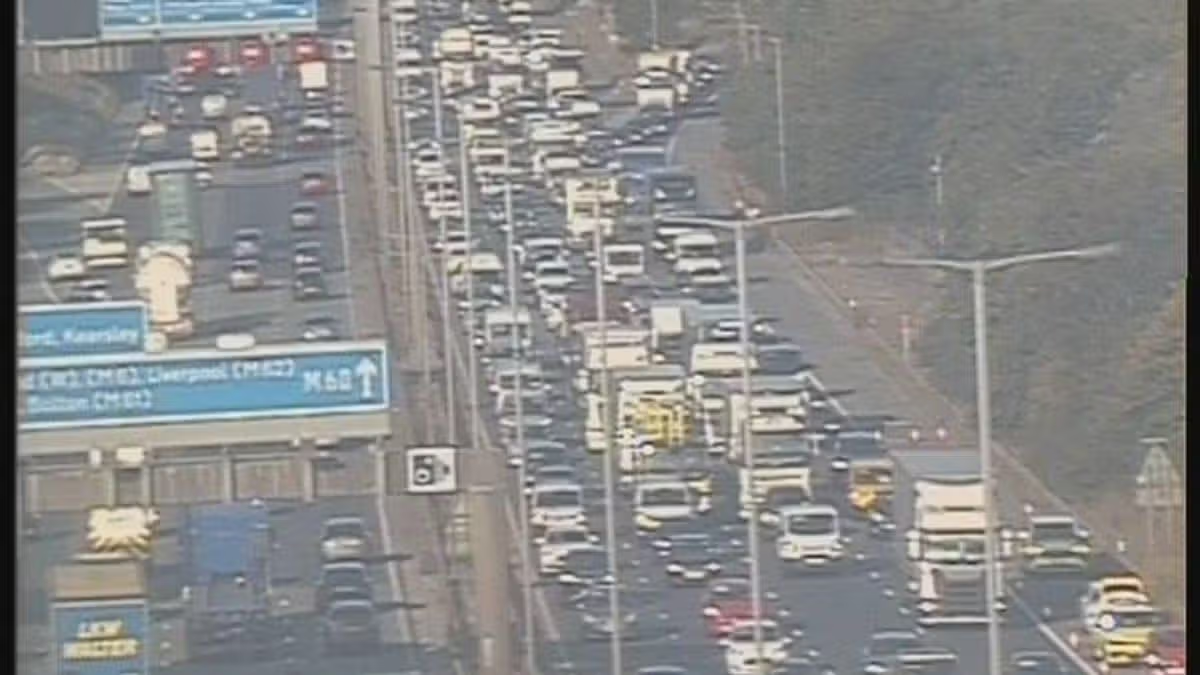
Long queues are building on part of the M60 this morning amid reports of a crash.

According to traffic alert service Inrix, all traffic is currently being held on the clockwise side of the motorway.

It is held amid the crash between junction 16 for Pendlebury and junction 17 for Prestwich and Whitefield.

Advertisement

Click here to get the biggest stories straight to your inbox in our Daily Newsletter

Motorway cameras show long queues and heavy traffic in the area up to the incident.

Follow our live blog below for the latest traffic updates.

Source link

Advertisement
Continue Reading

NewsBeat

Cider producers facing ‘worst year ever’ amid dry weather

Published

on

Cider producers facing 'worst year ever' amid dry weather

Growers say the drought has left orchards with smaller, malformed apples that are “not fit for purpose.”

This year’s harvest is expected to be the poorest since records began in 1984.

While the cider industry is expected to avoid shortages, with stocks saved from previous years, some smaller producers say the dry summer has forced them to abandon some of their orchards altogether.

Advertisement

Speaking to The Telegraph, Lorraine O’Connor, who runs Cuckoo Valley Cider in Cornwall, said: “We weren’t worried to start with.

“But as the months went on and on with no rain at all, the apples started dropping really early.

“The leaves on our trees turned brown two months ahead of time, and the apples are a lot smaller.

Advertisement

“We have just been hoping and hoping for rain.”

Ms O’Connor had been expecting to harvest 16 tons of apples this season.

Instead, she now expects just 10 tons.

Steve Layton, who runs a family cider business in Herefordshire, said: “It has been relentless.

Advertisement

“All the water sources have dried up.”

Mr Layton said his commercial orchards were down by 40%, with some not expected to produce “any apples at all”.

According to the Environment Agency, 71.3% of England is currently in drought, with the worst-affected areas in the south and Midlands.

The north has also seen extended dry spells, and a sixth heatwave is forecast.

Advertisement

Farmers call on government to take action

The National Farmers’ Union and other industry groups are calling on the Government to offer interest-free loans tied to losses from the drought.

The Department for Environment, Food and Rural Affairs (DEFRA) said it was taking action to support the industry.

A DEFRA spokesman said: “As the Prime Minister has said, food and farming is part of national resilience and we’re acting now to support the sector.


Recommended reading:

Advertisement

“Our recent drought package responds directly to the pressures it is facing with £65m of support.

“We are listening and understand how difficult times are, and we will keep working closely with farmers to protect and promote British-grown products.”

While cider drinkers are unlikely to notice an immediate impact, producers warn that continued extreme weather could threaten future supplies.

Are you worried about the future supply of cider in the UK? Let us know in the comments.

Advertisement

Source link

Continue Reading

NewsBeat

There’s a better way to cool data centres that cuts their huge thirst for water

Published

on

There’s a better way to cool data centres that cuts their huge thirst for water

Water is an amazing substance. The human body is made up of more than 50% water. Approximately 70% of the earth’s surface is covered by water. We drink it, bathe in it, cook with it, clean with it. It is also used to cool data centres, which is an increasing draw on what is a scarce resource in many parts of the world.

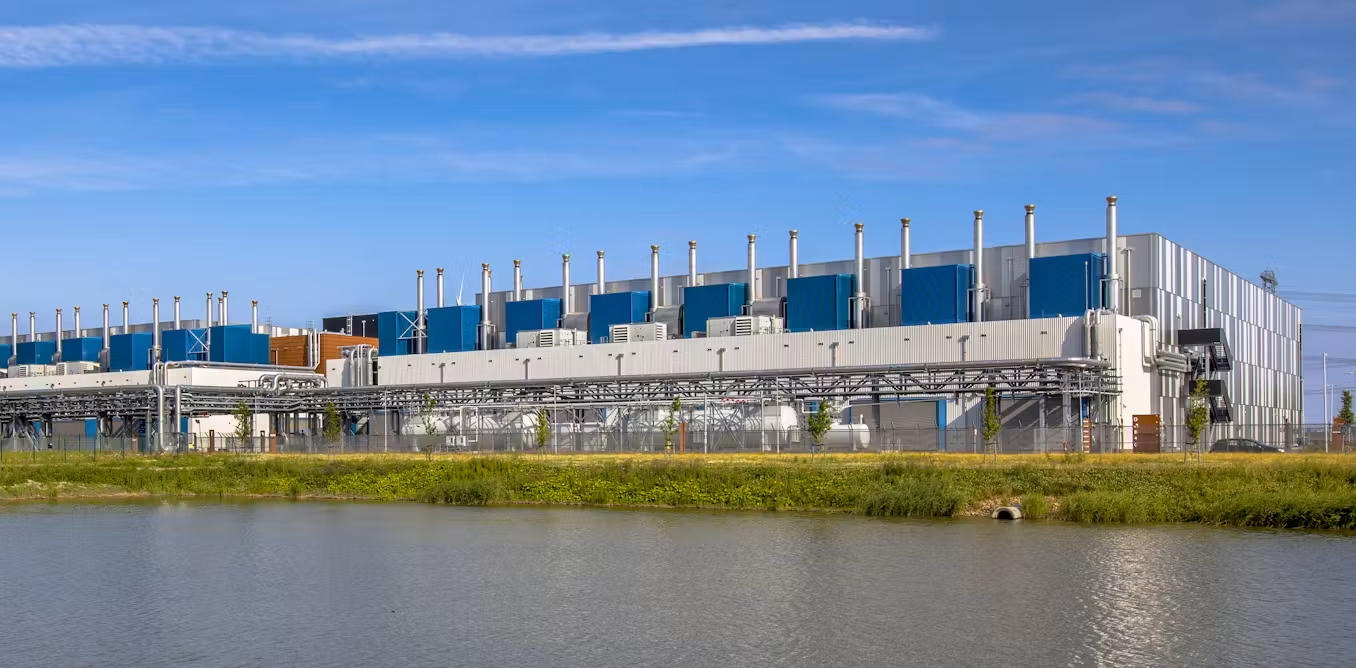
The boom in artificial intelligence (AI) has been fuelling the construction of new data centres worldwide. This is driven by the massive computing workloads required to train and run generative AI models. AI data centres are specialised facilities with the infrastructure needed to support the increased computational demands.

A recent UN report warned that water used by AI data centres is expected to equal the everyday water needs of 1.3 billion people by 2030. Currently, air conditioning systems carry cool air to the server rooms housing the electronic equipment. Water is then used to carry away waste heat from the air to the environment.

But are there other potential ways to cool these facilities, ways that may not consume as much water?

Advertisement

For engineering purposes, water has extraordinary thermal properties. It has a very high specific heat capacity (the energy required to raise its temperature). It also has an exceptionally high latent heat of evaporation (the energy required to turn liquid water into water vapour).

Latent heat is what cools you when sweat evaporates from your skin, an astonishingly powerful cooling mechanism. These properties make water the ideal medium to transport heat, for applications ranging from automobiles and home heating, to large scale thermal power stations.

If you step inside a data centre, your senses are struck by the noise of cooling fans and the feel of swirling airflow on your skin.

The reason that air is used for direct cooling of the equipment is that it is safe, compared to a liquid like water, which could leak and damage electronics. In comparison with water, however, air is very poor at transporting heat even when given a helping hand by noisy cooling fans and churning air flows. The energy required to cool data centres is comparable in scale to the energy consumed by the electronic equipment itself.

Advertisement

Water is used to extract the waste heat from the air conditioning system through something called a chilled water loop. Hot air from the servers is passed over cold water coils. The now warm water is then piped outside the server hall.

A structure called a cooling tower is used to remove this heat from the chilled loop. The water to be cooled is brought in contact with ambient air as a spray, and a portion of it evaporates.

This cools the rest of the water, which is then recirculated. There are other flavours of data centre cooling which also exploit the latent heat of water – using the direct and indirect evaporative cooling of outside air. However, these also consume lots of water.

Advertisement

Cooling loops in a data centre: heat exchangers are used to transfer thermal energy between the loops.
T. J. Breen et al. (2011)

Is water consumption a bad thing?

Evaporative cooling places a demand on water supplies, but it also serves to reduce electrical energy consumption of the overall cooling infrastructure. In this context, it is important to note that electricity generation itself also requires water.

I am a professor at the University of Limerick, so for Ireland’s mix of energy sources, approximately 0.1-2 litres of water are required per unit of electricity (L/kWh).

Hence, by reducing electricity demand, evaporative cooling could be regarded as a “least bad” option in terms of the overall consumption of energy and water resources.

Of course, sufficient sources of water are required – clearly a critical factor in many parts of the world – and water stress is an issue even in rainy Ireland. However, there is some evidence of collected rainwater being used to reduce the demand on the water network here.

Advertisement

The use of air as the primary coolant for the electronic equipment significantly influences the overall energy consumption of a data centre. Because air is such a poor coolant, it only heats up by 5-20°C when it passes through the equipment.

The cooling infrastructure has to remove large quantities of thermal energy at relatively low temperatures – in the range of 25-40°C. Heat transfer is driven by temperature differences, hence the cooling plant is large, and it requires a lot of electricity to run the associated fans, pumps and compressors.

What if liquid was used to cool the electronic equipment using a “direct-to-chip” scheme? In this case, sealed pipe networks bring the coolant into the equipment, to extract heat from the power-hungry CPUs and GPUs (microprocessors and graphics processors) at the heart of servers.

Here, because a liquid such as water is far superior to air, the water being piped away from the equipment is hotter – closer to the component temperature limits, and potentially 60°C or higher.

Advertisement

Direct-to-chip schemes do reduce the cost of cooling, and offer opportunities to make use of waste energy in the form of heat carried away by water from the server equipment.

So why haven’t all data centres moved to this technology? Some are already using direct liquid cooling, but there may be some resistance to retrofitting an “air driven” facility. The replacement of electronic equipment in data centres is fairly frequent (between 2-7 years), allowing the transition to “direct-to-chip”. But there are costs involved in making the switch and some air cooling needs to be retained for certain classes of equipment.

Direct-to-chip systems would require a smaller, more frugal infrastructure.

Data centres now draw such vast quantities of electrical energy – over 7.5 TWh in today’s Ireland, almost a quarter of metered consumption – that it is imperative to reduce consumption and reuse the resource where possible.

Advertisement

Source link

Continue Reading

Trending

Copyright © 2025