
Crypto World
Samsung Falls 8.7% After Record $79 Billion Payout Disappoints

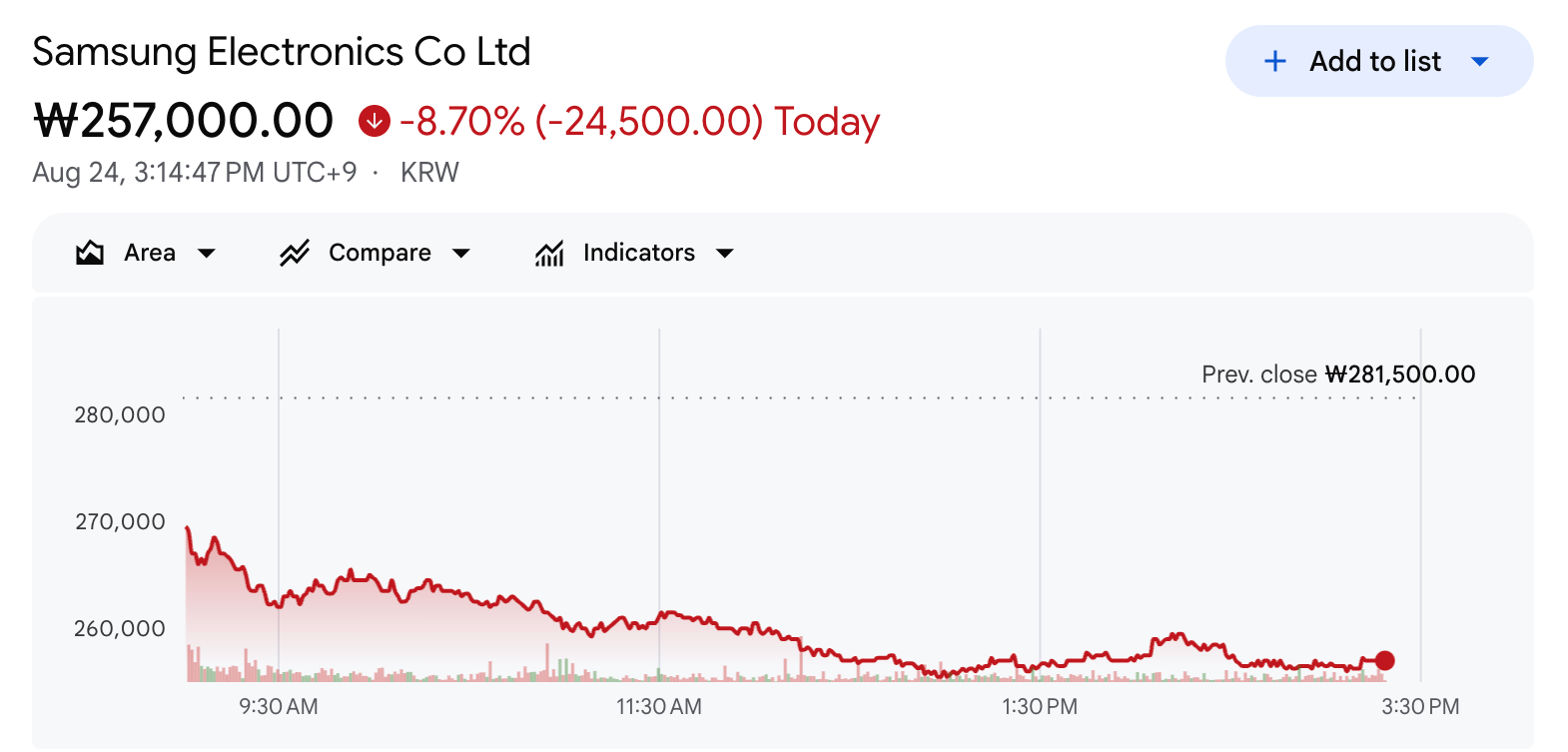
Samsung Electronics’ stock dropped 8.7% on Monday after its record shareholder return plan disappointed investors.
The stock traded near 257,000 won, down 24,500 won from Friday’s close. It has now surrendered the gains that followed the board announcement.

Follow us on X to get the latest news as it happens
Why a Record Payout Still Disappointed
Samsung’s board approved 2026 shareholder returns of 90 trillion won to 110 trillion won, or roughly $65 billion to $79 billion. This is about five times the previous high of 20.3 trillion won set in 2020.
Roughly 30 trillion won will be paid as third-quarter cash dividends. Samsung reaffirmed its pledge to return half of its free cash flow.
Analysts had modeled a bigger number. The plan also offered little detail on treasury share cancellations.
“Unlike SK Hynix, Samsung Electronics did not mention the possibility of raising its existing shareholder return policy, nor did it announce a plan to cancel treasury shares that could more directly contribute to the stock price increase, which is disappointing,” Eugene Securities analyst Sohn In-joon said.
Samsung’s board also approved a 15 trillion won buyback for employee compensation. Morgan Stanley described the wider package as slightly below expectations. The company will decide on the remaining shareholder return at a January board meeting.
Korean Markets Stay Volatile as Retail Money Shifts
Meanwhile, the selloff spread across Seoul. SK Hynix slipped 2.7%, and the KOSPI shed almost 3%, extending a stretch of heavy swings that began in July.
The index fell 22% that month. Officials convened an emergency meeting after severe retail losses and curbed demand for single-stock leveraged funds.
Retail risk appetite did not retreat, though. It changed the wrapper. Investors bought about 3.5 trillion won of Equity-Linked Securities (ELS) in July, the most since April 2023, according to the Korea Financial Investment Association.
Notes tied to Samsung Electronics and SK Hynix led the sales. For Samsung shareholders, the number that may count arrives in January, when the board sets the remaining return.
Subscribe to our YouTube channel to watch leaders and journalists provide expert insights
The post Samsung Falls 8.7% After Record $79 Billion Payout Disappoints appeared first on BeInCrypto.


Key takeaways
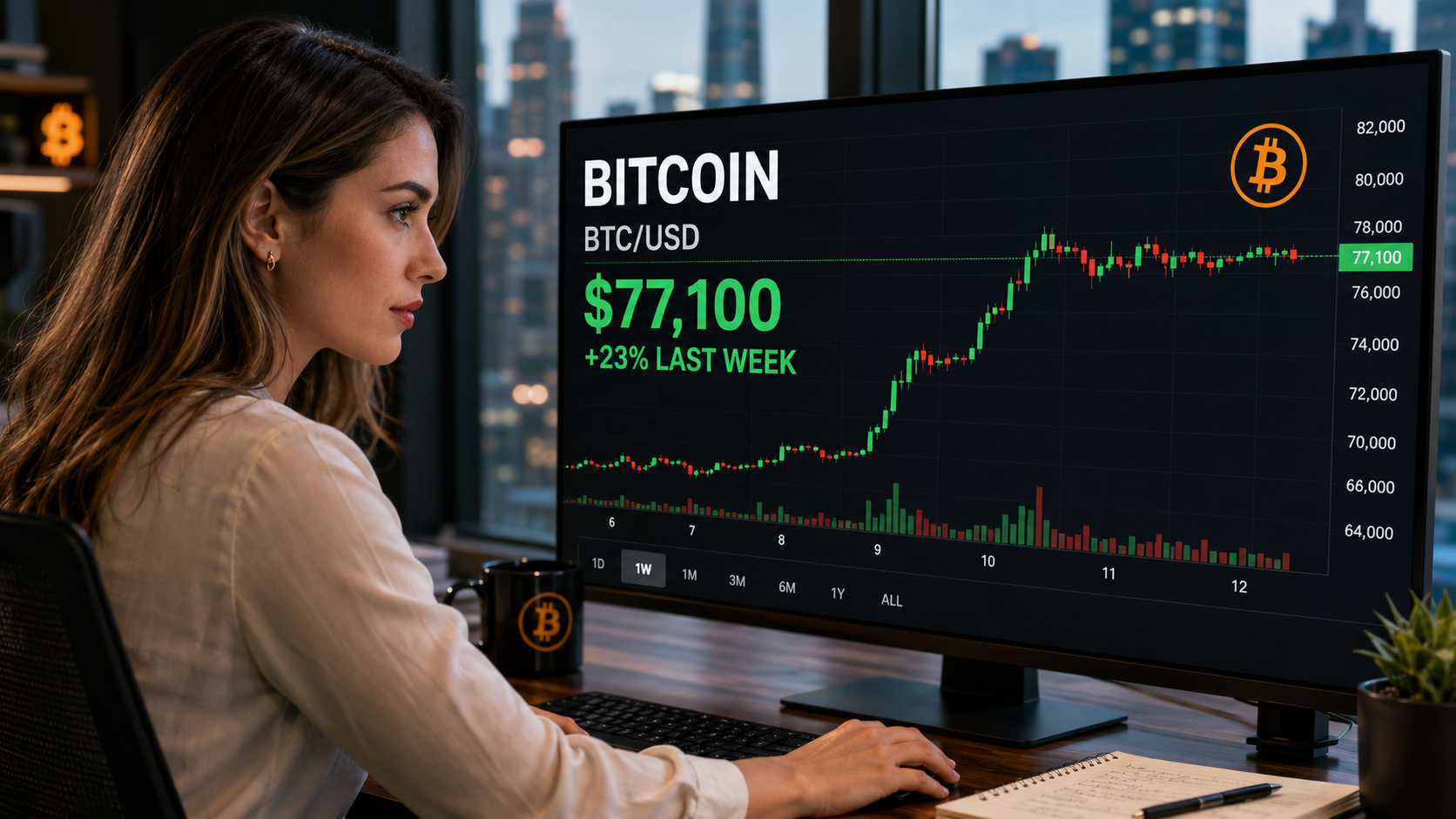
- Bitcoin trades around $77,000 after gaining more than 23% last week, its strongest weekly performance since March 2023.
- Investors realized $1.72 billion in profits on Friday, the highest daily total since November 2024.
- US spot Bitcoin ETFs attracted $1.92 billion in weekly inflows, their strongest showing since October 2025.
- BTC faces immediate resistance at $78,490 and $80,000, with additional upside targets at $81,059, $87,599 and $88,990.
Bitcoin is trading around $77,000 on Monday after surging more than 23% last week, its strongest weekly gain since mid-March 2023.
The rally followed the US Treasury’s announcement that it would expand its debt buyback operations, improving sentiment across cryptocurrency markets.
Strong institutional demand also supported the advance, with US spot Bitcoin exchange-traded funds recording their largest weekly inflows since October 2025.
However, on-chain data suggests some investors are taking profits as BTC approaches the psychologically important $80,000 level.
That selling activity could result in a temporary consolidation phase or a short-term pullback before Bitcoin attempts another move higher.
Bitcoin investors realize $1.72 billion in daily profits
CryptoQuant data shows Bitcoin holders realized approximately $1.72 billion in profits on Friday.
The figure marked the highest daily realized profit total since late November 2024. Last week’s rapid price increase moved many investors back into profitable territory, encouraging some holders to sell and secure their gains.
Historically, sharp increases in realized profits can precede a period of consolidation or a temporary correction as additional supply enters the market.
The profit-taking does not necessarily signal the end of Bitcoin’s broader recovery. However, it does indicate that the market may face increased selling pressure near major resistance levels.
Despite the increase in profit-taking, Bitcoin’s underlying spot demand has improved. CryptoQuant’s apparent demand metric has moved into positive territory after remaining negative since late February.
The shift suggests net buying interest has strengthened, potentially providing support even as some investors reduce their positions.
A sustained improvement in spot demand would help offset selling pressure and support the case for a continuation of Bitcoin’s rally.
However, traders will be watching whether buyers can maintain that momentum while BTC consolidates below $80,000.
Institutional investors played a significant role in last week’s price advance. US spot Bitcoin ETFs recorded approximately $1.92 billion in net inflows, according to SoSoValue data.
The figure represented the highest weekly inflow so far this year and the strongest since mid-October 2025.
Continued inflows could provide additional support for Bitcoin as it attempts to overcome nearby resistance.
Conversely, a slowdown in institutional demand may make it more difficult for BTC to sustain its recent gains, particularly while short-term momentum appears stretched.
BTC caces immediate resistance at $78,490
Bitcoin recently tested the 61.8% Fibonacci retracement level at $78,490. The level is derived from the move between the August 2024 low near $49,000 and the October 2025 record high of $126,199.
A weekly close above $78,490 would strengthen the bullish technical outlook and could open the way toward the 50-week Simple Moving Average at $81,059.
Before reaching that level, Bitcoin must also clear the psychological resistance at $80,000.
If buyers push BTC above both barriers, the next major upside target would be the 50% Fibonacci retracement level at $87,599.
The 100-week SMA near $88,990 represents another significant resistance level within the same price zone.
Bitcoin remains above its 200-week SMA at $64,571 following its recent breakout from a prolonged consolidation phase.
The weekly Relative Strength Index stands near 55, comfortably above the neutral level of 50.
This reading suggests that momentum has improved without yet reaching an extreme on the weekly timeframe.
The weekly Moving Average Convergence Divergence indicator also remains bullish after recording a positive crossover in mid-July.
Rising green histogram bars suggest that upward momentum continues to build. Together, these indicators support the possibility of additional gains if Bitcoin can overcome resistance between $78,490 and $81,059.
The daily chart presents a more cautious picture despite Bitcoin’s strong overall structure.
BTC trades well above its 50-day, 100-day and 200-day Exponential Moving Averages, located at $66,786, $67,415 and $71,781, respectively.
However, the daily RSI has climbed to approximately 79, placing Bitcoin firmly in overbought territory.
Such readings do not automatically imply an imminent reversal, but they often indicate that a market may need to consolidate or retrace after a sharp advance.
The daily MACD remains positive, confirming that bullish momentum is still in place, although the strength of the recent move leaves BTC vulnerable to profit-taking.
If Bitcoin pulls back, the 200-day EMA near $71,781 represents the first major technical support level.

The psychological $70,000 mark is another important area that could attract buyers if selling pressure increases.
A deeper decline would expose the 100-day EMA at $67,415 and the 50-day EMA at $66,786.
The nearby horizontal support at $66,500 strengthens that broader demand zone. If those levels fail, Bitcoin could fall toward the next major support area around $62,300.
For now, BTC’s immediate outlook depends on whether buyers can absorb profit-taking and push the price above $78,490 and $80,000. A successful breakout would keep $81,059 and the $87,599 to $88,990 region in focus.


Households shown bitcoin’s prior-year return were 23% more likely to report owning crypto in a follow-up survey.

XRP has moved from under $1 to around $1.50 in less than two weeks, crowding news headlines with its rally. Now, is it time to bank gains into strength, or keep full exposure to a trade that is increasingly running on leverage rather than fresh spot demand?
XRP briefly touched $1.69 on August 22 before retreating toward the $1.50–$1.53 range. By August 23, the token was at $1.48, up 47.77% over seven days, with a market cap of $92.95 billion and $22.45 billion in daily volume.

The rally is also riding a strong market backdrop. Bitcoin climbed from $62K to $77K over the same window, while the crypto Fear & Greed Index reached 67, classified as Greed. XRP has simply moved much faster, with spot ETF inflows adding another layer of demand.
Discover: The Best Token Presales
The Overbought Signal and a Long Heavy Derivatives Book
Spot XRP ETFs recorded $18.38 million in net inflows on August 21, with Bitwise accounting for about $16.89 million. Weekly inflows approached $40 million, reportedly the strongest week for XRP ETFs since May. Cumulative net inflows are near $1.55 billion.
That gives XRP a legitimate spot demand story. The problem is that tens of millions in weekly ETF inflows remain small compared with a market cap above $90 billion. The rally, therefore, appears to be getting help from both real demand and increasingly aggressive derivatives positioning.

The technical picture adds another warning. One widely cited reading placed daily RSI near 85.4, deep into overbought territory, while other estimates put it between 70 and 83. Neither guarantees a reversal, but both show how far XRP has moved in a very short period.
Leverage tells the more concerning story. XRP futures open interest jumped 34.49%, or roughly $939 million, to about $3.66 billion over seven days. Binance positioning data showed 72.1% of accounts long versus 27.9% short.
That is a crowded trade. Twenty-four-hour liquidations reached $70.74 million, with longs accounting for $54.68 million, or 77.3% of the total. Three-day liquidations reached $145.15 million, while the largest single wipeout hit $50.27 million on August 22.
Funding also remained positive at 0.01% every four hours, equivalent to an annualized rate near 24.94%. Longs are still paying a premium to stay in the trade even after taking heavy losses.
Short covering helped fuel the earlier move, too. At present, roughly $2.2 million in short positions are at risk as XRP pushed through $1.40 to $1.50. But forced short covering is less durable than unleveraged spot buying.
That makes taking some profit increasingly reasonable. A 20% to 30% trim around current levels would lock in part of the gain while retaining exposure to a possible move toward $1.65 to $1.70 and potentially $2.
Trade XRP on Bybit and Get a Chance to Win Our $1,000 USDT Airdrop
Forget The News, XRP Still Has a Structural Bull Case
The bullish case is not purely technical noise. Ripple CEO Brad Garlinghouse joined the inaugural meeting of the CFTC’s Innovation Advisory Committee alongside representatives from major financial institutions. He described the group as an “Olympic roster of crypto.”
That is notable for XRP, which spent years fighting an SEC enforcement action. Still, the committee seat is a policy forum role, not a court ruling or formal legal classification. The SEC’s new “Regulation Crypto Assets” proposal also does not settle the separate Ripple case.
The CLARITY Act remains another major variable. The legislation could classify XRP as a digital commodity under CFTC oversight, but political momentum does not guarantee passage. That uncertainty leaves the rally exposed to disappointment if expectations run ahead of reality.
RLUSD adds to the Ripple ecosystem story, with its market cap growing to roughly $2.1 billion from about $1.5 billion at the start of the year. However, apart from the news, this does not prove direct demand for XRP because the two assets serve different functions.
However, after a 50% rally in less than two weeks, taking something off the table is not the same as turning bearish. It simply means keeping exposure to the upside while making sure the market does not take back gains that are already there.
Discover: The Best Crypto to Diversify Your Portfolio
The post XRP News: Price Rally, Take Profit or Let It Run? appeared first on Cryptonews.
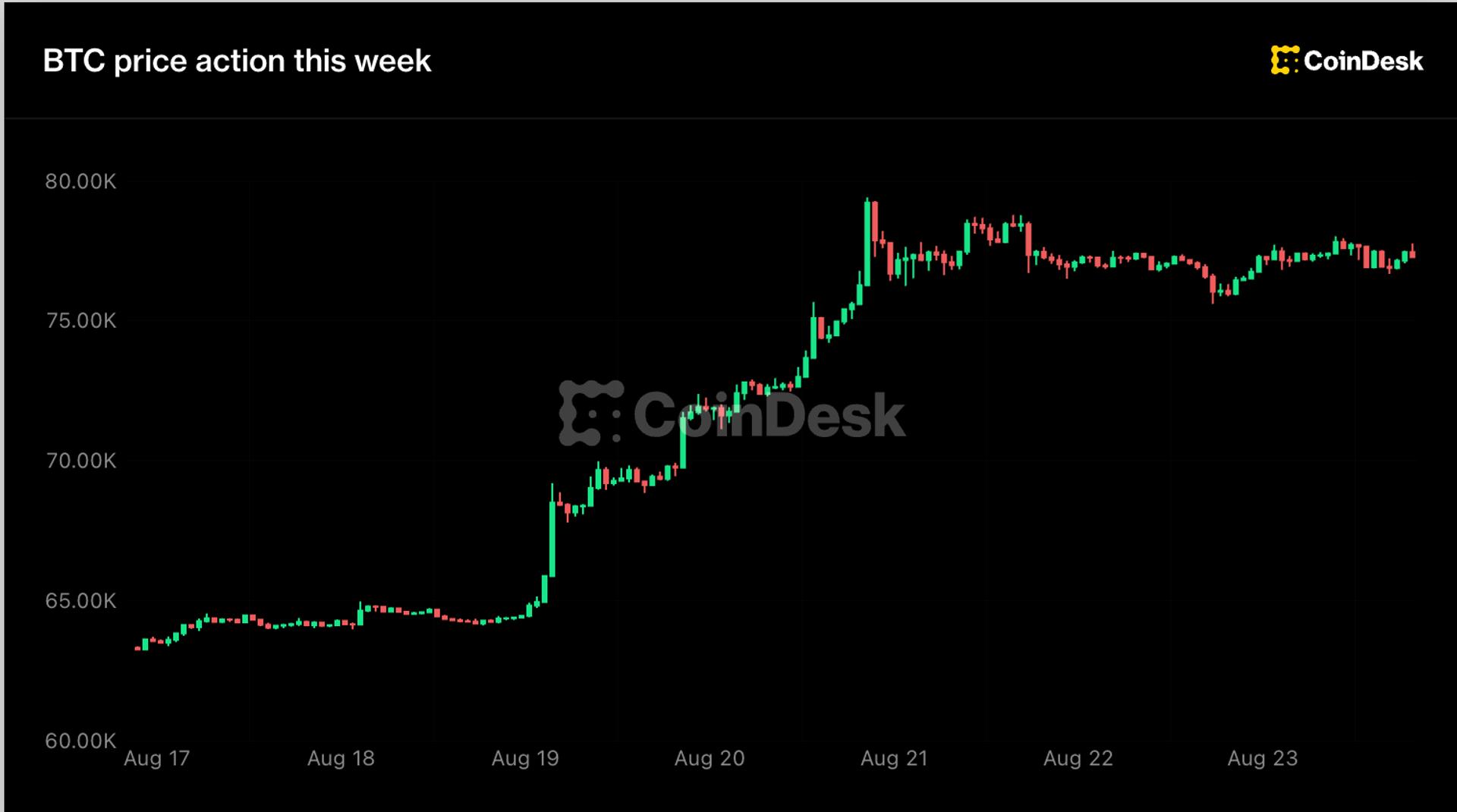
Bitcoin holds its gains near $77,000 after a 22% week, while last week’s biggest altcoin winners steady, with focus turning to Fed Chair Warsh’s Jackson Hole debut.
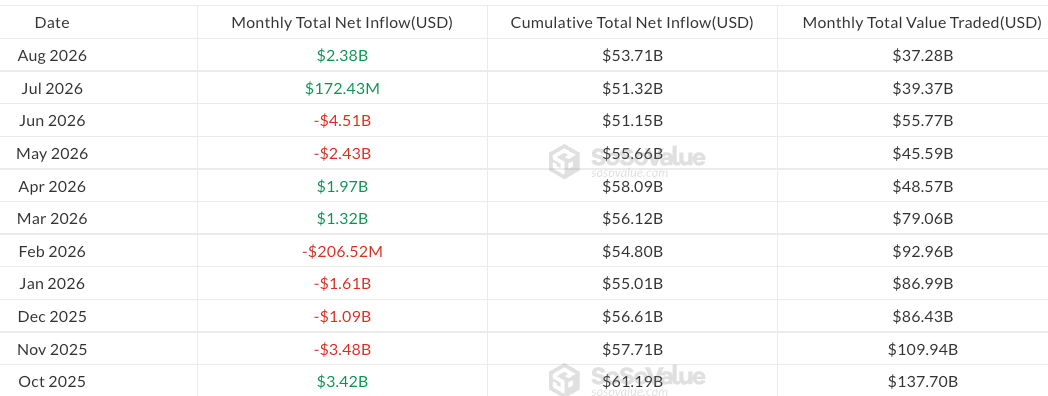
US spot Bitcoin exchange-traded fund (ETF) inflows surged last week after months of uneven flows, with investors pouring nearly $2 billion into the products amid a surge in Bitcoin’s price.
Bitcoin ETFs recorded $1.92 billion in net inflows during the week ending Friday, marking their strongest weekly performance in nearly 10 months, according to SoSoValue data.
ETF analyst Nate Geraci said Sunday that spot Ether ETFs also attracted about $700 million. He added that Bitcoin and Ether funds each posted their strongest weekly inflows since October 2025.
The renewed ETF demand came amid Bitcoin jumping more than 20% last week, briefly surging past $79,000 on Friday after starting the week near $63,000, according to CoinGecko.
Bitcoin ETFs remain in the red for 2026
Despite the latest surge, US spot Bitcoin ETFs have recorded about $2.91 billion in net outflows so far in 2026.
The funds saw their heaviest monthly outflows in June at $4.51 billion, following $2.43 billion in withdrawals in May. August has brought $2.38 billion in net inflows through Friday, making it the strongest month for inflows so far this year.
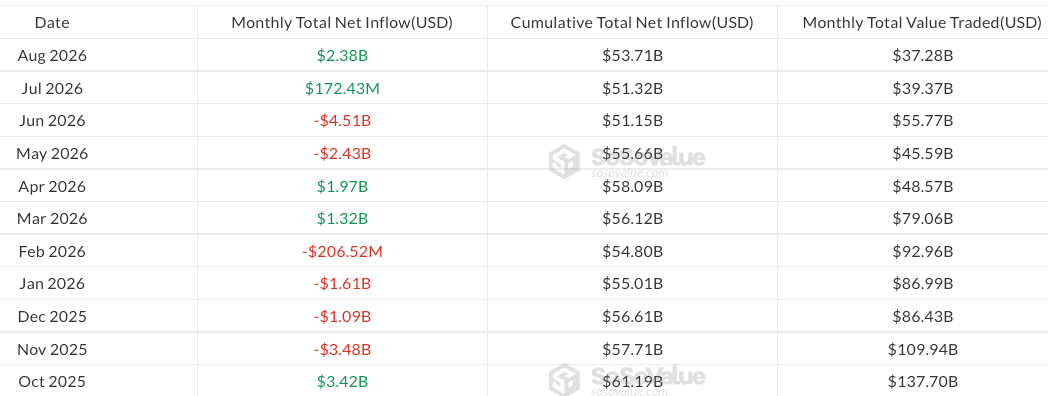
Monthly spot Bitcoin ETF flows since October 2025. Source: SoSoValue
During the last major inflow wave in October 2025, the funds attracted $3.42 billion. The October inflows preceded the Oct. 10 crypto market crash, which triggered the largest liquidation event in the industry’s history, wiping out roughly $19 billion in leveraged positions within 24 hours.
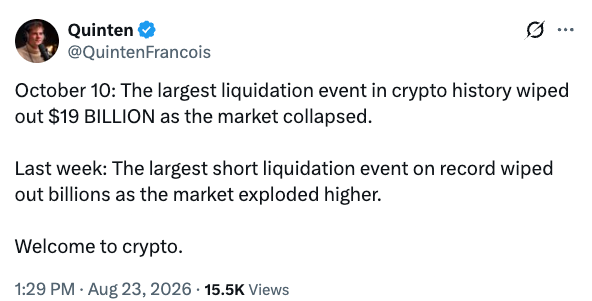
Source: Quinten
Since Oct. 6, when Bitcoin traded near $124,700, its price has plummeted roughly 38%.
BlackRock’s IBIT flashes a “bullish signal”
BlackRock’s iShares Bitcoin Trust ETF (IBIT) was responsible for much of last week’s resurgence, attracting about $1.33 billion in net inflows across five consecutive trading days, according to Farside Investors data.
IBIT’s daily inflows rose from $160.2 million on Monday to $503 million on Thursday, before easing to $239.3 million on Friday.
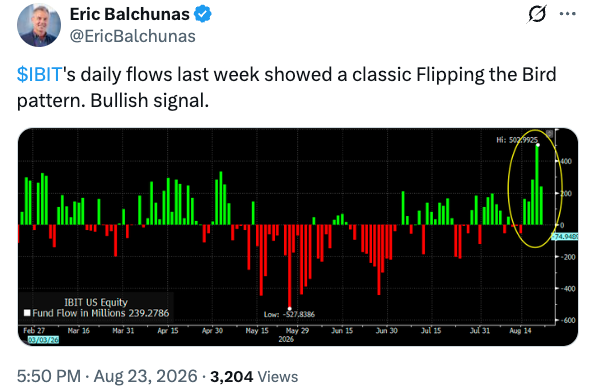
Source: Eric Balchunas
Bloomberg ETF analyst Eric Balchunas took to X to highlight what he described as a “classic Flipping the Bird pattern” in IBIT’s daily flows, adding that he viewed it as a bullish signal.
Magazine: We are so back! Bitcoin’s 23% rally on US debt policy: Hodler’s Digest
Crypto World
Gate Releases Latest Proof of Reserves Report: Total Reserve Ratio Reaches 127%; Total Reserves Exceed $8.215 Billion
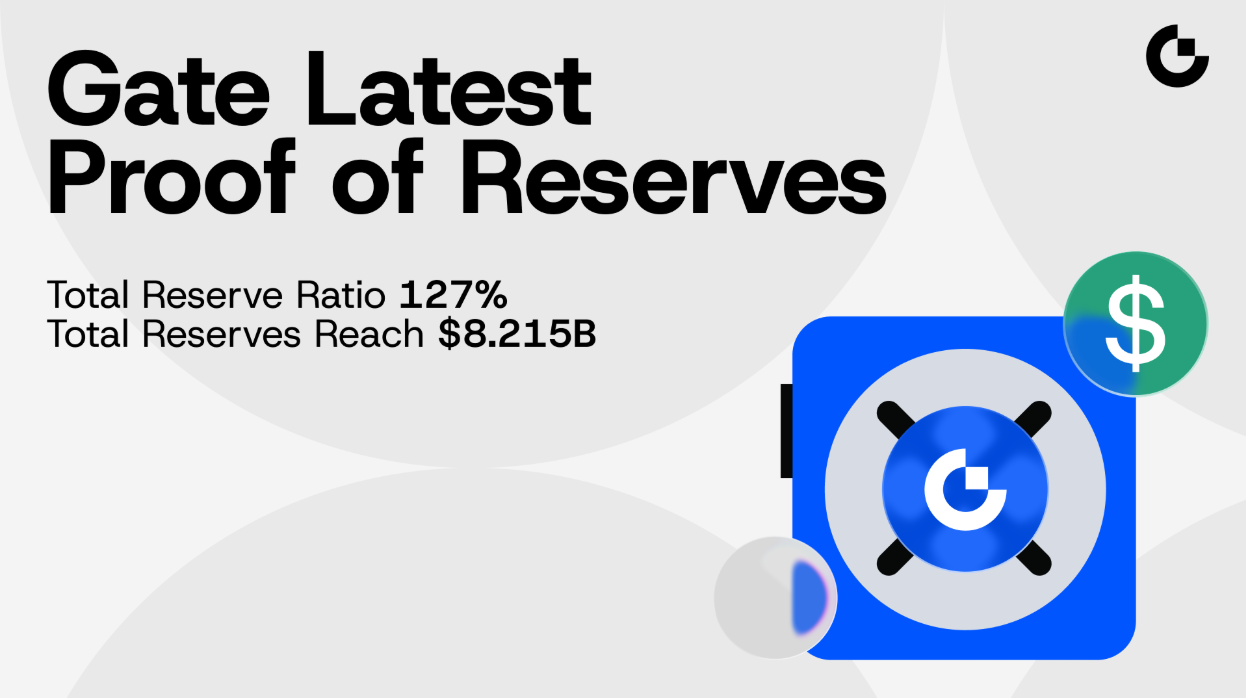

According to the official announcement, Gate has released its latest Proof of Reserves report. As of August 19, 2026, Gate’s total reserves increased to $8.215 billion, with an overall reserve ratio of 127%, remaining well above the industry security benchmark of 100%. The ample surplus reserves further strengthen the platform’s ability to withstand market volatility and potential liquidity risks, reflecting its robust asset management and risk control capabilities.
Reserve holdings for core assets continued to grow. BTC user holdings increased from 21,557 BTC in the previous report to 22,436 BTC, while Gate’s reserve holdings rose from 26,775 BTC to 27,550 BTC, representing an excess reserve ratio of 22.79%. ETH user holdings increased from 374,348 ETH to 375,429 ETH, while the platform’s reserve holdings grew from 456,798 ETH to 458,203 ETH, with an excess reserve ratio of 22.05%.
For stablecoins, total user assets across USDT, USDC, USD1, and GUSD increased from $1.336 billion in the previous report to $1.578 billion, while the platform’s corresponding reserves rose from $1.59 billion to $1.761 billion. This represents an aggregate reserve ratio of 111.63% and an excess reserve ratio of 11.63%.
In addition, major assets such as GT and XRP maintained reserve ratios well above the 100% benchmark, reaching 131.15% and 116.09%.
Gate has consistently regarded asset security and transparent governance as fundamental to the platform’s long-term development. As one of the early platforms in the industry to advance proof-of-reserves transparency, Gate continues to improve its publicly accessible and verifiable reserve mechanisms. Through technologies and solutions including zero-knowledge proofs (ZKP), Merkle tree verification, hot and cold wallet management, and user asset snapshots, Gate enhances the transparency and verifiability of reserve disclosures. At the same time, Gate continues to strengthen its internal risk management framework, implementing multiple measures such as asset segregation, access control, and security audits to enhance asset security and operational management capabilities, supporting the platform’s long-term and stable operations.
Building on its robust security and infrastructure foundation, Gate continues to expand its product ecosystem and global asset services. The platform now serves more than 59 million users worldwide and supports trading in over 4,900 crypto assets and more than 12,800 stocks and ETFs, with its stock business spanning four major markets: U.S., Hong Kong, Korean, and Japanese equities. On this basis, Gate continues to expand its stock and related financial product offerings, including Pre-IPOs, IPO Access, and gStocks tokenized stocks, providing users with diversified investment options across different stages and asset classes.
Looking ahead, Gate will continue to advance the development of its proof-of-reserves transparency, security infrastructure, and risk management systems, while continuously optimizing its product ecosystem and global service capabilities around user needs. As digital assets and traditional financial markets become increasingly integrated, Gate will continue to explore more asset classes and trading scenarios, building a more open, diversified, one-stop asset trading and management experience for users worldwide through a transparent, secure, and efficient service framework.
Details can be found here.
About Gate
Gate, founded in 2013 by Dr. Han, is one of the world’s leading cryptocurrency and integrated financial services platforms. Serving over 59 million users globally, it supports trading across 4,900+ digital assets and 12,800+ stock assets, while providing access to a comprehensive range of TradFi assets, including metals, stocks, indices, forex, and commodities, delivering users a one-stop, multi-asset trading experience and blockchain-related services. As an industry benchmark, Gate was among the first platforms to implement 100% Proof of Reserves. Its ecosystem includes Gate Wallet, Gate Ventures, Gate for AI Agent, and a wide range of products and services.
For more information, please visit: Website | X | Telegram | LinkedIn| Instagram | YouTube
Disclaimer:
This content does not constitute an offer, solicitation, or recommendation. You should always seek independent professional advice before making investment decisions. Note that Gate may restrict or prohibit certain services in specific jurisdictions. For more information, please read the User Agreement.
The post Gate Releases Latest Proof of Reserves Report: Total Reserve Ratio Reaches 127%; Total Reserves Exceed $8.215 Billion appeared first on BeInCrypto.

What our eschatologies excuse
Three tech leaders, three different pictures of humanity’s ultimate destiny—resignation, survivalism, apocalypticism. But I would assert that they share the same consequences. For one, in each version, the future isn’t something we build together. It’s something they get to build on our behalf.
And notice who is left out of each version. Altman’s future has room for “great companies” and “expanding human capability,” but arguably less concern for the people whose jobs AI might make irrelevant in the process. Musk’s future may have some room for wealthy people who can book a seat on a colony ship but less for the rest of us. Thiel’s future has room for innovation, but little for those who want to question what we are innovating for and towards. In every case, the very people who have a stake in the future are not part of building that vision of that future.
This also helps explain why some tech bros seem so disinterested in philanthropy or profit-sharing. If you genuinely believe the human era is ending and something else is taking its place, it stands to reason you have no need to feel obligated to the people around you. Why invest in public health, or housing, or building a robust civil society, if the relevant future doesn’t include most of the people who’d benefit? Why fund a school, or fix a subway, or pay taxes toward anything you won’t personally need in twenty years? This eschatology doesn’t just fail to produce ethics. It actively excuses their absence. Empathy stops looking like a virtue and starts looking like a waste of resources on people who, in this version of the future, don’t really count.
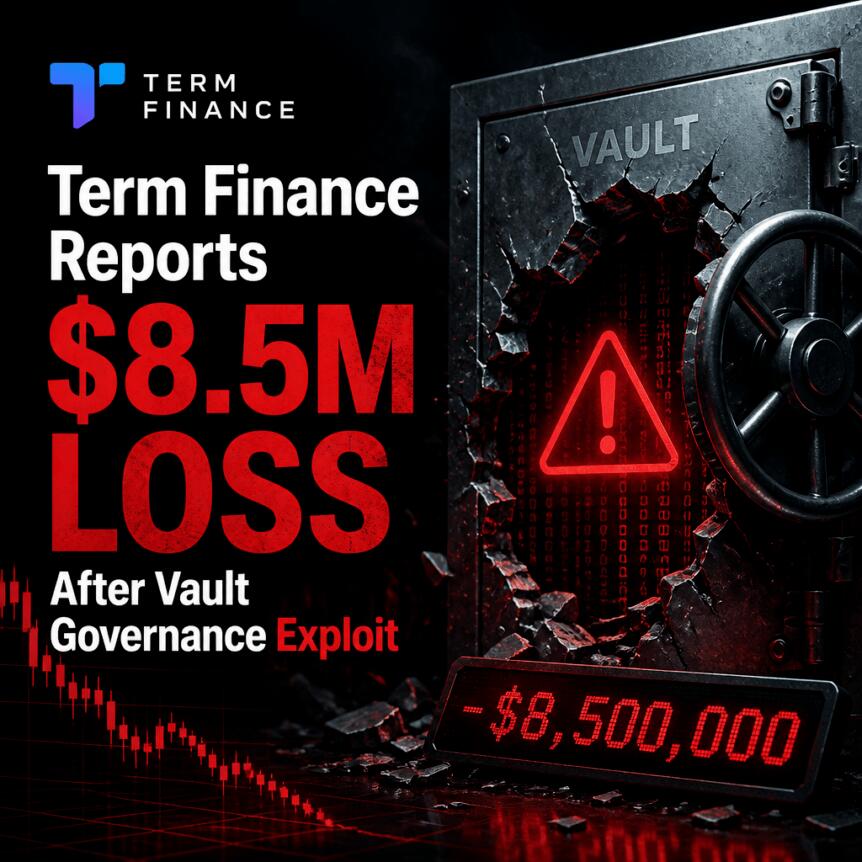
Decentralized lending protocol Term Finance has reportedly suffered a major governance-related theft targeting its vault product, with security firms estimating losses of roughly $8.5 million. The incident centers on Term Meta Vaults—strategy vault contracts designed to allocate and manage assets—where an attacker allegedly gained control of governance and used it to drain funds.
PeckShield said the attacker extracted about 2,843 ETH and 1.68 million USDC. PeckShield’s post valued the ETH at approximately $6.87 million at the time of the reported drain, and stated that the USDC was converted into about 1.68 million DAI. CertiK reported a broadly similar figure, putting the total loss at around $8.5 million.
Key takeaways
- Security firms estimate Term Finance’s vault theft at about $8.5 million, based on reported withdrawals of ETH and stablecoins.
- The attack is described as a governance takeover: the attacker allegedly obtained voting power and passed proposals enabling vault control.
- Term Labs says it has shut down Term Meta Vaults and revoked their DAO governance roles, aiming to stop further deposits while allowing withdrawals.
- Earlier risk controls were already tightened after a prior 2025 oracle incident, but this new event again highlights governance as a critical attack surface.
Estimated losses and what was taken
Multiple blockchain security monitors aligned on the scale of the exploit. According to PeckShield’s alert, the attacker drained approximately 2,843 ETH and 1.68 million USDC from Term’s vault system. PeckShield also indicated that the USDC was traded into roughly 1.68 million DAI.
CertiK’s estimate matched the order of magnitude, placing the combined loss at about $8.5 million. The reported theft was especially significant relative to what Term had deployed in its vaults: DefiLlama data indicates the Term vault product held about $12.45 million prior to the incident, including nearly all of its roughly $8.8 million in Ethereum deposits.
Term Labs freezes vaults, claims core protocol markets were not affected
Term Labs responded by stating it had “irreversibly shut down all Term Meta Vaults” and revoked their DAO governance roles. The company said the move prevents additional deposits, while withdrawals remain open.
In its statement, Term Labs said its investigation so far indicates the underlying Term protocol, along with its direct borrowing and lending markets, were not affected. The team also emphasized that it was still validating the full scope of impact, including whether any additional exposure exists beyond the vault contracts targeted in the incident.
Governance manipulation allegedly enabled vault control
Monitoring service Defimon said the attacker likely achieved control by cheaply acquiring a majority of a sparsely distributed governance token. Defimon reported that the attacker then used that control to submit proposals that allowed it to seize control of Term’s vaults.
Term has not confirmed how the attacker obtained voting power or which exact governance functions were used. That uncertainty matters for users and integrators because it points to gaps that may extend beyond a single contract bug—especially when governance frameworks can be influenced through token concentration, proposal mechanics, or voting wrappers.
Term’s vault contracts are built using Yearn V3 infrastructure. However, Yearn stated that the exploit relied on a custom governance wrapper and that the attack vector does not apply to standard Yearn vault setups. This distinction is important for builders evaluating whether “Yearn-based” automatically implies “protected by default” governance assumptions.
Why this echoes a prior Term incident
This governance exploit comes after an earlier Term incident in April 2025, when an oracle error is reported to have triggered unintended liquidations totaling about 918 ETH. Term’s subsequent response included recovering about 556 ETH at the time, reducing its final loss to 362 ETH, and reimbursing affected users, according to a postmortem published by Term.
In the wake of that April 2025 episode, Term pledged third-party validation for critical updates and committed to greater governance transparency. The new theft suggests that, regardless of improvements to operational controls and monitoring, governance pathways can still become high-impact targets if attackers can acquire voting influence or exploit proposal execution flows.
At this point, the most actionable questions for stakeholders are whether Term’s remaining vaults and governance arrangements are fully isolated from the compromised mechanics, and how quickly Term can quantify any residual exposure. With the company already disabling Meta Vault deposits and revoking governance roles, attention should turn to the scope of affected contracts, the likelihood of partial recovery, and whether Term’s governance design will undergo further structural changes before the next round of vault operations resumes.
Your look at what’s coming in the week starting Aug. 24
Solana validators and delegators began voting on three network governance proposals on Aug. 23, covering a proposed constitution, faster SOL disinflation and a redesigned transaction fee structure.
Summary
- Three Solana governance proposals are testing constitutional rules, faster disinflation and redesigned transaction fees simultaneously.
- Voting remains open through epoch 1023, currently expected to end Thursday at approximately 15:30 UTC.
- SGP-0002 would double annual disinflation from 15% to 30% while preserving Solana’s terminal inflation floor.
- SGP-0003 proposes a fixed inclusion payment alongside a resource fee burned entirely by the protocol.
- Stake-weighted approval requires one-third participation and support from two-thirds of participating stake under proposed rules.
Voting on SGP-0001, SGP-0002 and SGP-0003 will remain open until the end of epoch 1023. Solana developers expect the epoch to conclude at approximately 15:30 UTC on Thursday, Aug. 27, although blockchain epoch timing can shift.
The proposals are stake-weighted signaling votes. Approval would establish a mandate to proceed, but the inflation and fee changes would still require technical implementation before becoming active.
Solana Constitution would formalize network decisions
SGP-0001 asks validators and delegators to ratify the Solana Constitution. The document would become the canonical framework for network-level decisions and activate Solana’s on-chain governance system, known as svmgov.
The proposed system allows validators to vote using their active stake. Delegators can normally vote through their validator, but they retain the right to override that decision using their own stake account.
Under the proposed rules, participation must reach one-third of network stake. Approval requires support from two-thirds of participating stake, excluding abstentions from the approval calculation.
An SGP represents a directional decision rather than a complete technical specification. Solana Improvement Documents, or SIMDs, provide the detailed protocol changes that developers review and implement afterward.
Faster disinflation could reduce SOL issuance
SGP-0002 asks the network to support doubling Solana’s annual disinflation rate from 15% to 30%. The proposal would not immediately halve the current inflation rate. Instead, it would accelerate how quickly inflation falls toward the existing 1.5% terminal floor.
The associated SIMD-0550 estimates that the change would shorten the time required to reach the terminal rate from approximately 5.7 years to 2.8 years. It projects around 18.9 million fewer SOL in emissions over six years compared with the current schedule.
Those figures remain projections rather than confirmed supply reductions. The actual result would depend on the activation date and network conditions. The change is also consensus-sensitive because validator rewards affect capitalization and bank hashes.
The vote follows an earlier debate over Solana’s security budget. As previously reported, an 80% inflation reduction proposal failed to secure sufficient approval in March 2025 despite receiving support from 61.39% of participating stake.
Solana fee reform would expand transaction burns
SGP-0003 asks voters to endorse splitting Solana’s base transaction charge into an inclusion fee and a resource fee. The inclusion fee would go to the block leader, while the resource portion would be burned completely.
The accompanying SIMD-0553 proposes a fixed inclusion fee of 2,500 lamports per transaction. The resource fee would vary according to the computational resources requested by each transaction.
Supporters argue that resource-based pricing would make transactions requesting more network capacity pay more. Burning the resource fee would also remove SOL from circulation rather than distributing that portion to validators.
A successful vote would only authorize developers to pursue the model. It would not immediately change fees or SOL burns. Detailed implementation, testing and feature activation would follow through the SIMD process.
What happens after the three Solana votes?
Validators and delegators can vote for, against or abstain before epoch 1023 ends. Votes are weighted using active stake recorded during the governance snapshot.
If a proposal reaches quorum and the required approval threshold, its outcome becomes a network mandate. SGP-0001 would ratify the governance framework, while SGP-0002 and SGP-0003 would guide work on their related technical specifications.
SOL traded near $94.27 on Aug. 24, up approximately 1.8% over 24 hours and about 25% over seven days. The broader cryptocurrency rally contributed to the weekly move, and available market data does not establish that governance voting caused the increase.
Final vote totals will determine whether Solana proceeds with all three proposals, accepts only part of the package or leaves the existing inflation and fee structures unchanged.

Sleeper pitchers Week 23: Rankings, sleepers and start/sit
5 Of The Most Reliable Car Brands To Consider If You’re Buying A Used Pickup Truck

Kate Middleton summed up feelings about Meghan Markle in three words

Weekend Open Thread – Corporette.com

Weekend Open Thread: Brooks Brothers

London Mayor Sadiq Khan handed a peerage by Keir Starmer alongside 15 other Labour figures… just days before the PM leaves No10

Paying financial aid and putting another charm on my James Avery bracelet…
![[KPOP IN PUBLIC] LISA - 'MONEY' | Cover by BN DANCE TEAM FROM VIETNAM](https://wordupnews.com/wp-content/uploads/2026/02/1770893501_maxresdefault-80x80.jpg)
[KPOP IN PUBLIC] LISA – ‘MONEY’ | Cover by BN DANCE TEAM FROM VIETNAM

This XRP Prediction Is Happening….. South Korea Just Made The First Move!!!!!!
-

 Fashion3 days ago
Weekend Open Thread: Madewell – Corporette.com
-

 Business6 days ago
SMA Solar Technology AG (SMTGY) Q2 2026 Earnings Call Transcript
-

 Crypto World2 days ago
anatomy of crypto’s biggest liquidation event since 2021
-

 Business2 days ago
Musk’s Tesla, SpaceX Confirm $16.8 Billion ‘Terafab’ Chip Plant as World’s Largest Building in Texas
-

 Tech6 days ago
Qwen3.8-27B runs frontier-class coding agents and reasoning locally, no cloud API required
-

 Crypto World6 days ago
OCC Greenlights Trump Family Crypto Firm for Trust Charter
-

 Politics2 days ago
6 months on, Irish renters crushed by effects of government housing bill
-
 NewsBeat2 days ago
The ‘Lucky Dip Gang’ causing carnage for clicks: After five thugs were killed speeding in the wrong direction on a motorway, GUY ADAMS investigates a sick new trend… and why police aren’t even allowed to pursue them
-

 Crypto World6 days ago
NAVI Prime launches institutional lending framework on Sui
-

 News Videos4 days ago
Don’t Leave Your Financial Future To Chance | August 19, 2026
-

 Tech5 days ago
GLM-5.3 hits the API at $1.4/$4.4 per million tokens
-
Tech6 days ago
5 Of The Most Reliable Car Brands To Consider If You’re Buying A Used SUV
-
 Crypto World6 days ago
Dow’s 3-Year Winning Run Isn’t a Crash Signal, Still 49% Odds of Double-Digit Gains
-

 Business6 days ago
Stock Market Today: Tech Futures Slide As Treasury Yields Jump; Nvidia, Micron, Sandisk Sell Off
-

 Tech7 days ago
Straight Up the Cliff, Yunnan’s New Fuyao Ladder Turns a Three-Hour Climb Into a 50-Second Ride for Students
-

 Tech6 days ago
Keychron K8 Ultra 8K review: a great value keyboard with comfort issues
-
 Tech6 days ago
Nvidia discloses $21B stake in SpaceX
-
Business6 days ago
Fabrinet (FN) Q4 2026 Earnings Call Transcript
-

 Business4 days ago
Five Below: Kids Discount Retailer Reaps Rich Rewards
-

 Business5 days ago
Marvell Shares Jump 7% as Google Chip Deal Confirms Custom AI Silicon Partnership, Analysts
You must be logged in to post a comment Login