Thomas Wolf has spent a decade convincing the world that open-source AI is not a charity project. On August 27, 2026, the market settled the argument. Nvidia agreed to buy Hugging Face, the company famous for hosting the open-source AI ecosystem with more than 3 million open-source LLMs, for $12.9 billion, according to The Information, a price that values the ten-year-old startup at roughly 86 times its $150 million in annualized revenue and nearly triple the $4.5 billion valuation it fetched in 2023.
The deal is one of Nvidia’s largest acquisitions to date, leaked the same day the chipmaker reported $96.2 billion in quarterly revenue and forecasts a 70 percent jump in revenue next fiscal year and disclosed it has $18 billion committed to equity investments through 2027. At Nvidia’s current pace, $12.9 billion is about thirteen days of sales.
Nvidia is about to spend two weeks of revenue to secure the distribution layer for the one corner of AI it does not control: open source.
The irony is not lost on anyone who has followed the company. In January, the Financial Times reported that Hugging Face had turned down a $500 million investment from Nvidia at a $7 billion valuation, a signal that independence mattered more than a quick capital injection.
Nvidia came back with a different offer. This time, it bought the whole thing.
For Thomas Wolf, the co-founder and chief science officer, calculus has never been about the exit. It is about the ecosystem. But the ecosystem now belongs to Jensen Huang.
Thomas Wolf never planned to sell hardware. He built his reputation and a company now being priced at $12.9 billion on doing the opposite. For years, Hugging Face was the “GitHub for AI models,” a platform where researchers shared open-source neural networks for free.
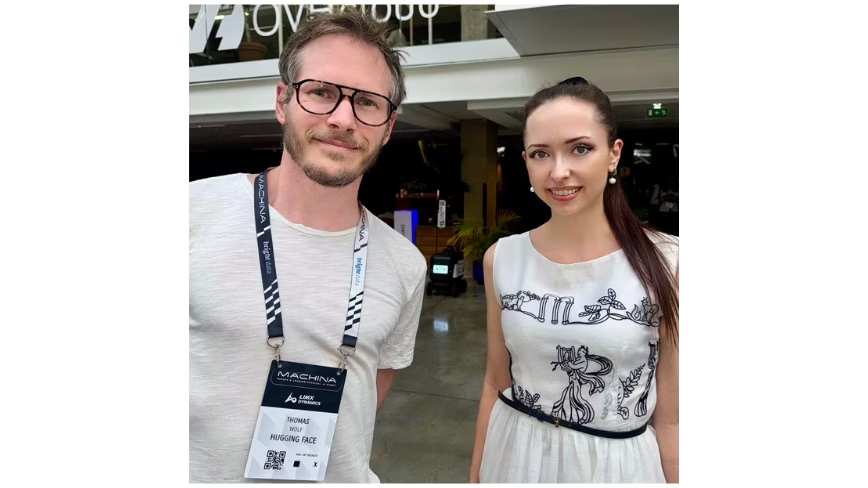
But Thomas Wolf has a rule: follow the talent, then follow the problem. “I actually always wanted to work with people I really wanted to work with,” he says. That instinct led him from theoretical physics to patent law to quantum computing. Now it has led him to something different: a warehouse full of robot arms.
This summer, Hugging Face is releasing its second consumer robot kit, the Reachy Mini, priced between $300 and $500. The first model, launched last year at roughly $100, has already sold more than 10,000 units. The company is on track to sell 20,000 this year. “People are really excited,” Wolf says. “I’m actually very, very excited about this new one.”
It’s a curious pivot for a company most of the tech world still thinks of as the “GitHub for AI models.” But Hugging Face, all 250 employees of it, has spent the last year quietly transforming from a repository of community-built models into something far more ambitious: a vertically integrated AI platform that now spans frontier models, physical robotics, and an enterprise storage business that Thomas Wolf says is gaining traction faster than almost anything else the company has built.
From Software to Hardware
The robotics pivot started with software. Hugging Face released an open-source library for robotics that gained traction fast. But Wolf noticed a bottleneck that code couldn’t fix. “Hardware was very expensive,” he says. “Even the cheapest ones are still like several thousand dollars, $7,000 to $10,000, $20,000 to $30,000, $50,000.”
For a software developer who wanted to experiment with physical AI, the barrier was insurmountable. So Hugging Face built the cheapest credible entry point it could. The response was immediate. “If you are a software developer interested in AI, you’d love to do robots. There is a need for entry-level accessible robots that you could buy. And so we started with a robotics arm, one of the models that costs $100. Then we saw a lot of excitement.” That excitement pushed Hugging Face to acquire French robotics startup Pollen Robotics, that now forms the core of Hugging Face’s physical AI division, marry its open-source software stack to affordable hardware: a new kit the Reachy Mini, an open-source desktop robot DIY kit priced between $399 and $499, ready for release this summer.
The Reachy Mini is not the only robot shipping this year. On the day Nvidia’s acquisition was reported, Thomas Wolf unveiled Microduck, a 25-centimeter open-source biped with 15 actuators and a full sensor suite: camera, speaker, LiDAR, NFC, Bluetooth, Wi-Fi. It is designed to be trained from scratch with reinforcement learning. It also ships with more than half a dozen pre-trained policies so it can walk, sit, crouch, roller-skate, pick up objects with its articulated beak, and recover on its own, all for $399. Thomas Wolf calls it “the first truly accessible RL robot.” Microduck`s order volume reached over $2.6M after the launch announcement.
Thomas Wolf has used this exact playbook before: democratize the tools, then watch the community build what incumbents won’t. It is the same playbook that turned Hugging Face’s model hub into the world’s default repository for open-source AI. The platform now hosts more than 4 million models. “We have more than 3 million new models on the hub,” Thomas Wolf notes, though he admits even he can’t test them all. But the platform’s trending leaderboard, a kind of Billboard Hot 100 for AI researchers, has become the starting point for developers who want to know what’s genuinely useful right now.
The Open-Source Arms Race
If 2025 was the year business discovered open-source AI with Deepseek release, 2026 is the year it caught up to the frontier. Thomas Wolf points to GLM 5.2 by Chinese AI leader Z.ai released just weeks before our conversation, as the latest shock. “GLM 5.2 which was surprisingly close to Opus 4.8 or Frontier,” he says. “Every year, every few months, having this open source model that suddenly makes a jump, extremely good, I think it’s fascinating.”
His personal favorite right now is Google’s Gemma 4. He calls it “really good” and small enough to run locally. “We just released a few days ago a demo of talking live with this model,” Thomas Wolf says.
Thomas Wolf has also been running experiments that sound like science fiction. He recently spent a week with 100+ AI agents collaborating freely on an open project. The result? They squeezed a 5× inference speedup out of Gemma 4 inside vLLM. He called it one of the most interesting emergent behaviors he has seen from agent swarms so far.
Thomas Wolf has no patience for the idea that open source is a sideshow. For him, it is the main event. “I think it’s a concept revolution,” he says. While closed labs guard their weights and training data, the open ecosystem is iterating in public. The result is a Cambrian explosion of specialized models: vision systems, scientific calculators, coding agents, that cost nothing to download and pennies to run.
The Revenue No One Saw Coming
Hugging Face is still a startup, just 250 people. It has made six acquisitions, all small, all talent-driven. “We’re acquiring regular AI companies,” Thomas Wolf says. “We look for very high talent, small companies that match our software culture, open source.” The process is “opportunistic,” not thematic. “If you see a team that you are very excited about, and then the topic needs to make sense where we think AI is going.”
But the company is no longer just a model marketplace. Thomas Wolf recently announced a partnership with Qualcomm to optimize AI inference on edge chips. More surprisingly, Hugging Face is now in the enterprise storage business. Because the hub houses petabytes of model weights and datasets, the engineering team built an ultra-efficient blob storage system. “We’re now selling this storage to people who store petabytes or terabytes of data,” Thomas Wolf says. “This has very strong traction right now.”
That traction is not theoretical. In June, AI lab Arcee became the first major American company to replace AWS S3 with Hugging Face Private Storage, in a multi-million dollar commercial partnership. When your customers are migrating off Amazon to store data with you, you are no longer just another open-source project. You are infrastructure.
It is a pragmatic, almost old-school tech move: solve your own infrastructure problem, then productize it. For a firm often portrayed as a nonprofit-adjacent community project, the storage pivot is a reminder that someone has to pay for the servers.
The Cloud Business Nvidia Actually Wanted
What the headlines miss is that Hugging Face is already a cloud company and that is precisely why Nvidia wrote the check.
For years, Hugging Face has built a managed compute layer on top of its model hub. Developers can spin up Inference Endpoints, dedicated GPU APIs that scale from $0.03-per-hour CPU instances to $80-per-hour clusters of eight NVIDIA H100s. They can host interactive demos on Spaces, paying by the hour for GPU hardware. They can route API calls through Inference Providers, a billing layer that connects users to third-party GPU clouds like Together AI, SambaNova and Groq.
Most importantly, Hugging Face and Nvidia already run Training Cluster as a Service, a joint product that gives any of Hugging Face’s 500,000 organizations on-demand access to large GPU clusters, billed only for the duration of a training run. It is, in essence, a distribution channel for Nvidia compute dressed up as a developer tool.
That channel matters because Nvidia’s own cloud business has struggled. The company reportedly scaled back its DGX Cloud offering roughly a year ago. Owning Hugging Face gives Nvidia a way back into cloud computing without starting from scratch: it inherits a platform where developers already rent GPUs, already pay for inference and already trust the brand.
There is also a balance-sheet angle. Nvidia has promised to help cover the cost of tens of billions of dollars in cloud computing deals for its largest customers. If those customers end up not using all the compute they signed up for, Nvidia could get stuck with excess capacity. Owning Hugging Face gives Nvidia a ready-made customer base, millions of developers and thousands of enterprises to absorb that unused capacity.
The revenue is still small in Nvidia terms. Hugging Face’s cloud services, storage and subscriptions produced roughly $150 million in annualized revenue as of this summer, up from about $100 million just two months earlier. But Nvidia is not buying a revenue line. It is buying the distribution layer for the one corner of AI that keeps developers dependent on CUDA while OpenAI, Google, Amazon and Anthropic build their own chips.
Science, Not Just Software
Thomas Wolf’s background: physics, quantum computing, patent law shapes where he thinks AI is heading next. “I’ve always loved to understand how the world works,” he says. Law taught him how human society functions. AI, he hoped, would reveal how intelligence itself works. He even muses about Anthropic`s latest research paper “Verbalizable Representations Form a Global Workspace in Language Models” suggesting large models develop internal workspaces akin to consciousness. “Maybe these AI models have a consciousness of their own, or like a workflow where they find a workspace in their mind where there is a concept.”
That curiosity is now driving Hugging Face into hard science. The company is backing initiatives in AI for biology, materials discovery, mathematics and physics. “AI is going to be really interesting over the next 1 to 3 years,” Thomas Wolf says. Ask him which field will be disrupted most, and he does not hesitate: “All of them. I think research will change a lot.”
He remains connected to his quantum roots, too, having made an angel investment in a European quantum startup last year. “I feel like there’s a couple of very interesting developments last year,” he says.
The Job Question
No conversation with an AI founder in 2026 is complete without the automation anxiety. Thomas Wolf’s answer is characteristically direct, and then characteristically hedged. “That’s the goal, to stop going to work,” he says, laughing. “I don’t know, but not in the super short term!”
Coding has already changed. Hugging Face uses AI agents to build teams differently. But Thomas Wolf is skeptical of the fully automated enterprise arriving overnight. “We still need a lot of humans with good taste, still a lot of smart people, high-capable, skilled guys to set the context for AI and to follow these agents,” he says. “I think it could take more time than people think.”
The Bet
Hugging Face is betting that the next great platform shift will not be won by the company with the largest closed model, but by the one with the most open ecosystem. Cheap robot arms. Efficient storage. A hub with 3 million models and counting. A team of 250 people punching so far above its weight that Nvidia just paid $12.9 billion to own it.
As Thomas Wolf puts it: “I think AI was this fascination about how is this intelligence made.”
Now he wants to put that intelligence in your hands. For $299.
The question is whether Nvidia will let him keep doing it his way.
Thomas Wolf turned down Nvidia once. This time, he said yes. But if history is any guide, he will keep following the talent, then following the problem and the problem, as he sees it, is not a lack of money. It is a lack of access.
As of August 29, 2026, Nvidia has agreed to acquire Hugging Face for $12.9 billion, according to The Information. The deal has not yet closed and remains subject to regulatory approval. Thomas Wolf spoke with the author prior to the publication of this article. Financial figures and product details reflect the most recent publicly available information.
































































You must be logged in to post a comment Login