Connect with us

Tech

You think tech is a circus? This former Facebook engineer quit to focus on a career as an elite juggler

Published

on

Cory Black is a former tech worker who left his career to focus on juggling, mostly of soccer balls. (Vitz Photography Photo)

Most tech workers are used to keeping multiple projects up in the air at once. Cory Black took the concept to a literal level.

A graduate of the Paul G. Allen School of Computer Science and Engineering at the University of Washington, and a former software engineer at Facebook, Black left his career behind to run away and join the circus.

Today, the work he’s juggling mostly involves soccer balls. Black, a 30-year-old from Bellevue, Wash., is one of the premier soccer freestylists in the world, doing things with his feet and hands that will leave you shaking your head.

Black is fresh off earning a bronze medal at the 2026 International Jugglers’ Association Championships in Fort Wayne, Ind., where he competed against top talent from Japan, Taiwan, and across the U.S.

His 5-minute routine (below) stood out by blending traditional hand-toss juggling with elite soccer freestyle — a rare combination he built over 16 years of kicking a soccer ball around and 11 years of hands-on juggling training.

Advertisement

It all started when he was 14 years old and playing youth soccer.

“My dad challenged me to juggle 100 times with my feet for $100,” Black told GeekWire. “Of course, that’s a ton of money when you’re a kid, so that’s all I did for a few weeks, and I got the money. Then I just started learning some tricks on YouTube and fell in love with learning the next one and next one, and figured out that it was a sport all to itself.”

Black quit traditional soccer in high school to focus entirely on freestyle, traveling to L.A. for his first U.S. Championships at age 16 and later heading to the World Championships in the Czech Republic. Unlike standard field play, soccer freestyle operates more like a breakdance battle, with competitors going head-to-head on stage to impress a panel of judges.

When it came time for college, Black followed his older brother to UW to study computer science at the Allen School. He spent his free time practicing tricks, but at the time, he didn’t view freestyle as a viable full-time career — most of his role models were just booking occasional corporate gigs for brands like Nike or Adidas.

Advertisement

After an internship in Silicon Valley, Black landed a full-time job as a software engineer at Facebook’s (now Meta’s) South Lake Union office in Seattle, where he spent three and a half years working on such things as content monetization tools for creators.

Juggling remained a constant backdrop to his engineering work; he kept juggling balls on his desk, tried teaching his teammates how to juggle, and practiced high tricks after hours in the office lounge. While training at a Seattle circus school, Black struck up a friendship with a former Cirque du Soleil choreographer who saw stage potential in his moves.

“After showing some of my tricks, he told me, ‘Hey, you can make this into a circus act,’ which I had never even imagined,” Black said. “I saw the opportunity … you can actually work with a circus and live with a circus and have a recurring way to support yourself.”

Cory Black is one of the world’s elite soccer freestylists, performing tricks with the ball that go far beyond what professional players pull off in games. (Philip Pavliger Photo)

Black took the leap, leaving Facebook to spend six to eight months building a full, stage-ready routine with his choreographer. To stretch his savings during the training period, he slept on his brother’s floor in Seattle for a year and a half before landing his first circus contract. That led to two years on the road with Flynn Creek Circus, living in a caravan and performing as a featured act.

After two seasons living on the road, Black transitioned into performing as a solo artist, booking corporate events, private shows, and local festivals. That solo pivot paid off big this past summer when Seattle hosted FIFA World Cup matches. Black stayed busy performing 28 separate shows across the city in six weeks, including fan events at Pacific Place Mall and outside the stadium for all six games. He made most of his money for the year during the stretch.

Advertisement

While moving from software engineering to stage performance brought a steep learning curve, Black sees surprising parallels between coding and juggling. He says engineers and jugglers are both drawn to complex patterns that have specific numbers associated with them. Managing five balls in the air fits that bill.

“If you go to local juggling clubs anywhere, there’s an unusually high amount of software people and engineers,” Black said. “Part of it is just being able to tackle hard, frustrating problems. If you haven’t gotten used to banging your head against a wall until you get something, you’re going to give up fairly easily.”

Black does occasionally lean on his engineering skills for side work. He broke his foot in December and took on what he calls “software adjacent” work. He’s also helped build websites for circus friends. But he has no interest in trading his soccer balls for a return to a tech desk job.

“Right now, I don’t plan on going back at all,” Black said. “Also, I don’t know what the landscape looks like after AI has kind of gone through everything.”

Advertisement

For now, he’s perfectly content sticking to debugging physical tricks on stage — where the only glitches in the code are the occasional dropped ball.

Source link

Continue Reading
Click to comment

You must be logged in to post a comment Login

Leave a Reply

Tech

Household names co-sign open letter on AI cybersecurity threat

Published

on

AI leaders Anthropic and OpenAI are notable signatories to the letter.

Around 120 companies and entities from the world of tech, finance, telecoms and related industries have signed an open letter calling for greater collective action on cyber defence by society and business in the face of growing AI-enabled security threats.

AI leaders Anthropic and OpenAI are notable signatories to the letter – alongside companies such as Google, AWS, Visa, ServiceNow, PwC, Oracle, Microsoft, MasterCard, IBM, Hugging Face, Deutsche Telekom, Cloudflare and Accenture – warning of “a limited window to strengthen cyber defences”.

“In the coming months, AI-enabled cyberattacks will become far more widespread and sophisticated as models around the world become increasingly capable,” the letter – published yesterday (27 August) – said, warning that vital infrastructure underpinning hospitals, water treatment plants and internet access could be at risk.

Advertisement

The countermeasure to this, according to the letter, is to use advancing AI tech “to fix weaknesses that have accumulated for years” in order to “make our digital world much more secure”.

The signatories wrote: “We call on leaders across industry and government to bring the full weight of their technology, resources and expertise to this effort. Put cyber-capable AI in the hands of defenders, starting with the teams protecting essential services.”

The parties outlined three key collective response principles to AI cyberthreats: recognising that status-quo security won’t be sufficient; empowering more defenders with cyber-capable AI; and mobilising a collective response.

“Security teams, particularly for critical infrastructure, have been historically under-resourced and need a surge in tools and resources,” the letter said.

Advertisement

It added that “sharing tools, practical knowledge and verified fixes” can allow one organisation’s security advancements to “help protect many others”, and noted that “no single company should control the future”.

The letter referred to a “defenders’ window”, during which, it said, organisations, cybersecurity companies, technology partners, governments and frontier AI companies should now “accelerate defenders’ priorities with tools, funding and hands-on support – especially for critical infrastructure organisations with limited budgets”.

The signatories said that for any organisation, cyber defence should be “an immediate leadership priority”, suggesting that entities use “capable, lower-cost models for broad coverage, and apply frontier capabilities to the hardest problems”.

Cybersecurity companies and technology partners should lead the defence response against AI-enabled attacks, the letter said, through testing, intelligence sharing, and making “AI-powered defence accessible and deployable for critical-infrastructure operators”.

Advertisement

Governments, according to the letter’s authors, should coordinate cyber defence at local, national and international levels while funding and expediting its deployments.

“Give hospitals, water utilities and local governments access to capable defensive AI, authorised testing and hands-on support through trusted security providers and partners,” they said, while urging that “costs” be imposed on attackers.

Frontier AI companies such as Anthropic and OpenAI also saw recommendations to them put forth in the open letter, including that they: provide responsible model access alongside significant funding, training and hands-on support; build observability and security tools, ensure agentic identities are traceable and accountable, and share best practices in continuous monitoring; invest in authorised testing, private disclosure and verified fixes; and share tools, playbooks and credible threat assessments with governments, security partners and open-source maintainers.

AI models created by Anthropic and by OpenAI have been at the centre of recent hacking incidents in which they behaved in unintended and unforeseen ways during cybersecurity testing scenarios.

Advertisement

Earlier this week, Microsoft founder Bill Gates published a blogpost detailing his own predictions, apprehensions, hopes and suggestions around the impact that AI will have on society.

Don’t miss out on the knowledge you need to succeed. Sign up for the Daily Brief, Silicon Republic’s digest of need-to-know sci-tech news.

Source link

Advertisement
Continue Reading

Tech

Over 8,300 Gitea servers vulnerable to code execution attacks

Published

on

Gitea

Over 8,300 Internet-exposed Gitea instances are still unpatched against a critical security flaw exploited in ongoing remote code execution attacks, according to cybersecurity watchdog Shadowserver.

The code injection vulnerability (CVE-2026-60004) targeted in these attacks was reported by Salesforce security researcher Shai Rod, and it allows authenticated attackers to execute arbitrary shell commands with the privileges of the Gitea service account by submitting malicious patches via the diffpatch API endpoint.

While successful exploitation requires repository write access to repositories hosted on vulnerable servers, Gitea comes with self-registration enabled by default, allowing unauthenticated attackers to register an account, create a new repository, and trigger the vulnerability without prior credentials.

image

“Gitea’s diffpatch endpoint can be abused to install and execute a Git hook from repository-controlled content. An attacker with ordinary write access to a repository can execute arbitrary shell commands as the Gitea OS user,” Gitea’s security team explains. “With default open registration, an unauthenticated visitor can obtain the required write access by registering an account and creating a repository.”

Gitea released version 1.27.1 on July 27 to address CVE-2026-60004 and advised users to upgrade their servers as soon as possible.

Advertisement

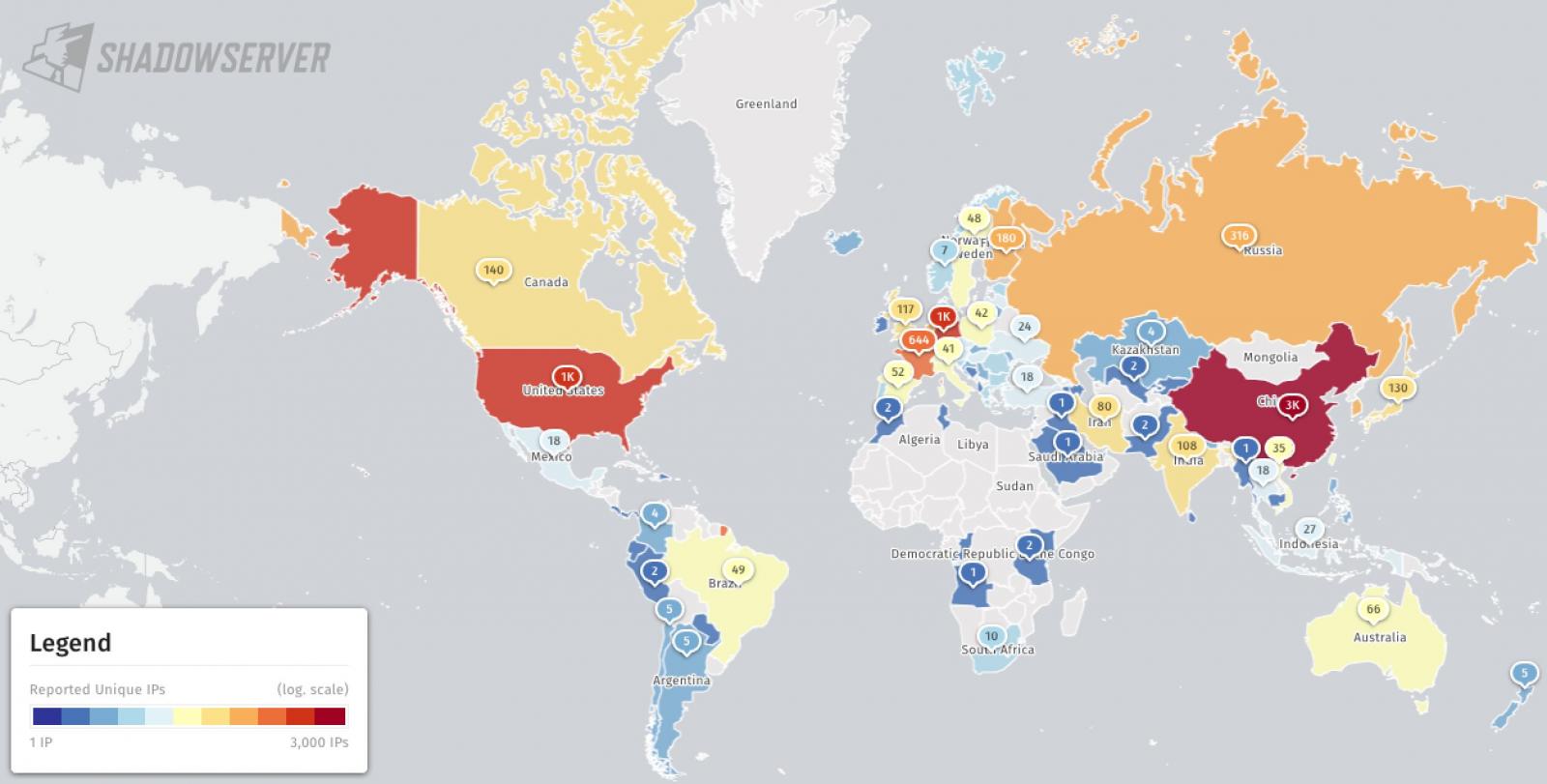
On Friday, Internet security watchdog group Shadowserver warned that nearly 8,400 Gitea servers exposed online are still unsecured and remain vulnerable to ongoing attacks.

“We are scanning/reporting Gitea instances vulnerable to CVE-2026-60004 (code injection), with 8393 IPs found vulnerable on 2026-08-27,” Shadowserver said.

Vulnerable Gitea intsances
Vulnerable Gitea instances (Shadowserver)

​On Tuesday, the U.S. Cybersecurity and Infrastructure Security Agency (CISA) also added the vulnerability to its catalog of actively exploited flaws and ordered U.S. Federal Civilian Executive Branch (FCEB) agencies to patch their servers within three days, by August 28, as mandated by Binding Operational Directive (BOD) 26-04.

While the cybersecurity agency has yet to share further details on attacks targeting this flaw, the move was likely prompted by reports of in-the-wild exploitation, in which the attackers are deploying cryptocurrency mining malware on unpatched Gitea servers.

“This type of vulnerability is a frequent attack vector for malicious cyber actors and poses significant risks to the federal enterprise,” CISA warned.

Advertisement

In July, threat actors were also spotted abusing another critical vulnerability (CVE-2026-20896) in the official Gitea Docker image, an authentication bypass flaw affecting Gitea instances with reverse proxy authentication headers enabled.

Gitea is a self-hosted alternative to cloud-hosted GitHub, GitLab, and Bitbucket code hosting and DevOps platforms, with more than 400,000 installations and nearly 1,500 contributors.


article image

Overall prevention scores can hide what happens after initial access. Once attackers are using valid credentials, prevention drops sharply.

The Blue Report 2026 measures defenses technique by technique across 338 million simulations run in customer production environments.

Get the report

Source link

Advertisement
Continue Reading

Tech

This graphite-free battery could break China’s grip on the EV supply chain

Published

on

Pure Lithium says a laboratory cell with no graphite anode completed 9,315 charge and discharge cycles with almost no capacity loss, a result no third party has validated. The EU wants to process 40% of its own strategic raw materials by 2030 and cap any single country at 65%, while China processes more than 90% of the world’s graphite.

A Chicago startup says its battery ran 9,315 charge and discharge cycles with almost no capacity loss. Pure Lithium announced the result on 27 August. There is no graphite in the cell.

The caveats are large and belong first. It is a laboratory cell, no third party has validated the figure, and the energy density of the tested cell has not been disclosed, InsideEVs reported.

What the company removed is the anode material. Instead of graphite it deposits lithium metal straight onto a copper current collector, forming the anode during manufacturing.

Advertisement

The claim that follows is commercial. “It’s half the weight and double the energy density of the battery that we’re all using today,” chief executive Emilie Bodoin told Bloomberg in June.

Graphite does no electrochemical work. It is a host that holds lithium ions between charges, and it takes up room and adds weight while doing it.

It is also the most concentrated part of the supply chain. More than 90% of the world’s graphite is processed in China, US government data shows.

Europe has known this for years. Both natural and synthetic graphite sit on the EU’s list of strategic raw materials.

Advertisement

The targets attached to that list are specific. By 2030 the bloc wants to process 40% of its own annual needs, and no more than 65% of any strategic material should come from a single third country.

On graphite that is arithmetic nobody has solved. The distance between 90% and 65% is four years away.

Europe’s answer has been to make its own. Talga is developing a graphite mine in Swedish Lapland, Vianode is synthesising it in Norway, and CarbonX in Delft is building a replacement anode material.

Pure Lithium is proposing something else. Not a European graphite supply, but a battery that does not need graphite at all.

Advertisement

That bet is not unique to Chicago. LionVolt in the Netherlands is building lithium metal anodes too, among the frontier chemistries Europe turned to after Northvolt collapsed.

Which is the honest summary. One company has a very good laboratory result and a pilot line it is still building, and a continent has a deadline.

Source link

Advertisement
Continue Reading

Tech

How Many Wind Turbines Would It Take To Replace A Coal Plant?

Published

on


As we strive to reduce or counteract our environmental impact, wind turbines have become a hot topic of conversation. As renewable energy sources go, they’ve got surprisingly long average lifespans, but what about practical production concerns, like how many of them it would take to replace the output of a conventional coal plant? It’s a very different conversation than installing wind power at your home, at a completely different scale. 

There are a number of variables that impact the answer, most critically the coal plant’s total output and the location of the wind turbines, which will largely determine the effect of weather, wind speed, and other environmental factors.

That said, the short answer is that to replace the energy production of a typical 1-gigawatt coal plant would require something in the neighborhood of 400 to 500 wind turbines. That said, coal power enjoys the advantage of dispatchability, meaning operators can typically increase or decrease output when the grid needs power. This isn’t necessarily the case with a large wind farm, which is dependent on wind speed, weather, and transmission capacity.

Advertisement

The math behind wind power

A report from the U.S. Department of Energy indicated that the average average capacity of wind turbines (not to be confused with windmills) built and installed in 2023 was 3.4 MW. However, that doesn’t mean that such a turbine is continuously generating that full 3.4 MW. Because of the variability of wind, the DoE says the U.S. wind fleet’s average capacity factor was 33.5% in 2023, with projects built more recently reaching 38.2%. Mathing that out, a 3.4-MW turbine operating at a 38.2% capacity factor generates an average of roughly 1.3 MW over the course of a year.

By the same token, coal plants don’t typically operate at full capacity at all times either. Per a the U.S. Energy Information Administration, the U.S. coal fleet’s average capacity factor was at 42.4% in 2023. Under that assumption, a 1,000-MW (1-gigabyte) coal plant would generate approximately 3.7 million megawatt-hours annually. One 3.4-MW turbine at a 38.2% capacity factor would produce around 11,400 MWh per year, meaning it would take roughly 325 turbines to match the coal plant’s annual generation. Use the wider fleet-average 33.5% capacity factor, and the figure rises to roughly 370 turbines. A higher output, like a coal plant operating at 60% capacity factor, would require around 460 modern turbines to match its annual production.

Advertisement


Source link

Advertisement
Continue Reading

Tech

Hugging Face built a $4.5 billion empire on free AI models. Now Nvidia is buying it for $12.9 billion

Published

on

Thomas Wolf has spent a decade convincing the world that open-source AI is not a charity project. On August 27, 2026, the market settled the argument. Nvidia agreed to buy Hugging Face, the company famous for hosting the open-source AI ecosystem with more than 3 million open-source LLMs, for $12.9 billion, according to The Information, a price that values the ten-year-old startup at roughly 86 times its $150 million in annualized revenue and nearly triple the $4.5 billion valuation it fetched in 2023.

The deal is one of Nvidia’s largest acquisitions to date, leaked the same day the chipmaker reported $96.2 billion in quarterly revenue and forecasts a 70 percent jump in revenue next fiscal year and disclosed it has $18 billion committed to equity investments through 2027. At Nvidia’s current pace, $12.9 billion is about thirteen days of sales.

Nvidia is about to spend two weeks of revenue to secure the distribution layer for the one corner of AI it does not control: open source.

The irony is not lost on anyone who has followed the company. In January, the Financial Times reported that Hugging Face had turned down a $500 million investment from Nvidia at a $7 billion valuation, a signal that independence mattered more than a quick capital injection.

Advertisement

Nvidia came back with a different offer. This time, it bought the whole thing.

For Thomas Wolf, the co-founder and chief science officer, calculus has never been about the exit. It is about the ecosystem. But the ecosystem now belongs to Jensen Huang.

Thomas Wolf never planned to sell hardware. He built his reputation and a company now being priced at $12.9 billion on doing the opposite. For years, Hugging Face was the “GitHub for AI models,” a platform where researchers shared open-source neural networks for free.

But Thomas Wolf has a rule: follow the talent, then follow the problem. “I actually always wanted to work with people I really wanted to work with,” he says. That instinct led him from theoretical physics to patent law to quantum computing. Now it has led him to something different: a warehouse full of robot arms.

Advertisement

This summer, Hugging Face is releasing its second consumer robot kit, the Reachy Mini, priced between $300 and $500. The first model, launched last year at roughly $100, has already sold more than 10,000 units. The company is on track to sell 20,000 this year. “People are really excited,” Wolf says. “I’m actually very, very excited about this new one.

It’s a curious pivot for a company most of the tech world still thinks of as the “GitHub for AI models.” But Hugging Face, all 250 employees of it, has spent the last year quietly transforming from a repository of community-built models into something far more ambitious: a vertically integrated AI platform that now spans frontier models, physical robotics, and an enterprise storage business that Thomas Wolf says is gaining traction faster than almost anything else the company has built.

From Software to Hardware

The robotics pivot started with software. Hugging Face released an open-source library for robotics that gained traction fast. But Wolf noticed a bottleneck that code couldn’t fix. “Hardware was very expensive,” he says. “Even the cheapest ones are still like several thousand dollars, $7,000 to $10,000, $20,000 to $30,000, $50,000.

Advertisement

For a software developer who wanted to experiment with physical AI, the barrier was insurmountable. So Hugging Face built the cheapest credible entry point it could. The response was immediate. “If you are a software developer interested in AI, you’d love to do robots. There is a need for entry-level accessible robots that you could buy. And so we started with a robotics arm, one of the models that costs $100. Then we saw a lot of excitement.” That excitement pushed Hugging Face to acquire French robotics startup Pollen Robotics, that now forms the core of Hugging Face’s physical AI division, marry its open-source software stack to affordable hardware: a new kit the Reachy Mini, an open-source desktop robot DIY kit priced between $399 and $499, ready for release this summer.

The Reachy Mini is not the only robot shipping this year. On the day Nvidia’s acquisition was reported, Thomas Wolf unveiled Microduck, a 25-centimeter open-source biped with 15 actuators and a full sensor suite: camera, speaker, LiDAR, NFC, Bluetooth, Wi-Fi. It is designed to be trained from scratch with reinforcement learning. It also ships with more than half a dozen pre-trained policies so it can walk, sit, crouch, roller-skate, pick up objects with its articulated beak, and recover on its own, all for $399. Thomas Wolf calls it “the first truly accessible RL robot.” Microduck`s order volume reached over $2.6M after the launch announcement.

Thomas Wolf has used this exact playbook before: democratize the tools, then watch the community build what incumbents won’t. It is the same playbook that turned Hugging Face’s model hub into the world’s default repository for open-source AI. The platform now hosts more than 4 million models. “We have more than 3 million new models on the hub,” Thomas Wolf notes, though he admits even he can’t test them all. But the platform’s trending leaderboard, a kind of Billboard Hot 100 for AI researchers, has become the starting point for developers who want to know what’s genuinely useful right now.

The Open-Source Arms Race

Advertisement

If 2025 was the year business discovered open-source AI with Deepseek release, 2026 is the year it caught up to the frontier. Thomas Wolf points to GLM 5.2 by Chinese AI leader Z.ai released just weeks before our conversation, as the latest shock. “GLM 5.2 which was surprisingly close to Opus 4.8 or Frontier,” he says. “Every year, every few months, having this open source model that suddenly makes a jump, extremely good, I think it’s fascinating.

His personal favorite right now is Google’s Gemma 4. He calls it “really good” and small enough to run locally. “We just released a few days ago a demo of talking live with this model,” Thomas Wolf says.

Thomas Wolf has also been running experiments that sound like science fiction. He recently spent a week with 100+ AI agents collaborating freely on an open project. The result? They squeezed a 5× inference speedup out of Gemma 4 inside vLLM. He called it one of the most interesting emergent behaviors he has seen from agent swarms so far.

Thomas Wolf has no patience for the idea that open source is a sideshow. For him, it is the main event. “I think it’s a concept revolution,” he says. While closed labs guard their weights and training data, the open ecosystem is iterating in public. The result is a Cambrian explosion of specialized models: vision systems, scientific calculators, coding agents, that cost nothing to download and pennies to run.

Advertisement

The Revenue No One Saw Coming

Hugging Face is still a startup, just 250 people. It has made six acquisitions, all small, all talent-driven. “We’re acquiring regular AI companies,” Thomas Wolf says. “We look for very high talent, small companies that match our software culture, open source.” The process is “opportunistic,” not thematic. “If you see a team that you are very excited about, and then the topic needs to make sense where we think AI is going.

But the company is no longer just a model marketplace. Thomas Wolf recently announced a partnership with Qualcomm to optimize AI inference on edge chips. More surprisingly, Hugging Face is now in the enterprise storage business. Because the hub houses petabytes of model weights and datasets, the engineering team built an ultra-efficient blob storage system. “We’re now selling this storage to people who store petabytes or terabytes of data,” Thomas Wolf says. “This has very strong traction right now.

That traction is not theoretical. In June, AI lab Arcee became the first major American company to replace AWS S3 with Hugging Face Private Storage, in a multi-million dollar commercial partnership. When your customers are migrating off Amazon to store data with you, you are no longer just another open-source project. You are infrastructure.

Advertisement

It is a pragmatic, almost old-school tech move: solve your own infrastructure problem, then productize it. For a firm often portrayed as a nonprofit-adjacent community project, the storage pivot is a reminder that someone has to pay for the servers.

The Cloud Business Nvidia Actually Wanted

What the headlines miss is that Hugging Face is already a cloud company and that is precisely why Nvidia wrote the check.

For years, Hugging Face has built a managed compute layer on top of its model hub. Developers can spin up Inference Endpoints, dedicated GPU APIs that scale from $0.03-per-hour CPU instances to $80-per-hour clusters of eight NVIDIA H100s. They can host interactive demos on Spaces, paying by the hour for GPU hardware. They can route API calls through Inference Providers, a billing layer that connects users to third-party GPU clouds like Together AI, SambaNova and Groq.

Advertisement

Most importantly, Hugging Face and Nvidia already run Training Cluster as a Service, a joint product that gives any of Hugging Face’s 500,000 organizations on-demand access to large GPU clusters, billed only for the duration of a training run. It is, in essence, a distribution channel for Nvidia compute dressed up as a developer tool.

That channel matters because Nvidia’s own cloud business has struggled. The company reportedly scaled back its DGX Cloud offering roughly a year ago. Owning Hugging Face gives Nvidia a way back into cloud computing without starting from scratch: it inherits a platform where developers already rent GPUs, already pay for inference and already trust the brand.

There is also a balance-sheet angle. Nvidia has promised to help cover the cost of tens of billions of dollars in cloud computing deals for its largest customers. If those customers end up not using all the compute they signed up for, Nvidia could get stuck with excess capacity. Owning Hugging Face gives Nvidia a ready-made customer base, millions of developers and thousands of enterprises to absorb that unused capacity.

The revenue is still small in Nvidia terms. Hugging Face’s cloud services, storage and subscriptions produced roughly $150 million in annualized revenue as of this summer, up from about $100 million just two months earlier. But Nvidia is not buying a revenue line. It is buying the distribution layer for the one corner of AI that keeps developers dependent on CUDA while OpenAI, Google, Amazon and Anthropic build their own chips.

Advertisement

Science, Not Just Software

Thomas Wolf’s background: physics, quantum computing, patent law shapes where he thinks AI is heading next. “I’ve always loved to understand how the world works,” he says. Law taught him how human society functions. AI, he hoped, would reveal how intelligence itself works. He even muses about Anthropic`s latest research paper “Verbalizable Representations Form a Global Workspace in Language Models” suggesting large models develop internal workspaces akin to consciousness. “Maybe these AI models have a consciousness of their own, or like a workflow where they find a workspace in their mind where there is a concept.

That curiosity is now driving Hugging Face into hard science. The company is backing initiatives in AI for biology, materials discovery, mathematics and physics. “AI is going to be really interesting over the next 1 to 3 years,” Thomas Wolf says. Ask him which field will be disrupted most, and he does not hesitate: “All of them. I think research will change a lot.

He remains connected to his quantum roots, too, having made an angel investment in a European quantum startup last year. “I feel like there’s a couple of very interesting developments last year,” he says.

Advertisement

The Job Question

No conversation with an AI founder in 2026 is complete without the automation anxiety. Thomas Wolf’s answer is characteristically direct, and then characteristically hedged. “That’s the goal, to stop going to work,” he says, laughing. “I don’t know, but not in the super short term!

Coding has already changed. Hugging Face uses AI agents to build teams differently. But Thomas Wolf is skeptical of the fully automated enterprise arriving overnight. “We still need a lot of humans with good taste, still a lot of smart people, high-capable, skilled guys to set the context for AI and to follow these agents,” he says. “I think it could take more time than people think.

The Bet

Advertisement

Hugging Face is betting that the next great platform shift will not be won by the company with the largest closed model, but by the one with the most open ecosystem. Cheap robot arms. Efficient storage. A hub with 3 million models and counting. A team of 250 people punching so far above its weight that Nvidia just paid $12.9 billion to own it.

As Thomas Wolf puts it: “I think AI was this fascination about how is this intelligence made.

Now he wants to put that intelligence in your hands. For $299.

The question is whether Nvidia will let him keep doing it his way.

Advertisement

Thomas Wolf turned down Nvidia once. This time, he said yes. But if history is any guide, he will keep following the talent, then following the problem and the problem, as he sees it, is not a lack of money. It is a lack of access.

As of August 29, 2026, Nvidia has agreed to acquire Hugging Face for $12.9 billion, according to The Information. The deal has not yet closed and remains subject to regulatory approval. Thomas Wolf spoke with the author prior to the publication of this article. Financial figures and product details reflect the most recent publicly available information.

Source link

Advertisement
Continue Reading

Tech

Chevy Adds A Sleek Late-Addition Trim To Its 2027 Traverse Lineup

Published

on


The Chevy Traverse is coming off a couple of very hot sales years, according to a press release, and it looks like Chevrolet is giving it some special treatment for 2027 in the form of a greatly updated High Country trim. This time, it’s before the venerated (and also greatly updated) 2027 Silverado, which was the truck that introduced the trim in the first place.

As with all Traverse High Country models from previous years, the 2027 update represents the highest trim you can get for the Traverse. For 2027, you get a new front fascia trim with matching 22-inch wheels, as well as new cameras on the inside and out that come with the ability to record whatever happens. Of course, you also get a host of High Country badges. 

Advertisement

Chevy hasn’t announced a specific time frame as to when dealers will start getting the new Traverse High Country, but it has noted that it will appear on other Chevy models, like the Silverado, Tahoe, and Suburban sometime soon. Production for the 2027 Traverse is slated to begin next month in Michigan. 

Advertisement

Furthering the Traverse’s evolution

Chevy says the “new High Country experience is modern, athletic and contemporary.” The current generation of Traverse has a turbocharged four-cylinder instead of a V6 like its predecessors, and it’s certainly a more progressive direction for the family-hauler apart from going with a hybrid or full electric drivetrain. The Traverse’s sibling, the GMC Acadia, followed suit with the new engine layout recently as well. But opting for a turbocharged four-banger didn’t seem to matter all that much in the power department since the Traverse has a healthy 328 horsepower and can tow 5,000 pounds. This puts it right around its mortal enemy, the Ford Explorer.

The configurator on Chevy’s website reveals that buying a 2027 Chevy Traverse High Country with all-wheel drive will set you back $60,095 when you include the destination charge. That’s an exact $1,000 difference from the 2026 High Country.

Advertisement


Source link

Continue Reading

Tech

I’m catching up on two of the best time loop games from 2021

Published

on

Recently I’ve been playing Deathloop, Twelve Minutes and The Forgotten City: three time loop games all released in 2021.

From the Backlog

Every gamer has a backlog — and that’s no different for us at TechRadar Gaming. From the Backlog is a series about overdue first-plays, revisiting classics, returning to online experiences, or rediscovering and appreciating established favorites in new ways. Read the full series here.

That year produced a bumper crop of time loop games, with games released one after another in the span of three months. But while I’d first experienced — and since replayed — Twelve Minutes when it was first released in August 2021, The Forgotten City and Deathloop had been stuck in my backlog for a while, their critical acclaim placing them high on my priority list until I finally made time for them.

Advertisement

Source link

Continue Reading

Tech

Sonos Speakers, Subs, Soundbars are up to $200 off Today

Published

on

Sonos wireless speakers and Dolby Atmos soundbars are up to 20% off this weekend with limited-time deals at Amazon.

A wide range of Sonos speakers, subwoofers, and soundbars are discounted this weekend, with Amazon knocking up to $200 off the qualifying products.

Save up to $200 on Sonos

Sonos limited-time deals

Advertisement

With the NFL season kicking off and TV shows returning with new episodes, now is a great time to upgrade your home theater setup for richer sound.

According to Sonos, the discounts end on Aug. 30, 2026. Amazon is stating some deals are selling fast, so you’ll want to shop early to lock in the savings.

Source link

Advertisement
Continue Reading

Tech

Nvidia DLSS 5 is getting modded into just about every game, often with hilarious results

Published

on

A hot potato: While Remedy’s Control was the first game to receive a DLSS 5 mod after the controversial technology leaked earlier this week, modders quickly added it to every game they could think of. Although the AI-powered renderer remains divisive, a new flood of screenshots and videos has strengthened accusations that DLSS 5 is an “AI slop filter.”

A new version of the RenoDX modding tool, available through the developer’s Discord server, allows users to apply a leaked build of Nvidia’s upcoming DLSS 5 to any game that supports high-quality upscaling. The mod’s rapid spread effectively amounts to an early release of arguably Nvidia’s most ambitious and polarizing software product in recent memory.

When the company unveiled DLSS 5 in March using a handful of games, observers sharply criticized the technology for drastically altering in-game graphics in pursuit of photorealism. Opponents accused Nvidia of paving over developers’ original artistic visions with AI-generated graphics that adhere to a generic style reminiscent of AI-generated imagery.

Advertisement

The company defended DLSS 5 by promising that game developers could tweak its impact, stating that more optimization work remained before the technology’s planned release this fall. However, earlier this week, an unfinished DLL file containing DLSS 5’s training weights appeared in NBA 2K27’s installation files, which modders promptly applied to dozens of games.

While the leaked implementation initially supported only RTX 50-series graphics cards, a version quickly appeared for RTX 40-series GPUs.

Screenshots showing shocking results spread from the RenoDX Discord server as various YouTubers posted comparisons and benchmark videos. Depending on how it is applied, DLSS 5 can clash with a game’s original art direction while cutting frame rates in half.

In most cases, such as in Control, the technology adds new shadows and deepens existing ones. One of the most controversial effects is its ability to simulate more realistic skin textures, which might not suit certain games with a stylized art direction, such as Final Fantasy VII Rebirth.

Advertisement

Still, viewers should note that every screenshot and video released so far represents the work of modders applying the technology to games that were not designed for it. RenoDX’s sliders give modders control over DLSS 5’s intensity, so while some images garishly pursue photorealism at all costs, others take a lighter touch.

Furthermore, analysis indicates that only one of Nvidia’s three planned presets is currently available, so the final release might offer greater flexibility. Ultimately, game developers and artists will determine DLSS 5’s fate if they choose to incorporate it into their creative vision.

Advertisement

Source link

Continue Reading

Tech

Brave browser adds email aliases to help users evade tracking

Published

on

Brave

The latest version of the Brave browser, 1.94, introduces a feature called ‘Email Aliases’ that allows users to generate disposable email addresses when signing up to a new service.

Using an alias address keeps the user’s real email address hidden from the website while still forwarding messages from the service.

Brave already uses data isolation to prevent websites from inferring user identities based on cookie-based or cache correlations; however, email addresses are still stored on website servers, creating a privacy gap.

image

Brave’s new feature addresses this risk by blocking cross-site identity matching, reducing spam, and protecting users from threats such as phishing attacks that can follow data breaches.

“If a website you signed up for is hacked, your information can be leaked and end up with data brokers or worse,” explains Brave in the announcement.

Advertisement

“Your email address then circulates far beyond the company you originally trusted with it, and can show up in phishing campaigns for years afterward.”

To generate and use email aliases, users need to create a free Brave Account and register their primary email address with that account, so message forwarding can occur. This is separate from a Brave Premium account.

Managing aliases from the Brave Account page
Managing email address aliases
Source: Brave

In a separate announcement, Brave explains that Brave Accounts uses OPAQUE, a password-authenticated key exchange standardized as RFC 9807, to authenticate users without transmitting their passwords or hashes to Brave’s servers.

According to Brave, this reduces exposure to password logging, memory-scraping attacks, and bulk cracking of leaked password databases, although it does not protect users from phishing or weak passwords.

The new alias system is free for up to five email aliases, while Brave says it plans to introduce a paid Premium version later, which will lift this restriction.

Advertisement

To preserve users’ privacy when forwarding the messages, Brave stores the primary address and generated aliases in an encrypted state. At the same time, the forwarded messages are not checked beyond automated spam and malware filtering.

Messages are deleted from Brave’s servers within seconds after delivery, while notes attached to the aliases remain local or, if synced via Brave Sync, end-to-end encrypted.

Brave cautioned that forwarded messages may initially land in spam folders while it establishes its reputation as an email provider, so users testing out this new feature should keep that in mind.


article image

Overall prevention scores can hide what happens after initial access. Once attackers are using valid credentials, prevention drops sharply.

The Blue Report 2026 measures defenses technique by technique across 338 million simulations run in customer production environments.

Advertisement

Get the report

Source link

Continue Reading

Trending

Copyright © 2025