
Crypto World
Saket Soni Wants to Protect the Workers Rebuilding Communities After Disaster


“Go to any fire- or hurricane- or flood-hit town in America, and you’ll see the labor shortage,” says Soni. “Even if the money comes, if the workers aren’t there to repair, then people won’t be coming home.” Soni hopes to continue developing this much-needed workforce over the next decade.
As well as providing legal advocacy for resilience workers, Resilience Force collaborates with third-party contractors to ensure laborers get better pay and safety standards. The nonprofit also offers a structured certification program that gives workers the technical and safety skills to perform roof repairs and other hands-on, AI-proof jobs. Then it puts people on the job directly, too, a blueprint with which they’ve seen success in states as politically and environmentally diverse as Louisiana and Colorado. While its in-house activities are paid for by philanthropy, Resilience Force provides free assistance to uninsured homeowners when it can.
As budget and staffing cuts at the Federal Emergency Management Agency further complicate recovery for communities affected by disasters, the Resilience Force model aims to directly confront three intersecting crises: climate change, the housing shortage, and a difficult job market. Inherently, Resilience Force also addresses a fourth crisis: anti-immigration sentiment.
Soni recalls a time he arranged help for a conservative Florida family whose home had been damaged by Hurricane Michael. “There was darkness all around,” he says. “They lost their electricity. Their roof was blown. They put up a sign that said, ‘Strangers will be shot.’” Nevertheless, Soni rolled up with a squad of Resilience Force workers, many of whom were immigrants, and rebuilt the house. In short order, the family took the sign down. “Everybody’s focused on how polarized the country is,” Soni says. “I see the opposite.”



Google is entering a multi-year partnership with Beast Industries. The deal brings Gemini and Google Health into Jimmy Donaldson’s MrBeast videos starting September 5.
Donaldson’s crew will lean on the AI assistant to navigate the jungle, desert, and Arctic in a survival challenge. Beast Industries CEO Jeff Housenbold calls it a bet on AI as both a creative engine and a business tool.
A Survival Challenge Built Around Gemini
Donaldson, the first creator to pass 500 million YouTube subscribers, already runs one of the best-funded operations in online video. The new deal extends that reach into Google’s consumer AI push.
Teams in the September 5 video will race through the jungle, desert, and Arctic. Gemini will help them flag dangers and track sudden weather changes.
A separate Gemini ad campaign will show Donaldson using the app to plan the logistics behind his stunts. Google’s new Fitbit Air will appear in a later challenge.
How Much of This Is Actually AI
Housenbold was more measured off camera about what Gemini actually does. Asked directly whether AI drives the video production itself, he drew a clear line.
“What we’re not doing is using it to make the content.”
He said Gemini instead supports research and feasibility work, like figuring out how to pull off stunts. Humans still write, shoot, and edit every video. That is a narrower role than Google’s campaign language implies.
It also echoes how Google is folding AI into other consumer platforms, mostly behind the scenes rather than on screen. Housenbold declined to disclose financial terms. He did note the partnership had sign-off from Google CEO Sundar Pichai.
For now, viewers get a demonstration of Gemini’s planning ability, framed as a survival story. That is a smaller claim than the creative partnership Google’s campaign describes.
The post MrBeast Signs Multi-Year Gemini Deal: How Much Is Actually AI? appeared first on BeInCrypto.
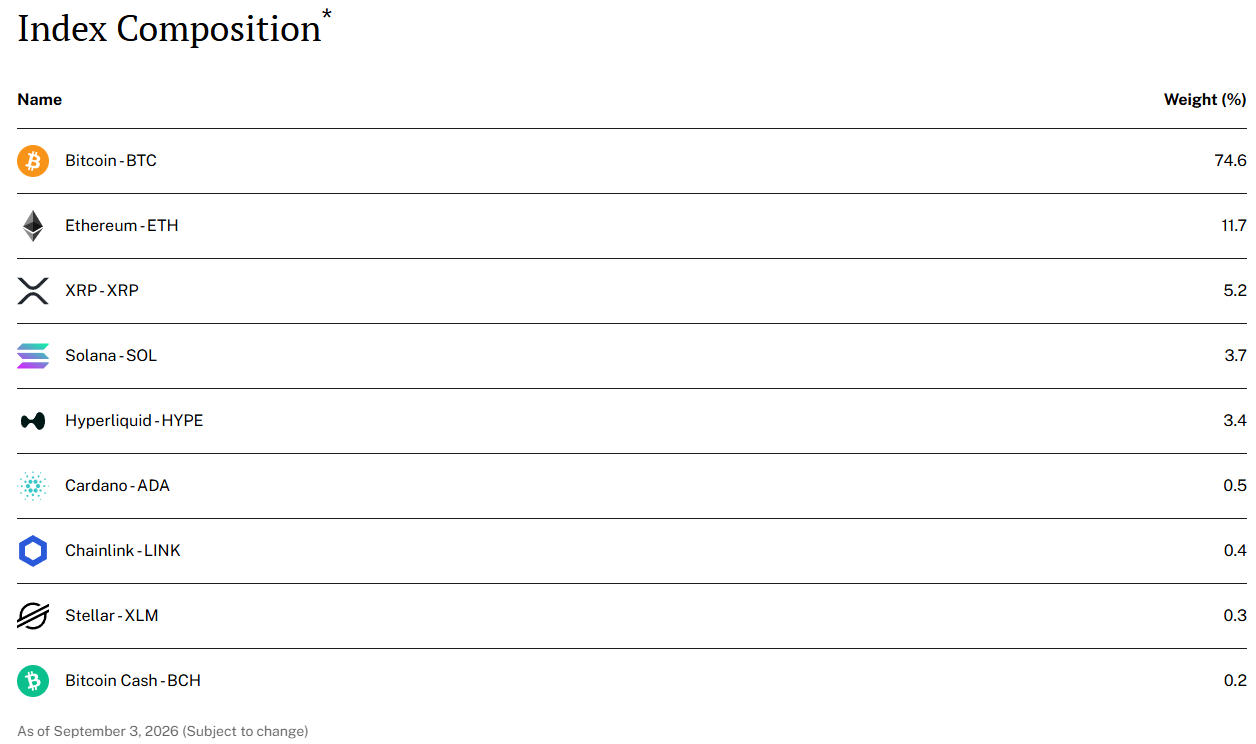
Hyperliquid’s (HYPE) native token has entered a US-listed crypto index exchange-traded fund (ETF) for the first time, joining Hashdex’s Nasdaq CME Crypto Index ETF (NCIQ) at a 3.4% weighting.
The addition makes HYPE the fund’s fifth-largest holding, ranking behind Bitcoin (BTC), Ethereum (ETH), XRP, and Solana (SOL).
How HYPE Entered the Hashdex Crypto ETF
NCIQ tracks the Nasdaq CME Crypto Settlement Price Index (NCIS). The index reflects the daily close of the Nasdaq CME Crypto Index (NCI), built under Nasdaq and CME Group methodology.
The fund held roughly $431.37 million in net assets as of September 1. Shares closed that day at $19.46, against a net asset value of $19.50, according to the fund’s disclosures.
Bitcoin’s weighting dropped from 78% to 74.6% in the update. Solana’s share climbed from 3.2% to 3.7% over the same period.

Ethereum, XRP, Cardano (ADA), Chainlink (LINK), Stellar (XLM), and Bitcoin Cash (BCH) round out the remaining holdings.
Momentum Builds for Hyperliquid
Hyperliquid is a layer-1 blockchain built around onchain perpetual futures trading. Perpetual futures let traders speculate on price without owning the underlying asset.
HYPE reached an all-time high of $84.80 in late August. A new buyback program funded by reserve yield helped drive that rally.
As of publication, HYPE trades at $81.76, up 5.74% over 24 hours. Its market capitalization stands near $18.31 billion, ranking tenth among all cryptocurrencies.

The listing adds to steady institutional demand for crypto ETFs this year. Spot Bitcoin ETF inflows have stayed strong, and Solana ETF inflows recently hit a multi-month high too.
Rival index providers have taken different approaches to asset selection. A Bitcoin-free benchmark from S&P Dow Jones and Pantera excludes BTC entirely.
How future rebalances unfold could determine whether HYPE’s weighting keeps growing.
The post Hyperliquid's HYPE Joins Hashdex Crypto ETF as Fifth-Largest Holding appeared first on BeInCrypto.

Thailand’s financial regulator has moved to formalize tighter oversight of crypto transfers, aiming to bring local rules closer to the international “Travel Rule” framework used to combat money laundering and terrorist financing. The Thailand Securities and Exchange Commission (SEC) said its new regulations require digital asset operators to collect and transmit information about parties involved in certain crypto transfers.
In an announcement made Wednesday, the SEC set Feb. 27, 2027 as the compliance start date. That timeline gives regulated crypto businesses nearly six months to build or upgrade systems needed to transmit, receive, and monitor transaction-related data.
Key takeaways
- Thailand’s SEC has issued new Travel Rule regulations covering crypto transfers handled by digital asset operators.
- The rules require operators to gather information on the parties to transactions and retain it for regulatory review.
- Self-custodial wallets will be subject to additional ownership or control verification steps when users send to or receive from them.
- Recordkeeping must cover each transaction for at least five years.
- Compliance begins Feb. 27, 2027, after consultations earlier in 2026.
Thailand’s Travel Rule push: data sharing for transfers
The SEC’s new framework requires digital asset operators in Thailand to collect information about both sides of eligible crypto transfers—effectively mirroring the core idea of the Travel Rule: tracking who sends and who receives value across financial rails. According to the SEC’s announcement, the regulations are intended to reduce the risk that crypto transfers are used to support illicit activity.
Regulators have been moving toward standardized transaction screening and information exchange for years, and Thailand’s final rules reflect that broader shift. The SEC’s move also aligns with the broader international picture: the Financial Action Task Force (FATF) estimated that 83% of surveyed jurisdictions had passed Travel Rule legislation as of 2026, per earlier coverage referencing FATF findings (see this Cointelegraph report).
For market participants, the practical significance is straightforward: compliance will require more than simple transaction monitoring. Operators will need processes to transmit and reconcile counterpart information, particularly where transfers cross different service providers or involve specific wallet types.
Self-custodial wallets will require ownership or control checks
A notable element of Thailand’s rules is how they treat self-custodial wallets—wallets where users control private keys and therefore directly control access to funds. Under the SEC’s framework, Thai digital asset operators must verify the ownership or control of self-hosted wallets when customers send crypto to or receive crypto from those addresses.
The point of friction for businesses is that self-custody reduces the usual intermediated link between user identity and on-chain activity. Centralized exchanges and custodians can typically manage onboarding and identity checks for their own users, but self-custodial transactions require operators to demonstrate that the wallet being used is genuinely under the customer’s control.
Beyond wallet verification, the SEC also requires that operators retain information that accompanies digital asset transactions for at least five years and provide the records for regulatory examination. That long retention period matters because it implies ongoing administrative and storage costs—alongside the technical effort of recording transfer metadata that regulators can later request.
The SEC also characterized the motivation behind the rules in risk terms. Pornanong Budsaratragoon, secretary-general of Thailand’s SEC, said the regulations aim to “reduce the risk of digital asset operators being used for money laundering and terrorist financing.”
From consultations to finalized rules
The Travel Rule regulations did not arrive abruptly. The SEC said the final text followed two rounds of public consultation during 2026. The process began with proposed principles in March and progressed to a draft notification in June, with the regulator indicating that most stakeholders supported the proposals.
That consultation history may help explain the compliance window. By setting an effective date in late February 2027, Thailand’s SEC effectively acknowledges that digital asset operators will need time to implement end-to-end workflows—especially around verifying self-custodial wallet control and ensuring that transaction information is systematically captured and retained.
For investors and traders, the indirect effect is that regulated service providers may tighten operational requirements around how users deposit, withdraw, and transact—particularly when interactions involve self-custodial addresses. While the rules are framed as AML measures, the on-the-ground result can be operational changes, additional documentation, and potentially more robust transaction screening before transfers are executed.
Thailand’s broader regulatory direction
Thailand’s Travel Rule finalization comes as the SEC also advances other crypto-related rulemaking. Earlier this week, the regulator proposed allowing intermediaries to offer retail investors access to certain crypto derivatives traded on regulated overseas exchanges. Days before that, it moved forward with draft rules for spot Bitcoin and Ether exchange-traded funds (ETFs), while also seeking feedback on requirements for foreign digital asset custodians used by funds investing in crypto.
Taken together, the SEC’s agenda suggests an approach focused on bringing more segments of crypto activity under formal compliance structures while maintaining a pathway for new regulated products. The emphasis on transaction-level traceability for AML purposes—now codified through the Travel Rule—fits naturally with a regulator that is simultaneously exploring how retail-facing offerings and fund structures can operate within oversight.
What remains to be seen is how Thailand will interpret and enforce the practical implementation details—particularly around self-custodial wallet verification and the technical standards for passing Travel Rule data between counterparties. Providers should watch for guidance on implementation expectations as the Feb. 27, 2027 effective date approaches, and traders should be alert for potential onboarding or transfer process changes from regulated platforms as they prepare to comply.

New Jersey’s Attorney General Jennifer Davenport and the state’s interim director for the Division of Gaming Enforcement, Mary Jo Flaherty, have petitioned the US Supreme Court to take up a dispute over who has the power to regulate prediction market companies.
The filing, made Wednesday, asks the nation’s highest court to decide whether federal law—specifically the 2010 Dodd-Frank Act—preempts states from enforcing their own sports betting rules against prediction market platforms that list contracts on markets registered with the Commodity Futures Trading Commission (CFTC). The case centers on New Jersey’s enforcement action against Kalshi.
Key takeaways
- New Jersey is asking the Supreme Court to rule on whether Dodd-Frank preempts state regulation of sports bets offered through CFTC-registered markets.
- The petition targets a dispute that has already been litigated through the federal courts, including an April ruling by the Third Circuit that went against New Jersey.
- New Jersey argues that if platforms can comply with the CFTC while violating state law, Congress did not intend to “immunize” the sports-betting industry from state gambling rules.
- Kalshi says it disagrees with New Jersey’s Supreme Court appeal and argues the company cannot be governed by “50 different regulators.”
- The Supreme Court’s decision—if it takes the case—could materially affect which regulators can control prediction markets in different states.
Why New Jersey wants the Supreme Court involved
In its petition, New Jersey points to its own enforcement against Kalshi over contracts tied to sporting events. According to the state’s filing, similar civil cases have been pursued by gaming authorities in “at least 20 states,” creating a patchwork of enforcement positions that New Jersey says the Supreme Court should resolve.
In a statement accompanying the move, Davenport argued that platforms like Kalshi market sports wagering as lawful across the country while refusing to follow the gambling rules of any individual state. Davenport’s remarks, as published by the New Jersey Attorney General’s office, frame the dispute as a question of whether Congress silently removed state authority from the equation.
The petition itself centers on a narrow but consequential legal question: whether the Dodd-Frank Wall Street Reform and Consumer Protection Act preempts states from regulating sports bets that fall within their jurisdictions when those bets are offered on markets registered with the CFTC.
The legal clash after the Third Circuit decision
New Jersey’s request comes after an April decision from the US Court of Appeals for the Third Circuit. In that ruling, judges voted 2-1 against New Jersey’s position, concluding that Kalshi had a “reasonable chance of success” in arguing that the CFTC’s Commodity Exchange Act preempted state law.
A key aspect of the fight described in the petition involves the CFTC’s characterization of certain prediction market contracts as “swaps,” which would place them within the agency’s regulatory scope. New Jersey’s filing disputes the idea that federal law overrides state sports-gambling rules even when markets are registered with the CFTC.
The petition also challenges the way the lower court handled the interplay between federal preemption and state enforcement, asking the Supreme Court to directly address whether states retain authority in these circumstances.
What a Supreme Court win could mean for prediction markets
New Jersey argues that the outcome could determine the legality of a wide range of sports betting activities conducted through CFTC-registered trading venues. In the Attorney General’s announcement, New Jersey highlighted the federal constraints that prohibit trading swaps off CFTC-registered markets, suggesting that if Kalshi prevails, sports wagering associated with those registered venues could be treated as illegal for any state that restricts it—even in cases where state law might otherwise allow it.
That framing reflects the broader tension at the center of the dispute: if prediction platforms are regulated under federal swap rules, then the question becomes whether states can still enforce their own licensing and gambling restrictions against them, or whether federal compliance effectively displaces state authority.
Kalshi pushes back on the appeal
Kalshi has not agreed with New Jersey’s effort to take the fight to the Supreme Court. In comments to Cointelegraph, Kalshi spokesperson Dani Lever said the company disagrees with the state’s decision to appeal and argued that prediction market platforms cannot reasonably operate under dozens of separate state regulatory regimes.
Lever said Kalshi remains confident in the lower courts’ rulings and that New Jersey’s filing does not change the company’s view of the case.
Could the Supreme Court step in soon?
Whether the Supreme Court will accept the petition is not yet known. Legal observers have speculated that justices may consider similar issues connected to prediction markets and appellate decisions in other jurisdictions, including disputes that have also reached federal courts in Nevada.
If the Supreme Court decides to take up the Kalshi dispute—or another closely related enforcement matter involving a different platform—the ruling would likely clarify which level of government can control prediction markets across state lines. Until that happens, companies and regulators may continue to face uneven enforcement, with state authorities asserting their power to apply local gambling laws and federal agencies maintaining that certain contract structures fall under CFTC oversight.
With New Jersey urging the Supreme Court to resolve the federal-versus-state regulatory question, the next key development for market participants is whether the justices grant certiorari—and, if they do, how they define the reach of Dodd-Frank preemption for CFTC-registered sports betting contracts.

Ethereum finds itself in a critical situation. ETH fell below the 50-week EMA at $2,372.88, and on the daily and 4-hour charts, there is increasing selling pressure. The critical question is whether ETH can return above $2,372 and move higher to $2,412-$2,421, or whether the breakdown will continue down to $2,265 and even $2,010.
Key Takeaways
- Price of Ethereum is below the 50-week EMA at $2,372.88, keeping the bearish pattern dominant unless it rallies above this mark.
- $2,365 is the initial downward price level to pay attention to, as a breakdown would lead to an ETH rally toward the $2,265 support region.
- $2,412-$2,421 is the nearest resistive zone for ETH to overcome to increase the chances of rallying toward $2,500-$2,550.
- The 50-week SMA at $2,541.78 is the primary resistive level acting as the upper border of TedPillows’ target region of $2,500-$2,550.
- The number of active addresses reduced from around 458,000 to 430,000, and the number of transactions declined from approximately 2.025 million to 1.75 million.
- ETH might be exposed to around $2,010 on a breakdown below $2,190-$2,265.
Ethereum Price Loses the 50-Week EMA
We took a look at the ETH weekly chart, and $2,372.88 was the crucial point to focus on. ETH was trading at $2,404, only $31 above the 50-week EMA.
At that time, ETH, according to the daily chart, was being quoted at $2,370.97, which is lower than the weekly EMA. The high and low of the daily candle were at $2,427.45 and $2,365.87, respectively.
That puts $2,365 on the immediate downside radar. If ETH can recover above $2,372 and push through the daily 9-day EMA at $2,412.30, buyers could regain some control. Above that, the 4-hour 9-EMA at $2,421.39 becomes the next hurdle.
$2,265 Is the Next Key Level
The 4-hour chart shows how quickly sellers took control. ETH went down from $2,419 to $2,365 within the candle, and therefore the price was about $2,370.22. Also, the RSI went down from 46.44 to 31.52. If the RSI goes below 30, then the coin is considered oversold.
This allows for some sort of bounce, but an oversold RSI does not necessarily guarantee that the downtrend is over. If ETH makes another bounce up to $2,400-$2,421 and fails, sellers may aim for $2,265. The weekly chart indicates the first level of significant support at $2,190-$2,265. In case of failure there, the next key level from the analysis comes at $2,010.
On-Chain Data Is Weakening Too
The on-chain data adds more concern. Ethereum’s market cap stayed around $32.0 billion-$32.4 billion as ETH moved from approximately $2.48K to $2.42K. Since market cap is calculated by multiplying price by circulating supply, a stable market cap alongside a lower ETH price can happen when circulating supply increases. The chart itself does not prove exactly what caused the supply change.
Network activity also moved lower. There was an approximate drop of 6.1% in the number of active addresses, from 458,000 to 430,000.
The number of transactions fell from 2.025 million to 1.75 million, which is an approximate fall of 13.6%. So, both the indicators are declining while ETH loses its technical support.
Ethereum Price: $2,200 or $2,550
The next move comes down to a few clear levels. ETH reclaiming $2,372 and breaking above $2,412-$2,421 will make the bull case more powerful. In that case, the upside target for ETH is seen between $2,500-$2,550, with the 50-week simple moving average $2,541.78 being the key level of resistance. Failure of ETH to retain the $2,365 level will turn the eyes toward $2,265.
For now, the data favors the bearish side. ETH is below the 50-week EMA, below the daily 9-day EMA, below the 4-hour 9-EMA, and network activity has also fallen. The key level to watch is $2,365. Hold it, and ETH could get a relief bounce. Lose it, and $2,265 becomes the next major test.

When van Hal arrived at the “very ugly institutional building” practicing this model of care that preceded Hogeweyk, he helped launch a pilot program focused on giving the residents back some of their autonomy. “We immediately saw improvement in how people reacted and responded,” van Hal says. “They became more active, less stressed and less agitated.”
That became the seed for Hogeweyk. When the nursing home eventually needed to be upgraded, its owner agreed to rebuild with patient autonomy in mind. Instead of a high rise institutional facility, they built homes to accommodate six or seven people with similar backgrounds and interests, and created a neighborhood to better resemble the real world. The key was to think of the people living in Hogeweyk as residents, not patients. “With the word ‘patient,’ the focus is on the disease instead of the human being in front of you,” van Hal says. “If you look outside, it’s difficult to see the difference between a visitor, a resident, a volunteer or a staff member. You just see people meeting, smiling and walking around.”
Studies show the residents at Hogeweyk are on average happier and use less medication than those in traditional nursing homes, and care providers around the world have taken inspiration from van Hal’s approach. One such facility is Agrace in Wisconsin, which is building the first Hogeweyk-style facility for dementia residents in the US, scheduled to open in 2027. Lynne Sexten, Agrace’s president and CEO, says that during her visits to Hogeweyk, she was struck by how few residents were bed-bound, or needed oxygen, and how their days were less regimented and repetitive compared with those of memory care residents in the US. “It’s monumentally different from what we see in memory care in the US.” Van Hal is hoping more facilities like Agrace take Hogeweyk’s lead to reframe how society thinks about and treats people with dementia. He now advises people interested in mirroring Hogeweyk’s model through his own consulting company. “It’s about changing our perspective on people with dementia from thinking of them as patients with dementia to thinking of them as persons living with dementia,” he says. “That’s my mission now.”

Japanese corporate Bitcoin holder Remixpoint has exited its major altcoin positions, selling its Ether (ETH), Solana (SOL), XRP and Dogecoin (DOGE) and leaving Bitcoin as its sole cryptocurrency exposure. The move reduces portfolio diversification but is framed as a shift toward a simpler strategy centered on Bitcoin.
In a disclosure filed on Wednesday, the company said it sold the altcoins for a combined 878.8 million yen (about $5.5 million) and expects to recognize a net gain of 117.8 million yen (roughly $736,000). Remixpoint completed the transactions on Tuesday, with gains anticipated to be booked in the second quarter of its fiscal year ending March 2027.
Key takeaways
- Remixpoint sold all ETH, SOL, XRP and DOGE holdings for 878.8 million yen and expects a 117.8 million yen net gain.
- The company says the portfolio change follows an assessment of market conditions, risk-return traits, and its broader financial strategy.
- After the sale, Bitcoin remains the company’s only cryptocurrency holding at about 1,506 BTC (approximately $115 million).
- Remixpoint reported mixed outcomes by asset class, recording gains on ETH, SOL and XRP but selling DOGE at a small loss.
From altcoins to a Bitcoin-only posture
According to the company’s filing, Remixpoint is one of Japan’s largest corporate Bitcoin holders and is now effectively consolidating its crypto exposure. After the divestment, the firm estimates it holds around 1,506 BTC, valued at about $115 million based on the figures presented in the disclosure and related price references at the time of publication.
Before the sales, Remixpoint held roughly 901 ETH, 13,920 SOL, 1.19 million XRP and 2.8 million DOGE. The filing notes that the altcoin positions were worth a few million dollars in total when assessed using CoinGecko pricing at publication—providing a reference point for why the company’s portfolio shift changes its risk profile and operational focus.
What the company sold—and how the results broke down
Remixpoint’s disclosures specify the aggregate proceeds and the profitability of the transactions. The company sold ETH, SOL, XRP and DOGE for a combined 878.8 million yen (about $5.5 million), resulting in a reported gain of 117.8 million yen (approximately $736,000).
The outcome was not uniform across assets. The company recorded gains on ETH, SOL and XRP sales, while DOGE was sold at a loss of 3.26 million yen (about $20,000). Overall, however, the net result remains positive as gains from the other altcoins outweighed the DOGE drawdown.
The company said it completed the sales on Tuesday and expects to recognize the gains in its second quarter of the fiscal year ending March 2027, aligning the transaction with its financial reporting cadence rather than immediate recognition.
Why Remixpoint says it moved away from altcoins
Remixpoint attributed its decision to sell the altcoin portfolio to an evaluation of market conditions and the risk-return characteristics of those assets. The company also pointed to how the change fits its financial strategy.
In the disclosure, Remixpoint said that focusing the crypto portfolio on Bitcoin is intended to “clarify investment strategy” and “improve capital efficiency.” While these statements are broad, they signal an approach that prioritizes a single asset allocation rather than managing performance across multiple high-volatility tokens.
For investors and market observers, the practical implication is a reduction in altcoin market exposure from a large corporate holder. Even if the sale is primarily a company-specific balance-sheet decision, corporate reallocations can influence liquidity and perceived demand dynamics—particularly when they involve multiple liquid assets within a short window.
Bitcoin lending returns and the pivot’s broader context
Remixpoint said it has also generated returns from its Bitcoin holdings through lending. The disclosure states the company earned 14.92 BTC from lending between Feb. 24 and Aug. 31, which it valued at 164.2 million yen (about $1 million).
That detail matters because it reframes the company’s profit sources. After shifting away from altcoins, the company’s crypto economics appear increasingly dependent on Bitcoin exposure and yield generation activities, rather than holding and realizing gains across a wider basket of assets.
The filing also indicates Remixpoint is a standout player among Japan’s corporate Bitcoin holders, described in third-party tracking as the country’s third-largest corporate holder. That context helps explain why its portfolio decisions attract attention: corporate treasury moves can signal how major institutional-style holders interpret volatility, risk budgeting, and strategy clarity.
Earlier coverage highlighted Remixpoint’s corporate Bitcoin purchases, including reporting on a strategy shift that involved acquiring Bitcoin. In the latest development, the direction of travel has changed again—this time toward simplifying the portfolio after holding a multi-asset crypto mix.
What to watch next
With Remixpoint now holding about 1,506 BTC as its only cryptocurrency, the next signal to monitor is whether the company continues generating yield via Bitcoin lending and whether its reported “capital efficiency” goals translate into further strategic updates. Readers should also watch for how and when similar corporate holders decide between maintaining altcoin exposure versus consolidating around Bitcoin.

When he began using a prosthetic leg soon thereafter, its limitations were obvious. “The first one I got was a basic free-swing hinge,” Schultz recalls. “It would swing when I walked, but if I got it wrong, it would just collapse and I’d fall over.”
Schultz didn’t just want to walk. He wanted to compete again. But existing prosthetics didn’t support the squatting positions his favorite action sports demand. So, he decided to make his own prosthetic.
“I went full ‘mad scientist’ in my garage,” continues Schultz, who used his experiments to establish the company BioDapt in 2010. His first product—a prosthetic knee called the Moto Knee—uses a high-pressure mountain bike shock absorber to mimic quadricep muscles by stabilizing an athlete’s stance and absorbing heavy impacts. It provides the range of motion athletes need to stand up and sit down on a bike or snowmobile. His next product, a foot-ankle contraption called the Versa Foot, provides the same shock absorption for sports that demand toe pressure and ankle tension, like snowboarding.
Using his own creations, Schultz has won four Paralympic and seven World Championship medals, not to mention 10 X Games gold medals across three different sports. Meanwhile, over 90% of lower‑limb athletes competing in Para snowboarding competitions use BioDapt’s products, and more than two dozen used them to compete this year at the Paralympic Winter Games in Italy.
Schultz says his proudest moments are when athletes try his prosthetics for the first time. “Once they understand how to move in it and what it allows them to do, it opens a huge door for them and puts a big ole smile on their face, just like I had when I tested it for the first time.”
To date, BioDapt has sold nearly 2,000 units, according to Schultz, who retired from the U.S. Paralympic snowboard team this year to focus on his business. In partnership with technology company Autodesk, he’s currently working on new equipment to help athletes train for the 2028 Summer Paralympic Games in Los Angeles.
“Para athletes today are doing things nobody thought would be possible 10 years ago,” Schultz says. “It’s been awesome to be part of that.”

Full Sail, a decentralized finance (DeFi) protocol operating on the Sui blockchain, says it will shut down after a security incident tied to its oracle provider, Switchboard. The protocol’s decision follows confirmed losses linked to automated vault activity, prompting it to disable new deposits and liquidity provider reward claims.
In an announcement posted on X on Tuesday, Full Sail outlined a winding-down plan that starts with immediate restrictions and transitions regular pools into a withdrawal-only state after additional security checks. Full Sail positioned user compensation as its top priority and said it would publish withdrawal and claim instructions in the coming days.
Key takeaways
- Full Sail is shutting down on Sui after losses connected to oracle infrastructure provided by Switchboard.
- The protocol has already disabled new deposits and liquidity provider (LP) reward claims, moving affected pools toward withdrawal-only operations.
- Full Sail previously disclosed a suspected compromise investigation and later said an attacker removed roughly $91,000 from three vaults.
- Switchboard stated it halted its network on several chains, including Aptos, Sui, IOTA, and Movement, while investigating potential compromises.
- Full Sail said it will use remaining protocol liquidity to compensate users and cover any shortfall so depositors are repaid first.
Protocol winds down after vault losses
Full Sail’s shutdown plan comes after a security incident last week that impacted the protocol’s automated vaults. According to Full Sail’s X posts, the problem surfaced after a suspected compromise of Switchboard’s oracle infrastructure, which the DeFi protocol relies on to support its vault and lending operations.
On Tuesday, Full Sail said it is immediately disabling new deposits and liquidity provider reward claims. It also indicated that “regular pools” will shift into withdrawal-only mode after final security checks. The company framed the operational shift as a necessary step to protect remaining funds while it prepares a clear path for users to retrieve assets.
Full Sail also said it will publish instructions for withdrawals and claim-related processes within the coming days. For investors and liquidity providers, that timing will be important: users typically need precise guidance on when pools reopen for withdrawals and how to submit any compensation claims, especially when protocols are decommissioned.
Timeline of the incident: disclosure, investigation, then confirmed losses
Full Sail first disclosed the incident on Saturday, stating it had paused deposits and withdrawals while it investigated the cause and confirmed a loss of funds. The early steps—pausing user flows while attempting to understand what happened—are common in DeFi security responses, particularly when the issue may relate to price feeds or other components that vaults depend on for automated execution.
Switchboard, Full Sail’s oracle provider, said in its own X update on Saturday that it was investigating a potential compromise of its Move-based implementations. In the same update, Switchboard reported halting its network on multiple chains, including Aptos, Sui, IOTA, and Movement—an action that suggests it was attempting to limit further risk while examining whether its oracle services were being manipulated.
As the investigation progressed, Full Sail later stated that an attacker removed about $91,000 from three of its vaults. While the amount is smaller than the total value at risk in some historical DeFi oracle incidents, the episode highlights how rapidly losses can propagate through protocols that automate vault behavior based on external data.
Broader spillover: related stablecoin lending losses
The fallout from the suspected oracle compromise was not limited to Full Sail. Virtue, a stablecoin lending protocol built on IOTA (and known for its VUSD stablecoin), separately reported losses after the incident. According to Virtue’s X post on Saturday, it saw approximately $455,000 in losses and said the backing of its VUSD stablecoin had been impaired.
This matters because it indicates a wider blast radius: if oracle infrastructure is compromised on multiple chains, any protocol using that infrastructure may be exposed, even if those protocols operate under different architectures or business models. In other words, the incident appears to be an ecosystem-level risk factor rather than an isolated failure inside one application.
Investors watching DeFi’s infrastructure layer may treat these reports as a reminder that oracle reliability—along with incident response discipline—is crucial for stablecoin-oriented systems as well as lending vaults.
How Full Sail plans to compensate users
Full Sail says it will use remaining protocol-owned liquidity to compensate affected users. It also added that the team will cover any shortfall so community depositors are repaid first. That pledge is especially relevant in shutdown scenarios, where the priority is typically to preserve user access to remaining funds and reduce uncertainty about repayment.
Full Sail also indicated that after final security checks, pools will be set to withdrawal-only mode. For users, this raises practical questions—such as whether each vault or pool will have its own withdrawal window or whether claims will be coordinated across pools—but Full Sail’s promised instructions should clarify the steps once published.
From an editorial perspective, the core theme is risk containment: by disabling deposits and LP reward claims immediately and focusing on withdrawals and compensation, the protocol is attempting to stop new inflows that could complicate accounting or increase exposure while it finalizes remediation.
What to watch next
Full Sail’s next critical update will be the timing and content of its withdrawal and claim instructions. Users and liquidity providers should closely follow those details as they may determine how quickly funds can be retrieved and how compensation will be calculated if any shortfalls must be covered by the team.

Bitcoin still has the ingredients for a major upside move in the coming years, BitMEX co-founder Arthur Hayes says, but he is not waiting to express that view through BTC alone. In a recent episode of Trade Secrets, Hayes argued that macro conditions could set the stage for a “seven-figure” outcome by 2030—while also saying he is currently positioning with Ethereum because he sees a faster, cleaner risk-reward profile.
Hayes’ comments arrive amid competing perspectives in the market. Earlier in the same show, Markus Thielen of 10x Research said that reaching $1 million for Bitcoin by 2030 is “mathematically impossible,” pointing to how prior inflow dynamics may not repeat at the scale required over the next four years. Hayes disagreed on the underlying premise, citing a different set of macro drivers.
Key takeaways
- Arthur Hayes maintains Bitcoin could revisit “seven figures” by 2030, framing the setup around liquidity and macro policy rather than only spot demand.
- Despite his bullish Bitcoin view, Hayes says he is buying ETH now, expecting ETH could “3x to 5x” relatively quickly.
- Hayes is less enthusiastic about Hyperliquid’s upside, arguing that high expectations reduce asymmetry for new capital.
- Regarding BitMEX, Hayes said the exchange’s shutdown feels positive because it is being ended “on our own terms,” not due to a hack.
Why Hayes thinks Bitcoin can reach $1 million by 2030
Hayes’ forecast centers on what he describes as a cluster of catalysts rather than a single metric. In his view, the collapse of the AI bubble, broad monetary expansion (“massive” money printing), and the possibility of US yield curve control are among the factors that could support a sustained risk-on cycle.
He also suggested the recent market low may already be in. Hayes claimed that $58,000 was “probably the bottom” for Bitcoin and that prices could then “grind higher,” describing the current environment as a “hate fuck rally.”
The key point for readers is that Hayes is not simply calling for a momentum trade. His argument is that macro liquidity conditions can reshape the demand curve for Bitcoin in ways that outperform the expectations embedded in more capital-demand-focused models.
That framing matters because Thielen’s counterargument—delivered only weeks earlier on the same show—took the opposite approach. Thielen argued the inflow magnitude needed to reach $1 million is so large that it cannot be supported by the scale of capital Bitcoin attracted over the prior 15 years. In other words, one side is modeling capacity for incremental inflows, while Hayes is betting on the potential for macro policy to accelerate the entire inflow regime.
Hayes shifts focus from Hyperliquid to Ethereum
While Hayes remains constructive on Bitcoin, he said he is less confident about the upside profile of Hyperliquid. He argued that the market already knows the project exists and has priced it with “massive expectations,” which reduces the kind of “asymmetry” that makes a trade compelling for large capital allocations.
Hayes added that his own allocation decision is also about opportunity cost—stating that there may be “better risk-reward” for Maelstrom Capital to deploy into the broader “shitcoin space” than to focus on Hyperliquid when expectations are already elevated.
The comments came shortly after US President Donald Trump said the United States is working to bring Hyperliquid into the country. Hayes, who was pardoned by Trump in 2024, dismissed the idea that presidential statements can directly drive crypto asset prices. He suggested that the real determinants are the Treasury, the Fed, and other monetary authorities, rather than political messaging.
“It’s irrelevant” to Hayes: politics versus monetary policy
Hayes argued that what a politician says may be “entertaining,” but it does not necessarily translate into price moves. He also questioned whether Trump would expend political capital to move crypto legislation—specifically mentioning the CLARITY Act—given competing priorities and what he characterized as low voter interest.
For market participants, the takeaway is not that politics never matters, but that Hayes’ lens prioritizes macro policy mechanisms over headline risk. In that framework, short-term announcements may move narratives, while longer-term monetary conditions decide whether the broader market can sustain new highs.
BitMEX shutdown: Hayes says the exchange “landed the plane”
Hayes also addressed BitMEX, the derivatives exchange he co-founded in 2014 with Ben Dolo and Samuel Reed. BitMEX recently announced it would shut down on Sept. 23 and urged users to close positions and withdraw funds ahead of the deadline. Hayes said he “feels excellent” about the shutdown precisely because it is happening under the company’s control.
He told Trade Secrets that the exchange is ending “on our own terms,” and emphasized that it was not shut down because of a hack. He described the situation as “landing the plane” in a controlled manner.
He also used the moment to argue that running a crypto exchange has become extremely difficult. In his assessment, competition is so intense and operating costs so high—especially around security and the infrastructure required for data centers—that the business case no longer works unless a firm has the scale of major players such as Binance or OKX. For entrepreneurs and operators, that is an important signal: even well-known platforms may conclude that the cost of survival exceeds the upside of growth.
Ethereum as the “number one pick” for now
Hayes’ sharpest actionable point was his current preference for Ethereum. He called ETH his “number one pick” at the moment, saying it offers a better risk-reward setup than Hyperliquid for a “spare unit” of fiat to deploy into crypto.
In his outlook, Ethereum has room to move quickly. Hayes said he expects ETH could do “3x to 5x pretty quickly,” adding that Hyperliquid may still rise, but he does not view it as positioned for a similar multiple.
Hayes also offered a structural rationale: Ethereum is the base layer for DeFi, and while it has been “hated” for various reasons, it is “long overdue” for a broader performance cycle. He pointed to a concrete linkage between ETH and Bitcoin’s momentum, noting ETH’s reaction when Bitcoin rallied—specifically saying he saw ETH “rip 20%” when Bitcoin did.
“Everybody hates it. It’s the one megacap crypto that has not eclipsed its 2021 all-time high.”
For investors, the practical implication is that Hayes is effectively rotating from a high-expectation high-profile trade (Hyperliquid) toward an asset he views as both structurally central and still trading below a key historical benchmark. Whether that rotation plays out will depend on how macro liquidity evolves and whether capital continues to flow into large-cap networks rather than fragmenting into newer venues.
Looking ahead, the market will likely keep watching two things in tandem: whether macro conditions that Hayes highlighted translate into sustained demand for major assets, and whether Ethereum can regain stronger relative momentum versus both Bitcoin and newer platforms. If the liquidity backdrop shifts, the debate between “inflow math” and Hayes’ macro-driven thesis may become less theoretical and more testable quickly.

At least two killed and multiple injured, including two cops, after gunman opens fire at Minneapolis apartment building

Oil edges down as investors weigh uncertainty over U.S.-Iran strikes

MrBeast Signs Multi-Year Gemini Deal: How Much Is Actually AI?





-

 Fashion5 days ago
Weekend Open Thread: Maeve – Corporette.com
-

 Crypto World6 days ago
Bitcoin’s 22% rally now needs real demand to outlast Treasury liquidity boost
-

 Business6 days ago
Apple Confirms September 9 Keynote and Reveals Its Full Pre-Order Schedule
-

 Business6 days ago
Salesforce Stock Soars 19% as Blowout Earnings and Agentforce AI Growth Silence Software Skeptics
-

 Business5 days ago
Onto Innovation Stock: AI’s Next Bottleneck Is Yield (NYSE:ONTO)
-

 Crypto World7 days ago
NVIDIA revenue hits $96.2B as AI demand doubles
-

 Crypto World5 days ago
Bitcoin price tests $82K resistance as Brandt stays long
-
 Tech4 days ago
Hugging Face built a $4.5 billion empire on free AI models. Now Nvidia is buying it for $12.9 billion
-

 Business5 days ago
iPhone 18 Pro Pre-Orders Could Shift to Saturday as Apple Reportedly Avoids September 11 Anniversary
-

 Tech7 days ago
Claude Cowork gets its own browser that doesn’t touch your tabs, bookmarks, or saved passwords
-

 Crypto World6 days ago
Truflation calls for Fed rate cut after PCE forecast
-

 News Videos4 days ago
Charlie Munger on Robinhood: No one should believe that Robinhood’s trades are free
-

 Crypto World7 days ago
GENIUS Act missed its deadline as OCC writes rules anyway
-

 Tech5 days ago
PaperCut releases second emergency patch for exploited flaws
-

 Tech6 days ago
The fix for the AI agent that hijacked a company’s DNS: it can propose the change, but it can’t approve it
-

 Tech4 days ago
Tamagotchi Ring Takes the 30-Year Digital Pet and Places it on Your Finger
-
 Business7 days ago
AI Assistant Startup Instinct Rockets to $2.5 Billion Valuation in Weeks Amid Investor Feeding Frenzy
-
 Entertainment6 days ago
‘Adults’ Creators Break Down Season 2’s Most Shocking Moments and Tease a Potential Season 3
-

 Tech4 days ago
As the influencer economy drives retail sales, Seattle startup raises $22M to play matchmaker
-
 NewsBeat4 days ago
Trump posts AI video of ‘Lake America’ being protected by an army of bequiffed ‘Donald Ducks’
You must be logged in to post a comment Login