
Crypto World
Ethereum News: Frame Transactions Join Ethereum’s 2027 Upgrade Roadmap

In Ethereum news today, a wallet can hold stablecoins but still can’t move them because Ethereum charges transaction fees in ETH. Without enough Ethereum to cover the fee, the wallet cannot submit the transaction.
Ethereum developers have scheduled a proposed fix for the 2027 Hegotá upgrade, although the design would not change the fact that the network will continue to charge fees in ETH.
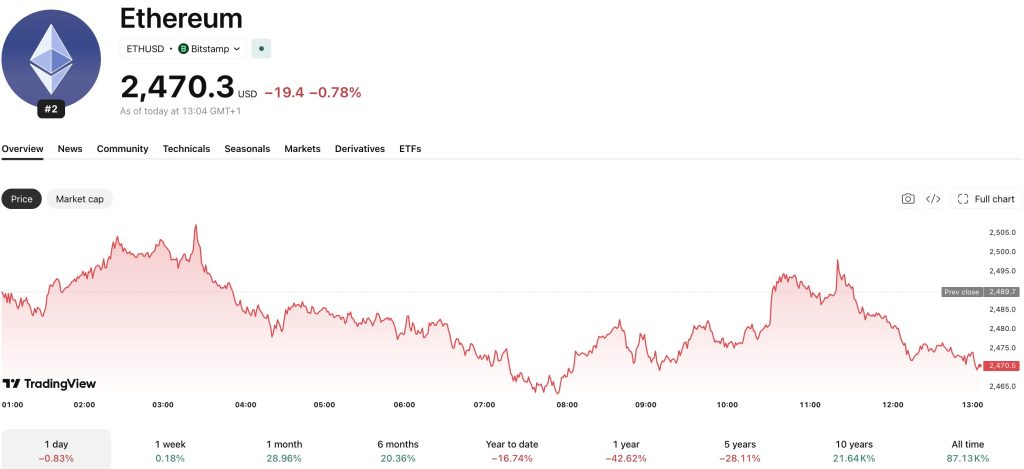
ETH USD is trading just under $2,500, at $2,480, down -0.9% over the past 24 hours, although it is still clinging to modest gains of +0.3% in the past week. Daily trading volume sits at $10.8M, up from $9M yesterday.
Ethereum Developers Find New Path For Smarter Transactions
Ethereum's EIP 8141 authors have found a new way to make transactions more programmable.
The proposal uses programmable contract calls called “frames” for transaction features. These frames could handle validation, gas… pic.twitter.com/NnhSaraVLz— BSCN (@BSCNews) September 7, 2026
Ethereum News Today: 2027 Upgrade Timeline
Core developers moved EIP-8141, known as Frame Transactions, to Scheduled for Inclusion during their Aug. 27 All Core Developers Execution call. The change gives the proposal a formal place in the planned Hegotá upgrade rather than leaving it only under consideration.
Hegotá is planned for 2027 and follows Glamsterdam, Ethereum’s next network upgrade. Ethereum groups protocol changes into codenamed upgrades, and Frame Transactions is now among the changes planned for Hegotá.
That status does not mean Frames is complete. The specification remains a draft; technical details can still change before deployment, and Frame Transactions cannot be used on Ethereum mainnet today. Implementation and testing work remain part of the path toward Hegotá’s planned deployment.
Why Frame Transactions Matter for Gas Payments
EIP-8141 addresses wallets holding stablecoins or tokens that can’t be transferred without ETH for gas fees. The proposal introduces “Frames,” which separate authorization, fee payment, and execution.
This lets a payments application cover the ETH fee or handle Ethereum payments on the user’s behalf, so the sender and fee payer don’t have to be the same. Validators would still receive fees in Ethereum, but this change allows users to transact without having to acquire ETH directly.
Some wallet systems already support sponsored transactions, and Frames aim to incorporate this functionality into Ethereum’s regular transaction flow. The proposal has ten authors, including Vitalik Buterin, who recently highlighted the updated EIP text.
Make Your Prediction Count With $25 For Free on Kalshi
How EIP-8141 Would Work
In other Ethereum news, the proposal breaks down transactions into separate frames. One frame confirms user authorization, another handles fee payments, and subsequent frames execute the operations.
This allows the account sending funds to differ from the account paying the fees. Actions can be grouped, so if a trade fails, the related approval can be reversed in the same transaction.
Additionally, this approach allows accounts to set their own validation rules, enabling key rotation or different signature schemes without needing a new address.
It also opens the door for accounts to adopt quantum-resistant cryptography, effectively introducing account abstraction elements into Ethereum’s standard transaction framework without necessitating asset migration.
Earn $50 and Enter $300K Prize Draw on EdgeX
Ethereum News: The Upgrade Does Not Remove ETH From the System

It is important to distinguish between abstracting gas payments for users and removing ETH from Ethereum’s fee system. Ethereum would still be paid in ether under the Frames design. The proposal changes how the fee payer is arranged; it does not eliminate the fee or replace ETH in the network’s existing fee system.
For a sponsored transaction, an application or another account would still need to handle the ETH payment. A user might pay an application in stablecoins, but the application would settle the underlying network fee in Ethereum.
In that sense, the proposal can reduce the need for an individual wallet holder to acquire ETH while preserving ETH-denominated fee payment at the protocol level.
Existing systems can already offer related capabilities through infrastructure such as ERC-4337, UserOperations, bundlers, and paymasters. What EIP-8141 proposes is protocol-level integration of similar programmable transaction features into Ethereum’s normal flow.
The remaining caveat is the proposal’s status. Frames is scheduled for Hegotá but remains a draft, and its technical details may still change before the planned 2027 deployment.
Discover: The Best Crypto to Diversify Your Portfolio
The post Ethereum News: Frame Transactions Join Ethereum’s 2027 Upgrade Roadmap appeared first on Cryptonews.


BeInCrypto is partnering with Opera to bring selected articles into Opera’s AI-driven content ecosystem, placing our reporting in front of a global user base of more than 296 million monthly active users. Through Opera’s recommendation cards, our news stories will appear on Opera’s homepage and within Opera’s articles.
The way we find news has changed radically. Readers no longer rely on direct visits to a homepage to get the latest updates. Discovery has shifted to real-time feeds, browser integrations, social video and recommendations. Integrating into Opera’s AI-driven content ecosystem is how we meet that shift, bringing digital finance reporting to audiences through content recommendations.
In April this year, we upgraded our homepage and article experience to better support how readers discover and consume content, including new video and social features.
This upgrade came as a response to accelerating global data: according to the Reuters Institute’s Digital News Report (June 2026), video news consumption has climbed from 67% in 2020 to 77% today, with social video specifically rising from 52% to 69% over the same period. Social media and video networks have also overtaken news organizations’ own websites and apps as the world’s most-used news source for the first time (54% vs. 51%).
Since then, discovery has continued moving beyond publishers’ own websites and into feeds, recommendations and other platforms.
“Since we overhauled our homepage infrastructure in April, the shift from active searching to algorithmic, seamless news discovery has only accelerated,” says Vlada Morhunova, Product Manager at BeInCrypto. “Audiences expect relevant financial insights to find them natively within their daily digital habits. Our integration with Opera is the logical next step in that evolution, moving our journalism beyond our own domain and straight into the user’s workflow.”
Readers can now access the latest news by visiting beincrypto.com and opera.com.
BeInCrypto is part of the BeInNews Academy Ltd, an independent media group covering the convergence of finance and digital assets. We help professionals act with confidence in a complex and fast-changing industry through our newsroom, research reports, events, expert network and multimedia studio.
The post BeInCrypto Partners with Opera to Expand Access to Digital Finance News appeared first on BeInCrypto.

Key takeaways
- XLM remains above important moving-average support zones, preserving its broader bullish structures.
- Its long-to-short ratios rose to 1.15, approaching one-month highs.
- XLM faces immediate resistance at $0.20, followed by targets at $0.218 and $0.237.
Stellar’s XLM is trading above important support zones on Tuesday, maintaining the possibility of further gains despite mixed momentum signals.
Derivatives data also showed an increasingly bullish tilt toward the cryptocurrency. Positive funding rates and rising long-to-short ratios indicate that more traders are positioning for an upward price move.
Derivatives traders increase long positions
CoinGlass data showed that the long-to-short ratio for XLM stood at 1.15 on Tuesday, approaching its highest level in a month.
A ratio above one means that more traders hold long positions than short positions. The latest increase therefore suggests that derivatives market participants expect XLM prices to rise.
Funding rates provide further evidence of bullish positioning. XLM’s rate became positive on September 2 and subsequently climbed to 0.0147%.
Positive funding means traders holding long positions are paying those with short exposure to maintain market balance.
While this generally reflects bullish sentiment, an excessively high rate can eventually increase the risk of long liquidations if prices suddenly decline.
Current readings support a constructive outlook without necessarily indicating that positioning has reached extreme levels.
XLM recovery extends above EMA support
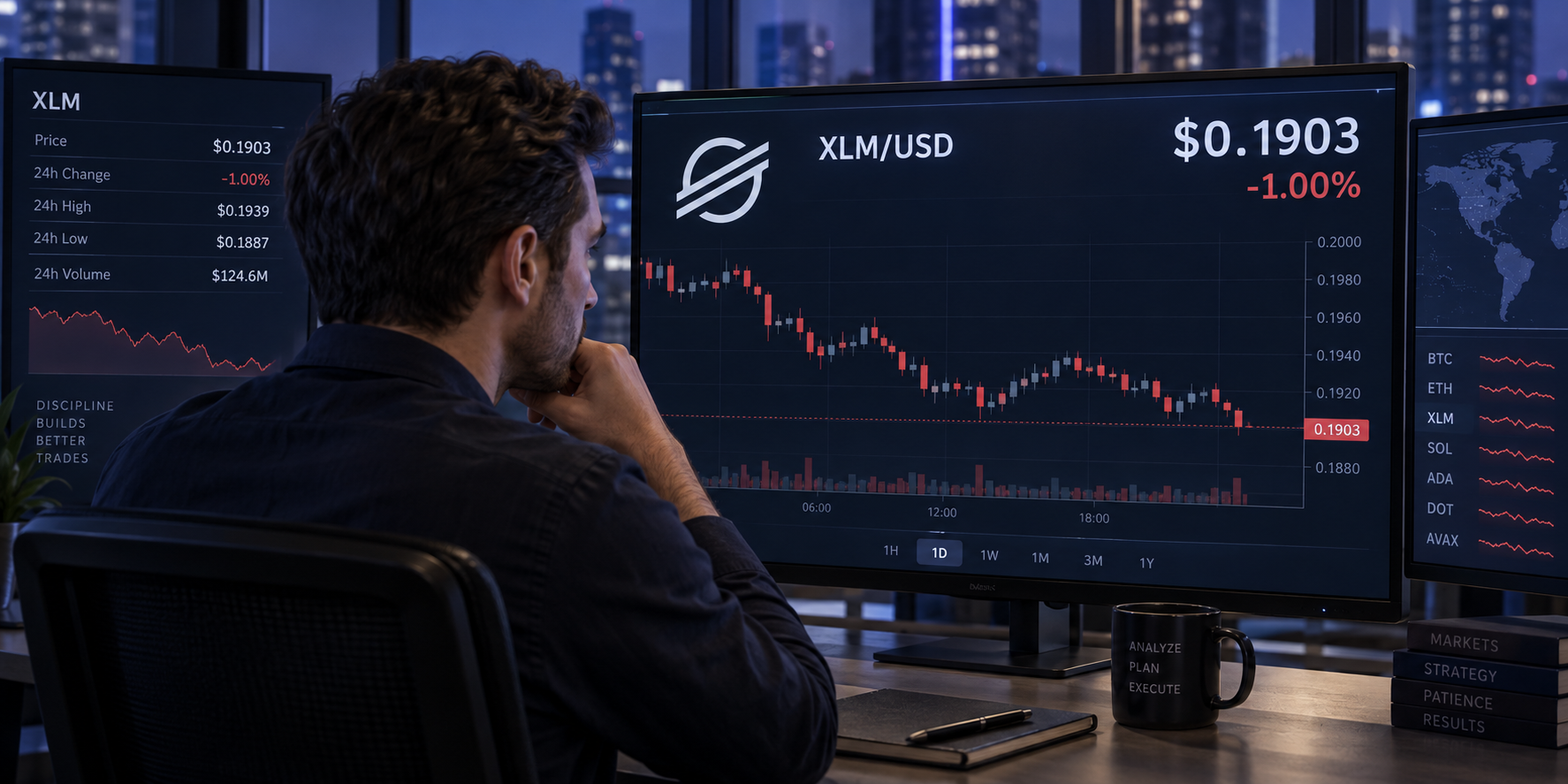
XLM traded around $0.193 on Tuesday after climbing above its major exponential moving averages.
The 50-day, 100-day and 200-day EMAs are concentrated between approximately $0.179 and $0.188. This cluster now forms a potential demand zone that could attract buyers during short-term pullbacks.
XLM’s RSI stands near 60, keeping the indicator within bullish territory without showing overbought conditions.
The MACD also maintains a mildly positive reading, with its main line above the signal line and the histogram remaining above zero. The setup suggests that upward momentum remains constructive, although buyers have not yet established a decisive breakout.
XLM faces its first significant resistance at the 61.8% Fibonacci retracement level near $0.200.
A sustained break above that psychological and technical barrier could allow the price to challenge the 50% retracement at approximately $0.218. The next resistance sits at the 38.2% Fibonacci level near $0.237.
Clearing those barriers could open a path toward the descending trendline and the 23.6% Fibonacci retracement around $0.260.
On the downside, the 200-day EMA at $0.188 offers immediate support. The 100-day and 50-day EMAs provide additional protection near $0.180 and $0.179, respectively.

If sellers push XLM below this moving-average cluster, the horizontal support at $0.177 and the 78.6% Fibonacci retracement at $0.173 would come into focus.
Buyers would need to defend this area to maintain the broader recovery. A decisive breakdown could expose deeper support levels at $0.142 and $0.139.
Overall, derivatives positioning and technical support favor further gains for XRP and XLM. However, confirmation will require XRP to overcome $1.90 and XLM to secure a sustained breakout above $0.20.

Disclosure: This content is provided by a third party. Neither crypto.news nor the author of this article endorses any product mentioned on this page. Users should conduct their own research before taking any action related to the company.
Dogecoin (DOGE) started out as a joke; its creators originally intended for users to tip each other for entertaining social media content. Despite its playful origins, Dogecoin has since become one of the most popular cryptocurrencies.
Summary
- SHR Miner offers cloud mining contracts that let Dogecoin users access mining rewards without purchasing or maintaining their own equipment.
- Contract plans range from 1 to 50 days, with different prices, estimated daily profits and total returns depending on the selected package.
- New users are offered a $15 registration bonus and a free hash power contract that the platform says provides a daily reward of $0.60.
- Mining activity, contract status, rewards and withdrawals can be managed through SHR Miner’s web based dashboard.
Like other cryptocurrencies, Dogecoin (DOGE) can be mined using cloud platforms. Cloud mining is an attractive option if you wish to avoid technical hassles, bypass initial hardware investments, or escape high electricity costs. Essentially, cloud mining involves outsourcing the entire mining process to a third party; as a leading global cloud mining service provider, SHR Miner enables Dogecoin enthusiasts to participate in mining rewards with a zero-barrier entry by leasing computing power from industrial-grade mining rigs.

How to earn profits mining Dogecoin with SHR miner
There are several benefits to mining Dogecoin rather than other cryptocurrencies. First, transaction speeds on the Dogecoin blockchain are fast, which means Dogecoin mining pools typically pay out earnings every 24 hours.
In addition to offering quick withdrawals, Dogecoin can generate a steady income for you. Consequently, Dogecoin mining is efficient, profitable, and holds great promise. Furthermore, there are numerous markets where you can sell your Dogecoin, making it well worth considering as a source of daily income.
Earn Dogecoin rewards with SHR Miner, get started in just three steps:
1. Register an account
Upon creating an account, you will receive a $15 new-user bonus and earn a daily reward of $0.60 through a free hashing power contract. (Click here to register)
2. Select a contract plan
Choose a short-term or long-term cloud mining contract based on your budget and requirements, with contract durations ranging from 1 to 50 days.
3. Start earning rewards
Once the contract is activated, users can view daily rewards via the dashboard and select a supported cryptocurrency for withdrawal.
Examples of popular cloud mining contracts
| Contract Name | Price | Profit | Days | Principal + Total Return |
| New User Experience Agreement | $100 | $4 | 2 | $100+$8 |
| Bitdeer Sealminer A2 Pro | $500 | $6.25 | 5 | $500.00 + $31.25 |
| Litecoin Miner L9 | $1000.00 | $13.00 | 10 | $1000.00 + $130 |
| Bitcoin Miner S21 XP Imm | $5000.00 | $70.50 | 25 | $5000.00 + $1762.5 |
| Bitcoin Miner S21e XP Hyd | $10000.00 | $151.00 | 35 | $10000.00 + $5285 |
| ANTSPACE HK3 | $30000.00 | $513.00 | 40 | $30000.00 + $20520 |
SHR Miner offers a variety of cloud mining contracts to meet the diverse needs of users regarding budgets, durations, and target returns. Whether users prefer short-term flexibility or are focused on long-term returns, they can select the plan that best suits their individual circumstances.
For details on specific contract prices, terms, and estimated rewards, click here to view all contract plans.
Why choose SHR miner?
Compliant UK Operations: We hold the necessary operational licenses, prioritize business transparency and regulatory compliance, and charge no hidden fees.
24/7 Technical Support: Our systems run continuously, backed by a professional team providing round-the-clock customer support.
No Complex Setup Required: The platform handles all aspects of mining rig deployment and hash rate allocation.
Real-Time Information Access: Users can view contract status, mining progress, and daily rewards via the web-based dashboard.
Genuine Hash Rate: Users receive hash power corresponding to their chosen contract, without the risks associated with third-party equipment maintenance.
One-Stop Management: Mining, reward tracking, withdrawals, and contract renewals can all be managed on a single platform.
As the market sees a return to favorable price levels, cloud mining offers cryptocurrency holders a new way to participate in the digital asset ecosystem, while eliminating the complexities of deploying and maintaining mining hardware themselves.
In short
Cloud mining is an excellent choice for those seeking ways to generate passive income. If used properly, these opportunities can easily accumulate cryptocurrency wealth in “autopilot” mode, requiring only a minimal investment of time. At the very least, they are far less time-consuming than any form of active trading. Passive income is the ultimate goal for every investor and trader, and with SHRMiner, maximizing your passive income potential is easier than ever.
Disclosure: This content is provided by a third party. Neither crypto.news nor the author of this article endorses any product mentioned on this page. Users should conduct their own research before taking any action related to the company.

In Bitcoin news today, a British investor, identified only as Chris, has recovered all 61 Bitcoin he lost access to more than 12 years ago after the collapse of the early UK exchange Intersango.
The holdings are worth roughly £3.3M. His individual claim was resolved through negotiation rather than a courtroom decision after lawyers assembled records to establish that the coins belonged to him.
— Financier.news (@FINANCIERNEWS) September 8, 2026
 British Investor Recovers £3.3M in Lost Bitcoin
A UK man identified as Chris recovered 61 BTC worth roughly £3.3 million after losing access for over 12 years when early exchange Intersango collapsed in 2014. He originally invested just £1,500 in 2011 when Bitcoin traded at… pic.twitter.com/NJE0Nhsfg6
Chris invested £1,500 in Bitcoin in 2011, when the cryptocurrency traded at around £2.94 per coin. He bought through Britcoin, which later became Intersango. According to CEL Solicitors, which handled the claim, he instructed the firm in January 2026, and the case was settled on May 28, roughly four months later.
Establishing ownership required historical bank statements, emails, exchange records and documents prepared for proceedings in US courts. CEL Solicitors has said more than 5,500 BTC connected to former Intersango users have been traced, although each claimant must establish ownership of specific holdings.

Bitcoin News Today: From Frozen Account to Negotiated Settlement
Intersango attracted thousands of users during Bitcoin’s early years before running into trouble in late 2012. Its website went offline in early 2014, and customers attempting withdrawals received no response. Chris found his account frozen when he tried to move his coins, which were then worth roughly £4,000.
After several unsuccessful attempts to contact the company, Chris eventually treated the holdings as lost. As Bitcoin’s value increased over the following years, he told LBC that watching the price rise was difficult after he had written off the coins. He tried again to recover the assets in early 2026 after his wife encouraged him to contact CEL Solicitors.
Ryan Sweetnam, director of financial litigation at CEL Solicitors, said the firm had to prepare documentation for US court proceedings before it could resolve the claim.
The process took time, but Chris’s individual matter ultimately ended through negotiation without a judge deciding the claim. The firm says the 61 BTC later reached a wallet Chris controls.
Chris has since transferred the recovered holdings to an FCA-regulated platform. He said he plans to retain part of the amount in crypto and convert some into cash.
Discover: The Best Crypto to Diversify Your Portfolio
A Wider Pool of Stranded Coins
THIS IS INSANE
Last time the Bitcoin Weekly "Supertrend" flipped green, $BTC skyrocketed +500%. pic.twitter.com/AFpJr7xYOQ
— Crypto Rover (@cryptorover) September 8, 2026

Intersango was not regulated by the Financial Conduct Authority, leaving Chris with limited options when the exchange stopped operating.
His case differs from a lost-wallet recovery involving a forgotten private key or password. The coins remained inaccessible because an exchange holding customer assets ceased operating.
The three Intersango co-founders have been involved in litigation over the platform’s closure. During those proceedings, it was alleged that one founder holds about 5,500 BTC, valued at around £500M, with at least part of the holdings potentially belonging to former customers. Sweetnam said the litigation acknowledged that assets connected to former Intersango users still existed.
Former users pursuing similar crypto recovery claims may need old bank statements, exchange emails and other records to support their cases. An email address originally used to register an Intersango account may also provide a starting point for tracing an account.
Earn $50 and Enter $300K Prize Draw on EdgeX
What Comes Next for Other Claimants
In other Bitcoin news, other former Intersango customers may pursue individual claims, but each will need to establish that the specific assets sought belong to them. Sweetnam said the process could take time even where there is an acknowledged debt and an effort to return assets.
The UK’s regulatory environment for crypto businesses has changed substantially since Intersango stopped operating, although the full authorization regime has not yet taken effect. The FCA’s application period for the new regime runs from September 30, 2026, through February 28, 2027.
The regime is due to take effect on October 25, 2027, when trading platforms, custodians, stablecoin issuers and other covered businesses will need authorization to conduct regulated crypto activities in the country.
Discover: The Best Token Presales
The post Bitcoin News: 61 BTC Returned After 12 Years Frozen in Intersango Account appeared first on Cryptonews.

Two major events in the following week or so could determine whether XRP’s technical setups play out, potentially sending the token to a new multi-month peak at around $2.00.
The first arrives on September 15, when the US Senate is scheduled to hold its first procedural vote on the CLARITY Act. The next one is just a day later.
Analysts Eye $2 and Beyond
Analyst Celal Kucuker described the token’s current technical structure as “amazing,” arguing that several formations are pointing toward the same target of around $2.30. Given the asset’s current price of around $1.39, this would represent another 60% surge if it materializes.
To do so, though, XRP would have to overcome some serious resistance levels that have halted its progress in the past and are sitting immediately above it. Fellow analyst Bird highlighted a large concentration of liquidity between approximately $1.60 and $1.85, followed by an even more significant pocket at $2.00.
Based purely on this liquidity map, the analyst estimated a 70% probability of XRP moving higher through $1.50 and $1.60 before targeting the subsequent region. The bearish scenario would become more relevant if the cross-border token loses $1.30, which could open the door for another dip to $1.20 or even $1.00.
However, it’s worth noting that liquidity maps change constantly and do not guarantee the direction of the next move, something that Bird also acknowledged.
CW offered another bullish technical scenario, indicating that XRP’s previous correction bottomed around the 0.5 Fib retracement before the subsequent rebound carried it above the 0.618 level. The current version of such an expansion would bring the asset to over $2.10.
Next 8 Days Matter
Those targets could soon face a much more fundamental test as the US Senate’s cloture vote on the motion to proceed with the CLARITY Act is scheduled for a week from today at 2:15 PM ET. This is not a vote to pass the legislation, as we have explained in the past. If successful, the vote would instead advance the bill toward formal Senate consideration. Nevertheless, its implications for the crypto market, especially assets like XRP, are quite significant.
A day later, the Federal Reserve will deliver its latest interest-rate decision. The combination of the two events creates an unusually concentrated event window for Ripple’s token. Regulatory progress could improve sentiment around the asset, but a hawkish Fed decision, such as a rate hike, which is more likely as of now, could simultaneously pressure XRP alongside the rest of the market.
The post Huge Week Ahead for XRP: Could These 2 Events Finally Trigger a Move Toward $2? appeared first on CryptoPotato.
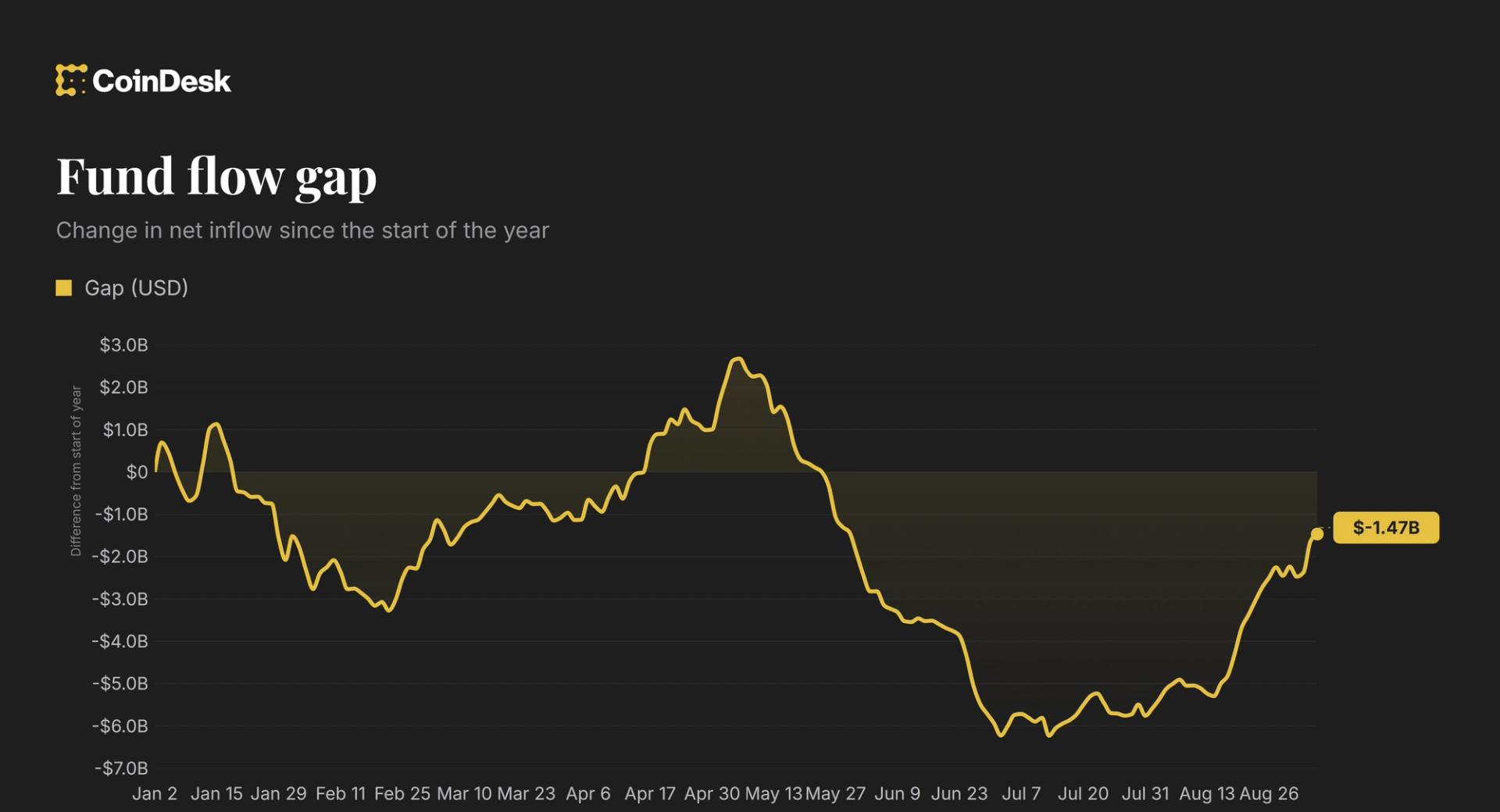
Your day-ahead look for Sept. 8, 2026


Blockchain network Harmony Protocol has taken the decision to wind down, worried that “threats posed by state actors and AI agents are too great.”
Harmony informed users on Sunday via X that the project, launched in 2019, would migrate to Ethereum, where it hoped its ONE token would be safer.
However, the prevalence of hacks currently wreaking havoc on the Ethereum ecosystem suggests that Harmony may well remain exposed in its new home.
On August 11, the protocol suffered an exploit which resulted in the “unauthorized minting” of 3 trillion native ONE tokens. The team later executed a rollback of the chain, restoring its pre-hack state.
The price of ONE dropped sharply directly after the hack and has lost more than 40% of its value over the past month.
Harmony was previously rocked by a devastating $100 million hack of its Horizon bridge back in 2022, a year which saw multiple bridges lose nine-figure sums.
At its peak, earlier that same year, the network held over $1 billion of TVL. Today, that figure sits at just $150,000.
Read more: Moonwell’s latest $9M attack marks four incidents in a year
Running to safety
The migration will be based on a snapshot with user balances “airdropped to the same wallet addresses on Ethereum.”
Tokens deposited in smart contracts, however, cannot be migrated and those users have been given just three days warning to withdraw any such funds.
At the same time as sunsetting the Harmony network and migrating to Ethereum, the project appears to be pivoting to become “the remix economy for AI video.”
It, rather ambitiously, eyes advertising revenue which “could generate tens of millions of dollars from a million users.”
The migration announcement recommends that existing Harmony validators consider taking a new role as “governors, AI video operators or affiliates.”
Read more: How 4,000 BTC walked out of Blockstream’s Liquid Network
Will Harmony be safer on Ethereum?
While Harmony may not have the best track record, its chosen destination has itself served as the venue for an alarming number of security incidents over recent months.
Blockchain security firm CertiK tallied a staggering 344 incidents which occurred in the first half of 2026 in a recent report. Of these, 153 were on the Ethereum network, approximately 44% of the total number.
The year’s uptick in exploits is suspected to be linked to the surge in powerful AI models.
Back in June, the crypto community nervously awaited the release of Anthropic’s Fable before it quickly became clear that the model had been “nerfed” to avoid servicing cybersecurity-linked queries.
Read more: Bitcoin bridge Boltz suspends services as AI hacks outpace patches
That said, at the protocol level, Ethereum is about as safe as blockchains get. Multiple other networks have recently suffered exploits targeting their structural layer, though.
Apart from the incident on Harmony, other recent examples came when a bug caused disruption and losses across at least four chains which all used a vulnerable Cosmos EVM module.
On Sunday, Blockstream’s Liquid Network was drained of 4000 bitcoin, worth around $320 million. The majority of funds have since been returned.
Also in late August, an exploit of Core DAO led to $5.5 million of validator rewards being issued ahead of schedule.
Ultimately, when hosted on a comparatively secure base layer protocol like Ethereum, safety rests on the quality of each individual project’s code. Whether or not Harmony’s new AI video venture will sink or swim is up to the team alone, no matter where it’s hosted.
Got a tip? Send us an email securely via Protos Leaks. For more informed news and investigations, follow us on X, Bluesky, and Google News, or subscribe to our YouTube channel.

Arm Holdings (ARM) on Tuesday previewed new innovations in its artificial intelligence compute portfolio spanning data centers to edge devices, including physical AI. Arm stock rose in early trading. At its Arm Everywhere conference in China, the semiconductor design firm announced a next-generation edge AI platform called Arm Compute Subsystems (CSS) for Mobile 2. The platform promises sustained performance, security…
Copyright ©2026 Investor’s Business Daily, LLC. All rights reserved. 87990cbe856818d5eddac44c7b1cdeb8


The Ethereum Foundation has committed to making Ethereum (ETH) resistant to quantum computers by December 2029, treating the date as a fixed deadline rather than a research goal.
The Protocol cluster published that target alongside its scoring of 62 proposals for Hegotá, the hard fork after Glamsterdam.
Ethereum Fixes a Deadline It Cannot Schedule
The Foundation wants Ethereum’s base layer to be quantum-resistant across execution, consensus, and data. Its priorities blog says the network should plan for Q-day arriving as early as 2030.
That target matches migration timelines independently set by Google, Cloudflare, and Microsoft. The Foundation acknowledged that it is front-running most credible forecasts.
“Planning for Q-day in 2030 is a deliberately aggressive assumption,” the blog reads.
The cluster will treat the deadline as non-negotiable at least until January 2027, when outside experts help reassess quantum progress. Roughly 65% of ETH already sits in quantum-vulnerable addresses, according to Project Eleven.
Follow us on X to get the latest news as it happens
Hegotá Becomes the First Test of the 2029 Promise
The Foundation framed Hegotá as the fork that decides whether the later post-quantum forks ship on time. Full resistance sits five hard forks out, and hitting December 2029 would need an average of 7.2 months per fork, a pace the cluster itself calls aggressive.
Frame Transactions carries that load as the must-ship execution-layer item, opening a path to new signature schemes without a hard fork for each one. A separate A-tier package, EIP-8298 and EIP-8151, completes the route by letting accounts abandon secp256k1 as the master key. A third, EIP-8365, starts retiring validator withdrawal credentials still tied to vulnerable cryptography.
The consensus layer gets the opposite treatment. Its cryptography cannot be swapped without a fork, so components wait for the complete design. Hash-Chain RANDAO landed at B tier, sound in direction but early in sequence.
The reluctance extends to the execution layer. ML-DSA verification precompiles fell to C tier, with the cluster declining to enshrine one scheme before a dedicated cryptographic review.
Subscribe to our YouTube channel to watch leaders and journalists provide expert insights
The post Ethereum Foundation Sets a December 2029 Deadline to Beat the Quantum Clock appeared first on BeInCrypto.
Robinhood’s tokenized AMC product briefly traded far above the referenced stock during the U.S. Labor Day weekend, prompting a fresh test of whether activity on Robinhood Chain can move real equity markets.
Summary
- Robinhood Stock Tokens provide economic exposure but grant holders no ownership or voting rights whatsoever.
- IOSG estimated tokenized AMC supply expanded nineteenfold as arbitrageurs responded to an onchain price premium.
- AMC shares rose during premarket trading, although researchers could not isolate token related buying precisely.
- Dynamic creation and redemption can close premiums, limiting sustained squeezes in genuinely backed stock tokens.
- Market closures can interrupt issuance, leaving token prices temporarily exposed to thin liquidity and premiums.
IOSG researcher Mario Chow reported on Sept. 7 that the token reached $18.04 after AMC Entertainment shares closed at $2.54 on Sept. 3. AMC subsequently rose as much as 22% in premarket trading before surrendering most of the advance.
The episode demonstrates that an onchain premium can generate demand for the corresponding shares when an authorized participant creates additional stock tokens. It does not establish that token trading caused the entire move in AMC.
It also does not show that Robinhood issued an unlimited supply of AMC stock tokens. Robinhood’s system allows the supply to expand or contract through creation and redemption. Issuance remains governed by the product’s legal terms, operational procedures, available collateral and market access.
Robinhood stock tokens are not AMC shares
Robinhood describes its Stock Tokens as tokenized debt securities issued by Robinhood Assets (Jersey) Limited. They track the economic performance of referenced U.S. securities but do not convey direct ownership.
According to Robinhood’s official documentation, holders receive no legal or beneficial rights in the company whose shares a token tracks. They cannot vote as AMC shareholders or assert ownership claims against AMC.
Robinhood’s 2026 quarterly filing similarly identifies Stock Tokens as debt securities issued by the Jersey affiliate. The company lists regulatory, litigation, operational and reputational risks associated with making them accessible through Robinhood Wallet.
The products are not registered under U.S. securities laws and cannot be offered to U.S. persons. Eligible investors in selected jurisdictions can nevertheless transfer and trade them through wallets, centralized exchanges or decentralized applications.
This separation explains AMC CEO Adam Aron’s objection. Aron said AMC had not authorized or participated in the product. He called the token “contemptible, outrageous, disgusting” and said the company had engaged outside securities counsel.
Robinhood rejected AMC’s demand to discontinue it. As crypto.news reported, Robinhood argued that it could continue offering the AMC-linked product without the issuer’s consent because the instrument is Robinhood’s debt security rather than an AMC-issued share.
Another distinction concerns the meme coins involved. Robinhood did not issue $MEME, $CINEMA or $BONER. Independent developers created those tokens and liquidity pools on Robinhood Chain, a permissionless Ethereum-compatible network. Some pools use Robinhood Stock Tokens as their quoted asset.
An AMC premium prompted token supply to expand
IOSG’s research reconstructed creation and redemption transactions for the AMC-linked token. It estimated that the supply rose from 152,106 tokens to 2.90 million within three days.
The researcher counted approximately 3.05 million newly created tokens and 310,000 redeemed tokens during the period. Those figures produced a net increase of approximately 2.74 million.
Because each token tracks the economics of one share, creating tokens may require the participating intermediary to obtain corresponding market exposure. Robinhood says assets supporting its Stock Tokens are held through regulated financial institutions, although token holders do not own those assets directly.
IOSG estimated that approximately $7.6 million of real AMC shares was purchased as the token supply increased. The report further estimated that those purchases represented as much as 7.6% of trading during the busiest premarket interval.
Those calculations are external estimates derived from blockchain activity and market data. Robinhood has not publicly confirmed the $7.6 million figure, identified the authorized participant or published a transaction-by-transaction record of corresponding AMC purchases.
AMC shares still reacted during the period. The stock advanced from a Sept. 3 close of $2.54 to approximately $3.11 in early premarket trading on Sept. 4, according to the IOSG analysis. It later fell back and closed near $2.65.
The timing is consistent with some buying pressure reaching the equity market. However, timing alone cannot establish how much of the move came from token creation. AMC news, speculative trading and ordinary premarket orders could also have contributed.
Crypto.news separately reported that AMC shares gained about 21% during the public dispute. No official filing has attributed that movement to Robinhood Chain activity.
Creation and redemption work against a lasting squeeze
A conventional short squeeze relies on constrained share availability. Rising prices force short sellers to repurchase shares, which creates more demand and can push prices higher again.
GameStop displayed an extreme version of that structure in January 2021. An SEC staff report found that GameStop’s short interest reached 122.97% of its public float. AMC’s short interest was much lower at 11.4%.
Robinhood and other brokers restricted purchases of both stocks on Jan. 28, 2021. Robinhood’s regulatory filings attribute the restrictions to clearinghouse deposit requirements and related liquidity pressure.
The current stock-token structure behaves differently. When a token trades above the value of its reference share, an authorized participant can potentially acquire the share exposure, create more tokens and sell them into the premium.
Additional supply reduces scarcity. The arbitrage trade also becomes less attractive as the token price moves back toward the referenced share price. This creates negative feedback rather than the self-reinforcing demand associated with a short squeeze.
Redemption can reverse the process. If a Stock Token trades below its reference value, eligible intermediaries may acquire and redeem tokens, reducing their supply and potentially unwinding the corresponding market hedge.
The IOSG report found a similar expansion in Robinhood’s tokenized Hims & Hers product. Its supply reportedly increased from 468 tokens around the launch of the $BONER market to 130,876 tokens.
These findings support the argument that meme-coin buying can transmit some demand into tokenized equities and potentially into underlying shares. They do not support the stronger claim that onchain buyers can permanently lock the real equity’s circulating supply.
Dynamic issuance does not alter AMC’s actual shares outstanding. It changes the number of Robinhood debt instruments providing economic exposure to AMC.
Market closures leave a temporary pricing gap
Token markets can remain active when the underlying U.S. stock market is closed. The creation channel may not operate with the same availability because authorized participants need access to equity trading, custody and settlement services.
This mismatch can leave a Stock Token without an immediate arbitrage route during weekends or market holidays. Thin liquidity can then push its onchain price far above or below the last available reference price.
IOSG attributed the AMC token’s rise to $18.04 partly to this timing gap. The move occurred after the U.S. market closed and before intermediaries could respond through the usual creation process.
Once premarket trading began, the gap narrowed. The actual AMC share price initially moved upward while the token price declined. By shortly before the regular session, both were reportedly trading near $2.61 to $2.62.
The episode suggests that the token itself can experience a short-lived squeeze when new creation is unavailable. Such a move does not necessarily transfer proportionally to the underlying share.
Existing supply also matters. After the AMC token supply expanded to approximately 2.90 million, IOSG observed smaller deviations during the following closure. A deeper token float made another extreme premium more difficult to produce.
The risk may be greater for newly launched products with limited supply, concentrated liquidity or temporarily paused creation. Investors also face smart-contract, issuer, pricing-feed and redemption risks that do not exist in the same form when holding ordinary registered shares.
Activity around these products is growing. In related coverage, Robinhood Chain’s RWA-linked trading volume reached a reported $390 million, including $217 million from meme coin and stock-token pairs.
Genuine and imitation stock tokens require clearer labels
A separate risk comes from tokens that use a public company’s name or ticker without any backing or formal relationship with the company.
Robinhood’s genuine Stock Tokens have an identified issuer, legal terms and reference assets. Robinhood Chain’s documents describe them as tokenized debt instruments issued by Robinhood Assets (Jersey) Limited.
A third party can still deploy an unrelated token using similar branding on a permissionless blockchain. Such a token may have a fixed supply but no custodian, redemption right, authorized participant or claim against underlying shares.
Similar names can make the two products difficult to distinguish in wallets and decentralized exchange interfaces. A market price that follows a public stock does not prove that the token holds corresponding shares or offers enforceable redemption rights.
IOSG identified counterfeit stock-linked contracts as the larger investor-protection concern. Its researchers said some copied equity names and supplied token balances that appeared designed to imitate genuine products.
Those findings have not produced a publicly announced enforcement case. Still, they reinforce the need to verify contract addresses, issuer documentation and redemption terms instead of relying on a ticker symbol.
As previously reported, tokenized equity holders reached 752,000 across five platforms, while Robinhood accounted for 328,000. Wider adoption increases the consequences of unclear ownership and backing disclosures.
What happens next depends partly on whether AMC takes formal legal action. Aron said the company had retained securities counsel, but AMC has not announced a lawsuit or regulatory filing challenging Robinhood’s product.
Regulators must also decide how unaffiliated stock-linked instruments should disclose ownership, issuer consent, collateral and redemption rights. Until those questions are resolved, the creation channel remains the main mechanism connecting token prices with real equity markets.
FAQs
Do Robinhood AMC tokens represent ownership of AMC?
No. They are debt securities issued by Robinhood Assets (Jersey) Limited. Holders receive economic exposure but no AMC voting or ownership rights.
Can meme-coin buying increase AMC’s share price?
It can create demand for AMC-linked tokens. Creation of additional tokens may lead intermediaries to purchase corresponding market exposure. The size and direct effect on AMC shares cannot be isolated from other trading.
Why did the AMC token trade above the real stock?
The premium formed while U.S. equity markets and normal creation channels were unavailable. Onchain trading continued, allowing limited token liquidity to diverge from the stock’s last price.
Can Robinhood issue unlimited AMC tokens?
Robinhood has not described the supply as unlimited. The supply can expand and contract through creation and redemption, subject to product terms, collateral, market access and operational controls.
Are meme coins paired with stock tokens genuine equities?
No. A meme coin remains a separate crypto token. Its trading pool may use a genuine Stock Token as the quoted asset, but that does not give the meme coin equity backing or shareholder rights.

Why Viking FK uses two head coaches as Norwegian club makes Champions League debut

Amazon drops 15-inch M5 MacBook Air to season low at $1,349

‘She has no shame’: Embarrassing reason behind Nicola Peltz’s ‘Rising Star’ award… despite being in her 30s and acting since childhood. OLIVIA KEMP reveals industry anger – and what happened when she questioned prize

Egyptian TV Presenter Sarah Khalifa, 11 Others Sentenced To Death In Major Drug Trafficking Case In Cairo

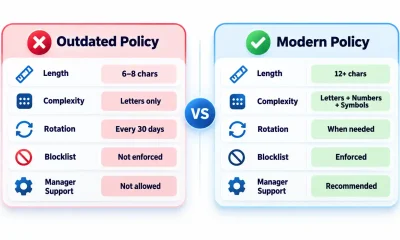
Strong Password Policy and Password Manager Guide
The 10 Most Influential Books of the 20th Century, Ranked

The Prayer That Brings Money from Unseen Sources | Kenneth E. Hagin’s Secret

BIS Reveals Banks Will Require A Minimum Of 19,998 XRP To Process 20 Billion Transactions At Scale!

3 Kunci yang Bisa Bawa Kamu Financial Freedom #financialfreedom #keuangan
-
 Business2 hours ago
Egyptian TV Presenter Sarah Khalifa, 11 Others Sentenced To Death In Major Drug Trafficking Case In Cairo
-
 Tech3 hours ago
Strong Password Policy and Password Manager Guide
-
Entertainment2 hours ago
The 10 Most Influential Books of the 20th Century, Ranked
-

 Crypto World3 hours ago
Stablecoins could save South Korean merchants up to $3.8 billion a year, budget office says
-
 Crypto World3 hours ago
Hyperliquid Season 3 Airdrop Wait Fuels a Meme Coin Machi Big Brother Promotes
-

 Crypto World2 hours ago
How Democrats Plan to Investigate Trump’s Ballroom
-

 Sports2 hours ago
Rob Baxter: Exeter boss says England should pick English-based players
-

 Politics2 hours ago
Susan Sarandon Claims She Lost Film Work Due To Her Support For Palestine
-

 Business3 hours ago
model backs CBD drinks brand
-
 NewsBeat3 hours ago
‘Shocking, disappointing, woeful’: Reaction to Wales’ fall in the global schools Pisa scores – live
-

 Crypto World3 hours ago
Tracking cocoa may be just the beginning for PwC, Merck, Hashgraph provenance system
-
 Crypto World3 hours ago
Visa expands stablecoin card network to 160 programs
-
 News Videos3 hours ago
MASSIVE XRP RECORD SET! EVERYTHING CHANGES TODAY!!!
-

 Sports3 hours ago
Lindermann back to his best in 2026 Chelmsford Stakes
-

 News Videos2 hours ago
Get Ready: Bitcoin About To Explode Higher?
-
Business2 hours ago
Goldman Sachs maintains neutral stance amid market shifts
-

 Tech2 hours ago
How Bats Prevent Doppler Acoustic Interference
-

 News Videos2 hours ago
The Man Who Cracked The Crypto Algorithm Reveals Next Great 10x Opportunity | Crypto Banter
-

 Tech2 hours ago
Apple TV may be planning a ‘Silo’ spinoff
-
 Politics2 hours ago
Splits Emerge In Reform Over Masked Anti-Migration Protesters
You must be logged in to post a comment Login