
Crypto World
Whitehat Rescues 3,832 NFTs Amid Suspected Magic Eden Flaw



Yuga Labs’ 0xQuit said the NFTs are safe and will be returned once the risk passes, while holders were urged to revoke NFT permissions.


The Federal Reserve’s two September 24 proposals describe more than the assets behind a dollar token. One proposal sets the terms for an insured state member bank to seek approval for a stablecoin subsidiary; the other would govern the issuer, its reserves and its capital. The distinction determines which firms can use the Fed’s application route at all.
Summary
- The Fed released 2 proposed stablecoin rules at 2:30 p.m. EDT on September 24, 2026.
- An insured state member bank would seek Fed approval for a subsidiary, with 120 days for a decision after a complete application.
- The proposed initial capital floor is $5 million for a newly approved issuer during its first 3 years.
- A proposed 2% capital charge on uninsured reserve deposits would equal $20 million on a $1 billion exposure.
- A state issuer passing $10 billion in outstanding coins would face a proposed 360-day transition or stop net new issuance.
The Federal Reserve has proposed two stablecoin rule packages that put an approval test in front of insured state member banks and an operating rule around issuers under its supervision.
The Board of Governors published the proposals on September 24 at 2:30 p.m. Eastern time. Its 60-page application notice is Docket R-1900, RIN 7100-AH30. A separate, 392-page notice would implement reserve, capital, redemption, custody and related requirements under the GENIUS Act. Both are proposals open for comment, not licenses granted or final regulations. The comment period closes 60 days after publication in the Federal Register, a date the notices had not supplied when released.
The scope deserves care. The application notice addresses an insured state member bank seeking permission for a subsidiary to issue payment stablecoins. It does not offer every fintech a direct route to the Fed. The broader operating notice covers issuers supervised by the Board through the paths described in that proposal. An OCC application, a state-qualified issuer and a state member bank subsidiary do not become the same legal entity simply because all three propose dollar tokens.
Crypto.news reported the Fed proposals on September 24. Reading the two notices side by side reveals a more useful question than whether a proposed issuer can buy Treasury bills. Which legal entity submits the application, who controls the subsidiary, when does the review clock actually start, and how much capital would its chosen reserve mix consume?
The application belongs to the bank
The GENIUS Act permits three domestic issuer categories described in the Fed’s application notice: a qualifying subsidiary of an insured depository institution approved by its primary federal regulator, a federal qualified issuer approved by the Office of the Comptroller of the Currency, and a state-qualified issuer approved by its state regulator. Different supervisors handle the different paths. An insured state member bank applies to the Federal Reserve for approval of its subsidiary under section 5 of the statute, codified at 12 U.S.C. 5904.
That legal distinction can be obscured by a familiar phrase, a bank stablecoin. In the Fed’s proposed application procedure, the bank is the applicant and its controlled subsidiary is the contemplated issuer. A technology company supplying wallets or software is not the applicant on that basis. A bank with a national charter has a different primary regulator. An uninsured state member bank does not use the insured-bank procedure in this notice. The notice says such a bank may approach its home state stablecoin regulator, while its existing Federal Reserve obligations continue to apply.
The proposed rule defines control using existing bank holding company concepts. Ownership or voting power of at least 25% of a class of voting securities is one path; control over a majority of directors is another; a controlling influence determined by the Board after notice and hearing is a third. A prospective issuer formed by multiple banks raises a practical question: which bank controls the company, and which regulator reviews it? The Fed asks that question explicitly in Questions 1 through 4 of its application notice.
For a consortium, the Board says it may accept one application on behalf of multiple insured state member banks if the venture counts as a subsidiary of each. The notice does not say that every multi-bank venture automatically meets that test. A structure in which a bank owns a small minority interest and a separate commercial company directs issuance needs analysis of who actually controls the issuer. A named bank on a consortium’s promotional list does not settle the question.
The distinction is timely because 21 financial institutions committed in September to form a stablecoin company, with a proposed launch in the first half of 2027 subject to conditions. The announcement is evidence of a planned venture, not evidence that its eventual entity will apply through the Fed’s insured state member bank route. Banks can collaborate through a company that uses another licensing path. The proposal leaves the legal design consequential.
The 120-day clock starts after a completeness decision
The proposed application process contains two clocks. Under section 247.30, the Board would tell an applicant within 30 days of receiving its materials whether the filing is substantially complete and identify missing information if it is not. The 120-day decision period runs from the submission date of a substantially complete application. If the Board does not decide a complete application within that period, the proposal restates the statute’s deemed-approval provision.
Filing a letter on day one therefore does not guarantee approval on day 120. The Fed says the submission date is the date its Reserve Bank received the final material needed for substantial completeness, not the later date when the Board sends its completeness notice. An application with omitted material needed to evaluate statutory factors is not substantially complete. A material change can cause a previously complete application to be treated as new if the information on hand is no longer sufficient.
The notice supplies examples: deteriorating financial condition, a material change to the issuer’s business plan, or another change affecting review. This is a procedural limit on a headline claim that applications are approved automatically if the Fed waits. Automatic approval is tied to a complete application and a defined 120-day period. A company cannot make the clock run by sending an incomplete business plan and calling it a filing.
Nor can the Board deny a substantially complete application for any reason it likes. The GENIUS Act, as described in the notice, limits denial to a determination that the applicant’s activities, including those of the proposed issuer, would be unsafe or unsound based on statutory factors. The proposal supplies a process for a denied applicant to seek a hearing and appeal. Those limits support the opposing reading of the application rule: the 30-day notification, 120-day decision period, limited denial grounds and appeal procedures constrain regulatory delay as much as they screen applicants.
There is an important difference between missing a deadline and refusing an application. The deemed-approval provision addresses a regulator’s failure to issue a decision on a complete file within 120 days. A timely denial triggers a separate process in which the applicant can contest the grounds. The proposed procedural rule details hearings and final determinations, while the statute restricts the substance of a denial. A prospective issuer should therefore distinguish three statuses in any public account of its progress: submitted, substantially complete and approved. None can safely be substituted for another. A press release that says an application was filed tells readers nothing by itself about when the 120-day clock began.
The Board says an applicant should send its letter to the appropriate Federal Reserve Bank, which would forward a copy to the Board. The applicant has to sign, describe the proposal, state the action sought and explain why approval meets the statutory factors. Existing information that the supervisor already holds can in some cases reduce duplication, but the proposed rule still requires the information needed to assess the stablecoin subsidiary. The detail becomes especially relevant where an established bank launches a new entity: examination history for the parent does not itself supply a business plan, governance scheme and redemption process for the proposed issuer.
The disclosure burden remains substantial. The proposed application includes a business plan, financial information, policies and procedures, relevant agreements, governance and material third-party relationships. It asks who does what across the proposed program. A bank can outsource technical tasks, but the Board still wants to see the issuer’s operating structure and the bank’s oversight of it. The notice invites pre-filing feedback for complex proposals, an option that does not itself constitute approval.
Reserve choice changes the capital calculation
The operating proposal separates the dollars backing outstanding tokens from the issuer’s own loss-absorbing capital. A dollar of qualifying reserves for a dollar of coins is a backing requirement. Capital is a second layer, intended to absorb risks to the issuer’s continued operations and certain exposures. Describing a fully reserved issuer as needing no capital confuses those two accounts.
The Fed proposes a $5 million initial minimum during a three-year de novo period, indexed to nominal U.S. GDP. The applicable minimum would be the higher of that floor and a calculated risk-based requirement. The Board could set a different amount in specified circumstances, including when the calculated minimum does not match an issuer’s exposures. The $5 million is neither an application fee nor a universal final capital requirement. It is a proposed floor for a newly approved Board-supervised issuer in its initial period.
One line of the 392-page notice makes the reserve decision measurable. Proposed section 247.17(a)(1) assigns a 2% capital requirement to uninsured eligible deposit claims held as reserve assets. The Fed links that treatment to bank credit risk. A bank failure could delay recovery or leave a loss in the issuer’s reserves. The notice specifically recalls Circle’s approximately $3.3 billion in uninsured USDC reserves held at Silicon Valley Bank when regulators closed that lender in March 2023.
Apply the proposed rate to simple, hypothetical exposures. If an issuer holds $250 million in uninsured eligible deposits, the 2% component is $5 million. At $1 billion, it is $20 million. At $3.3 billion, matching the approximate historical exposure cited in the notice without implying that today’s Circle would hold that sum in such accounts, the arithmetic reaches $66 million. These are illustrations of one proposed component, not complete regulatory capital calculations, final costs or findings about a named issuer.
The arithmetic exposes the point at which the initial $5 million floor ceases to tell a reader much about the reserve bank choice. Even before operational risk and any other applicable charges enter, a hypothetical $1 billion uninsured deposit exposure produces a $20 million component. The proposal asks whether the 2% calibration should instead range from 1% to 4%, or vary with the credit standing of the deposit bank. At 1% the same $1 billion example produces $10 million; at 4% it produces $40 million. Those alternative rates are questions for commenters, not adopted rules.
The Fed’s framework considers other categories as well, including undercollateralized reverse repurchase agreements, eligible funds, operational risk and non-reserve assets. The calculation uses different measurement periods for some exposures. It would be false precision to treat the deposit example as the entire capital bill. The comparison does show why a prospective issuer should model its custody and reserve structure alongside its licensing application. A plan naming a reserve bank but leaving the size of uninsured exposure unspecified omits information central to its capital needs.
The proposal’s treatment of operating risk cannot be replaced with the usual argument that short Treasury bills have little credit risk. A redemption desk must work on weekends when a Treasury market does not; software access, failed transfers, custody controls, reconciliation and customer screening can each demand money even when reserves remain intact. The Fed’s separate capital calculation for operational risk therefore depends on inputs other than the market value of government securities. The agency proposes quarterly measurement for the revenue-based component and asks whether other measurement frequencies would work better.
The choice between depositing cash at a bank and holding short government securities is not binary in practice. An issuer needs settlement balances to pay redemptions, while it can hold another part of its backing in permissible liquid instruments. A design promising rapid redemptions but putting every dollar into instruments that must first be sold depends on the sale and payment chain working when customers want out. Conversely, an issuer that keeps large uninsured bank deposits may have immediate access to cash in normal conditions but incurs the proposed deposit credit-risk component. Neither observation proves one reserve mix is right for every program. Both follow from the Fed’s distinct treatment of liquidity and bank exposure.
Custody creates another decision. Proposed sections on covered custodians describe protection for reserve property and for the private keys that allow token issuance. An issuer that relies on an outside bank to hold Treasury securities and a separate technology firm to manage minting permissions needs to map which party controls each asset, who can authorize movement, and how the issuer reconciles outstanding coins with eligible backing. The application asks for material third-party relationships and relevant agreements for that reason. A marketing statement that the reserves are safe does not disclose the chain of authority.
The Fed describes a possible increase or decrease in the de novo capital requirement when it finds a different amount sufficient to support operations. It asks commenters whether the three-year period is appropriate and whether the initial $5 million level, indexed to nominal GDP, should be higher or lower. For a prospective issuer, a model that merely budgets $5 million as a fixed, permanent cost misses both the proposed higher-of test and the regulator’s reserved authority. The precise requirement would emerge from the adopted rule and the issuer’s actual exposures.
Different agencies have already taken their own steps. The FDIC proposed bank issuer standards in April, and the OCC published its stablecoin proposal in February. The Fed notice compares its proposed $5 million starting floor with those agencies’ approaches. Similar figures across proposals do not remove the differences in jurisdiction, application process or final text. None of these proposals should be described as a final license for a specific company.
The $10 billion boundary is a second eligibility test
State supervision is a route for eligible issuers below a statutory scale threshold. Proposed section 247.51 addresses a state-qualified issuer whose consolidated outstanding issuance passes $10 billion. The Board proposes a transition to its federal framework within 360 days, unless the issuer stops issuing new payment stablecoins on a net basis while above the line or obtains an available waiver permitting continued state supervision.
The notice asks an issuer crossing that level to notify the Board within five calendar days. Its notice would identify the supervising state, the outstanding amount, the crossing date and whether it has stopped net new issuance. A capital analysis would follow within 270 days. A request for a waiver, if sought, would be due within 240 days under the proposed procedure. A transition is not simply a new label on the same business; the issuer would need to meet the applicable federal requirements within the timetable.
Consider an issuer at $9.9 billion. A $200 million net issuance would take it to $10.1 billion, above the threshold, under a simple point-in-time calculation. The proposal asks whether measurement should instead use a rolling average and whether issuance by nonconsolidated affiliates should count. Those questions remain open. It is therefore premature to assert that splitting tokens among subsidiaries would keep a program permanently below the line. The Board expressly asks commenters how affiliated issuance should be treated.
The U.S. stablecoin licensing landscape already includes different supervisors and unfinished implementing rules. A growing state issuer faces the timing question earlier than a startup seeking its first license. It may need to prepare for federal supervision while current growth, reserve composition and capital remain moving targets. The $10 billion provision does not mean a coin above that value instantly becomes illegal. The notice specifies a transition period, a possible waiver and an alternative of halting net new issuance.
A promise to redeem has its own operating requirements
The proposed reserve rule would require eligible assets backing outstanding coins on a one-to-one basis. The Board would require a public redemption policy setting out a timeframe, fees, minimum redemption quantity and procedures. Proposed section 247.12 says timely redemption may not exceed two business days after a request, subject to applicable requirements. Onboarding and customer screening still apply. An exchange customer who can sell a token in seconds is not necessarily the same person as an eligible customer redeeming directly with its issuer.
That distinction can be missed when an issuer’s market price stays close to one dollar. Secondary-market trading shows what buyers and sellers will accept; it does not answer who has a contractual redemption claim on the issuer and through which channel. The application notice asks about redemption policies precisely because the issuer needs an operational route from token presentation to payment. A banking partner, custodian and transfer system sit in that route.
Safekeeping requirements in the other notice reach reserve assets, tokens used as collateral and private keys used to issue payment stablecoins. The Fed would apply requirements to certain Board-supervised custodians holding covered assets, including protections intended to keep customer property separate from a custodian’s creditors. The scope differs from a generic wallet software provider that does not control the customer’s keys. The proposal asks where those boundaries should fall.
Governor Michael Barr, in his September 24 statement accompanying the notices, supported safeguards that address runs and payment system risks. The strongest case for the Fed’s approach is therefore operational: clear redemption terms, eligible liquid reserves, capital where bank deposits are uninsured and documented custody arrangements could make an issuer’s promise easier to evaluate before a stress event. The strongest concern from a prospective entrant is the amount of upfront work and uncertainty while separate agencies finish rules that are meant to fit together. Both readings are compatible with the text; the eventual requirements depend on comments and final decisions.
What the proposal cannot tell applicants yet
The Fed has not published a list of approved issuers under these new proposals. Its application notice does not reveal which prospective companies will apply through a state member bank, an OCC-supervised entity or a state regulator. A charter, a pending application, a partnership announcement and permission to issue under a final regime are distinct milestones.
Several variables remain open on the face of the notices: the final capital calibration, whether the $10 billion threshold uses a momentary observation or an average, how multi-bank issuers document control, and how final rules across agencies line up. The notices are extensive because the Board is asking questions on these points, not because it has resolved all of them. A claim that a specific issuer qualifies today would require its organizational documents, supervisory status, application and regulator decision.
There is a checkable way to follow the process. Federal Register publication starts the stated 60-day comment period. Final rule text determines whether the proposed $5 million floor and 2% deposit charge survive. Application notices and decisions would show which banks actually seek approval. Consortium ownership documents would show whether a bank controls the issuer. Outstanding issuance disclosures would identify state issuers nearing $10 billion.
The Fed’s application notice says it will notify an applicant within 30 days whether its filing is substantially complete. Once the final required materials reach the appropriate Reserve Bank, the proposal defines the submission date from that receipt, which starts the statutory 120-day decision period.
What to watch
- Federal Register publication: Check the publication date to calculate the 60-day comment deadline.
- Final Fed rules: See whether the $5 million initial floor, 2% deposit charge and 360-day state-issuer transition survive.
- Public application decisions: Look for an identified insured state member bank and the subsidiary it proposes to control.
- Issuer ownership disclosures: Check public filings for who controls any multi-bank venture before assigning it a Fed application route.
- Outstanding coin disclosures: Track whether a state-qualified issuer approaches or crosses $10 billion in consolidated issuance.
FAQ
Can any stablecoin company apply directly to the Fed?
No. The proposed application route in Docket R-1900 addresses an insured state member bank seeking approval for a subsidiary. Other potential issuers use the regulator applicable to their legal structure.
Does the bank or its subsidiary submit the application?
The insured state member bank submits it. The proposed subsidiary would issue the payment stablecoin if the relevant approvals are obtained.
Is an application approved automatically after 120 days?
The statute’s deemed-approval provision applies when the Board does not decide within 120 days of a substantially complete application’s submission date. The Fed proposes a separate 30-day notice about completeness and can identify missing information.
Is $5 million enough capital for every issuer?
No. The proposed $5 million floor applies during an initial three-year period, and an issuer would need the higher of that figure and its calculated requirement. The Board could require a different amount in specified circumstances.
How would uninsured reserve deposits affect capital?
The proposal assigns a 2% component to eligible uninsured deposit claims held in reserves. On a hypothetical $1 billion exposure, that component alone is $20 million, before other applicable requirements.
Can a bank consortium apply through one filing?
The Fed says it may accept one filing on behalf of multiple insured state member banks if the issuer qualifies as a subsidiary of each. The notice seeks comment on how control works in a consortium.
What happens when a state issuer passes $10 billion?
The proposal describes a 360-day transition to federal supervision, an option to stop net new issuance while above the threshold, and a possible waiver. It asks for notification within five calendar days of crossing the line.
Are the Fed’s September 24 rules already in force?
No. They were published as proposals for comment, and the actual comment deadline depends on Federal Register publication. This is educational analysis, not investment advice.
Disclaimer: This article is for information and educational purposes only and does not constitute financial or investment advice. Figures reflect regulatory filings and reporting available at the time of writing and change with each disclosure. Nothing here is a recommendation to buy, sell, or hold any security or asset. Always do your own research. Information is accurate as of September 25, 2026.

The practice gained traction after the National Zoo received giant pandas from Beijing in the wake of President Richard Nixon and First Lady Pat Nixon’s historic trip to China in 1972, which marked a new, positive chapter in U.S.-China relations.
China claims ownership of nearly all the giant pandas in the world, even their offspring, and controls who receives them. Beijing eventually shifted from gifting giant pandas to leasing them to other countries in 1984 as the animal’s population dwindled, but the practice continued and spread to other nations like Austria, Canada, and Malaysia. China regularly considers loaning pandas an act of goodwill—even when the host nation typically foots the bill of about $1 million annually for a pair.
A giant panda’s presence or absence in a country tends to represent ebbs and flows of its relationship with China. For instance, amid tensions with Japan over Taiwan, Tokyo returned two giant pandas to Sichuan on loan in January, marking the first time Japan does not have a giant panda since 1972, when China-Japan ties first normalized. In 2010, two U.S.-born panda cubs returned to China, days after Chinese officials warned then-President Barack Obama against meeting the Dalai Lama, whom Beijing considers a separatist.
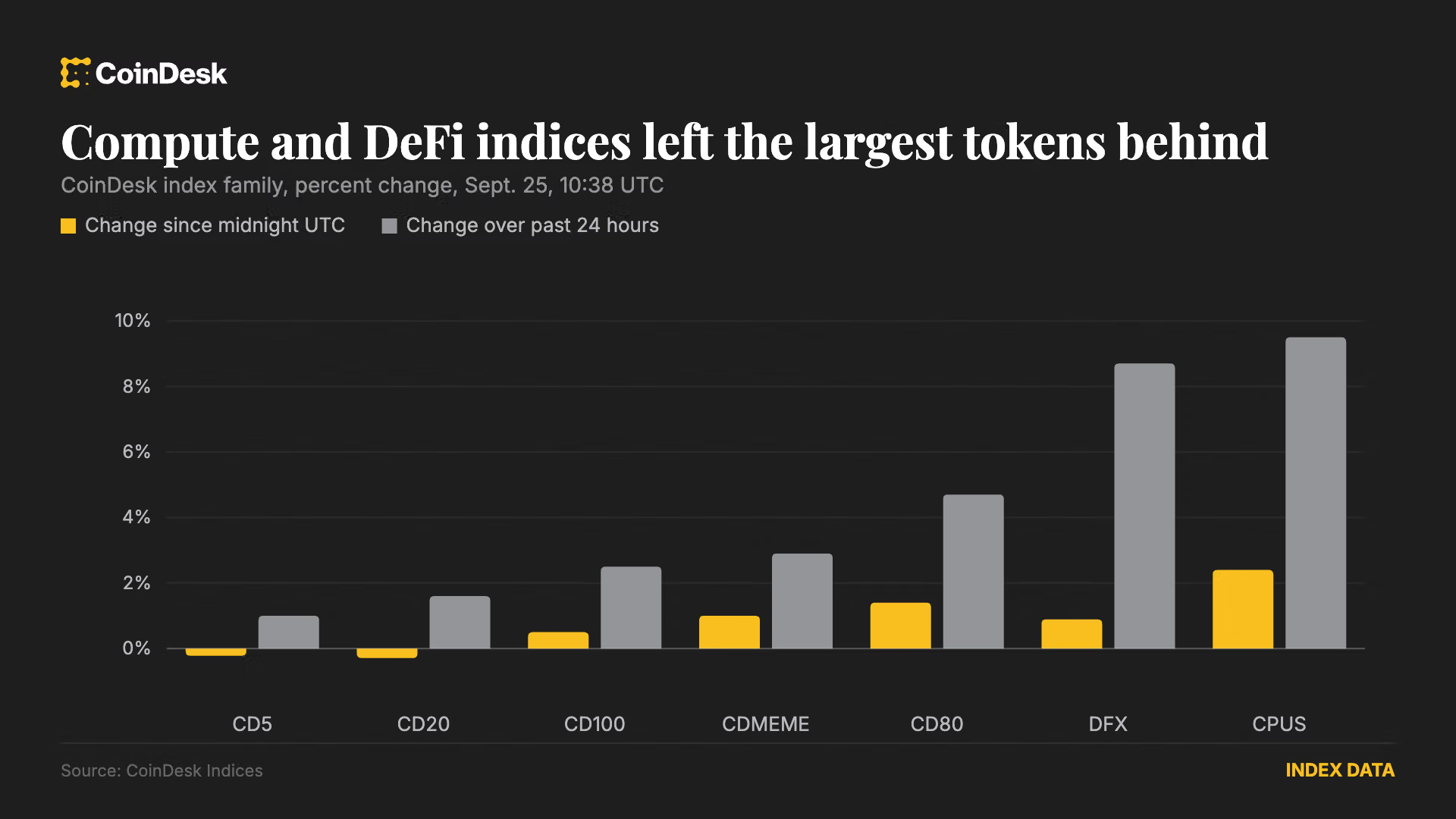
Bitcoin is consolidating, trading at $84,342 on Friday and unchanged since midnight UTC, while almost everything else in the market is climbing, with 93 of the 100 CoinDesk 100 constituents higher over the past 24 hours and the CoinDesk 80 up 4.7% against the CoinDesk 5’s 1.0%.
The rotation follows the pattern of previous cycles, in which capital moves into more speculative bets once bitcoin has run hard and stalled, with the cost of holding a long position through elevated funding pushing traders to rotate.
Bitcoin has climbed from below $63,000 in August to almost $87,000 on Tuesday and has gone sideways since, and altcoins are benefitting as a result, CoinMarketCap’s altcoin season index reading 56 out of 100 against 45 a week ago and 38 a month ago, its highest in more than three months.
Chainlink , internet computer (ICP) and bittensor (TAO) drove the CoinDesk Computing Index (CPUS) 9.5% higher over 24 hours, with the DeFi Select Index (DFX) up 8.7%, both more than three times the blended benchmark’s 2.5%.

Why the choir camaraderie? One reason: singing together is a low-cost, inclusive activity. Plus, recent studies show that singing with others helps bolster social cohesion, as well as providing numerous physical benefits, from lowering blood pressure and cortisol levels to bolstering lung health. Group singing is on the rise, and it couldn’t have come at a better time.
Dr. Frank Russo, a psychology Professor at Toronto Metropolitan University, who studies the science behind what happens physically, mentally, and to our sense of connection when we sing together, pointed to the recent World Cup as an example.
“Thousands of people who may never have met are synchronizing their voices, movements, and attention around a shared identity. For a few minutes, they behave almost like a single coordinated social unit,” he says, explaining that by singing together, fans bolster their connection and collective identity. “People sing because they feel united, but the act of singing may make them feel more united.”
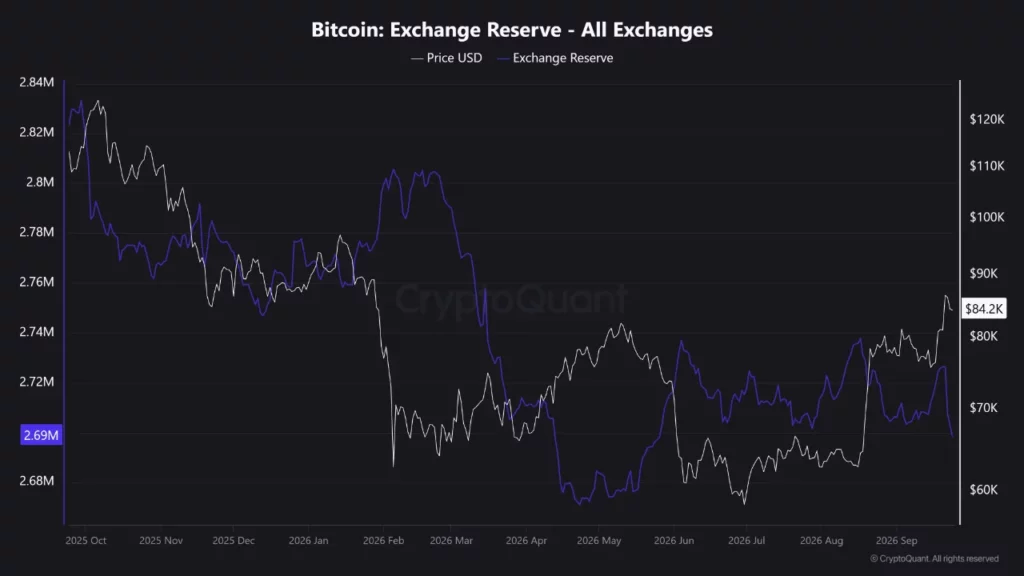
Bitcoin has held near $84,000 while long-term holders take moderate profits and exchange balances decline, leaving improving on-chain signals without a confirmed recovery.
Summary
- Bitcoin long-term holders are realizing 72% profits, far below December 2024’s roughly 350% peak levels.
- Exchange reserves fell 1.03% as 12,153 BTC left trading platforms between September 17 and 23.
- Bitcoin open interest dropped 10.4% from September 21, while funding eased to 0.00570% by Thursday.
- September 22 produced 19,105 BTC outflows alone, meaning weekly withdrawals were not consistently dominant overall.
- Spot Bitcoin ETFs drew $191 million September 24, extending their net inflow streak to six.
CryptoQuant contributor Darkfost said in his September 25 analysis that long-term BTC holders are currently realizing profits of roughly 72%. His comparison puts the figure well below the nearly 350% profit level recorded in December 2024, when long-term-holder gains were much closer to previous cycle extremes.
CoinGecko currently places BTC near $84,403, with a 24-hour trading range between roughly $82,941 and $84,843. The market tracker shows BTC up around 10.3% over seven days after the rebound from September’s lower levels.
Are long-term Bitcoin holders starting to sell heavily?
Darkfost does not describe the current activity as aggressive distribution. The analyst said long-term holders tend to react less to short price swings than short-term holders, making their realized profits useful for tracking selling pressure during larger market moves.
His data place current realized profits near 72%, compared with approximately 350% in December 2024. Darkfost described the current phase as moderate and said similar readings have appeared during earlier bear-market periods, when long-term holders were less motivated to unload large positions immediately.
The 72% figure does not mean long-term holders have sold 72% of their BTC. It measures the profit performance associated with coins being spent by that cohort, which CryptoQuant defines through holding-age metrics.
Darkfost’s interpretation is that holders could continue waiting for higher profit levels before heavier selling emerges. His view remains an analyst assessment based on historical behavior, not a forecast that long-term holders will refuse to sell if market conditions change.
The distinction is relevant after BTC rallied from roughly $75,000 to above $87,000 within days. As crypto.news reported in the earlier $84,000 Bitcoin analysis, BTC has already faced two rejections around the $87,000 region while ETF demand and large-holder accumulation continued below the surface.
Bitcoin is leaving exchanges, but one day drove much of it
Exchange flows give another constructive reading, though the weekly pattern is less uniform than a headline net-outflow figure suggests.
CryptoQuant analyst CoinNiel reported in the latest exchange-flow analysis that exchanges recorded 12,153 BTC in net outflows between September 17 and September 23. The previous week had produced 6,142 BTC in net inflows, reversing the direction of the weekly figure.
CoinNiel cautioned that September 22 accounted for approximately 19,105 BTC in withdrawals by itself. His data therefore show that net outflows did not dominate every session during the seven-day period.
Exchange reserves moved lower at the same time. CoinNiel measured total reserves at roughly 2.726 million BTC on September 21 before they dropped to a provisional 2.698 million BTC on September 24, a decline of approximately 1.03%.
His analysis does not treat every withdrawal as a purchase. Coins can leave exchanges for private custody, transfers between institutions, collateral management or other purposes, so reserve declines alone cannot establish fresh spot demand.
A separate Binance reading adds more detail. As crypto.news reported earlier on September 25, Darkfost tracked more than 13,800 BTC leaving Binance on its largest daily net-outflow reading since 2023. Binance reserves fell from around 705,000 BTC to 685,000 BTC over four days.
Darkfost associated the Binance withdrawals with accumulation, while crypto.news noted that netflow data cannot identify the reason every holder moved coins. The Binance figure and CoinNiel’s all-exchange dataset measure different scopes, so the two readings should not be combined as one total.
Falling leverage is removing some pressure from Bitcoin
Derivatives data show leverage cooling after BTC’s move above $87,000.
CoinNiel reported that Bitcoin open interest fell from approximately $29.34 billion on September 21 to a provisional $26.29 billion on September 24. The 10.4% decline occurred as BTC pulled back from its recent high.
The analyst cautioned that open interest is measured in dollar terms, meaning part of the decline can come from changes in BTC’s price. CoinNiel therefore said the full drop cannot be attributed solely to traders closing leveraged positions.
Funding rates cooled as well. CoinNiel measured average funding near 0.00662% during the previous week before it increased to 0.00777% between September 17 and 23. The provisional September 24 reading then dropped to 0.00570%.
Lower funding reduces the cost of maintaining leveraged long positions compared with the previous readings. CoinNiel described the combination of easing funding, lower open interest and exchange withdrawals as “encouraging” but stopped short of treating it as proof of a renewed uptrend.
The change follows a period when leverage expanded quickly during BTC’s rebound. Crypto.news previously reported that leverage was rising as Bitcoin moved through $85,000, with futures traders adding more than $2 billion in positions after spot ETF demand helped start the rally.
Why Bitcoin’s recovery is still missing one confirmation
Spot demand remains the unresolved part of CoinNiel’s assessment. The CryptoQuant analyst said falling reserves and lower leverage create a better setup, but stronger evidence of persistent spot buying would be needed before describing BTC’s recovery as confirmed.
ETF activity provides one source of measured spot demand. U.S. spot Bitcoin ETFs received another $191 million on September 24, extending their net inflow streak to six consecutive sessions. As previously reported by crypto.news in the September 25 Bitcoin price report, BlackRock’s IBIT received roughly $163 million during the session while Fidelity’s FBTC took in approximately $12.86 million.
The six-day sequence followed much larger inflows earlier in the week. Crypto.news reported approximately $999 million on September 21, $714.7 million on September 22 and $346.98 million on September 23 before daily inflows moderated to $191 million.
ETF subscriptions have therefore remained positive even as BTC failed to stay above $87,000. CoinNiel’s exchange analysis still calls the recovery unconfirmed because ETF flows represent only one part of total spot-market activity.
His downside test is more direct. CoinNiel said renewed exchange inflows combined with rapidly increasing funding and open interest would weaken the current cautiously constructive reading. The analyst plans to watch whether exchange withdrawals persist once September 24 figures are finalized and whether spot buying becomes clearer.
Bitcoin’s derivatives market faces another large reset on September 25. Coinbase Markets data cited by crypto.news show roughly $18.1 billion in combined BTC and ETH options scheduled for quarterly expiry, with Bitcoin call open interest concentrated around the $90,000 and $100,000 strikes.
Disclosure: This article does not represent investment advice. The content and materials featured on this page are for educational purposes only.

This debate also coincides with proposed changes to Section 106, a clause in the National Historic Preservation Act of 1966 that requires federal agencies to assess how development affects historic sites, which are decades in the making. If these changes are enacted, federal land, where Native Nations hold consultation rights under extant law, could theoretically become terrain AI data center developers could claim without a federal review process.
More than 700 organizations, including Native Nations, have already signed a letter opposing this change to Section 106—but this isn’t the first time it has been targeted.
Near the end of President Donald Trump’s first term, the Secretary of the Interior issued Secretarial Order 3389, exempting major energy and land-management projects from standard Section 106 review. It was a move the Biden administration noticed early on and swiftly reversed.
The current Advisory Council on Historic Preservation rewrite picks up where that order left off, and is part of energy, transmission, and mining’s long game to weaken Section 106 as a source of delay for infrastructure—one that predates the AI boom by years.

Samourai Wallet co-founder Keonne Rodriguez has said he faces another federal prison transfer after a drug-treatment program at FCI McKean was deactivated.
Summary
- Rodriguez says FCI McKean ended his treatment program, triggering another transfer with roughly seventy inmates.
- Completing the federal drug program could cut Rodriguez’s five-year sentence by up to twelve months.
- His previous transfer from Morgantown to McKean took thirty days despite a four-hour driving distance.
- DOJ says Samourai transmitted more than $237 million in criminal proceeds through its privacy services.
- Senate CLARITY legislation containing developer protections failed to advance on a 49–50 procedural vote September.
Rodriguez’s September 24 post on X says the prison warden informed program participants that he and roughly 70 other inmates would be transferred to facilities where the treatment remains available. The Federal Bureau of Prisons had not published a separate notice confirming McKean’s program shutdown at the time of reporting, so the transfer details come from Rodriguez’s account.
Why is Rodriguez facing another prison transfer?
Rodriguez entered the Residential Drug Abuse Program, or RDAP, because successful completion can reduce an eligible federal inmate’s sentence. The BOP explains that eligible participants may receive an early-release reduction after completing the residential treatment program.
For sentences of 37 months or longer, current BOP policy allows an early-release reduction of up to 12 months. Rodriguez is serving five years, making that maximum theoretically relevant if he satisfies the program’s eligibility and completion requirements. The reduction is not automatic because the BOP retains authority over eligibility and the amount granted.
Rodriguez said he had only recently settled into FCI McKean when inmates learned the treatment program would no longer continue there. His account says participants now expect reassignment to institutions that still offer RDAP.
An older BOP program-location guide listed a residential drug program at McKean, although the agency’s public materials reviewed for this report do not independently confirm the September 2026 deactivation Rodriguez described.
His last four-hour transfer took 30 days
The prospect of another move follows what Rodriguez described as a month-long transfer from FPC Morgantown in West Virginia to FCI McKean in Pennsylvania.
In a September 24 letter published by The Rage, Rodriguez said the facilities were approximately a four-hour drive apart. His transfer instead began June 10 and involved buses, two flights and a stop at the Federal Transfer Center in Oklahoma City.
Rodriguez said he requested permission to make the journey through a transfer furlough because he had minimum-security status and had self-surrendered to begin his sentence. He wrote that officials denied the request without explanation on June 8. Those descriptions are his personal account and have not been independently confirmed by the BOP.
During the transfer, Rodriguez said officers placed him in ankle restraints and handcuffs secured to a waist chain before taking him by bus to an airport. He described passing through detention facilities with inmates from different security classifications and spending long periods inside cells.
Rodriguez called the journey the “absolute worst 30 days” of his life. He wrote that he shared one cell with a man serving a murder sentence and described sleeping on part of a foam mattress while part of his body rested on the metal bunk.
The BOP says prison placement and transfers can depend on security classification, bed availability, program needs, medical requirements and other factors. Federal law directs the agency to consider housing inmates reasonably close to their primary residences when practicable, but programming needs can affect placement decisions.
Samourai case ended with five- and four-year sentences
Rodriguez is serving a five-year sentence after pleading guilty in August 2025 to conspiracy to operate an unlicensed money-transmitting business. Co-founder William Lonergan Hill received four years.
The U.S. Attorney’s Office for the Southern District of New York said Samourai transmitted more than $237 million in traceable criminal proceeds through its services. Prosecutors linked the funds to darknet markets, fraud, cybercrime, sanctioned jurisdictions and other offenses.
Samourai offered Whirlpool, which mixed Bitcoin transactions, and Ricochet, which inserted extra transaction hops between sending and receiving addresses. Prosecutors said more than 80,000 BTC, then valued above $2 billion, moved through the services after their launches.
Judge Denise Cote sentenced Rodriguez on November 6, 2025. The court imposed three years of supervised release after imprisonment and a $250,000 fine. Rodriguez and Hill paid approximately $6.37 million in forfeiture representing Samourai fees, according to the Justice Department.
As crypto.news previously reported, Rodriguez later sought public donations after saying legal expenses left him more than $2 million in debt. He said at the time that he was still seeking presidential clemency while preparing to begin his sentence.
Developer protections remain unresolved after CLARITY vote
Rodriguez’s case has continued to appear in U.S. debates over when developers of non-custodial crypto software can face money-transmission obligations.
The final Senate CLARITY Act text released September 14 contained provisions derived from the Blockchain Regulatory Certainty Act. Senator Cynthia Lummis’s office said the language would shield qualifying developers from money-transmission registration requirements and create a civil safe harbor.
As crypto.news previously reported, Coin Center had urged lawmakers to preserve protections for non-custodial blockchain developers. The advocacy group argued that software developers who never control customer assets should not automatically be treated as money transmitters.
The Senate did not advance H.R. 3633 on September 15. The official roll call shows the cloture motion failed 49–50, short of the three-fifths threshold required to proceed.
Lawmakers gave different reasons for opposing the measure. Republican Senator Susan Collins said the legislation required more study, including questions over community-bank deposits. Democratic senators including Catherine Cortez Masto and Angela Alsobrooks cited unresolved concerns over ethics, illicit-finance enforcement and other provisions.
The failed procedural vote left the proposed developer language unenacted. Rodriguez’s conviction and sentence remain governed by the law and judgment already entered in his criminal case.
For Rodriguez, the immediate issue is administrative rather than legislative. His latest account says the BOP must designate another institution where he can continue the treatment program tied to his potential sentence reduction. No destination or transfer date had been publicly disclosed when his September 24 update was published.
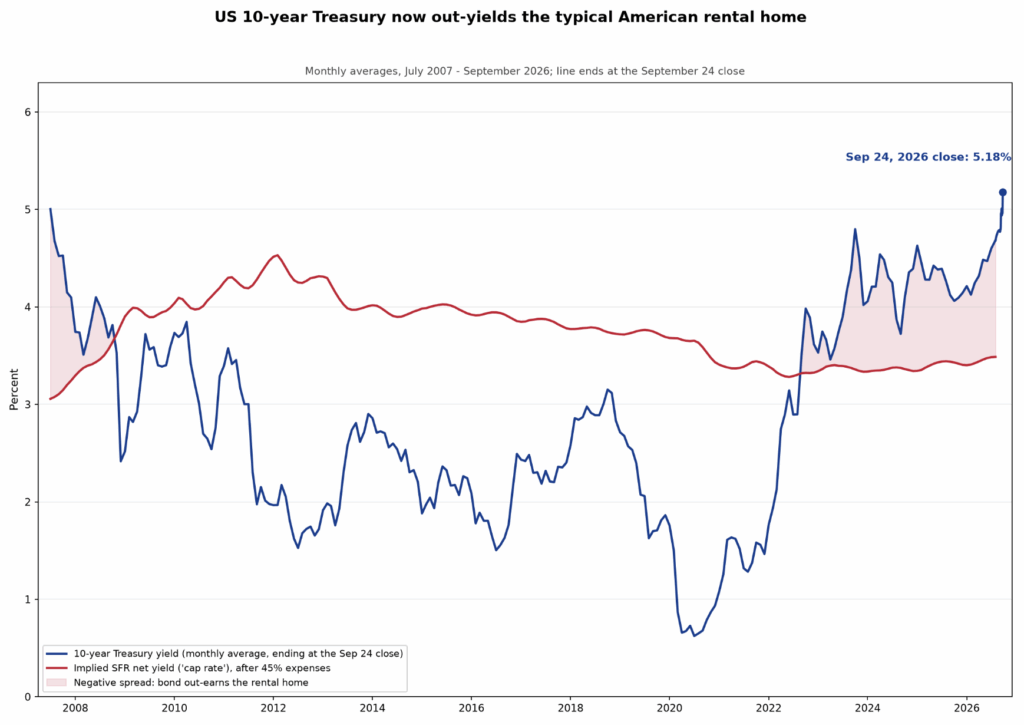
It would be more profitable for the average investor to buy a 10 year US government bond than to become a typical landlord. Indeed, this relative profitability is at its highest level since July 2007.
Negative housing spreads occur when the interest rate “spread” between low-risk US Treasuries are outperforming the risky operations of renting-out real estate.
Specifically, the US 10-year Treasury yield-to-maturity closed at 5.11% on Wednesday and pushed further to 5.18% on Thursday.
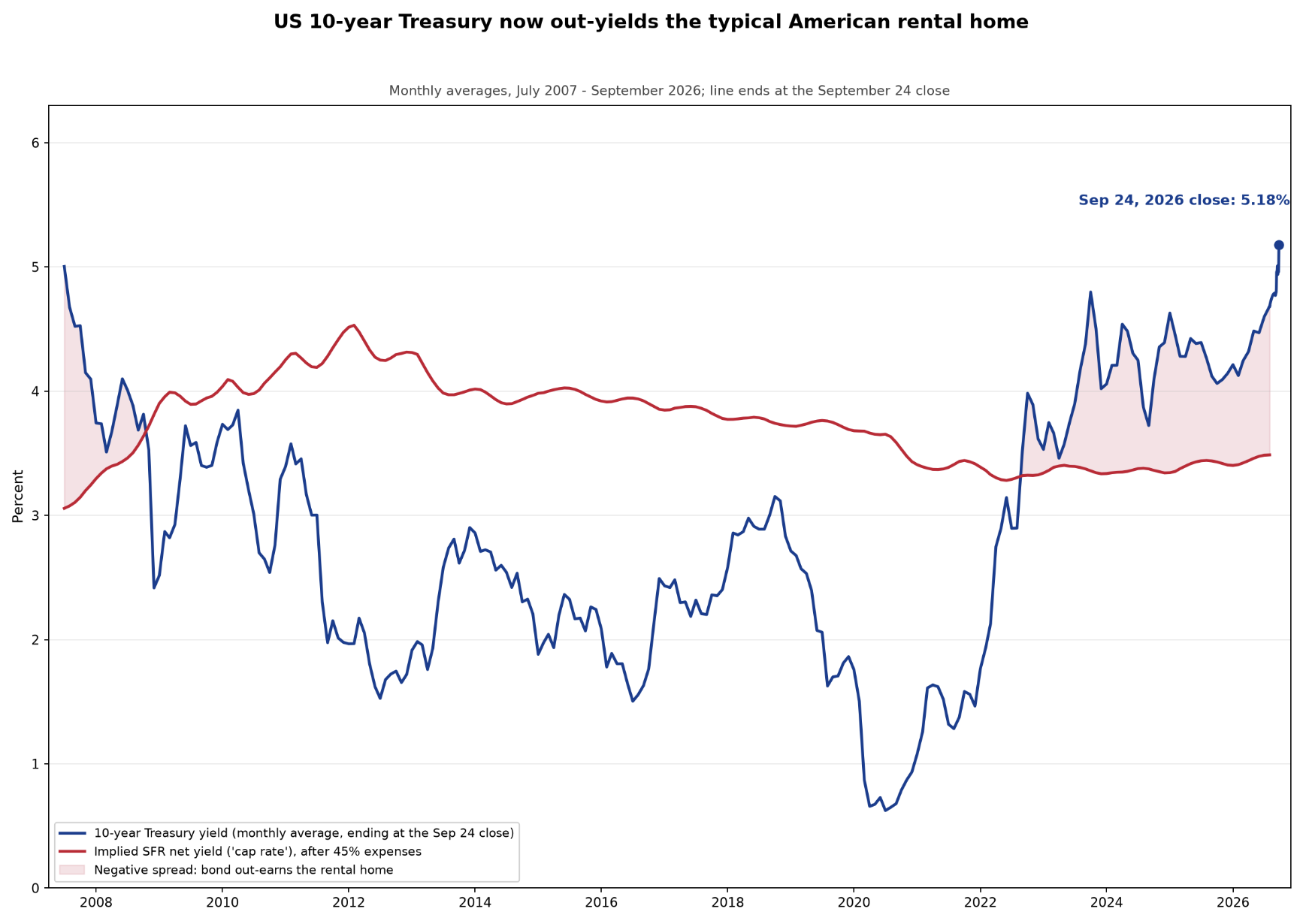
An oil shock and borrowing spree during the US war with Iran helped push Treasury bond yields to bizarre heights this year.
A recent rate hike from the Federal Reserve then catapulted yields past the 2007 housing bubble.
Last week, Chairman Kevin Warsh announced the Fed’s first hike in three years, and his committee’s own projections for an additional increase to their Fed Funds Rate this year.
Read more: US 20-year bond auction just had its worst showing ever
Negative housing spreads cause rental investment collapse
Nick Gerli, CEO of a real estate data firm, posted a chart drawing more than 250,000 views with a simple statement: Real estate for cash flow has a negative opportunity cost relative to government bonds.
According to his calculation, 10-year Treasuries above 5.1% easily beat the 4.8% single family house rental cap rate.
That 4.8% figure is one of many benchmarks for after-cost returns on rental properties. Individual property owners might earn double-digit returns during great years with minimal repairs, and then lose money the next year amid unexpected costs or low occupancy. Real estate returns vary drastically.
Got a tip? Send us an email securely via Protos Leaks. For more informed news and investigations, follow us on X, Bluesky, and Google News, or subscribe to our YouTube channel.

A single account for currencies, digital assets and commodities can simplify trading, but a tidy interface says little about what sits underneath.
Compare how each product is structured, priced, executed and governed – not the length of the instrument list.
Why crypto-native traders are looking beyond crypto
For traders used to crypto markets, adding currencies or gold can broaden the set of market drivers they follow. The scale is different too: the BIS 2025 Triennial Central Bank Survey recorded average OTC foreign-exchange turnover of $9.6 trillion per day in April 2025.
More markets do not automatically mean better diversification
Bitcoin, a technology-stock CFD and a high-beta currency may all fall when risk appetite fades. Diversification depends on correlations, position sizes and how those relationships change – not the number of symbols on screen.
Why product structure matters
“Buying gold” could mean owning a security, trading a futures contract or taking a leveraged CFD position. Crypto access might involve the underlying asset or a derivative with no wallet withdrawal. Before comparing forex and crypto trading, identify what is actually traded, who the counterparty is, how the position is margined and whether it expires or incurs overnight financing.
What “multi-asset trading platform” should mean in practice
Market access and instrument availability
Ask for the exact instrument schedule available in your country. “Stocks” may mean shares or CFDs, while “forex” may cover rolling spot-style products rather than futures. Compare trading hours, contract size, quote currency and what happens to orders when the underlying market is closed.
As crypto-native traders add currency and commodity exposure, providers increasingly compete on consolidated market access and risk tools. The 1xTrade trading platform is one example of this approach. As with any provider, traders should independently confirm which products are available in their jurisdiction and review the applicable costs, execution terms and legal disclosures before opening an account.
One interface versus one risk model
A unified online trading platform should show total margin use and exposure across asset classes. Test whether order tickets behave consistently, profit and loss are converted clearly into the account currency, and stops can be reviewed alongside exposure elsewhere.
Check 1: Execution and order handling
Why FX execution is different from a centralised exchange
Crypto traders may expect one visible order book, but retail OTC FX commonly involves dealer pricing. The BIS analysis of the 2025 FX execution landscape describes a decentralised, fragmented market in which spot and most FX derivatives trade over the counter; dealers internally match more than 80% of customer trades.
Ask how market orders, limits and stops are handled, whether slippage can be positive as well as negative, and what happens during gaps or connection failures. Evaluate execution quality using fill records, not a speed slogan or demo alone.
Check 2: Total trading costs
Spreads, commissions and overnight costs
Trading platform fees should be assessed for a realistic holding period. Add the bid–ask spread, commission, overnight financing or swap, currency-conversion charge and any market-data or inactivity fee. Then review deposit and withdrawal charges. A narrow headline spread may still produce a higher all-in cost for a position held for several days.
Check 3: Risk controls before leverage
Position sizing, stops and exposure limits
Leverage increases market exposure relative to deposited capital, amplifying losses as well as gains. A stop can constrain an intended exit but cannot guarantee its price in a fast or gapping market. Useful controls, therefore, include a pre-trade margin preview, position-size input, account-wide exposure view and clear liquidation rules.
Before placing an order:
- Set the maximum account loss for the trade in cash, not just percentage points.
- Calculate the size from the stop distance and contract value.
- Check the combined exposure of correlated positions.
Check 4: Funding and withdrawals
Read the operational terms before funding. Confirm supported currencies and rails, identity checks, minimums, fees, processing windows and whether withdrawals must use the original method. Test a small withdrawal early. “Processed” is not “received” when a bank, card network or blockchain adds another settlement step.
Check 5: Legal, jurisdictional and product disclosures
Trading platform due diligence starts with the exact contracting entity – not the brand name. Check that entity on the relevant regulator’s official register, then match its permissions to the product and your location. Corporate registration alone does not establish financial-services authorisation.
The CFTC’s retail forex advisory tells US customers to research OTC dealers before depositing, verify CFTC registration and review NFA disciplinary history. Wherever you live, read the client agreement, execution policy, risk disclosure, complaints route and rules on client-money protection before opening an account.
A practical multi-asset platform checklist
| Factor | What to verify | Why it matters |
| Market access | Exact products available in your jurisdiction | Familiar asset labels can hide different legal structures |
| Execution | Order types, pricing model, slippage and execution disclosures | Fills affect real cost and exit quality |
| Costs | Spread, commission, financing, conversion and withdrawal charges | Headline pricing rarely captures the full cost |
| Risk controls | Stops, sizing, margin rules and exposure tools | Small market moves can become large account moves |
| Legal status | Entity, jurisdiction, permissions and restrictions | The protections must match the actual provider and product |
| Withdrawals | Processing terms, verification and fees | Access to capital is part of platform usability |
Final thoughts: Convenience should not replace due diligence
The right trading platform 2026 is one whose products, costs and rules you can explain before committing capital. Apply the same checklist to every forex trading platform and crypto trading platform considered. A unified workflow matters only if it makes exposure, execution and obligations easier to see.
Disclosure: This content is provided by a third party. Neither crypto.news nor the author of this article endorses any product mentioned on this page. Users should conduct their own research before taking any action related to the company.

Samourai Wallet co-founder Keonne Rodriguez says he is facing yet another prison transfer after a drug treatment program at FCI McKean was deactivated, threatening the availability of the rehabilitation program he had been counting on to potentially shorten his sentence.
Rodriguez, who is serving a five-year federal term following a guilty plea tied to an alleged unlicensed money-transmitting business, said on X that McKean’s warden told program participants that Rodriguez and roughly 70 others would be moved to institutions where treatment would still be available. He entered the program because completing it could reduce his sentence by up to a year.
Key takeaways
- Keonne Rodriguez says FCI McKean shut down the drug treatment program he relied on for possible sentence reduction.
- Rodriguez claims McKean officials told program participants—him and about 70 others—that they would be transferred to facilities where treatment remains available.
- The transfer risk comes alongside broader U.S. legislative efforts to clarify whether non-custodial crypto developers should be treated as financial intermediaries.
- Congressional momentum for the CLARITY Act has stalled recently after a failed Senate effort to advance the bill.
Rehabilitation disruption at FCI McKean
Rodriguez said the most recent setback began when the program at FCI McKean was deactivated. He wrote that McKean’s warden informed the group that he and dozens of other participants would be moved to different federal facilities where treatment is still offered.
According to Rodriguez, his decision to enter the program was driven by the potential sentencing benefit: completing the treatment could, he said, reduce his term by as much as a year. With the program turned off at McKean, the practical question for him is whether the next facility will keep the promised pathway to sentence reduction within reach.
Earlier, Rodriguez described the movement between prisons as far more punishing than the distance might suggest. In a letter published by The Rage, he called the transition from FPC Morgantown to McKean the “absolute worst 30 days” of his life and said his request to make the roughly four-hour trip himself was denied.
From Morgantown to a “federal transfer” flow
Rodriguez’s account depicts a system built around transfers rather than continuity of routine. He said inmates leaving Morgantown were placed in ankle shackles and handcuffs attached to waist chains. He then described being taken by bus to an airport and flown to the Federal Transfer Center in Oklahoma City.
At the Federal Transfer Center, Rodriguez said he was housed with prisoners from different security classifications and spent much of his time locked in a cell. He described the experience in stark, prison-era language, saying he wondered whether “all the circles of hell” were contained within the federal transfer facility.
He also said that eventually he was assigned a cell with an inmate serving a murder sentence and that he was given only part of a foam mattress. Rodriguez stated that the setup left part of his body resting on a metal bunk overnight.
Rodriguez later faced another major procedural milestone: he is serving time after pleading guilty in a case involving Samourai Wallet’s operations. The U.S. Department of Justice said in a release that Rodriguez and co-founder William Lonergan Hill transmitted more than $237 million in criminal proceeds through the service.
Sentencing context and what Rodriguez claims is at stake
Rodriguez is currently serving a five-year sentence, and he has been vocal about conditions and the operational uncertainty that comes with prison transfers. The new claim about McKean’s treatment program matters because it directly affects whether he can stay enrolled in a structured course that, he says, could reduce his sentence.
His account also underscores a broader reality for incarcerated people: even when rehabilitation is available at one facility, a change in programming can force a relocation—sometimes on short notice—where eligibility and access may differ.
Rodriguez’s statements also echo a theme that has repeatedly appeared in federal criminal cases involving crypto: the practical consequences of how a defendant’s sentence interacts with institutional rules, program availability, and transfer logistics.
Legislative backdrop: developer protections still unresolved
The prison news arrives while lawmakers continue wrestling with how U.S. rules apply to crypto developers, particularly in situations where developers do not control users’ assets.
According to a recent report on the CLARITY Act, the latest Senate draft retained provisions intended to protect non-controlling developers from certain money-transmission requirements under the Bank Secrecy Act. However, the legislative effort has not advanced smoothly: Cointelegraph reported that the Senate failed to advance the CLARITY Act on Sept. 15 after a procedural vote fell short of the 60 votes needed to move the legislation forward.
That contrast—ongoing legal uncertainty for developers in Washington alongside Rodriguez’s real-world account of how institutions can change course—highlights a persistent issue for the industry: while policy debates continue, compliance expectations remain uneven, and the consequences can extend well beyond code and into enforcement and sentencing.
The CLARITY Act’s stalled progress means that questions about regulatory treatment—especially around whether certain developer behaviors could be interpreted as financial intermediation—remain unresolved for the moment. Even if the bill’s drafting language includes protective measures, the key uncertainty for builders and users is whether legislation will actually move, and how any final framework would be applied.
For Rodriguez, the immediate thing to watch is whether his next facility preserves access to the treatment program he says could reduce his sentence. More broadly, industry readers should monitor how the CLARITY Act debate evolves in the Senate, because the outcome will shape how investors, developers, and compliance teams plan for what the law requires.

Financial Planning: Work Backwards for Your Dreams #shorts

Firefighters rush to scene as blaze engulfs workshop building

Dynex Capital: A 17% Yield Looks Attractive, But Dividend Coverage Deserves Attention




-

 Fashion7 days ago
Weekend Open Thread: Talbots – Corporette.com
-

 Crypto World2 days ago
Goldman Sachs and Deutsche Bank Agree: The S&P 500 Rally Isn't Over
-

 Tech4 days ago
Researchers escape OpenAI Codex sandbox to run commands on host
-

 Fashion23 hours ago
8 iPhone Accessories That Add Personality
-

 Crypto World4 days ago
Who Needs CLARITY Anyway? ARB Could See 70X Increase: Hodler’s Digest
-

 Crypto World6 days ago
Circle launches Arc Studio AI agent for building onchain apps
-
 NewsBeat7 days ago
Trump says US has reached an agreement to take permanent control of Greenland’s security
-

 Crypto World7 days ago
Trading Bitcoin on Robinhood? Why 2% Spread Has Traders Worried
-

 Tech6 days ago
Trump suggests rebranding AI with a new name, says he’s also creating an AI Force
-

 Crypto World6 days ago
Bitcoin price breaks channel as RSI climbs to 63
-

 Business4 days ago
Analog Devices (ADI) Bets $1.35 Billion on Chips that Let Machines Think for Themselves
-

 Tech4 days ago
Google’s $899 Googlebook is a bet that you’ll buy a new laptop for Gemini
-

 Crypto World4 days ago
Coinbase, Robinhood, Circle Seen as Tokenized-Stock Winners
-

 Crypto World2 days ago
This Bearish Netflix Stock Trade Can Cash In On Video Streaming Giant’s Woes
-
 Business2 days ago
Oil Price Today (September 23): Crude oil below $100 on hopes of US-Iran talks. What did Trump say?
-

 Crypto World3 days ago
Trump-Xi Polymarket Odds for Handshake Hit 50%
-

 Crypto World6 days ago
World Money launches in 150+ countries with Stripe
-

 Entertainment2 days ago
These 17 Fall Amazon Dresses Seriously Look Like Anthropologie
-

 Crypto World1 day ago
Crude Oil Prices Pressured by Diplomatic Hopes in the Middle East
-

 Crypto World7 days ago
Silver prices recover quickly, hitting weekly high today
You must be logged in to post a comment Login