

Join Mikko Hyppönen and security leaders from the NFL, CHANEL, and Atlassian for a two-hour digital summit on what AI-speed attacks change, what defenders should stop doing, and how to validate, decide, fix, and re-validate at machine speed.
Tech & AI
PS5 Owners Get Big Graphics Upgrade For Free



After more than a decade of development, several delays, and a pretty significant leak, Rockstar Games is poised to release the long-awaited “Grand Theft Auto VI.” The game is available for pre-order, and it’s racked up considerable sales already, pulling in around $500 million as of mid-August 2026. While many players are incredibly excited to finally get their hands on the game, some might be concerned with how well it will look on their base model PlayStation 5.
After all, when Sony released the PS5 Pro, it pushed the console’s graphics capabilities far beyond the base model. However, the Pro console is expensive, and not everyone can afford one — especially if they already have a PS5. In an interesting move that appears to align with enhancing “GTA VI,” Sony is rolling out a major graphics upgrade to the PS5 base model, and it’s already gone into effect on all consoles.
The upgrade in question is called the Quick Spectral Super Resolution (QSSR) update, which is a type of AI upscaling that takes the baseline graphics and supercharges them in various notable ways. QSSR adds greater pixel-level clarity alongside better stability to a game’s environment, adding greater detail that pushes the PS5 closer to what the PS5 Pro can accomplish natively. While the update came along in time for other games, it seems likely that the real reason Sony is pushing out the free update is to better enhance “GTA VI’s” gameplay when it arrives on November 19, 2026.
The PS5 QSSR upgrade
The Playstation 5 Pro already uses a process called PSSR upscaling and other means, including advanced ray tracing, to upgrade the graphics capabilities of its games. QSSR is essentially the same thing as PSSR, though it’s not as powerful due to hardware limitations. That said, it should offer a significant boost in performance via AI upscaling to improve the overall look of PS5 games.
The PSSR relies on the PS5 Pro’s dedicated machine-learning hardware, which the base model lacks. The QSSR update is meant to sidestep this bottleneck but improving the efficiency of the existing hardware, effectively reducing the need for extra processing power. The update includes a means of taking on known PS5 issues with complex textures, subpixel shimmering, and less stable imagery. It also upgrades some ray-traced reflections.
Digital Foundry tested the new QSSR update and highlighted it as an excellent boost, though it did identify some issues. There’s a small performance cost in some games, though it’s small enough that some gamers might not even notice.
Developers who already know how to code for PSSR can apparently more easily adopt QSSR, as it’s designed to be more streamlined. The QSSR update arrived on October 1, 2026, alongside the releases of “Marvel’s Wolverine” and “Ghost of Yōtei,” so it’s only a matter of time before players see the improvements in “GTA VI.”
Continue Reading

The closures come as receivers Kroll prepare Crystal Jade for sale
Crystal Jade has closed another four outlets in Singapore, leaving nine restaurants in operation. No further closures are expected, Channel News Asia reported.
Three of the four outlets were Crystal Jade La Mian Xiao Long Bao locations, at Bugis Junction, Toa Payoh and i12 Katong. The fourth was a Crystal Jade GO at Punggol Oasis Terrace. All ceased operations on Tuesday, Oct 6.
About 120 workers across the affected outlets and some corporate functions were issued termination notices.
The closures are part of a reorganisation of Crystal Jade’s Singapore business ahead of a proposed sale, financial and risk advisory firm Kroll said in a media release on Wednesday, Oct 7.
Kroll representatives were appointed receivers of the holding companies for Crystal Jade’s Singapore and Hong Kong operations on Sep 29. In a receivership, an appointed receiver takes control of certain assets of a company, typically to protect or recover their value.
Kroll said the restaurant premises would be handed back to landlords.
“All affected employees have been informed directly and will receive salary payments up to their final date of employment. Restaurant staff will continue to serve their applicable notice periods and will be compensated in accordance with their employment contracts,” the firm added.
Employees who need help with final pay or benefits may continue to contact the HR team.
About 210 employees will remain at Crystal Jade’s Singapore holding company after the reorganisation, Kroll said.

Kroll said it intends to market the business for sale as a going concern, aiming to preserve the brands, operations and value Crystal Jade has built over more than 30 years.
The proposed sale is intended to support the business’s continuity and future growth and is not expected to result in further operational restructuring. The nine remaining restaurants in Singapore will continue operating as usual.
Separately, Crystal Jade Food Manufacturing, the group’s central kitchen, ceased operations on Monday, Oct 5. It falls outside the receivership, and Kroll said management decided to close it as part of the group’s wider restructuring.
To support affected employees, Kroll said that it and Crystal Jade have been engaging the Food, Drinks and Allied Workers Union (FDAWU) and other associations since Sept 30.
FDAWU, an affiliate of the National Trades Union Congress (NTUC), said in a media statement on Oct 7 that Crystal Jade is not unionised, but that it had been approached by the appointed receivers to support affected union members and workers.
2026 has been a rough year for Crystal Jade. Prior to this, it had already shuttered five Singapore outlets at Hillion Mall, Suntec City, The Clementi Mall, Jurong Point and Great World.
It is also facing a court charge for failing to submit its complete income tax return for FY2025 on time, where it could be fined up to S$5,000.
Founded in Singapore in 1991, Crystal Jade was one of the country’s fastest-growing Chinese restaurant groups, reaching 120 restaurants worldwide in 2015.
However, that footprint is closer to 100 restaurants across 25 cities now.
- Read other articles we’ve written on Singaporean businesses here.
Featured Image Credit: Ricky Tho via Google Reviews


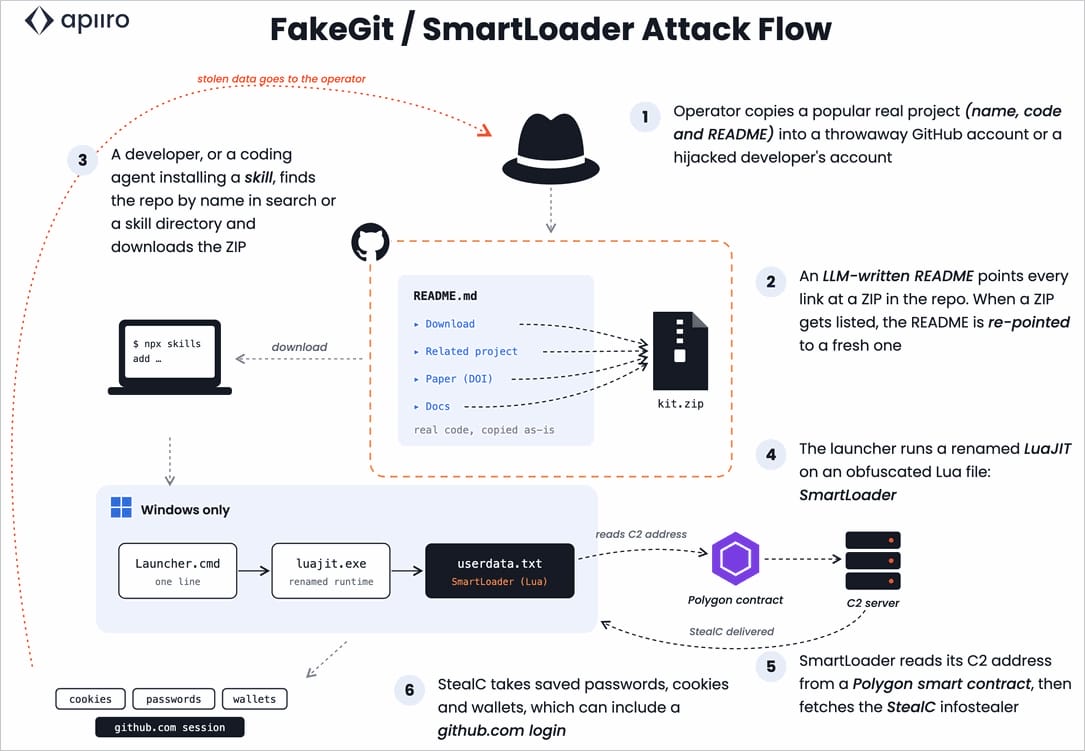
More than 17,000 fake repositories on GitHub are distributing the SmartLoader malware after the FakeGit campaign reactivated earlier this month to push the StealC infostealer.
The operator uses mostly throwaway accounts, but researchers identified at least 700 accounts that appear to belong to legitimate developers.
The malicious repositories use convincing README instructions with a download button pointing to a ZIP archive containing the initial payload, SmartLoader, that is used to distribute other malware.
While similar activity with various payloads has been observed since at least January, the FakeGit term was associated with this operation in July, when researchers at enterprise browser platform Island published a report on 7,600 fake GitHub repositories pushing the SmartLoader malware.
Island noted at the time that 800 of the malicious repositories masqueraded as AI skills or MCP servers that appeared in public AI registries and catalogs.
A new report from researchers at software supply-chain security platform Apiiro says that FakeGit resumed its activity on October 4 and now uses 17,610 repositories on GitHub.
In just 34 hours, FakeGit pushed more than 13,000 repos, peaking at 2,999 an hour.
“In the commits we sampled, 97% touched only the README, and 88% pointed its “Download” button at a ZIP that installs SmartLoader,” Apiiro says.
“Nobody had to create a single new repo. The fleet was already there. It just got re-aimed,” the researchers added.
Source: Apiiro
How FakeGit survived
According to the researchers, the reason behind FakeGit’s survival is that removing repositories is based on lists that cover only a fraction of the malicious repos.
Also, blocklisted payloads and backup copies remain accessible, so attackers can simply change the download links while keeping the same repositories active.
“71% of the fleet was missing from URLhaus before our report, and a domain-level DNS blocklist can’t block one file on GitHub without blocking GitHub,” Apiiro explains.
The researchers found malicious archives in forks, older files, release assets, issue attachments, and separate download-hosting repositories, which makes deleting one link at a time ineffective.
“Delete one file and the operator can point the lure at a spare copy: a fork, an older ZIP, a release asset or an issue attachment,” the researchers said.
Apiiro researchers recommend that users verify the repository’s owner. Furthermore, the source for installing AI skills and MCP servers should be official registries or vendor repositories.
If SmartLoader execution is suspected, users should treat the incident as a potential GitHub account compromise, revoke active sessions and access tokens, and move to passkeys.

Tech & AI
Wikipedia says rogue AI agents from OpenAI edited its private wikis and hammered its servers


Wikimedia Foundation, the organization that hosts Wikipedia and other major wiki-based collaboration projects, is once again clashing with AI companies over their alleged abuse of its servers. In particular, the foundation said that OpenAI was “caught” performing unauthorized operations through its supposedly autonomous, and most certainly “rogue,” AI agents.
Read Entire Article
Source link

Schools across the nation are trying to reduce chronic absentee levels. A recent study from The GRAD Partnership, Everyone Graduates Center and the Partnership for Student Success, finds that small and rural districts are recovering attendance rates faster than larger, more urban and suburban districts.
The study reported that rural districts with fewer than 1,000 students brought their chronic absenteeism back to within 2% of their pre-pandemic baseline by the 2024-25 school year at about twice the rate as urban districts with more than 50,000 students.
While some small and rural districts have bounced back, many districts across the country still have a long way to go to get back to pre-pandemic attendance rates. EdSurge talked with a deputy superintendent, a director of attendance and student supports, and an instructional coach at different districts nationwide to understand how they tackle the issue.
The researchers couldn’t find a clear reason as to why small and rural districts have bounced back quicker. California and Iowa accounted for over 30% of the small and rural districts that bounced back, despite taking two different approaches.
California opted for a larger scale approach, changing its absenteeism and truancy laws and investing more funding in schools’ pandemic recovery statewide. On the other hand, Iowa took the more granular path, offering technical assistance and templates to districts and using data to identify needs and increase attendance.
Finding the connection among the standout bounce-back states and districts is the next central research question, according to the study, which looked at 8,586 school districts across 34 states and the District of Columbia.
A Proactive Approach
At Earlville Community Unit School District 9 in Illinois, School Social Worker Michele Fahrlander uses a proactive program to ensure attendance.
“Because we are a smaller district, we are able to take a more individualized approach,” she says. That means family outreach centers on early intervention and consistent communication.
“We try not to wait until attendance becomes a major concern before reaching out. When we start noticing a pattern of absences or a decline in attendance, we make contact to try to better understand what might be contributing to the student’s absences and how we can support both the student and the family,” she says.
The program helped increase district-wide attendance from 62% in 2022 to 88% in 2026, with high school attendance climbing from 61% to 90%.
“We use several different methods of communication depending on what works best for each family. This might include phone calls, texts, emails, letters, or meetings,” she says. “The frequency of contact really depends on the individual student and their needs.”
For some, a single conversation and some additional support may be enough. For students with more significant or ongoing attendance concerns, “we increase communication and may have regular check-ins with students, attendance meetings, or develop an individualized attendance plan or contract,” she says.
Should a student’s absences increase, “families receive attendance letters at specific thresholds, including after five and 10 days of absence,” she says. “The 10-day letter also communicates the additional documentation requirements for future absences.”
Along with this general approach, “we also focus on creating positive motivation for students to want to attend school,” she said. At the junior high level, for example, Earlville Community Unit School District 9 offers the Not Being Absent (NBA) Attendance Incentive Program. “Students earn points for attendance as part of their homeroom team, which creates some friendly competition and gives students recognition for being at school,” Fahrlander says.
At the high school level, there are quarterly attendance incentive field trips for students who meet the attendance expectations.
“Overall, our goal is to combine positive motivation for all students with more individualized support for students who are at greater risk,” she says. “In a small, rural district, it is often easier to notice when a student starts to struggle with attendance because our staff know the students and families well. A student is not just a name or number on an attendance report.”
Reframe the Messaging
At Moline Coal Valley School District in Illinois, a small district serving about 7,300 students across 15 schools, Deputy Superintendent Brian Prybil focuses on the content of the outreach. He encourages a positive tone, with an eye toward building trust.
“For example, I had one principal who intentionally worked on making personal phone calls to the parents,” he says.
The calls were never scolding. “It was, ‘Hey, hope everything’s going OK. This is what Billy missed today,’ instead of building a punitive type message,” says Prybil, who is also the co-author of “Sixth Essential: A Playbook For School Leaders.”
There are many reasons for absenteeism, some of which schools can help families to address. With that in mind, Prybil says a key message in those calls is, “If you need anything, let us know.”
Teachers can support that effort. “The number one thing for teachers is to build trust with their students,” he says. “Not every day is going to be perfect. But we can invest in getting to know our students and letting them know that we’re all in this together.”
In high school in particular, “it’s really easy to blame kids” for not showing up, he says. But as long as they are present, teachers can “try to be positive with them, try to build that relationship and accomplish what you can accomplish with the time you have with them.”
Automated Routines
Automating the logistics around attendance frees staff to focus on those human conversations.
Chris Miller serves as director of attendance and student support at the North Central Ohio Educational Service, which supports schools in multiple rural districts. Previously, as an assistant principal at a high school, he was in charge of attendance, and it was a logistical nightmare.
“It was difficult to keep up,” he says. “Every day, kids are missing, and your report that you run on Monday, on Tuesday is outdated already. And we’ve got to do it again and again and again.” When manual tracking proved ineffective, he built an app, Attendance K12.
With help from technology, “we’ve curbed the time on figuring out the who, and now we can spend people’s time discussing with families about the why,” he says. “That’s where the rural districts really have an advantage, because those conversations often fall on the ears of people who are familiar with [school staff].”
Teachers play a key role: Technology can help to track and manage absenteeism, but educators are the front line of remediation.
Rather than just focusing on missed work when a kid returns to class, teachers should be focused on “creating an environment that is welcoming when they return,” he says. “By creating that space that feels comfortable, it eliminates some of that return-to-school anxiety that sometimes builds when they start stacking absences.”
Coordinating a Strategic Effort
At Stanfield Elementary School in rural North Carolina, instructional coach Jessica Dunn approaches attendance response as a coordinated endeavor.
Rather than one person handling it alone, “we’re involving administration, the counselor, the social worker,” she says, with those efforts based on timely reports from a data manager. “We do it as a team, truthfully.”
When the team goes into action, it focuses on addressing the factors that cause absenteeism in the first place. For example, the team sends home bags of food that a church partner provides. “That alleviates that stress for them, and our counselor does a great job of getting those bags out,” she says. With one less thing to worry about, “they can focus on getting the kids here.”
While attendance is always hard to manage, Dunn believes the nature of a rural community makes all this a little easier. Teachers, counselors, and administrators “know everybody, they can connect to them,” she says. In a rural community, or a small school, keeping attendance up “is all about support, connection, and relationships.”
Elon Musk has questioned the influence of Indian billionaire Mukesh Ambani as SpaceX struggles to launch its Starlink satellite internet service in the country. Musk’s comments, which were posted on X, escalate a dispute over regulatory delays after the Indian government rejected his claims that powerful business interests were blocking its entry.
Musk accused on Wednesday unnamed “oligarchs” of blocking Starlink’s launch in India to maintain what he called their “monopolistic chokehold” on the country, without identifying them or providing evidence for his claim. He called the alleged blocking a “crime against the people of India” and argued that Starlink could bring affordable, high-speed internet to people who lack internet access.
Hours later, India’s Ministry of Communications pushed back, saying its regulatory framework for satellite communications is “fair and non-discriminatory.” The ministry said in a statement that Starlink and two other licensed satellite operators are all at “broadly the same regulatory stage.” It added that all three companies are undergoing security assessments that must be completed before they can seek spectrum, the radio frequencies that satellites use to send signals.
Musk went further on Thursday, questioning the influence of Reliance Industries chairperson Mukesh Ambani.
”Is Ambani the real boss of India?” he wrote on X, after claiming that Starlink had spent years complying with Indian regulations and questioning why it still lacked a license.
Starlink has spent more than five years trying to enter India, a market with more than a billion internet subscribers. But it has yet to begin commercial services despite securing key regulatory approvals and partnering with telecom giants Reliance Jio and Bharti Airtel last year. SpaceX has also set up a local team as it prepares for a launch, appointing former Payoneer executive Prabhakar Jayakumar to lead its India operations in December.
Musk’s comments came hours after Lauren Dreyer, Starlink’s vice president of business operations, appeared at India Mobile Congress, a telecom industry conference in New Delhi and reiterated the company’s commitment to the market.
“We stand ready to serve India,” Dreyer said, adding that Starlink wants to help realize Prime Minister Narendra Modi’s goal of achieving universal connectivity across the country.
Starlink said it already has more than 20 gateway sites (the ground stations that link its satellites to the internet) and hundreds of antennas on the ground in India, and has adapted its operations to meet the country’s regulatory, security, and data-sovereignty requirements. Moreover, SpaceX has positioned its satellite network as a complement to — rather than a replacement for — India’s terrestrial telecom networks.
SpaceX first attempted to launch Starlink in India in 2021. The company, however, had to refund preorders for its equipment in early 2022 after the Indian government called it out for “booking/rendering the satellite internet service” before getting the necessary licenses.
Starlink has also previously clashed with India’s largest telecom operators over how satellite spectrum should be allocated. Starlink pushed for spectrum to be assigned administratively, while Reliance Jio argued that it should be auctioned — a position that could have made Starlink’s entry more expensive. India ultimately sided with Starlink’s preferred approach, deciding to allocate satellite spectrum administratively rather than through an auction.
Jio and Airtel, India’s two biggest telcom operators, are also pursuing their own satellite internet services, even as they have agreed to distribute Starlink in India. Jio is working with satellite operator SES on satellite broadband, while Airtel is a major backer of Eutelsat OneWeb, another licensed satellite operator in India.
While the timing of Starlink’s India launch remains unclear, the company this week launched Starlink Mobile, which connects ordinary phones to satellites, in neighboring Bangladesh.
Starlink, India’s Ministry of Communications, Reliance Jio, and Bharti Airtel did not immediately respond to requests for comment.
Update: This article was originally published at 11:14 p.m. PDT and has since been updated to include Musk’s comments questioning Reliance Industries chairperson Mukesh Ambani’s influence in India.
When you purchase through links in our articles, we may earn a small commission. This doesn’t affect our editorial independence.


The company employs more than 2,000 in its Dublin tech hub.
Mastercard is opening a second office at its Leopardstown campus tech hub in Dublin alongside announcing a number of commitments to expand its payments infrastructure in Europe.
The new building was officially opened today (8 October) by Taoiseach Micheál Martin, TD. It comes two decades after the company first established a base in the country. Since 2008, Mastercard’s workforce has grown from 36 to more than 2,000 in Dublin.
Mastercard is also committing to expand critical payments operations in Europe, with plans to bring in all components of local transactions into Europe by 2030. It already processes domestic transactions in France, Germany and Spain through its new European infrastructure.
The payments giant also said that all new Mastercard European credit and debit cards issued from next year will support offline payments.
A number of European countries, including Finland, Sweden, Norway, Denmark and Estonia, are rolling out offline payments in the region in response to heightened geopolitical tensions in the region as banks act to ensure payment infrastructure continues to work in case of an internet blackout.
“The opening of Mastercard’s new office is a strong endorsement of Ireland’s reputation as a leading location for innovation, technology and digital transformation,” said Taoiseach Martin.
“Mastercard has played a key role in shaping the future of payments and financial technology globally, and its continued expansion in Ireland highlights the strength of our talented workforce, pro-business environment and vibrant technology ecosystem.
“I warmly welcome this investment and look forward to seeing Mastercard continue to innovate and grow from its Irish base in the years ahead.”
Ed McLaughlin, the president and chief technology officer at Mastercard added: “From AI and cybersecurity to next-generation payments infrastructure that brings greater resilience and speed to commerce, the work happening here is helping build the future.
“This expansion of our European tech hub reflects the growth of our teams in Dublin, our confidence in Ireland’s talent, and our ambitions for the years ahead.”
Don’t miss out on the knowledge you need to succeed. Sign up for the Daily Brief, Silicon Republic’s digest of need-to-know sci-tech news.
If you entered your password on a phishing site, treat that password as exposed even if you have not seen any suspicious activity yet. Leave the fake page, open the real service independently, and secure the account before checking what else may have been affected.
Quick Take
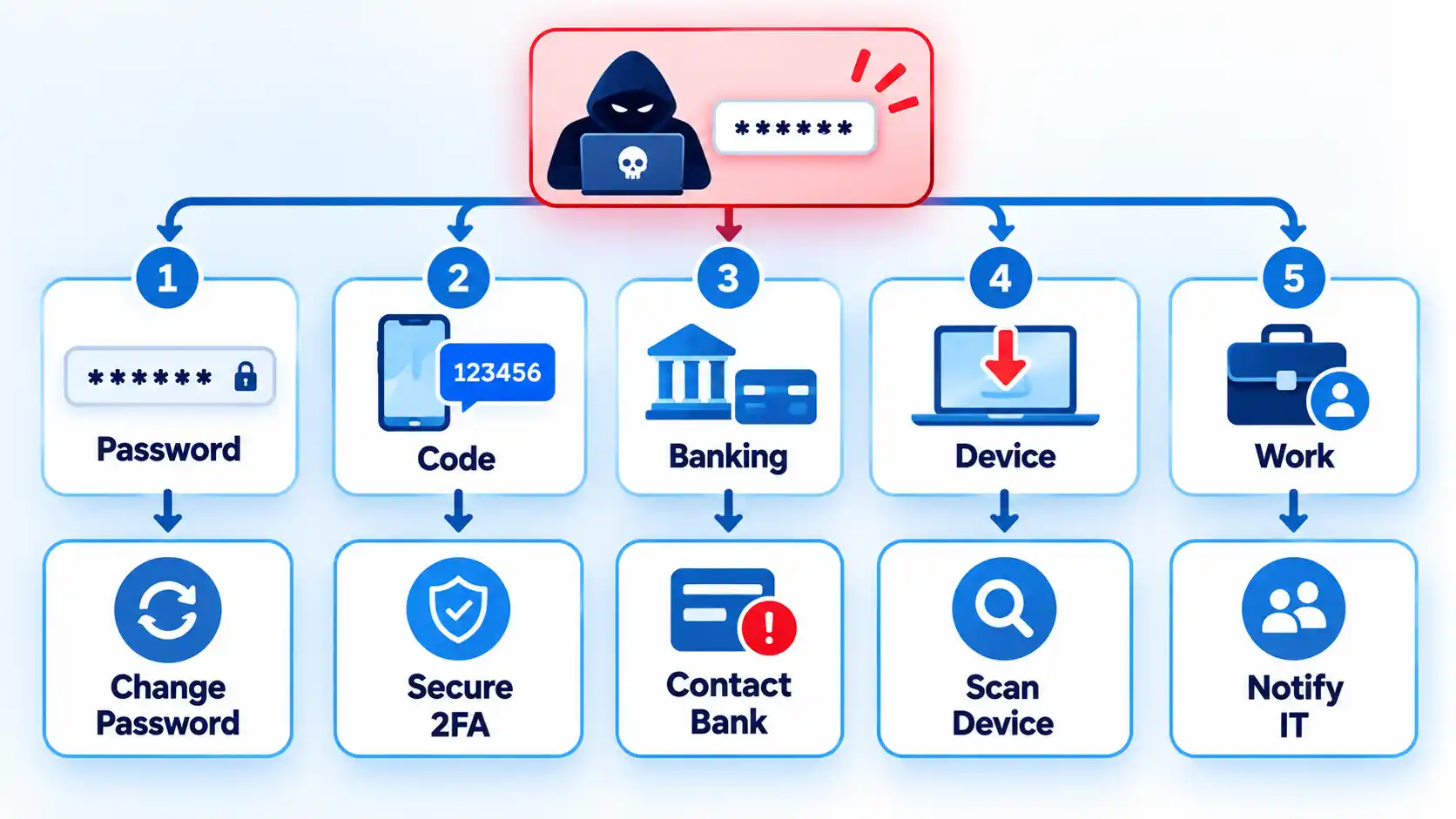
Change the exposed password through the real service, replace the same password anywhere else you used it, end unfamiliar sessions where the service allows it, check recovery details, and enable two-factor authentication. If you are already locked out, use the provider’s official account-recovery process instead.
What to Do After Entering Your Password on a Phishing Site
Start with the account whose password you entered. The exact menus differ between services, so use the provider’s real website or app rather than returning through the phishing message or page.
If you also installed suspicious software, gave someone remote access to the device, or followed instructions that may have compromised the device itself, deal with that device exposure before relying on it for sensitive account recovery. The FTC’s response for computer or phone access puts security-software updates and a scan before password changes.
Warning
Do not go back to the phishing page to change your password, confirm your identity, enter another code, or follow a supposed security link. Reach the real service independently.
- Leave the phishing page and open the real service. Close the suspicious page or message. Open the service from an app you already trust, a saved bookmark you know is genuine, or an address you verify independently. This prevents the attacker from collecting another password or verification code while you try to recover.
- Change the password if you can still sign in. Create a new password that you have not used on another account. We advises people who gave a scammer their account credentials and can still log in to replace the compromised password. Do not simply add a character to the exposed password or switch back to an older password that you have used before.
- Use official account recovery if you are locked out. If the real password no longer works, or the recovery phone number or email has been changed, use the provider’s own account-recovery process. Google, for example, directs users to its account recovery process if someone changed the password or recovery phone number, or if the user cannot sign in for another reason.
- Replace the same password on your other accounts. Password reuse turns one exposed credential into a risk for several services. We specifically advises changing the password on any other account where you used the same password. Prioritize your primary email and other important accounts because access to one service can sometimes help an attacker reach others.
- End sessions you do not trust. Many services provide a security page showing signed-in devices or active sessions. Review the controls your provider offers and remove access you do not recognize. Google, for example, lets users inspect recently signed-in devices and sign out unfamiliar devices or sessions. Changing a password and signing out active sessions address different routes an attacker may use to remain connected.
- Check your recovery information and account settings. Confirm that recovery email addresses, phone numbers, and other recovery methods still belong to you. If the affected account is email, also inspect forwarding rules and filters for settings you did not create. I will recommend checking recovery information after regaining control and removing email-forwarding rules you did not set up.
- Turn on two-factor authentication. Two-factor authentication, often shortened to 2FA, means the account requires two different kinds of proof when you sign in rather than relying on the password alone. The FTC notes that even someone who knows the username and password cannot complete a protected sign-in without the second authentication factor. Use a method the service supports and that you can recover safely if you lose your usual device.
Check for Signs the Account Was Used
Typing a password into a phishing page makes that password unsafe, but it does not by itself prove that the attacker successfully signed in. After securing the credential, look for evidence that somebody actually used the account.
- Unfamiliar devices or sessions: review the provider’s security or sign-in activity for devices, browsers, or sessions you do not recognize. Check the surrounding details before removing access because one physical device can sometimes create more than one session.
- Unexpected security alerts: look for notices about sign-ins, password resets, new devices, recovery changes, or other security events you did not initiate.
- Changed recovery details: confirm that recovery phone numbers, email addresses, security methods, and similar account controls still belong to you.
- Messages or posts you did not send: check sent mail, social-media messages, posts, and other outgoing activity. Unauthorized messages are a practical sign that someone may have used the account.
- Email forwarding or filtering you did not create: an attacker with email access may create rules that forward messages elsewhere or hide security and password-reset emails from your normal inbox.
- Purchases or service activity you do not recognize: check account-specific history where relevant, such as orders, subscriptions, payment activity, cloud files, or profile changes.
Google’s device history is one example of why account activity needs context: several sessions can belong to the same device, so inspect the details before deciding whether an entry is unfamiliar. If you find unauthorized activity, follow the provider’s security or recovery process and remove access where that control is available.
Broader signs that someone logged into your account can include security-setting changes, unfamiliar devices, and actions performed without your permission. If you need to investigate beyond the affected account, these signs your data has been compromised provide a wider audit of account, email, financial, and breach indicators.
What If You Shared More Than a Password?
A phishing incident can collect more than one type of information. Do not automatically perform every recovery action below. Identify what the site actually received or what you did on the device, then follow the matching branch.
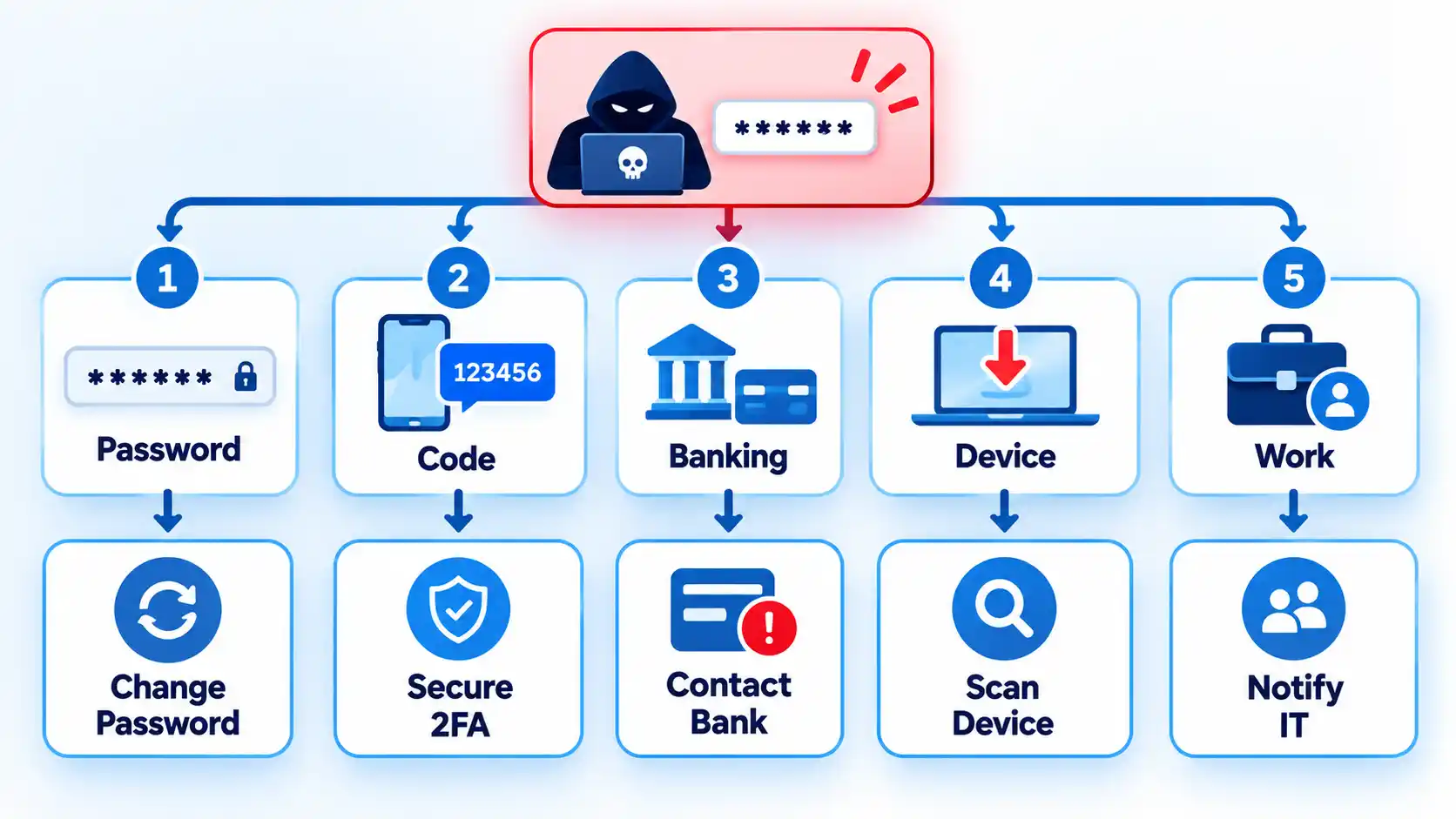
| What was exposed | What it changes | First response |
|---|---|---|
| Password only | The password may be used against that account or other accounts where you reused it. | Complete the account-recovery procedure above, including password replacement, session review, recovery checks, and stronger authentication. |
| One-time code or sign-in approval | The attacker may have obtained the additional proof needed for a sign-in or another protected account action. | Review recent security activity immediately, remove unfamiliar access where possible, and use the provider’s recovery or security process if you see activity you did not authorize. If you shared a phishing verification code, do not assume that changing the password alone reverses whatever the code may have authorized. |
| Bank or card details | The incident may also involve financial fraud rather than only account access. | Contact the bank immediately through a channel you obtain independently from the phishing message or page. |
| Government ID or other identity document | An identity document cannot be protected by changing an online password. | If you uploaded an ID to a scam website, preserve evidence and follow the document-specific recovery steps for the ID and any other information the site received. |
| Downloaded file, installed software, or device access | The device itself may be at risk in addition to the account. | If you installed suspicious software or gave someone access to the device, update trusted security software and run a scan before relying on the device for further sensitive work. I recommend scanning a computer or phone after giving a scammer access. These steps for situations where you downloaded or ran suspicious software cover the broader malware response. |
| Work or school account or device | The incident may affect organization-managed email, files, applications, or other resources as well as the individual account. | If the phishing happened on a work device, contact the organization’s IT team and explain what happened. Also follow your employer’s or school’s incident-reporting process when one exists. |
A password-only incident does not automatically mean your device has malware, your bank details were stolen, or your identity documents were exposed. The response should expand only when the phishing interaction or later evidence shows another type of exposure.
How to Know the Account Is Secure Again
The immediate account-recovery phase is complete when you have addressed the realistic routes an attacker could still use. That does not prove nobody viewed or copied information while the password was exposed.
Verify the result
- The affected account now uses a new password that is not reused on another service.
- Every active account that used the exposed password has been changed or otherwise secured.
- You can access the genuine account normally, or you have entered the provider’s official recovery process if access has not yet been restored.
- Recovery email addresses, phone numbers, and other recovery methods are yours and have not been replaced by unfamiliar details.
- Unfamiliar sessions or devices have been signed out where the provider gives you that control.
- Unauthorized forwarding rules, filters, messages, posts, or other account changes found during your review have been removed or corrected.
- Two-factor authentication is enabled where the account supports it, and you can still access the recovery method for that second factor.
- If the incident also involved suspicious software or device access, that device has entered the appropriate scan or remediation process before you rely on it for sensitive activity.
- Any other exposure, such as banking information, an ID document, a verification code, or work credentials, has moved into its appropriate recovery process.
Continue watching security notifications and account activity after the immediate cleanup. If new unauthorized activity appears, use the provider’s official security or account-recovery process rather than returning to the phishing message.


Thousands of residents in Homer, Alaska had no idea the clouds above their homes were being seeded this past August. A San Francisco start-up called Rainmaker had quietly sent cloud seeding drones into the sky, dispersing a silver compound meant to trigger precipitation, and claims the three-hour operation produced 19 million US gallons of water. Most locals only found out after the fact.
The episode has become a flashpoint in a debate that is unfolding across more than 50 countries now experimenting with weather modification: can technology meaningfully ease water shortages, and should companies be allowed to alter the sky over people’s homes without clearly telling them first?
How Cloud Seeding Drones Work
Cloud seeding itself is not new. The technique dates back to 1946, when scientists at General Electric’s research laboratory first used dry ice to coax rain from clouds. Silver iodide followed a year later and proved far more effective, since dry ice evaporates into gas too quickly to be useful. The chemistry speeds up a natural process: compounds dispersed into a cloud form ice crystals, which grow heavy enough to fall as rain or snow once gravity takes hold.

What has changed is the delivery method. Instead of relying solely on piloted aircraft, companies like Rainmaker now use autonomous cloud seeding drones to fly directly into storm systems, releasing silver iodide flares that burn and atomize water particles so they stay suspended in freezing air long enough to form crystals. Rainmaker founder and CEO Augustus Doricko says each flight releases just 20 grams of silver, spread across thousands of square kilometres, resulting in ground concentrations he describes as “parts per quadrillion” — far below thresholds set by the US Food and Drug Administration.
The drones give operators a more surgical approach than older methods. “They offer a more targeted nature to these clouds we hope will be responsive,” says Jon Meyer, an assistant state climatologist at the Utah Climate Center, who has watched the technology evolve from a niche academic curiosity into a growing commercial sector. Rainmaker already operates across Idaho, Utah, Colorado and parts of the Middle East, including Jordan, where Doricko says chronic water scarcity leaves residents with utility water only a few hours a week.
Modest Gains, Bigger Questions
Even enthusiasts concede that cloud seeding drones are no silver bullet. Meyer notes that under ideal conditions, seeding might squeeze out an extra 5 to 10 percent of precipitation — a meaningful boost in drought-stricken regions, but nowhere near enough to manufacture a downpour from clear skies. Rainmaker’s own Alaska results illustrate the limits: 19 million gallons sounds dramatic, but spread across 100 square miles it amounts to roughly 0.01 inch of rain.
A 2017 study using radar and precipitation gauges offered some of the first solid evidence that silver iodide seeding behaves as scientists predicted, lending credibility to a field that had long struggled to prove its effectiveness. That research, combined with advances in drone technology, has helped fuel a wave of new start-ups chasing contracts from governments and utilities desperate for more reliable water supplies.
But not everyone is convinced the benefits outweigh the risks. Cooper Freeman, Alaska director of the Center for Biological Diversity, says he’s troubled that Homer residents were not clearly warned before the Rainmaker operation, and he questions whether anyone tracked what happened to the silver iodide after it fell. “It doesn’t appear that there was any downstream monitoring to verify that this silver iodide didn’t impact the environment,” he says. He also worries that pouring money into cloud seeding drones distracts from the harder, less glamorous work of conserving water in the first place. “Having a company come in to do this seeding isn’t going to solve our water woes,” Freeman argues.
A Thirsty Planet, A Growing Industry
The stakes behind this debate are considerable. United Nations Secretary-General António Guterres warned in July that the world is using freshwater faster than it can be replenished, and separate research has found the past five years to be the driest stretch for global rivers in more than three decades. Against that backdrop, it’s little surprise that governments from the American West to the Middle East are willing to experiment with any technology that might coax a bit more rain from the sky.
Some companies are even rethinking the chemistry involved. Recast Systems, another San Francisco venture, is testing a protein-based alternative to silver iodide, hoping to sidestep environmental concerns altogether while still triggering ice formation inside clouds.
Whether cloud seeding drones ultimately become a serious tool against water scarcity or remain a marginal, controversial experiment likely depends on two things: whether the modest rainfall gains prove worth the cost and regulatory headache, and whether companies can convince both scientists and the public that what they’re spraying into the sky is genuinely safe. For now, residents like those in Homer are left asking a more basic question — not whether the technology works, but whether anyone plans to tell them before it’s used over their heads again.
Sources:
Explore more on this topic with Vexel Search.

Google has released Chrome 155 with support for decoding JPEG XL images, a format that offers 30-50% better compression than JPEG along with lossless compression, JPEG transcoding, HDR, animation, and progressive decoding. From a blog post: We expect that JPEG XL is most helpful for high-fidelity or lossless compression, especially of photographic images or in cases in which fine-grained progressive decoding is preferred. In this post, we share why we brought JPEG XL to Chrome, how we used Rust to ensure memory safety first, the extensive performance work that makes it fast, and what the journey tells us about developer feedback and the web standards ecosystem.
[…] With JPEG XL officially landing in Chrome, the web becomes faster, richer, and safer. We encourage developers, content creators, and platform owners to start using .jxl images and animations in their pipelines. Try it out, file bugs, and help us continue building a faster and safer web for everyone.


Read more of this story at Slashdot.

For decades, Bose has been viewed by much of the audiophile world as a consumer electronics company operating outside the traditional high-end audio establishment. That description is becoming increasingly outdated. Its acquisition of McIntosh Group, along with continued expansion into automotive, immersive, and software-driven audio, suggests Bose is building a much broader audio technology business.
The latest move is the acquisition of Firelight Technologies, the Melbourne-based company behind FMOD. Financial terms were not disclosed, but Bose confirmed that Firelight will become part of its Audio Technology business while FMOD remains available to its existing customers and development community.

FMOD operates well below the level where most consumers encounter audio. Developers, sound designers, and composers use it to create sound that responds dynamically to events inside games and other interactive environments.
Unlike recorded music, which largely unfolds as mastered, interactive audio must react instantly as a player moves through a space, accelerates a car, fires a weapon, or triggers any number of events. FMOD integrates with Unity, Unreal Engine, custom game engines, consoles, computers, mobile devices, and web applications.
Bose is therefore not simply buying another audio technology company. It is acquiring software that helps determine how sound behaves inside virtual spaces. Gaming is the immediate opportunity, but Bose has also pointed to potential applications in VR/AR, automotive, and other real-time environments.
Related Reading:
The StreamUnlimited Deal Makes More Sense Now

Three months before buying Firelight, Bose acquired StreamUnlimited Engineering, a Vienna-based company that develops network-audio software, hardware modules, streaming technologies, certification tools, and other infrastructure used by consumer-electronics manufacturers.
That deal received far less attention outside the industry, but strategically it may be just as important.
Bose said StreamUnlimited would continue serving existing customers while helping the company expand its access to streaming technologies, services, and capabilities. Its solutions would also remain interoperable with third-party products and ecosystems rather than being locked inside Bose hardware.
Put the two acquisitions beside one another and an interesting picture starts to emerge.
StreamUnlimited provides connected-audio infrastructure. FMOD provides interactive-audio infrastructure. Bose already has decades of DSP and acoustic research, a substantial consumer-audio business, automotive relationships, and ownership of McIntosh and Sonus faber.
The company no longer needs every Bose technology to arrive inside a product carrying a Bose badge.
That may ultimately be the most consequential shift.
McIntosh & Sonus faber Changed the Conversation
Bose’s November 2024 acquisition of McIntosh Group, parent company of McIntosh Laboratory and Sonus faber, was the deal that forced the traditional high-end industry to pay attention.

McIntosh and Sonus faber occupy territory that Bose historically did not. McIntosh sells massive amplifiers, preamplifiers, source components, and systems whose blue meters have become symbols of American high-end audio. Sonus faber builds Italian loudspeakers that can involve wood, leather, carbon fiber, and enough artisanal craftsmanship to make assembling a Bluetooth speaker feel rather pedestrian.
Bose acquired both without attempting to turn either into Bose.
At the time, Bose said McIntosh and Sonus faber would continue concentrating on their established high-end categories while the companies explored opportunities together in the home, on the go, and in the car. Bose also specifically highlighted automotive as an area where its four decades of experience could complement the luxury brands.
That was important. Bose did not need to persuade traditional audiophiles that a $30,000 loudspeaker with its own logo was suddenly desirable. It bought two brands whose credibility in that market had already been established over generations.
Some audiophiles reacted as if Taco Bell had purchased Le Bernardin.
Nearly two years later, there is little evidence that Bose has hampered either company’s ability to innovate. If anything, both brands have continued behaving very much like themselves.
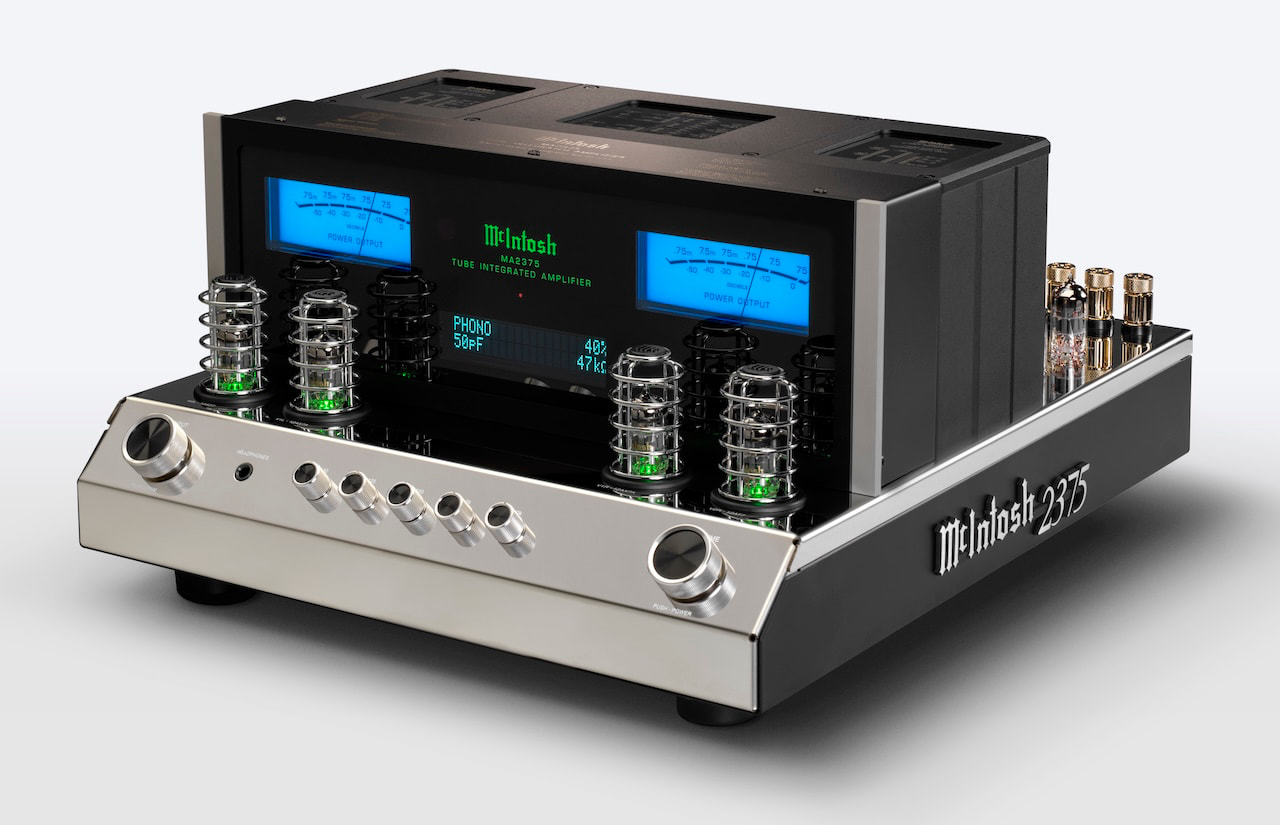
In 2026, McIntosh introduced the $15,000 MA2375, an unapologetically old-school, all-analog vacuum tube integrated amplifier with KT88 output tubes, Unity Coupled Circuit output transformers, MM/MC phono stages, and the blue meters that have been glowing in Binghamton for generations.
A few months later, it introduce the $12,500 CS7500 Streaming Preamplifier, combining McIntosh preamplification with Qobuz, Spotify, TIDAL, AirPlay, Google Cast, Roon, HDMI ARC, and high-resolution digital playback.
Sonus faber has hardly been sitting around waiting for instructions from Massachusetts either. Its new Olympica G3 Collection incorporates technology derived from the $750,000 Suprema, including the Camelia midrange driver, cork-damped internal chambers, redesigned woofers, and revised crossover networks, while retaining the wood, leather, asymmetrical cabinets, and Italian craftsmanship that define the brand.
The five-model range stretches from stereo listening into dedicated home theater applications without turning Sonus faber into something unrecognizable.
Whatever concerns surrounded the Bose acquisition in 2024, the evidence so far suggests that Bose understood the value of leaving both companies enough room to remain themselves.
The Car May Be Where Many of These Pieces Meet
Bose has worked in automotive audio since the early 1980s, and its current automotive business extends far beyond installing a branded amplifier and some door speakers.

The company has been developing SeatCentric technologies that can create different listening experiences for individual passengers, position navigation and safety alerts spatially, isolate telephone calls, manipulate perceived sound locations, and actively reduce unwanted audio in specific areas of a vehicle.
Its CES demonstrations have included Dolby Atmos, Perceptual Sound Rendering, individualized listening zones, UltraNearfield speakers, and 3D audio without conventional overhead speaker arrays. Bose has also integrated its audio processing directly into Qualcomm’s Snapdragon Digital Chassis, allowing automakers to run Bose tuning on the vehicle’s central computing platform rather than requiring a dedicated Bose DSP.
That last development deserves more attention.
The automobile is rapidly becoming a software-defined environment. Music, navigation, phone calls, safety alerts, voice assistants, entertainment, engine-sound synthesis, active noise cancellation, gaming, and potentially augmented reality increasingly share the same computing infrastructure.
FMOD specializes in audio that reacts to events in real time.
You can probably see why Bose might find that interesting.
There is no announced Bose-FMOD automotive product, and connecting those dots should not be confused with reporting one. But Bose already talks about interactive cabin experiences where sound changes according to passenger location, vehicle information, and surrounding conditions. FMOD comes from a world where responsive audio is the entire point.
The overlap is difficult to ignore.
QuietComfort Is Still Extremely Important

All of this could make it sound as though Bose has lost interest in selling headphones.
It has not.
The QuietComfort franchise remains one of Bose’s most powerful consumer businesses, and the company continues investing in adaptive ANC, immersive audio, personalization, voice pickup, and spatial processing. Its QuietComfort Ultra Earbuds (2nd Gen), for example, retained the company’s CustomTune system while adding improved adaptive noise cancellation, voice pickup, and wireless charging.
Bose’s expertise in noise cancellation may actually be more strategically valuable today than when the technology was primarily used to make an airplane cabin tolerable.
Noise control, individualized audio, spatial rendering, and perceptual processing increasingly apply across headphones, vehicles, AR/VR environments, gaming, and smart spaces. A company capable of moving those technologies between categories does not need to win every market with the same physical product.
The QuietComfort headphones are the consumer-facing part most people know.
The intellectual property underneath them is where things get interesting.
And Then There Is Home Theater

Bose also remains a major participant in soundbars and home entertainment, another category increasingly defined by software rather than the number of drivers somebody managed to cram into an enclosure.
Dolby Atmos, virtualized height information, room adaptation, dialogue enhancement, psychoacoustic processing, and sound-field manipulation all require expertise in making listeners perceive sound in places where a physical loudspeaker may not exist.
Gaming and VR present variations of the same fundamental problem. So does automotive.
That does not mean Bose will merge its soundbar, automotive, and FMOD engineering teams into some giant spatial-audio Voltron next Tuesday. It means the company has accumulated expertise in several businesses where software determines what the listener perceives as much as the transducer does.
The walls between those businesses are getting thinner.
Bose Is Building More Than Products
The more interesting conclusion is that Bose increasingly operates across multiple layers of the audio business rather than simply manufacturing products. Its recent acquisitions give it deeper involvement in connected audio, interactive sound, luxury hi-fi, and automotive, but the company has also started moving upstream into music itself.
In 2026, Bose launched Bose Studios and Bose Records, with plans to work with emerging and underrecognized artists while developing original music, video, podcasts, live events, and other content. Bose has said it does not intend to own artists’ masters or take a share of their streaming and record sales, making the initiative less of a conventional record-label play than another way for the company to participate in the music ecosystem.
Automotive extends that reach further. Bose already works directly with major vehicle manufacturers, while its integration with Qualcomm’s Snapdragon Digital Chassis allows Bose audio processing to run directly on the vehicle’s Snapdragon Cockpit Platform rather than requiring a dedicated Bose DSP inside an amplifier.
Taken together, Bose now has potential involvement in how audio is created, distributed, processed, personalized, and ultimately reproduced — even when Bose did not manufacture the headphones or loudspeakers through which someone hears it.
That is a very different business from selling Wave Radios.
Perhaps Audiophiles Need to Update Their Opinion of Bose
Bose has spent decades occupying an awkward place in audiophile culture.
Its products became enormously popular, which in certain corners of high-end audio is apparently grounds for suspicion. The company’s willingness to use DSP, psychoacoustics, compact enclosures, and unconventional engineering also did not always endear it to a community that can become emotionally attached to technologies whose greatest innovation occurred before the first moon landing.
You do not have to love every Bose product to recognize how outdated that dismissal has become.
This is a company that owns McIntosh and Sonus faber, controls one of gaming’s important interactive-audio platforms, owns a major connected-audio engineering operation, remains deeply embedded in automotive, and continues to compete near the top of the global ANC headphone market.
Other audio companies may have stronger credibility in individual categories.
Very few now cover this many categories at once. And fewer still possess technologies capable of moving between them.
What Could Bose Be Planning?

The temptation is to imagine one enormous Bose ecosystem connecting McIntosh amplifiers, Sonus faber loudspeakers, QuietComfort headphones, FMOD gaming audio, automotive systems, and StreamUnlimited software.
There is currently no evidence Bose intends to build that, and it may not need to.
The more plausible strategy is also potentially more powerful: own important audio technologies across multiple markets and allow them to reinforce one another without forcing everything into a single consumer platform. FMOD can continue serving game developers. StreamUnlimited can continue working with outside manufacturers. McIntosh can remain McIntosh, while Sonus faber can keep building loudspeakers in Italy that look considerably nicer than most people’s furniture.
What Bose gains is optionality. Interactive audio developed for games could influence immersive automotive experiences. Automotive personalization could inform future headphones or AR products. Streaming infrastructure can support connected products across multiple brands, while Bose’s DSP, ANC, and psychoacoustic expertise can migrate almost anywhere that microphones and speakers coexist.
Not every piece needs to connect directly for the collection to become valuable. Bose increasingly has a position in how sound is created, processed, distributed, personalized, and reproduced across the home, the car, headphones, games, and other interactive environments. That is a considerably larger ambition than selling more speakers with a Bose logo on the front.
The Firelight acquisition pushes Bose even further beyond the traditional definition of an audio manufacturer. The company appears to be positioning itself for a future in which the most influential audio businesses will not merely build excellent speakers or headphones; they will control important pieces of the software, signal processing, connectivity, content, personalization, and hardware required to deliver sound wherever people happen to be listening.
Audiophiles are free to keep making jokes about the 901.
Godzilla does not generally stop walking because the villagers are laughing.
Related Reading:

Sports20 minutes ago
Asiad selection row: Para-shooters allege corruption; PCI denies claims | Asian Games 2026

Entertainment26 minutes ago
10 Flawless Movies With the Cleverest Protagonists

Tech & AI51 minutes ago
9 restaurants left, central kitchen shut, & 120 jobs gone


-

 Fashion6 days ago
Weekend Open Thread: Veronica Beard
-

 Tech & AI3 days ago
Common Mistakes You Should Avoid When Using Foldable Phones
-
 Tech & AI6 days ago
Fireflies.ai Launches Fireflies Talk for Free, Unlimited Voice Dictation
-

 Tech & AI6 days ago
Excellent hardware badly hampered by too-small SSD
-

 Crypto7 days ago
NEAR Intents hacked days after freezing stolen Bitget funds
-

 Tech & AI7 days ago
Whatever AI Safety Is, It’s Not This
-

 Tech & AI6 days ago
Mystery AMD Chip “Gainsborough” Fuels Steam Deck 2 Speculation — But Don’t Get Too Excited Yet
-

 Tech & AI7 days ago
Can Schools Trust AI Features in Edtech Products?
-

 Sports12 hours ago
Saracens’ Venter Brands Premiership Rugby ‘Autocratic’ Over £5,000 Media Fine
-

 Gaming6 days ago
Reigns Studio Nerial Shuts Down as Founders Step Back “To Our Roots”
-

 Tech & AI6 days ago
Sony’s new PS5 Pro lottery requires 60 hours of playtime just to apply
-

 Tech & AI5 days ago
Koreans Left With Spoiled Food Due To Borked Samsung Firmware Update For ‘Smart’ Fridges
-
 Crypto7 days ago
Bitcoin edges higher ahead of U.S. jobs report as global bond yields surge
-

 Entertainment6 days ago
Russo Brothers Tease Very Surprising Ending for Avengers: Doomsday
-

 Business & Hustles5 days ago
Beyond Ozempic: Lilly and Novo Chase the Next Obesity Blockbuster With Amylin
-

 Entertainment6 days ago
From Horror Reboots to Soul Reinventions: This Week’s Entertainment Headlines
-

 Tech & AI5 days ago
Muse Creates Detailed Profiles of All Your Friends and Family
-
Tech & AI7 days ago
CDC Opens Up COVID Vaccine Procurement Without Explanation
-

 Gaming5 days ago
Sony’s Late-Stage Listening Tour on Physical Games Raises More Questions Than It Answers
-

 Tech & AI5 days ago
Apple Clamps Down on Mac Privacy Setting as AI Agents Raise New Security Fears
You must be logged in to post a comment Login