
Sports
Frost’s dominance shows Flames the danger of trading him


CALGARY — There are games when Morgan Frost makes you believe again.
Games when the hands, the feet, the speed, the creativity all sync up and you suddenly remember why he went 27th overall.
Why he was once viewed as a core piece in Philadelphia.
Why coaches rave about his potential. Why GMs convince themselves he’s just one stretch away from breaking out for good.
Saturday was one of those games.
In the Flames’ 3-2 win over San Jose, a badly needed morale-booster after five-straight losses, Frost wasn’t just noticeable. He was the best player on the ice. First star. Game‑tilter.
The kind of centre you build around, not shop around.
A goal. An assist. Five shots on goal. Ten shot attempts. Two penalties drawn. A dangle around Mario Ferraro that drew gasps.
And, maybe most impressively, a 15‑for‑18 night in the faceoff circle, the very area he set a personal goal to improve this season.
“Today, that’s the best I’ve seen him play since he’s been with us,” said Flames coach Ryan Huska.
“The faceoff circle. He had pace to his game. He was setting people up. He’s scoring goals. If you get that version of Morgan Frost every day, I think you’re pretty happy.”
That version is why it’s dangerous to even think about trading him.
But the other version — the one that disappears, the one that stops moving his feet — is why the Flames have to at least listen.
Frost is the kind of player who can drive a coach crazy.
When he’s on, he looks like a second‑line centre for the next decade. When he’s off, he’s pedestrian.
“Yeah, 100 per cent,” said Huska when asked if the key to Frost’s success is using his speed.
“He tries to play through people standing still. And when you play that way, you’re an easy guy to play against. But when he’s moving and he’s got some grit to his game… he’s a really good player.”
That’s the Frost paradox.
He can be elite. He can be invisible.
He can be a foundational piece. He can be a trade chip.
With the organization prioritizing its youth movement, no one is being pushed out the door, but no one is untouchable either.
A 26-year-old centre with upside is valuable, especially in an organization devoid of them.
A centre with inconsistency is movable.
On Saturday, Frost didn’t just score. He didn’t just create. He didn’t just flash.
Playing between Matvei Gridin and Jonathan Huberdeau, it was Frost’s slick setup that sprung Gridin for a game-tying tally the rookie called his first “real” NHL goal.
It was Frost’s pace that forced the Sharks into mistakes. It was Frost’s confidence that allowed him to try that outrageous move around Ferraro, and prompted Huska to put him on the ice just to take the faceoff that led to Joel Farabee’s game-winning shorthanded snipe.
“I think I was moving my feet,” said Frost, who banged in a power-play goal late in the first to tie the game 1-1.
“It gets talked to me about every day, and I think I did a good job today. When I’m feeling confident, that’s when I can start to be a little more creative and do some of the things that I know I can.”
To Frost’s credit, he’s not delusional about his inconsistency.
“I was definitely going through a rough stretch there before,” he said. “That’s always been the thing with me, keeping it going for a long stretch of time.”
He knows the book on him, and he knows the solution.
One area where Frost has made undeniable progress is the dot.
His goal entering the season was to get above 53 per cent – a lofty target for a guy who didn’t crack 50 per cent until last year. Now he’s 21st in the league at 55.6 per cent.
“That’s something I can feed off,” he said.
“There were a few times Husk threw me out there basically just for the faceoff… it can get you out on the ice more, and that’s where you want to be.”
A centre who can win draws, drive play, and create offence is valuable. A centre who can do all that at 26 is even more valuable.
Which brings us back to the dilemma.
It’s not like the Flames are actively shopping Frost. But they’re listening. They have to.
For a team desperately in need of centres, trading a 26‑year‑old evolving middleman feels counterintuitive, but letting him walk for nothing in two years would be worse.
Saturday’s performance, and the three goals in four games that came with it, is the kind of stretch that makes you want to keep him forever.
But the stretches before that? Those are the ones that make you wonder what his value might be on the market.
The Flames are going to find out.
If the Flames ever do move Morgan Frost, it won’t be because of nights like Saturday.
It’ll be because there aren’t enough of them.

For several years now, the No. 1 golf equipment story I have been obsessed with is Cobra’s 3D printing. Dig deep and you’ll find their process is the culmination of a decade’s-worth of work by a team who was challenged to think outside the box. Not only did this year find something new, they charged down a path of innovation that could be the greatest stride in golf equipment I will ever cover in my career.
The Fully Equipped team dove in on this story and spent two days with the Cobra team to discuss how they’ve gotten the project to where it currently sits, the trials they went through, the problem-solving they needed, special programs they use, and a glimpse into the future of what 3D printing means for the consumer customer. Here are my 3 biggest takeaways from our feature piece.
It almost didn’t happen… at several stages
;)
The very first question I asked when we sat down to begin discussing the project was, “Who will raise their hand and take credit for being in a board room years ago and proposing such a wild idea?” Turns out that, as Director of R&D Doug Roberts pointed out, that man was Ryan Roach. Roach leads the Innovation Team at Cobra Golf and his job, in a nutshell, is to dream. There’s some pressure attached to those dreams, of course; in actuality it’s Roach’s job to justify his dreams. And that’s exactly what Roach saw in 3D printing: A dream.
;)
John Sodaro / GOLF
In theory, the idea was simple. Create the ability to make a 1-of-1 golf club for anybody who wants to order. Even 10 years ago, this was possible; it just cost a significant amount of money. You’d have to build the tooling for a set of irons, test those irons, make changes, invest in more tooling, create a new set, and repeat until you had the clubs you wanted. A single set made for a tour pro for example could cost tens of thousands of dollars. That may be worth it when you’re playing for millions on the PGA Tour, but not when you’re trying to win $5 off your buddies on the weekends. So the dream added an asterisk. Create the ability to make a 1 of 1 golf club for anybody who wants to order *and* at an accessible price point.
;)
John Sodaro / GOLF
Their first hurdle? Nobody knew how to do it and nobody knew where to start — until Roach brought the idea of 3D printing forward. It had been used in other industries, and the technology was rapidly improving, but the idea of bringing the technology to golf was unheard of. From what we’ve been told, those discussions alone were almost enough to stop the project from happening. Become an industry leader would take resources, people, and most terrifying of all: time.
The second hurdle? Tour adoption. This concept wasn’t going to work if it didn’t work in the hands of the best players. This mean that the made-from-powdered-metal, stainless steel, lattice filled irons would have to perform, feel, and sound just like the forged options that players have been using for years. Any sacrifice in any category would halt the project.
Rickie Fowler changed nearly every club this year. He told us why | Bag Spy
;)
Thankfully Rickie Fowler, Max Homa, Matti Schmid, Lexi Thompson, and others have all settled in very nicely to their new 3DP irons, all of which are personal builds.
;)
John Sodaro / GOLF
Finding the digital speed to keep up with the analog speed
One of the most interesting things that came up during our interviews for the feature was their use of nTop. nTop is a computational design software that is a significant reason for the entire project’s success. Why it’s so interesting is because, in a weird turn of chance for the year 2026, the analog side of the 3D printing process was outrunning the digital side. Once a design was sent to the printer, it could be done in days, depending on the urgency. The issue was that the experimentation to actually design the clubs, particularly the internal lattice, was tedious and time consuming.
;)
John Sodaro / GOLF
Cobra’s Bryce Hobbs, R&D Team Leader, speaks in the feature about their research into mass properties. Mass properties are essentially the determination of how the weight in the head is going to be distributed depending on the performance outcome they are trying to achieve. If we take a look at the retail line of 3DP.MB, 3DP Tour, and 3DP.x you can see mass properties shift. The MB has its weight more central in the blade for better control and a higher overall center of gravity. The 3DP Tour uses over 100 grams of tungsten that’s set out towards the perimeter of the blade with a wider sole for increased forgiveness, and a lower, deeper CG placement. The 3DP.x takes that even further to spread the mass out towards the perimeter and create Cobra’s most forgiving 3DP platform design. And that’s all decided by how the internal lattice is constructed.
I’m not incredibly versed in computational design programs, but from what I got out of it was that nTop allowed them to speed up their digital design process by 10x; specifically in the way they design the internal lattice structures. The reason the internal lattice structure is so crucial to the irons is that it controls the performance characteristics of that design. Depending on the characteristics desired by the designer and the eventual player, tungsten weight needs to be moved around inside the head. With nTop, they’re able to prototype, design, and test different internal structures, shapes, and even materials with no delay in their overall manufacturing process. The digital design process can support the timelines of the analog manufacturing times, helping to speed up the overall process but also taking steps to learn faster. This is where the genius of the club design and the 3D printing engine really starts to hit home, and gives us a glimpse into what the future may actually look like in pursuit of the *accessible* 1-of-1 dream.
;)
John Sodaro / GOLF
What ACTUALLY comes next?
It’s hard to know exactly what comes next, but we’ve now been given plenty of hints as to what is possible. It’s just a matter of what the Cobra team decides to do in the space, and how quickly they want to do it. Let’s recap what we know, and what we can infer for the future based off the available facts.
1. Tour pros are getting custom 1-of-1 irons.
For Cobra’s Tour staff and select others, there is nothing off limits. They can choose every aspect of their iron build that they want down to the head weight. CG placement, top-line thickness, sole shape, offset, speed, even the material the iron is made out? Everything is in play for those at the highest level of the game. They even converted longtime Cobra S2 Forged player Lexi Thompson into a new set of 3DP irons. How’d they do it? They printed her a set that visually retains the crazy offset those irons had and the interesting blade shape and sole, with an internal structure that gave her more speed and more forgiveness on off-center strikes. Mind you, Cobra’s S2 Forged came out 15 years ago. This is a pretty big deal.
So you’d have to imagine that in pursuit of an *accessible* 1-of-1 irons program, that would all be up for grabs with the consumer in some way. I have no idea, they were very careful about not leaking that info. But I’m just telling you what we know is currently possible.
;)
John Sodaro / GOLF
2.) The lattice is the key.
I would encourage you to watch the nTop portion of the feature over again and really pay attention to what Ben says. The lattice is the key to this entire thing. By being able to structurally achieved different mass properties, they can give players options that nobody else can. You love your MBs but you want that CG pushed a little bit lower? No problem. Massive performance change, zero visual change. Do you love the 3DP Tour but wish it had a bit less offset and spun a bit more? No sweat. Massive performance change, zero visual change. All by adapting the way the lattice is built and the weight inside the head is manipulated. And it’s all at the finger tips of Ben and his co-workers. It’s hard to even fully wrap a thought process around understanding the potential that that unlocks.
3.) Cobra WANTS us to be the beneficiaries of their dream
You hear it at the end from Caitlin Farley. Doug Roberts mentions the excitement they had for 3DP Tour to hit retail for the first time. Ryan Roach mentions his confidence in the project several times. Bryce Hobbs and Ben Lemery are both focused on the “light” at the end of the tunnel. That’s their dream. 1 of 1 sets for consumers. Cobra wants this. This project isn’t meant to stay a Tour-only thing. It’s meant to give every single player an accessible chance at creating whatever set of irons they need to shoot the best scores. The levels of this are hard to comprehend. If they can scan and print Lexi’s S2 Forged irons with 2026 performance inside, what’s to stop them from scanning any other iron?
;)
John Sodaro / GOLF
Everything is on the table. We don’t know when. We still don’t quite know exactly how. And we don’t even know if they’ll stop at irons. What we do know is that this continues to be the coolest story in golf equipment innovation, and I couldn’t be more grateful to have a front-row seat to follow along and see the eventual impact it’s going to leave on our industry. Everything we know right now is truly the lead up, the Part 1 of this entire story. Part 2 has seemingly just started, and the introduction is already astonishing.
It’s like watching a sequel for a great movie and the first 60 seconds of the sequel have already made you forget the original. We’re watching that sequel in real time.
“>

The Athletic’s Dane Brugler publishes the most thorough draft publication in the world every April, and after doing that recently, he has a follow-up mock draft freshly released. For the Minnesota Vikings in Round 1, he rolled with Tennessee cornerback Jermod McCoy.
Minnesota may need cornerback help, and McCoy’s rising stock is putting him firmly in the first-round conversation.
McCoy’s draft profile has soared in the last couple of weeks, so much so that many wonder if he’ll even be available at Pick No. 18
One Draft Analyst Sees a Clear Fit in Minnesota
The draft is seven days away. Fasten your seatbelts.
Brugler: McCoy to MIN
In Round 1, Brugler tabbed McCoy for Minnesota, who would be the Vikings’ first Round 1 cornerback in six years (Jeff Gladney, 2020, TCU).
He explained the pick, “McCoy is a tough player to project in a mock draft — some teams are comfortable with his 2025 knee injury, while others won’t consider him in the first round. I don’t know how the Vikings feel, but adding his level of talent to a Brian Flores defense would be fun to watch.”
As it stands, the Vikings have Byron Murphy Jr., Isaiah Rodgers, and James Pierre lined up for CB duty in 2026, but no one would be too upset if the club invested in a potential young stud like McCoy.
Why? Well, Minnesota hasn’t successfully drafted a cornerback of any kind since 2015 or 2016 (Trae Waynes & Mackensie Alexander).
The Full Haul per Brugler
Because Brugler is about as thorough as it gets, he completed a full seven-round mock. Here’s the Vikings’ full haul, according to him:
- Jermod McCoy (CB, Tennessee) | R1
- Lee Hunter (DT, Texas Tech) | R2
- A.J. Haulcy (S, LSU) | R3
- Sam Hecht (C, Kansas State) | R3
- Jeff Caldwell (WR, Cincinnati) | R5
- Mason Reiger (EDGE, Wisconsin) | R6
- J.C. Davis (OT, Illinois) | R7
- Seth McGowan (RB, Kentucky) | R7
- Josh Cuevas (TE, Alabama) | R7
Fans would be especially elated by Hunter in Round 2 and Hecht with the Sam Darnold compensatory draft pick.
SI.com‘s Will Ragatz on Hunter: “When it comes to big-bodied run stuffers at defensive tackle, I like the idea of Hunter at 49 a lot more than Kayden McDonald at 18. He had 31.5 tackles for loss over the past three seasons at UCF and Texas Tech.”
“Hunter didn’t test very well athletically and isn’t much of a pass rusher, but he could be just what the Vikings need as a powerful nose tackle in the middle of their defense.”
McCoy’s Scouting Report
McCoy’s draft stock is rapidly rising, potentially putting him out of Minnesota’s reach by the time their selection is made. Widely regarded as the second-best cornerback in this year’s class, he trails only Mansoor Delane from LSU, who is projected as a 1st-Round pick.
Still only 20 years old, McCoy is returning from a torn ACL sustained in 2025 while at Tennessee. When healthy, he typically lines up as an outside cornerback, handling boundary responsibilities.
McCoy is 6’1″ and 190 pounds with 4.37 speed. He’s known for his ball skills, timing, fluidity, and press-man technique. He must improve his tackling and run support. The ACL tear in January 2025 also isn’t ideal.

NFL.com’s Lance Zierlein compared him to Tyson Campbell and noted, “McCoy is a toolsy outside corner with CB1 flashes, but an ACL tear robbed him of a much-needed third season. Hips and feet are smooth, allowing for quality lateral transitions and efficient gathers to match hard-breaking curls. He’s athletic in his recoveries but average acceleration leaves him chasing too often on go routes.”
“More focused, physical press disruption should make the rep easier to control. He’s opportunistic with strong ball skills at the catch point. His route squeeze and zone awareness should improve with more reps. We should expect McCoy’s athletic traits and instincts to help him make up for lost time once he gets into camp.”
RB Neglected for the Most Part
In Brugler’s mock, the Vikings didn’t nab a running back until Round 7, hopping into bed with McGowan of Kentucky, who will be a 25-year-old rookie and offers an RB2-RB3 skill set. Most fans expect — and want — a more serious young running back.
Before Round 7, men like Jadarian Price (Notre Dame), Jonah Coleman (Washington), Mike Washington Jr. (Arkansas), Emmett Johnson (Nebraska), and Nick Singleton (Penn State) will be available to Minnesota. First-rounder Jeremiyah Love, also from Notre Dame, will be long gone before Minnesota is summoned to pick.
Here’s to hoping that the Vikings land a tailback before Round 7. It’s time.

;)
TaylorMade Golf
The entire Shadowfall collection can be viewed at taylormadegolf.com

Chelsea owner Behdad Eghbali has revealed how the club will drastically shift their transfer strategy after growing dissent among supporters.
The Blues are currently in a battle to qualify for next season’s Champions League, with fifth the target in the Premier League to secure a berth, despite a remote chance of an extra English team in Europe’s top club competition.
But after inconsistent results since Enzo Maresca’s departure and the hiring of Liam Rosenior, fans have underlined “an erosion of trust” with the owners and the project, but Eghbali maintains the club’s approach will evolve in the coming months, instead targeting some “ready-made” players, despite a committed approach to signing younger, unproven talent in recent years.
“The view was to recruit and build elite players that can, frankly, be together and have that stability in the squad. We’re still in the 40th, 50th minute of that process,” Eghbali said at the CAA’s World Congress of Sports conference in Los Angeles on Thursday.
“But the view is to keep, sign and retain and compensate and extend some of the world’s best players, and ultimately the view was you need, eight, 10, 12, 15 elite players to win and win sustainably, year after year.
“I think we’ve done a few things right, a lot of things right. We’ve got to be better on a few things, to add more ready-made players at this part of the project, to take it to the next level, to be consistent over time.”
Eghbali also admitted regret at the mid-season departure of Maresca, adding: “Our policy has been no in-season [head coach] changes.
“You certainly review and hold not only the manager, but the management team, the sporting team, accountable, but typically in the summers, not in season.
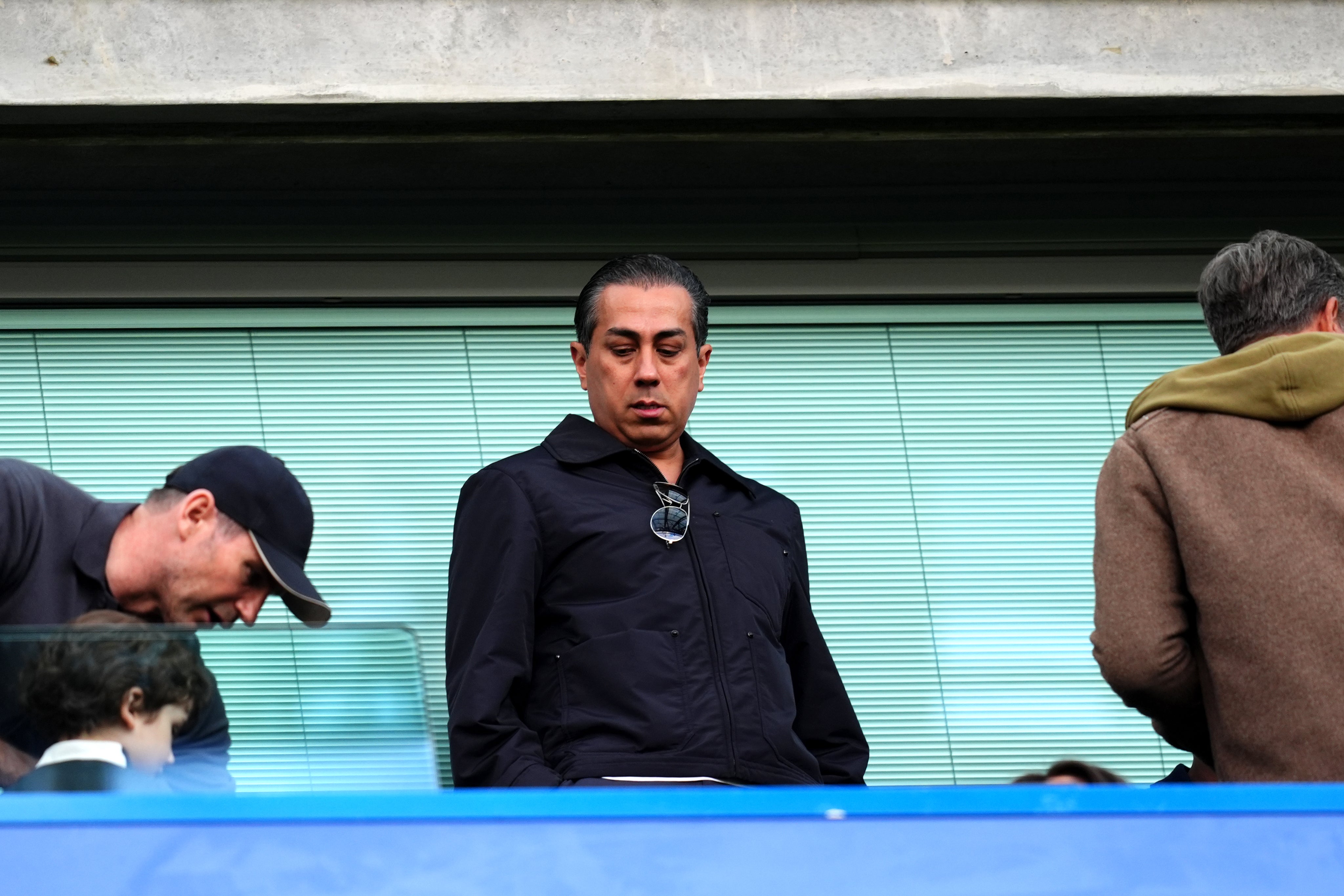
“It’s not a change we wanted to make [Enzo Maresca leaving]. It’s a change that had a bit of a negative impact in the season, when you’re changing systems and personnel, and it’s one we’ve got to fight our way out of.
“We still have six matches in the Premier League, and an FA Cup semi-final coming up. So, hopefully the story of this season hasn’t been written yet, and you’ve got a lot to fight for. In my perspective, when you get punched in the face, you’ve got to fight back, you’ve got to stand up and fight. And it’s going to hopefully show a lot about the character of this squad.”
The Blues reported a pre-tax losses of £262.4m for the last financial year, a Premier League record, with around £1.5bn spent on transfer fees since the new ownership group took charge in 2022.
And now the Chelsea Supporters’ Trust (CST) has said there is a “lack of confidence” in the owners.
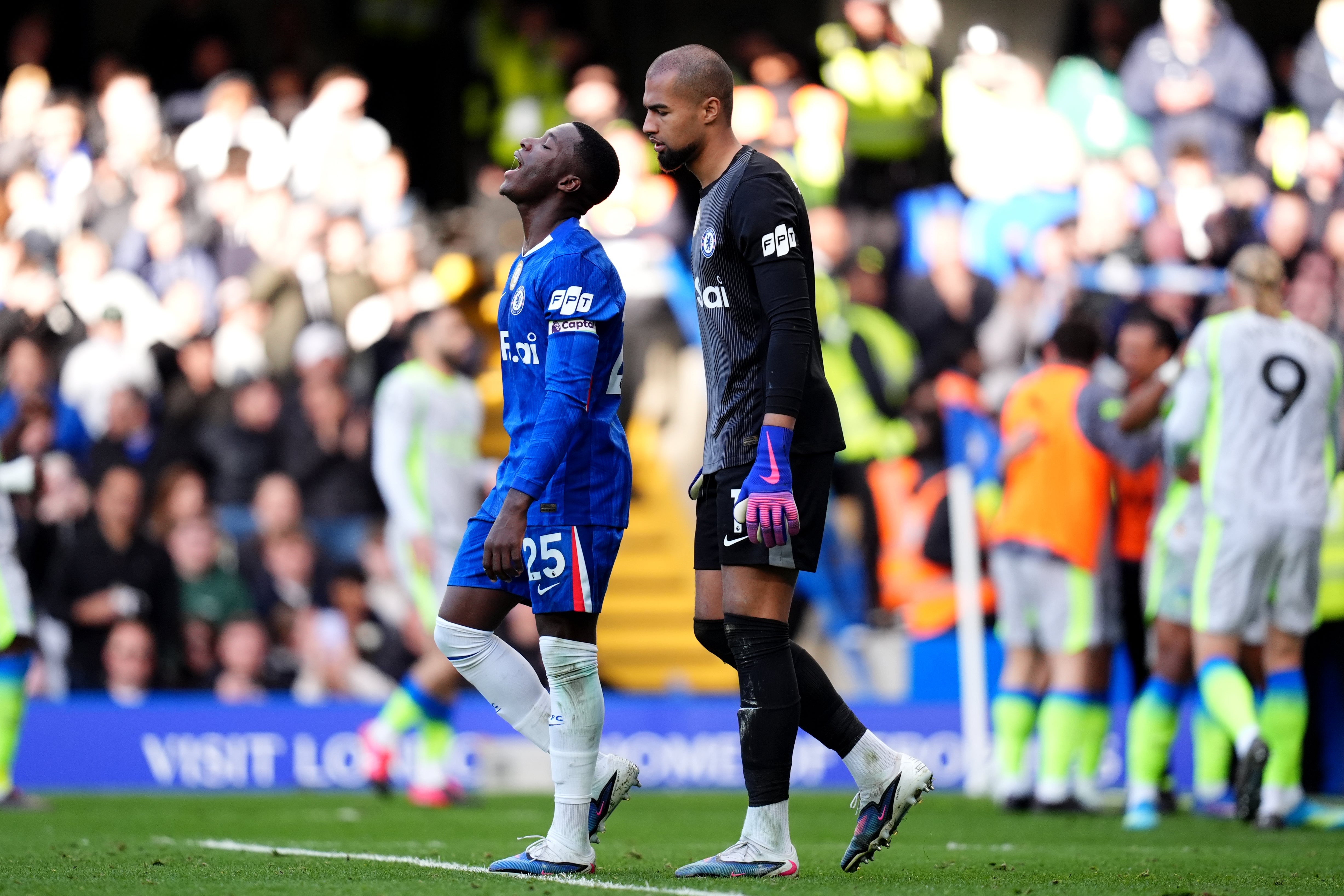
“These concerns are not driven by short-term results, and they will not be resolved by them. They relate to the underlying direction of the club, and they will persist regardless of fluctuations on the pitch,” said the CST.
“At the heart of supporter concern is a simple point: the current model has demanded a huge amount of faith from the fanbase, while giving too little clarity in return. Supporters have watched relentless upheaval. Players, managers, staff, and structures have changed at pace. This has been presented as part of a long-term plan.
“Yet four years on, there is still no sufficiently clear or convincing explanation of how that plan delivers sustained success while preserving a recognisable Chelsea identity. The vision remains unclear, its execution inconsistent, and its leadership insufficiently accountable.”
Ryder Cup star Jon Rahm was calm about the future of LIV Golf amid speculation the series’ Saudi backers could be about to pull funding.
The breakaway competition launched in 2021 and sent shockwaves through the sport, positioning itself as a rival to the PGA Tour and DP World Tour.
However, speculation has mounted this week that the Saudi Public Investment Fund (PIF) is set to end its backing, which is reported to be approaching 5 billion US dollars (£3.7bn) since the series was launched.
Spanish star Rahm, who is reported to have earned £64million since joining the series in 2023, was interviewed after the first round of the ongoing LIV event in Mexico City.
“Until the people in charge told me if the rumours were valid or not, it didn’t make sense for me to think about it or to waste time thinking about it,” he said, in quotes reported by Sky Sports.
“As everything suddenly came out, so quickly, I wasn’t too worried about that, because normally, before the rumours come out, we know something.
“There’s always someone in the league who knows something. It was so fast that I didn’t really worry about it.”
The Telegraph has reported that players and staff have been told that the PIF funding is only guaranteed until the end of the current season, and that outside investment would be needed to keep going beyond then.
LIV Golf chief executive Scott O’Neil was bullish about the league’s future in an interview on Thursday.
“If we keep the trajectory going the way we are and the revenue growth going, this is going to be a really good business for a really long time,” he said.
On Thursday it was announced that the PIF had sold a 70 per cent stake in Al Hilal, one of four Saudi Pro League clubs it owns.
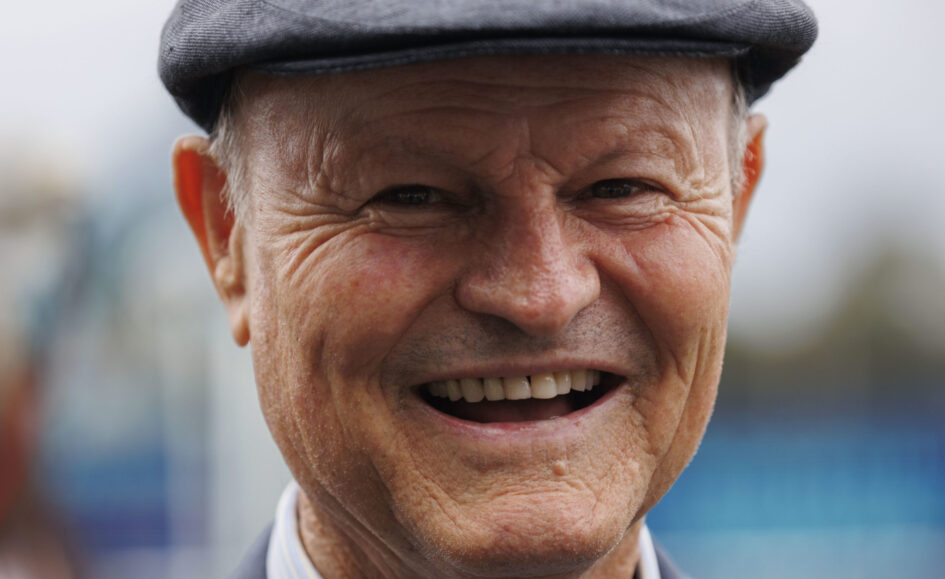
David Payne’s modest stable has a proven flair for developing Group 1 runners, with hopes high that the two-year-old Persian Wonder will follow suit.
The budding star contests Saturday’s Champagne Stakes (1600m) at Randwick, targeting his breakthrough top-tier success after promising runs, notably a solid second to Southend in the Baillieu (1400m) at Rosehill a month ago.
From South African origins, Payne has amassed over 100 Group 1 wins internationally, polishing Australian champions including Criterion, Ace High and Montefilia.
His operation continues to exceed its scale, operating on a tight budget and small team.
While the trainer modestly points to luck, his expertise in picking yearlings is unquestionable.
“I have been in the game a long time and I’ve been lucky with buying horses,” Payne said.
“But you’ve got to find the horse first. We buy maybe ten at the sales, other stables might buy 250. But we always find one, and we’ve got a couple there at the moment.”
Alongside Bangkok Hottie, fresh from a Wednesday win at Warwick Farm and set for a spell before the spring Princess Series, Persian Wonder stands as a future stable standout.
A challenging wide gate at Randwick adds difficulty, but with his affinity for rearward positions, Payne will stick to settling him back.
On his previous run closer to the front under James McDonald, he fell short of winning, yet Payne valued the experience.
“It was a good run. I thought he might have been a bit too handy, but it’s good that James taught him to get out of the gates,” he said.
“It’s a tough race on Saturday so we’ll ride him quiet and see what happens.
“We have been aiming him at this for a while, so we’ll see if he’s good enough.”
McDonald stays with Sires’ Produce Stakes winner Campione D’italia, bringing Chad Schofield back for Persian Wonder after his striking fourth placing in the Pago Pago Stakes (1200m) on March 14.
Visit betting sites to find the top racing odds for the Champagne Stakes.
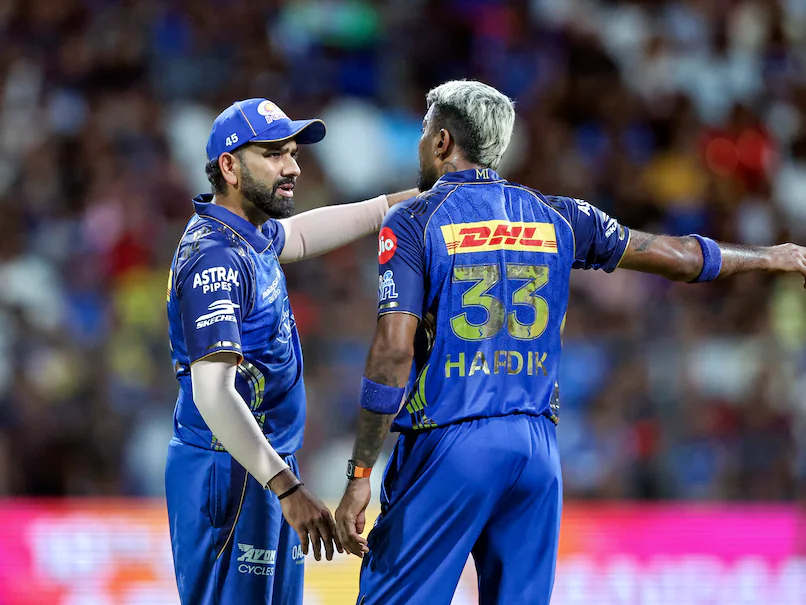
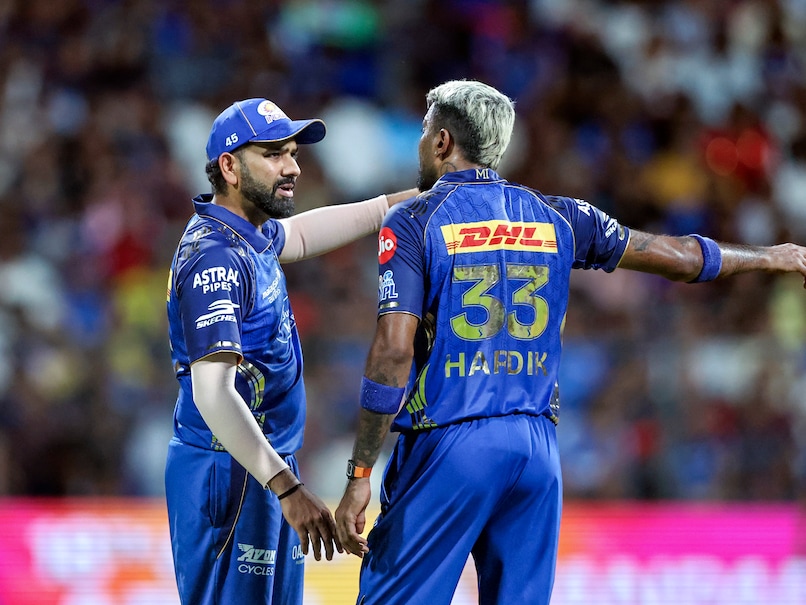
Mumbai Indians (MI) captain Hardik Pandya has come under scrutiny following the team’s dismal start to the IPL 2026 season. With just one win in five matches, MI languishes second from the bottom of the points table. On Thursday, the five-time champions were brushed aside at home by Shreyas Iyer‘s Punjab Kings (PBKS), marking their fourth defeat of the campaign. MI’s lone victory this season came against the Kolkata Knight Riders (KKR) at the Wankhede Stadium on March 29.
Speaking on Cricbuzz, former India batter Manoj Tiwary criticised Hardik’s captaincy against PBKS, arguing that the all-rounder’s leadership has been below par since he took charge of the franchise.
“From where will ownership come? One has to look at oneself as well. You need to see how you have been playing. According to me, just because you are not having success this year doesn’t mean the mistakes happened only this year. You need to look at the root cause as well. From 2015-2023, Rohit Sharma helped the Mumbai Indians win several trophies,” said Tiwary.
Tiwary also urged Hardik to relinquish the captaincy and return it to Rohit Sharma, noting that the veteran batter led the franchise to five titles between 2013 and 2023.
“In 2023, there was no trophy. In 2024, there was no trophy, and the chances of the same happening are high this year too. I think the captaincy is weak. I don’t want to be harsh. But Hardik is not leading the team the way it should be. It’s very important to be proactive as a captain. I think that if a solution is needed, Hardik should step back from the captaincy and hand the responsibility back to Rohit. When you removed Rohit, you did an injustice,” he added.
Beyond the leadership change, Tiwary slammed Hardik’s tactical choices during the defeat to PBKS, specifically his decision to promote himself up the order ahead of Sherfane Rutherford. Furthermore, he questioned the move to open the bowling with Deepak Chahar despite the pacer’s recent struggles.
“Hardik shouldn’t have promoted himself against the Punjab Kings. He scored 14 runs off 12 balls. Sherfane Rutherford just got five balls. If Rutherford had played as many balls, he would have hit 3-4 sixes. Hardik Pandya thought he could do it. Yes, he could have done it. You should have pushed Rutherford up. And secondly, there is no point in giving Jasprit Bumrah the second over when you are not giving him the first. Deepak Chahar just isn’t able to swing the ball,” he said.
Featured Video Of The Day
IPL 2026 News | RCB Outplay CSK For 2nd Win On Trot, Ruturaj Gaikwad & Co Suffer 3rd Loss
Topics mentioned in this article

Friday hits the newsstands with a wide variety of topics and the return of a familiar face to the front pages: Leo Messi.
The new adventure of the ’10’ makes him the owner of UE Cornellà. A development that is the main story of the day in the newspapers.
Advertisement
But there are also echoes of Real Madrid’s debacle in Munich. The next steps for Los Blancos are also one of the main talking points this Friday.
MARCA

AS

MUNDO DEPORTIVO

SPORT

SUPERDEPORTE

ESTADIO DEPORTIVO

This article was translated into English by Artificial Intelligence. You can read the original version in 🇪🇸 here.
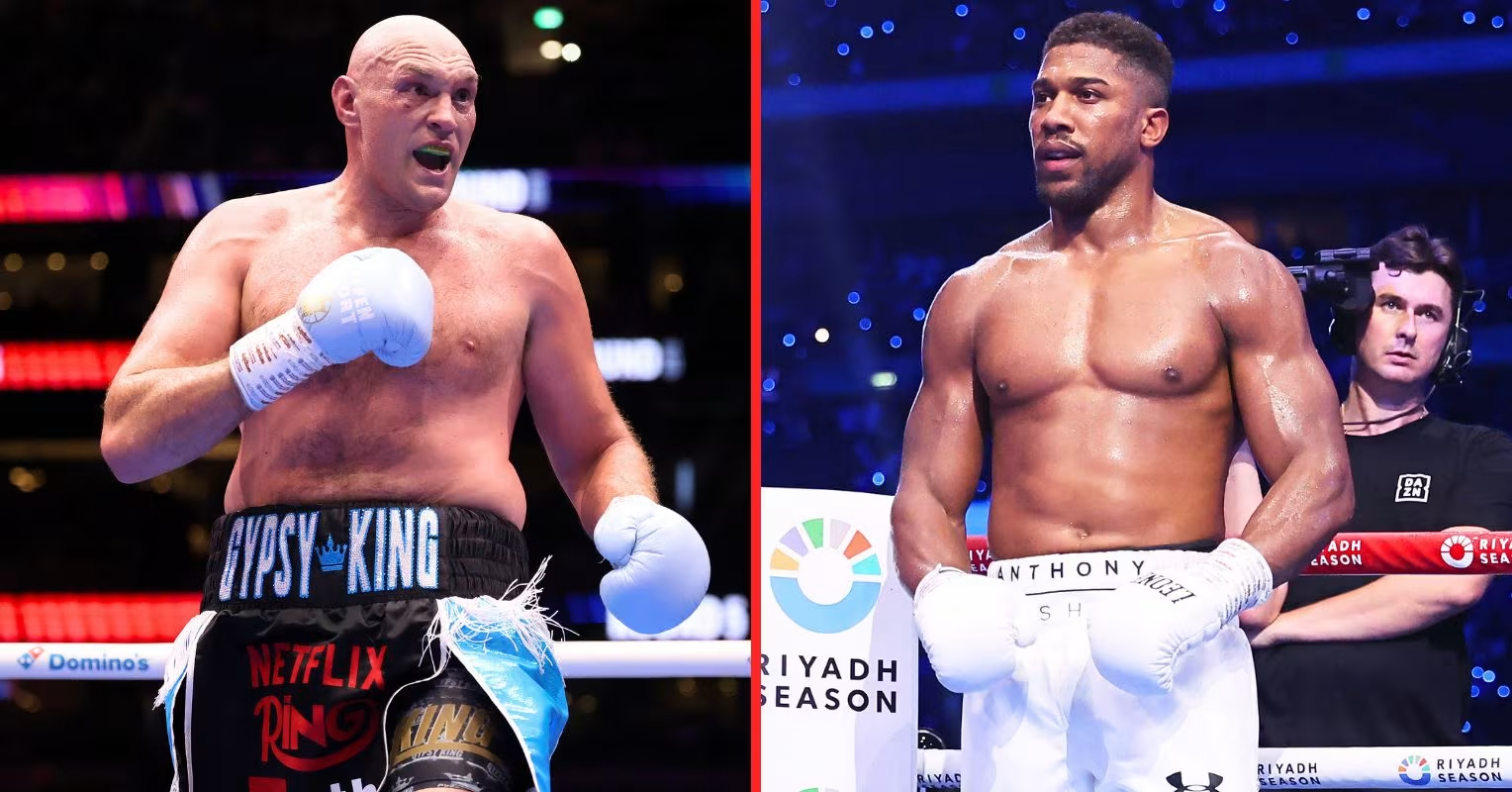

After Saturday last weekend’s call-out, Anthony Joshua is under pressure to accept a mammoth fight against Tyson Fury. Now, super-middleweight icon Carl Froch has had his say on how he thinks the potential bout may play out.
Fury boxed his way to a comfortable decision win against Arslanbek Makhmudov, claiming a first victory since 2023 and doing so after 16 months of inactivity, in what he hopes will be the first outing of a two-fight year.
Post-fight, Fury heaped the pressure onto fellow two-time world champion Joshua, demanding that he and ‘AJ’ fight next, but the Londoner was unwilling to rush into annoucing the contest.
Instead, Joshua remained calm and collected, refusing to publicly agree to the fight but saying that he does believe it will happen this year.
Speaking to his YouTube channel, Froch said that he sees Fury as the favourite, impressed by his Saturday showing against Makhmudov.
“I think that AJ will be the underdog for this one. I think that Fury is the favourite, especially off the back of that performance; he eased in tonight, it was just steady, he took his time, still looks good.
“I envy that actually, 16 months out of the ring and he is able to come and do a performance like that. Okay, he was in with Makhmudov, he is not in with a world beater, but it was a good 12 rounds’ work.”
Super Eagles forward Henry Onyekuru will not feature in Genclerbirligi’s league match against Galatasaray this weekend after being left out by the coaching staff.
The Nigerian joined Genclerbirligi last summer on a free transfer, but he has struggled to make an impact. He has not scored or provided an assist in 19 appearances this season and has only picked up one yellow card.
There have also been reports of problems off the pitch, including issues over unpaid wages earlier in the campaign. It was claimed that Onyekuru and some teammates refused to train at one point due to salary concerns.
Ahead of the match against his former club, coach Volkan Demirel asked Onyekuru to train separately from the rest of the squad. As a result, he has been ruled out of the game.
A report from the club’s technical staff described his recent performances as “inadequate and unmotivated”, with an official statement expected soon.
The decision comes at a difficult time for Genclerbirligi, who are battling relegation and sit just two points above the drop zone with five matches left.
Onyekuru’s situation has drawn criticism, with some observers questioning his commitment. His performances have not helped his case, as he has struggled to influence games under several different managers this season.
There has also been attention on his lifestyle off the pitch, with regular social media posts showing a luxurious way of life. While this does not directly affect his performances, it has added to the negative perception during a tough period for the club.
Despite the criticism, there are suggestions that the club may also be trying to move him on to reduce financial pressure. More details are expected soon, but for now, his future at Genclerbirligi remains uncertain.

Fake Ledger Device Sold Chinese Marketplace: Research
Cobra gave us exclusive access inside their 3D-printing process

Game Cube Hot Tub Animation Brought Into Real World

Why Israel is blocking foreign journalists from entering

Bitcoin: We’re Entering The Most Dangerous Phase

Alan Cumming Brands Baftas Ceremony A ‘Triggering S**tshow’

THE BIGGEST WIN OF MY LIFE! #gambling #casino #money #comedy #slots

BITCOIN & GOLD LIVE TRADING ANALYSIS @tradingmentor22 Live Trading || #goldtrading #cryptotrading

#reseller #gold #antique #buisness #jewelry #fyp #crazy #money #ytshorts
-

 Politics7 days ago
US brings back mandatory military draft registration
-
 Sports7 days ago
Man United discover Nico Schlotterbeck transfer fee as defender reaches Dortmund agreement
-

 Fashion7 days ago
Weekend Open Thread: Veronica Beard
-

 Politics5 days ago
World Cup exit makes Italy enter crisis mode
-

 Business6 days ago
Tesla Model Y Tops China Auto Sales in March 2026 With 39,827 Registrations, Beating Cheaper EVs and Gas Cars
-

 Crypto World4 days ago
The SEC Conditionalises DeFi Platforms to Be Avoided for Broker Registration
-

 Crypto World3 days ago
SEC Signals Exemption for Crypto Interfaces From Broker Registration
-

 News Videos2 days ago
Secure crypto trading starts with an FIU-registered
-
 NewsBeat4 days ago
Pep Guardiola and Gary Neville agree over Arsenal title problem that benefits Man City
-

 Business6 days ago
Ireland Fuel Protests Enter Day 5 as Blockades Spark Shortages and Government Prepares Support Package
-

 Business7 days ago
OpenAI Halts Stargate UK Data Centre Project Over Energy Costs and Copyright Row
-

 Crypto World6 days ago
Federal judge blocks Arizona from bringing criminal charges against Kalshi
-

 NewsBeat3 days ago
Trump and Pope Leo: Behind their disagreement over Iran war
-

 Crypto World3 days ago
SEC Proposes Certain Crypto Interfaces Don’t Need to Register as Brokers
-
 NewsBeat5 days ago
JD Vance announces ‘no agreement’ with Iran over nuclear weapons fear
-

 Business6 days ago
IMF retains floor for precautionary balances at SDR 20 billion
-

 Business6 days ago
Former Liverpool CEO eviscerates FIFA for World Cup ticket pricing
-
 Crypto World4 days ago
Sei Network Enters Quiet Reset Phase as On-Chain Metrics Signal a Slowdown in 2026
-
Business6 days ago
Coreweave CSO Venturo sells $5.5m in class a common stock
-
Sports6 days ago
1st-Round WR Enters Vikings Mock Draft Orbit
You must be logged in to post a comment Login