

Crypto World
Bitcoin ETFs snap back with $458m day as institutional demand returns



After four weeks of redemptions, U.S. spot Bitcoin ETF products snap back with a $458m daily surge and renewed institutional demand.
Summary
- U.S. spot BTC ETFs pulled in $787.3m in weekly net inflows for the week ending Feb. 27, ending a four-week outflow streak that had drained ~$2.48b from the complex.
- Mar. 2 marked the first positive day of the month with $458.2m in inflows — BlackRock’s IBIT led at $263.2m, followed by Fidelity’s FBTC at $94.8m and Bitwise’s BITB at $36.4m.
- BTC trades near $67,000–$68,000 as ETF-driven accumulation resumes; U.S. funds now hold ~1.5m BTC, roughly 7% of maximum supply, reinforcing a structural institutional bid.
U.S. spot Bitcoin ETFs are quietly back in accumulation mode, and the tape looks more like the start of a second leg than a dead‑cat bounce. Weekly data shows Bitcoin ETF products pulling in about $787.3m in net inflows in the seven days to Feb. 27, ending a four‑week outflow streak that had drained roughly $2.48b from the complex. A single three‑day burst added around $1.02b, including a $506.5m peak day, as issuers such as BlackRock and Fidelity saw flows reverse sharply after a bruising February. For a deeper breakdown of that shift, crypto.news highlighted how “weekly Bitcoin ETFs flow remain positive with BTC back above $66K,” framing it as the first decisive sign that redemptions have been absorbed.
That turn set the stage for March’s opening jolt of demand. Fresh figures show about $458.2m in net inflows into U.S. Bitcoin ETFs on Mar. 2, marking the first positive day of the month and immediately easing fears of another protracted bleed. BlackRock’s IBIT vehicle captured roughly $263.2m, more than half of the total, while Fidelity’s FBTC drew about $94.8m and Bitwise’s BITB added around $36.4m. As one flow recap put it, “March kicked off on a positive note as investors collectively put $458.2 million into the different Bitcoin ETF products,” a sharp contrast with the $27.5m in redemptions that had closed February.
Institutional confidence returns as ETF breadth widens
For analysts, this looks less like noise and more like confirmation of a structural bid from wealth platforms and pensions. A recent crypto.news analysis noted that “Bitcoin ETFs recorded $787.31 million in net inflows for the week… ending four red weeks,” adding that it was “the first positive week since late January” and a sign that sidelined capital steps back in quickly when macro fears fade. A separate research piece on ETF adoption argued that spot products have become a “cornerstone of institutional investment strategies,” estimating that U.S. funds held around 1.5m BTC, or roughly 7% of maximum supply, by late 2025.ainvest+1
Price is starting to reflect that flow regime. Bitcoin (BTC) trades around $67,000–$68,000, up roughly 1–2% over the last 24 hours, after ranging between about $63,000 and $67,000 during the latest ETF‑driven reversal. Ethereum (ETH) is changing hands near $2,000, with 24‑hour volumes in the low tens of billions as it lags Bitcoin’s ETF story but remains tightly correlated to broader risk sentiment. Solana (SOL) sits in the mid‑$80s, little changed on the day, yet increasingly tethered to the same flows as traders position for potential multi‑asset products.



- BNB gets institutional boost from YZi Labs amid broader market price weakness.
- This $100 million infusion arrives as BNB price holds near $630
- Commitment highlights institutional faith in BNB’s utility and yield potential.
BNB price hovers near $630 as investor jitters mount amid escalating US/Israel-Iran tensions.
The negative sentiment across crypto and risk assets aside, YZi Labs has announced a fresh $100 million commitment to Hash Global’s BNB Holdings Fund.
Can this move help the bulls hold onto gains?
BNB gets institutional boost
YZi Labs, formerly Binance Labs, announced a $100 million strategic investment into Hash Global’s BNB Holdings Fund, building on prior support for the compliant yield vehicle launched in June 2025.
Ella Zhang, Head of YZi Labs, highlighted BNB as a “foundational utility asset with attractive yield, powering the future of financial infrastructure,” inviting traditional capital for its structural returns and growth.
The fund has delivered strong performance, posting 32.5% returns since inception through diversified revenue streams including BNB price appreciation, launchpad allocations, airdrops, and custody yields, with bi-weekly liquidity for investors.
This move signals deepening institutional adoption, amid continued interest from private wealth platforms and high-net-worth individuals.
Despite price weakness and notable ecosystem downsides, BNB looks to be attracting investment from individuals seeking regulated exposure to the token.
KK, founder of Hash Global, noted:
“BNB’s institutionalization should not be viewed merely as portfolio inclusion, but as a structural alignment between capital and ecosystem development. The ecosystem co-building model is the defining feature that differentiates BNB from other digital assets.”
BNB price outlook
Current market data shows BNB trading around $629, down 3% in the last 24 hours.
Prices are also down in the past week and month, but BNB has held steady within this range since dipping from above $700 in February.
Downtrend weakness remains as Bitcoin struggles to break $70,000 amid headwinds from the intensifying US/Israel-Iran conflict.
With reports of further strikes and risks of the conflict spilling across the region, cryptocurrencies could dip even further. On Tuesday, BNB dropped from highs of $651 amid such fresh derisking.
If extreme fear grips sentiment, with odds rising of a deeper war, prices may retest support around $550. Lower demand reload zones lie in the $450-$500 range.
However, if bulls hold onto gains above immediate support, resilience could see prices bounce higher.
BNB’s ecosystem strength, including BNB Chain’s growing daily transactions, real-world asset adoption and investment inflows, provides a buffer.
The institutional inflows could counter prevailing macro fears and help buyers keep bears off.


The Financial Action Task Force (FATF) said that “stablecoins are the most popular virtual asset used in illicit transactions,” including Iran and North Korea, and therefore calling for stricter oversight of stablecoin issuers in a 42-page report published Tuesday.
In January 2026, the global watchdog said it found stablecoins accounted for most illicit onchain activity. It estimated there was approximately $51 billion in illicit stablecoin activity relating to fraud and scams in 2024.
In its March 2026 report, the task force again warned dollar-pegged tokens have become a key vehicle for illicit finance. It cited a Chainalysis report that said stablecoins accounted for 84% of the $154 billion in illicit virtual asset transaction volume in 2025. The report highlighted cases involving North Korean and Iranian actors using stablecoins such as USDT for proliferation financing and cross-border payments tied to sanctioned activity.
TRM Labs released a report mid-February saying that in 2025, illicit entities received $141 billion in stablecoins, the highest level observed in five years. The report noted that overall stablecoin activity exceeded $1 trillion per month on several occasions last year. Sanctions-related activity accounted for 86% of illicit crypto flows, the report said, with bad actors mostly relying on stablecoin platforms.
The FATF said peer-to-peer transfers via unhosted wallets present a “key vulnerability” because these types of transactions can occur without anti-money laundering controls.
While stopping short of calling for blanket blacklisting, the FATF urged countries to impose anti-money laundering (AML) obligations on stablecoin issuers and consider requiring tools such as wallet freezing and banning or restricting functions embedded in smart contracts.
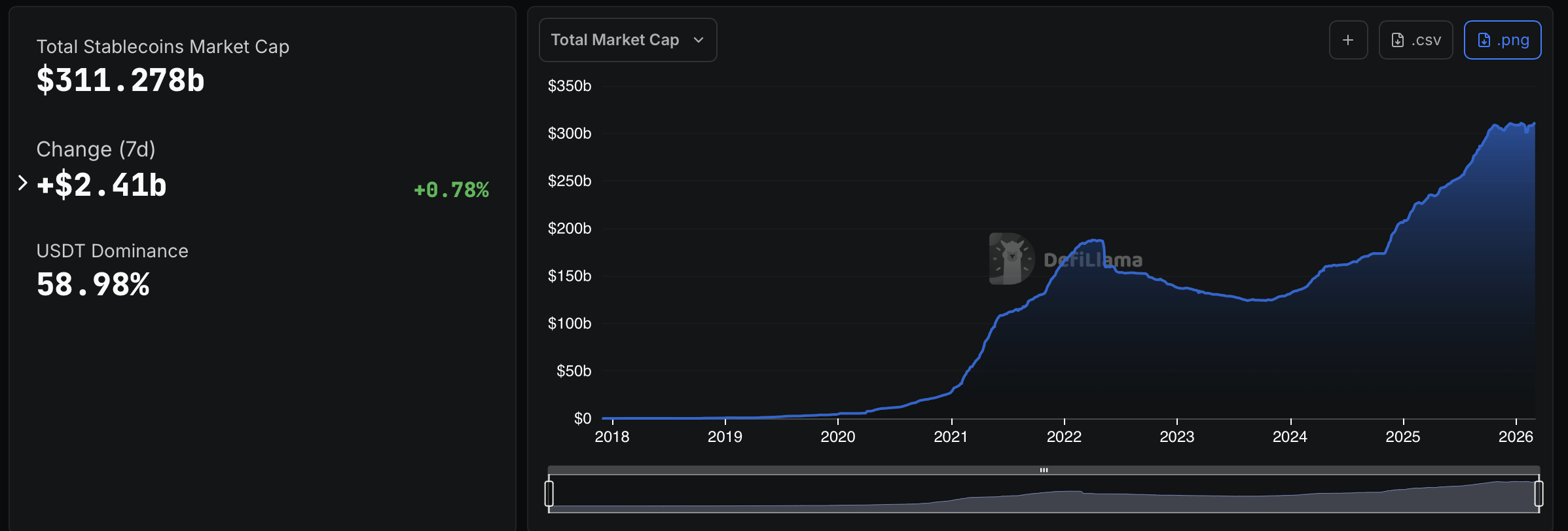
With stablecoins now exceeding $300 billion in market value, FATF warned regulators must act quickly to close compliance gaps as adoption accelerates.

The total open interest (OI) for XRP futures across major crypto exchanges has plunged 70% from its peak five months ago, settling at $203 million on March 3, 2026.
The sharp drop in unsettled contracts mirrors levels seen in April 2025, a period that immediately preceded a significant price rally for the digital asset, raising questions about whether the market is once again flushing out excess leverage.
Open Interest Collapse Mirrors April 2025 Setup
Data compiled by market analyst Amr Taha shows that XRP’s aggregate open interest has cratered from $660 million in October 2025 to just $203 million today.
Binance, the dominant venue for XRP derivatives, has seen its OI dip below $270 million, a threshold last witnessed on April 8, 2025. Smaller platforms have also seen activity shrink considerably, with Bitfinex and BitMEX now holding just $4.3 million and $3 million in XRP open interest, respectively.
“Historically, such phases have aligned with local bottoms, as excessive leverage is flushed out and market conditions reset,” Taha noted.
Open interest tracks the total number of outstanding futures and perpetual contracts that remain open. According to the market watcher, a sudden dip alongside falling prices often suggests traders are closing positions or being liquidated as leverage unwinds.
The analyst suggested that the current combination points to forced liquidations and voluntary exits rather than new speculative build-up.
“Traders are either closing positions voluntarily or being liquidated due to margin calls,” he wrote.
The derivatives reset comes at a time when geopolitical tensions are rattling markets. On March 2, analyst Darkfost reported that 472 million XRP, worth about $652 million, flowed into Binance following U.S. and Israeli strikes on Iran.
Such large exchange inflows can signal positioning for potential selling, adding pressure to spot prices, and XRP swung from $1.43 down to $1.27 during the weekend turmoil, allowing BNB to leapfrog it to once again become the fourth-largest cryptocurrency by market cap.
Volatility Spikes as Price Trends Lower
Separate data highlighted by Arab Chain on March 2 shows XRP’s 30-day realized volatility on Binance reaching 1.16, its highest level since March 2025.
Realized volatility measures the annualized standard deviation of daily returns over a 30-day period, and a reading at this level means daily price swings have widened significantly compared to recent months.
At the time of writing, the Ripple token was trading around $1.35, having dipped nearly 2% in the last 24 hours. It also remains down almost 17% over 30 days and about 50% within the past year. Furthermore, the asset is 63% below its all-time high of $3.65, which it reached in July 2025.
However, there might be a positive aspect to consider in the current situation. As Taha pointed out, the April 2025 drop in Binance open interest coincided with a major bottom near $1.80, which was followed by a rally that eventually took XRP to its most recent all-time high.
The post XRP Open Interest Falls 70% to Yearly Lows: What Does it Mean for Ripple’s Price? appeared first on CryptoPotato.
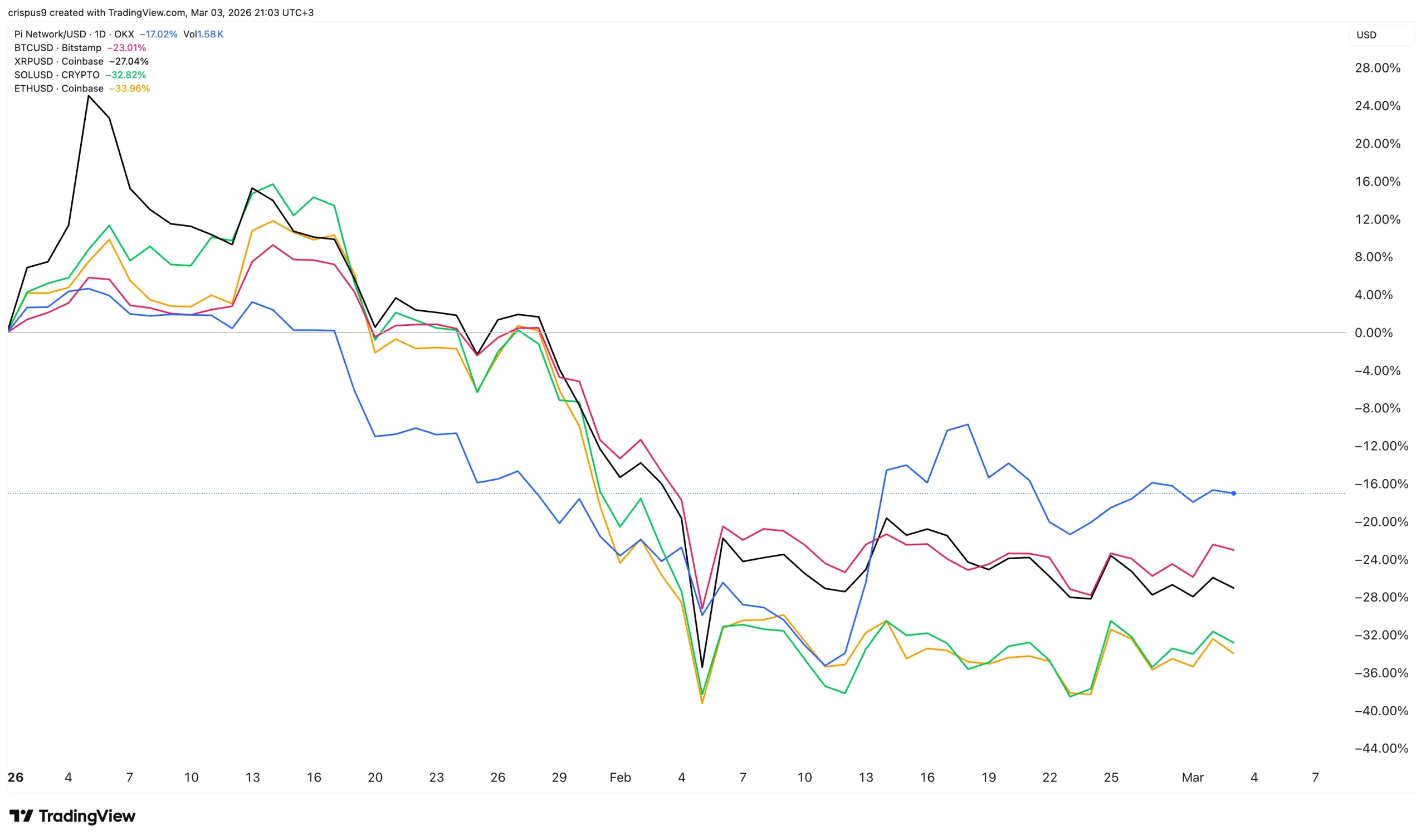
Pi Network price is suddenly doing better than top cryptocurrencies like Bitcoin, XRP, and Solana this year, driven by key catalysts like the potential Kraken listing and the upcoming validator rewards distribution.
Summary
- Pi Network price has retreated by about 17% this year.
- It has done better than other popular cryptocurrencies.
- The team has made some major announcements this year.
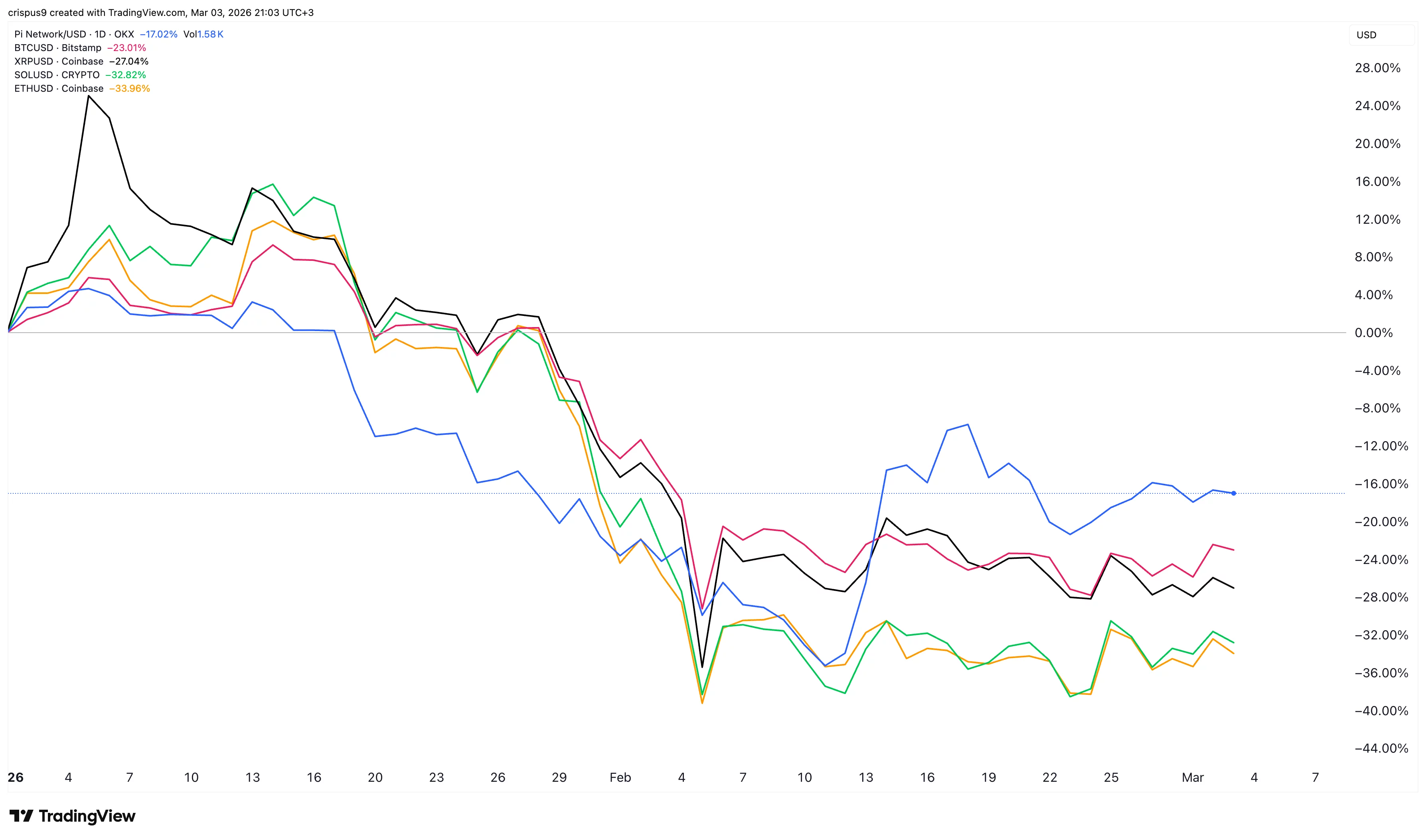
Pi Coin (PI) token has dropped by 17% this year, while Bitcoin (BTC) is down by 23%. Ethereum (ETH), Ripple (XRP), and Solana (SOL) have dropped by 35%, 27%, and 33%, respectively.
Top reasons why Pi Network is beating top coins
The coin has done well in the past few weeks, driven by some key catalysts. For one, the coin celebrated its first anniversary in February. While the price remains much lower than its all-time high, the developers highlighted key milestones, including on KYC, where millions of people have moved to the mainnet.
Pi Network price has also done better than top rivals as investors reacted to the news of the potential listing by Kraken. Odds of a listing jumped after the company added it to its listing roadmap page. This means that the listing may happen any time this year.
Additionally, the developers have started pushing the much-anticipated upgrade to v23. The first three stages have already completed, with the remaining ones happening in the next few weeks. This upgrade will lead to more improvements, including security and speed improvements.
Meanwhile, Pi Network price has also done well ahead of the upcoming validator rewards distribution, which are expected to happen later this month. Also, the developers are working on native token, an automated market maker, and decentralized exchange tools.
Pi Coin price faces major risks
Still, Pi Coin price faces major risks ahead. The most notable one is that it is highly inflationary. It has no burning mechanism, and millions of tokens are unlocked daily. Data shows that over 1.4 billion tokens will be unlocked in the next 12 months.
Pi Network also faces the centralization risk, where the foundation holds over 90 billion tokens. It also makes all decisions, with the community members having no say on major decisions.
Additionally, the recent Pi Network may be a dead-cat bounce as we experienced in May last year when the team teased of a major announcement. The announcement turned out to be the $100 million ecosystem fund launch. While this was an important announcement, it pushed the token lower as investors were expecting a potential exchange listing.
Pi Network is still a ghost chain with no much activity in its ecosystem. A year after the mainnet launch, there is no major application in the network.
SoFi Technologies has partnered with Mastercard to enable settlement in its dollar-backed stablecoin, SoFiUSD, across Mastercard’s global payments network, allowing issuers and acquirers to settle card transactions using a bank-issued digital dollar.
Under the agreement, SoFi Bank N.A. plans to settle its own Mastercard credit and debit transactions in SoFiUSD, while SoFi’s payments technology platform Galileo will give client banks and card issuers the option to use the stablecoin for transaction settlement across the number two processor’s network.
The company said SoFiUSD is the first stablecoin issued by a US nationally chartered and insured deposit bank on a public, permissionless blockchain and would allow transactions to be settled 24 hours a day, seven days a week across Mastercard’s network.
SoFiUSD, launched in December, is issued by SoFi Bank, an OCC-regulated insured depository institution, and is backed 1:1 by cash reserves. Mastercard’s Multi-Token Network is expected to support the stablecoin alongside fiat currencies, tokenized deposits and other digital assets.
The companies said they will also explore additional use cases, including cross-border remittances, business-to-business transfers, programmable treasury applications and stablecoin-enabled card programs, subject to regulatory requirements and Mastercard network rules.
The move comes as Mastercard has been increasingly active in the stablecoin space. In November, the company partnered with Thunes to expand stablecoin wallet payouts through Mastercard Move, enabling near real-time transfers to regulated stablecoin wallets via Thunes’ Direct Global Network.
Related: SoFi reports record Q4 revenue as crypto trading resumes late in quarter
Rival Visa expands stablecoin settlement and payout infrastructure
Mastercard is not alone in integrating stablecoins into its payments infrastructure, with biggest processor Visa also widening its use of digital dollars across settlement and payout services.
In September, Visa began testing stablecoin-based cross-border settlement, launching a Visa Direct pilot that allows select banks to pre-fund international transfers using Circle’s USDC (USDC) and (EURC). The payments giant later expanded support to four stablecoins across four blockchains, enabling conversion into more than 25 fiat currencies.
Visa has also moved into direct stablecoin payouts. In November, it introduced a Visa Direct pilot allowing businesses to send funds straight to recipients’ stablecoin wallets, giving freelancers and marketplaces the option to receive USD-backed tokens instead of traditional bank transfers.
That expansion extended overseas last month when Netherlands-based Quantoz Payments became a principal Visa member, enabling it to issue Visa-branded debit cards backed by its regulated e-money tokens and support fintechs offering stablecoin-linked products in Europe.
The total stablecoin market cap at the time of writing was about $311.28 billion, per DefiLlama data. Transaction volumes grew to a record $969.9 billion in August 2025, with forecasts nearing $1 trillion monthly by December 2026, CoinLedger reported in September.

Magazine: Would Bitcoin really be at $200K if not for Jane Street? Trade Secrets


Bermuda’s disciplined path to an onchain economy
When Bermuda announces its ambition to become the world’s first fully onchain national economy with support from Circle and Coinbase, you could picture a dramatic, quick overhaul. However, that is not the case.
To be a fully onchain economy, Bermuda has not taken a hard route, which might involve instantly building government services and pushing merchants to accept digital payments. Instead, the island is following a cautious path of well-thought-out, regulated innovation in finance.
The island intends to begin with carefully designed pilots. It will work through licensed and supervised institutions, share the results with transparency and only expand when the systems prove reliable and effective. The goal is to position “onchain” as dependable, everyday infrastructure rather than a radical, quick shift.
What fully onchain means (and what it doesn’t) in this context
As outlined in the announcement at the World Economic Forum, Bermuda is focusing on rolling out digital asset infrastructure across government departments, local banks, insurers, businesses and everyday consumers.
The early emphasis appears to be on stablecoin-powered payments and expanded financial tools rather than abruptly replacing traditional systems.
Here’s what “fully onchain” does not include:
-
No legislation making crypto or stablecoins legal tender
-
No prohibition on cards, bank wires, cash or other conventional payment methods
-
No immediate push for the population to switch to self-custody wallets.
Bermuda’s approach is pragmatic; it focuses on establishing the efficacy of the infrastructure before broadening its reach.
Did you know? Bermuda was among the first jurisdictions to allow insurers and reinsurers to experiment with blockchain record-keeping, long before “onchain economy” became a buzzword.
Credentials of Bermuda for running this experiment
The Bermuda Monetary Authority has built a framework that encourages innovation. This enables Bermuda to execute complex experiments with speed, transparency and accountability.
Bermuda’s regulatory container for crypto
Bermuda has spent years building a robust, supervised framework for digital asset activities. The cornerstone of this system is the Digital Asset Business Act (2018), which empowers the Bermuda Monetary Authority (BMA) to license and oversee firms in this space. This matters because turning an economy “fully onchain” is not just a technical endeavor; it is a holistic effort involving consumers, compliance, risk management and operations.
The BMA’s tiered licensing system — Class T (for pilot/beta testing), Class M (modified requirements for a limited period) and Class F (full operations) — is designed for staged progression.
Firms can start small, test concepts under supervision, demonstrate safety and viability, and scale when ready. This structure supports controlled pilots rather than blanket mandates, allowing regulators to contain risks, gather data and refine rules iteratively.
Smaller systems can iterate faster
Unlike large economies with cumbersome legacy payment systems, deeply ingrained consumer habits and fragmented political interests around money, a compact jurisdiction like Bermuda can move faster. Coordinating across government agencies, key merchants, regulated financial institutions and local stakeholders becomes simpler when the initial focus is narrow.
Rather than overhauling the entire economy, this approach focuses on stablecoin-based flows for things like government fees, permits or targeted disbursements. This combination of strong regulation and agility positions Bermuda to run a structured, evidence-based experiment.
Did you know? Bermuda’s economy relies heavily on cross-border transactions, from insurance premiums to reinsurance settlements, making it unusually sensitive to payment delays. This is one of the reasons blockchain rails appeal more for efficiency than ideology.
Why testing beats mandates for an onchain transition in Bermuda
While Bermuda’s aim is a long-lasting, widely accepted integration of digital assets into its national financial system, “mandates” could risk slowing or complicating the effort.
Mandates invite swift resistance
Pushing widespread use of crypto could lead to immediate pushback over privacy concerns and create an impression of government overreach. People may feel as if changes are being forced on them.
Bermuda’s public statements emphasize a measured, step-by-step approach, and its leadership intends to build confidence first and then broaden access.
Government payments require reliability
Trustworthy execution of government payments requires a series of processes:
-
Secure onboarding and identity verification
-
Processing refunds, disputes or clear non-reversible rules
-
Accurate reconciliation, auditing and reporting
-
Robust fraud monitoring and responsive customer support
-
Controlled vendor onboarding and procurement safeguards.
Pilots allow agencies to trial these processes under strict controls that include limited volumes, vetted providers and specific use cases. This ensures all factors related to transactions function seamlessly before integrating critical public services.
Financial stability and consumer safeguards remain central considerations
Stablecoin-based systems face some specific real-world challenges. These include expectations around redemptions and liquidity, risks from overreliance on one issuer or platform, potential outages, regulatory lapses and user exposure to scams or errors.
Controlled testing enables the government to isolate and manage these risks and gather hard evidence on what fails. It can determine what users find confusing, where vulnerabilities emerge and which protections truly work.
Banking partners prefer predictability over disruption
Modern financial systems rely heavily on established banking networks and correspondent relationships, particularly for international transactions. A sudden mandate could signal regulatory uncertainty or an attempt to bypass traditional rails.
Bermuda’s strategy demonstrates alignment with existing compliance standards rather than a radical break from them. It leverages supervised intermediaries, tiered licensing under the Digital Asset Business Act and infrastructure from players like Circle and Coinbase.
Did you know? Unlike countries experimenting with crypto as legal tender, Bermuda’s population already has near-universal banking access, so onchain pilots are aimed at optimization and not financial inclusion emergencies.
What problem an onchain pilot in Bermuda aims to solve
Bermuda’s initiative positions onchain infrastructure as adequate for everyday uses. It is designed to cut friction, reduce costs and streamline value transfer in areas where traditional systems are slow and expensive.
Official announcements and reporting focus initially on stablecoin payments and merchant enablement. The policy targets real transactional and operational improvements rather than speculative or investment-driven use cases.
When stablecoins enable fast, low-cost settlements that integrate seamlessly into existing merchant systems and reduce payment overhead, onchain may function as a practical utility. People and businesses adopt it because it performs better, not because of regulation or hype.
How a pilot could work in practice in Bermuda
Public details describe initial pilots in government agencies, alongside broader private-sector enablement. Here is a scenario of how a phased pilot might unfold:
-
A specific government department selects a limited use case, such as a permit or refund process.
-
Approved, licensed providers handle payment acceptance, built-in compliance checks and integration.
-
Residents and merchants join voluntarily through user-friendly interfaces, with straightforward fiat off-ramps and dedicated support.
-
The program measures clear objectives such as settlement speed, cost per transaction, fraud incidence, customer support volume, merchant participation rates and user feedback.
-
Data from the pilot guides the next steps: Scale up successful elements, refine pain points or adjust or pause as needed.
This methodical, evidence-driven rollout stands in sharp contrast to broad mandates. It prioritizes controlled experimentation to build reliability and trust before wider adoption.
Partners in Bermuda’s initiative, not a mandate
Bermuda’s initiative is built around active collaboration with Circle and Coinbase. These companies are providing the underlying stablecoin infrastructure, enterprise-grade tools and support for education and user onboarding.
This partnership serves two practical purposes:
-
Execution capability: Running reliable, national-scale digital payments and onboarding flows demands sophisticated engineering, security architecture and operational capacity that most governments do not maintain internally.
-
Trust and integration: Working with well-known, regulated firms lowers friction for local banks, insurers and larger merchants who already recognize and trust these names, making adoption smoother.
Relying on major partners also introduces a significant risk: concentration around one or two providers. This issue can be addressed early through a thoughtful pilot, contingency planning and interoperability considerations.
Frameworks for adoption: Balancing innovation with institutional integrity
To ensure an onchain economy is welcome and not resisted, the supporting rules and transparency matter as much as the technology itself. Key elements include:
-
Optionality: Conventional payment methods (cards, bank transfers, cash) must remain fully available at every stage.
-
Transparency: Clearly communicate the pilot’s scope, any associated fees and regular, public reporting on performance metrics.
-
User protections: Provide straightforward risk disclosures, scam-awareness education, accessible support channels and simple complaint/escalation paths.
-
Privacy and compliance clarity: Explain exactly what data is collected, who can access it, under what legal basis and how it is protected.
-
Resilience measures: Build in provider redundancy, documented incident-response procedures and timely communication during any outages or disruptions.
Bermuda’s emphasis on education and onboarding in its public statements signals that sustainable adoption is earned through usefulness and trust.
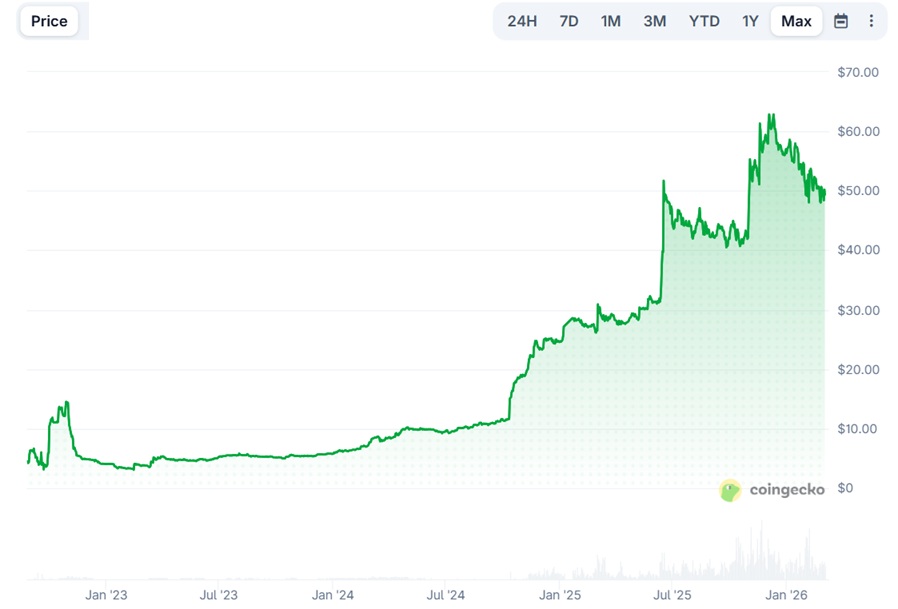
Most exchange tokens don’t get talked about until they’ve already made their move. WBT, the native coin of European crypto exchange WhiteBIT, is a textbook example. It spent the better part of 2023 trading under $6 with almost zero mainstream attention. Now it sits above $50, ranks inside the top 15 by market cap, and has quietly outperformed some of the most hyped tokens in the market over the past three years.
So what changed? And more importantly, is there still room to run?
A Slow Build, Then an Explosion
WBT launched in August 2022 and immediately landed in the middle of a brutal bear market. It’s all-time low hit around $1.90 in late 2022, and for most of 2023, it barely moved, closing the year near $5.78. Not exactly the kind of chart that gets people excited.
But things began to change in 2024, when WBT began steadily climbing from $6 to $24 by the year’s end, a quiet 4x that most of Crypto Twitter completely missed. Then, in 2025, the token accelerated, blowing past $30, $40, and $50, eventually touching $65.30 on November 18, 2025. From its lowest point to its highest, that’s over 3,000% in roughly three years.
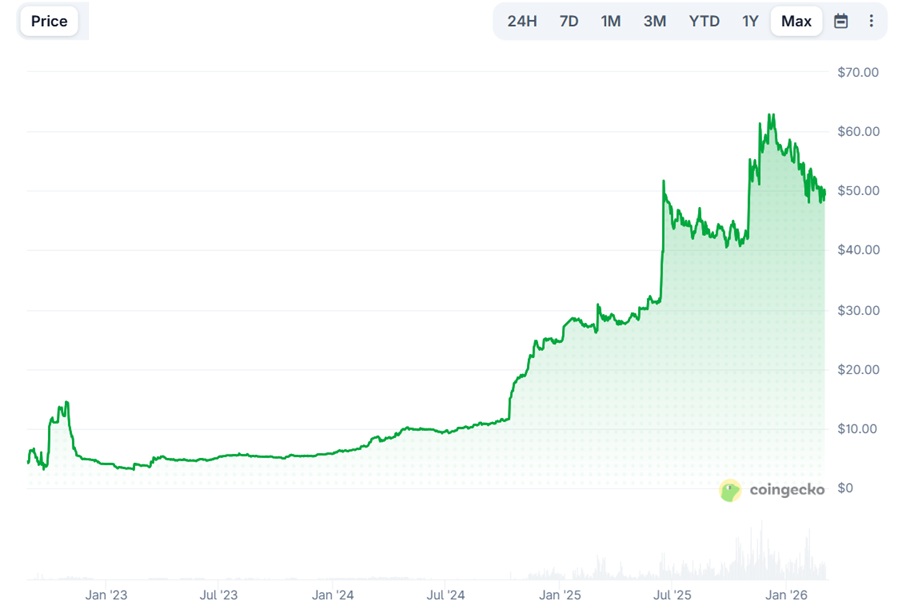
As of February 2026, WBT is consolidating around $50 with a market cap above $10 billion. On-chain data from earlier this month shows 99.52% of the circulating supply is in profit, which is a rare position for any crypto asset.
Adding to the institutional credibility, WBT was included in the S&P Crypto Indices at the end of 2025, a milestone that puts it on the radar of fund managers and institutional allocators who rely on index inclusion as a baseline for asset legitimacy.
The Engine Behind the Price
Price doesn’t move in a vacuum. Behind WBT’s chart is a business that’s been scaling aggressively.
WhiteBIT is the largest European cryptocurrency exchange by web traffic. It was founded in 2018, and by the end of 2025 its parent entity W Group reported serving over 35 million customers globally with a total capitalization of $38.9 billion. The exchange now operates across multiple regions, recently launching WhiteBIT US as a New York-based entity and entering Saudi Arabia through a cooperation agreement focused on blockchain infrastructure and CBDC development.
WBT isn’t just a token to trade, but is woven into everything on the platform. Holding it unlocks up to 90% off taker fees, 100% off maker fees, free daily ERC 20 withdrawals, boosted referral rates, and staking rewards. That kind of utility creates a natural demand: more users on the platform means more people with a reason to hold WBT.
On the supply side, the tokenomics include a hard cap of 400 million tokens with no future minting. The exchange also runs weekly token burns, gradually compressing the circulating supply, which currently sits around 214 million. Deflationary pressure plus growing demand is a combination that tends to push price in one direction.
Big Brand, Bigger Ambitions
WhiteBIT has made moves that most exchanges in its tier haven’t even attempted. A three-season partnership with FC Barcelona started in 2022. In 2025, they added a global partnership with Juventus FC, complete with kit sleeve branding and a dedicated Crypto Fan Zone for supporters.
These aren’t just marketing stunts but signal the kind of institutional credibility that attracts larger players. WhiteBIT now serves over 1,300 institutional clients with solutions spanning OTC trading, liquidity provision, custody, and Crypto-as-a-Service. The WhiteBIT Nova debit card processed over $50 million in its first year. WhitePool, their mining operation, climbed into the top 15 globally.
Each of these developments feeds back into WBT demand.
What to Watch From Here
WBT is currently sitting about 25% below its all-time high. The consolidation around $50 after a massive run is healthy, but the next move depends on a few key factors.
On the bullish side: the US launch is still in its early stages, the Saudi expansion opens a massive new market, weekly burns continue to tighten supply, and a broader crypto bull cycle could lift all boats. As of today, Kraken has also added WhiteBIT Coin (WBT) to its Tokens Launching Soon roadmap on its official listings page, signaling upcoming support on one of the world’s largest exchanges, a potential catalyst for fresh demand.
On the cautious side: exchange tokens are directly tied to platform performance. Increased competition, regulatory shifts, or a prolonged market downturn could slow things down.
Either way, the data makes one thing clear. WBT’s move from $3 to $65 wasn’t luck. It was built on real users, real utility, and real growth. Whether you’re watching it or holding it, this is a token worth understanding.
Disclaimer: This article is for informational purposes only and does not constitute financial advice. Always do your own research before making investment decisions.
The post WBT Did a Quiet 15X While Everyone Was Watching Meme Coins appeared first on Cryptonews.

TLDR
- Unified platform from Crypto.com enables tax-advantaged growth of both equities and cryptocurrencies.
- Staking capabilities and integrated portfolio management available through Crypto.com IRAs.
- Both Traditional and Roth retirement accounts offered with contribution matching up to 5%.
- Access to stocks, ETFs, and 400+ digital tokens within a single user interface.
- Multi-asset retirement accounts signal evolving convergence of digital and conventional investments.
Crypto.com has unveiled a groundbreaking retirement solution for U.S. investors that merges equities and digital currencies within a unified platform. This innovative service enables account holders to maintain stocks, exchange-traded funds, and crypto assets under tax-advantaged retirement vehicles. Both Traditional and Roth IRA variants are now directly available through Crypto.com’s ecosystem.
The platform delivers an opportunity for investors to diversify across multiple asset categories while maximizing tax efficiency. Traditional IRAs offer tax-deferred accumulation, while Roth accounts provide tax-free growth potential. Account holders can execute contributions, transfer existing accounts, and complete rollovers without incurring fees.
Crypto.com provides incentives including up to 5% matching on contributions and up to 2% on transfers and rollovers. These benefits are designed to drive user adoption and accelerate retirement savings growth. Integrated portfolio management capabilities are embedded within the application.
IRA Features Include Crypto Holdings and Staking Rewards
The Crypto.com IRA platform accommodates bitcoin, ethereum, and over 400 additional digital currencies. Multiple tokens are eligible for staking and lockup mechanisms, allowing account holders to generate supplemental yields within their retirement accounts. According to IRS guidelines, staking income is subject to taxation in the year received.
The service also facilitates trading of equities, ETFs, and cryptocurrencies through a consolidated interface. Advanced features like Recurring Buys and Whale Baskets provide enhanced flexibility and automation for portfolio construction. Users can track performance and rebalance holdings directly within the Crypto.com application.
Crypto.com facilitates enhanced yield generation by enabling compounding of crypto staking income. Earned rewards are systematically deposited into retirement accounts, fostering long-term asset accumulation. This framework establishes an integrated approach to blending digital and traditional investment vehicles.
Market Context and Regulatory Environment
This product launch aligns with expanding mainstream adoption of cryptocurrency within U.S. retirement planning. Policy initiatives have promoted greater accessibility, with executive directives and legislative measures endorsing crypto participation. Major financial institutions like Morgan Stanley have similarly expanded digital asset options for their clientele.
Unlike employer-provided 401(k) programs, these Crypto.com retirement accounts function as individual vehicles. Investors retain full authority over asset selection and account administration. Custodial arrangements for stocks and ETFs were not specified, while cryptocurrency custody operates through the platform infrastructure.
Crypto.com is positioning itself within an emerging sector of multi-asset retirement products that bridge conventional securities and blockchain-based assets. This development mirrors widespread momentum toward portfolio diversification and digital asset adoption. The platform consolidates access to equities, ETFs, cryptocurrencies, and yield opportunities, streamlining comprehensive retirement preparation.


A confidential blockchain advisory agreement between Libra co-creator Hayden Davis and Argentinian president, Javier Milei, has been discovered on a suspect’s phone during the country’s ongoing investigation into the collapse of the LIBRA token.
That’s according to La Nación and sources familiar with the results of a January 9 report led by the Public Prosecutor’s Office (MPF).
The department’s computer experts reportedly recovered multiple copies of the agreement from Mauricio Novelli’s seized phone. The document appeared in exchanges between himself and Davis as various drafted iterations before the final version was signed by Milei.
The Argentinian president reportedly still denies the existence of the “confidential agreement” that cemented Davis’ role as the country’s blockchain advisor and, in turn, his association with LIBRA’s launch on February 14, 2025.
Novelli is part of a group of lobbyists, alongside Manuel Terrones Godoy and Sergio Morales, who allegedly helped launch and profited from LIBRA’s collapse.
Read more: Javier Milei disbands crypto unit he set up to investigate himself
Prosecutor Eduardo Taiano said that the MPF’s findings mean that the undersecretary of presidential affairs, who reports to Milei’s sister, General Secretary Karina Milei, will now have to confirm whether or not she has copies of the secret agreement.
The report also found Novelli played a key role in organizing the LIBRA launch and maintained contact with both Milei and his sister, Davis, Terrones Godoy, Morales, and Julian Peh, the CEO of the KIP protocol, which helped launch the token.
Multiple messages between Novelli and other parties were also found to have been deleted, but some messages were recovered after forensic extraction.
“All individual conversations and those related to WhatsApp groups made up of Novelli, Terrones Godoy and Sergio Morales were found to be empty or had been deleted,” analysts claimed.
One exchange involved Cardano founder Charles Hoskinson who accused Terrones Godoy of demanding a five-figure sum of money to meet Milei.
Hoskinson was promised “magical things will happen,” but refused the offer.
Hayden Davis-linked wallets sent $1M USDC after signing deal
Argentinian outlet Clarín revealed that Milei had signed a “confidential agreement” with Davis 15 days before the launch of LIBRA. It was subject to a non-disclosure agreement and required Davis to provide unpaid blockchain advice “ad honorem.”
Davis would “provide professional support, in line with global trends in decentralization and technological modernization, ensuring the highest quality and confidentiality at every stage of the advisory process.”
On the day it was signed, two payments of USDC worth roughly $1 million, were sent from Davis-linked wallets to the wallet of 75-year-old Orlando Rodolfo Mellino, a retiree with no real address, who then sent the funds to a wallet linked to Novelli.
Read more: LIBRA case judge orders full disclosure of Javier Milei bank accounts
La Nación reports that after a year, the investigation into LIBRA has been carried out at varying speeds, and has witnessed delays in key areas, such as the disclosure of the report into Novelli’s devices. It adds that Milei is yet to hire a lawyer to represent himself.
Meanwhile, Davis appeared to be walking free as of December 2025. Crypto analytics firm Bubblemaps recently claimed that Davis had made $15 million from Pump Fun’s private token sale just six months after LIBRA’s launch.
However, Bubblemaps then deleted its findings after Pump Fun’s pseudonymous CEO, Alon Cohen, called it defamatory “misinformation.” He said, “No one from the team ever spoke to the guy, I didn’t even know he existed until after the scandal.”
Got a tip? Send us an email securely via Protos Leaks. For more informed news and investigations, follow us on X, Bluesky, and Google News, or subscribe to our YouTube channel.

Visa is expanding its stablecoin-linked card program with Bridge, broadening its geographic reach and pushing toward onchain settlement. The latest move lifts the program from its initial Latin American rollout to 18 countries, with a plan to surpass 100 countries across Europe, Asia-Pacific, Africa and the Middle East by year-end. The expansion builds on the program’s April 2025 debut in markets including Argentina, Colombia, Ecuador, Mexico, Peru and Chile, and comes as the two companies test settlement directly in stablecoins through a pilot tied to Visa’s rails and Bridge’s banking partner. The broader industry context features heightened activity around stablecoins in payments, with rival initiatives in the space highlighting a competitive push toward real-time, programmable settlement.
Key takeaways
- Visa and Bridge are extending the stablecoin-linked card program to 18 countries, with a target of more than 100 countries by year-end across Europe, Asia-Pacific, Africa and the Middle East.
- The program’s initial launch in 2025 covered Latin American markets, including Argentina, Colombia, Ecuador, Mexico, Peru and Chile.
- Settlement is moving toward onchain processing, enabled by Bridge’s collaboration with Lead Bank, allowing transactions to be settled in stablecoins instead of fiat.
- Visa is evaluating potential support for Bridge-issued assets, which are created programmatically by businesses rather than by a traditional issuer.
- The move comes amid broader payments-industry activity around stablecoins, including Mastercard’s recent stablecoin card enablement with MetaMask in the United States.
Tickers mentioned: $USDT, $USDC
Market context: The expansion aligns with a wider shift toward crypto-enabled payments and onchain settlement rails, as major incumbents test how tokens can streamline merchant settlements and reduce counterparty risk in everyday purchases.
Market context: Linked to broader USDt and USDC usage in payments, the push also sits against a backdrop of regulatory scrutiny and ongoing experimentation with tokenized settlement in traditional rails.
Why it matters
The enhanced collaboration between Visa and Bridge underscores a strategic bet on programmable, onchain settlement as a means to speed up merchant settlements and improve transparency for card programs built on stablecoins. By enabling issuers and acquirers to settle transactions directly in stablecoins, the network could reduce latency and friction inherent in fiat conversions, especially for cross-border transactions or cross-currency purchases. The approach also signals an appetite to expand the set of tools available to fintechs and brands that want to issue their own digital dollars or stable assets tailored to their customer base, without relying solely on a third-party issuer.
Bridge’s participation remains central to the evolution of these rails. The program leverages Bridge’s infrastructure to enable onchain settlement, with Lead Bank providing the regulatory and banking framework necessary to move transactions from card networks into the onchain ecosystem. In practice, this arrangement allows card issuers to settle in stablecoins rather than converting transactions to local fiat post-authorization, aligning settlement timelines with blockchain realities and potentially improving settlement finality for merchants and consumers alike.
From a competitive standpoint, the Visa-Bridge expansion sits alongside a broader trend in the payments space: the growing willingness of major processors to experiment with crypto rails. Mastercard, for example, has recently enabled stablecoin card spending in the US through a partnership with the MetaMask wallet, illustrating how traditional payment networks are responding to consumer interest in crypto-backed payments and the desire for real-time settlement capabilities. The juxtaposition of these efforts signals a broader industry push toward integrating crypto-native settlement with fiat-backed consumer spending, while navigating the regulatory and risk considerations that come with such a transition.
Visa’s crypto leadership has been clear about meeting businesses where they operate. Cuy Sheffield, Visa’s head of crypto, has framed the expansion as part of a broader strategy to bring the speed, transparency and programmability of stablecoins into the settlement process. The company is exploring how Bridge-issued assets—stablecoins that are created programmatically by businesses on Bridge’s platform—could be supported more broadly within Visa’s network, a path that could unlock new programmable currency options for merchants and brands that want to control settlement terms or tokenized reward structures. Unlike the most widely used stablecoins issued by independent entities, Bridge-issued assets are designed to be created and managed via Bridge’s infrastructure, a model that could appeal to fintechs seeking bespoke token strategies.
Bridge has positioned the expansion as a step toward more seamless, on-chain settlement for digital-asset-enabled card programs. The practical effect is a potential reduction in the time and complexity involved in moving value from a customer’s stablecoin balance to a merchant’s local currency—an outcome that could matter for shoppers who want near-instant payments and for issuers seeking tighter control over settlement economics. The program’s onchain settlement is described as a natural extension of Bridge’s rail, with Lead Bank acting as the bridge between traditional banking and the onchain settlement layer. In a mid-February update, Bridge noted that it had received conditional approval from a regulator to become a national trust bank, a milestone that underscores the regulatory dimensions of this kind of expansion and the careful navigation required to scale such rails.
As part of the broader, ongoing stablecoin race in payments, Visa’s initiative adds to a landscape where banks and fintechs are willing to experiment with programmable money at the point of sale. The expansion’s strategic rationale rests on creating more options for merchants to accept stablecoins without abandoning familiar payment interfaces, and for consumers to transact with tokens that can be settled efficiently. By aligning with Bridge’s architecture and Lead Bank’s regulatory framework, Visa is building a more integrated model where stablecoins do not live only in wallets or exchanges but become a practical settlement instrument for everyday card purchases.
The announcement also highlights a broader industry trend: the move toward enhanced interoperability between card rails and blockchain settlement. If the onchain settlement pilot proves scalable, issuers may gain more flexibility in structuring rewards, fees and settlement terms around stablecoins, potentially broadening the appeal of crypto-enabled cards to a wider audience of merchants and cardholders. While regulatory considerations remain a constant backdrop, the practical demonstrations of speed and transparency in settlement have kept this initiative in the spotlight as a potential blueprint for future integrations across the payments ecosystem.
What to watch next
- Timeline and results of the onchain settlement pilot with Lead Bank and Bridge; potential adjustments to settlement cadence and liquidity requirements.
- Progress toward the goal of reaching 100+ countries by year-end, and which markets will be prioritized in the near term.
- Details on Visa’s potential support for Bridge-issued assets and any regulatory approvals that shape that path.
- Regulatory developments regarding Bridge’s national trust bank status and how they affect cross-border card programs.
Sources & verification
- Visa and Bridge expansion to over 100 countries: official Visa investor relations announcement.
- Original Latin American rollout: Visa and Bridge collaboration announcement outlining the April 2025 launch.
- Onchain settlement pilot and Bridge-Lead Bank collaboration: Visa press materials and Bridge announcements, including regulatory status updates.
- Industry context: Mastercard’s stablecoin card spending in the US via MetaMask—contextual reference in related coverage.
Key figures and next steps
Market reaction and key details
Why it matters
The Visa-Bridge collaboration represents a deliberate push to embed stablecoins deeper into everyday payments while testing the viability of onchain settlement for consumer card programs. If the pilot demonstrates efficiency gains and regulatory viability, issuers and merchants could gain access to more flexible settlement terms and new token-based monetization options. For users, the prospect of faster settlement and more predictable funds availability could enhance the appeal of stablecoins as a practical payments tool, particularly for cross-border purchases and commerce that spans multiple currencies.
Beyond Visa, the broader payments ecosystem is watching how these rails will coexist with existing fiat-based settlement, risk controls, and compliance regimes. The tension between innovation and regulation remains a key driver, but the ongoing experiments with stablecoins at the point of sale reflect a maturing phase in crypto-enabled payments where real-world usage and governance concerns are increasingly aligned. As more institutions participate, the competence and reliability of onchain settlement in consumer contexts will be tested under a variety of market conditions, from everyday retail transactions to cross-border remittances.
What to watch next
- End-of-year milestones for country expansion and the potential scaling of onchain settlement.
- Regulatory updates on Bridge’s national trust bank status and related compliance requirements.
- Adoption metrics from merchants and issuers participating in the program, including any changes in settlement times and cost structures.

Israel-Hezbollah fire escalates, Israeli troops push into south Lebanon

Wall Street Lunch: Dow Plunges 1,200 Points Before Dip-Buyers Pitch In

BNB holds near $630 as YZi Labs pumps $100M into Hash Global Fund


-

 Politics5 days ago
ITV enters Gaza with IDF amid ongoing genocide
-

 Fashion4 days ago
Weekend Open Thread: Iris Top
-

 Politics10 hours ago
Alan Cumming Brands Baftas Ceremony A ‘Triggering S**tshow’
-

 Tech3 days ago
Unihertz’s Titan 2 Elite Arrives Just as Physical Keyboards Refuse to Fade Away
-

 Business7 days ago
True Citrus debuts functional drink mix collection
-

 NewsBeat6 days ago
Cuba says its forces have killed four on US-registered speedboat | World News
-
Sports4 days ago
The Vikings Need a Duck
-
 NewsBeat3 days ago
Dubai flights cancelled as Brit told airspace closed ’10 minutes after boarding’
-
 NewsBeat6 days ago
Manchester Central Mosque issues statement as it imposes new measures ‘with immediate effect’ after armed men enter
-
 NewsBeat3 days ago
The empty pub on busy Cambridge road that has been boarded up for years
-

 NewsBeat2 days ago
‘Significant’ damage to boarded-up Horden house after fire
-

 NewsBeat3 days ago
Abusive parents will now be treated like sex offenders and placed on a ‘child cruelty register’ | News UK
-
 NewsBeat7 days ago
Police latest as search for missing woman enters day nine
-

 Entertainment1 day ago
Baby Gear Guide: Strollers, Car Seats
-

 Business6 days ago
Discord Pushes Implementation of Global Age Checks to Second Half of 2026
-

 Business5 days ago
Only 4% of women globally reside in countries that offer almost complete legal equality
-
 Tech4 days ago
NASA Reveals Identity of Astronaut Who Suffered Medical Incident Aboard ISS
-
Politics3 days ago
FIFA hypocrisy after Israel murder over 400 Palestinian footballers
-

 Crypto World7 days ago
Entering new markets without increasing payment costs
-
 NewsBeat2 days ago
Emirates confirms when flights will resume amid Dubai airport chaos