
Business
10 Features to Look for in Policy Management Software


Publishing internal guidelines is easy, but proving that your workforce has actually read and understood them during an unexpected regulatory audit is a high-stakes challenge. To bridge this gap, modern policy management software features must transform static document distribution into an active, verifiable process of compliance. Selecting the right platform allows compliance officers, HR leaders, and IT administrators to replace tedious spreadsheets with automated workflows, ensure target distribution across global teams, and achieve true operational accountability.
This guide breaks down the essential core capabilities—from automated policy distribution and tracking to native Microsoft 365 policy management software integration and audit-ready reporting—so you can evaluate tools effectively, reduce organizational risk, and choose a solution that drives measurable compliance confidence. Here is what to look for when evaluating your options.
The Strategic Value of Enterprise Policy Management Software
At its core, modern policy management involves systematically creating, distributing, tracking, and maintaining an organization’s regulatory and operational documentation. Rather than relying on static file repositories or passive email attachments, dedicated policy management software features actively govern how internal policies move through their lifecycle. It automates delivery, enforces mandatory employee acknowledgements, and records fine-grained activity data to convert passive communication into verifiable compliance.
For compliance officers, HR leads, and IT administrators, relying on manual follow-ups or shared network folders creates severe governance risks. In real-world operations, unread safety guidelines or outdated operational procedures directly expose organizations to regulatory fines, legal liabilities, and failed audits. An enterprise-grade policy management software provides complete visibility, ensuring that critical updates reach the right personnel and that every policy acknowledgement is tracked without heavy administrative burden.
Choosing a platform with robust policy distribution and tracking capabilities transforms compliance from a reactive scramble into a predictable, streamlined workflow. Key operational advantages include:
- Elimination of Administrative Bottlenecks: Automated notification workflows and reminders remove the need for manual email follow-ups.
- Audit Readiness: Continuous collection of digital signatures and access logs creates immediate evidence for internal and external auditors.
- Seamless Ecosystem Alignment: Platforms designed for native integration—such as specialized tools like DocRead for SharePoint—allow teams to enforce compliance directly within their existing Microsoft 365 environments without forcing users into unfamiliar third-party software.
A common misconception is that a standard cloud storage platform or intranet is sufficient for policy governance. However, simple storage lacks the critical enforcement mechanisms, target assignment capabilities, and granular tracking required to maintain a robust, audit-ready compliance posture.
Essential Policy Management Software Features for Enterprise Governance
To build a secure and compliant workplace, evaluating policy management software features requires looking beyond standard document storage. Modern organizations need specialized software capabilities that ensure active engagement, targeted delivery, and continuous compliance verification across every department.
1. Targeted Policy Distribution & Dynamic User Management
Distributing company guidelines across large organizations requires precise targeting. Instead of emailing documents to entire company lists, modern platforms automatically assign policies based on specific roles, departments, locations, or custom AD (Active Directory) groups. When an employee changes roles or a new team member joins, smart assignment rules immediately issue the required reading materials, ensuring seamless onboarding without manual intervention.
2. Mandatory Read & Policy Acknowledgment Tracking Software
A critical distinction in compliance management is moving from publishing a document to confirming understanding. Purpose-built solutions incorporate digital sign-offs where users actively acknowledge that they have read and agreed to the policy. Implementing robust policy acknowledgment tracking software ensures every sign-off is logged with accurate timestamps, creating legally defensible records that protect your organization during disputes or regulatory reviews.
3. Automated Notifications & Deadline Management
Manual follow-ups waste hundreds of administrative hours each year. Leading compliance tools automate task delivery, sending personalized notifications when new documents are assigned or modified. Integrated deadline tracking ensures that if an employee misses a review window, automated escalation rules trigger reminders to the employee and their line manager—maintaining steady progress toward total compliance.
4. Real-Time Audit-Ready Compliance Reporting Software
When auditors arrive, administrative teams often scramble to compile proof of policy distribution. A specialized platform eliminates this panic through real-time dashboards and exported logs. Comprehensive audit-ready compliance reporting software provides instant visibility into compliance rates, pending sign-offs, and overdue tasks across individual departments or the entire workforce.
5. Native Integration with Microsoft 365 & SharePoint
Introducing standalone software often creates user friction, security vulnerabilities, and fragmented workflows. Solutions built natively for your existing ecosystem allow organizations to manage governance directly inside their digital workplace. Choosing a native microsoft 365 policy management software solution ensures that file permissions, access control, and user management remain synchronized with your core infrastructure.
6. Centralized Policy Control & Version Management
Overlapping file versions and outdated policy PDFs stored on local drives pose serious compliance risks. A centralized repository ensures a single source of truth for all operational documentation. Built-in version control archiving automatically archives older revisions while ensuring employees only access and acknowledge the most current, approved policy version.
7. Automated Policy Review Schedules & Lifecycle Management
Policies must evolve alongside regulatory shifts and industry standards. Governance software includes automated lifecycle scheduling that alerts document owners when a policy is due for periodic review. This prevents outdated guidelines from remaining active and keeps governance frameworks continuously aligned with legal requirements.
8. Custom Knowledge Checks & Quizzes
In high-risk industries, simple digital signatures may not suffice to demonstrate understanding. Enterprise platforms allow compliance officers to attach short, customizable quizzes to critical policies. Employees must pass the quiz to complete their acknowledgment, confirming that key safety protocols or regulatory standards are truly comprehended.
9. Tailored User Dashboards
Employees need a clear, distraction-free view of their compliance obligations. User-centric dashboards display assigned tasks, pending acknowledgments, completed certifications, and due dates in a unified portal. This clear layout reduces administrative confusion and empowers staff to manage their required reading efficiently.
10. Granular Security, Permissions, & Admin Controls
Protecting sensitive compliance records requires strict administrative permissions. Platform administrators can set granular access rights controlling who can edit documents, reassign policies, or access executive compliance reports. This ensures sensitive regulatory data remains secure while giving regional managers the exact visibility they need.
Selecting an enterprise platform that delivers these fundamental policy management software features transforms static policy distribution into a proactive, trackable process. By leveraging dedicated solutions like DocRead for SharePoint, compliance officers and IT leads eliminate manual overhead and maintain total audit readiness effortlessly.
How Policy Management Software Solves Compliance Challenges Across Departments
Evaluating software capabilities is most effective when applied to real-world scenarios. Here is how modern enterprise policy governance tools solve everyday operational bottlenecks across different organizational departments.
- HR & Workforce Onboarding: During rapid company growth, HR teams often struggle with manual policy distribution and follow-ups. By implementing dedicated sharepoint policy management features, HR administrators automate document assignments for new hires based on department roles. New employees receive automated reading tasks with strict deadlines, resulting in 100% policy acknowledgment compliance within their first week while reducing administrative follow-up time by over 80%.
- Corporate Compliance & Regulatory Audits: Facing a sudden regulatory audit, a compliance director needs immediate proof that all staff completed mandatory data protection training. Using audit-ready compliance reporting software, the team generates real-time completion reports and timestamped digital signatures across global offices in minutes, completely eliminating audit anxiety and avoiding costly non-compliance fines.
- IT & Operations Governance: When updating critical IT security policies, system administrators must ensure employees do not bypass important security protocols. Leveraging automated policy reminders in microsoft 365, the platform sends targeted notifications and escalates overdue tasks to line managers, ensuring rapid organization-wide alignment without disrupting daily IT operations.
These practical applications demonstrate that investing in the right policy management software features replaces manual tracking with predictable, automated compliance—giving your organization complete visibility and audit readiness.
Best Practices for Implementing Policy Management Software Features
Selecting software is only the first step; maximizing its value requires a thoughtful implementation strategy. Following these practical best practices ensures smooth adoption and long-term compliance success across your enterprise.
- Map Policies to Roles, Not Individuals: Avoid assigning documents to specific named users. Instead, utilize dynamic role-based policy assignment linked to your Active Directory or Microsoft 365 groups. This guarantees that internal role changes or new hires trigger policy updates automatically, maintaining seamless governance without constant manual maintenance.
- Set Realistic Acknowledgment Deadlines: Give employees adequate time to review complex documents while maintaining operational momentum. Establishing clear, reasonable timeframes paired with automated compliance tracking tools prevents administrative bottlenecks while ensuring staff prioritize critical policy reviews.
- Leverage Existing Workspace Infrastructure: Minimize user friction by deploying software directly inside the tools your workforce already uses every day. Implementing a purpose-built solution like DocRead for SharePoint keeps policy distribution within your existing intranet, driving higher engagement rates without introducing separate logins.
- Audit Your Policy Library Periodically: Technology works best when underlying content is up to date. Schedule regular lifecycle reviews for all corporate documentation to retire obsolete guidelines and ensure employees are only asked to acknowledge active, relevant standards.
Applying these best practices helps your organization fully unlock the power of core policy management software features, turning compliance into a streamlined, reliable, and stress-free process.
Take Control of Your Governance with Purpose-Built Policy Management
Choosing the right policy management software features is essential for transforming passive document storage into an active, verifiable compliance process. By prioritizing targeted distribution, mandatory acknowledgments, automated reminders, and real-time reporting, compliance leaders and IT administrators can protect their organization from audit risks while saving hundreds of administrative hours. Modern governance relies on clear visibility, complete control, and seamless workplace integration.
Taking action now ensures your organization remains audit-ready, reduces legal exposure, and establishes verifiable accountability across every department. Equipping your workforce with tools built for active policy tracking eliminates compliance gaps before they become costly liabilities.
Ready to streamline your compliance workflows within your existing environment? Explore how Collaboris policy management software empowers enterprise teams to automate policy distribution, track acknowledgments in real time, and achieve complete compliance confidence.
Frequently Asked Questions About Policy Management Software
How do policy management software features help with regulatory audits?
Dedicated policy management software features streamline audits by providing real-time, audit-ready compliance reporting software. Instead of searching through emails or paper records, administrators can instantly generate timestamped logs proving when employees received, read, and acknowledged specific guidelines. This verifiable proof significantly reduces non-compliance risks and ensures your organization remains fully prepared for internal and external regulatory reviews.
Can policy management software integrate with Microsoft 365 and SharePoint?
Yes, modern platforms can integrate natively with your existing digital workplace. Selecting a specialized microsoft 365 policy management software solution like DocRead for SharePoint allows you to manage policy assignments, track acknowledgments, and leverage central document libraries directly within your familiar Microsoft environment without requiring separate user credentials or risky file migrations.
How does policy acknowledgment tracking software handle new employee onboarding?
Advanced platforms utilize dynamic user management tied to Active Directory or Microsoft 365 groups. When a new hire is added to a specific department or role, the system automatically assigns all mandatory policies for their position. Automated reminders and deadline tracking ensure new team members complete their required reading during onboarding without requiring manual administrative follow-up.
What is the difference between document management and policy management software?
While document management systems simply store, organize, and control file versions, dedicated policy management software features actively drive compliance enforcement. Beyond basic storage, policy management tools provide targeted distribution, automated notification workflows, mandatory digital acknowledgments, custom comprehension quizzes, and detailed audit trails to ensure policies are read, understood, and tracked across the workforce.
About the Author
Ryan Malaluan, CAPM®, is an SEO & Content Strategist with over 8 years of experience in search engine optimization, content strategy, and digital marketing. He holds a Bachelor of Arts in Literature and is a Certified Associate in Project Management (CAPM®), combining strong communication skills with structured, results-driven strategies to improve online visibility and organic growth.



A financial researcher and avid investor with a keen eye for innovation and disruption, as well as growth buy-outs and value stocks. Keeping an eye on the pace of high tech and early growth companies, I write about current events and the biggest news surrounding the industry, and strive to provide readers with ample research and investment opportunities.
Analyst’s Disclosure: I/we have no stock, option or similar derivative position in any of the companies mentioned, but may initiate a beneficial Short position through short-selling of the stock, or purchase of put options or similar derivatives in LEN over the next 72 hours. I wrote this article myself, and it expresses my own opinions. I am not receiving compensation for it (other than from Seeking Alpha). I have no business relationship with any company whose stock is mentioned in this article.
Seeking Alpha’s Disclosure: Past performance is no guarantee of future results. No recommendation or advice is being given as to whether any investment is suitable for a particular investor. Any views or opinions expressed above may not reflect those of Seeking Alpha as a whole. Seeking Alpha is not a licensed securities dealer, broker or US investment adviser or investment bank. Our analysts are third party authors that include both professional investors and individual investors who may not be licensed or certified by any institute or regulatory body.

According to the company’s exchange filing, the order is a one-time contract, with the supply of solar modules scheduled across FY27 and FY28. The company did not disclose the commercial value of the order.
The order has been awarded by a domestic entity and involves the supply of 2 GW of solar modules. Waaree Energies said that neither its promoter group nor group companies have any interest in the entity awarding the order.
The company also clarified that the order does not fall under related-party transactions.
The latest order adds to Waaree Energies’ order visibility as demand for solar modules and renewable energy infrastructure continues to grow in India.

Waaree Energies Share Price, Valuation and Technical Indicators
Share price performance: Waaree Energies shares have remained subdued in recent weeks. The stock has declined around 6% over the past month and is down nearly 26% over the last one year. The company currently has a market capitalisation of around Rs 72,747 crore, while its 52-week high stands at Rs 3,718.80.
On the valuation front, Waaree Energies has a price-to-earnings (P/E) ratio of 19.3, while its price-to-sales (P/S) ratio stands at 3.37 and price-to-book (P/B) ratio at 4.91.From a technical perspective, Waaree Energies shares are currently trading below seven out of eight Simple Moving Averages (SMAs), indicating weakness across several key moving-average levels.
In the June 2026 quarter, Foreign Institutional Investors (FIIs) increased their stake in the company from 7.06% to 8.57%, while mutual fund holdings declined marginally from 2.98% to 2.81% during the same period.
Disclaimer: The views/recommendations mentioned in this article, wherever applicable, are those of the respective SEBI-registered Research Analyst/brokerage and have been reproduced/reported with due attribution. They should not be construed as the views or recommendations of The Economic Times Digital or the journalist. Readers are advised to consider the original research report and make their investment decisions based on their own assessment. Brokerage disclaimers here
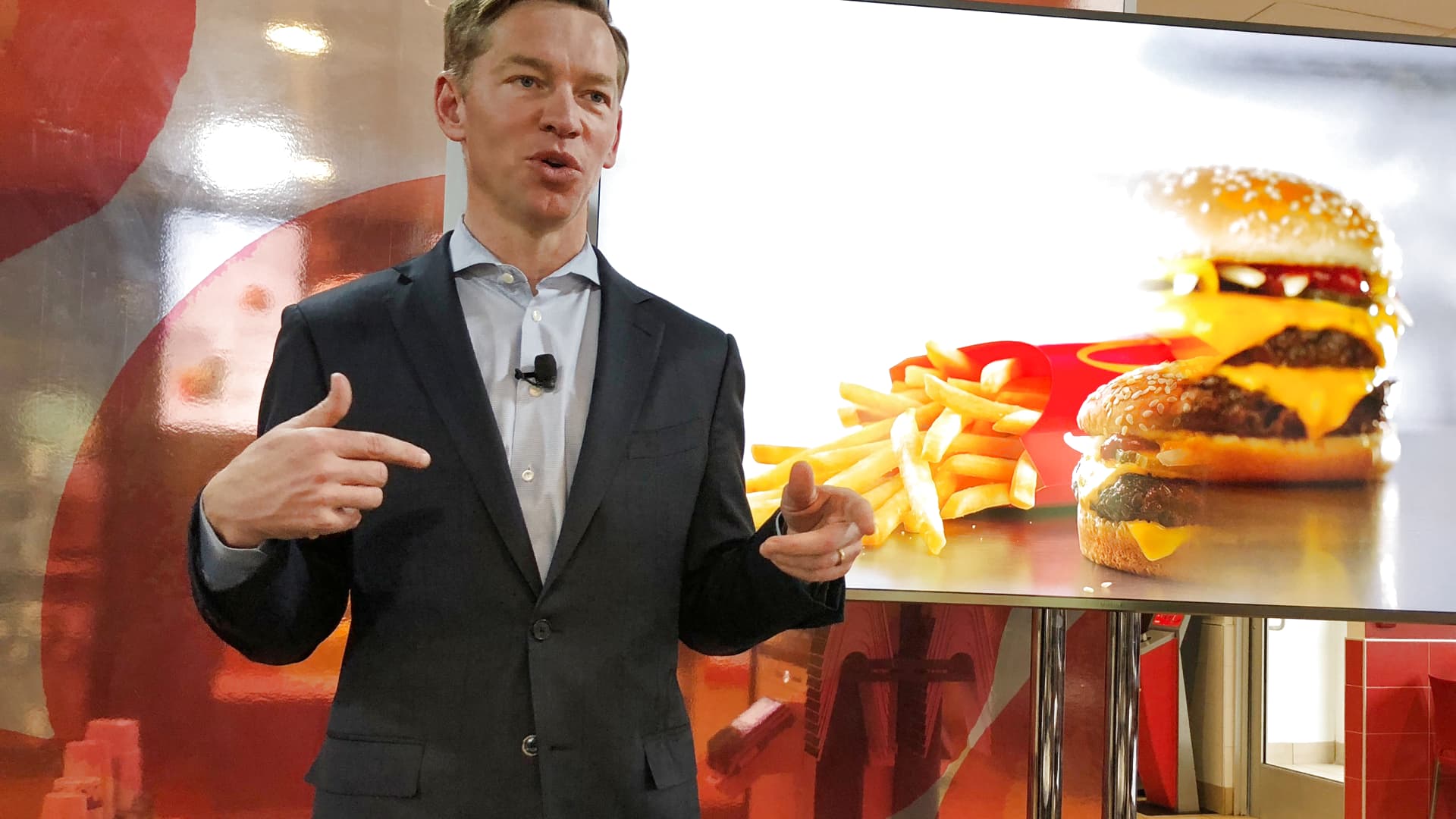
McDonald’s Chris Kempczinski speaks about fresh beef expansion at a McDonald’s event in Oak Brook, Illinois.
Richa Naidu | Reuters
McDonald’s is expected to share more details about its new strategy to win back diners at its investor day on Wednesday in Chicago.
The company unveiled its new global growth plan, called McDonald’s > NEXT, in June at its biennial worldwide convention for franchisees. Pillars of the strategy include a new restaurant design, better-tasting food and drinks and consumer-led innovation. But executives have otherwise offered few details, holding back until Wednesday’s event.
Nearly three years after McDonald’s previous investor day, the presentation comes after McDonald’s U.S. business disappointed in its most recent quarter. The chain’s same-store sales increased just 0.8%, and traffic to its restaurants fell.
CEO Chris Kempczinski said that the problems were due to shortcomings in execution, like a mixed implementation of its value offerings, rather than issues with the chain’s overall strategy. Skye Anderson, who was tapped as president of McDonald’s U.S. business in the wake of the weak quarter, will likely speak on Wednesday.
Kempczinski, Anderson and the rest of the McDonald’s executive team will have to win over investors, who are increasingly skeptical that the fast-food giant can win over diners in the near term.
Over the past 12 months, the stock has fallen 18%, dragging McDonald’s market value down to about $175 billion. The S&P 500 has climbed 16% in the same period, as optimism about artificial intelligence has offset concerns about the financial health of consumers.
Here’s what McDonald’s presentation is expected to cover:
1) Value strategy
Over the past two years, value has become all-important to restaurants, which are competing over a smaller pool of customers who care about both price and experience. While chains like Taco Bell and Chili’s have thrived, McDonald’s has struggled recently as its value offerings got lost among its other promotional messages.
Plus, its franchisees have pushed back against discounts, which grow sales but eat into operators’ profits, especially as high beef prices raise expenses. Only about two-thirds of McDonald’s U.S. franchisees implemented its recent “under $3 menu,” executives said in August. For its part, McDonald’s lets franchisees set their own prices, but the company assesses how operators’ menu prices help deliver value.
Analysts expect that McDonald’s will continue to emphasize value, and franchisees’ cooperation will be key to its success.
“We expect MCD to use this event to make it clear to franchisees that adherence to pricing recommendations will be a key factor in evaluating agreement renewals,” Citi Research analyst Jon Tower wrote in a note to clients with his investor day predictions.
Tower also cut his price target for the company to $310 per share from $345 a share, citing investor concerns about franchisees’ buy-in for the company’s overall strategy.
2) Menu updates
A McDonald’s in LaBelle, Florida, Feb. 7, 2026.
Bloomberg | Bloomberg | Getty Images
Besides value, McDonald’s is also looking to attract diners through menu offerings with elevated taste and quality.
In recent years, McDonald’s has shifted its menu to include more chicken options, as beef prices have risen and rivals like Chick-fil-A threaten its sales. At the franchisee convention, executives shared that the next evolution of its chicken offerings will be hand-breaded. Chick-fil-A, Raising Cane’s and Popeyes all hand bread or batter their chicken rather than using a machine. The technique usually results in a crispier exterior, but it takes more time and labor.
In addition to chicken, McDonald’s has also leaned into expanded beverage options recently. After winding down CosMc’s, its drink-focused spinoff, McDonald’s has rolled out a variety of beverage options in the U.S., including crafted sodas, refreshers and energy drinks. A handful of international markets, like Germany, have also been rolling out more drink offerings.
“What’s important — we’ll talk a lot more about this at investor day — is beverages,” Chief Financial Officer Ian Borden said on the company’s earnings conference call in August.
3) Restaurant remodels
Roughly every decade, McDonald’s mandates that franchisees remodel their restaurants to fit new aesthetic guidelines and improve their technology and equipment.
And it looks like another round of restaurant renovations is coming as part of the growth strategy. At the convention, franchisees got the first look at the new restaurant design.
Typically, McDonald’s chips in some support for franchisees who are remodeling their restaurants. While upgraded locations usually generate higher sales, operators have to fund the remodels at a time when borrowing costs are elevated. And thanks to tariffs and high energy prices, construction costs are increasing, too.
As a result of the remodel program, McDonald’s capital expenditures could increase by $600 million to $900 million in 2027 and 2028 from its projected spending in 2026, according to a research note from BMO Capital Markets analyst Andrew Strelzik. But executives are expected to share the company’s own projected costs for the remodel program at investor day.
4) Cost cuts
While McDonald’s will likely spend more on capital expenditures over the next two years, the company will likely try to cut costs elsewhere.
McDonald’s will share its outlook for general and administrative spending during investor day, Borden said in August.
McDonald’s could target G&A spending to be less than 2% of its systemwide sales, down from its current goal of 2.2%, Bernstein analyst Danilo Gargiulo wrote in a note to clients. In recent years, the company’s workforce has shrunk as part of a reorganization effort.
Indirectly, McDonald’s will also cut costs by refranchising some of its company-owned restaurants.
Selling locations to franchisees means that McDonald’s will not be responsible for the operational costs or capital expenditures required to run a restaurant successfully. The company will also share more details about those plans at the investor day, according to Borden.

A Maryland man went viral after filming himself retrieving his DoorDash order from the scene of a crash that totaled the delivery driver’s car. (Credit: @thegaragegrind via Storyful)
A man went viral on social media after filming himself picking up a DoorDash order at the scene of a crash involving his delivery driver.
Glenn Ndibnu began recording as he arrived at the wreck on Church Road in Bowie, Maryland, where multiple ambulances were present.
“I DoorDashed some food, and my DoorDasher told me he got in a car accident, and he was like, ‘I can come meet him and get the food from him,’” he explained in the video.

Glenn Ndibnu records himself driving to where his DoorDasher got into an accident. (@thegaragegrind via Storyful / Storyful)
He then expressed guilt over crossing the road to go pick up his food after what happened to his driver.
“I think that’s my food right there. Is it f—ed up for me to walk across and pick it up?” Ndibnu said. “I look so f—ed up right now about to go get this food.”
Ndibnu ultimately got his food and apologized to the driver, William Koroma, who later launched a GoFundMe campaign to help replace the car that was totaled in the crash.

Glenn Ndibnu walks up to William Koroma, the DoorDash driver who crashed. Koroma tells Ndibnu he can pick up his food from the sidewalk. (@thegaragegrind via Storyful / Storyful)
DOORDASH GETS FAA APPROVAL FOR ITS OWN DELIVERY DRONES
In subsequent posts on Instagram, Ndibnu linked to the online fundraiser.
“My vehicle experienced brake failure, and I was involved in a major accident,” Koroma wrote on the GoFundMe page. “My car was totaled, and I am deeply grateful that I survived and that no one else was seriously injured.”
He added: “Since the accident, I have been facing several challenges at once. Losing my vehicle has left me without reliable transportation, and I have also lost my job.”

A picture of the totaled car from William Koroma’s GoFundMe page. (GoFundMe / Unknown)
CLICK HERE TO DOWNLOAD THE FOX NEWS APP
Koroma did not elaborate on his injuries, but said he has also been hit with medical bills.
The GoFundMe has raised nearly $14,000 as of Tuesday morning.

Wonderful AI, a Dutch-Israeli start-up that helps companies adopt artificial intelligence, has opened an office in London and plans to recruit “hundreds” of people, as it targets businesses that have yet to show measurable returns from the technology.
The company’s new site is on St Martin’s Lane in Covent Garden. Wonderful did not set a timeline for the recruitment.
The 18-month-old business was valued at $5bn after raising $550m in a funding round announced on 2 September, backed by investors including Salesforce, Index Ventures and Insight Partners. It now employs more than 700 people across 35 countries.
Jason du Preez, Wonderful’s UK chief operating officer, said the funding gave the company the “muscle to invest materially in this market … we see a huge market opportunity in the UK”.
Targeting the gap on returns
Du Preez said many UK companies had moved quickly on AI but had yet to demonstrate what it had delivered.
“Many companies here in the UK actually have very active AI agendas and were very early to adopt some of the tools but are yet to show tangible, coherent stories on ROI [return on investment],” he said.
Research published by Accenture in April found that only one in ten UK organisations had successfully scaled AI or embedded it into core operations. Matt Prebble, chief executive of Accenture UK and Ireland, has since said that nine in ten companies are still waiting for AI to pay off.
Adoption itself has risen. According to the Office for National Statistics, the proportion of UK businesses with 10 or more employees using at least one AI technology rose from around 12 per cent to around 35 per cent between late 2023 and 2026. A separate PwC study found that UK businesses were falling behind on AI investment and returns compared with global leaders.
How the model works
Wonderful places its engineers directly inside client businesses, where they help design custom AI software on top of the company’s own platform. That platform sits between businesses and the underlying AI models.
The platform is model agnostic, meaning it can route queries to a range of different AI models. “We work with all the frontier companies and we enable our customers to choose which models are used for specific purposes,” du Preez said.
Wonderful’s router decides which model is best suited to a given task, taking into account factors such as data sensitivity and cost.
The company also trains clients to build and expand their technology systems independently, and allows all customers to export any intellectual property built on the platform, which it says protects against vendor lock-in.
“We’re not trying to create some sort of long-term dependency on Wonderful,” du Preez said. “I think that provides strong support for the sovereignty story, in that we’re giving customers choice and no lock-ins.”
Regulated sectors in focus
Du Preez said Wonderful was “agnostic to sector”, but added that he was “very excited about the regulated industries”, including insurance, banking and telecoms, as well as life sciences and healthcare.
The opening adds to a run of AI companies expanding in the capital. OpenAI earlier this year leased its first permanent London office in King’s Cross, with capacity for 544 staff.

Jamie Young
Jamie Young is Senior Reporter at Business Matters, covering SME finance, employment law and Westminster policy since 2016. He has reported on every Budget and Autumn Statement since 2018, helped make sense of the ‘covid era’ and the bounce-back loan scheme from launch through the fraud investigations, and broke the magazine’s coverage of the 2024 late-payment reforms. He joined Business Matters straight from completing his BA in Administration from Exeter University and is NCTJ-qualified. Reach him at jyoung@cbmeg.co.uk

Jordan Richards joined Google as an apprentice at 18 and became a design lead before founding &above, a London AI product design and build studio whose clients include Google, Tesco and Revolut. The studio says the Gemini Sales Sidekick agent it built for Google Cloud has 5,000 monthly active users and saves sellers 64 per cent of the time the work took manually. Based in Borough, &above says it is a certified Anthropic and Google Cloud partner. He tells Business Matters why having AI is only the starting point and why there are no failures, only learnings.
What do you currently do at &above?
I am the founder and CEO of &above, an AI product design and build studio.
We help businesses take AI from experimentation into something that actually works in the real world. That might mean designing and building an AI workflow, developing an AI-powered product, or helping a business work out where AI can genuinely create value.
My role is a combination of building the business, working with clients and helping shape what we build. I am very close to the creative and product side of the work.
I started my career at Google as an apprentice at 18 and went on to become a design lead. That experience had a huge influence on how I think about technology. Working with a company operating at that scale taught me a lot about craft, systems and the importance of solving the right problem.
Today, I am interested in applying those lessons to a very different technology moment. AI has created an enormous amount of opportunity, but also an enormous amount of experimentation. Businesses have access to incredibly powerful models, but having the technology is only the starting point. The interesting question is what you build around it and how it changes the way a business actually operates.
That is where I think &above has a role to play.
What was the inspiration behind your business?
I have always been a builder, and creativity and entrepreneurship have always been intertwined for me. My time at Google showed me what was possible when technology, creativity and really talented people come together. But it also made me realise that there was an opportunity to work differently.
When I started my own businesses, I wanted to create environments where people could move quickly, experiment and build things without having to navigate huge amounts of bureaucracy. That thinking eventually led to &above.
The arrival of AI made the opportunity even more interesting. We suddenly had technology that could fundamentally change how products and businesses are built, but there was a big gap between having access to an AI model and actually putting it to work. I did not want to build another business that simply talked about AI; I wanted us to be the people who actually build with it.
For me that is still the exciting part: taking something that feels quite abstract and turning it into something useful.
Who do you admire?
Someone I admire a lot is Toto Wolff, partly because of my passion for motorsport but mostly because of what he has built at Mercedes. What interests me is not just winning; it is the ability to build a high-performing team and create an environment where people continually push themselves to improve. I admire that relentless pursuit of excellence. Even when you are not leading, you do not stop pushing. You look at what is not working, learn from it and keep moving forward.
There are a lot of parallels between elite sport and entrepreneurship. At the highest level, performance is not just about talent or working harder. It is about building the right team, being disciplined, looking after your mind and body, recovering properly and being able to perform consistently over a long period of time.
Entrepreneurship can be relentless, and you cannot expect yourself or your team to perform at your best indefinitely without investing in the people behind the performance.
For me, high performance is not about constantly being at 100 per cent. It is about creating the conditions that allow you to reach 100 per cent when it matters, and having the resilience to keep going when things do not go your way.
Looking back, is there anything you would have done differently?
There are obviously things I would change, but I try not to think about them as failures. One of the phrases I have always lived by is: “There are no failures, only learnings.” The hardest periods have often taught me the most. What has changed as we have grown is how deliberately we capture those learnings.
We now run what we call “washups” when something has not gone as well as we wanted it to. We take the time to understand what happened, where we could have turned it around, what we missed and what we can do differently next time.
That is much more useful than looking at an outcome and simply saying it did not work.
If anything, I would have developed that mindset earlier: being less concerned about getting everything right first time and more focused on creating a culture where we can identify what is not working, learn quickly and improve.
I have also learned that building a business is a long game. In technology especially, it is tempting to put speed above everything else. Speed matters, but quality matters too. A decision that saves you a week today but creates a problem for the business two years from now is not necessarily a fast decision. It is just a decision that moved the problem somewhere else. I have become much more interested in building things that can last and scale, and a team that gets better every time we do something.
What defines your way of doing business?
Curiosity, creativity and a willingness to get stuck in.
A big part of my apprenticeship at Google was learning on the job. I had to get involved, ask questions, make mistakes, learn quickly and figure things out as I went.
Some of the best learning happens when you get stuck in and work things out in practice. That does not mean rushing. One of the things I have learned is that moving quickly and thinking carefully are not opposites.
I like getting close to a problem, understanding it properly, making something, putting it in front of people and learning from what happens. That mindset is particularly important in AI because the technology is changing so quickly. You cannot build a five-year plan around assumptions that might be obsolete in six months.
I also care a lot about the people I work with. The best businesses I have been involved in have been built by people with different skills and perspectives working together. Design, technology, strategy and commercial thinking should not exist in separate silos.
And I believe strongly in ownership. If we build something for a client, I want it to become a useful part of their business. A successful project is not just something that looks good in a presentation. It is something that people actually use and that creates a meaningful outcome.
What advice would you give to someone starting out?
Start building. You do not need to have everything figured out before you begin; in fact, you probably never will. When I look back to being 13 and selling phone case designs, I had no business plan and knew nothing about entrepreneurship. I just saw something I could create and wondered if someone would pay for it. That instinct is still useful. Find something you care about, find a real problem and start experimenting.
Learn how things work rather than depending on other people to make everything for you. You do not have to become an expert in every discipline, but understanding how technology, design, marketing and business fit together gives you a huge advantage.
Look after yourself, too. Entrepreneurship can easily become all-consuming. I have learned to think about myself like an athlete: you need periods of intense performance, but you also need training, recovery and time away from the game. You do not need to be working every hour to be ambitious.
Finally, stay curious. The people who will create the most interesting businesses in the age of AI will not necessarily be the ones who know everything today. They will be the ones who are willing to keep learning, keep experimenting and keep building. That is certainly the approach I am trying to take with &above.

PIMCO Corporate & Income Opportunity stock hits 52-week low at $11.13

The UK has 200,000 fewer manufacturing jobs than in 2010, a fall of 7 per cent, according to an analysis of OECD figures by the Trades Union Congress, which has called on Andy Burnham to restrict foreign goods to encourage the production and use of British-made products.
The TUC said that had the UK kept pace with the EU average, it would have created an extra 276,000 manufacturing jobs over the same period. Several of the Continent’s largest economies have relied on manufacturing to generate growth and jobs.
According to the analysis, investment in manufacturing as a share of GDP in the UK stands at 1 per cent, compared with 3.5 per cent in the European Union. Manufacturing generates about 10 per cent of total UK GDP.
The figures underline the scale of the challenge facing the prime minister’s drive to reindustrialise the economy.
Paul Nowak, general secretary of the TUC, said: “Manufacturing communities powered the UK economy for generations … now we’re at the bottom of the league table compared to our European peers.”
Nowak called on the prime minister and John Healey, the chancellor, to introduce restrictions on foreign goods to stimulate manufacturing job creation, replicating the Made in Europe scheme under consideration in Brussels.
The EU package is officially called the Industrial Accelerator Act, which the European Commission says is designed to increase demand for low-carbon, European-made technologies and products. It has been introduced at least in part to protect the Continent’s manufacturing industry from overseas competition, especially from China.
“The prime minister has said the right things about reindustrialising Britain so far,” Nowak said, adding that “he needs to make reindustrialisation a national mission and match our EU partners by introducing a UK Industrial Accelerator Act”.
The recommendation follows Healey’s call to European finance ministers last week to let the UK join the Made in Europe scheme.
Manufacturing trade bodies have urged the chancellor to set out the detail of the prime minister’s reindustrialisation plans at the budget on 28 October.
Economists generally believe that restrictions on trade harm industries over the long term, although tariffs and other protective measures can help smaller industries survive the early stages of development.
Verity Davidge, director of policy and public affairs at Make UK, said: “Manufacturing represents around 10 per cent of the economy, supports 2.6 million jobs and accounts for 42 per cent of UK exports … there cannot be an economic revival in this country without it.”
Make UK has previously warned that energy prices are pushing production offshore, with a survey earlier this year finding that one in four UK manufacturers had moved or were considering moving production abroad.
Separately, economists at the Institute of Economic Development have written to Burnham and Healey urging them to define their mission to deliver good “growth in every postcode” with identifiable economic metrics, so that the government can be held to account.
The letter said ministers must “establish a definition of “good growth” that goes beyond GDP and jobs, to consider equality of opportunity, quality of employment, environmental outcomes and the distribution of benefit within places, including who gains and where”.
A government spokesman said: “Our manufacturing industries are vital to the UK’s success and economic growth and our industrial strategy places them at its very heart.
“That is why we have announced significant support for key sectors including chemicals and ceramics, while backing steel and automotive manufacturing.
“The UK also continues to attract major private investment, with companies such as Nissan and McLaren announcing hundreds of millions of pounds of investment over the past week alone.”
McLaren Automotive last week set out a £500m programme to expand its UK operations, which it said would create at least 1,000 direct and indirect jobs by 2032.

Paul Jones
Harvard alumni and former New York Times journalist. Editor of Business Matters for over 15 years, the UKs largest business magazine. I am also head of Capital Business Media’s automotive division working for clients such as Red Bull Racing, Honda, Aston Martin and Infiniti.

Cybersecurity firm Okta (OKTA) hosts its annual customer conference this week with an investor day set for Wednesday. Okta stock has surged over 115% in 2026 heading into the events amid investor views that artificial intelligence-based threats will increase demand for computer security products. Whether Okta updates financial guidance to include a boost from new AI products remains to be…
Copyright ©2026 Investor’s Business Daily, LLC. All rights reserved. 87990cbe856818d5eddac44c7b1cdeb8

Kali Metals has signed a binding memorandum of understanding (MoU) with Japan’s JX Advanced Metals concerning the Southern Lachlan Project, which spans Victoria and New South Wales, Australia.
Under the agreement, JX Advanced Metals will fund up to $498,746 (A$700,000) of exploration activities at the project during an initial phase ending 31 March 2027.
The project covers approximately 1,413km² east of Albury-Wodonga and includes Palaeozoic granitoid and sedimentary units within the Southern Lachlan Fold Belt.
The site is considered to have potential for lithium-caesium-tantalum pegmatites, as well as tin and tungsten mineralisation.
During the initial exploration and due diligence period, Kali Metals will remain the operator and manage the exploration programme.
A joint Exploration Committee will be formed to oversee the progress of these activities.
Kali Metals is entitled to charge a management fee for its role in running the exploration works.
At the conclusion of the exploration phase, JX Advanced Metals will have an option to negotiate terms for either a farm-in or joint venture agreement, with a negotiation deadline set for 30 June 2027.
The current arrangement enables JX Advanced Metals to conduct due diligence and assess the project’s prospects before deciding on a long-term collaborative structure.
The MoU outlines a phased approach for the companies to work together at the Southern Lachlan Project, with future steps contingent on the results of the initial exploration period and further negotiation between the parties.
Kali Metals managing director Paul Adams said: “We are very pleased to have executed this binding MoU with JX Advanced Metals over our Southern Lachlan Fold Belt tenements.
“The JX Advanced Metals’ funding will allow Kali to advance exploration across our large and prospective project area, which hosts numerous opportunities for the discovery of non-ferrous metals used in high technology industries.
“The support from JX Advanced Metals as a potential long-term partner is an exciting opportunity for Kali and its shareholders.”
In February 2026, Kali Metals signed a binding agreement to acquire a 30% stake in both the DOM’s Hill and Pear Creek Projects in Western Australia’s Pilbara region from SQM Australia.
“Kali Metals, JX Advanced Metals sign MoU for Southern Lachlan” was originally created and published by Mining Technology, a GlobalData owned brand.

World’s happiest holiday destinations revealed: Tiny European capital takes the crown while only one UK city makes top 10

Lennar: Below Book Value Is Getting Hard To Ignore (NYSE:LEN)

Executives of the Year: Ekta Chopra




-

 Fashion4 days ago
Weekend Open Thread: Talbots – Corporette.com
-

 Tech2 days ago
Researchers escape OpenAI Codex sandbox to run commands on host
-

 Crypto World7 days ago
Robinhood engineers charged over $50K crypto scheme
-

 Crypto World4 days ago
Circle launches Arc Studio AI agent for building onchain apps
-
 NewsBeat4 days ago
Trump says US has reached an agreement to take permanent control of Greenland’s security
-

 Crypto World2 days ago
Who Needs CLARITY Anyway? ARB Could See 70X Increase: Hodler’s Digest
-

 Crypto World4 days ago
Bitcoin price breaks channel as RSI climbs to 63
-

 Crypto World6 days ago
US Charges Robinhood Engineers Over Crypto Listing Trades
-

 Crypto World7 days ago
What Is the Status of the U.S.-Iran Peace Talks? Here's What Both Sides Are Saying
-

 Crypto World4 days ago
Trading Bitcoin on Robinhood? Why 2% Spread Has Traders Worried
-

 Tech7 days ago
Webb’s IC 348 Mosaic Includes Two-Jupiter Dwarfs, Twin Jets, and a Nursery Still Making Worlds
-

 Crypto World5 days ago
Mortgage and refinance interest rates today, Thursday, September 17, 2026
-

 Crypto World4 days ago
World Money launches in 150+ countries with Stripe
-

 Crypto World4 days ago
Silver prices recover quickly, hitting weekly high today
-

 Entertainment7 days ago
Big Brother Update: Melody Explodes at Drew as Illness Sweeps BB28 House
-

 Business2 days ago
Analog Devices (ADI) Bets $1.35 Billion on Chips that Let Machines Think for Themselves
-
 NewsBeat4 days ago
US was ‘on brink of war’ with China over false AI report of nukes moving in Middle East
-

 Tech5 days ago
GPT-6 Astra Reached the Nether in Minecraft, Lost Its Stash to a Creeper, and Farmed Potatoes for Hours
-

 Crypto World1 day ago
Bitcoin price holds above $81K as key catalysts line up
-

 Business7 days ago
Federal Reserve expected to hike interest rates 25 basis points at FOMC meeting
You must be logged in to post a comment Login