

-neuron-chip.jpg)







Sonos Beam Ultra review
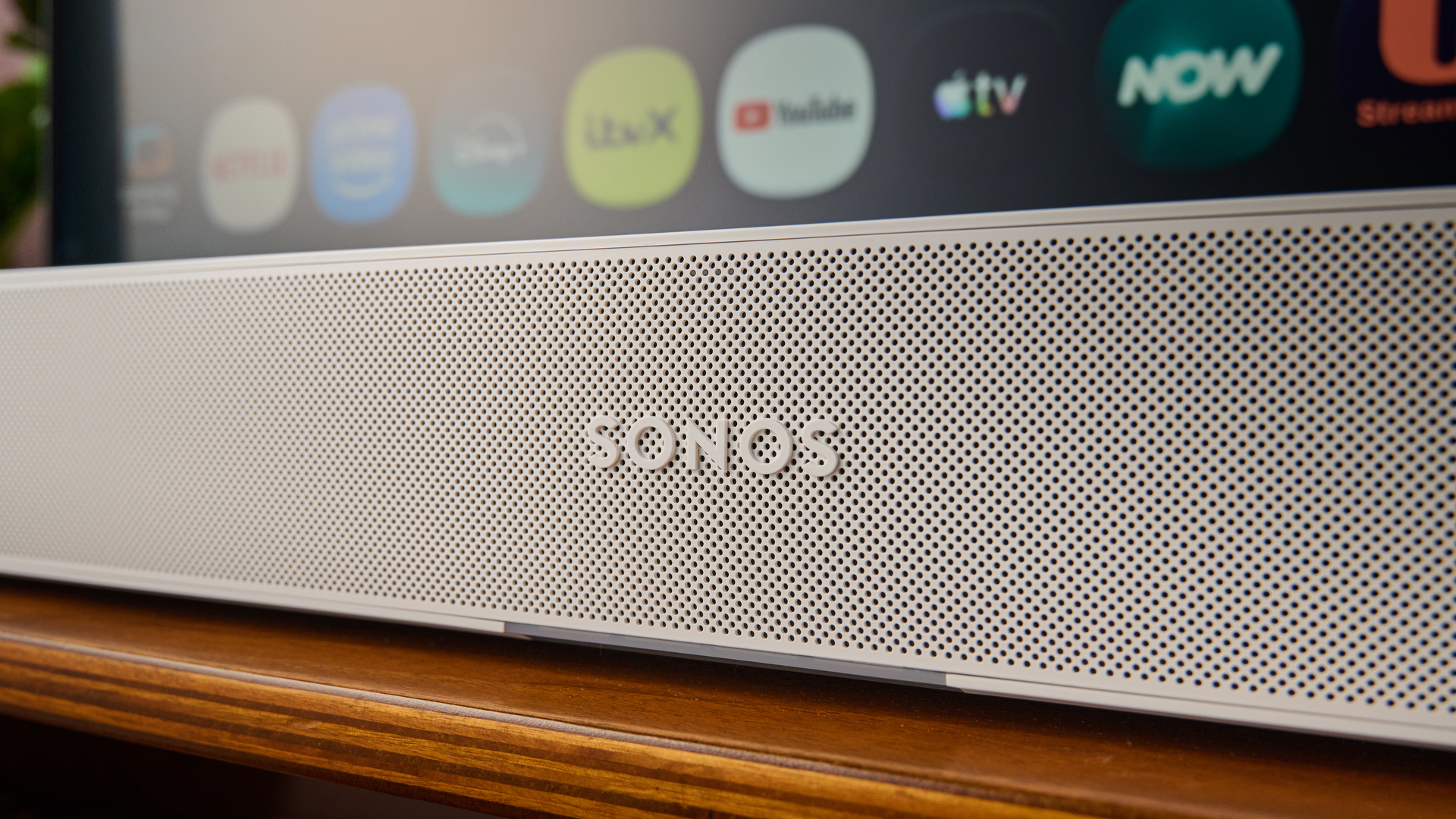
The Sonos Beam Ultra doesn’t merely feel like an evolution of the pre-existing Beam products. Instead, it feels like something of a middle child between the Sonos Beam Gen 2 and the Sonos Arc Ultra. After all, it sits bang in between its sibling models when it comes to channel configuration, boasting a 7.1.2 setup with nine drivers, and while it has up-firing drivers for true Dolby Atmos, it still maintains a fairly compact design.
But the Beam Ultra certainly isn’t an awkward middle-child; it’s a highly capable mid-range option that provides striking cinematic sound, while still being able to fit into a smaller setup. But is the Sonos Beam Ultra worth its $699 / £699 / AU$1,099 asking price?
Like most of the best soundbars, the Sonos Beam Ultra supports Dolby Atmos (though notably Sonos omits DTS:X), and it handles the format very effectively. When watching a 4K UHD Blu-ray of The Mask, the soundbar seamlessly tracked the titular character as he tornadoes across the screen, with audio sounding as if it far exceeded the limited confines of the soundbar. When The Mask jumped upwards, diagonally, his upward trajectory was captured with precision.
Latest Videos FromTechRadar

And the Beam Ultra continued to impress me with its height effects across multiple movies. For instance, in Godzilla Minus One, the sense of a plane flying overhead was replicated more naturally than I expected from a mid-range bar. When Godzilla first appeared, the width of the kaiju’s movement was handled brilliantly — it sounded as if the creature’s stomping and destruction were emanating from different corners of the testing room, rather than a set of speakers, even without the help of surround speakers.
What’s more, the Sonos Beam Ultra nails the fundamentals. Watching Top Gun: Maverick, the roar of jet engines was palpable, and I found this to be the case across multiple films. For a mid-sized standalone bar, the Beam Ultra produces incredibly regimented, deep, and responsive low-end sound, which is excellent for movies with high-octane action sequences and dark, impactful scores. The Beam Ultra can also get seriously loud if you want to fill a more open space, but I never noticed any tinniness or harsh compression.
Still, this doesn’t come at the expense of sounds elsewhere in the frequency range. I found dialogue to be generally clear and detailed too, though I will note that turning on the Speech Enhancement mode and setting it to Medium gave me the best results. This means you can bring voices forward without hampering the fidelity of other elements in the mix.
The Beam Ultra even proved to be a hit for music, whether I was listening to an Atmos or stereo mix. With an Atmos mix of I’m Gonna Love You Just A Little More Baby by Barry White, there was tremendous width to the guitars, the vocals were perfectly clear in the center, and the bass had pleasant warmth to it. Moving over to First Summer by H.K., deep bass came through with attention-grabbing impact, sounding more full-sounding than I’d anticipated, yet keys and vocal chops in the mid-range still maintained excellent clarity, as did articulate drums in the treble.

The Sonos Beam Ultra isn’t just a great performer; it’s also rammed full of useful features. TruePlay is here, which can optimize sound for your room in mere seconds, but there are also ways to manually adapt audio. For instance, you can adjust height effects to your choosing, and there’s even a height-effect simulation mode if there’s less than four inches of space above your soundbar — ideal if you’re placing the Beam Ultra on a shelf in your TV stand, say.
I’ve already mentioned the Speech Enhancement mode, which has multiple levels to emphasize speech as little or much as you need, but there’s also a Night mode if you don’t want to disturb others. You can turn these options on in the Sonos app, but there’s also an option to add a voice assistant if you want to make adjustments on the fly.
The Beam Ultra can, as you’d expect, also interact with other components in your Sonos system. You can pair compatible speakers, such as the Sonos Play, and use them as surround speakers. TV Audio Swap is also back, and enables you to transfer sound from your Beam Ultra to your Sonos Ace or Sonos Ace Ultra headphones. I tried this out with the latter cans, and found that switching was speedy and responsive, while the quality of spatial audio was exceptional — make sure to read my Sonos Ace Ultra review for a deeper dive.
There are a fair few ways to connect to your Sonos Beam Ultra too. Of course, HDMI eARC is the most important — this is what you’ll use to hook the soundbar up to your TV and experience Dolby Atmos movies in all their glory. There’s also Wi-Fi 6 for streaming content over a local connection, allowing you to use services like Tidal Connect and Spotify Connect. And, unlike with the Beam Gen 2, you also get Bluetooth 5.3 connectivity as well as USB-C line-in.
One thing I would have really have loved to see, though, is an HDMI input, which has been left off of the Sonos Beam Ultra. Given that connecting the soundbar up to your TV already takes away one precious HDMI slot, it would’ve been great to get a passthrough port on this model — it’s something I use on my Marshall Heston 120 at home, given that I have multiple game consoles connected up.
Something that does not disappoint, though, is the Beam Ultra’s design. It’s sleek, modern, and stylish — but understated enough to seamlessly slot into just about any living space. It also has a great standard of build, intuitive touch controls, and handy status indicator lights to signify connection status. There’s also a microphone slider, which you can deactivate if you don’t want your soundbar listening in on you.
But here comes the big question: is the Sonos Beam Ultra actually worth the money? While $699 / £699 / AU$1,099 is by no means cheap, I still think the answer is yes. It’s priced right in between the Beam Gen 2 and Arc Ultra, and feels like a true best-of-both-worlds option — the height channels give it much more convincing Atmos performance than the Beam Gen 2, but you also get amazing power in a single, compact package.
Sure, you could get a soundbar and sub combo like the Samsung HW-Q800F for a similar price, and that will give you even deeper, more cinematic bass. But that model has a more restrictive 5.1.2 configuration, and if you want something more low-profile, it won’t fit the bill. You also get an excellent suite of features from the Beam Ultra, and you can add a compatible sub and other other Sonos speakers for surround sound if you wish.
As a result, the Sonos Beam Ultra might just be the best compact Dolby Atmos soundbar I’ve tested. In spite of its modest size, it plates up powerful, immersive, and clear audio, so if you want a simple plug-and-play solution to get amazing audio into just about any space, this is my top recommendation.

Sonos Beam Ultra review: Price and release date
- Priced at $699 / £699 / AU$1,099
- Released in September 2026
The Sonos Beam Ultra is priced at $699 / £699 / AU$1,099, placing it mid-way between the Sonos Beam Gen 2 and the Sonos Arc Ultra. While you can get some multi-box options for a similar price, like the Sony HW-Q800F, for instance, the Beam Ultra features an extensive 7.1.2 driver configuration, and its compact nature is a central part of its appeal.
Sonos Beam Ultra review: specs
|
Dimensions |
29.5 x 2.6 x 4.1 inches / 750 x 65 x 105mm |
|
Speaker channels |
7.1.2 |
|
Connections |
HDMI eARC, Wi-Fi 6, Bluetooth 5.3, USB-C |
|
Dolby Atmos / DTS:X |
Yes / No |
|
Sub included |
No |
|
Rear speakers included |
No |

Should I buy the Sonos Beam Ultra?
|
Attribute |
Notes |
Score |
|---|---|---|
|
Features |
Good connectivity options, great sound modes, can add sub and surrounds, no DTS:X or HDMI passthrough. |
4.5/5 |
|
Performance |
Expansive sound in a compact package with imposing bass and clear dialogue. |
5/5 |
|
Design |
Stellar looks, slim build, neat touch controls. |
5/5 |
|
Setup & usability |
Plug and play set-up, easy to connect to via Wi-Fi or Bluetooth. |
5/5 |
|
Value |
Not cheap, but a perfect marriage of the standard Beam and Arc that’s priced accordingly. |
4.5/5 |
Buy it if…
Don’t buy it if…
Sonos Beam Ultra review: also consider
| Header Cell – Column 0 |
Sonos Beam Ultra |
Samsung HW-Q800F |
Bose Smart Ultra Soundbar |
|---|---|---|---|
|
Price |
$699 / £699 / AU$1,099 |
$1,099 / £799 / AU$1,099 |
£899 / $899 / AU$1499 |
|
Dimensions |
29.5 x 2.6 x 4.1 inches / 750 x 65 x 105mm |
Main soundbar: 43.7 x 2.4 x 4.7 inches / 1110.7 x 60.4 x 120mm; subwoofer: 9.8 x 9.9 x 9.8 inches / 249 x 251.8 x 249mm |
2.3 x 41 x 4.2 inches / 58 x 1045 x 107mm |
|
Speaker channels |
7.1.2 |
5.1.2 |
5.1.2 |
|
Connections |
HDMI eARC, Wi-Fi 6, Bluetooth 5.3, USB-C |
1x HDMI input, 1x HDMI eARC, digital optical, Wi-Fi, Bluetooth 5.3 |
HDMI eARC, digital optical, Ethernet, USB (service only), Bluetooth, Wi-Fi |
|
Dolby Atmos / DTS:X |
Yes / No |
Yes / Yes |
Yes / No |
|
Sub included |
No |
Yes |
No |
|
Rear speakers included |
No |
No |
No |
How I tested the Sonos Beam Ultra

- I spent one week testing the soundbar in our TV testing space at Future Labs
- I watched a variety of movies, and listened to music in both Dolby Atmos and stereo formats
I spent one week testing the Sonos Beam Ultra at our TV testing space at Future Labs, during which time I exhausted its various features, watched a variety of movies, and listened to music in both Dolby Atmos and stereo formats.
To test the Beam Ultra, I hooked it up to the Samsung R95H TV via HDMI. I also made use of the Panasonic DP-UB820 to view Dolby Atmos-enabled 4K UHD Blu-rays. When listening to music, I streamed tunes over Tidal Connect via Wi-Fi, and made use of the TV Audio Swap feature to transfer audio from the soundbar to the Sonos Ace Ultra headphones.
I also compared the Sonos Beam Ultra directly against the Sonos Beam Gen 2 to assess improvements to height effects, expansiveness, and general functionality.
I’ve spent several years testing audio-visual gear at TechRadar, where I’m a Senior Reviews Writer. I’ve tested a vast number of soundbars specifically, from compact models like the Marshall Heston 60 to grand surround systems like the LG Sound Suite Immersive Suite 7 Pro.



















































You must be logged in to post a comment Login