Connect with us

Business

$87b boost to the WA economy from small business

Published

on

$87b boost to the WA economy from small business

Yes. Corporate subscriptions are available for teams and organisations, with discounted rates as user numbers increase. Pricing starts from $1,625 + GST per user.
Get in touch
to discuss the right option for your organisation.

Business News subscriptions are used by executives, investors, consultants and professionals who need to stay informed and make better decisions about the WA market. When you subscribe you’ll get

  • Unlimited access to WA’s most trusted business journalism
  • Data & Insights — detailed profiles of WA companies, people, projects and deals
  • MyBN — a personalised feed based on the companies, people and sectors you follow
  • Special publications and industry reports
  • Daily and weekly email newsletters

Data & Insights is a research tool built specifically for the WA market. It draws on more than 30 years of Business News reporting, updated regularly to reflect what’s happening now. Use it to:

  • Look up detailed profiles of WA companies, including financials, directors and ownership
  • Find decision-makers and track their career movements
  • Research live and completed projects across WA industries
  • Monitor deals, appointments and market activity
  • Access industry rankings and league tables

Data & Insights is updated daily by our dedicated research team, which uses the latest announcements, ASX filings and editorial coverage to keep our person, company, list and project records up to date.

Business News welcome all opportunities to make our dataset accurate, complete and current, so if you have an update request, please email the team at
general@businessnews.com.au, and we’d be happy to assist.

Advertisement

MyBN
is part of every subscription. It’s your personalised view of Business News. You can follow the companies, people, sectors and projects that matter to you, and get a news feed and alerts tailored to your interests. You can save articles to read later and retain only what you need.

Only subscribers have full access to all content on the Business News website.

Advertisement

If staying informed about the WA economy is part of your job, and/or you’re looking for networking opportunities in WA, Business News is built for you.

Business News subscribers are:

  • Executives and directors tracking competitors, clients and market movements
  • Investors and advisers researching companies, deals and industry trends
  • Consultants and professionals staying across sectors relevant to their clients
  • Business owners looking for leads, context and market intelligence

Most Business News publications cover national or global markets. Business News is focused entirely on Western Australia, which means the journalism, the data and the intelligence are all built around WA companies, people and projects — not adapted from a national feed. Data & Insights, included with every subscription, combines more than 30 years of WA-specific editorial research with live business data. There’s no comparable product for the WA market.

Advertisement

The Morning Digest Email provides a comprehensive wrap of the major headlines, relevant to WA business, and includes with a snapshot of the overnight news covering oil, gold and ASX-listed companies.

The Afternoon Wrap Email focuses on the news covered by our team of journalists during the course of the working day, including exclusive stories and analysis, all of which relates to WA business and the local economy.

The BN Weekender Email contains a wrap of the Business News from the week that was, highlighting the top stories in each area of WA business.
Sign up for free.

Advertisement

We’re happy to help.
Get in touch
and our team will come back to you.

Advertisement
Continue Reading
Click to comment

You must be logged in to post a comment Login

Leave a Reply

Business

2,100 homes plus employment space planned for for Cheshire countryside

Published

on

Business Live

Developer says project will help Cheshire East meet housing need

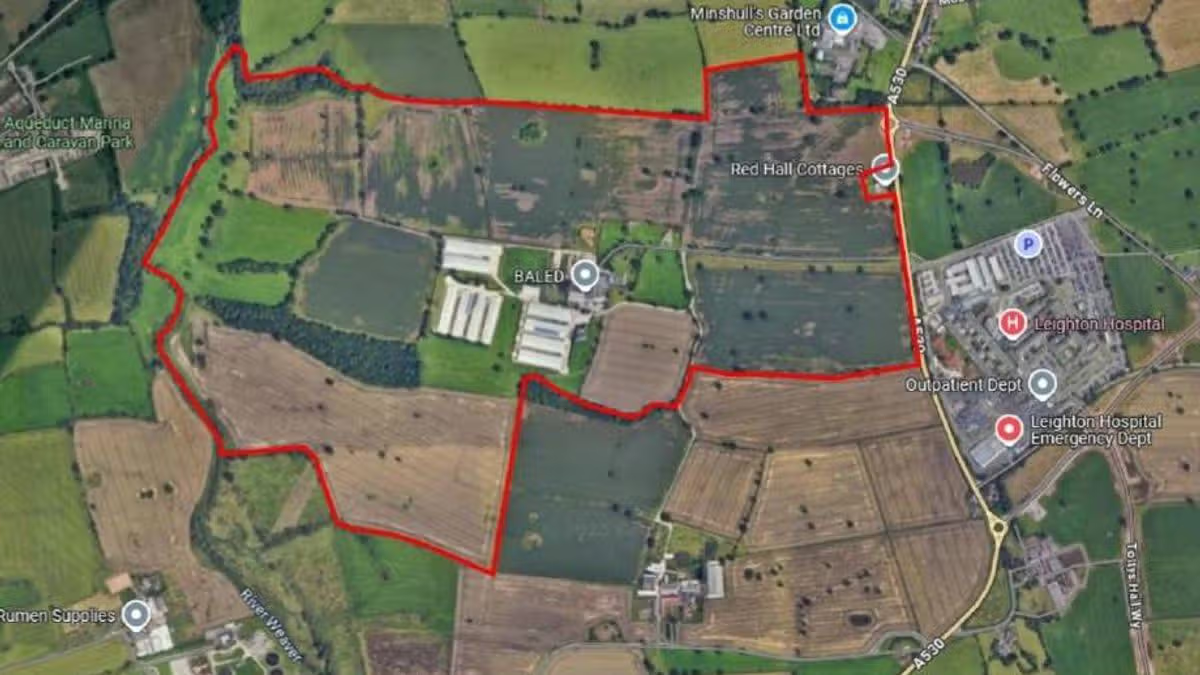
The application site, outlined in red, for up to 2,100 homes on land at Red Hall Farm, Crewe.

The application site, outlined in red, for up to 2,100 homes on land at Red Hall Farm, Crewe(Image: Local Democracy Reporting Service)

Plans have been submitted for a massive 2,100-home estate in the open countryside on the outskirts of Crewe.

Advertisement

Cheshire Fresh Ltd has applied for outline permission to build up to 2,100 homes, including 30 per cent affordable, on land at Red Hall Farm off Middlewich Road, close to Leighton Hospital.

The scheme includes the demolition of existing buildings, the provision of employment land, retail and health services and space to support a local centre, as well as provision of a site for a primary school and public open space.

A planning statement, submitted by Spawforths on behalf of the applicant, states: “The site is located within unallocated open countryside, however it represents the most logical and sustainable location for the expansion of Crewe.

“Unlike other sites located around Crewe, the site does not fall within a designated green gap, it is not within the green belt, and is not within or subject to significant landscape, ecological or heritage constraints, nor is it at risk of flooding.”

Advertisement

The majority of the 113-hectare site consists of arable farmland, which, the applicant says, is ‘predominantly subgrade 3b agricultural land’.

Cheshire East doesn’t have a five-year supply of housing land since the government revised the national planning policy framework (NPPF) at the end of 2024.

The planning statement from Spawforth’s says: “This sustainable urban extension on the urban edge of the town, presents an opportunity to contribute towards the council’s housing need…

“The proposed development is located in a highly sustainable location to the north east of Crewe.

Advertisement

“The site is close to the amenities provided within Crewe town centre, and is well connected to the wider strategic road network, with direct links to the A530 and close links to the Shavington Bypass, connecting to the A534, the A500, and the M6 and beyond.

“Furthermore, surrounding highway network that serves the site has already been the subject of significant updates through the North West Crewe package scheme.”

It adds: “The proposed development is also seeking to deliver employment space in a location adjacent to a major hospital as well as Bentley Motors, both of which are vital to the economic prospects of the region.”

The application, number 26/2711/OUT, can be viewed on the planning portal on Cheshire East Council’s website. The last date for submitting comments is September 9.

Advertisement
Continue Reading

Business

The Expanding Cultural Influence of Digital Games

Published

on

It has been revealed that the digital gaming revolution has revolutionized the way we purchase and play games. Still, it has also given us an uncountable number of ways to save money.

The curtains were closed and the activity was technical, solitary and slightly obscure. That was the image, at least. But it was never entirely accurate.

Gaming was social long before online multiplayer became ordinary. Players exchanged discs, discussed strategies and carried heavy computers to local gatherings.

What changed was not simply the number of people playing. The culture that had formed in private rooms became visible to a much wider public. Today, gaming is present in fashion collections, film production, live music, sport events and online entertainment. Characters become celebrities. Soundtracks reach concert venues and virtual clothing inspires real-life fashion. Gaming has not merely joined popular culture. It has developed into one of the systems through which popular culture now moves.

The hobby built its own institutions

Gaming did not wait for traditional cultural industries to recognise it. Players created their own forums, competitions and social rules. They modified games, produced artwork and organised gatherings around technology that was not always designed to travel.

The basement was therefore more than a stereotype. It was an early cultural space where people learned how to build communities around interactive media. The activity involved playing but also programming, collecting, designing and displaying their expertise in front of others.

Advertisement

Local multiplayer gatherings turned private enthusiasm into a shared event. Later, streaming made the audience visible. A person playing at home could suddenly perform for thousands of viewers, while spectators developed their own rituals, jokes and personalities. Modern gaming festivals show how far that idea has expanded.

This combination matters because it makes digital games difficult to place in one traditional category. The industry has grown alongside this wider culture. Its broader influence comes from the way games encourage participation rather than passive spectatorship.

Games began exporting their language

Early games borrowed heavily from elsewhere. Adventure titles used the structure of fantasy novels. Action games recreated the pace of films, while sports games copied television presentation. As the medium matured, the direction of influence started to reverse.

Film and television now borrow production methods from games, as parts of the filmmaking process itself increasingly resemble game development. Music has also moved into game worlds. A soundtrack no longer needs to sit quietly behind the action. It can define a character, introduce players to an artist or become the reason a particular online casino slot remains memorable. Virtual performances and online casinos take the connection further by turning the audience into participants who move through the event rather than watch from fixed seats.

Advertisement

Events have changed too. Younger audiences are accustomed to entering environments where they can choose a route, complete a task and shape their own experience. That expectation influences exhibitions, branded events and festivals, which increasingly offer more than a stage and a timetable.

Gaming’s greatest cultural contribution may therefore be a new relationship between the audience and the work. Players expect to explore, alter and discuss what they encounter. They do not simply receive a finished product and move on.

Advertisement
Continue Reading

Business

Families under pressure to find food in summer, says charity

Published

on

Four volunteers - three women and a man - volunteering at a foodbank. They are organising the food and drink products - which include bottles of Ribena, cartons of oat milk, and snap pots of spaghetti hoops - neatly onto a table.

With the school holidays in full swing, a charity is running ‘family fun days’ to help those struggling with the cost of food over the summer break.

YMCA Cheltenham is hosting park-based events, which allow children to play outside and enjoy free, healthy food with their family.

Rob Charsley, head of communities, health and wellbeing at the charity, said 67 children and their families had attended an event in one week alone.

Meanwhile, in Somerset, Radstock Food Club said the increased cost of living had seen a rise in the number of people requiring their service, with more than 100 families now receiving food from the facility.

Advertisement
Continue Reading

Business

Charity Clothing Coventry charity opens school uniform pop-up

Published

on

Zia Lee stands in a black vest top with a denim cap on and black glasses and long blonde hair.  Behind her are green crates with school names and carefully folded uniforms in them.

Angelica Jaros’ son is starting school this year, on top of buying uniform for her six-year-old daughter too.

She said there was pressure to get new clothes, bags and shoes.

“It’s about £300 per kid…. because you remember when you were a child, you wanted to go to school with brand new things, you want the same thing for your kids as well,” Jaros explained.

Meme Horner, 21, volunteers at the charity and said it’s a way of giving back.

Advertisement

“As a child I got hand-me-downs, my mum got quite a lot of help, so it’s kind of like just giving back to the community in a way, I feel good doing it,” she said.

Schools having three branded items is still too many, she added.

“The crisis of money nowadays, the inflation has gone up so dramatically, and parents are struggling to do the basic necessities, let alone get children three pairs of logoed clothing for school,” she explained.

Advertisement
Continue Reading

Business

(VIDEO) MrBeast’s ‘Last To Leave Mansion’ Traps Contestants Who Called Him ‘Too Easy’ In Brutal Challenges

Published

on

Shannon Elizabeth

GREENVILLE, N.C. — YouTube star MrBeast has released a new endurance video that recruited contestants specifically because they had publicly claimed his challenges were too easy, then put that boast to the test inside a sprawling mansion over more than three months.

The video, titled “Last To Leave Mansion, Keeps It,” features roughly 15 contestants competing to be the final person remaining in the house, with the winner keeping the property itself. MrBeast, whose real name is Jimmy Donaldson, has built his channel around elaborate competitions offering cars, islands and cash prizes, but this installment leaned on a specific premise: every participant had previously posted online that his games were not difficult.

According to the video and outside coverage of the shoot, Donaldson directly told the group he had seen their comments before laying out the rules. “You guys all said publicly my videos are easy,” he told contestants early in the challenge, adding that they would now get to experience one for themselves.

Advertisement

The early stretch of the competition, covering the first 12 days, centered on simple survival in the mansion. Several contestants said the isolation and separation from family proved harder than expected, and multiple participants left within the opening days. One contestant, explaining his decision to quit, said he did not expect to be away for as long as the game required, telling producers he was not prepared to stay for an extended stretch. Another contestant, addressing the camera as he packed up, still insisted the game was manageable, saying it was “still pretty easy,” even as he chose to leave.

Around the two-week mark, Donaldson introduced a twist drawn from one of his earlier videos: a handcuff challenge. Contestants were paired off and physically cuffed together for an undisclosed length of time, with elimination for anyone who removed the restraints. The rule immediately complicated basic tasks like eating, sleeping and moving through the house, since each pair had to coordinate every movement. Donaldson told the group they would not be told how long the cuffs would stay on, saying it “could be a day, could be a year,” a line he used to raise the psychological pressure on participants already grappling with close-quarters living.

The handcuff phase ran for roughly four weeks before contestants were freed, at which point Donaldson introduced a second callback challenge modeled on one of his bunker-survival videos. Under the new rules, an alarm would sound at random intervals throughout the house, and contestants had 60 seconds to reach a hand scanner and register their palm or face elimination. Contestants reacted to the announcement with a mix of dread and forced confidence, with one participant shouting “This is too easy!” as the rules were explained — a boast Donaldson appeared to anticipate. “By the end of this video, they won’t be saying things are too easy,” he said.

As the challenge progressed, producers tightened the format further, cutting the response window from 60 seconds to 30. The shortened timer forced contestants to rethink where they slept and spent their time, with several opting to remain near the scanner rather than risk being caught too far away when the alarm sounded. One contestant said he had decided to sleep near the device because the alarm could go off “at any moment” and he was not willing to take the risk.

Advertisement

The video’s production also drew attention beyond its gameplay. A companion piece published by the technology company Insta360, which supplied camera equipment for the shoot, said the format required tracking every contestant’s hand position throughout a house where people were free to move at will, calling it more complicated to film than earlier hand-based challenges despite the simplicity of the underlying rules.

A feature published by Time magazine as part of its 2026 look at Beast Industries described the scene inside the Greenville property during filming, noting visible damage throughout the house, including debris in the yard and stains on interior surfaces, as contestants tested the limits of the competition. The piece noted that the participants were college-age men who had criticized Donaldson’s challenges as insufficiently difficult before being invited to compete, and that Donaldson visited the set personally during filming to check on the chaos his format had produced.

The video, which reached the top of global YouTube trending charts this month, has drawn tens of millions of views in its first days online. Comment sections and reaction videos have focused heavily on contestant behavior inside the house, with viewers criticizing several participants for damaging the property and for conflicts that emerged during the extended stay. Some viewers speculated in comments beneath the video that certain contestants left too easily given the stakes, while others praised the format as among the strongest challenge videos Donaldson has released this year.

Donaldson’s channel has grown into one of the most-watched on YouTube, with subscriber counts in the hundreds of millions, largely on the strength of elaborate, high-cost competitions that blend cash giveaways with survival-style formats. His recent projects have increasingly drawn on his own back catalog, reviving past challenge formats — including bunker isolation and handcuff endurance tests — and applying them to new groups of contestants under tightened rules.

Advertisement

Neither MrBeast’s team nor individual contestants featured in the video have released additional statements beyond what appeared in the release itself. The final outcome of the competition, including which contestant ultimately kept the mansion, was revealed in the video’s concluding segment.

Continue Reading

Business

PayPay Corporation (PAYP) Q1 2026 Earnings Call Transcript

Published

on

OneWater Marine Inc. (ONEW) Q1 2026 Earnings Call Transcript

Kotaro Emae
Head of Investor Relations Department

Good morning, and good evening, everyone, and welcome to PayPay’s earnings call for the first quarter of fiscal 2026. I’m Kotaro Emae, Head of Investor Relations. Joining me on today’s call are Nakayama-san, our President and CEO; Kagechika-san, our CFO; and Motoda-san, Head of Finance and Corporate Strategy.

As a reminder, today’s call is being broadcast live, and a replay will be available on our website at a later date. Before we begin, please note that today’s discussion includes forward-looking statements, non-IFRS financial measures and unaudited financial data. Actual results may differ materially from our expectations. For more details, including risk factors and non-IFRS reconciliations of non-IFRS measures to the most directly comparable IFRS measures, please carefully review the disclaimer on Page 2 of our presentation. We ask for your understanding of these terms as we proceed.

With that, I will now turn the call over to Nakayama-san.

Advertisement

Ichiro Nakayama
President, CEO, Corporate Officer & Representative Director

Hello, everyone. This is Nakayama speaking. So before we begin the presentation, I would like to say a few words in Japanese.

Advertisement
Continue Reading

Business

Pampa Energia: Rincon De Aranda And Fertilizers Add New Legs To The Bull Case

Published

on

Pampa Energia: Rincon De Aranda And Fertilizers Add New Legs To The Bull Case

Pampa Energia: Rincon De Aranda And Fertilizers Add New Legs To The Bull Case

Continue Reading

Business

Elon Musk Says Starlink Will Be in Every Car Calling It the Only Way to Connect Billions of Vehicles

Published

on

SpaceX owner and Tesla CEO Elon Musk at the E3 gaming convention in Los Angeles

AUSTIN, Texas — Elon Musk said all cars will eventually feature Starlink connectivity, describing satellite internet as the only practical method for delivering high-bandwidth service to the global vehicle fleet.

“All cars will have Starlink in the future,” Musk posted on X. “It’s the only way to get super high bandwidth to billions of vehicles.”

The comment came in response to discussion of a Tesla Cybercab prototype spotted in Texas with a flush-mounted Starlink dish on its rear. Photos shared by an account tracking Tesla developments showed the antenna integrated more seamlessly than earlier temporary installations on test vehicles.

Musk, who leads both Tesla and SpaceX, has long argued that traditional cellular networks face inherent limits in providing consistent, high-capacity connections across vast numbers of moving vehicles, especially in rural or remote areas where coverage is sparse. Starlink’s low-Earth-orbit satellite constellation is designed to deliver broadband nearly anywhere with a clear view of the sky.

Advertisement

The vision aligns with Tesla’s work on autonomous vehicles and robotaxis. Continuous high-bandwidth connectivity could support real-time data exchange for full self-driving systems, over-the-air software updates, high-definition mapping, and in-vehicle entertainment or productivity features once cars operate without a driver. For a fleet of robotaxis, reliable connectivity would also enable remote monitoring, fleet management and rapid response to edge cases.

SpaceX has steadily expanded Starlink’s capabilities for mobile use. The service already powers connectivity on aircraft, ships, recreational vehicles and some emergency vehicles. Smaller, more integrated terminals have been under development to suit automotive constraints of size, weight, aerodynamics, vibration and power consumption. A flush-mounted design on the Cybercab suggests progress toward solutions that minimize visual and aerodynamic impact.

Musk has previously projected ambitious long-term figures for Starlink. In related comments, he has indicated the network could eventually carry more than half of global internet traffic and generate substantial revenue for SpaceX, with some estimates from the company and analysts pointing toward potential annual revenue in the hundreds of billions or higher as adoption scales across consumer, enterprise, maritime, aviation and mobility markets.

Integrating Starlink into passenger cars at scale would represent a significant expansion. Billions of vehicles worldwide currently rely primarily on cellular networks, which can face congestion, coverage gaps and capacity constraints as data demand from connected cars rises. Satellite connectivity offers a complementary or alternative layer that is less dependent on ground infrastructure density.

Advertisement

Challenges remain. Automotive-grade hardware must withstand extreme temperatures, vibration, weather exposure and long service lives. Cost per unit will need to decline for mass-market adoption. Regulatory approvals, spectrum coordination and manufacturing scale for millions of terminals would also be required. Power draw and heat management inside a vehicle present additional engineering hurdles.

Tesla has already embedded extensive connectivity and computing hardware in its vehicles for Autopilot and Full Self-Driving features. Adding a dedicated high-bandwidth satellite link would build on that foundation. Other automakers have explored satellite partnerships or hybrid cellular-satellite solutions, but Musk’s statement frames Starlink as a potential industry standard rather than a Tesla-only feature.

The Cybercab, Tesla’s purpose-built robotaxi design, lacks a traditional driver’s cabin and features a minimalist exterior. That architecture may simplify antenna placement compared with conventional passenger cars that have more complex roof lines, glass roofs or aerodynamic requirements. Early test vehicles have carried more conspicuous external antennas; the flush-mounted version indicates ongoing refinement.

Musk’s remarks arrive as SpaceX continues launching batches of Starlink satellites and refining the network’s capacity and latency. Direct-to-cell capabilities, which allow ordinary smartphones to connect via satellite in limited fashion, are progressing in parallel and could complement vehicle-mounted terminals.

Advertisement

For consumers, the practical benefits could include uninterrupted navigation and streaming on long road trips, reliable emergency communications in remote areas, and smoother operation of advanced driver-assistance or autonomous systems that depend on cloud data. For fleet operators, consistent connectivity supports predictive maintenance, route optimization and centralized oversight.

The statement does not include a specific timeline for widespread automotive integration. Musk has a history of setting ambitious targets that sometimes shift based on technical progress and manufacturing realities. Still, the public affirmation that every car will eventually carry Starlink capability signals a strategic priority linking SpaceX’s satellite network with the mobility sector.

Automakers, suppliers and telecommunications companies will likely watch closely as Tesla and SpaceX advance the hardware and service models. If high-bandwidth satellite connectivity becomes standard, it could reshape expectations for vehicle connectivity much as cellular data did in the previous decade.

Musk’s brief post distilled a broader thesis: scaling high-capacity internet to the world’s vehicle fleet requires a network architecture that is not limited by the density of ground-based towers. In his view, Starlink provides that path. The appearance of integrated hardware on a Cybercab prototype offers an early visual of how that future might look on the road.

Advertisement
Continue Reading

Business

Shopping arcade apartments plan ‘best opportunity’ for Preston landmark’s future, councillors told

Published

on

Business Live

Upper floors of Victorian Miller Arcade to become housing

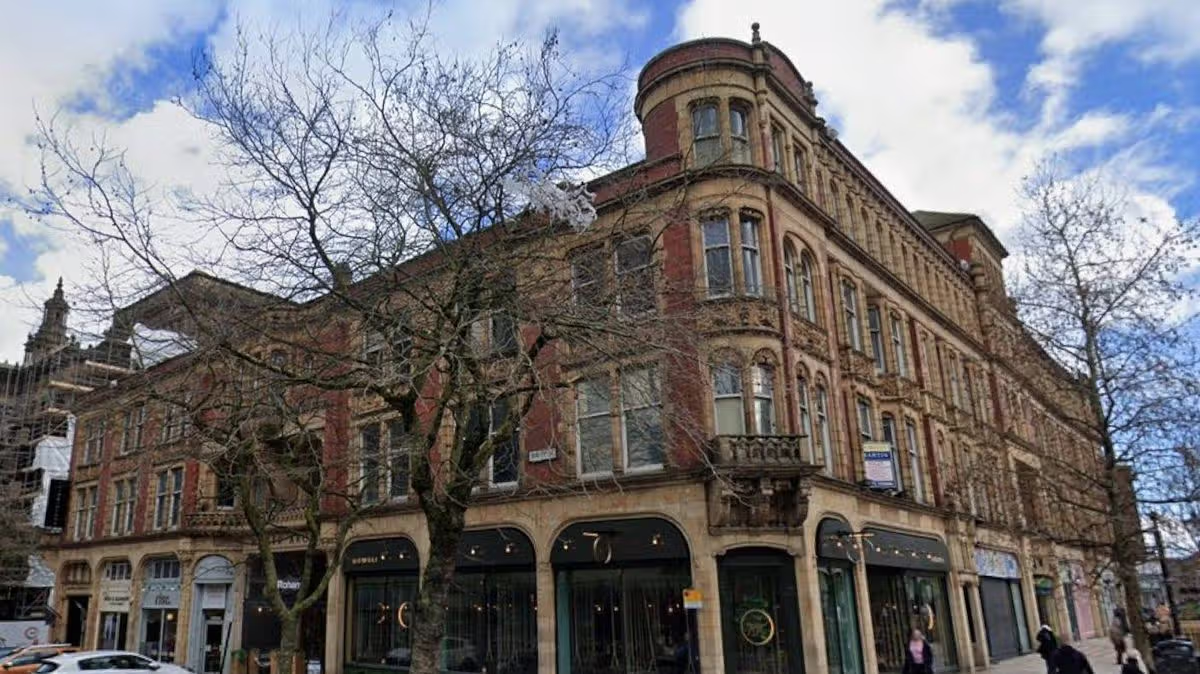
Miller Arcade in Preston.

Miller Arcade in Preston(Image: Google)

Converting most of Preston’s Miller Arcade into apartments is the “best opportunity” to guarantee the building’s future – and ensure it is fully used.

Advertisement

That was the message to councillors as they gave the green light to a revamp that will see the upper floors of the Victorian shopping emporium, off Lancaster Road, become home to 46 residential properties.

Preston City Council’s planning committee unanimously approved the overhaul, which also includes the creation of communal facilities – including a gym, cinema, library and workspace – for future residents.

The top three storeys of the Grade II-listed property were last in use as offices – one of their many original functions – but have been vacant for well over a decade. They were initially also occupied by two hotels, a Turkish baths and a wine lodge.

The redevelopment will not affect the ground floor retail space, which will continue in its current form, having first opened in 1899 – making it Preston’s oldest shopping precinct.

Advertisement

However, the committee heard that bringing the levels above back into use would be financially costly and practically demanding, because of their poor condition in some parts.

Alban Cassidy, the agent for the scheme, told the meeting that it had required “compromise”, both from the firm behind the blueprint – Darwen-based Icon Heritage Ltd. – and the city council’s heritage advisers.

He said discussions had enabled a position to be reached “where everyone is comfortable that [this] is the best…way forward for the site”.

“I think this is the best opportunity the Miller Arcade has ever had to… [secure] a long-term use that respects the heritage of the building, but also brings into use the whole of the structure.

Advertisement

“[That means] it [will] not only be repaired…but it also has…a future – [because] it will then be maintained…and it will continue to be one of the jewels in the crown in our city centre,” Mr. Cassidy added.

Structural and condition surveys laid bare the scale of the challenge in getting the blueprint off the drawing board. Cracking in the terracotta cladding is regarded as an outward sign of “corrosion of [the] steel embedded within the facade” of the building, as a result of it not being watertight.

Committee member Cllr Rob Walsh noted that the problems identified in the two assessments were the result of visual inspections – and so were limited only to those that could be seen with the naked eye.

Raising particular concern about the potential for steel “within the walls” to have rusted, he asked whether there were any plans for “a more detailed review of the structural integrity of the building”.

Advertisement

Alban Cassidy said building surveyors and structural engineers had “gone as far as they can” at the planning application stage, but would “look further into the building” once permission was granted.

However, he told the meeting that the applicant had been put on notice about what to expect – and the “implications” of that for what will be an “expensive” development.

“The detail is to come. It’s not going to be [something that can be determined] in six months…but we’re aware of it, committed to it and we’ll face it as it comes.

“This is a Victorian building that has been neglected for some time – and therefore these things need addressing. No-one is going into it with their eyes shut,” Mr. Cassidy said.

Advertisement

There are no signs of structural damage to the internal elevations of the shopping arcade itself and the condition of the external walls has been deemed “satisfactory”.

Questioned by Cllr Ben Ward about the capacity of the applicant as a “a relatively new company”, -founded just under five years ago – to deliver such a “big” and “important” scheme, Mr. Cassidy said the firm was “well financed” and had assembled a professional team for the purpose.

A report by planning officers concluded that the external works required – including window and masonry repairs, the replacement of the existing flat roof with a new insulated covering, and repairs to the glazed vaulted roof over the arcade – would have a positive impact on the building itself and the Market Place Conservation Area in which it stands.

Against that backdrop, the suitability of the conversion was barely mentioned in the committee discussion, with deputy chair Cllr Sara Holmes welcoming what she described as “a great opportunity to improve and bring back [into use] Miller Arcade”.

Advertisement

A previous apartments proposal for the building which was given the go-ahead back in 2015 never came to fruition – but Mr. Cassidy said that the proposal had been “threadbare”

The much-loved city landmark is renowned for its Victorian Baroque architecture and was modelled on the larger Burlington Arcade in London. When it opened, the arcade would have been a purveyor of luxury goods, aimed at Preston’s most well-heeled residents.

Any original features will be retained “wherever possible” as part of the revamp, planning documents state – but many of the most “ornate” have previously been stripped out.

The committee granted both planning permission and so-called ‘listed building consent’ for the apartments – 24 one-bedroomed, 18 two-bed and four ‘studio’ flats – along with works to be carried out in the basement.

Advertisement

Don’t miss the latest news and analysis with our regular North West newsletters – sign up here for free

Continue Reading

Business

AAON, Inc. (AAON) Q2 2026 Earnings Call Transcript

Published

on

OneWater Marine Inc. (ONEW) Q1 2026 Earnings Call Transcript