
Business
Alibaba Shares Sink 6.7% as Investors Digest 75% Profit Plunge From Massive AI Spending Surge

Shares of Alibaba Group Holding fell 6.67%, or $8.71, to $121.82 as of 10:00 a.m. EDT Friday, extending a steep two-day decline that began after the Chinese e-commerce and cloud computing giant reported a 75% plunge in quarterly profit tied to aggressive spending on artificial intelligence infrastructure.
Alibaba’s U.S.-listed shares initially fell roughly 5% Thursday after the company reported net income of 10.54 billion yuan, or approximately $1.55 billion, for its fiscal first quarter ended June 30, down 76% from the same period a year earlier, according to Quartz. That decline followed an even sharper drop cited by other outlets; Bloomberg and the Washington Post both reported the profit plunge at more than 75%, with figures ranging between 10.4 billion and 10.54 billion yuan depending on the specific accounting measure cited.
The steep profit decline came despite solid overall revenue growth. Alibaba reported quarterly revenue of 268.95 billion yuan, or roughly $39.64 billion, up 9% year over year and slightly ahead of the 268.88 billion yuan consensus estimate compiled by LSEG, according to CNBC. Non-GAAP net income, which strips out share-based compensation, investment gains and losses and certain other items, fell 38% to 20.72 billion yuan, or about $3.05 billion, while adjusted EBITA declined 30% to 27.33 billion yuan, or roughly $4.03 billion, according to Quartz.
The primary driver behind the profit collapse was a dramatic increase in capital spending tied to artificial intelligence infrastructure. Capital expenditures reached 67.68 billion yuan, or nearly $10 billion, a 75% increase from the same period a year earlier, according to multiple outlets. The company attributed the spending surge to a combination of factors, including uneven timing of customer purchases, an expansion of CPU-compute capacity, and rising prices across a broad range of chip components, according to CNBC. Free cash flow for the quarter registered an outflow of 44.67 billion yuan, or approximately $6.58 billion, compared with a smaller outflow of 18.82 billion yuan during the same period last year, according to Quartz.
Alibaba’s cloud computing business, the segment most directly tied to its AI ambitions, showed strong underlying growth even as the broader company’s profitability suffered. Cloud revenue rose 45% to 48.4 billion yuan, according to Briefs, with AI-related products delivering triple-digit percentage growth for the twelfth consecutive quarter, according to Caixin Global. Alibaba’s annualized recurring revenue from model and application services surpassed 16 billion yuan, the company disclosed, and it separately opened public testing of QwenWork, a new enterprise AI agent product.
The company’s core e-commerce business, by contrast, delivered more mixed results and contributed to the broader earnings pressure. According to Caixin Global, revenue from Alibaba’s China e-commerce business fell 8% year over year to 110.9 billion yuan, while international e-commerce revenue declined 1% to 27.8 billion yuan. China Quick Commerce revenue, however, surged 45% to 53.30 billion yuan, according to Quartz, reflecting continued strong growth in that faster-delivery segment even as Alibaba’s more traditional e-commerce operations contracted.
Bloomberg’s Luz Ding characterized the results as reflecting a company aggressively defending its position within an intensely competitive global AI landscape, describing Alibaba as having “ratcheted up quarterly capital spending to almost $10 billion” to safeguard its standing in that arena. The report noted Alibaba’s shares fell more than 4% in premarket trading Thursday in immediate reaction to the results.
Alibaba Chief Executive Officer Eddie Wu sought to reassure investors that the heavy spending was producing tangible results despite the near-term profit hit. According to Advisor Perspectives, citing Bloomberg, Wu stressed on Thursday that the company’s AI investments were bearing fruit, with Alibaba expecting annualized revenue from AI products to approach $10 billion in the current quarter, up from approximately $7.3 billion during the April-to-June period.
Alibaba’s quarterly results follow an even more difficult prior quarter, during which the company posted adjusted net income of just 86 million yuan and recorded its first operating loss since 2021, according to Quartz, as spending on AI infrastructure and quick commerce delivery weighed heavily on earnings at that time. In connection with those earlier results, Alibaba committed to reaching $100 billion in combined annual revenue from its cloud and AI businesses within five years, according to Bloomberg.
Analyst reaction to Thursday’s results reflected a degree of caution regarding near-term earnings pressure even as most maintained a broadly constructive long-term view of the company’s AI strategy. According to GuruFocus, adjusted earnings landed at 8.52 yuan per American depositary share, roughly 19% below the 10.53-yuan consensus estimate analysts had projected. GuruFocus also noted that at Thursday’s closing price of $127.01, Alibaba was trading approximately 4.76% above its calculated GF Value estimate of $121.24, suggesting the stock had already priced in a meaningful degree of optimism regarding the company’s AI-driven growth prospects even as its near-term profitability absorbed the cost of that strategic bet.
Commentary from Briefs characterized the market’s reaction as reflecting genuine investor uncertainty about the timeline for AI investments to translate into meaningful profit expansion. “While cloud revenue growth of 45% shows the strategy is gaining traction, the market’s reaction indicates skepticism about when these investments will translate into meaningful profit expansion,” the outlet noted, adding that the coming quarters would prove critical in determining whether Alibaba’s continued heavy AI spending ultimately pays off or instead weighs on returns for an extended period should demand growth slow or competitive pressure intensify.
Alibaba’s competitive position within China’s rapidly evolving AI landscape remains a significant factor shaping investor sentiment toward the stock. According to Advisor Perspectives, Alibaba’s flagship Qwen AI model family became the world’s most popular open model family this year, cementing the company’s status as a global artificial intelligence frontrunner. The company’s Qwen consumer app, an all-in-one AI assistant capable of handling tasks including shopping and payments, is expected to compete directly with a new AI agent product on rival Tencent’s WeChat platform in the coming quarters, as well as against ByteDance’s popular Doubao AI assistant, which introduced its own subscription plan earlier this year.
With Alibaba’s 88VIP membership base growing by double digits year over year to approximately 64 million members as of June 30, according to Quartz, and the company continuing to project substantial near-term growth in AI product revenue, investors are likely to remain focused in the coming quarters on whether Alibaba’s aggressive capital spending trajectory begins showing clearer signs of translating into improved overall profitability, or whether the company’s continued heavy investment in AI infrastructure will keep pressuring earnings for an extended period as it works to maintain its competitive standing against both domestic Chinese rivals and global AI leaders.


Lumentum EVP retort sells $2.05m in shares


With combined experience of covering technology companies on Wall Street and working in Silicon Valley, and serving as an outside adviser to several seed-round startups, Gary Alexander has exposure to many of the themes shaping the industry today. He has been a regular contributor on Seeking Alpha since 2017. He has been quoted in many web publications and his articles are syndicated to company pages in popular trading apps like Robinhood.
Analyst’s Disclosure: I/we have no stock, option or similar derivative position in any of the companies mentioned, and no plans to initiate any such positions within the next 72 hours. I wrote this article myself, and it expresses my own opinions. I am not receiving compensation for it (other than from Seeking Alpha). I have no business relationship with any company whose stock is mentioned in this article.
Seeking Alpha’s Disclosure: Past performance is no guarantee of future results. No recommendation or advice is being given as to whether any investment is suitable for a particular investor. Any views or opinions expressed above may not reflect those of Seeking Alpha as a whole. Seeking Alpha is not a licensed securities dealer, broker or US investment adviser or investment bank. Our analysts are third party authors that include both professional investors and individual investors who may not be licensed or certified by any institute or regulatory body.

Thailand’s agricultural supply chain faces vulnerability due to complex carbon management challenges. Without clear government policy and investment in technology, small farmers risk losing access to vital global markets.
Key Points
- Complexity and Challenges: Thailand’s agriculture has a lengthy supply chain involving inputs, processing, and exports. This complexity complicates carbon management, especially for smallholder farmers who lack economic incentives to adopt sustainable practices. Efforts to enforce compliance, such as bans on burning, encounter resistance due to concerns over profitability.
- Need for Technology and Data: Accurate traceability and reliable data are essential for Thailand to establish a low-carbon footprint. The private sector has begun collaborating with institutions to gather data on carbon emissions; however, significant investment is required to build the necessary technological infrastructure—a challenge for smaller farmers and businesses.
- Government Leadership and Urgency: The absence of cohesive national policies from various ministries hampers funding, creates confusing standards, and diminishes negotiation power in global markets. Without immediate government action to address carbon certification, Thai agricultural exports may face significant barriers within two years, jeopardizing the livelihoods of millions.
Complex Supply Chains and Carbon Management Challenges
Thailand’s agriculture and food industry features a complex, multi-tiered supply chain, ranging from upstream inputs like seeds to downstream processing and exports. This intricate system complicates carbon management, as all elements are interconnected. The primary challenge lies with smallholder farmers, who often question financial incentives when pressured to modify practices, such as banning burning or reducing chemical fertilizer use. Their inquiries emphasize a need for economic viability, indicating that traditional enforcement methods, like laws and penalties, are insufficient. To foster genuine compliance, there must be real economic benefits for environmentally friendly practices.
The Need for Technological Infrastructure and Data Accuracy
A significant hurdle in achieving low-carbon claims is the absence of credible data. Thailand must develop accurate traceability systems and internationally recognized metrics to qualify its rice as low-carbon. Currently, private sector initiatives, including collaborations with educational institutions, are attempting to establish carbon footprint metrics. However, this requires substantial investment in technology and big data infrastructure, which is often beyond the means of small farmers and mid-sized enterprises. Innovation is crucial, as it can streamline manual processes and produce trustworthy carbon metrics needed for global markets.
Absence of Cohesive Government Policy
The lack of a unified government approach poses serious challenges to the agricultural sector’s future. With more than ten ministries involved but operating independently, there is no integrated national policy to unify efforts, leading to budget misalignments and confusing standards for farmers. This policy vacuum impacts farmers’ ability to adapt and undermines Thailand’s bargaining power in international negotiations. Stakeholders warn that without prompt action, Thailand may face consequences, including exclusion from vital global markets due to the absence of necessary carbon certification. The survival of countless Thai farming households hangs in the balance, contingent on decisive government leadership.

American Securities sells 7.9m SOLV Energy shares for $0

Tracking Renaissance Technologies (RenTec) 13F Portfolio – Q2 2026 Update

The FDA and CDC are investigating Taco Bell’s lettuce supplier as consumers in four states are urged to avoid shredded lettuce.
A food safety alert has been issued over an E. coli and salmonella outbreak that has sickened dozens of people across 15 states, most of whom reported eating alfalfa sprouts before they fell ill, according to the U.S. Centers for Disease Control and Prevention.
So far, 55 people have reported falling ill, including four hospitalizations.
No deaths have been reported.
FDA WIDENS CYCLOSPORA OUTBREAK INVESTIGATION TO SIX MORE STATES AS CONFIRMED CASES TOP 6,000

A food safety alert has been issued over an E. coli and salmonella outbreak that has sickened dozens of people across 15 states, most of whom reported eating alfalfa sprouts before they fell ill, according to the U.S. Centers for Disease Control and (CDC / Unknown)
The affected alfalfa sprouts were produced by Everything Sprouts and sold under the Calco and Everything Sprouts brands at retailers and grocery stores.
Customers should throw away or return any of the affected products and wash surfaces that may have come into contact with sprouts.
E. coli symptoms include stomach cramps, bloody diarrhea and nausea, and salmonella symptoms involve diarrhea, stomach cramps and fever.
The CDC urged people to see a doctor immediately if they experience diarrhea and fever higher than 102 degrees, bloody diarrhea or diarrhea for more than two days, the inability to keep anything down, or signs of dehydration, including not peeing much, dry mouth and throat and feeling dizzy when standing.
MICHIGAN REPORTS 2 DEATHS IN RARE PARASITE OUTBREAK THAT HAS SICKENED MORE THAN 11,000
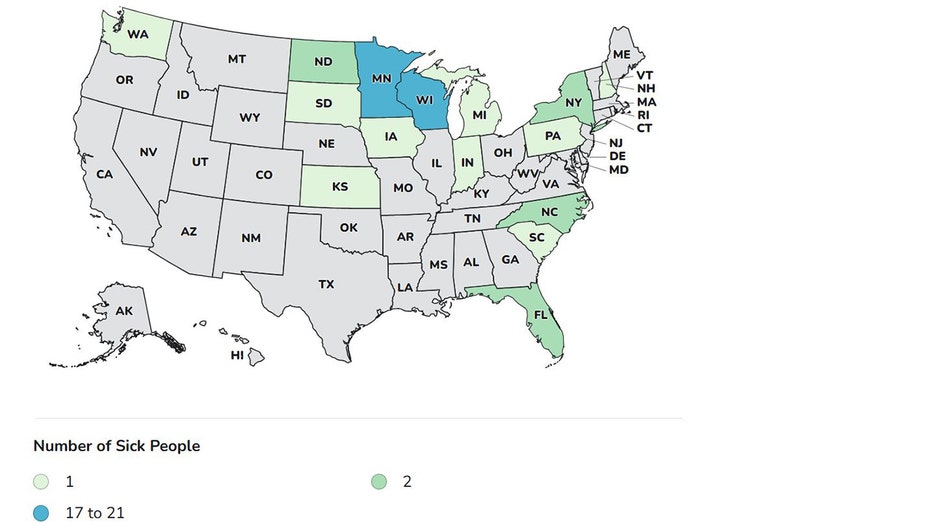
Fifty-five people have reported falling ill in 15 states. (CDC / Unknown)
The majority of people sickened were in Minnesota, 21, and Wisconsin, 17; while two people were sickened in New York, North Dakota, North Carolina and Florida; and one illness was reported in Washington, South Dakota, Iowa, Kansas, Indiana, Pennsylvania, Michigan, New Hampshire and South Carolina.
LETTUCE FARMERS PLOW CROPS BACK INTO SOIL AS CYCLOSPORIASIS FEARS TANK DEMAND FOR FRESH GREENS
Along with the CDC, public health and regulatory officials in several states, and the U.S. Food and Drug Administration are investigating the outbreak, which involves three strains of E. coli and one of salmonella.
DOCTORS WARN YOUR ‘STOMACH BUG’ MAY ACTUALLY BE A PARASITE THAT’S HARDER TO DETECT

A Cyclosporiasis outbreak has been linked to iceberg lettuce. (iStock / iStock)
Of those sickened, 46 were infected with E. coli, seven with salmonella, and two with both. The CDC said that some people were infected with more than one strain of the infections.
The illnesses started in late May and continued through Aug. 8.
CLICK HERE TO DOWNLOAD THE FOX NEWS APP
This outbreak comes amid several other food-borne ones reported recently that are connected to jalapeños, iceberg lettuce, eggs and blueberries.

American farmer and rancher Steven McBee Jr. joins ‘Varney & Co.’ to discuss soaring beef prices, the cattle shortage, the reopening of livestock imports and AI’s growing impact on farmland values.
President Donald Trump said Friday that he would allow up to 300,000 metric tons of ground beef to be imported into the United States tariff-free for the next 90 days, with a commitment that the meat would be sold at 25% below current market prices.
The announcement immediately drew backlash from cattle industry groups and several Republican senators who warned that increasing imports could hurt American ranchers.
In a Truth Social post announcing the plan, Trump said it would “substantially lower” the price of ground beef for American families, arguing that prices had soared under the Biden administration as the domestic cattle supply had shrunk.
“As we work to rebuild this herd and help our ranchers, for the next 90 days, the United States will allow up to 300,000 metric tons of product for ground beef to be imported with no out of quota tariff,” Trump wrote.
A HISTORIC SHORTAGE IS SQUEEZING AN AMERICAN DINNER STAPLE, AND RELIEF COULD BE YEARS AWAY

President Donald Trump announced a plan to allow up to 300,000 metric tons of ground beef to be imported tariff-free for 90 days in an effort to lower prices for American consumers. (Bonnie Cash/UPI/Bloomberg/Getty Images / Getty Images)
“We have a commitment that this beef will be sold at 25 percent below current market prices,” he continued. “This deal will reduce prices for Americans while giving space for our Great American Beef Herd to grow again.”
After Trump’s announcement, the National Cattlemen’s Beef Association said it was “disappointed” by the plan, arguing that introducing below-market beef could negatively affect American cattle producers.
Speaking with FOX Business’ Nicole McManus, National Cattlemen’s Beef Association CEO Colin Woodall urged the federal government not to interfere with the cattle industry.
“The best thing is to stay out of our business. That’s what we want, first and foremost,” Woodall said. “Let us work the way we do as producers to take care of our cattle, to take of our natural resources and to be able to grow.”
TRUMP PAUSES 50% TARIFFS ON CANADA HOURS BEFORE DEADLINE AFTER ANNOUNCING POTENTIAL DEAL

The U.S. cattle herd has fallen to its lowest level in 75 years. (Jonne Roriz/Bloomberg/Getty Images / Getty Images)
Woodall sharply criticized Trump’s plan, arguing the president was overlooking strong consumer demand for U.S. beef.
“This is the third time in less than a year that the president has made a similar announcement about increasing imports in order to decrease the price of beef,” Woodall said.
“And, once again, he’s missing the point,” Woodall continued. “He’s missing the picture, and he’s definitely lost the plot line. This is about demand. The consumer demands our product. The customer loves what we’re producing.
“We’re producing the highest quality beef we ever have, and they have shown their willingness to pay for it. The American consumer does not have to buy beef. They want to buy beef and, unfortunately, the president is just not factoring that into his consideration.”
The American Farm Bureau Federation also responded to Trump’s announcement, warning that “short-term measures could have long-term negative effects” for consumers and ranchers.
PIZZA HUT MAKES SURPRISING CHANGE TO ICONIC NAME AHEAD OF NFL SEASON
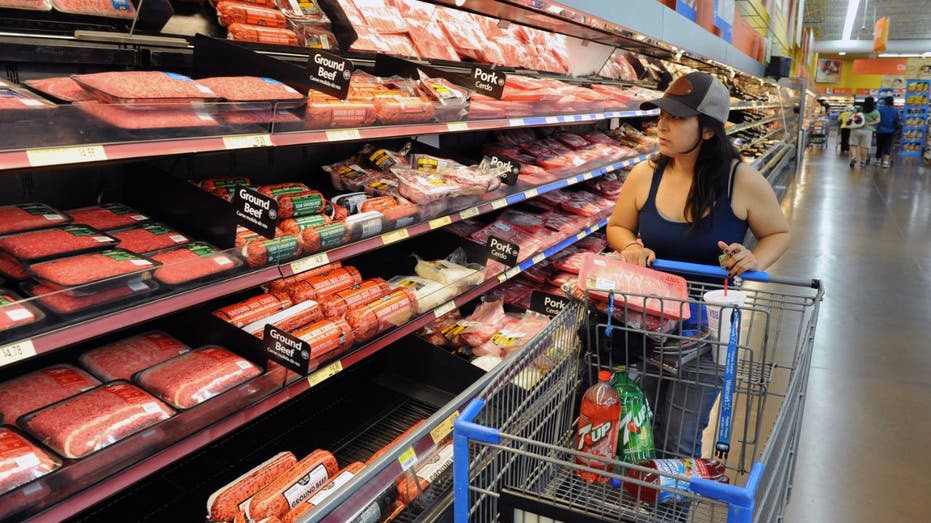
President Donald Trump said imported ground beef under his new plan would be sold at 25% below current market prices. (Bob Riha, Jr./Getty Images / Getty Images)
U.S. Cattlemen’s Association President Justin Tupper also criticized the plan.
“You don’t put America first by putting U.S. cattle producers last,” Tupper said in a statement. “This move will weaken our markets and gamble with food safety in the process.”
Several Republicans on Capitol Hill also pushed back, including Sen. Tim Sheehy, R-Mont., who said he had advised Trump against the move and warned it could hurt ranching families.
“The President’s heart is in the right place on wanting lower prices for the American people, and beef prices have been impacted by the Mexican screwworm,” Sheehy posted on X.
FORD’S US MANUFACTURING EXPANSION TO BRING ‘THOUSANDS AND THOUSANDS OF JOBS,’ LUTNICK SAYS
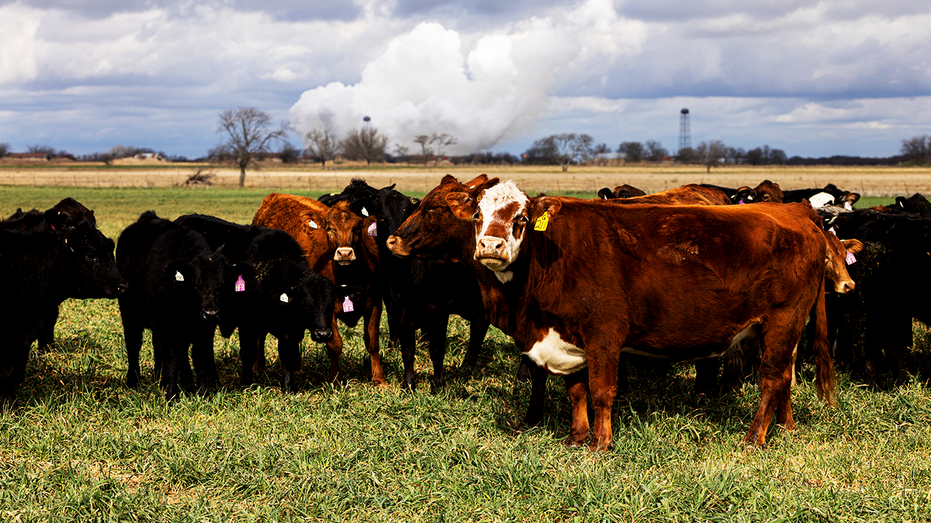
America’s ranchers are facing the smallest domestic cattle herd in 75 years as consumers contend with elevated beef prices. (Angela Piazza/The Dallas Morning News / Getty Images)
“But the reality is this action will make it more difficult for American ranchers to rebuild our herd and bring prices down for the American people. And most importantly, this will harm our ranching families who feed the nation.”
Trump responded to the criticism while speaking to reporters Friday.
“I love the ranchers; they’ve done a fantastic job,” Trump said. “But they admit that we need a little help, and, in order to get the prices down, so that’s what we’re doing.”
Trump did not specify which countries would supply the beef, telling reporters only that “there are a few” and that they would send the “highest quality beef.”
GET FOX BUSINESS ON THE GO BY CLICKING HERE
The announcement comes as U.S. ranchers face the smallest domestic cattle herd in 75 years and Tyson Foods announced last week that it would close beef facilities in Illinois and Utah.
FOX Business has reached out to the White House for additional comment.

Operator
Good morning, and welcome to the Onfolio Holdings Second Quarter 2026 Earnings Conference Call. Joining us today are Dominic Wells, Chief Executive Officer; and Adam Trainor, Chief Operating Officer and Interim Chief Financial Officer. Before we begin, I would like to remind everyone that certain statements made during this call may constitute forward-looking statements within the meaning of the Private Securities Litigation Act — Reform Act of 1995.
These statements involve known and unknown risks, uncertainties and other factors that may cause actual results to differ materially from those expressed or implied. Forward-looking statements are based on management’s current expectations as of today’s date, and the company undertakes no obligation to update or revise any such statements.
For a detailed description of risks and uncertainties, please refer to the Risk Factors section of the company’s most recent Form 10-Q filed with the SEC. Additionally, during this call, management may reference certain non-GAAP financial measures and supplemental operating metrics as indicators of performance.
These measures should not be considered in isolation or as substitutes for GAAP results. A reconciliation of non-GAAP measures to the most comparable GAAP measures is available in the company’s SEC filings, which can be found on the company’s website at investors.onfolio.com/filings. With that, I’ll turn the call over to Dom. Please go ahead, sir.
Dominic Wells
Founder, Chairman, CEO, Chief Revenue Officer, Secretary & Treasurer
Thank you, and good morning, everyone. We appreciate you joining us today. For anyone newer to the Onfolio story, we are an owner-operator of cash-generating digital businesses, primarily in B2B marketing agencies and B2C online education. Since our IPO in 2022, we have grown
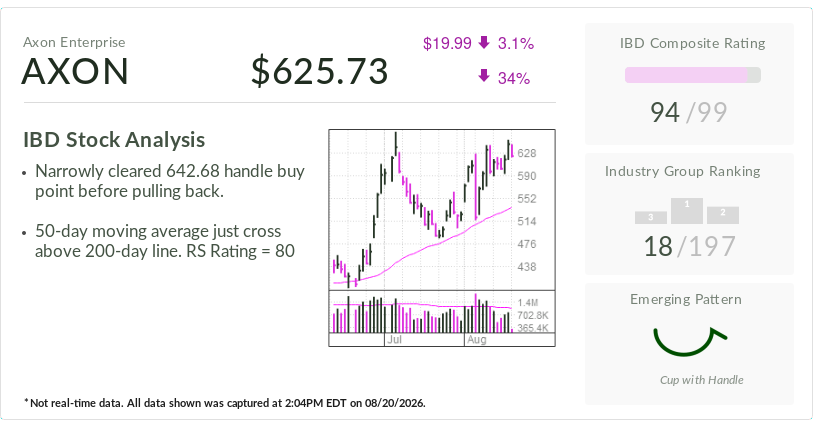
Axon Enterprise Axon Enterprise AXON $ 632.24 $17.98 2.93% 28% IBD Stock Analysis Narrowly cleared 642.68 handle buy point before pulling back. 50-day moving average just cross above 200-day line. RS Rating = 80 IBD Composite Rating 93/99 Industry Group Ranking 23/197 Emerging Pattern Cup with Handle Cup with Handle A positive chart pattern named such because it resembles the…
Copyright ©2026 Investor’s Business Daily, LLC. All rights reserved. 87990cbe856818d5eddac44c7b1cdeb8

Is the Fed’s stock valuation model working again?

12 Years Later, the Best Fantasy Video Game Quote of the 2010s Still Hits Hard

Bigger Scoops and Full Control is Why the Ninja Creami XL (NC601) Still Earns Its Place as Summer Lingers

3 Crypto Experts Just Made MASSIVE Ethereum Price Predictions

Weekend Open Thread – Corporette.com

Weekend Open Thread: Brooks Brothers

London Mayor Sadiq Khan handed a peerage by Keir Starmer alongside 15 other Labour figures… just days before the PM leaves No10
3 Crypto Experts Just Made MASSIVE Ethereum Price Predictions

#trading #tdctrades #millionaire #motivation #money #mindset #privatejet #reichtum #geld

Day 54 of 90 Days of Financial Wisdom #finance #gospel #wealth #christian #finance
-

 Fashion8 hours ago
Weekend Open Thread: Madewell – Corporette.com
-

 Sports7 days ago
Birmingham 2026: Day 6 Timetable for Irish Athletes
-
 NewsBeat7 days ago
Myanmar says over 300,000 Rohingya refugees verified for repatriation as exodus enters ninth year
-

 Business4 days ago
SMA Solar Technology AG (SMTGY) Q2 2026 Earnings Call Transcript
-

 Politics7 days ago
SEQ Code: The Three Letter Boarding Pass Code That Could Give You The Worst Seat
-

 Crypto World7 days ago
Pi Network Protocol 27 endgame: last upgrade before what?
-

 Tech4 days ago
Qwen3.8-27B runs frontier-class coding agents and reasoning locally, no cloud API required
-

 Crypto World4 days ago
OCC Greenlights Trump Family Crypto Firm for Trust Charter
-
 Entertainment7 days ago
Marvel Studios Reveals New X-Men Cast Including Adam Driver and Sadie Sink
-
 Tech7 days ago
Every fusion startup that has raised over $100M
-
 Business7 days ago
Monarch Mutual Fund set to enter MF space with maiden overnight fund; files draft with Sebi
-

 News Videos2 days ago
Don’t Leave Your Financial Future To Chance | August 19, 2026
-

 Business7 days ago
Cristiano Ronaldo’s Secret Wedding Deepens As Presenter Claims Family Learned ’30 Seconds’ Before
-

 Business7 days ago
Facebook Down Now? Users Report Login And Loading Problems As Outage Trackers Monitor Ongoing Issues
-

 Crypto World5 days ago
Data of 54K Wallet Users Leaked, Clarity Odds Just 10%: Hodler’s Digest, Aug. 16
-

 Crypto World4 days ago
NAVI Prime launches institutional lending framework on Sui
-

 Politics5 days ago
Britain is facing a housing disaster
-

 Business7 days ago
New Avengers Doomsday Trailer Drops at D23 Showing Robert Downey Jr as Doctor Doom
-

 Tech7 days ago
How to watch FIH Hockey World Cup 2026: FREE live streams, schedule
-
 Business6 days ago
Rebel Creamery files Chapter 11 with $23.8M Van Leeuwen judgment on appeal
You must be logged in to post a comment Login