A fire at a Bangkok music pub in the early morning hours killed at least 27 people and injured 73 others, with officials warning the death toll could rise as dozens remained in critical condition. Eyewitness footage showed patrons fleeing the burning venue as flames spread rapidly through the packed establishment.
Thai authorities have launched an investigation into potential safety violations, including emergency exit accessibility, occupancy limits, and fire suppression systems. The incident has prompted broader scrutiny of nightlife venue safety standards and may lead to stricter regulatory enforcement across Thailand’s entertainment and hospitality sectors.
The Tragedy Unfolds
A devastating fire broke out at a music pub in Bangkok in the early hours, claiming the lives of at least 27 people and leaving dozens more injured, according to multiple international news outlets including AP News and the BBC. The blaze occurred late at night when the venue was reportedly packed with patrons enjoying live music, transforming a night of entertainment into a scene of chaos and tragedy within moments.
Officials confirmed that the death toll could rise further as rescue operations continued, with reports indicating 22 to 25 people in critical condition, according to updates from Reuters and DW. The severity of injuries among survivors has raised concerns about the final casualty count, as medical teams work to stabilize those who suffered severe burns and smoke inhalation.
Scenes of Panic and Escape
Eyewitness accounts and video footage captured the terrifying moments as flames engulfed the popular nightspot. Footage widely circulated on social media and news platforms showed survivors frantically running out of the burning building, desperately trying to escape the rapidly spreading fire, as reported by People.com. The chaotic scenes underscored the speed at which the fire consumed the structure, leaving many with little time to react.
According to CNA, the fire ultimately injured 73 people, a figure that reflects the scale of the disaster and the number of patrons present at the time. The Guardian also released video footage showing people fleeing the scene as flames erupted from the building, illustrating the panic that ensued when the fire first broke out.
Investigation into Possible Negligence
In the aftermath of the tragedy, Thai authorities have launched a formal investigation to determine the cause of the fire and whether negligence played a role in the high death toll. Police are examining potential safety violations, structural issues, and whether proper fire safety protocols were followed at the venue, according to reporting from CNA’s live updates on the incident.
Advertisement
This investigation comes amid broader scrutiny of nightlife venue safety standards in Thailand, a country with a significant entertainment and tourism sector. The probe will likely examine building codes, emergency exit accessibility, and whether the venue had adequate fire suppression systems in place. Given the packed nature of the venue at the time of the fire, questions have also emerged regarding whether occupancy limits were exceeded.
Historical Context of Fatal Fires in Thailand
This incident is not isolated in Thailand’s history of tragic fires at entertainment venues. The Guardian compiled a list of significant fatal fires in Thailand, highlighting a pattern of similar disasters that have plagued the country’s nightlife and public venues over the years. These recurring incidents point to systemic challenges in enforcing fire safety regulations across commercial establishments, particularly in densely packed urban entertainment districts like Bangkok.
The pattern of such tragedies raises important questions about regulatory oversight and enforcement mechanisms within Thailand’s hospitality industry. Historical fires have often been linked to overcrowding, inadequate emergency exits, flammable building materials, and insufficient fire suppression equipment—factors that safety advocates argue require more rigorous government intervention.
Impact on Thailand’s Business and Tourism Sectors
Beyond the immediate human tragedy, this incident carries significant implications for Thailand Business News and the broader hospitality sector. Bangkok’s nightlife industry is a critical component of the country’s tourism economy, attracting millions of international visitors annually. Incidents like this can potentially undermine consumer confidence and prompt increased regulatory scrutiny that may affect how nightclubs and pubs operate going forward.
Advertisement
Thai authorities may face pressure to implement stricter enforcement of existing fire codes or introduce new regulations specifically targeting entertainment venues. Such regulatory responses, while necessary for public safety, could impose additional compliance costs on business owners in the hospitality sector, potentially affecting profit margins for smaller establishments already operating on thin margins.
Moving Forward
As Thailand grapples with the aftermath of this devastating fire, the nation faces difficult questions about balancing economic vitality in its entertainment sector with adequate safety protections for patrons. The investigation’s findings will likely shape future policy discussions around building codes, venue licensing requirements, and emergency preparedness standards.
For families of the victims, the coming days will bring the painful process of identification and mourning, while survivors face long recovery journeys from their injuries. The broader Thai business community, particularly within hospitality and tourism, will be watching closely to understand how this tragedy might reshape regulatory frameworks and public perception of venue safety standards moving forward.
This incident serves as a somber reminder of the critical importance of stringent fire safety measures in commercial venues, particularly those hosting large crowds in enclosed spaces during nighttime hours when visibility and quick evacuation can be most challenging.
NEW YORK — Shares of Space Exploration Technologies Corp., known as SpaceX, fell 5.46 points, or 3.76 percent, to 139.84 on Monday, extending recent weakness in the newly public aerospace and satellite company as investors navigated post-IPO volatility and a limited public float.
The decline came as the stock, which debuted in June in the largest U.S. initial public offering on record, continued to trade below its early highs. SpaceX raised approximately $75 billion to $86 billion in its IPO, pricing shares at $135 and achieving a massive initial valuation. However, the publicly tradable float remains small relative to the company’s overall market capitalization, amplifying price swings.
SpaceX’s shares have been highly volatile since listing. They surged in the immediate aftermath of the IPO before pulling back sharply from peaks above $225. Monday’s trading reflected ongoing adjustments as early investors and funds respond to the company’s debut and subsequent index inclusions.
The company joined the Nasdaq-100 index earlier in July, triggering buying from passive funds tracking the benchmark. While such inclusions typically support prices through mandated purchases, the thin float has led to exaggerated moves in both directions.
Advertisement
Analysts have highlighted the stock’s sensitivity to supply dynamics. Lockup expiration schedules allow certain early investors and employees to sell shares over time, potentially adding selling pressure. The limited public availability of shares has contributed to rapid price fluctuations since trading began.
SpaceX, led by Elon Musk, operates in multiple high-growth areas, including reusable rockets, satellite internet through Starlink and commercial space services. The company has secured major contracts, including deals with xAI and others for satellite and computing infrastructure, providing revenue visibility.
Despite operational momentum, valuation concerns have emerged. The stock trades at high multiples relative to current revenue, reflecting expectations for future expansion in AI-related data services, satellite constellations and launch capabilities. Some observers note that profitability may remain elusive in the near term as the company invests heavily in ambitious projects like Starship development.
The Monday session occurred against a mixed broader market backdrop. Technology shares faced pressure from profit-taking in semiconductors, while energy stocks advanced on oil price gains tied to Middle East developments. SpaceX’s movement aligned with volatility seen in other high-profile growth names.
Advertisement
Trading volume remained elevated compared to pre-IPO levels, consistent with interest in the high-profile listing. Options activity also reflected active positioning around potential catalysts, including upcoming launches and contract announcements.
SpaceX’s business fundamentals include a growing Starlink subscriber base and a robust launch cadence. The company has achieved multiple record booster reuses with its Falcon 9 rockets, demonstrating cost efficiencies that competitors struggle to match. Starlink has crossed significant customer milestones, contributing the majority of revenue in recent periods.
Longer-term growth drivers include expansion of satellite internet services to new markets, potential deep-space missions and integration with artificial intelligence infrastructure. Partnerships and government contracts provide additional tailwinds, though regulatory and competitive risks persist in the space sector.
Wall Street coverage has been generally positive, with several firms initiating coverage post-IPO. Price targets vary widely, reflecting differing views on execution of ambitious plans and the company’s path to sustainable profitability.
Advertisement
The stock’s post-IPO journey highlights challenges for newly public companies with concentrated ownership. Musk retains a substantial stake, and early investors hold much of the remainder, limiting immediate liquidity for public shareholders.
Index inclusions, such as the Nasdaq-100 addition, have provided technical support through passive inflows. However, the overall float constraints continue to influence trading dynamics.
Investors monitoring SpaceX will watch for updates on Starship test flights, Starlink deployment milestones and quarterly performance metrics as the company transitions to public reporting requirements. The quiet period following the IPO has limited detailed commentary, but upcoming earnings and operational disclosures could provide further clarity.
The aerospace sector has seen increased interest amid commercial space growth and government partnerships. SpaceX’s leadership position in reusable launch technology and satellite communications positions it uniquely, though execution risks and capital intensity remain key considerations.
Advertisement
Monday’s decline contributed to a broader pullback from recent peaks. The stock remains above its IPO price in some sessions but has experienced significant swings, underscoring the speculative nature of early trading in high-profile listings.
Broader market participants continue to assess SpaceX’s role in emerging industries. Its Starlink service has potential to bridge connectivity gaps globally, while launch capabilities support both commercial and scientific missions.
As trading progresses, the balance between growth optimism and valuation discipline will likely shape investor sentiment. SpaceX’s ability to deliver on operational targets and monetize its technologies will be central to sustaining its market valuation.
The session’s activity reflects typical post-IPO adjustment phases, where initial enthusiasm meets reality of public market scrutiny. SpaceX’s unique position in the space economy ensures ongoing attention from investors worldwide.
I once spent three weekends building a meal-planning template in Notion- color-coded, beautifully organized, genuinely useful. I priced it at $19. I sold four copies. Two were to my mom, who I’m fairly sure just felt bad for me.
So no, digital products are not automatically passive income, and anyone telling you otherwise is usually selling something. What they are is one of the lowest-overhead ways to build a real side income, if you pick the right product for the effort you’re actually willing to put in. Below are 20 of them, ranked honestly by how much work they take versus what they tend to pay.
Digital products are intangible goods like ebooks, templates, onlinecourses, presets, and other downloadable files, that are created once and sold repeatedly online with no inventory, shipping, or per-unit production cost. That “create once, sell many times” model is what makes the margins good, but it doesn’t make the creation effortless — that part still varies wildly by product type.
20 Digital Products to Sell, Ranked by Effort vs. Payoff
Fastest to Launch
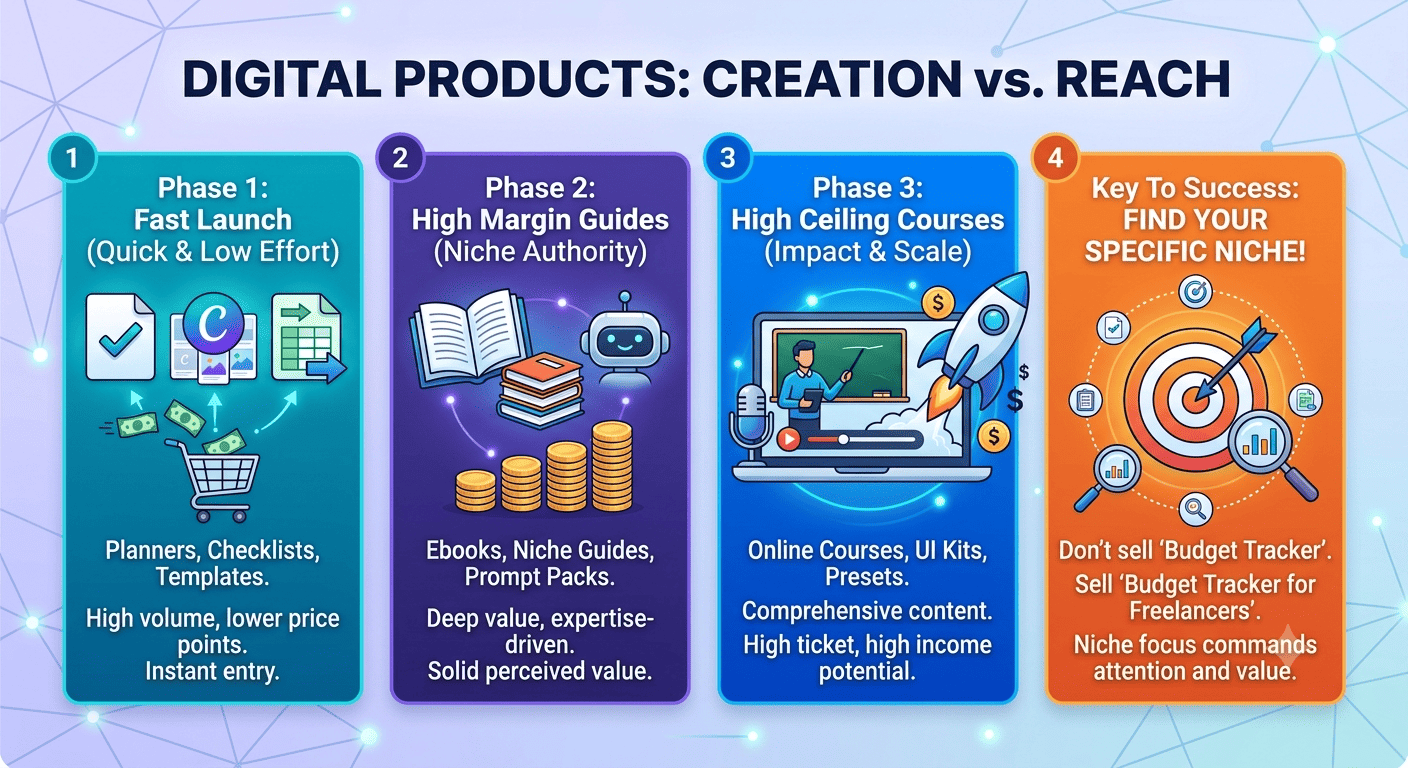
1. Printables (planners, checklists, wall art) — Low effort, quick to design in Canva or Illustrator. Price: $2–$15. Sells well on Etsy in home, wellness, and organization niches.
Advertisement
2. Canva and social media templates — Build one style, duplicate, swap colors and text. Price: $5–$30 for a set. Strong demand from small businesses and creators who want a consistent look without hiring a designer.
3. Notion templates — Currently one of the fastest-moving categories, popular for project management, finances, and content planning. Price: $10–$50.
4. Niche spreadsheets and trackers — Budget trackers, habit trackers, debt payoff planners. Solve one specific problem, which is exactly why they sell. Price: $5–$25.
5. SVG and craft cut files — For the Cricut/Silhouette crowd. Low production time once you’ve built a style. Price: $2–$10 each, often bundled.
Advertisement
Best Margins for the Effort
6. Ebooks and niche guides — General nonfiction sits around $2.99–$9.99; specific, specialized topics (“budgeting for freelancers” vs. generic money advice) command $4.99–$19.99. Time investment is the main cost — there’s no printing or shipping to eat into margin.
7. AI prompt packs — Curated, tested prompts for a specific use case (content writing, coding, design). Cheap to produce, currently high perceived value given how many people are still figuring out how to use AI tools well.
8. Done-for-you business templates — Contracts, intake forms, onboarding guides, SOPs. Service providers pay well for these because they save hours and make a new business look established fast. Price: $15–$75.
9. Done-for-you email flows — Pre-written welcome sequences, abandoned cart flows, or nurture sequences for a specific niche. Less common than the other categories, which is part of the appeal. Price: $25–$150.
Advertisement
10. Workbooks (CBT-style, journaling, goal-setting) — Structured, printable, often paired with an ebook. Price: $9–$25.
11. Mini-courses and frameworks — Condensed versions of a bigger topic: a checklist, a short video walkthrough, a repeatable process. Buyers want a fast, specific win. Price: $19–$79.
Higher Effort, Higher Ceiling
12. Online courses — The highest-ticket common digital product, and the one that takes the most upfront time to build well. Short single-topic courses run $10–$20; comprehensive multi-module courses run $99–$499. Justifies the price if the outcome is genuinely high-value for the buyer.
13. Website themes and UI kits — Requires real design/dev skill, but sells to a market (other creators and small businesses) that’s willing to pay for something that saves them dozens of hours. Price: $30–$150.
Advertisement
14. Lightroom presets and video LUTs — Niche but proven — some creators have built six-figure businesses almost entirely around a signature editing style. Price: $10–$40 per pack.
15. Stock photo and video packs — Higher production effort (you’re the one shooting), but reusable across many buyers once built. Price varies widely by license type.
16. Simple software, plugins, or automation scripts — Highest technical bar on this list, but often the least competitive category because fewer people can build it. Price: highly variable.
Fastest-Growing in 2026
17. Guided meditation and breathwork audio — Short 5–20 minute sessions, sold individually or bundled. Low production cost, strong repeat-purchase rate. Price: $4.99–$19.99.
Advertisement
18. Audiobook versions of existing ebooks — If you already have written content, this reaches an audience that reads less and listens more. Price: $9.99–$19.99.
19. Children’s audio stories — A genuinely underserved niche — parents actively search for screen-free entertainment. Price: $2.99–$9.99.
20. AI-personalized products — Personalized children’s books, custom workout plans, tailored templates generated per buyer. Newer category, growing fast, though it leans on tools and workflows that are themselves still evolving.
How Do You Pick the Right One for You?
Looking at that list, the honest filter isn’t “which one is most profitable” — it’s three narrower questions:
Advertisement
What do you already know or make, that someone else would pay to skip learning? The sellers who succeed fastest usually aren’t inventing a new skill for the product — they’re packaging one they already have.
How much upfront time can you actually give it? A printable set is a weekend. A comprehensive course is realistically a multi-month project, even working part-time.
Is there a specific buyer, or a vague one? “A budget tracker” is vague. “A budget tracker for freelancers with irregular income” is specific — and specific is what sells, because it tells a stranger scrolling past thirty other listings that this one was made for them.
If you can’t answer the third question yet, that’s the actual first step — more important than picking a format off this list.
Are Digital Products Actually Worth It in 2026?
Worth it, yes — automatically passive, no. The “low overhead” part is genuinely true: no inventory, no shipping, no per-unit cost eating your margin. What doesn’t show up in that pitch is that low overhead doesn’t mean low effort — it just moves the effort earlier, into the creation and marketing, instead of into ongoing fulfillment.
The other honest caveat: the obvious niches (generic budget planners, generic productivity templates) are genuinely saturated. The products that still do well tend to be specific rather than broad — which is a theme you’ll notice repeats throughout this whole list.
Where Should You Actually Sell Digital Products?
Marketplace (Etsy, Creative Market)
Dedicated platform (Gumroad, Sellfy, Payhip)
Your own site (Shopify, WooCommerce)
Built-in traffic
Highest — buyers are already browsing
Low — you bring your own audience
Lowest — entirely your own traffic
Fees
Listing + transaction fees
Monthly or per-sale fees
Platform/hosting cost, generally lower per-sale
Control over branding
Limited
Moderate
Full
Best for
New sellers with no existing audience
Creators with some following who want more control
Established sellers who already drive their own traffic
Most sellers starting from zero audience do best on a marketplace first, then migrate to their own platform once they have proof a product sells and don’t want to keep paying marketplace fees on repeat buyers.
What Mistakes Tank Digital Product Sales?
Picking a saturated niche with no differentiation. “Another budget tracker” competes with thousands. “A budget tracker for wedding planners” doesn’t.
Advertisement
Weak previews and mockups. Buyers can’t hold a digital product before purchasing — the preview images are doing all the trust-building work a physical product gets for free.
Pricing based on hope, not research. Check what comparable, specific products in your niche are actually charging before picking a number.
Launching with zero validation. Posting in a relevant community, running a small pre-sale, or just asking your existing audience what they’d pay for costs nothing and prevents building something nobody wants.
How Much Can You Realistically Make Selling Digital Products?
Here’s where most guides on this topic get misleading — they lead with one creator’s standout number ($50,000, sometimes six figures) presented as typical. It isn’t. Outcomes vary enormously based on three factors: how specific the niche is, how large an audience you already have (or can reach), and price point.
Advertisement
A realistic range for someone starting from scratch, building one solid product, and doing their own marketing: modest supplemental income in the first several months, with growth from there tied directly to how much ongoing marketing and product expansion happens — not something that keeps compounding on autopilot.
The Bottom Line
The products on this list that tend to work are the specific ones, built by someone who already had the underlying knowledge, sold to a buyer they could describe in one sentence. Everything else on the list- the platform you choose, the price you set- matters less than getting that part right first.
Business owners bracing for a Burnham premiership have been offered a rare note of reassurance from one of the City’s most respected voices. Jim O’Neill, the economist and former Treasury minister, says the probable next prime minister will not arrive in Downing Street with a fresh round of punishing tax rises.
Speaking on The Rest Is Money podcast with Robert Peston and Steph McGovern, O’Neill said the biggest risk to confidence would be a new government talking the country down all over again.
“If something can be done to change the mindset of consumers and businesses, and make them think, ‘Hang on a second, we don’t have to worry as much about the next few years as we have been doing, effectively on and off since the financial crisis,’ then I think the human instincts and the natural juices would start to flow – so long as you don’t have an incoming government repeating what Keir did: ‘Oh, well, it’s actually way worse than we thought. Sorry, we’re going to tax the hell out of you. Life’s going to be miserable.’ That is definitely not the nature of our probable incoming leader.”
But the reassurance comes with a hard edge. O’Neill argues the UK can no longer duck politically toxic “sacred cows”: the pension triple lock, a root-and-branch overhaul of welfare, replacing council tax and stamp duty with a fairer system of land and property taxation, and a credible long-term framework for infrastructure investment.
Advertisement
On the triple lock, whose mounting long-term cost the Office for Budget Responsibility has repeatedly flagged, he was blunt. “I think the triple lock needs to be dealt with. And I suspect, once the right person is bold enough to do it, it’s going to be pretty hard for any major political opposition to disagree. It’s also very unfair from an intergenerational perspective, with all these young people who can’t afford to buy or rent in some parts of the country being expected to pay more and more tax for a lot of people who own their own homes and still get a very nicely protected pension increase all the time.”
He was equally scathing about Sir Keir Starmer’s tinkering with Britain’s welfare bill. “I do think one of the many mistakes that Keir Starmer presided over was effectively trying to play around with small amounts of savings in welfare, purely to meet what one might regard objectively as an arbitrary fiscal rule or fiscal space. Whereas, if you’re really going to do it, you’ve got to have a systematic reform of everything that connects to the various welfare payments that are going on.”
The stakes, he warned, are being set daily in the bond markets. “You’ve got, lurking in the background every second of every day, the financial markets. They are not charging the UK a premium on its borrowing for nothing. They are expecting that, at some point, somebody is going to be bold enough to take on some of these so-called sacred cows and put us on a more sustainable path for debt.”
Advertisement
For SMEs, the practical takeaway is focus. O’Neill argues markets could support higher borrowing for growth-enhancing projects, provided decisions are independently assessed, and he wants far greater devolution of skills, education and employment support, though he cautions the Greater Manchester model cannot simply be copied elsewhere.
His advice to the man who has already signalled room for movement on tax and a business rates cut for high street firms is characteristically direct. “Andy needs to figure out exactly what his key priorities are, communicate that to everybody and then actually stick with them. He then needs to choose the people around him who can deliver them.”
O’Neill stresses he holds no formal role with Burnham. The sacred cows, though, now have a very public list of names against them.
Amy is a newly qualified journalist specialising in business journalism at Business Matters with responsibility for news content for what is now the UK’s largest print and online source of current business news.
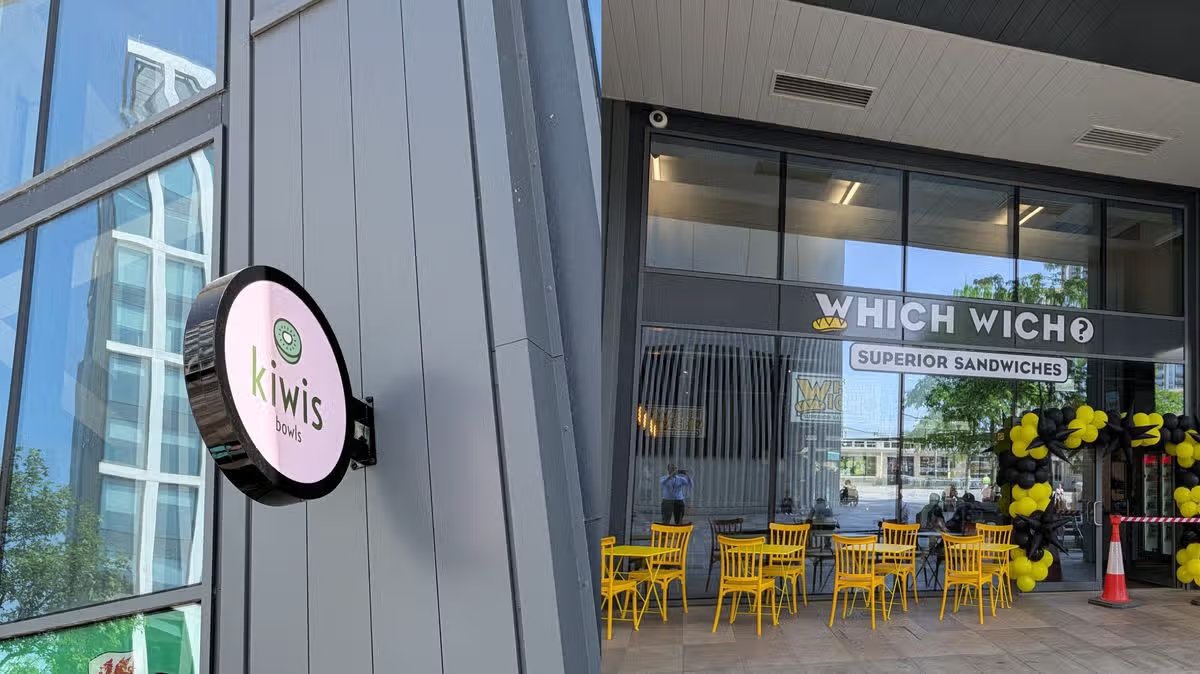
Which Wich and Kiwis Bowls has taken space at the Cardiff Bus Interchange.
Cardiff Bus Interchange has signed up new tenants to its ground floor retail element. The bus station, which is managed by Transport for Wales (TfW), has attracted Kiwis Bowls and the international sandwich specialist Which Wich.
They follow the opening of a Starbucks in April last year.
Advertisement
Alexia Course, chief commercial officer at TfW said: “We’re delighted to welcome these new retailers to Cardiff Bus Interchange.
Following the arrival of Starbucks last year, these new additions now bring even more choice for passengers and strengthen our tenant mix. We’re creating spaces that serve customers and support local businesses.”
The integration of these units was managed by TfW’s recently in-housed commercial property team.
Supporting the interchange’s digital infrastructure, the project highlights a significant digital milestone. TfW subsidiary ffeibr provided both retailers with high-speed business broadband, showcasing a successful internal collaboration between TfW and ffeibr.
Advertisement
Guy Reifer, managing director of ffeibr, added: “This is an exciting milestone for ffeibr, as we continue our expansion into the direct to business sector.”
“Our mission is to provide reliable, high-speed connectivity that helps Welsh businesses, as well as businesses in Wales, thrive, and this partnership is a great example of that in action.
Cycle storage
Moreover, TfW by providing secure storage for cyclists through its cycle hangar project. TfW has installed 40 cycle hangars across seven different housing associations and eight local authority areas as part of phase one of the project.
TfW worked closely alongside specific housing associations who proposed the sites following an initial expression of interest that was issued. TfW then carried out joint site visits to evaluate each location to ensure the best fit for the cycle hangars and the housing associations.
Advertisement
Deputy Minister for Transport Mark Hooper said: “Cycling is one of the most affordable, healthy and sustainable ways people can get around.
“Ensuring everyone has access to secure storage is a vital part of making that a practical option. These new cycle hangars for housing association tenants show what we can achieve when we work together to make it easier for people to cycle.
Nicola Grima, active travel delivery programme lead, said: “We’re so pleased to have completed phase one of our Cycle Hangar project alongside many housing associations within different local authorities across Wales.
“The lack of secure cycle parking is a barrier to people choosing to cycle for everyday journeys, so providing secure cycle parking is a way to overcome this barrier. Wales has great walking and cycling infrastructure and we want as many people as possible to make use of it.”
Advertisement
TfW has confirmed that phase two of the project is already in development which will provide 40 hangars across 10 local authority areas.
China’s mobile-first culture has advanced beyond American smartphone adoption, with apps like WeChat integrating communication, payments, and social networking into daily life. This connectivity has bridged geographical distances and reshaped urban routines, potentially setting a new global standard for smartphone integration.
The shift has also introduced challenges, including reduced face-to-face interaction, digital addiction, and privacy concerns, particularly among young people. Balancing digital convenience with social well-being is increasingly important as widespread smartphone use continues to reshape cultural norms and behaviors.
This episode explores whether smartphones dominate American culture and suggests that China has advanced the mobile-first lifestyle even further. It highlights China’s innovative approaches to mobile technology, their integration of smartphones into daily life, and how this shift influences social and economic behaviors, possibly setting a global standard beyond what is seen in the United States.
The pervasive use of smartphones has significantly transformed Chinese society, impacting communication, social interactions, and daily routines. In urban areas, smartphones are essential tools for coordinating work, socializing, and accessing information, fostering a more connected and efficient lifestyle. Apps like WeChat facilitate instant messaging, mobile payments, and social networking, integrating various aspects of daily life into one device. This technology-driven shift has bridged geographical gaps, enabling families and friends to stay connected regardless of distance.
However, the rise of phone culture has also brought challenges. Excessive screen time can lead to social withdrawal and reduced face-to-face interactions, altering traditional communal values. Young people, in particular, spend hours immersed in digital worlds, which influences their social skills and real-world relationships. Additionally, concerns about privacy and digital addiction have emerged as society grapples with the implications of widespread smartphone use.
Overall, phone culture is reshaping Chinese society by enhancing connectivity while also posing social and psychological challenges. As technology continues to evolve, balancing digital convenience with social well-being becomes essential. This transformation underscores the importance of adapting cultural norms to navigate the digital age effectively.
Three winters ago, I decided delivery driving was going to be my genius side hustle. I had a car, a phone, and crucially a wildly inflated sense of how much “flexible income” actually means. I pictured myself cruising around town, podcast on, cash rolling in between errands. Two hours and four food deliveries later, I’d made $19. Minus gas, that came out to something like $6.40 an hour, which is less than I would’ve made standing perfectly still and doing nothing. I still, for reasons I cannot defend, kept the app on my phone for another eight months.
So: are delivery apps actually a smart way to make money, or just a well-marketed way to burn a tank of gas for gas-station wages? The honest answer is it depends entirely on which app, which city, which hours, and whether you’re willing to treat it like a numbers game instead of a vibe. Here’s what the data and a lot of driver forums actually say.
Below is the real breakdown of what each one pays, who it’s actually good for, and where the marketing outruns reality.
Does DoorDash still pay off in 2026?
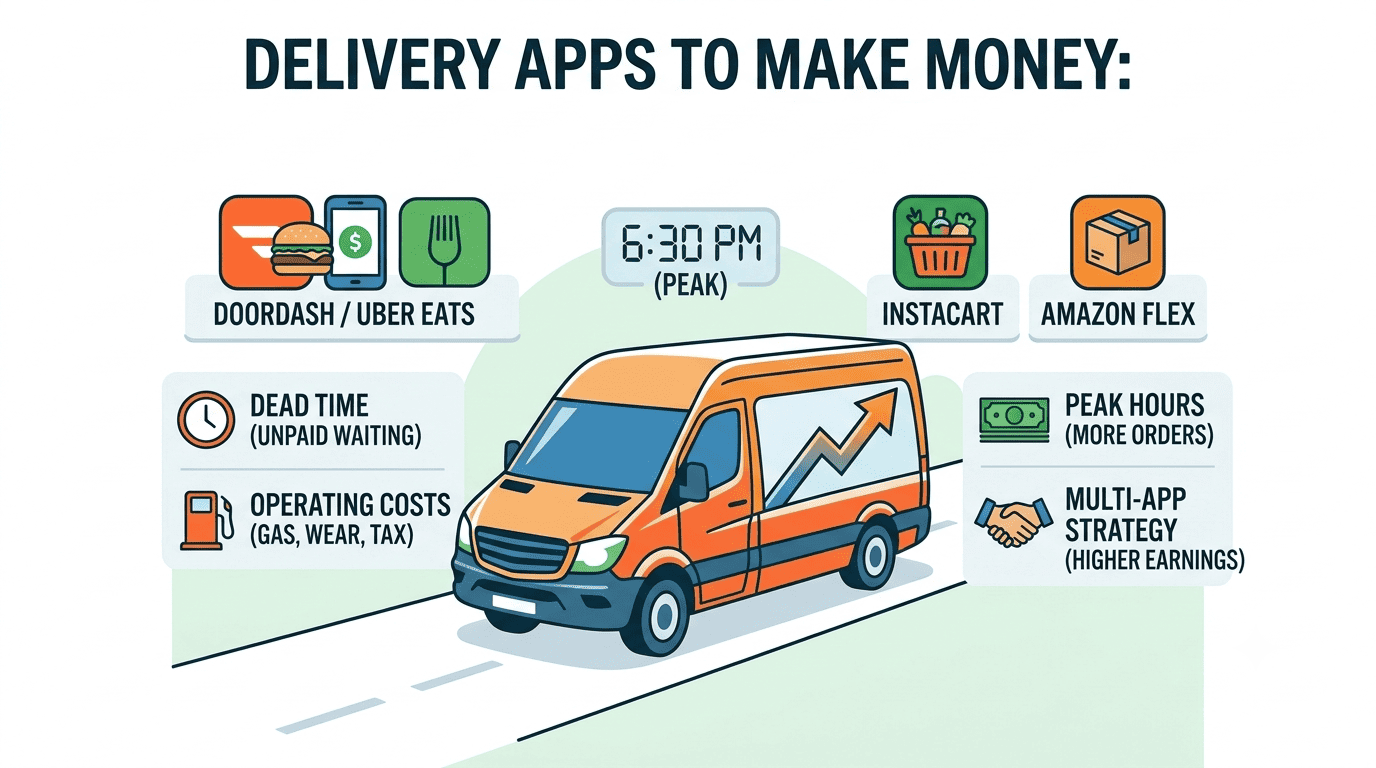
DoorDash remains the biggest name in the game, and for good reason- the order volume is unmatched in most cities, and sign-up takes about five minutes. Average pay lands around $15–$25 an hour before expenses, though that range swings hard depending on your market and whether you’re driving during a genuine rush or just refreshing the app hoping something pings. The tradeoff for that volume is competition: in saturated areas, you’ll spend real time waiting between orders, and that dead time doesn’t pay.
Worth it if you live somewhere with consistent lunch and dinner demand. Less worth it if you’re in a smaller market where three other Dashers are circling the same three restaurants.
Advertisement
Is Uber Eats better if you’re already driving for Uber?
If you’re already signed up to drive passengers, Uber Eats is close to a no-brainer — you can toggle to delivery when rides slow down and keep earning either way. On its own, though, the pay is a touch lower than DoorDash in most markets, generally $12–$20 an hour. The real value here is flexibility: fewer awkward conversations with strangers in your back seat, more control over exactly what kind of driving you’re doing at any given moment.
Is Instacart the better bet if you’d rather shop than drive?
Instacart flips the model: instead of picking up and dropping off, you’re shopping an actual grocery list, which means more time per order but noticeably higher pay — often $15–$30 an hour, with the top end reserved for big batches during peak hours. It’s more physically and mentally involved than food delivery (substitutions, weighing produce, hunting down that one specific brand of oat milk), but the tipping culture tends to reward shoppers who communicate well and get orders right the first time.
This is a strong option if you’d rather be inside a store than behind a wheel for three straight hours.
What makes Shipt different from Instacart?
Shipt runs on a similar model to Instacart — shop, deliver, repeat — but it’s built around Target and a handful of retail partners, and shoppers who build repeat relationships with the same customers often see it pay off in loyalty and better tips. Average pay sits around $16–$22 an hour. The catch: getting approved can take longer than some competitors, and route availability depends heavily on how saturated your zip code already is with other shoppers.
Advertisement
Is Amazon Flex actually the highest-paying option?
Of the mainstream apps, Amazon Flex is frequently cited as one of the better-paying choices — $18–$25 an hour is a common range, and you know your earnings upfront because you’re booking a fixed block (usually two to four hours) rather than gambling on per-order pings. The predictability is the whole appeal. The downside is that popular blocks get snapped up fast, so if you’re not fast on the draw when new slots post, you may find yourself checking the app repeatedly with nothing to show for it.
Does Walmart Spark deserve more attention than it gets?
Spark doesn’t get talked about as much as the bigger names, but it’s worth a look if there’s a Walmart or Sam’s Club nearby — you’ll deliver groceries and general merchandise, and pay tends to land in a similar range to Instacart and Shipt. Availability is the limiting factor here more than pay; it’s simply not as widespread yet.
Where does Grubhub fit into all of this?
Grubhub was one of the original food delivery apps, and while it’s lost significant market share to DoorDash and Uber Eats and changed corporate ownership more than once along the way, it still operates its own driver network in a number of cities. Pay tends to run $10–$17 an hour, generally lower than DoorDash or Uber Eats, but drivers in dense urban markets sometimes report steadier demand and fewer wild swings in order flow.
Is Roadie worth downloading if you’re not trying to drive full-time?
Roadie takes a genuinely different approach: instead of building a schedule around deliveries, it’s designed to monetize trips you’re already taking. Multi-stop gigs pay somewhere in the $25–$50 range, and there’s no requirement that you’re delivering food- it might be a suitcase, a piece of furniture, or a random Craigslist find someone needs moved across town. It’s less a full-time income stream and more a way to make an errand you were running anyway slightly less annoying.
Advertisement
Can you actually make more money hauling instead of delivering food?
This is the piece most “best delivery apps” lists gloss over: apps built around heavy or bulky items — think Bungii, GoShare, and Curri — consistently pay more per hour than food delivery, sometimes two to three times as much. One 2026 industry analysis tracking roughly a billion gig trips found task-based hauling work outearning standard food delivery by a wide margin. The logic checks out: fewer people own a pickup truck or cargo van, so the pool of available drivers is smaller, and platforms pay a premium to fill jobs. The tradeoff is obvious, you need the right vehicle, and you need to be willing to actually lift the couch.
How much should you realistically expect to make?
Here’s where the marketing and the math tend to part ways. Every app’s advertised hourly rate is gross pay- before gas, before the extra wear on your brakes and transmission, before the portion of your car’s depreciation that’s quietly happening every time you drive for money instead of pleasure. A driver technically “earning” $22 an hour on paper might be walking away with closer to $15–$17 once fuel and mileage are accounted for, and that’s before you’ve set aside anything for the self-employment tax bill waiting for you the following spring.
Is it smarter to run multiple apps at once?
Almost every experienced driver will tell you the same thing: don’t marry one app. Running DoorDash, Uber Eats, and Instacart simultaneously and accepting whichever offer pings highest first- is the closest thing to a proven strategy in this space. It fills the dead time that kills your hourly rate on any single platform, and it hedges against the days when one app’s demand mysteriously dries up for no explainable reason (every driver has a story about this).
The tradeoff is mental load. Juggling three notification streams while driving isn’t for everyone, and there’s a real argument for picking one or two apps you can actually manage well rather than spreading yourself across five and doing all of them mediocre.
Advertisement
What don’t the app store descriptions mention?
A few things worth knowing before you sign up for anything:
You’re a 1099 contractor, not an employee. No withholding, no benefits, and a tax bill that can catch first-timers off guard.
Vehicle wear adds up faster than people expect. Oil changes, brake pads, and higher insurance premiums (some personal auto policies exclude commercial delivery use entirely) are real costs, not hypothetical ones.
Age and background-check requirements vary. Most platforms require drivers to be at least 18 or 19, hold a valid license, carry insurance, and pass a background check — Instacart’s shopper-only track is one of the few that doesn’t require a car at all.
“Average pay” figures are averages, not guarantees. Your actual market, the time of day you drive, and local tipping culture will move your real number more than any app’s advertised range.
None of this means delivery apps are a bad way to make money for a lot of people, especially those with an already-flexible schedule, they’re a genuinely useful way to turn spare hours into cash without a job interview. But treating it as a strategic, numbers-driven side hustle instead of easy money is what separates the drivers actually building meaningful extra income from the ones burning gas for less than minimum wage- which, if it wasn’t already obvious, is a club I know from firsthand, deeply humbling experience.

















































You must be logged in to post a comment Login