Connect with us
DAPA Banner
DAPA Coin
DAPA
COIN PAYMENT ASSET
PRIVACY · BLOCKDAG · HOMOMORPHIC ENCRYPTION · RUST
ElGamal Encrypted MINE DAPA
🚫 GENESIS SOLD OUT
DAPAPAY COMING

Business

Buyback alert! 5 stocks turning ex-record dates for share buybacks in May. Check details – Share buybacks

Published

on

Buyback alert! 5 stocks turning ex-record dates for share buybacks in May. Check details - Share buybacks

Zydus Lifesciences on Tuesday announced its biggest-ever share buyback worth Rs 1,100 crore at a buyback price of Rs 1,150 per share, offering nearly a 10.5% premium over the stock’s previous closing price. Zydus Lifesciences’ board approved a plan to buy back up to 95.65 lakh shares, each with a face value of Re 1, representing 0.95% of the company’s paid-up equity share capital, for an aggregate amount not exceeding Rs 1,100 crore. The buyback will be conducted via the tender route. The record date to determine shareholders’ eligibility for the buyback has been fixed as May 29 (next Friday).

Continue Reading
Click to comment

You must be logged in to post a comment Login

Leave a Reply

Business

Rahul Shah bullish on pharma, sees Sun Pharma and Aurobindo as key large-cap plays

Published

on

Rahul Shah bullish on pharma, sees Sun Pharma and Aurobindo as key large-cap plays
Consumption trends in India’s equity markets continue to show a mixed but gradually improving picture, with investors increasingly becoming selective across consumer-facing sectors. While quick service restaurants (QSR) continue to face pressure, premium retail and select FMCG-linked businesses are showing stronger resilience and visibility.

Speaking to ET Now, market expert Rahul Shah from MOFSL said that Page Industries stands out as one of the strongest recovery stories within the consumer space. He highlighted improving growth momentum and positive management commentary, pointing out that “strong performance, upbeat on the sales part, 11% quarter-on-quarter growth, and we believe that after a long time we have seen this kind of growth coming back in Page.” He also noted that earnings estimates have been revised upward and that the company’s product expansion through digital platforms and retail channels is supporting visibility. According to him, Page Industries offers rare double-digit growth visibility in a volatile market and remains reasonably valued given its long-term growth outlook.

On other consumer names such as Nykaa and Honasa, Shah adopted a more cautious stance. He said Nykaa was largely in line with expectations and while the numbers were stable, “I feel that there is limited upside on the stock,” indicating that major re-rating potential may be capped in the near term. Honasa too was seen as largely aligned with expectations without strong immediate triggers for upside.

On broader consumption strategy, Shah suggested a balanced portfolio approach combining select FMCG names with premium consumption plays. He emphasized Marico as a consistent performer in the FMCG space, stating that it continues to stand out due to market share strength, product launches, and earnings sustainability. Along with Page Industries, he sees FMCG leaders like Marico as key anchors for playing the consumption theme in the current market environment.

Advertisement

In the insurance space, Shah reiterated the importance of maintaining sector allocation in portfolios. While acknowledging strong numbers from LIC, including growth in value of new business margins and annual premium equivalent, he expressed a preference for Max Financial Services within the space. He highlighted strong margins, robust growth, and expanding distribution channels beyond banks, noting that “Max remains our preferred bet and we see 20% upside in it.” At the same time, he indicated that LIC could act as a rerating candidate given improving sentiment and market positioning.


On the pharma sector, Shah observed that the space continues to outperform broader markets, supported by global uncertainty and defensive positioning. He noted that the Nifty Pharma index is at a 52-week high and highlighted strong performance from Sun Pharma and Aurobindo Pharma. While acknowledging that Cipla and Dr Reddy’s delivered weaker results, he maintained a constructive outlook on large-cap pharma, suggesting that Sun Pharma remains a key stock to watch, especially after its earnings, while Aurobindo Pharma also looks attractive after meeting street expectations.
Overall, the market narrative continues to shift towards selective consumption recovery, steady pharma strength, and insurance-driven defensive growth. With earnings visibility diverging across companies, investors are increasingly focusing on stock-specific opportunities rather than broad sector bets.

Continue Reading

Business

Oil Falls On Renewed Hopes for U.S.-Iran Deal

Published

on

Oil Falls On Renewed Hopes for U.S.-Iran Deal

1506 ET – Oil futures post back-to-back losses as President Trump says the U.S. is in the final stages of negotiations with Iran, raising hopes of a deal to end the conflict and reopen the Strait of Hormuz. Still, Trump adds that failure to reach a deal meant a resumption of military action. “Typical Trump style, but the market is buying into the possibilities,” says Mizuho’s Robert Yawger in a note. Hopes for an agreement led the market to overlook a bullish EIA inventory report showing U.S. commercial crude stocks down by 7.9 million barrels last week, although distillate stocks rose for a second straight week. WTI settles down 5.7% at $98.26 a barrel and Brent falls 5.6% to $105.02.(anthony.harrup@wsj.com)

Oil Futures Extend Losses on Hopes for U.S.-Iran Deal

1235 ET – Oil futures extend losses as the market focuses on hopes for a deal to end the U.S.-Iran conflict and reopen the Strait of Hormuz. The fact prices could fall further following a bullish U.S. crude stock drawdown for last week “tells me it’s more likely than not some kind of negotiation is happening,” says BOK Financial’s BOKF -0.17%decrease; red down pointing triangle Dennis Kissler. “The market is anticipating some sort of agreement.” The EIA reported a 7.9 million barrel decline in commercial crude stocks, along with a 9.9 million barrel release from the Strategic Petroleum Reserve. WTI is off 5.2% at $98.75 a barrel and Brent falls 5.5% to $105.16 a barrel. (anthony.harrup@wsj.com)

Copyright ©2026 Dow Jones & Company, Inc. All Rights Reserved. 87990cbe856818d5eddac44c7b1cdeb8

Continue Reading

Business

Goldman Sachs reinstates Ageas stock coverage with neutral rating

Published

on


Goldman Sachs reinstates Ageas stock coverage with neutral rating

Continue Reading

Business

Jailed tycoon's Birkin bags sell for over half a million dollars

Published

on

Jailed tycoon's Birkin bags sell for over half a million dollars

The luxury handbags sold in a government auction in Ho Chi Minh.

Continue Reading

Business

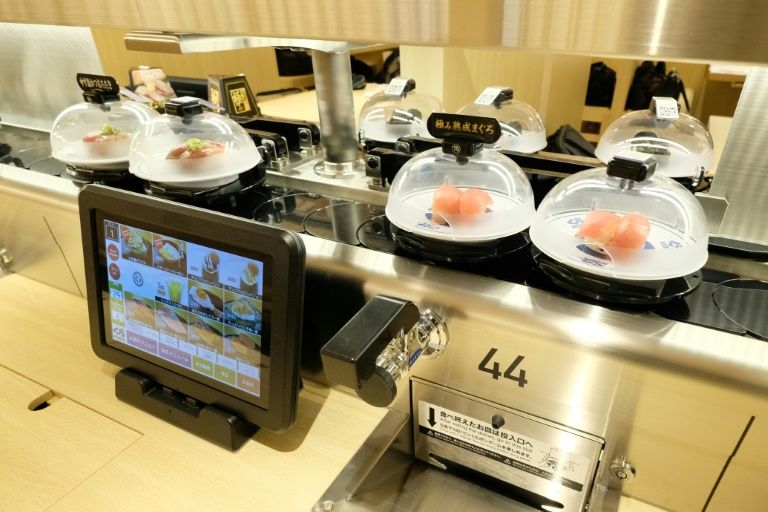
Trump Invests $1M-$5M in Kura Sushi USA Chain With 27 California Locations

Published

on

Japanese restaurant chain Kura Sushi plans to install cameras above its conveyor belts to monitor customers

NEW YORK — President Donald Trump purchased between $1 million and $5 million worth of shares in Kura Sushi USA Inc. on Feb. 2, 2026, according to financial disclosures released on May 14, 2026.

Kura Sushi USA operates the Kura Revolving Sushi Bar chain, known for its conveyor-belt system that delivers sushi plates to customers. The company is the U.S. subsidiary of Japan’s Kura Sushi Inc. and is listed on Nasdaq under the ticker KRUS.

The investment was part of a broader portfolio of stock trades executed in the first quarter of 2026. Trump’s disclosures also included significant positions in major technology companies such as Nvidia, Amazon and Apple, with total trades estimated between $220 million and $750 million during the period.

Kura Sushi USA had 27 locations in California as of May 2026, with additional sites in other states. Northern California restaurants include locations in San Francisco’s Stonestown Galleria, Cupertino and Berkeley. The chain has expanded using automation and technology to enhance the dining experience.

Advertisement

Shares of Kura Sushi USA rose following the disclosure of Trump’s stake. The stock gained more than 6% on the day the filing became public, with the Japanese parent company also seeing gains of up to 5.4%.

Trump has publicly expressed dislike for raw fish and sushi in the past. Despite this, the investment proceeded through third-party financial advisers managing his portfolio. A spokesperson for the Trump Organization stated that neither Trump nor his family members participate directly in day-to-day investment decisions.

Kura Sushi USA focuses on fresh ingredients prepared without artificial additives, following the Japanese parent company’s “muten” philosophy. The revolving sushi concept originated in Japan in 1977, and the U.S. operation has grown steadily since its establishment in 2008.

The company has outlined plans for further U.S. expansion, emphasizing technology and automation. It operates more than 90 locations nationwide as of May 2026, with additional sites in development.

Advertisement

The disclosure comes from the U.S. Office of Government Ethics. Presidents are required to file periodic financial reports detailing assets, investments and transactions. The forms use ranges rather than exact figures for privacy and reporting purposes.

Kura Sushi USA shares a name similarity with some Japanese technology firms, leading to occasional confusion in market commentary, though the company is strictly a restaurant operator.

The investment has drawn attention due to Trump’s known preferences and the relatively small size compared to his other holdings. Analysts noted it as one of the more unusual entries in his first-quarter portfolio.

Kura Sushi USA reported steady growth prior to the disclosure. The chain emphasizes interactive dining with touch-screen ordering and plate-counting systems that reward customers. It has introduced promotions such as Hello Kitty collaborations to attract families and younger diners.

Advertisement

The broader restaurant industry has faced challenges with labor costs and consumer spending, but conveyor-belt concepts have maintained appeal through efficiency and novelty. Kura Sushi continues opening new locations while refining its model.

No official comment from the White House addressed the specific investment in Kura Sushi. The Trump Organization maintains that all investments are handled independently to avoid conflicts of interest.

The disclosure reignited discussions about presidential investments and potential conflicts. Similar scrutiny has followed previous administrations regarding business holdings during terms in office.

Kura Sushi USA’s parent company in Japan holds a majority stake in the U.S. operation. The brand has expanded aggressively in the American market, targeting malls and urban centers with high foot traffic.

Advertisement

Financial filings show Trump executed more than 3,700 trades in the first quarter through advisers. The portfolio mix includes technology, defense and other sectors alongside the restaurant investment.

Industry observers will monitor how the investment performs and whether it signals any broader interest in consumer or restaurant stocks. Kura Sushi USA continues normal operations across its California and national locations.

The company’s California presence includes both standalone restaurants and mall-based outlets. Popular items feature fresh tuna, salmon and specialty rolls delivered via the signature conveyor system.

This marks one of several notable investments disclosed in Trump’s latest ethics filing. The full document details assets and transactions required for transparency during his presidency.

Advertisement
Continue Reading

Business

Stop Blaming Young People for Britain’s Jobs Crisis

Published

on

Stop Blaming Young People for Britain's Jobs Crisis

Britain’s largest online retailer has waded into one of the most uncomfortable debates in Westminster and the boardroom: who, exactly, is to blame for almost a million young people sitting outside the labour market?

The answer, according to Amazon’s UK country manager John Boumphrey, is not the young people themselves.

In a candid interview with the BBC’s Big Boss series, Boumphrey said the prevailing narrative that Generation Z lacks motivation, resilience or grit simply does not square with what his managers see on the warehouse floor. “We have to stop blaming young people,” he said, arguing that the education system is no longer “producing young people who are ready for work”.

Coming from the man who runs an operation employing 75,000 people across roughly 100 UK sites — half of them recruited straight out of school, college or unemployment — the intervention will sting employers who have spent the past 18 months grumbling about a “soft” younger workforce.

A million reasons to pay attention

The numbers behind Boumphrey’s comments are sobering. Almost a million 16- to 24-year-olds in the UK are now classified as NEET — not in education, employment or training — a figure that has hovered uncomfortably close to seven-figure territory for more than a year, according to the Office for National Statistics. At the same time, the headline unemployment rate ticked up to 5 per cent in the three months to March, from 4.9 per cent a month earlier.

Advertisement

For SME owners, who account for the lion’s share of first jobs in Britain, the picture is grimmer still. Hospitality has retrenched, graduate schemes have thinned and entry-level vacancies in retail have collapsed, leaving fewer of the rungs school leavers traditionally use to climb into work. Business Matters has tracked the trend through the year, including in our recent report on how the NEET rate is closing in on the one-million mark.

Boumphrey’s argument is that the diagnosis matters. “I think too often you read about young people that somehow they lack motivation, they lack resilience, they lack the will to develop skills,” he said. “That is not our experience. We work with some individuals who are probably furthest from work and that’s where we actually see the biggest transformation.”

The case for compulsory work experience

His proposed remedy is unfashionably practical: make a stint of work experience mandatory for every over-16 in the country.

He argues that even a single week on a real shop floor, in a logistics hub or in an office teaches the soft skills schools struggle to deliver. “If you get a T-level student, they come in for a week, they understand the value of teamwork, of communication and problem solving,” he said. “It’s not a motivation problem, it’s a system problem, and that requires a system response.”

Advertisement

The T-level itself, introduced in 2020 and structured around a mandatory industry placement of at least 315 hours, has been quietly absorbed by larger employers but remains a foreign concept to many smaller firms. As Business Matters has set out before, T-levels carry real upside for SME employers willing to host a placement, not least because they create a low-risk pipeline of pre-trained recruits.

The Amazon paradox

The irony, Boumphrey concedes, is that his own business cannot find enough of the workers it needs. Amazon has just over 100 premises in the UK, including 30 fulfilment centres, and is on course to add several more on the back of its £40bn UK expansion programme. Yet roles built around its newer robotic infrastructure — mechatronics engineers, robotics technicians, maintenance specialists — sit stubbornly unfilled.

“When Amazon introduced robots into its warehouses there was some concern they would replace people,” he said. “Actually, the reverse happened. We ended up employing more people. Mechatronics engineers, people who can actually maintain the robots, people who are technicians, they’re not roles that exist. We can’t find enough people to fill those roles.”

His proposed fix is regional and collaborative: business, local authorities and further education colleges sitting around the same table to map skills gaps in each travel-to-work area, rather than relying on a one-size-fits-all national curriculum.

Advertisement

Tax, scale and the political subtext

The Amazon UK boss could hardly avoid the perennial question of tax, given the group’s scale and its political profile. He claimed the company contributed “more than £5.8bn” in the UK last year and insisted Amazon pays “all the tax we’re meant to pay”. The wider contribution, he argued, must also be measured in the 75,000 jobs the company underwrites.

Amazon now accounts for roughly 30 per cent of all online sales in the UK and, earlier this year, overtook Walmart as the world’s largest company by annual revenue. That scale gives Boumphrey a louder microphone than most when he tells policymakers and fellow employers that the country’s youth jobs problem is structural, not generational.

For SME owners watching from the sidelines, the takeaway is uncomfortable but useful. The labour market is not short of young people who want to work. It is short of pathways that prepare them to do so — and, increasingly, short of employers prepared to build those pathways themselves.


Amy Ingham

Amy is a newly qualified journalist specialising in business journalism at Business Matters with responsibility for news content for what is now the UK’s largest print and online source of current business news.

Advertisement

Continue Reading

Business

Franco family expands Bullsbrook footprint with $15m sale

Published

on

Franco family expands Bullsbrook footprint with $15m sale

The $15 million purchase brings the family’s Bullsbrook portfolio to 150 hectares of land, following the reveal of Abadeen’s plans to deliver 3,000 lots in the area.

Continue Reading

Business

Government borrowing higher than expected in April

Published

on

Government borrowing higher than expected in April

Borrowing, the difference between spending and income from taxes, was £24.3bn last month.

Continue Reading

Business

South West firms pause investment plans as Iran war uncertainty bites

Published

on

Business Live

Higher fuel costs and supply chain pressures are among the challenges facing businesses

Bath City Centre

Bath City Centre(Image: Bath Chronicle)

Mid-sized businesses across the South West are reducing or pausing investment amid the global political uncertainty being caused by the Middle East conflict, according to new research.

Nearly three quarters of the businesses questioned in the survey by advisory firm BDO said supply chain pressures and higher energy and fuel costs were among the biggest challenges they faced.

The bi-monthly survey of companies with revenues of between £10m and £500m found material delays and costs, stock shortages and suppliers folding were a top concern for more than half (51 per cent) of leaders in the region.

Nearly three in five (59 per cent)of South West firms questioned said they intended to halt or reduce investment as they waited for the situation in the Middle East to stabilise.

Advertisement

As a result, the region’s companies are considering steps such as increasing customer costs (46 per cent) and reducing or not paying a bonus (46 per cent), BDO said.

More than two-fifths of the region’s business leaders are also looking to prioritise UK-based suppliers (41 per cent), and a further 36 per cent are considering onshoring or nearshoring, in a move that could provide a boost to South West manufacturing.

Andrea Bishop, regional managing partner at BDO in the South West, said: “The mid-market is vital to the South West and wider UK growth. Instead of focusing their sights on expansion, they are struggling to absorb the latest economic shock in an uncertain global and political backdrop.

“Mounting pressures around energy, fuel costs and supply chains, which were issues affecting businesses even before the conflict in Iran, are only adding to the sustained feeling of uncertainty amongst regional business leaders.”

Advertisement

According to BDO, South West business leaders are looking to the government for extra support in case of further escalation. Popular policy or support measures for the next 12 months include transport and fuel cost relief; measures to reduce employment costs; and dedicated supply disruption support such as grants for businesses materially impacted.

“The government must ensure it listens to the wants and needs of South West business leaders in this crucial segment,” Ms Bishop added.

“Addressing these challenges head on could be the key to providing the stability needed to reignite the region’s economic growth.”

Advertisement
Continue Reading

Business

Opinion: Breaking down the whats and whys

Published

on

Opinion: Breaking down the whats and whys

OPINION: WA could learn from planners in other states when it comes to managing growth.

Continue Reading

Trending

Copyright © 2025