Connect with us

Business

Campaigners denied appeal against Gatwick Airport expansion

Published

on

A red and white plane, with blue sky and clouds in the background

In a 29-page ruling, they said: “We conclude that each of the grounds of appeal raised by each appellant is unarguable.

“Neither appeal has a real prospect of success. We also consider that there are no other compelling reasons for either appeal to be heard.”

The two senior judges also said that the previous ruling was “detailed and thorough”.

Gatwick is the UK’s second busiest airport and one of the busiest single-runway airports in the world.

Advertisement

The expansion will allow the site to be used for the departures of narrow-bodied planes such as Airbus A320s and Boeing 737s.

Following the decision, Barclay said: “We are very disappointed with the Court’s decision. We took this challenge as far as we could because we believed that the decision to allow Gatwick to expand was fundamentally flawed.

“It was not supported by government policy, would only serve to line the pockets of the airport and airlines, and would do so at the expense of local residents and the climate.”

Cagne said: “Residents should be immensely proud of what they have achieved in holding Gatwick Airport’s shareholders to account.

Advertisement

“This proposed new runway will come at a significant cost to both the taxpayer and the planet.”

Continue Reading
Click to comment

You must be logged in to post a comment Login

Leave a Reply

Business

1440 Foods debuts textured protein bar

Published

on

1440 Foods debuts textured protein bar

The bar features a cookie base wrapped in chocolate.
 

Continue Reading

Business

Mamdani’s Free Child Care Plan in New York City May Need $5 Billion More a Year, New Report Shows

Published

on

New York City Mayor Zohran Mamdani

NEW YORK — Mayor Zohran Mamdani‘s signature promise of universal free child care for New York City families is likely to cost significantly more than he pledged on the campaign trail, according to a new independent analysis that estimates the city may need to find roughly $5 billion in additional annual funding to fully realize the program.

The gap stems from a report released Monday by the Center for New York City Affairs, a nonpartisan research organization affiliated with The New School, which found that fully funding universal child care for children ages 6 weeks to 5 years would require between $8.7 billion and $9.3 billion annually, well above the roughly $6 billion figure Mamdani cited throughout his mayoral campaign.

A campaign promise meets fiscal reality

Mamdani ran on what was widely described as the most ambitious universal child care proposal in the country, pledging free day care for all children regardless of family income starting at just six weeks old. The plan built on New York City’s existing universal pre-K programs for 3- and 4-year-olds, extending guaranteed access down to infants and toddlers for the first time.

Advertisement

According to the new report, much of the roughly $3 billion gap between Mamdani’s original cost estimate and the center’s updated projection is tied to staffing costs, particularly the mayor’s pledge to bring child care worker pay in line with public school teacher salaries. The report estimates the city would need to hire approximately 23,000 new child care workers to meet the program’s staffing requirements, with the bulk of that hiring concentrated in care for infants and children under age 3, the age groups that require the most intensive staffing ratios.

When accounting for the funding the city has not yet formally secured toward that expanded $8.7 billion to $9.3 billion target, the overall shortfall facing the administration climbs to roughly $5 billion beyond what has currently been committed through state partnerships and existing budget allocations.

Where funding stands so far

Mamdani’s administration has already taken initial steps toward the broader goal, working in partnership with Gov. Kathy Hochul’s administration to launch free child care for 2-year-olds in high-need areas of the city. The state has committed funding, in different reported amounts ranging from roughly $1.21 billion to $1.7 billion, to support the first two years of that rollout, which is set to offer 2,000 free seats for 2-year-olds beginning this fall in low-income neighborhoods, with another 12,000 seats planned for 2027. A similar expansion of roughly 2,000 new seats for 3-year-olds is also planned for the fall.

Advertisement

New York City already guarantees universal child care access for 4-year-olds under its existing pre-K program. Under the state agreement, funding for the 2-year-old expansion is guaranteed for its first two years, after which the state Legislature would need to approve continued funding to sustain the program going forward.

How Mamdani plans to pay for it

Throughout his campaign, Mamdani proposed funding his child care expansion primarily through tax increases on corporations and the city’s highest earners, an approach that requires cooperation from the state government and the Legislature, since New York City does not have unilateral authority to raise many of those taxes on its own. The mayor’s office has estimated that raising taxes on corporations and the top 1% of income earners could generate roughly $9 billion combined, though that revenue would need to cover other budget priorities beyond child care alone.

Separately, the Fiscal Policy Institute has proposed a new 0.43% child care payroll tax on workers earning more than $25,000 annually, an approach the group estimates could generate roughly $3.6 billion toward the program, in addition to its support for higher taxes on corporations and wealthy residents.

Advertisement

Speaking at a press conference announcing a related free child care center for city employees, Mamdani framed the broader investment in economic terms. “This is what Wall Street could call a good investment,” Mamdani said, describing the rationale behind the city’s child care spending.

Not everyone is convinced new taxes are the answer

The plan has drawn skepticism from some business and fiscal policy voices in the city, who argue that new revenue should not be the administration’s first response to the funding gap. Kathryn Wylde, president and CEO of the Partnership for New York City, has cautioned against relying primarily on new taxes to close the shortfall. “While it would be great to offer families free childcare,” Wylde said, arguing that the city and state should first look at spending cuts to free up existing resources before turning to new tax revenue.

The affordability backdrop driving the push

Advertisement

Supporters of the expanded program point to the steep cost of private child care in New York City as justification for the public investment. The average cost of private child care for infants and toddlers has climbed to roughly $18,200 annually for family-based care and $26,000 annually for center-based care, according to figures from the city comptroller’s office. A typical family with an infant and a 4-year-old can end up spending nearly 40% of its annual income on child care, according to separate research cited by state officials.

That affordability crisis has also been linked to broader demographic shifts in the city. The number of New York City families with three or more children has dropped by nearly 17% over the past decade, while the city’s under-20 population has declined by close to 200,000 in recent years, trends that advocates argue are partly driven by the high cost of raising young children in the city.

With the funding gap now more clearly quantified, Mamdani’s administration faces the challenge of either scaling back elements of the original universal child care promise or securing significantly more revenue than initially projected, likely requiring extended negotiations with Hochul’s administration and the state Legislature over new taxes or additional state funding commitments. How the city bridges that gap in the coming budget cycles is expected to shape not only the pace of the program’s rollout to younger children, but also broader questions about the fiscal sustainability of one of the most ambitious social policy pledges of Mamdani’s mayoralty.

Advertisement
Continue Reading

Business

S&P 500 Notches New All-Time High Near 7,665 as Wall Street Rallies on Falling Oil and Strong Earnings

Published

on

FTSE 100 Surges 0.8% Today as Oil Eases and Markets

U.S. stocks pushed to a fresh record Tuesday, with the S&P 500 climbing to an all-time high near 7,665 as falling oil prices, easing tensions in the Middle East and a strong corporate earnings season combined to lift Wall Street back into record territory for the first time since June.

The benchmark index advanced roughly 0.8% during Tuesday’s session, surpassing its previous closing record of 7,620.90, which had been set on June 2. The index rose 0.7% shortly after the opening bell to trade at 7,653 points, putting it on pace for its first new closing record in more than two months, before extending gains further as the session progressed. The move left the S&P 500 up approximately 11.4% for the year.

A rebound from summer turbulence

Tuesday’s record marks a notable turnaround after a stretch of volatility earlier in the summer, when nerves about the sustainability of artificial-intelligence-related spending briefly rattled markets and pulled the index away from its earlier highs. A strong second-quarter earnings season, combined with a rotation into different sectors and a rebound across technology stocks, has helped push the S&P 500 back toward record levels in recent weeks.

Advertisement

Much of Tuesday’s momentum built directly on a powerful session Monday, when the tech-heavy Nasdaq Composite surged 2.13%, the S&P 500 climbed 1.48%, and the Dow Jones Industrial Average advanced 1.32% to its own record close. Megacap technology stocks led that rally, with Amazon soaring 4.6% to surpass a $3 trillion market capitalization for the first time. Other major gainers included Microsoft, up 4.9%, Meta Platforms, up 6%, Alphabet, up 4.9%, Nvidia, up 2.9%, and Tesla, up 3.5%.

Oil prices and Iran diplomacy fuel investor optimism

A significant driver behind Tuesday’s gains came from falling oil prices, tied to growing optimism that diplomatic talks between the United States and Iran could soon resolve tensions surrounding the Strait of Hormuz, a critical global oil shipping corridor. Treasury Secretary Scott Bessent told CNBC early Tuesday that he believes a deal to reopen the strait could be reached soon, comments that helped ease investor anxiety over the potential for continued supply disruptions tied to the ongoing conflict.

Falling crude prices have also helped calm broader inflation concerns among investors, while U.S. Treasury yields pulled back Tuesday after climbing sharply the previous week, providing additional support for stocks trading at elevated valuations.

Advertisement

Earnings season continues to deliver

Tuesday’s rally also coincided with a busy stretch of corporate earnings reports that have generally exceeded Wall Street’s expectations. Investors were awaiting SpaceX’s first-ever quarterly earnings report as a public company, due after Tuesday’s closing bell, one of the most closely watched releases of the week given the scale of investor interest in the space and AI infrastructure company since its June initial public offering. SpaceX shares rose about 1% to $116 in Tuesday trading, though they remained well below the company’s $135 IPO price.

Other companies reporting strong results in recent sessions have included Caterpillar, whose record quarterly revenue tied to data center construction demand helped drive Monday’s broader market rally, and Palantir Technologies, whose blockbuster earnings and raised full-year outlook added further momentum to the technology sector’s rebound.

The stocks driving the rally

Advertisement

Among individual names fueling the S&P 500’s climb back to record territory, memory chip maker Micron has stood out as one of the year’s top performers, with shares up sharply as part of a broader surge in memory and semiconductor stocks tied to demand for AI infrastructure. Micron recently crossed the $1 trillion market capitalization threshold for the first time, reflecting the scale of investor enthusiasm surrounding companies positioned at the center of the AI buildout.

A historically frequent occurrence

Tuesday’s new high continued what has been a remarkably frequent pattern for the index throughout 2026. According to Charlie Bilello, chief market strategist at Creative Planning, the S&P 500 has now notched dozens of all-time highs so far this year, part of a broader historical trend in which the index has recorded more than 1,300 all-time highs since its inception in 1957, averaging a new record roughly once every 19 days. A year ago, the index stood near 5,900; five years ago, it was around 4,200; and a decade ago, it traded closer to 2,100, underscoring the scale of the index’s long-term climb even amid periodic bouts of volatility.

A note of caution ahead

Advertisement

Despite Tuesday’s record, some market strategists have flagged the coming months as historically challenging for stocks. According to Bank of America, the period spanning August through October has historically represented the S&P 500’s weakest three-month stretch of the calendar year, a seasonal pattern some investors are watching closely given the market’s current elevated valuations and continued uncertainty tied to both AI-related spending trends and the unresolved situation surrounding Iran and the Strait of Hormuz.

With SpaceX’s earnings due after Tuesday’s close and continued developments expected in the U.S.-Iran diplomatic talks over the Strait of Hormuz, investors are bracing for a stretch that could bring renewed volatility even as the market sits at fresh record highs. Additional earnings reports and economic data in the coming days, including Friday’s closely watched labor market report, are expected to further shape investor sentiment as Wall Street looks to build on Tuesday’s milestone heading into the historically softer late-summer trading months.

Continue Reading

Business

Traders on edge! Why Nifty jumped 150 points in final minutes again

Published

on

Traders on edge! Why Nifty jumped 150 points in final minutes again
India’s benchmark Nifty saw another sharp late-session move on Tuesday, jumping nearly 150 points in the final few minutes during the closing auction window, a day after a similar end-of-day spike of around 200 points surprised traders. The index still ended lower for the day, closing at 24,614, down 159 points, or 0.64%. But the late rebound helped it recover from the day’s low of 24,427 and close well above the bottom.

The move came as traders continued to adjust to the newly introduced Closing Auction Session, or CAS, which has changed how the closing prices of large F&O stocks are decided. The system came into effect from August 3 and applies to stocks that are part of the futures and options list.

On Monday, the Nifty had jumped nearly 200 points in just two minutes near the close. Tuesday’s 150-point recovery again showed that the closing auction window can now have a visible impact on index levels.

Also Read: Promoter ownership climbs to two-year high despite persistent FII selling

Advertisement

Nifty weak for most of the day


The Nifty opened with a 71-point gap-down at 24,703, which also became the day’s high. The index remained under selling pressure for most of the session as investors booked profits after the recent rally.
Largecap stocks in financial services and IT weighed on the index. The Sensex held up better, but the Nifty remained under pressure through most of the day. The index later slipped to an intraday low of 24,427. From there, the closing auction helped lift the Nifty by about 150 points before it finally settled at 24,614.The recovery helped the index form a long lower wick on the daily candle, suggesting buying support at lower levels. Despite the fall, the Nifty continues to trade above key moving averages, which indicates that the broader bullish structure remains intact.

Closing auction in focus again

The late move has put the new closing auction system back in focus. From August 3, stocks that are part of the F&O list no longer trade continuously until 3:30 pm Continuous trading in these stocks stops at 3:15 pm After that, they enter a closing auction process.

Other stocks continue trading until 3:30 pm, while index and stock F&O contracts trade until 3:40 pm

Advertisement

The key point is that F&O-linked stocks do not fully shut at 3:15 pm Only normal trading stops. A 20-minute auction process then runs until 3:35 pm to decide their official closing price.

Since many Nifty stocks are part of the F&O list, the closing auction price of these stocks directly affects the final index level. That is why the Nifty can move sharply near the close, even after regular continuous trading in those stocks has ended.

Earlier, the closing price of a stock was calculated using the volume-weighted average price, or VWAP, of trades in the final 30 minutes of continuous trading. Under the new CAS system, buy and sell orders are pooled during the auction and matched at one equilibrium price. This price becomes the official closing price.

Expiry adds to volatility

Advertisement

Vinod Nair, Head of Research at Geojit Investments, said Tuesday’s weekly expiry, along with the new mechanism for deciding F&O closing prices, had distorted market trends. “Tuesday’s weekly expiry, combined with the implementation of the new mechanism for determining F&O closing prices, has led to a distortion in market trends,” Nair said.

He said the gap between the 3:30 pm and 3:40 pm closing prices of Nifty stocks and the index, along with the divergence with the Sensex, suggested that the new system was not functioning as intended.

“This has triggered forced square-offs of positions, particularly among retail investors, ahead of the 15 minutes blind derivatives window closing session,” he said.

Nair said these appeared to be initial teething issues and that exchanges and the market regulator need to address the discrepancies. He added that the impact was currently limited to the F&O segment of trading stocks and main indices.

Advertisement
Continue Reading

Business

Goodles explores new pasta format

Published

on

Goodles explores new pasta format

The company’s Twirly Mac features three flavors.

Continue Reading

Business

Palantir Stock Soars 27% After Karp Calls Blowout Earnings ‘Otherworldly,’ Raises Full-Year Guidance

Published

on

Palantir

Palantir Technologies shares surged more than 27% Tuesday, trading at $159.74 as of 11:49 a.m. Eastern time, after the AI software company posted second-quarter results that far exceeded Wall Street expectations and sharply raised its full-year revenue guidance, marking the stock’s best single-day gain in more than a year.

The rally, which pushed shares up as much as 27.13% during Tuesday’s session, reversed a stretch of declines for Palantir earlier this year tied to broader investor anxiety over the sustainability of AI-related spending across the technology sector.

A quarter Karp called ‘otherworldly’

Palantir reported second-quarter revenue of $1.94 billion, up 93% from roughly $1 billion a year earlier and well ahead of analyst estimates of $1.8 billion, according to data compiled by LSEG. Adjusted earnings per share came in at 41 cents, comfortably topping Wall Street’s expectation of 35 cents. Net income roughly tripled during the quarter, with Palantir crossing $1 billion in quarterly profit for the first time in the company’s history.

Advertisement

Chief Executive Alex Karp did not hold back in describing the results. “This quarter was otherworldly,” Karp said in a statement, pointing to the company’s surging commercial business and describing rising demand for what he called AI sovereignty, the ability of companies and governments to keep their data private from major AI developers, as a defining driver of the quarter’s performance.

Commercial and government revenue both surge

Palantir’s U.S. commercial revenue jumped 149% year-over-year to $764 million, while U.S. government revenue climbed 90% to $809 million, underscoring broad-based strength across both sides of the company’s business. Total contract value rose 49% year-over-year to $3.373 billion, while U.S. commercial total contract value specifically surged 153% to $2.132 billion.

The company’s remaining deal value within its U.S. commercial segment, representing the value of contracts still awaiting fulfillment, jumped 124% year-over-year and 27% quarter-over-quarter to $6.24 billion, a figure analysts pointed to as evidence that Palantir’s growth trajectory remains firmly intact heading into the second half of the year.

Advertisement

Profitability metrics also impressed

Beyond top-line revenue growth, Palantir posted GAAP operating income of $912 million, representing a 47% operating margin, while adjusted operating income reached $1.194 billion, translating to a 62% margin. The company generated operating cash flow and adjusted free cash flow of $1.2 billion during the quarter, a 63% margin, while its Rule of 40 score, a common measure of software company financial health that combines growth and profitability, climbed to 155%, far above the 40% threshold typically viewed as a sign of strong performance. Palantir ended the quarter with $9.4 billion in cash and equivalents.

The company also disclosed strong deal activity during the quarter, closing 220 deals worth at least $1 million, including 98 deals worth at least $5 million and 73 deals worth at least $10 million.

A dramatically raised outlook

Advertisement

On the strength of those results, Palantir significantly raised its guidance for the remainder of the year. The company now expects full-year 2026 revenue between $8.15 billion and $8.158 billion, up sharply from its previous guidance range of roughly $7.65 billion to $7.66 billion, implying annual growth of approximately 82%, up from the 71% growth rate management had forecast just one quarter earlier. Palantir also raised its full-year adjusted operating income guidance to between $4.889 billion and $4.897 billion, along with adjusted free cash flow guidance of $4.5 billion to $4.7 billion.

For the third quarter specifically, Palantir guided toward revenue of $2.160 billion to $2.164 billion, above the roughly $2 billion analysts had been expecting, along with adjusted operating income of $1.292 billion to $1.296 billion.

Karp defends the company’s growth trajectory

During the company’s earnings call, Karp struck a confident tone about Palantir’s position relative to the broader software industry, arguing that few companies operating at Palantir’s scale have posted comparable growth rates. He also expressed confidence that the current pace of expansion has room to continue, suggesting the company’s growth trajectory could persist for at least another year and a half. In a letter to shareholders, Karp framed the company’s growth around demand for what he described as AI independence, arguing that customers have increasingly sought to avoid becoming overly reliant on major AI language model providers.

Advertisement

Wall Street responds positively

Analysts at Citi were among those reacting favorably to the results, writing in a note that Palantir’s performance helps weaken the broader bear case around rising competition in the AI software space, arguing that the company’s focus on data privacy and sovereignty sets it apart from rivals building on top of major AI labs’ infrastructure.

A boost for Karp personally

Tuesday’s rally also had a direct impact on Karp’s personal wealth. His net worth rose by an estimated $2 billion during Tuesday’s trading, pushing his total estimated net worth to roughly $14.2 billion, according to tracking of the stock’s movement. Karp co-founded Palantir alongside several partners, including fellow billionaire Stephen Cohen, and the company became publicly traded on the New York Stock Exchange in 2020 through an unconventional direct listing process rather than a traditional initial public offering.

Advertisement

A notable weak spot

Despite the overwhelmingly positive results, the company’s international business emerged as one of the few relatively soft spots in an otherwise strong report, with growth outside the U.S. lagging behind the explosive gains seen domestically across both Palantir’s commercial and government segments.

With Tuesday’s surge marking Palantir’s largest single-day stock move in more than a year, investors will be watching closely in the coming quarters to see whether the company’s dramatically raised guidance holds up, particularly as broader questions continue to swirl around the pace and sustainability of enterprise AI spending across the technology sector. For now, Tuesday’s results appear to have significantly bolstered confidence among both Wall Street analysts and Palantir’s own leadership that the company’s rapid growth trajectory remains firmly on track heading into the back half of 2026.

Advertisement
Continue Reading

Business

A crash coming? Ray Dalio warns AI rally looks like 1929 and 2000 bubbles

Published

on

A crash coming? Ray Dalio warns AI rally looks like 1929 and 2000 bubbles
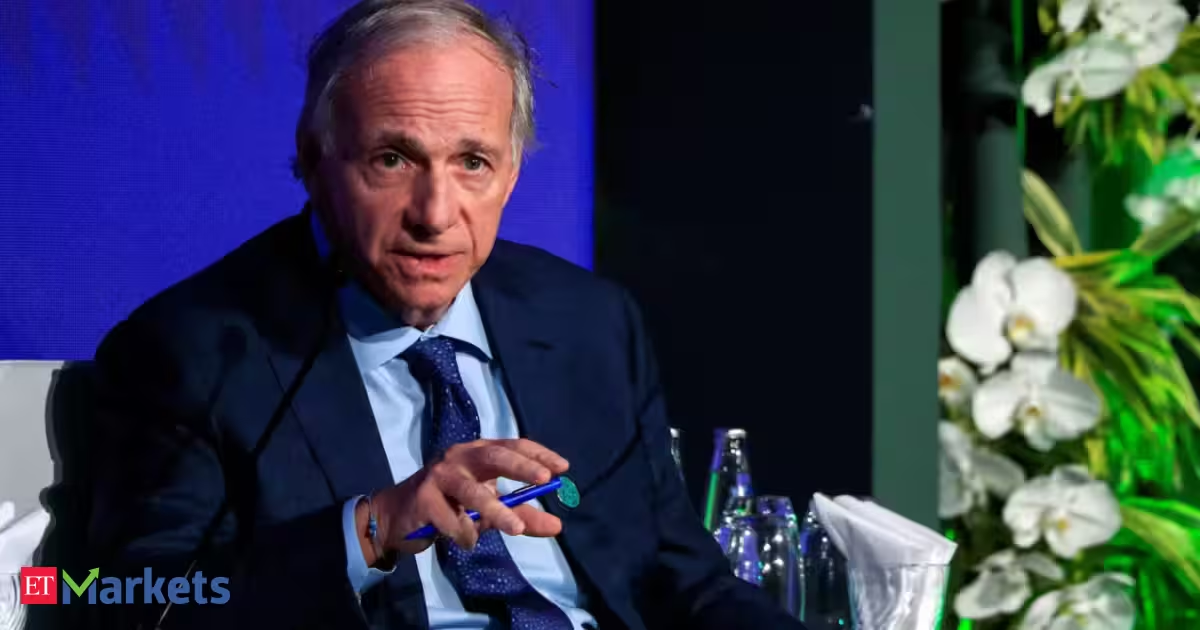
Ray Dalio, the billionaire founder of Bridgewater Associates, has warned that the market rally driven by artificial intelligence is showing signs of a bubble similar to those seen before the 1929 crash and the dot-com bust in 2000. Dalio made the comments during an appearance on The Diary of a CEO with Steven Bartlett. Bartlett referred to investor Jeremy Grantham’s warning that markets are facing “the biggest investment bubble in American history.” Dalio agreed.

Dalio said the current market has many features seen during earlier speculative periods. Investor excitement around AI has pushed valuations higher, while companies linked to the theme are attracting large amounts of capital.

His warning comes as some of the biggest AI-linked companies are moving toward public markets. SpaceX has already completed what was described as the largest IPO ever, while Anthropic and OpenAI are reportedly moving toward valuations near or above $1 trillion.

Also Read: 9 microcap multibaggers: How India’s stock market minnows beat every major index in six months

Advertisement

Dalio said rising interest rates and a wave of stock issuance are among the main risks that can burst a market bubble. In past cycles, markets have often become vulnerable when investors were willing to pay very high prices for fast-growing companies, just as more companies rushed to sell shares.


SpaceX’s market performance has added to those concerns. Since listing in June, the company has lost more than $500 billion in market value, according to CNBC. Its shares have posted four straight weekly losses and are more than 50% below their intraday high.
The stock recently closed at $108.37, below its IPO price, although the company still has a market value of about $1.4 trillion. Its price-to-sales ratio remains in the 70s, while the company is burning billions of dollars each quarter and carries almost twice as much debt as cash.Dalio’s comments add to a growing debate on whether the AI trade has moved too far, too fast. Supporters argue AI will reshape the economy and justify large investments. Critics say valuations have run ahead of earnings and cash flow.

Grantham has also warned about bubble-like conditions. He has a long record of calling major market excesses, including the Japanese asset bubble, the dot-com bubble and the US housing bubble before the 2008 financial crisis.

Strategists at Goldman Sachs have also flagged risks around tech valuations and earnings expectations.

(Disclaimer: Recommendations, suggestions, views and opinions given by the experts are their own. These do not represent the views of Economic Times)

Advertisement
Continue Reading

Business

ON Semiconductor: Near-Term Headwinds, Long-Term Upside (NASDAQ:ON)

Published

on

ON Semiconductor: Near-Term Headwinds, Long-Term Upside (NASDAQ:ON)

This article was written by

As of June 2026, I’m globally ranked in the top 1.9% of investment experts and financial bloggers on TipRanks. My goal is to clarify the complexities of investment opportunities and risks for both individual and professional investors, while also helping newer investors build confidence as they learn to evaluate opportunities with a disciplined, long-term mindset, so please follow me if this is the type of research you’re looking to read.

Analyst’s Disclosure: I/we have a beneficial long position in the shares of ON either through stock ownership, options, or other derivatives. I wrote this article myself, and it expresses my own opinions. I am not receiving compensation for it (other than from Seeking Alpha). I have no business relationship with any company whose stock is mentioned in this article.

Seeking Alpha’s Disclosure: Past performance is no guarantee of future results. No recommendation or advice is being given as to whether any investment is suitable for a particular investor. Any views or opinions expressed above may not reflect those of Seeking Alpha as a whole. Seeking Alpha is not a licensed securities dealer, broker or US investment adviser or investment bank. Our analysts are third party authors that include both professional investors and individual investors who may not be licensed or certified by any institute or regulatory body.

Advertisement
Continue Reading

Business

Bev Craig: ‘Getting to Leeds, Sheffield or Bradford has to be made easier’

Published

on

Business Live

New Greater Manchester mayor says she will work with other mayors to find transport solutions

Bev Craig at a victory rally on Saturday

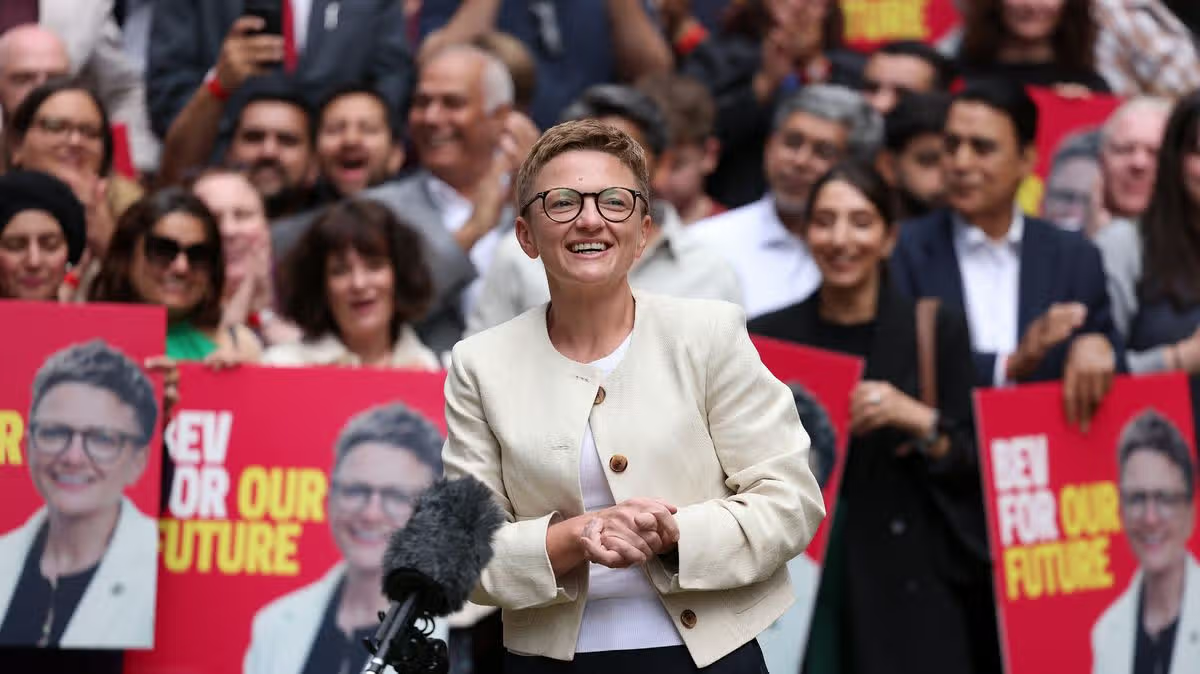
Bev Craig at a victory rally last Saturday(Image: Sean Hansford | Manchester Evening News)

Greater Manchester mayor Bev Craig has said travel from the North West to cities such as Sheffield and Leeds ‘has to be made easier’ as she pledged to push for improvements.

Advertisement

She told the Local Democracy Reporting Service that she will work with other mayors to find ‘solutions’ to make east-west transport connections better.

Journeys times from Manchester across the Pennines are currently lengthy and can be hit with delays.

Those who choose to drive to Sheffield from Manchester often rely on using Snake Pass (A57) through the Peak District, a journey of around 40 miles which can take an hour and 30 minutes or longer during busy times of day.

Catching the train from Manchester to Sheffield can take between 45 minutes to an hour depending on the service, in a route which also crosses the Peak District.

Advertisement

But new calls have been made to revive plans for a 14-mile tunnel between Manchester and Sheffield, led by a team known as Future Works who reckon the project could cost around £2bn.

Asked about the idea on Monday, Bev Craig said: “I’ve been a long advocate of better east-west connections, we’ve seen throughout the debates we’ve been having about Northern Powerhouse Rail that getting to Leeds, getting to Sheffield or Bradford has to be made easier.

“I’m looking forward to getting stuck in over the next few weeks, working with colleagues in Transport for the North and linking up with other mayors to be able to see what solutions we can get.

“The reality for me is that train travel just isn’t reliable enough, it isn’t quick enough, and it isn’t effective enough in this country, and we think that mayors will be able to help with that and be able to push for faster travel.”

Advertisement

Plans for a tunnel under the Pennines connecting Manchester and Sheffield were explored a decade ago as a way of cutting congestion levels and boosting connections between Greater Manchester and South Yorkshire, but the idea was eventually shelved.

The Northern Powerhouse Rail (NPR) scheme also aims to boost railway travel across the north, including with a new line between Manchester and Liverpool.

This could see up to £45bn being invested and ultimately transform rail services across Liverpool, Manchester, Leeds, Bradford, Sheffield and York.

The project would be delivered in three phases, with upgrades to the lines east of the Pennines, including electrification, specifically on the Leeds-Bradford, Leeds-Sheffield and Leeds-York corridors.

Advertisement

It would then move to plans for a new line between Liverpool and Manchester, via Warrington and Manchester Airport, before the third phase to focus on better links across the Pennines.

To find all the planning applications, traffic diversions, road layout changes, alcohol licence applications and more in your community, visit the Public Notices Portal.

Continue Reading

Business

McDonald’s names Skye Anderson as its U.S. president

Published

on

McDonald's names Skye Anderson as its U.S. president

Skye Anderson, president of McDonald’s USA

Source: McDonald’s

McDonald’s announced that company veteran Skye Anderson will lead its U.S. business, effective Tuesday, as the company tries to win over cost-conscious diners in its largest market.

Advertisement

“I look forward to working closely with her and the U.S. leadership team to help accelerate performance and unlock the significant opportunity in front of us, and I have tremendous confidence that she is the ideal leader for this next phase of our U.S. business,” McDonald’s CEO Chris Kempczinski said in a statement.

Earlier this year, Anderson was named chief operating officer for McDonald’s USA. Before that, she led the company’s Global Business Services segment, which was created with the aim of making its corporate operations more efficient and using the restaurant giant’s scale. She also spent four years in charge of McDonald’s U.S. West Zone; in that role, she increased average restaurant unit cash flow by $100,000 and drove same-store sales growth of more than 30%, according to the company.

Anderson has been with the company for 26 years.

“I’ve had the opportunity to work closely with Skye throughout much of her career, and I’ve repeatedly turned to her to lead some of our most important businesses and transformation efforts because she’s a proven change agent who can act with urgency to mobilize our System,” Kempczinski said.

Advertisement

Anderson succeeds Joe Erlinger, who has held the role for more than six years. Erlinger will stay on as an advisor through early 2027.

McDonald’s also reported its second-quarter results on Tuesday. The company’s earnings topped Wall Street’s estimates, but its revenue fell short of analysts’ expectations. U.S. same-store sales grew just 0.8%, and traffic to its domestic restaurants fell during the quarter.

Broadly, McDonald’s has outperformed U.S. rivals by leaning into value meals and buzzy promotions to attract diners. But a successful marketing move — like its tie-in meal with the “Minecraft” movie during the year-ago period — means that the burger chain has to keep surpassing its own wins to grow same-store sales.

In early June, the company unveiled a new growth strategy as it aims to become diners’ first option. The plan includes menu innovation that elevates taste and quality, listening to how consumers interact with brands, and a new restaurant design.

Advertisement
Choose CNBC as your preferred source on Google and never miss a moment from the most trusted name in business news.
Continue Reading

Trending

Copyright © 2025