Connect with us

Business

Can You Install a Large Ceiling Fan on a Drop or False Ceiling?

Published

on

Can You Install a Large Ceiling Fan on a Drop or False Ceiling?

Yes, a large ceiling fan can be installed below many drop or false ceilings, but the visible ceiling surface should not be treated as the fan’s structural support. The fan needs to transfer its load to suitable framing, a structural slab, or another approved support above the finished ceiling.

False ceilings can make a room look cleaner, hide ducts and wiring, and create space for recessed lighting, but they also change how a ceiling fan has to be mounted. A ceiling tile, gypsum panel, POP finish, or suspended grid is usually part of the room’s finish rather than the structure that should carry a large rotating fan. The safest installation keeps those two jobs separate: the building structure supports the fan, while the false ceiling simply surrounds the mounting assembly or downrod.

Think of the false ceiling as a finish layer, not the point that holds the fan up.

Can a Large Ceiling Fan Be Mounted Directly to a Drop Ceiling?

In most situations, the answer is no. A suspended ceiling grid, lightweight ceiling tile, gypsum board, or decorative plaster finish should not automatically be used as the primary support for a large ceiling fan. Those materials may be suitable for lighting panels, diffusers, access tiles, or other lightweight components, but a fan creates a different type of load.

Why Ceiling Tiles and Suspended Grids Are Not the Fan Support

A ceiling fan is not a stationary object. Its motor starts and stops, the blades rotate continuously, and small vibration or torque can be transferred into the mounting point. That means the support has to deal with more than the fan’s static weight. Even if a suspended ceiling system can carry a certain amount of stationary load, that does not mean it should be used as the sole support for a rotating fan.
Advertisement

Can You Install a Large Ceiling Fan on a Drop or False Ceiling?

The Fan Should Be Supported Independently

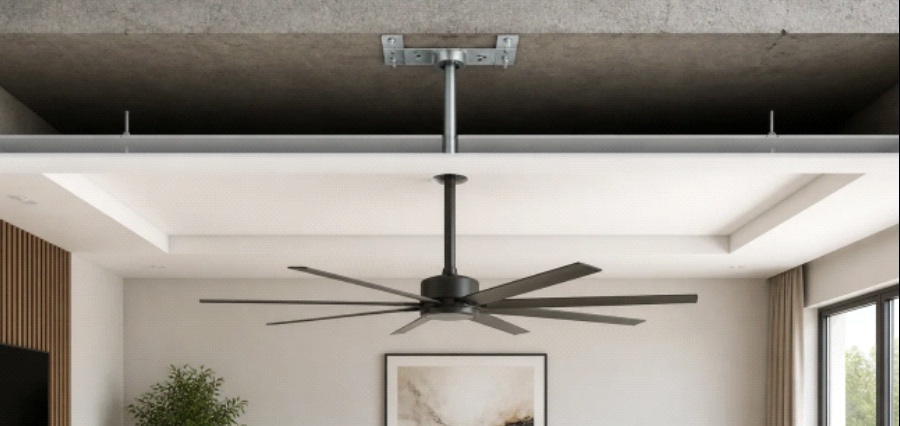
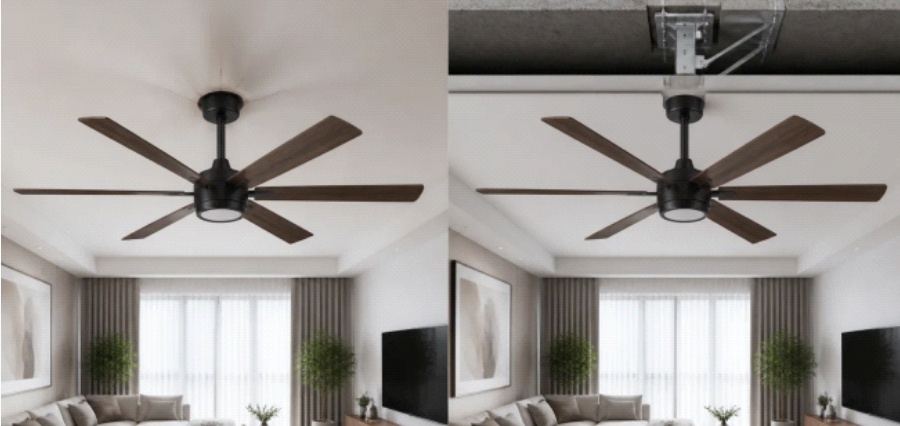
The mounting system should carry the fan back to a suitable structural element above the false ceiling. The finished ceiling can have an opening for the downrod or mounting assembly, but it should not accidentally become the part that bears the fan’s weight.

A typical load path is: structural slab, joist, beam, or framing -> approved support or mounting assembly -> downrod or hanger -> fan motor and blades. The false ceiling sits around that system rather than replacing it.

What Should Actually Support the Fan Above a False Ceiling?

Structural Framing or the Solid Ceiling Above

The correct support depends on the building. In one room, the fan may be attached to a timber joist. In another, the mounting point may need to connect to a structural slab, a beam, metal framing, or an engineered support member. The important point is that the load reaches a structural element that is appropriate for the fan and the mounting system being used.

Use a Complete Fan Mounting System

Different large ceiling fans vary in total weight, blade span, motor construction, mounting bracket, and supplied hardware. The structural support should therefore be checked against the requirements of the exact model rather than chosen only from the fan’s diameter.

Advertisement

A proper installation may involve a structural connection, a compatible mounting bracket, suitable fasteners, a hanger assembly, and a downrod. Improvising with random anchors or relying on the false-ceiling finish is not a substitute for a planned mounting system.

How Does the Fan Pass Through a Drop or False Ceiling?

Create an Opening Around the Mounting or Downrod Area

When the structural mounting point is above the finished ceiling, the downrod or other parts of the fan assembly may need to pass through the ceiling void. The visible opening should be sized so the mounting components can sit correctly and the ceiling finish can be completed neatly around them. A canopy or trim detail may conceal the opening once the fan is installed.

Do Not Let the False Ceiling Carry the Fan

The opening around the downrod should not be so tight, distorted, or improvised that the false ceiling begins to carry part of the motor load. The finished ceiling should remain a finish layer while the fan remains independently supported from above.

Why Downrod Length Matters With a False Ceiling

The Downrod May Need to Reach Below the Finished Ceiling

A false ceiling creates a gap between the structural ceiling and the finished ceiling. That space may be only a few inches deep or it may be substantial enough to hide ducts, cable trays, lighting, and mechanical systems. The fan mounting point is often above that void, so the downrod has to be considered as part of the whole vertical installation rather than measured only from the visible ceiling.

Advertisement

Final Installed Height Matters More Than Downrod Length Alone

The same principle applies when comparing large ceiling fans for high ceilings: the important measurement is where the fan and blades actually end up relative to the floor and surrounding ceiling features. A longer downrod may be needed to pass through the ceiling void, but the final fan height still has to suit the room.

Before choosing a downrod, measure the structural mounting point, the depth of the false ceiling, the motor and blade position, and the desired clearance above the floor. That gives a more useful picture than selecting a rod length in isolation.
Can You Install a Large Ceiling Fan on a Drop or False Ceiling?

How Much Clearance Does a Large Fan Need Below a False Ceiling?

There is no single clearance number that applies to every large fan. The required space above and around the blades depends on the fan design and the manufacturer’s installation instructions. What matters is that the full rotating blade sweep is clear of ceiling drops, decorative edges, beams, lights, vents, and other obstructions.

Do Not Position the Blades Inside a Ceiling Recess by Accident

A stepped or recessed false ceiling can create an awkward situation where the fan motor is centered in a higher area but the blade tips approach a lower border. Measure the complete blade diameter, not just the center point. The fan should not be placed where the blades pass dangerously close to a lower ceiling section or decorative feature.

Advertisement

What If the False Ceiling Has Different Levels?

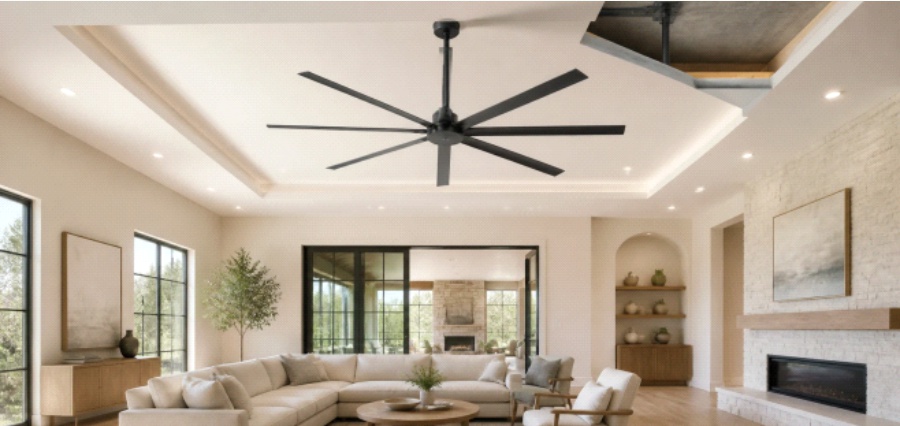
Tray ceilings, recessed centers, lowered perimeter sections, and decorative POP or gypsum designs are common. They can work well with a large fan, but they need more careful planning than a flat ceiling.

Place the Fan in a Clear Central Zone

The preferred position is usually one where the entire blade sweep stays within a clear zone. Check the relationship to lower ceiling edges, recessed lights, air-conditioning vents, curtain tracks, beams, and other features before cutting the ceiling or fixing the mount.

Measure the Entire Blade Sweep

A 72-inch fan needs room for a 72-inch rotating diameter, not simply enough space for its center housing. The farther the blade tips extend, the more important it becomes to check every nearby drop, corner, and ceiling transition.

Is a Large Ceiling Fan Too Heavy for a False Ceiling?

The better question is whether the structure above the false ceiling and the selected mounting system are suitable for the fan. If the fan is independently supported from an appropriate structural point, the finished ceiling should not be asked to carry the motor and blades at all.

Advertisement

Blade Span and Fan Weight Are Not the Same Thing

A 60-inch, 72-inch, or 84-inch diameter tells you how far the blades span, but it does not tell you the fan’s total weight. Blade material, blade count, motor size, lighting components, housing construction, and hardware can all change the load. Use the exact model specifications rather than assuming a larger diameter always means a particular weight.

Can You Install a Large Fan Below a Gypsum or POP Ceiling?

Yes, this type of installation is possible when the fan is supported independently from the structural ceiling or framing above. The gypsum board or POP surface can be finished neatly around the downrod or mounting assembly, but it should not be treated as the structural anchor for the rotating fan.

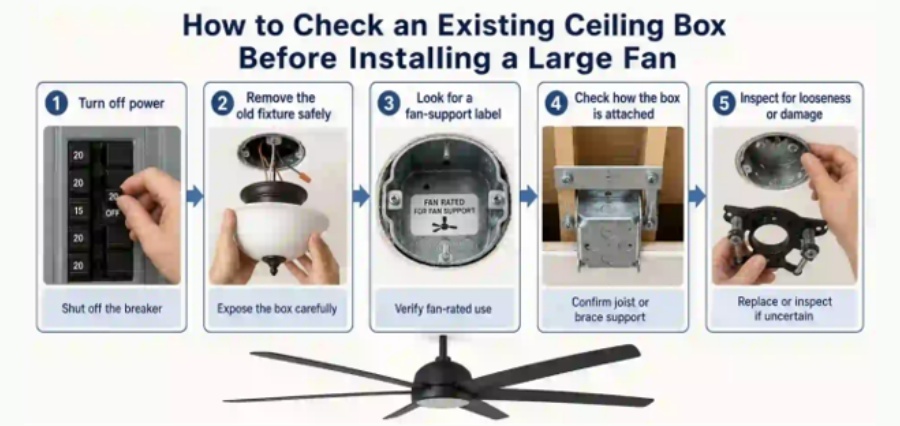
Because decorative false ceilings often hide framing, wiring, and services, planning the fan location before the ceiling is closed can make the work much easier. In an existing room, it may be necessary to inspect the space above the ceiling before the correct mounting point can be confirmed.

Can You Install a Large Fan on a Suspended Tile Ceiling?

Suspended tile ceilings are common in offices, shops, basements, and commercial rooms. The visible T-bar grid is designed to support the ceiling system and compatible lightweight components, not to act automatically as the main mounting structure for a large fan. The fan should have its own support that connects to suitable building structure above the grid.

Advertisement

The ceiling tile can be cut or finished around the fan assembly as required, but the grid and tile should remain separate from the fan’s structural load path.

How to Plan the Installation Before Cutting the False Ceiling

  1. Identify the structural ceiling above. Find out whether the fan location is below a slab, joist, beam, framing member, or another structural element that can be evaluated for the mounting system.
  2. Check the fan’s actual specifications. Confirm total weight, blade span, supplied bracket, downrod options, and any installation requirements for the exact model.
  3. Measure the ceiling void. Record the distance between the structural mounting level and the finished false ceiling.
  4. Determine final fan height. Work from the structural mounting point through the false-ceiling depth to the motor and blade level, then compare that with the room and floor height.
  5. Check the full blade sweep. Make sure the blades will clear stepped ceiling edges, lights, vents, beams, walls, and decorative features.
  6. Plan the ceiling opening and finish. Allow enough space for the assembly to pass through without making the false ceiling carry the fan, while still leaving a clean finished appearance.
  7. Confirm the structural connection before installation. If the support cannot be identified or inspected, solve that uncertainty before the fan is installed.

What Fan Parts Matter Most in a False-Ceiling Installation?

The parts above the motor become especially important when the structural mounting point is hidden above a suspended or decorative ceiling. These can include the mounting bracket, canopy, hanger ball or hanger assembly, downrod, coupler, fasteners, and structural support. If those components are unfamiliar, a large ceiling fan parts and DIY guide can help you identify what each part does before the ceiling opening and final fan position are planned.
Can You Install a Large Ceiling Fan on a Drop or False Ceiling?

The key is to understand which pieces are decorative, which pieces guide the fan through the ceiling, and which pieces actually carry the load. Confusing those roles is one of the easiest ways to create a poor installation.

Common Mistakes When Installing a Fan Below a False Ceiling

Attaching the fan directly to ceiling board. Gypsum, plaster, POP, or decorative panels should not be assumed to provide the structural support required for a large rotating fan.

Using the suspended grid as the main support. A drop-ceiling grid is part of the ceiling system, not automatically the structure for a large fan.

Advertisement

Choosing the downrod before measuring the ceiling void. This can leave the fan too high, too low, or awkwardly positioned relative to the finished ceiling.

Ignoring stepped-ceiling clearance. The fan center may fit perfectly while the blade tips pass too close to a lower ceiling edge.

Cutting the ceiling before locating the structural support. The best-looking ceiling position may not align with an appropriate mounting point above, so the support plan should come first.

Assuming a bigger fan only needs a bigger opening. A larger fan may change the weight, mounting bracket, downrod, clearance, and final installed height as well as the hole in the ceiling.

Advertisement

When Should You Ask a Professional to Handle the Installation?

Professional help is a sensible choice when the structure above the false ceiling cannot be seen, concrete anchoring is required, the ceiling void is deep, the ceiling design is complex, the wiring is old, or the fan is unusually heavy. It is also useful in commercial suspended ceilings, where building services and structural elements may share the same overhead space.

  • The structural mounting point cannot be identified.
  • The fan location does not line up with suitable framing.
  • The installation requires anchors into a structural slab.
  • The false ceiling has multiple levels or fragile decorative work.
  • A long downrod or unusual hanger arrangement is needed.
  • The electrical connection or existing wiring is uncertain.

Quick Decision Guide

Situation Recommended approach
Solid structure directly above the false ceiling Verify a suitable fan mounting system and connect the fan to the structure.
Gypsum or POP finish only Do not rely on the finish layer alone to support the fan.
Suspended tile grid Support the fan independently from suitable structure above the grid.
Deep ceiling void Plan the downrod and final installed height before cutting the ceiling.
Stepped or recessed ceiling Measure the complete blade sweep and all surrounding clearances.
Structural support cannot be identified Inspect the space above the ceiling before installation.
Very large or heavy fan Confirm the model-specific mounting requirements and support method.

Frequently Asked Questions

Can you put a ceiling fan on a drop ceiling?

Yes, but the fan should normally be supported independently from suitable structure above the drop ceiling rather than from the ceiling tile or suspended grid itself.

Is it safe to install a ceiling fan on a false ceiling?

It can be safe when the mounting system transfers the fan load to appropriate structural support and the installation follows the requirements of the fan and mounting hardware.

Advertisement

Can a large ceiling fan hang directly from gypsum board?

Gypsum board should not be assumed to be the primary structural support for a large rotating fan. The fan should be connected to suitable structure or an approved support system above it.

Can you install a ceiling fan under a POP ceiling?

Yes, provided the fan is supported from appropriate structure above the POP finish and the ceiling opening is planned around the mounting or downrod assembly.

Advertisement

How much weight can a drop ceiling hold?

There is no single number that should be used to decide whether a drop ceiling can support a large fan. The fan should generally have an independent structural support path rather than relying on the suspended ceiling system.

Does a false ceiling require a longer downrod?

Sometimes. The correct length depends on the distance from the structural mounting point to the finished ceiling and the final blade height required in the room.

Advertisement

Can fan blades rotate partly inside a false-ceiling recess?

The full blade sweep should have the clearance required by the fan manufacturer. Stepped ceiling edges or recesses should not interfere with the rotating blades.

Can you mount a ceiling fan to a suspended ceiling grid?

The grid itself should not automatically be treated as the main support for a large fan. The fan should be independently connected to suitable building structure above the grid.

Advertisement

How do you choose fan size for a false ceiling?

Choose the fan based on the room and the model’s requirements, then verify structural mounting, blade clearance, final installed height, and the dimensions of the false-ceiling opening.

What should be checked before installing a large fan below a false ceiling?

Check the fan specifications, structural support, ceiling-void depth, mounting hardware, downrod length, final installed height, and clearance around the complete blade sweep.

Advertisement

The Bottom Line

A large ceiling fan can work perfectly well below a drop or false ceiling when the support is planned correctly. The finished ceiling may hide the structure, but it should not replace it. Support the fan from a suitable structural point, use a mounting system that matches the exact fan, allow the downrod or hanger to pass through the ceiling cleanly, and check the final blade height and full sweep before installation. When the structure above the ceiling is unknown, inspection should come before cutting, mounting, or testing the fan.

Continue Reading
Click to comment

You must be logged in to post a comment Login

Leave a Reply

Business

BlackRock Capital Appreciation Fund Q2 2026 Commentary

Published

on

Father and son counting money at home

BlackRock Capital Appreciation Fund Q2 2026 Commentary

Continue Reading

Business

TON Strategy Company: Good For Speculating On GRAM's Potential

Published

on

Escudo digital futurista con símbolo de candado que representa la ciberseguridad y la protección de datos

TON Strategy Company: Good For Speculating On GRAM's Potential

Continue Reading

Business

What UK SMEs Get Wrong About Their First Office

Published

on

What UK SMEs Get Wrong About Their First Office

However, the first office selection process is always made on the basis of cost, convenience of location, or even size of the office. Expensive mistakes are normally discovered much later on in the process.

Based on experience of working with myHQ Spaces and dealing with thousands of office enquiries, there is always the same set of common errors that are made. It is not about selecting the wrong kind of office space. It is about jumping too soon, comparing incomplete pricing, and making decisions on assumptions about the way the business will operate in two or three years’ time.

Mistake 1 — Treating the Quoted Rate as the Cost

The work area offered at £300 per desk monthly does not have to be £300. The VAT is generally levied at the current standard rate of 20% in the UK for all products and services, which implies that the £300 work area cost will amount to £360 inclusive of VAT. This will mean that for a team of five individuals, the cost will be £1,800 monthly or £21,600 annually.

Free newsletters
Advertisement

The stories that matter to UK business, straight to your inbox.

Advertisement

The real issue is whether the figure presented gives you an indication of what is actually included. Room usage could be capped at a certain monthly allowance, with extra hours billed on a separate basis. Other services such as printing, storage, visitor access, out-of-hours access, car parking, etc., could fall outside the stated price. Some organizations quote the price inclusive of VAT, while others quote the price exclusive of VAT.

Mistake 2 — Committing to a Lease Before the Headcount is Settled

It may be wise to go for a traditional commercial lease in case the need for space is quite predictable; however, if you have an uncertain number of employees, it might not be worth pursuing. According to business.gov.uk, company leases usually last 10 to 15 years, although shorter leases have become quite common. It also mentions that break clauses can be negotiated, depending on the terms of the lease agreement.

The commitment goes beyond just paying the rent. There are other commitments involved, like fit-out charges, maintenance, and dilapidations if the property comes back to the landlord in bad shape. This implies that a business will pay rent for office space which it does not need anymore and also the cost to bring the property back into shape. Flexspace can thus be termed as an insurance premium. It involves paying more for each desk, but in doing so, one avoids betting on something that has not even happened yet.

Mistake 3 — Choosing Location by Prestige Instead of Hiring Pool

A premium business address may be impressive for websites and business cards, but it may not be a convenient place for your employees. The office should be in a place that can easily be reached by people through a manageable commute, especially where the expectation is that the staff will attend often. Business.gov.uk identifies proximity to the employees, customers, and transport links as important considerations for business premises.

Advertisement

Such logic does not apply only to London. An enterprise from Bristol could be interested in a centrally-located office, but discover that an office in a less central position will be better because it will be closer to where their primary customers reside. It can happen in Manchester, Birmingham, Leeds or Glasgow. Should an affordable office cost employees an additional 40 minutes of travel time, then the saving on rent becomes meaningless.

Mistake 4 — Taking Space Before It is Needed

The existence of an office might indicate that the company has matured to the next level, but this should not be the factor that determines when the commitment should take place. Should a majority of the staff work off-site, having an office rented five days a week might result in a lot of capacity going to waste. Day passes, membership options, and conference room facilities might serve as other solutions until it becomes clear how much office space is needed.

An alternative approach would be to first create the company, test the market, hire the staff, and then measure the working system that has developed. The reverse approach is very common; get into a big office and hope the people will follow. This gets the order of demand and costs backward. Should the process of hiring take longer than anticipated, then the company is saddled with an office expense without the required number of staff.

Mistake 5 — Not Comparing Like With Like

Two different office quotes may share the exact headline rate but actually signify two entirely different costs. One may consist of meeting room credits, Internet connection, receptionist service, and some utilities, whereas others may not. The deposit amount, set-up fee, notice period, and other such factors may also influence the cost of the agreement.

Advertisement

It is important to first ask all providers the same questions before making a comparison. Questions include: What is included in the price per month? What is excluded from the pricing? What is the deposit amount? What is the notice period? Are the meeting rooms included and, if yes, for how many hours? All of this information should be presented in a straightforward cost comparison on a monthly and annual basis. The goal is not to look for the lowest price per desk.

The Practical Sequence

Making the first decision in regard to the office is much simpler once you make the distinction between the headline price and the real commitment. You need to calculate the total cost including VAT and extras, and align the term of the lease agreement with your level of confidence regarding future staffing. The location should be chosen based on where your team could reasonably do its work, and not simply by looking at prestige factors. In any case, take the permanent space only if you really need it operationally.

https://www.business.gov.uk/invest-in-uk/expand-your-business-in-the-uk/guide/detailed-guides/find-the-right-location-and-premises/

Advertisement

Continue Reading

Business

DRDGold: Reclamation Company Set For Higher Production In Fiscal Year 2027 (NYSE:DRD)

Published

on

Aerial photo of a Johannesburg mine and CBD from a helicopter, Johannesburg

This article was written by

I have more than five years experience in the financial industry. I focus mostly in the commodities, foreign exchange and cryptocurrencies. I also write on general issues like equity research, economics and geopolitics.Fellow contributor Crispus Nyaga is my colleague.

Analyst’s Disclosure: I/we have a beneficial long position in the shares of DRD either through stock ownership, options, or other derivatives. I wrote this article myself, and it expresses my own opinions. I am not receiving compensation for it (other than from Seeking Alpha). I have no business relationship with any company whose stock is mentioned in this article.

Seeking Alpha’s Disclosure: Past performance is no guarantee of future results. No recommendation or advice is being given as to whether any investment is suitable for a particular investor. Any views or opinions expressed above may not reflect those of Seeking Alpha as a whole. Seeking Alpha is not a licensed securities dealer, broker or US investment adviser or investment bank. Our analysts are third party authors that include both professional investors and individual investors who may not be licensed or certified by any institute or regulatory body.

Advertisement
Continue Reading

Business

Dow Jones Futures: Nasdaq Hits New High; Sandisk, Micron Trigger Buy Signals

Published

on

Dow Jones Futures: Nasdaq Hits New High; Sandisk, Micron Trigger Buy Signals

Dow Jones futures were little changed early Wednesday, along with S&P 500 futures and Nasdaq futures. The stock market had a mixed but mostly positive session Tuesday as crude oil prices continued to slide. The Nasdaq hit a record high. The Dow Jones fell slightly as Cisco Systems (CSCO) and financials led losers. Chip and AI plays fared well. Sandisk…

Copyright ©2026 Investor’s Business Daily, LLC. All rights reserved. 87990cbe856818d5eddac44c7b1cdeb8

Continue Reading

Business

Mining sector keeps local shares from sinking into red

Published

on

Mining sector keeps local shares from sinking into red

Yes. Corporate subscriptions are available for teams and organisations, with discounted rates as user numbers increase. Pricing starts from $1,625 + GST per user.
Get in touch
to discuss the right option for your organisation.

Business News subscriptions are used by executives, investors, consultants and professionals who need to stay informed and make better decisions about the WA market. When you subscribe you’ll get

  • Unlimited access to WA’s most trusted business journalism
  • Data & Insights — detailed profiles of WA companies, people, projects and deals
  • MyBN — a personalised feed based on the companies, people and sectors you follow
  • Special publications and industry reports
  • Daily and weekly email newsletters

Data & Insights is a research tool built specifically for the WA market. It draws on more than 30 years of Business News reporting, updated regularly to reflect what’s happening now. Use it to:

  • Look up detailed profiles of WA companies, including financials, directors and ownership
  • Find decision-makers and track their career movements
  • Research live and completed projects across WA industries
  • Monitor deals, appointments and market activity
  • Access industry rankings and league tables

Data & Insights is updated daily by our dedicated research team, which uses the latest announcements, ASX filings and editorial coverage to keep our person, company, list and project records up to date.

Business News welcome all opportunities to make our dataset accurate, complete and current, so if you have an update request, please email the team at
general@businessnews.com.au, and we’d be happy to assist.

Advertisement

MyBN
is part of every subscription. It’s your personalised view of Business News. You can follow the companies, people, sectors and projects that matter to you, and get a news feed and alerts tailored to your interests. You can save articles to read later and retain only what you need.

Only subscribers have full access to all content on the Business News website.

Advertisement

If staying informed about the WA economy is part of your job, and/or you’re looking for networking opportunities in WA, Business News is built for you.

Business News subscribers are:

  • Executives and directors tracking competitors, clients and market movements
  • Investors and advisers researching companies, deals and industry trends
  • Consultants and professionals staying across sectors relevant to their clients
  • Business owners looking for leads, context and market intelligence

Most Business News publications cover national or global markets. Business News is focused entirely on Western Australia, which means the journalism, the data and the intelligence are all built around WA companies, people and projects — not adapted from a national feed. Data & Insights, included with every subscription, combines more than 30 years of WA-specific editorial research with live business data. There’s no comparable product for the WA market.

Advertisement

The Morning Digest Email provides a comprehensive wrap of the major headlines, relevant to WA business, and includes with a snapshot of the overnight news covering oil, gold and ASX-listed companies.

The Afternoon Wrap Email focuses on the news covered by our team of journalists during the course of the working day, including exclusive stories and analysis, all of which relates to WA business and the local economy.

The BN Weekender Email contains a wrap of the Business News from the week that was, highlighting the top stories in each area of WA business.
Sign up for free.

Advertisement

We’re happy to help.
Get in touch
and our team will come back to you.

Advertisement
Continue Reading

Business

Dow Jones Futures: Falling Oil Prices, Yields Spark Stock Market Rally; AMD, Intel, Micron, Nvidia, Sandisk Are Key Movers

Published

on

Stock Market Today: Dow Rises As Treasury Yields Fall; Broadcom Dives

Futures for the Dow Jones Industrial Average and the other major stock indexes traded mixed ahead of Tuesday’s open. On Monday, the Dow Jones industrials jumped 366 points as oil prices and Treasury yields fell sharply. Advanced Micro Devices (AMD), Intel (INTC), Micron Technology (MU), Nvidia (NVDA) and Sandisk (SNDK) were big movers during Monday’s trading session. AMD stock surged 10%…

Copyright ©2026 Investor’s Business Daily, LLC. All rights reserved. 87990cbe856818d5eddac44c7b1cdeb8

Continue Reading

Business

Apimeds Pharmaceuticals completes 1-for-10 reverse stock split and reduces par value

Published

on


Apimeds Pharmaceuticals completes 1-for-10 reverse stock split and reduces par value

Continue Reading

Business

JD Sports profit falls a fifth as US consumers feel cost of living crisis

Published

on

Business Live

The FTSE 100 sportswear retailer saw like-for-like sales slip by 2.8 per cent in the six months to August

JD Sports signs

JD Sports has seen sales fall in its key North American markets (Image: Jonathan Brady/PA Wire)

JD Sports has reported a decline in both revenue and profit in the first half of this year, as subdued consumer confidence in its crucial US market creates a “tough trading environment”.

Advertisement

Régis Schultz, chief executive of the so-called ‘King of Trainers’, said on Wednesday that he is “encouraged” by the progress towards his growth plan, while acknowledging that cost-of-living pressures are “weighing” on its core consumer.

The FTSE 100 group recorded a 2.8 per cent fall in like-for-like sales during the six months to August, while pre-tax profit tumbled by a fifth to £282m.

The retailer’s overall sales were pulled down by a four per cent decline in North America. The region represents the group’s largest market, making up 38 per cent of its sales.

JD’s performance in the region had been supported by the US tax refund season and new product launches at the beginning of the year, but trading has “softened” in recent months, as reported by City AM.

Advertisement

The drop in North American sales was attributed to “weaker consumer sentiment amidst the broader cost-of-living backdrop and deferred ‘back-to-school’ demand into August,” the group said.

“Footwear performance remained challenged, reflecting softness in end-of-cycle product lines and a promotional market,” the firm told shareholders.

However, JD highlighted a recovery in sales of outdoor products. Revenue in this category rose by 4.2 per cent to £743m across the group, compared with a 3.1 per cent drop in sales of branded JD items.

The retailer’s UK sales declined by 1.4 per cent during the period, although the group noted that its momentum has picked up in recent months.

Advertisement

JD recorded a three per cent sales uplift in the Asia Pacific region, which represents five per cent of its overall market.

Schultz, who earlier this year weathered an attempted boardroom coup by JD’s then-chairman, has been under mounting pressure from investors to provide concrete evidence that his growth strategy is bearing fruit.

Speaking on Wednesday, he acknowledged that JD Sports continues to grapple with “cost-of-living pressures” and fierce discounting from competitors.

However, he reassured investors: “By staying close to both our customers and our brand partners, and leveraging our growing own brand capability, we continue to lead with the right products, in the right places and at the right prices.”

Advertisement

The group scaled back its full-year profit forecast by £50m earlier in the year, but confirmed on Wednesday that it remains on course to deliver between £700m and £800m.

Earlier this week, JD Sports revealed it would make its debut in Mexico, with plans to open more than 140 stores next year through a local franchise partner.

“Mexico is a market with a large, highly engaged consumer base and a demographic profile which aligns strongly with JD’s unique position as a curator of footwear and apparel trends across sport, music and fashion,” the group had said.

Richard Chamberlain, an analyst at RBC Capital Markets, said JD’s earnings met analyst expectations, adding that it is delivering “strong” cash generation amid a “muted” market.

Advertisement

JD Sports shares dropped 3.5 per cent to 75p on Wednesday morning.

Continue Reading

Business

Jefferies resumes Aevex stock coverage with buy rating on growth outlook

Published

on


Jefferies resumes Aevex stock coverage with buy rating on growth outlook

Continue Reading

Trending

Copyright © 2025