

Business
Chip Stocks Drive Market Rally as Nasdaq Futures Jump

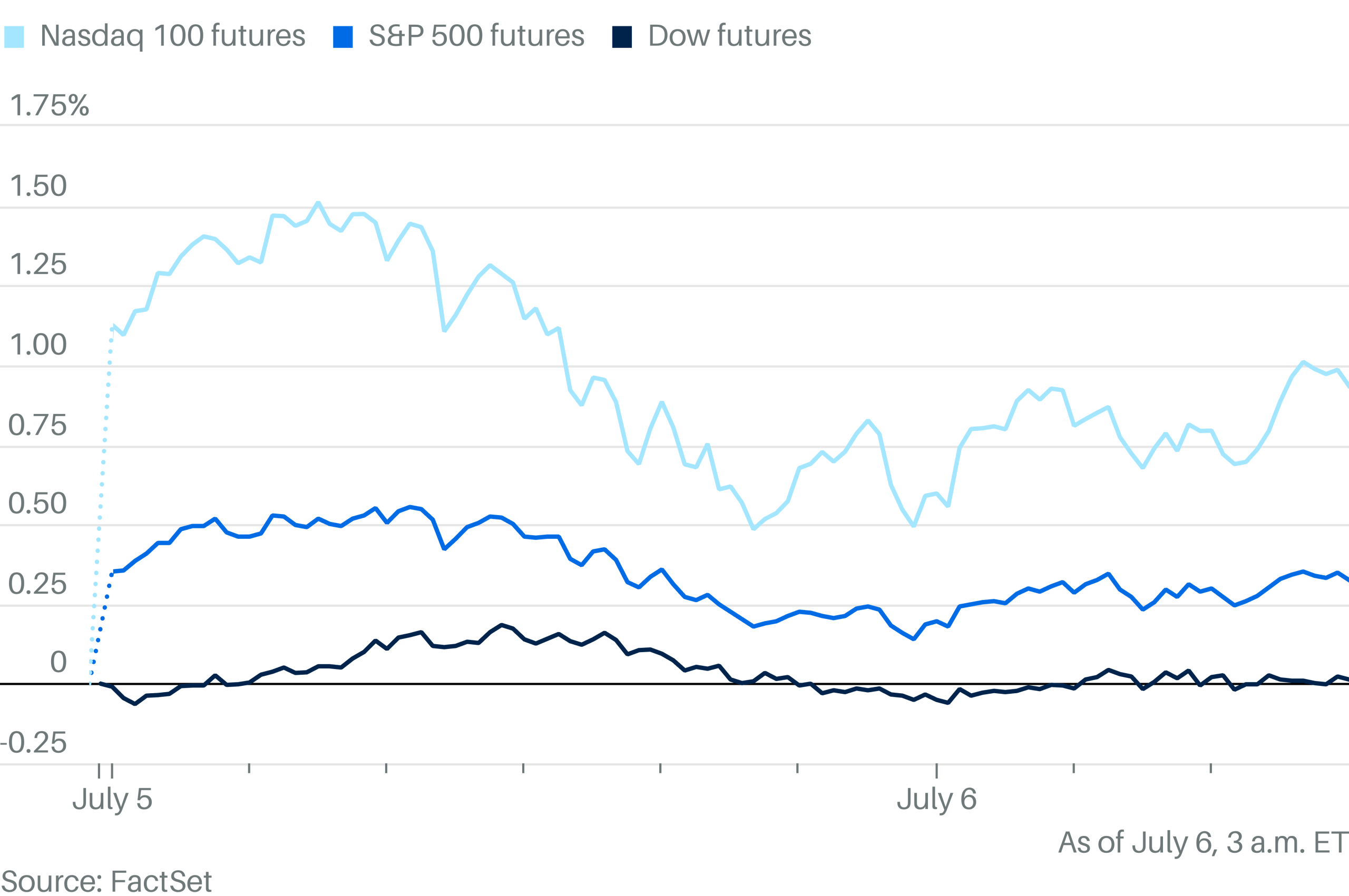
U.S. stock futures looked set to open in the green early Monday, with the technology sector driving the gains.
Corporate news is set to dominate the headlines in a light week for economic data, with the exception of Wednesday’s release of the Federal Reserve’s minutes from its June monetary-policy meeting.
Nasdaq 100 futures were gaining 1.1%, S&P 500 futures were rising 0.5% and Dow Jones Industrial Average futures were slipping 28 points, or 0.1%.

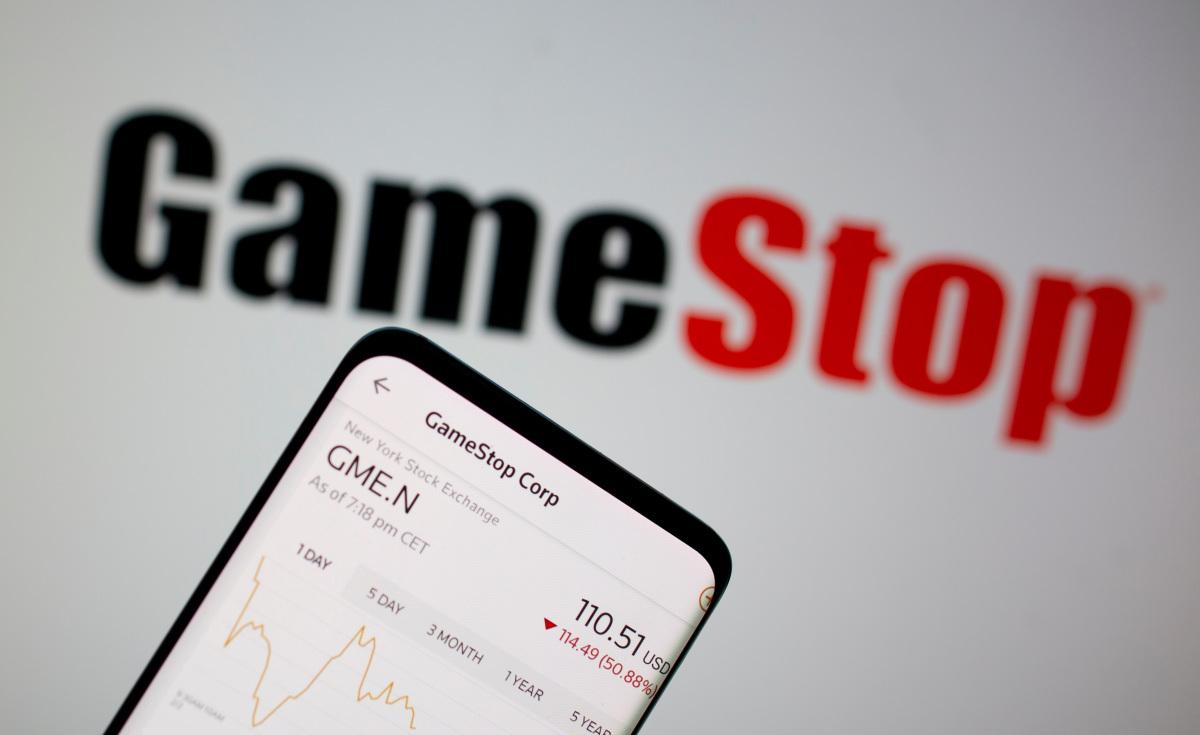
GameStop Corp. shares traded lower Tuesday, reflecting ongoing volatility for the video game retailer as it continues its evolution from brick-and-mortar mainstay to a more diversified player in a rapidly changing industry.
The stock fell about 1.34%, or 31 cents, to $22.42 in morning trading. The modest decline came amid broader market fluctuations and as investors monitored the company’s strategic initiatives following years of intense public attention tied to its meme stock status.
GameStop has been working to transform its business model amid declining physical game sales and the rise of digital downloads. Under leadership including Chairman Ryan Cohen, the company has explored e-commerce enhancements, potential acquisitions and cost-cutting measures to improve profitability. Recent reports indicate active pursuit of larger opportunities, including interest in platforms like eBay, as it seeks to leverage its brand and customer base.
The retailer still operates hundreds of stores across North America and Europe, serving enthusiasts with new and used games, consoles, accessories and collectibles. However, industry shifts toward cloud gaming, subscription services and direct-to-consumer models have pressured traditional retail footprints. GameStop has responded by closing underperforming locations, investing in online capabilities and expanding into areas like PC gaming and esports merchandise.
Financial results in recent quarters have shown mixed progress. While revenue has faced headwinds from reduced hardware cycles, efforts to stabilize margins through inventory management and private-label initiatives have yielded some positive results. The company maintains a sizable cash position, providing flexibility for strategic moves but also inviting scrutiny over capital allocation.
GameStop’s journey captivated markets in 2021 when retail investors on platforms like Reddit drove a massive short squeeze, sending shares from under $20 to nearly $500 at peaks. That episode highlighted the power of coordinated online communities and reshaped conversations around market mechanics, short selling and retail participation. Though the frenzy subsided, the stock has remained more volatile than peers, occasionally spiking on news or social media sentiment.
Analysts continue to debate the company’s valuation and prospects. Some see potential in a loyal customer base and opportunities in gaming-adjacent businesses, while others cite structural challenges in physical retail and question the sustainability of non-core ventures. The stock’s price-to-sales multiple reflects expectations of successful pivots, but execution remains key.
Chairman Ryan Cohen, who rose to prominence through his involvement with Chewy and subsequent stake in GameStop, has influenced direction toward technology and efficiency. His vision emphasizes customer experience, digital transformation and prudent financial management. Recent governance changes and adjusted financial targets underscore efforts to professionalize operations.
The broader video game industry faces its own dynamics. Major publishers like Microsoft, Sony and Nintendo navigate console cycles, while mobile and PC gaming expand. GameStop’s partnerships with these players remain important, but competition from Amazon, Best Buy and direct digital storefronts intensifies.
For investors, GameStop represents a high-risk, high-reward proposition tied to meme culture and turnaround potential. Short interest, though lower than 2021 peaks, persists as some bet against full recovery while others anticipate catalysts from new initiatives. Trading volume often surges with news, reflecting its dedicated following.
The company has explored diversification beyond gaming retail. Speculation around technology investments, e-commerce platforms or even entertainment ventures has surfaced periodically. Any major acquisition could significantly alter its trajectory and market perception.
GameStop’s balance sheet strength provides a buffer. With substantial cash reserves and minimal debt in recent periods, it has avoided the distress faced by some traditional retailers. However, prolonged unprofitability could erode that advantage if strategic bets fail to generate returns.
Community sentiment on social media remains a factor. The “ape” investor movement that fueled earlier rallies still monitors developments closely, though influence has waned compared to 2021. Management has focused on fundamentals over short-term hype.
Looking ahead, the holiday season and new console releases could provide tailwinds for core sales. Back-to-school periods and major game launches typically boost traffic. Success in online fulfillment and loyalty programs will be critical for competing in omnichannel retail.
GameStop’s history dates to its founding in 1984 as a small software retailer. It grew into a category leader through acquisitions and mall-based expansion. The shift to digital disrupted that model, prompting multiple turnaround attempts over the past decade.
Current leadership emphasizes agility. Store associates receive training for enhanced customer service, while technology investments target better inventory visibility and personalized marketing. The company has also ventured into collectibles and merchandise, capitalizing on pop culture trends.
Regulatory and market structure issues stemming from 2021 continue influencing broader discussions. GameStop’s experience highlighted settlement cycles, payment for order flow and short-sale transparency, prompting some regulatory reviews though major overhauls remain pending.
For employees and franchisees, the company’s path forward carries direct implications. Store rationalization has reduced the workforce, but investments in remaining locations aim to create more sustainable operations. Community events and in-store experiences help differentiate from pure online competitors.
Analysts’ price targets vary widely, reflecting uncertainty. Bullish cases cite undervaluation and optionality from cash reserves and brand strength. Bearish views point to secular decline in physical media and execution risks in new ventures.
Tuesday’s trading fit a pattern of relatively contained moves amid low immediate catalysts. With earnings not imminent, focus remains on operational updates and industry trends. Any news on acquisitions or partnerships could quickly shift momentum.
GameStop’s market capitalization hovers around $10 billion, making it a mid-cap name with outsized attention. Its inclusion in certain indices and ETFs ensures steady institutional interest alongside retail flows.
As the gaming industry evolves toward immersive experiences, metaverses and cross-platform play, GameStop must position itself as more than a product seller. Potential roles in events, content creation or technology services could open new revenue streams.
The company’s story resonates beyond finance. It symbolizes retail disruption, investor empowerment and adaptation challenges in legacy businesses. For many, GameStop evokes memories of discovering games in physical stores, a cultural touchpoint undergoing digital reinvention.
Investors will watch for signs of strategic clarity. Successful navigation could reward patient shareholders, while missteps might pressure the stock further in a competitive landscape.
In the near term, modest movements like Tuesday’s reflect digestion after earlier volatility. Broader market sentiment toward consumer discretionary stocks also influences performance amid economic data and consumer spending trends.
GameStop’s legacy includes pioneering loyalty programs and trade-in models that shaped industry practices. Preserving customer relationships while modernizing remains central to its strategy.
As shares traded around $22, the market weighed transformation potential against retail headwinds. The coming months may bring clarity through operational results and any transformative announcements.
Victims of a 2023 data hack at genetics testing company 23andMe are set to receive a multi-million payout from the firm.
A California bankruptcy court judge ruled on Tuesday that Chrome Holding, which last year took control of 23andMe after its bankruptcy, should pay out $46.75m (£35m) in compensation.
23andMe compiles genetic profiles of people through DNA testing kits, but it was heavily criticised after as many as 6.9 million people had their data breached in the 2023 hack.
Representatives of Chrome Holding and 23andMe have been contacted for comment.
Chrome Holding, which operates under the name TTAM Research Institute, is operated by 23andMe’s co-founder, Anne Wojcicki. She won the company’s assets last year through a bankruptcy auction with a bid of $305m.
The ruling said the settlement will be first paid to Kroll Restructuring, which is representing the victims, within five business days from Tuesday.
Kroll will then distribute the funds to the victims, the ruling said.
The appointment of companies like Kroll is typical in corporate bankruptcy proceedings.
The BBC has contacted the legal team representing the victims to ask how many people will receive the payout.
23andMe early last year filed for bankruptcy, about 18 months after hackers were able to access roughly 14,000 user accounts.
Because the company offered “comprehensive” genetic profiles of people who submitted their DNA, including genetic markers related to their health and family history, some of the information accessed by hackers was highly personal.
While the number of accounts accessed directly in the breach only represented a small fraction of 23andMe’s total users, the hackers were able to access the profiles of those users’ relatives. That gave them access to millions of profiles that 23andMe hosted.
The breach led to investigations and fines, including a £2.31m fine by the Information Commissioner’s Office (ICO), a UK watchdog.
The ICO said 23andMe had failed to put adequate measures in place to secure sensitive user data prior to the incident.
In May, Rob Bonta, the Attorney General of California, sued the company following an investigation that found 23andMe “failed to take basic steps to protect users’ data.”
Bonta also claimed that 23andMe “lied to consumers about the severity of its 2023 data breach.”
The company has continued to operate since the bankruptcy, offering DNA testing kits to people online.
23andMe was once valued at $6bn. It started in 2006 and went public in 2021, but it has never turned a profit.

Heritage Foundation chief economist EJ Antoni debates AIs impact on employment, arguing competition fosters job creation. Cheryl Casone highlights AI valuation concerns, shifting investment trends, and national security implications with China.
American workers who never use artificial intelligence (AI) may be more likely to be laid off than those who use AI more regularly, according to new data.
Gallup research found that 62% of workers who have been laid off were non-users of AI who used it once per year or less often. By contrast, only 50% of currently employed workers were non-users of AI, with 22% described as infrequent AI users who utilize it a few times per month or year. Among laid-off workers, 16% were infrequent AI users.
Currently, employed workers were also more likely to report using AI on a daily basis or a few times per week, with 28% of current workers reporting that compared with 22% of laid-off workers in their prior role.
FORD REHIRES EXPERIENCED ENGINEERS AFTER AI MISSES THE MARK

Laid-off workers aren’t attributing their job loss to AI, though it may factor into how companies are restructuring, Gallup found. (Yuki Iwamura/Bloomberg via Getty Images)
“This pattern holds even after accounting for age, education, type of industry and the length of time since being laid off, suggesting that workers who are AI non-users appear to have been more vulnerable in the job market,” Gallup said.
One particularly vulnerable group was tech workers who reported using AI on a monthly basis or less frequently, as they were three times more likely (18%) to have been laid off than tech workers who used AI at least monthly (6%).
Gallup added that workers in the tech sector were already facing elevated layoff exposure in comparison to other industries, which contributed to there being a stronger pattern between the level of AI use and layoffs than in other sectors.
MICROSOFT CUTS 4,800 POSITIONS, INSISTS JOBS ‘NOT BEING REPLACED BY AI’

Workers who use AI regularly were less likely to be laid off, Gallup found. (Roberto Schmidt/AFP via Getty Images)
The survey also found that American workers are continuing to report that their employers are downsizing their workforces, and they don’t see artificial intelligence (AI) or automation as driving the cuts.
Gallup found that the share of U.S. employees who reported layoffs at their company was about 21% in the first quarter of 2026, as it held relatively steady after the share of such reports nearly tripled from the second quarter of 2022 to the third quarter of 2025.
TOP TOBACCO COMPANY TO CUT THOUSANDS OF JOBS

Tech workers who aren’t AI users were more vulnerable to layoffs, Gallup found. (iStock)
Workers who experienced layoffs were asked by Gallup to describe the primary reason they were laid off and very few – just 1% of respondents – mentioned reasons related to AI and automation.
However, that doesn’t necessarily mean that AI or automation didn’t contribute to employers’ decisions to move forward with layoffs, as respondents cited other reasons like organizational restructuring and downsizing (15%), or the elimination of a role (3%).
GET FOX BUSINESS ON THE GO BY CLICKING HERE
That could suggest that AI is factoring into business leaders’ consideration of their workforce structure and decisions to hire or downsize, even if it wasn’t articulated to the laid off workers as the reason they lost their job.

However, net profit growth is likely to remain in single digit for the third quarter in a row amid compressed profit margin on account of input cost inflation. According to the ETIG estimates, revenue and net profit is expected to grow by 10.6% and 5.8% respectively. In the year-ago quarter, revenue and profit growth was 4.9% and 8.5% respectively.
“We expect the June quarter to mark the beginning of an earnings recovery, although the aggregate numbers will be distorted by the sharp weakness in the performance of oil marketing companies (OMC) due to elevated crude prices during the quarter,” said Siddhartha Khemka, research head, wealth management, Motilal Oswal Financial Services. He expects a healthy earnings growth of 14% for the companies under coverage excluding OMCs.
Shweta Rajani, associate director, Anand Rathi Wealth, expects profit growth to lag the top line growth for the June quarter. “This suggests that business activity has remained healthy, even as higher operating costs continue to weigh on profitability,” Rajani said. She expects the volatility seen during the quarter, including geopolitical tensions in West Asia, to have only a marginal impact on the June quarter earnings, with a larger effect likely to be seen in the coming quarters.
 Agencies
Profit growth may stay in single digits for a third quarter as input cost inflation squeezes margins; revenue and profit seen up 10.6% and 5.8%, respectively
Margin Pressure

The aggregate operating margin is expected to shrink by 100 basis points to 21.9% year-on-year, implying input cost pressure. “Margins will be impacted by higher crude-linked input costs, logistics expenses and commodity volatility during the quarter,” Khemka said. He believes the pressure is largely transitory and margins should improve over the coming quarters as commodity prices stabilise and operating leverage improves.
According to Rajani, companies with strong pricing power, particularly in consumer businesses and financial services, are expected to protect margins better than sectors with limited ability to pass on higher costs.
Select companies from the automobiles, banking and finance, consumer and metal sectors are likely to report strong growth while capital goods, cement, IT, and pharma companies may report weak numbers.
OUTLOOK
Analysts believe growth to strengthen in subsequent quarters. “We expect earnings growth to strengthen over the remainder of the year as domestic demand improves, policy support continues, interest rates soften and private investment gradually picks up,” said Khemka. He estimates Nifty 50 earnings to grow by 14% and 15% for FY27 and FY28 respectively.
Sector view
AUTOMOBILES
Revenue growth is expected to remain in double digits helped by strong volume growth amid sustained demand pull. However, elevated raw material costs will affect profitability resulting in single digit net profit growth.
BANKING
Deposit growth continued to trail credit offtake during the quarter, implying a sustained elevation in borrowing costs. This is also likely to put pressure on net interest margins even though net profit growth will likely be in double digits. Asset quality is expected to remain stable.
CAPITAL GOODS
Revenue and profit growth is expected to be in single digit given slower execution of projects in the Gulf region and weakness in government orders. The pace in overall order bookings is also expected to be muted and may remain so in the second quarter due to monsoon.
CEMENT
Cement companies are expected to reel under higher input cost pressure, which is likely to compress operating margins. Ultratech is likely to report a low-double digit revenue growth while net profit may grow in single digit year-on-year.
CONSUMER GOODS
Barring ITC, which is expected to fare poorly amid the impact of higher duties, consumer goods companies across categories are likely to report double digit growth in revenue and profit aided by sustained demand. Higher product prices may offer some comfort amid firm input costs.
INFORMATION TECHNOLOGY
Top tier software exporters are expected to show weaker than usual revenue growth in dollar terms given the continued trend of delays in project ramp ups and slower decision making by clients. The year-on-year rupee denominated revenue growth should benefit from a weaker rupee against major currencies.
OIL AND GAS
Oil marketing companies are likely to face higher under-recoveries on fuels and LPG, which are expected to squeeze operating profitability. For oil producers, realisations are expected to improve given heightened crude oil prices while gas distributors will benefit from higher sales volume.
METALS
For ferrous companies, volume growth is expected to be muted amid lower exports. This may be partly offset by price increases and safeguard duty imposition. In the case of nonferrous companies, prices stayed elevated due to supply shortage amid the Gulf crisis. This is expected to result in double digit earnings growth for these companies.
PHARMACEUTICALS
Profitability of pharma companies with overseas exposure is likely to be under pressure given deceleration in the US business. This will be partly offset by a favourable currency movement and better growth in the domestic business. Hospital chains are likely to continue reporting double-digit revenue and profit growth.
TELECOM
Bharti Airtel is expected to report strong net profit growth amid double digit rise in revenue. Improving revenue per user, stable tariff charges and subscriber additions are key positives for the sector.


FOX Business host Larry Kudlow discusses how the cut would ‘add growth to the GOP message’ on ‘Kudlow.’
It’s time to cut the capital gains tax. Right now. If there’s a 3.0 reconciliation budget bill that requires only 50 Republican votes plus Veep Vance for 51, the GOP can do it. Put a capital gains tax cut in that 3.0. It’ll add growth to the GOP message. Polls show that in addition to the voter ID bill, voters want government fraud to be cleaned up, and they’d like middle class tax cuts for growth.
Yet we need some leadership from the Senate majority leader, John Thune, and we also have to convince President Trump. He does want a reconciliation 3.0 bill for the SAVE America voter ID citizenship bill and for military spending replenishment, both of which are fine by me — but we need a cap gains tax cut that will benefit average middle class working folks.
Right now empty nesters don’t need their multi-bedroom homes, but they really can’t afford to pay a $500,000 capital gains tax which comes mainly from President Biden’s 21 percent inflation during his four years in the White House.
Last night I talked to Newt Gingrich about this issue and here’s what the former House Speaker said: “There are millions of Americans whose children have grown up their houses too big. They’d like to sell it. But the current tax consequence is so great they won’t sell it.” Indexing capital gains, he added, “it’s very simple. Should you have to pay tax on inflation? Now, if you don’t pay tax on inflation, suddenly you have a much bigger interest in investing.” Mr. Gingrich concluded that “when we cut the capital gains tax, when I was speaker, revenue was at $60 billion from capital gains. After we cut it, it jumped to $200 billion”
Sure enough, absolutely. Actually, no one should have to pay a tax on inflation. So if we index the capital gains tax for inflation, people would just pay tax on the real appreciation of their home or other assets, and that is much fairer.
Newt Gingrich discusses how capital gains tax reforms can benefit the housing market and stimulate investment.
We’re not just talking about the rich by the way, but really middle-class homeowners who might have bought their house maybe 30 or 40 years ago, and the inflation mounts up. Why should they be soaked just because the Federal Reserve printed too much money, or the federal government spent too much money? The answer is that they shouldn’t.
Many of us have been fighting this battle for decades. Yet now if we want to end the housing recession, indexing capital gains would unlock probably a million homes for sale on the market that would be available at a decent price for Gen Z and millennial affordability.
Here’s another key point. The capital gains tax exemption for the sale of a home should be doubled. Right now it’s at $250,000 for a single person, and $500,000 for married filing jointly couples.
These levels have not been changed since 1997, nearly 30 years ago. There’s been a lot of inflation since then. So why not raise the capital gains tax exemption to $500,000 for singles and $1 million for married couples filing jointly? It’s guaranteed that the unlocking effect because of lowering capital gains taxes will produce a flood of revenues for the federal fisc, and will greatly loosen up the frozen housing market.
The trend for existing home sales is about 5 million a year over time. But in recent years, it slumped to 4 million a year. A drop of one million a year. Cutting the capital gains tax will boost these sales and probably new housing starts as well.
It would be great to get lower mortgage rates and easier regulations at the local level. Closing the border by Mr. Trump will stop all of the illegal migrants who bid up rental homes and home ownership prices. And according to a paper published by the Federal Reserve Bank of Dallas, this wave of migration accounted for roughly 30 percent of home-price growth. Cutting the capital gains tax would be huge. Let’s get going on it.
Business
Nvidia Shares Fall Nearly 2% After Report Says China’s DeepSeek Is Developing Its Own AI Inference Chip
Shares of Nvidia fell Tuesday, trading at $191.70, down $3.85, or 1.97 percent, after a Reuters report said Chinese artificial intelligence company DeepSeek is developing its own semiconductor for AI computing, a move that could reduce the startup’s reliance on chips from both Nvidia and Huawei.
Note: This article is intended to provide factual context and does not constitute financial advice. Readers should consult a licensed financial advisor before making investment decisions.
According to the Reuters report, citing three sources familiar with the matter, DeepSeek’s chip is being designed specifically for inference, the stage of AI computing in which an already-trained model generates responses to user queries, rather than for training new models from scratch. That focus places the project squarely within what has become the fastest-growing segment of AI computing demand, as more of the industry’s overall workload shifts from building large language models to running them for end users. Inference tasks can often be handled by specialized, lower-cost chips that consume less power than the general-purpose graphics processing units Nvidia has built its business around.
The effort reportedly began roughly a year ago and remains in its early stages. According to the Reuters report, DeepSeek has been in discussions with outside chip-design firms, semiconductor foundries and memory suppliers as part of the initiative, while also quietly increasing its hiring of chip-design engineers in recent months without posting public job listings for those specific roles.
DeepSeek’s move would mark a significant strategic shift for a company that has been held up in China as a national AI success story since it drew rapid global attention last year with the release of two highly efficient AI models. The base model for DeepSeek’s R1 reasoning system was trained using Nvidia’s H800 chip, a China-specific variant that the U.S. government subsequently banned from export in late 2023. Since then, DeepSeek has increasingly shifted its computing workloads toward Huawei’s Ascend chip lineup, releasing a version of its V4 model earlier this year that was specifically optimized for Huawei’s hardware.
Should DeepSeek successfully develop its own competitive inference chip, the move would add to the competitive pressure already facing both Nvidia and Huawei within China’s AI chip market, according to the Reuters report. It would also place DeepSeek alongside a growing list of AI developers worldwide that have moved to design their own custom silicon rather than relying solely on Nvidia’s hardware. OpenAI unveiled its first custom inference chip, developed in partnership with Broadcom and named Jalapeño, last month, while Anthropic has separately been exploring the development of its own chips, according to earlier Reuters reporting from April.
DeepSeek faces significant obstacles specific to its position as a Chinese company, however. U.S. export restrictions bar Chinese chip designers from using the most advanced semiconductor manufacturing foundries located overseas, while separate American export controls have limited China’s access to high-bandwidth memory, a component considered essential to building competitive inference chips. DeepSeek founder Liang Wenfeng acknowledged in a 2024 interview that these export restrictions presented genuine obstacles for the company’s broader ambitions.
The chip development news comes as DeepSeek has also been pursuing its first external funding round. According to media reports cited by TradingKey, the company completed a Series A funding round in mid-June, raising approximately 51 billion yuan, or roughly $7.5 billion, at a post-money valuation of around 400 billion yuan. The funding round reportedly employed an unusual transaction structure, with external investor funds directed into a limited partnership managed by Liang rather than invested directly into the DeepSeek entity itself, and with those investors receiving no voting rights or board representation in exchange for their capital.
DeepSeek has moved quickly to put that capital to use. The company posted a large recruitment call in late June covering 33 positions across seven categories, including algorithms, research and development, and data engineering, stating it was working to at least double the size of all its departments. The company has also begun building out its own computing infrastructure, posting its first data center-related job listings in Ulanqab, Inner Mongolia, earlier this year, a shift that analysts described as moving DeepSeek away from a lighter-asset research and development model toward a more capital-intensive approach involving self-built computing clusters.
Nvidia’s decline Tuesday came amid a broader pullback across chip and technology stocks tied to a separate development: blowout second-quarter earnings guidance from Samsung Electronics that nonetheless triggered profit-taking across the memory chip sector. Micron Technology fell roughly 4.7 percent to 7 percent during the session, while Western Digital and SanDisk also posted significant declines, according to multiple market reports. Nvidia’s own decline was compounded by a separate report indicating that some U.S. companies have been exploring cheaper Chinese AI models as alternatives to offerings from major American technology firms, adding further pressure to sentiment around Nvidia and other companies central to the AI infrastructure buildout.
Nvidia’s stock has underperformed some of its chip-sector peers so far in 2026, according to a technical analysis published by BeInCrypto. The stock lost the $200 level on June 23 and has not reclaimed it since, with the analysis identifying $189 as a key support level within the stock’s broader trading channel. According to the same analysis, strong AI spending guidance from major cloud computing companies later in July, or a significant new agreement involving China, could help push Nvidia shares back above $200, while continued erosion of confidence in the broader AI trade could see the stock fall further below its current trading range.
Nvidia remains up approximately 4.9 percent year-to-date as of Monday’s close, according to data cited by Moomoo, even as the stock has faced repeated bouts of volatility throughout 2026 tied to shifting sentiment around AI infrastructure spending, export policy developments affecting China, and competitive dynamics within the broader semiconductor industry. With DeepSeek’s chip development effort still in its early stages and facing significant regulatory and technical hurdles, analysts have generally cautioned that any meaningful competitive impact on Nvidia’s business would likely take years to materialize, even as Tuesday’s report added to a broader narrative of AI companies worldwide seeking greater independence from Nvidia’s dominant position in AI computing hardware.

Furthermore, the likelihood of inclusion of Indian sovereign bonds in the Bloomberg bond index and the retreat in crude oil prices to levels last seen before the start of the Iran war should aid bond prices, they said.
Bond yields and prices have an inverse relationship and move in opposite directions.
Indian government bonds may see further gains as US jobs data eases rate hike concerns. The potential inclusion of Indian sovereign bonds in a major index also supports bond prices. Retreating crude oil prices further contribute to the positive outlook for these bonds. Benchmark 10-year yields have already declined and are expected to ease more. Analysts anticipate further easing towards 6.64% levels in the near term.
“Yields have eased over the past few sessions because the latest jobs data in the US came in lower than expected, so rate hike expectations by the US Fed have eased,” said Alok Singh, head of treasury at CSB Bank. “I do not expect a lot of uptick in yields, maybe 2-3 basis points, unless a decision on including Indian bonds in the Bloomberg index is deferred again.”
One basis point is a hundredth of a percentage point.
The benchmark 10-year yield has declined 7 basis points over the past three trading sessions, settling below the 6.70% mark for the first time since March 13. It ended at 6.69% on Tuesday and is expected to ease further, at least to 6.64%-6.65% levels.
“I expect further easing near 6.64% levels in the near term, and in the long term, if Bloomberg inclusion happens, 6.50% is visible,” Alok Singh said.The US non-farm payrolls rose at a much slower pace than expected, adding only 57,000 jobs in June (against 129,000 in May 2026) versus expectations of 110,000, according to Bank of Baroda.

Somewhere between England’s third goal against Mexico on Sunday night and my second glass of something cold enough to hurt, my phone lit up with the news that FIFA had suspended Folarin Balogun’s one-match ban.
Not overturned, you understand. Suspended. Parked for a “probationary period” of one year, like a sixth-former caught smoking behind the bike sheds who has promised, hand on heart, never to do it again.
The ban existed for the most boring reason imaginable: the rules. Balogun was sent off against Bosnia and Herzegovina for a nasty stamp on Tarik Muharemovic’s ankle, VAR had a look, and out came the red card. Under FIFA’s regulations a straight red brings an automatic one-match suspension. No appeal, no haggling. That is the entire point of the word automatic.
Except, it turns out, when the president of the host nation picks up the telephone. Donald Trump confirmed, quite cheerfully, that he had called Gianni Infantino to ask for a review of the card, on the expert basis that, in his own words, “I didn’t know what the hell a red card was.” Days later FIFA’s disciplinary committee reached for Article 27 of its own code, suspended the ban, fined US Soccer $40,000 for form’s sake, and Balogun trotted out against Belgium in Seattle on Monday night.
And all I could think of, watching this unfold, was Biff Tannen.
You remember Biff. Back to the Future Part II. The school bully who gets hold of a sports almanac from the future, bets on results he already knows, and builds a casino empire with his name in lights on the front. Screenwriter Bob Gale confirmed years ago that the older, richer, gold-lift-and-terrible-tie version of Biff was modelled on a certain New York property developer. It was a joke in 1989. The joke has now climbed out of the screen, taken the host nation’s armband and started ringing the referee.
Because the almanac was never really about the winnings. The almanac was about certainty, the delicious knowledge that the rules binding everyone else do not bind you. Biff didn’t out-gamble anybody. He simply operated in a market where he alone knew the outcome was negotiable. And Hill Valley in the rewritten 1985 wasn’t richer for it; it was a smoking ruin with one very shiny tower in the middle.
Business readers will recognise this pattern instantly, because it is precisely why the rule of law, rather than oil or talent or sunshine, is the most valuable economic asset any jurisdiction can own. Nobody invests where the courts take phone calls. Nobody signs a contract worth having if enforcement depends on who the counterparty knows. FIFA’s own statutes prohibit political interference, and Infantino insists his judicial bodies acted entirely independently, which would be considerably more soothing had the beneficiary not been the co-host’s star striker, days after a presidential phone call. UEFA said FIFA had “crossed a red line”. Wayne Rooney called it a disgrace. Belgium appealed and was told it had no standing, which is a bold thing to say to the actual opponents in the actual match.
The floodgates duly opened. Within a day the French federation was asking FIFA to look again at a yellow card shown to Michael Olise, and Thomas Tuchel was being asked, with a straight face, whether England ought to start appealing its red cards too.
Sponsors pay billions for this tournament on the understanding that the product is sport rather than scripted television, and analysts are already asking what political capture does to that valuation. I wrote only last week about air-conditioned stadiums and whether this World Cup is really a level playing field; I confess I did not expect the pitch to tilt quite this quickly.
It is the same disease I diagnosed when CBS cancelled Stephen Colbert to keep the White House sweet: institutions discovering, under pressure, that their rules were only ever suggestions. And with the promised World Cup boost already failing to show up in the US jobs numbers, the tournament’s real dividend, trust, is the one asset the hosts can least afford to burn.
Here is the delicious bit, though. Balogun played. And the United States lost 4-1 to Belgium and tumbled out of their own World Cup. Even Biff, clutching his almanac, eventually discovered that rigging the odds is not the same thing as being any good. You can lean on the referee, suspend the suspension and declare a great injustice reversed on your own social network. The scoreboard, bless it, remains one of the last institutions that doesn’t take calls.

Richard Alvin
Richard Alvin is a serial entrepreneur, a former advisor to the UK Government about small business and an Honorary Teaching Fellow on Business at Lancaster University.
A winner of the London Chamber of Commerce Business Person of the year and Freeman of the City of London for his services to business and charity. Richard is also Group MD of Capital Business Media and SME business research company Trends Research, regarded as one of the UK’s leading experts in the SME sector and an active angel investor and advisor to new start companies.
Richard is also the host of Save Our Business the U.S. based business advice television show.

Form 4 ServiceTitan Inc For: 7 July
Business
Microsoft Teams Down Now? Platform Down for Some Users as Outage Trackers Detect Unusual Response Times Today
Microsoft Teams users reported problems accessing the workplace communication platform Tuesday morning, with the social media account Status Is Down flagging the issue shortly before 11 a.m. Eastern time, though independent outage-tracking services showed a mixed picture of the scope and severity of any disruption.
The account, which regularly monitors and posts about potential service outages across major technology platforms, asked followers whether they were experiencing problems with Teams, using the hashtags #MicrosoftTeamsDown, #MSTeamsDown and #MicrosoftDown as reports began circulating online. The post had generated more than 140 views shortly after being published.
Independent monitoring services offered varying assessments of the platform’s status around the same time. Uptime tracking service UptimeRobot reported that an automated check run at 10:36 a.m. GMT detected unusual response times or error codes when attempting to reach Teams, and said its monitoring had confirmed the issue from multiple global locations, indicating the disruption was not isolated to individual users. According to UptimeRobot’s methodology, the service repeats failed checks from additional randomly selected global locations before confirming an outage, a process intended to rule out false positives tied to localized network issues.
Other monitoring platforms showed a more limited picture of the disruption. StatusGator, which tracks outage reports across thousands of cloud services, indicated that Microsoft Teams was operational as of its most recent check around 11:11 a.m. UTC, while noting that six user-submitted reports of problems had been logged over the preceding 24-hour period, a relatively modest number compared to the volume typically associated with widespread, confirmed outages. Similarly, outage tracker IsDown reported that Microsoft Teams remained operational as of its most recent check, with the service’s dashboard showing no active incidents at the time.
The discrepancy between different monitoring services reflects a common challenge in assessing real-time service disruptions, particularly for large platforms like Teams that serve millions of users across a wide range of network conditions, devices and account configurations. Outage-tracking services generally rely on a combination of automated checks against a company’s servers and self-reported issues from users, meaning the picture presented by any single tracker can vary depending on its specific monitoring methodology, the geographic distribution of its check locations, and the threshold it uses to distinguish between routine, isolated hiccups and a broader, confirmed service disruption.
As of Tuesday morning, Microsoft had not issued a public acknowledgment of a Teams outage through its official Microsoft 365 Status account, a channel the company has used in the past to confirm and provide updates on confirmed service disruptions. In previous incidents, Microsoft has typically directed affected users to check the Microsoft 365 Admin Center for specific incident identifiers and ongoing updates once a problem has been formally confirmed and is under investigation by the company’s engineering teams.
Tuesday’s reports come against the backdrop of a broader history of periodic disruptions affecting Microsoft’s suite of workplace collaboration tools. According to StatusGator, Microsoft Teams has experienced more than 124 recorded outages since the tracking service began monitoring the platform in August 2023, reflecting the recurring nature of service disruptions for a platform used daily by millions of businesses, schools, government agencies and other organizations worldwide. Microsoft 365 services, which include Teams alongside Exchange Online, Outlook and SharePoint, have experienced several notable multi-hour disruptions in recent years, including incidents traced to internal routing configuration errors that affected users across multiple continents.
Microsoft’s cloud infrastructure more broadly has also faced scrutiny following a series of Azure service disruptions earlier this year. According to Microsoft’s own published status history, the company experienced a significant incident in late May involving widespread virtual machine and storage service disruptions tied to a thermal event and subsequent retry amplification issues that cascaded across multiple regions. Microsoft has said it continues working to improve diagnostic tooling, retry policy design and overload prevention controls across its infrastructure, with several remediation efforts targeted for completion by July 2026, as the company works to reduce the frequency and severity of similar incidents going forward.
For users currently experiencing difficulty accessing Microsoft Teams, standard troubleshooting guidance from monitoring services typically recommends first confirming whether the issue is isolated to a single device or network by attempting to access the platform from an alternate browser, device or internet connection, such as a mobile hotspot. Additional steps commonly suggested include disabling any active virtual private network connections, clearing the device’s DNS cache, or restarting a home or office router. If Teams remains inaccessible across multiple devices and networks, that pattern would generally suggest a broader service-side issue rather than a problem isolated to an individual user’s setup.
Given the conflicting signals from different outage-tracking services Tuesday morning, with UptimeRobot flagging unusual response times while StatusGator and IsDown continued to list the service as operational, the scope of any disruption affecting Microsoft Teams users remained somewhat unclear as of this report. Users seeking the most authoritative and up-to-date information are generally advised to consult Microsoft’s official Service Health Dashboard directly, along with the Microsoft 365 Status account on social media, which the company has historically used to confirm and provide ongoing updates for verified service disruptions once its own internal monitoring systems detect and validate an issue.
As of Tuesday afternoon, no formal statement had been issued by Microsoft addressing the reports collected by Status Is Down or the unusual response times flagged by UptimeRobot’s automated monitoring. Given the platform’s history of periodic, often short-lived service disruptions, any issue affecting Teams on Tuesday, if ultimately confirmed by Microsoft, would likely follow a similar pattern to previous incidents, with resolution typically occurring within a period ranging from under an hour to several hours depending on the underlying cause. Users are encouraged to check official channels for updates as the situation, whatever its ultimate scope, continues to develop.

GameStop Shares Dip Modestly as Retailer Navigates Post-Meme Era Challenges

Ether Approaches $2K on Bitmine ETH Purchase and Robinhood L2 News

Taylor Swift And Travis Kelce Keeping Wedding Footage ‘Private’

No Jackpot Winner as $257 Million Prize Rolls Over to $269 Million Monday Draw

Renter of Home in Anne Heche Crash Denies Settlement With Son

Weekend Open Thread: Staud – Corporette.com

XRP MEGA NEWS: EUROPE JUST GAVE US THE GREEN LIGHT! XRP HOLDERS YOU BETTER SEE THIS!

Why Minimum Payments Cost You $2,000 Extra #creditcard #debtpayoff #moneytips #interest #finance

Bhagya & Vishmi | Five Million Money Drop S4 | Episode 46 | Sirasa TV
-

 Fashion4 days ago
Weekend Open Thread: High Hopes
-
 NewsBeat3 days ago
Taylor Swift and Travis Kelce wedding staffer hilariously struggles to keep her cool while checking in megastars
-

 Fashion1 day ago
Open Thread: What Great Books Have You Read Recently?
-

 Politics5 days ago
The House | “Reframing the debate from a binary discussion of winners and losers”: Yuan Yang reviews ‘We Are Not Machines’
-
 Crypto World7 days ago
Airdrop Registration Becomes Key Focus For Remittix As RTX Launch Updates Approach
-

 Crypto World4 days ago
Standard Chartered Secures MiCA License as ESMA Adds 37 New Crypto Firms
-

 Business1 day ago
AXT Shares Jump Nearly 14% as Semiconductor Materials Maker Rebounds on AI-Linked Indium Phosphide Demand
-

 Sports7 days ago
Broncos roster: OL Ben Powers (No. 74) entering final year of contract
-

 Crypto World6 days ago
Binance stock trading tops $1B in first month after launch
-

 Crypto World6 days ago
Alibaba-affiliate Ant Group enters the humanoid robot market with 12 deals
-
Crypto World1 day ago
SK hynix (000660.KS) Stock Dips as $28B Nasdaq ADR Offering Drives AI Memory Expansion
-

 Crypto World2 days ago
South Africa proposes crypto tax guidance under existing rules
-

 News Videos1 day ago
Best Time to Enter Small Caps Right Now? Another Bull Run? | Financially Free
-

 Tech3 days ago
Lenovo laptops are now shipping with YMTC SSDs, a sign of Chinese NAND entering the mainstream
-

 News Videos21 hours ago
Whats Hidden Inside This Cash Register? #treasure #reselling #money
-

 Business6 days ago
Meta Platforms Stock Jumps 7% Today as Bloomberg Reports Company Plans to Enter the Cloud Business
-
 NewsBeat6 days ago
New exhibition reflects five decades of movement between island of Ireland and GB
-

 Business5 days ago
What a 10 Percent Drop Means for Buyers, Sellers and Renters
-

 Crypto World5 days ago
Binance Re-Enters Philippines As EU MiCA Rules Restrict Access
-

 News Videos2 days ago
Avoid entering in FOMO #bitcoin #cryptocurrency #trading #scalping
You must be logged in to post a comment Login