
Business
Cottesloe, Scarborough and City Beach Shine on Sunset Coast


Perth’s coastline stretches along the Indian Ocean with stretches of fine white sand and clear turquoise water that draw both locals and visitors year-round. Western Australia’s capital benefits from a Mediterranean climate, reliable sunshine and a string of accessible beaches within easy reach of the city center. Recent guides from tourism authorities and local polls highlight a consistent group of standouts that combine natural beauty, facilities and variety for swimming, surfing, snorkelling and relaxation.

Cottesloe Beach remains the most recognizable. Located about 12 kilometres west of the central business district, it features soft blonde sand, grassy banks lined with Norfolk Island pines and a sheltered swimming area protected by reefs. The beach is patrolled by lifeguards during the warmer months and offers easy access to cafes and restaurants along Marine Parade. The Indiana Teahouse building, now home to Indigo Oscar, provides a focal point for ocean views. In March 2026, the beach hosted the 21st edition of Sculpture by the Sea, with more than 70 works by local, national and international artists installed along the shore. Founder David Handley said of the return after a 2025 hiatus, “It’s great to be back in Perth at Cottesloe Beach for the 21st Sculpture by the Sea.” The free exhibition drew strong crowds and underscored the beach’s dual role as a recreational and cultural landmark. Mornings often deliver the calmest conditions before the afternoon sea breeze, known locally as the Fremantle Doctor, picks up.
Scarborough Beach ranks high for its energy and amenities. Situated roughly 14 kilometres northwest of the city, the long stretch of sand supports swimming, surfing and bodyboarding. Lifeguards patrol year-round in key sections. The foreshore has undergone significant upgrades in recent years, adding a heated ocean pool, skate park, adventure playground, expansive grassed areas and a range of dining options. Sunset markets operate regularly in the warmer months, featuring food stalls and live music. The beach attracts families during the day and a livelier crowd in the evening as the sun sets over the ocean. Nearby Brighton Beach offers a quieter alternative with similar water quality but fewer people.
City Beach has emerged as a strong local favourite. In a late 2025 online poll conducted by a major Perth newspaper that attracted hundreds of votes, City Beach received 27.8 percent support, edging out Scarborough and Cottesloe. The beach sits about 11 kilometres from the CBD and features white sand, rock shelves that create sheltered swimming zones and shady grassed areas ideal for picnics and barbecues. Facilities include a surf club, beach matting for accessibility and a beach wheelchair. Nearby eateries provide casual and more upscale options. Lifeguards operate on weekends and public holidays in the peak season, with a roving presence during the week. Its central location between Cottesloe and Scarborough makes it a convenient choice for those seeking a balance of space and amenities without the heaviest crowds.
Leighton Beach, just north of Fremantle and about 16 kilometres from the city, delivers a more tropical atmosphere. Powdery white sand meets shallow azure water that suits families and less confident swimmers. The beach is patrolled on weekends and public holidays between October and April. Designated dog-exercise areas operate on the northern end. Visitors often bring umbrellas and set up for the day, then stop at nearby cafes such as Bib & Tucker for meals with coastal views. The relatively consistent conditions and proximity to Fremantle’s historic precinct make it popular for both swimming and longer stays.
Mettams Pool, further north near Trigg, stands out for its natural lagoon formed by reefs. The calm, shallow water supports snorkelling, with opportunities to see fish, starfish and other marine life close to shore on suitable days. A concrete ramp provides wheelchair access to the sand. The site forms part of Perth’s northern beach corridor and pairs well with a visit to nearby Trigg Beach for those interested in surfing. Lifeguard services are limited compared with the major southern beaches, so swimming between any marked flags and checking conditions remains essential. Coffee and basic facilities are available nearby.
These five beaches illustrate the range available along Perth’s Sunset Coast. Most offer free public access, with paid parking that can fill quickly on weekends and during peak summer periods from December to February. Water temperatures remain comfortable for swimming well into autumn. Safety advice from local authorities consistently stresses swimming between the flags where lifeguards are present, watching for rips and strong currents, and applying sun protection given the region’s high UV levels.
Infrastructure improvements, including accessibility features and foreshore upgrades, have enhanced the visitor experience in recent years. Events such as Sculpture by the Sea add seasonal interest, while everyday facilities support casual day trips. Public transport links, including trains to Cottesloe and buses serving the northern beaches, reduce reliance on cars for some locations.
Perth’s beaches continue to rank among Australia’s strongest coastal assets for their combination of water quality, sand quality and proximity to urban amenities. Whether seeking an iconic sunset at Cottesloe, the social atmosphere of Scarborough, the local preference for City Beach, the family-friendly shallows of Leighton or the snorkelling calm of Mettams Pool, visitors find consistent natural appeal backed by practical facilities. Conditions can change with wind and swell, so checking local forecasts and beach reports remains advisable before any visit.


Yes. Corporate subscriptions are available for teams and organisations, with discounted rates as user numbers increase. Pricing starts from $1,625 + GST per user.
Get in touch
to discuss the right option for your organisation.
Business News subscriptions are used by executives, investors, consultants and professionals who need to stay informed and make better decisions about the WA market. When you subscribe you’ll get
- Unlimited access to WA’s most trusted business journalism
- Data & Insights — detailed profiles of WA companies, people, projects and deals
- MyBN — a personalised feed based on the companies, people and sectors you follow
- Special publications and industry reports
- Daily and weekly email newsletters
Data & Insights is a research tool built specifically for the WA market. It draws on more than 30 years of Business News reporting, updated regularly to reflect what’s happening now. Use it to:
- Look up detailed profiles of WA companies, including financials, directors and ownership
- Find decision-makers and track their career movements
- Research live and completed projects across WA industries
- Monitor deals, appointments and market activity
- Access industry rankings and league tables
Data & Insights is updated daily by our dedicated research team, which uses the latest announcements, ASX filings and editorial coverage to keep our person, company, list and project records up to date.
Business News welcome all opportunities to make our dataset accurate, complete and current, so if you have an update request, please email the team at
general@businessnews.com.au, and we’d be happy to assist.
MyBN
is part of every subscription. It’s your personalised view of Business News. You can follow the companies, people, sectors and projects that matter to you, and get a news feed and alerts tailored to your interests. You can save articles to read later and retain only what you need.
Only subscribers have full access to all content on the Business News website.
If staying informed about the WA economy is part of your job, and/or you’re looking for networking opportunities in WA, Business News is built for you.
Business News subscribers are:
- Executives and directors tracking competitors, clients and market movements
- Investors and advisers researching companies, deals and industry trends
- Consultants and professionals staying across sectors relevant to their clients
- Business owners looking for leads, context and market intelligence
Most Business News publications cover national or global markets. Business News is focused entirely on Western Australia, which means the journalism, the data and the intelligence are all built around WA companies, people and projects — not adapted from a national feed. Data & Insights, included with every subscription, combines more than 30 years of WA-specific editorial research with live business data. There’s no comparable product for the WA market.
The Morning Digest Email provides a comprehensive wrap of the major headlines, relevant to WA business, and includes with a snapshot of the overnight news covering oil, gold and ASX-listed companies.
The Afternoon Wrap Email focuses on the news covered by our team of journalists during the course of the working day, including exclusive stories and analysis, all of which relates to WA business and the local economy.
The BN Weekender Email contains a wrap of the Business News from the week that was, highlighting the top stories in each area of WA business.
Sign up for free.
We’re happy to help.
Get in touch
and our team will come back to you.

Do you see the foreign investor purchases of Indian stocks in July after a gap as the beginning of a more durable return of global capital to India?
I would be cautious to say that’s the start of a major turn. Everything is a comparison. India trades at 19-20 times forward earnings versus 12-13 for emerging markets, implying a 50-60% premium. From a 10-year story, India is a very strong place. But tactically, pricing is easier elsewhere.
So, at what valuations would India start looking good?
Since India is still trading at a premium to the rest of emerging markets, the question investors must ask is, is that a fair premium? Indian stocks should trade at a premium because the fundamentals are much better and there is more visibility than in China. The PE (price-to-earnings) of the market has come down, so it’s better than it was two years ago. But earnings have disappointed, coming in 9% lower than expected, and over the last 12 months have been between 6-8%. Expectations are 12-16%, but if earnings don’t come through, markets are going to struggle. I think India is fairly valued, but I wouldn’t expect a re-rating.
Read more: New closing auction triggers confusion, sparks late Nifty swings

How will the rise in long-term US Treasury yields above the 5% mark alter the global investment landscape, particularly for emerging markets like India?
The US Treasury note is generally considered the risk-free asset globally, and when markets crash, money flows towards the US. If the risk-free rate gets higher, you have to generate more returns from other assets to justify it. At some point, getting 5.5- 6% on a US Treasury becomes too attractive, especially with geopolitical uncertainty.That makes policymaking difficult and impacts economies like India. Despite that, we are optimistic on India long term, but short term is more opaque.
Within EMs, which are your most preferred markets?
Over the past 12 to 18 months, South Korea and Taiwan have been the place to be. We think that’s changing because AI manufacturers will face challenges like access to raw materials and energy. AI requires a lot of energy, so energy and resource sectors will do quite well over the next decade. Countries with resources like rare earths and energy will benefit, many in emerging markets. We like emerging markets over developed markets. We wouldn’t underweight AI, but valuations are high. We prefer lesser-loved sectors like resources and financials, where earnings remain strong and valuations are much lower.Within India, which sectors or investment themes appear best positioned over the next 12-18 month?
Overall, India is priced quite highly, with pockets of extreme valuations, but there are areas with very good fundamentals. Financials is one of the areas more favourable, given how well the economy is performing and credit growth.On the IT side, it’s about being very specific. Some companies will benefit well from AI, others might lose out, but not the whole sector. Some companies have been hit hard despite strong fundamentals.
What is your outlook on the Indian rupee over the next year?
A lot of emerging market currencies depend more on what the dollar does than what they do themselves. Through 2025, you saw dollar weakness versus emerging markets.The dollar is expensive relative to its history, and with a huge fiscal deficit and inflation above expectations, it should weaken, which is good for emerging market currencies such as the Indian rupee. If the US increases interest rates to curb inflation, the dollar will strengthen. So a large part is dependent on US policy.India has good GDP growth, but inflation is still expected to be higher than in the US, so you would expect the rupee to depreciate over time.


David focuses on growth & momentum stocks that are reasonably priced and likely to outperform the market over the long-term. He is a long term investor of quality stocks and uses options for strategy. David told investors to buy in March 2009 at the bottom of the financial crisis. The S&P 500 increased 367% and the Nasdaq increased 685% from 2009 through 2019. He wants to help make people money by investing in high-quality growth stocks.
Analyst’s Disclosure: I/we have no stock, option or similar derivative position in any of the companies mentioned, and no plans to initiate any such positions within the next 72 hours. I wrote this article myself, and it expresses my own opinions. I am not receiving compensation for it (other than from Seeking Alpha). I have no business relationship with any company whose stock is mentioned in this article.
The article is for informational purposes only (not a solicitation or recommendation to buy or sell stocks). David is not a registered investment adviser. Investors should do their own research or consult a financial adviser to determine what investments are appropriate for their individual situation. This article expresses my opinions, and I cannot guarantee that the information/results will be accurate. Investing in stocks involves risk and could result in losses.
Seeking Alpha’s Disclosure: Past performance is no guarantee of future results. No recommendation or advice is being given as to whether any investment is suitable for a particular investor. Any views or opinions expressed above may not reflect those of Seeking Alpha as a whole. Seeking Alpha is not a licensed securities dealer, broker or US investment adviser or investment bank. Our analysts are third party authors that include both professional investors and individual investors who may not be licensed or certified by any institute or regulatory body.

President Donald Trump’s media company has launched a paid subscription service on Truth Social that offers users access to posts from the website’s most prominent accounts milliseconds before they appear to the general public. While the company’s announcement does not specifically mention the US president’s account, his is the most popular on the site, with more than 13 million followers.
The service reportedly costs up to $100,000 (£74,170) per month, with a lower-priced $60,000 (£44,679) option also available.
The BBC’s Samira Hussain explains what it is and whether it’s legal.
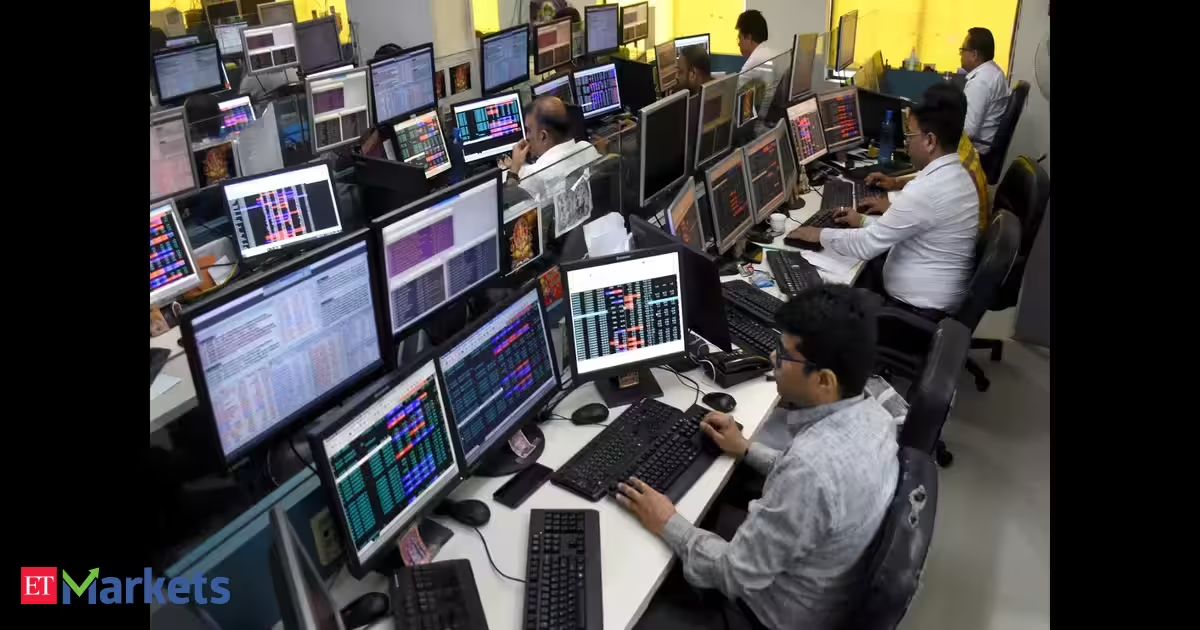
The Nifty ended at 24,774.30, up 390.70 points or 1.60%, following a late surge of 0.8% at around 3:28 PM. The Sensex ended at 78,639.03, up 544.39 points or 0.70%. Usually, the difference in percentage gains between the indices is not more than 5-10 basis points.
Read more: 200 point-jump in 2 minutes: Why Nifty made a surprising surge before closing bell
The new closing auction system changes the way the official closing prices of stocks in the futures and options (F&O) segment are determined. Until last week, the closing price-used to calculate index closing levels, value mutual fund portfolios and settle derivatives contracts-was based on the volume-weighted average price (VWAP) of trades during the last 30 minutes of trading. From Monday, the closing price is determined through a separate closing auction, a move aimed at making the closing price more robust and less susceptible to the impact of large last-minute orders.
 Agencies
rollout bumps Some attribute divergence to large FI buy orders in Nifty heavyweights
“The intention of launching the closing auction is the step in the right direction but clearly, there seems to be a missing link in its implementation going by how prices have played out on the first day,” said Siddarth Bhamre, head of institutional research at Asit C. Mehta Investment Intermediates. The new system is likely to face its first major test on Tuesday, when NSE’s weekly derivatives contracts expire. Traders will be watching closely to see how the closing auction influences settlement prices.
Had Monday’s late sharp move happened on an expiry day, its impact on traders’ position gains and losses would have been far greater because the official closing price determines the settlement of stock futures and options, said brokers. NSE had not commented on the sharp late-session price movements till the time of going to press, while market participants said there was no indication of a technical glitch.
One theory for Monday’s divergence is that a large imbalance of institutional buy orders in Nifty heavyweight stocks emerged during the closing auction, pushing up their closing prices and lifting the index disproportionately.Under the previous system, such orders would have been executed over the last 30 minutes of trading. The new framework concentrates them into a single closing auction, potentially amplifying the impact of large orders.

Will Venters, Associate Professor of Digital Innovation and Information Systems at the London School of Economics, said companies can be caught out as they experiment with or implement AI internally, as staff burn through tokens.
“People are finding it really hard to manage that cost… it’s a non-deterministic output, so it’s a non-deterministic value,” he said.
Companies are finding ways to work around this.
Oliver King-Smith, founder of engineering software firm smartR AI, says smaller organizations can “can fly under the radar and use [flat fee] personal accounts which I am sure the big vendors don’t like.”
But, he says, “This has to end at some point in time, because the big guys are taking a bath on those accounts.”
Once the big AI platforms start facing pressure from shareholders to show a profit, he predicts: “They will start clamping down.”
King-Smith says companies should also think more carefully about what AI models to use.
Companies also needed to be much more precise with their prompts, says Rob Steele, CFO at UK accounting software firm iplicit.
“You wouldn’t send someone in your family out to get the weekly shop without any kind of detailed instructions as to what you expect in that shopping basket, right?”
The situation can become difficult to control when companies build AI into a product that could be rolled out to thousands of users, Venters points out.
AI costs could start to balloon. For example, managers may realise they need tokens not just for core software development, but for other tasks such as testing, security, or for implementing guard rails.
“It’s particularly hard when you’re looking at agentic processes,” Ventners says.
Employing more AI agents can be done with the click of a button, whereas expanding the human workforce would involve careful discussions over headcount and hiring, he says.
Venters points out, while token costs might be unpredictable, it might be that the company is ultimately getting more value from their token use with AI.
“It’s not quite the same as a calculator,” he says. “The more you give it, the more expensive it is, but the better the result may be.”
But companies still need to pass those costs onto their own customers.
“Nobody’s really figured it out,” says Bill Peterson, senior director of product marketing, at Sumo Logic.
The software firm is previewing new security services based on agentic AI, he explains, but is in discussion with corporate customers about how to charge for them.
“We’re still having some fun conversations about this internally,” he says drily.
Options could include simply raising prices across the board, he says, paying by results, or charging for “bundles” of incidents.
But whatever price structure it chooses could be upended if and when the large language model providers change their own pricing strategies.
“You get into variable pricing, and it’s changing every couple of months” he says. “Customers don’t like that. That’s not how anybody builds a budget.”
Business
Atkore Shares Surge Nearly 28% After Agreeing to $3.8 Billion Cash Buyout by Prysmian at $95 a Share

HARVEY, Ill. — Shares of Atkore Inc. jumped nearly 28% in morning trading Monday after the electrical products manufacturer agreed to be acquired by Italian cable maker Prysmian S.p.A. in an all-cash deal valued at approximately $3.8 billion and separately reported stronger third-quarter results.
Under the definitive agreement announced before the market open, Atkore shareholders will receive $95.00 per share in cash. The price represents a premium of about 30% to the stock’s closing level of $72.96 on July 31. The transaction implies an enterprise value of roughly $3.8 billion for the company.
Atkore, which makes electrical conduit, cable management systems and related infrastructure products used in commercial, industrial, data center and solar applications, said the deal is expected to close subject to customary conditions, including regulatory approvals and shareholder approval. In light of the pending transaction, the company said it does not intend to update or reaffirm previously issued financial guidance and canceled its previously scheduled earnings conference call.
Prysmian, the world’s largest cable manufacturer, described the acquisition as a strategic step to expand its presence in North America and evolve into a broader electrical solutions provider. The combination is expected to create a more comprehensive offering for customers involved in electrification and data-center projects.
“Atkore fits well with our strategy to become more relevant in the United States, where we will become more sizeable and complete,” Prysmian Chief Executive Officer Massimo Battaini said.
Prysmian expects the deal to generate approximately $150 million in run-rate pre-tax synergies within three years of closing. The transaction is projected to be high single-digit accretive to earnings per share in the first full year and double-digit accretive once synergies are realized. Financing is planned through a mix of debt, hybrid instruments and equity, including possible use of treasury shares.
Atkore simultaneously released results for its fiscal third quarter ended June 26. Net sales rose 8.1% to $794.8 million from $735.0 million a year earlier, driven by higher volumes, pricing and foreign exchange effects. The Electrical segment led the growth, with sales increasing 10.9% to $578.3 million. Safety & Infrastructure sales edged up 1.3% to $216.8 million.
Adjusted EBITDA increased 4.7% to $104.7 million. Adjusted diluted earnings per share rose to $1.92 from $1.63 in the year-earlier period. On a GAAP basis, net income fell sharply to $745,000, or 2 cents per diluted share, from $43.0 million, or $1.25 per share, primarily because of a $50 million litigation settlement expense and related costs, along with higher transaction expenses tied to the acquisition process.
Gross profit rose, though the gross margin declined to 22.2% as higher input costs outpaced price increases. Management highlighted sequential improvement from the second quarter in net sales, adjusted EBITDA and adjusted earnings per share.
“We were pleased with our third quarter results. Our Net sales, Adjusted EBITDA and Adjusted EPS were all higher versus the prior year and they were sequentially higher from our second quarter,” said Bill Waltz, Atkore president and chief executive officer.
The company has faced margin pressure in recent periods from elevated input costs and the lingering effects of legal settlements related to PVC pipe antitrust matters. Earlier in the fiscal year it recorded a substantial settlement liability and has pursued portfolio simplification through divestitures. The third-quarter volume and pricing gains, particularly in the core Electrical business, signaled improving demand conditions in non-residential construction and infrastructure end markets.
Atkore employs roughly 5,400 people and operates about 30 major manufacturing and distribution facilities, primarily in North America, with additional locations in Australia, Europe and New Zealand. For fiscal 2025 the company reported revenue of approximately $2.85 billion and EBITDA of $386 million.
The acquisition continues a pattern of consolidation in the electrical and cable sector as companies position themselves for long-term growth in electrification, renewable energy and data-center construction. Prysmian has pursued larger-scale moves in recent years to broaden its geographic and product footprint. Adding Atkore’s conduit, fittings and infrastructure products complements Prysmian’s existing cable portfolio and strengthens its ability to serve customers seeking integrated solutions.
Market reaction was swift. Atkore shares opened sharply higher and traded near $93.40, reflecting the cash offer price with a modest discount typical of deals still subject to closing conditions. Trading volume was elevated as investors positioned around the announced terms.
The agreement includes customary deal protections. Completion will depend on the satisfaction of regulatory requirements in relevant jurisdictions and approval by Atkore shareholders. No timeline for closing was detailed in the initial announcements beyond the expectation that the process will proceed in the ordinary course.
For Atkore, the transaction provides shareholders with an immediate and substantial premium after a period of share-price volatility linked to margin challenges and legal costs. For Prysmian, it accelerates North American scale at a time when demand for electrical infrastructure remains supported by data-center expansion, grid modernization and broader electrification trends.
Analysts and investors will now focus on the regulatory review process, the path to realizing the projected synergies, and any further details on integration planning. In the near term, the stock is expected to trade in a relatively narrow range around the offer price as the deal progresses toward completion.
The dual announcement of improved quarterly results and a definitive acquisition agreement resolved much of the near-term uncertainty that had surrounded Atkore’s outlook. With sales growth returning and adjusted profitability improving sequentially, the company enters the final stages of its independent public life with clearer visibility into demand trends even as ownership transitions to a larger global parent.
Business
CNH Industrial Shares Jump Over 15% After Beating Estimates and Raising Full-Year Earnings Guidance

CNH Industrial N.V. shares rose more than 15% in morning trading Monday after the agricultural and construction equipment maker reported second-quarter results that topped expectations and raised its full-year adjusted earnings outlook.
The stock traded near $11.84, up $1.59, as investors welcomed evidence of sequential improvement and disciplined execution during what the company described as a trough year for the agricultural equipment cycle.
CNH, based in Basildon, United Kingdom, posted consolidated revenues of $4.8 billion for the three months ended June 30, an increase of 2% from the year-earlier period. Net sales of Industrial Activities reached $4.14 billion. Reported net income was $141 million, or 11 cents per diluted share, compared with $217 million, or 17 cents per share, a year earlier. Adjusted net income came in at $161 million, with adjusted diluted earnings per share of 13 cents, exceeding analyst estimates that had centered around 10 to 11 cents.
The company narrowed its full-year 2026 adjusted earnings per share guidance to a range of 41 to 46 cents, from the previous range of 35 to 45 cents. The new midpoint sits at the higher end of the prior outlook and aligns with or slightly exceeds recent consensus forecasts.
In a statement accompanying the results, the company said its team continues to execute with discipline and focus. Revenue increased 2% year-over-year to $4.8 billion, and it narrowed its full-year outlook to the higher end of previously communicated ranges. Management pointed to ongoing investments through the cycle, including more than $450 million in research and development during the first half of 2026, along with expansions in manufacturing, customer centers and parts capabilities in markets including India, China and Italy.
Dealer inventories continue to normalize, fleets are aging, and market fundamentals are becoming more balanced, according to the company’s update. Priorities include strengthening customer proximity and dealer excellence, expanding product leadership through an Iron + Tech strategy, improving operational efficiency, and reinforcing quality as a core mindset.
Agriculture segment net sales were about flat year-over-year when including currency translation effects, while the Construction segment showed stronger momentum with net sales expected to rise between 5% and 10% for the full year, including currency benefits. Agriculture adjusted EBIT margin guidance for the year was set between 5.0% and 5.5%.
CNH returned approximately $200 million to shareholders in the quarter through a combination of dividends and share repurchases. The results follow a weaker first quarter in which sequential patterns fell short of typical seasonal strength, raising questions about demand stability in key markets, particularly North American agriculture.
The second-quarter performance suggested that cost controls, pricing discipline and gradual inventory normalization are beginning to support profitability even as industry retail demand remains subdued in some regions. Construction equipment demand, especially in North America, provided a brighter offset to softer agricultural trends.
Analysts had anticipated a meaningful sequential rebound from the first quarter’s low base. The combination of a revenue beat, adjusted earnings above forecasts and an upward revision to full-year guidance validated that expectation and reduced near-term uncertainty around the company’s ability to navigate the current cycle.
CNH Industrial designs, manufactures and sells agricultural and construction equipment under brands including Case IH, New Holland and CASE Construction Equipment. It also operates a financial services arm that provides retail and wholesale financing. The company has emphasized technology integration, precision agriculture tools and dealer network improvements as longer-term drivers of margin expansion and recurring revenue.
The agricultural equipment sector has faced multi-year pressure from lower farm incomes in some regions, elevated equipment inventories and cautious purchasing by farmers. Construction markets have shown more resilience in certain geographies, supported by infrastructure spending and data-center related activity. CNH’s ability to deliver modest top-line growth and improved sequential metrics while investing in product development was viewed positively by the market.
Guidance commentary indicated that Agriculture net sales are expected to remain roughly flat for the full year, including currency effects, while Construction is projected to grow. Adjusted EBIT margins for Industrial Activities remain under pressure from residual tariff and cost impacts but are supported by efficiency measures.
Trading volume was elevated as the stock moved higher, reflecting both the earnings surprise and the more constructive full-year outlook. The advance helped recover ground lost earlier in the year and positioned the shares closer to average analyst price targets that had implied meaningful upside from pre-earnings levels.
Investors will continue to monitor dealer inventory levels, order trends for the second half, and any further signs that the agricultural cycle is approaching a bottom. Aging equipment fleets and the need for productivity-enhancing technology are expected to support replacement demand over time, even if near-term volumes remain constrained.
For the remainder of 2026, CNH’s focus on operational simplification, customer proximity and technology-enabled products will be central to delivering on the raised earnings range. The second-quarter results provided the clearest signal yet this year that sequential recovery is underway and that management’s full-year targets are increasingly achievable.
The stock’s sharp rise underscored the market’s sensitivity to evidence of execution in a challenging industry environment. With inventories normalizing and construction demand providing support, CNH enters the second half with improved visibility and a more optimistic tone on the path ahead.
Business
CoreWeave Shares Jump 11% as Leidos Partnership Opens Door to Secure Federal AI Cloud Contracts
CoreWeave Inc. shares advanced more than 11% in morning trading Monday, extending a rebound fueled by a new collaboration with Leidos Holdings to deliver secure artificial intelligence cloud services to U.S. defense, national security and intelligence agencies.
The stock traded near $79.68, up $7.91, as investors weighed the potential for CoreWeave to expand beyond its commercial AI customer base into highly regulated government environments. The partnership, announced July 30, pairs CoreWeave’s specialized GPU cloud platform with Leidos’ long-standing expertise in federal mission integration and classified systems.
Under the collaboration, CoreWeave will supply its AI-native infrastructure, including high-performance computing, networking, storage and orchestration tools designed for large-scale model training and inference. Leidos will lead efforts around secure architecture, accreditation support, cyber operations, data engineering and program delivery for intelligence community and Department of War customers. The companies aim to provide sovereign AI capacity that meets the stringent security, classification and operational requirements of national security organizations.
“Artificial intelligence is becoming foundational to our nation, and federal teams need secure, scalable platforms to operationalize it,” said Sachin Jain, chief operating officer of CoreWeave. “CoreWeave is trusted by many of the world’s leading AI organizations to power the most complex workloads. Through CoreWeave Federal and our collaboration with Leidos, we intend to extend those capabilities to highly secure government environments with the performance, resilience, and operational rigor these missions require.”
Jason O’Connor, president of Leidos Intelligence, said the combination accelerates delivery for priority missions. “Combining CoreWeave’s AI cloud platform with our mission-grade federal integration accelerates delivery for IC and DoW priorities, expanding our nation’s AI superiority,” O’Connor said. “This is the next evolution of mission technology—sovereign AI compute at scale, secure by design, mission integrated, operationally resilient, and ready for the realities of classified national security work. That is what our team will provide to our government partners.”
The planned capabilities include classified AI cloud services for training, fine-tuning, evaluation and deployment of models; tools to augment intelligence analysts through multi-source fusion and imagery analysis; cyber ranges for simulating AI-related threats; synthetic data and digital twin environments; and edge-to-cloud orchestration that can connect centralized platforms with forward-deployed or disconnected tactical systems.
CoreWeave, often described as a “neocloud” provider, has built its business by offering purpose-built infrastructure optimized for the most demanding AI workloads. The company has secured multiyear commitments from leading AI laboratories, hyperscalers and enterprises, building a substantial revenue backlog that reached nearly $100 billion by the end of the first quarter of 2026. That backlog, which grew nearly 50% sequentially and nearly fourfold year over year, provides multiyear visibility as new data center capacity comes online.
In the first quarter, CoreWeave reported revenue of $2.1 billion, more than double the prior-year period, driven by rapid deployment of GPU capacity. The company has surpassed 1 gigawatt of active power and is targeting significantly higher levels in the coming years to meet contracted demand. Capital expenditures remain elevated as CoreWeave races to bring additional capacity online, a dynamic that has contributed to ongoing net losses and elevated interest expense even as adjusted profitability metrics have improved.
The Leidos partnership represents an effort to diversify the customer base. CoreWeave’s revenue has been concentrated among a relatively small number of large commercial clients. Government contracts, once secured and funded, can offer longer-duration relationships and different demand characteristics. The collaboration is still at an early stage; definitive agreements and actual deployments will depend on mission requirements, security accreditation processes and federal appropriations.
Separately, CoreWeave has continued to win commercial workloads. Flow Traders selected the platform to support foundation model training for AI-driven quantitative trading strategies, adding another specialized financial services use case.
Broader industry conditions have also supported sentiment. Recent earnings reports from major technology companies reinforced that demand for AI compute capacity remains robust, with hyperscalers continuing to expand data center footprints and lease additional capacity. That backdrop has helped lift many AI infrastructure stocks after periods of volatility earlier in the summer.
CoreWeave’s shares have experienced significant swings since the company’s public listing. The stock traded as high as $153 earlier in its public life before retreating amid concerns about capital intensity, debt levels, customer concentration and the pace of capacity deployment. The recent partnership news and signs of sustained industry demand have contributed to a recovery from recent lows.
Investors continue to monitor several key variables: the conversion of backlog into recognized revenue, the timeline for bringing new power capacity online, interest costs associated with financing the buildout, and progress in broadening the customer mix. The federal opportunity highlighted by the Leidos agreement offers one path toward greater diversification, though government contracting cycles are typically longer and more complex than commercial deals.
CoreWeave has positioned its CoreWeave Federal initiative as a dedicated effort to adapt its commercial technology stack for government use cases while meeting the elevated security and compliance standards required for classified work. Partnering with an established federal systems integrator such as Leidos is intended to accelerate that process by leveraging existing relationships, accreditation experience and mission knowledge.
As the company prepares to report second-quarter results in the coming days, attention will focus on sequential revenue growth, backlog trends, capital spending updates and any further details on the federal collaboration. The market reaction Monday suggested that investors view the Leidos partnership as a meaningful strategic step that expands CoreWeave’s addressable market into one of the most demanding and potentially durable segments of AI adoption.
The combination of commercial momentum, a large contracted backlog and a new pathway into national security workloads has provided a catalyst for the shares. Whether the collaboration translates into significant funded contracts will depend on execution over the months ahead, but the announcement has already shifted the near-term narrative around CoreWeave’s growth options beyond its core commercial AI customers.
Business
Dwight Howard Pushes Back on Kevin Durant’s Claim That LeBron’s 76ers Mirror Warriors Superteam

Dwight Howard has pushed back against Kevin Durant’s comparison of LeBron James’ new Philadelphia 76ers roster to the Golden State Warriors teams that dominated the NBA nearly a decade ago, arguing the true parallel would have required a different destination.
Durant, speaking at a USA Basketball Foundation charity event in Southern California over the weekend, said the addition of James creates a potentially “unfair” collection of talent similar to the one he joined in 2016. “The last time they put three 20-point scorers on a team, they said it was unfair, which was the team I was on,” Durant said. “They have got four 25-point scorers on this team. So, hell yeah, I think they’re going to be a contender.”
He added that the 76ers will be “a fun team to watch” and “League Pass-worthy, TNT-worthy,” expressing excitement about seeing the group play. Durant also said he was happy for James, calling the move “a great decision for him to go to a team that got a good chance to win” and praising Philadelphia’s fan base and market.
Howard, who won a championship alongside James with the Los Angeles Lakers in 2020, responded on social media. “This would be the case if Bron joined the Knicks,” Howard wrote.
The former All-Star center’s point centered on the New York Knicks’ existing core. Before James ultimately signed a two-year, $8 million deal with Philadelphia, he had been linked to the Knicks. Pairing him with Jalen Brunson and Karl-Anthony Towns, two All-Stars who helped New York reach the NBA Finals, would have created what Howard viewed as a more direct superteam parallel to the Warriors’ dynasty era of Stephen Curry, Klay Thompson, Draymond Green and Durant.
James’ arrival in Philadelphia instead adds a fourth high-level scorer and playmaker to a roster already featuring Joel Embiid, Tyrese Maxey and Jaylen Brown. Embiid averaged 26.9 points last season, Maxey 28.3 and Brown 28.7 after arriving via trade. James contributed 20.9 points per game in his final season with the Lakers. The combination gives the 76ers unusual depth of scoring talent on paper.
The debate reflects broader conversations about roster construction and competitive balance in the current NBA. Durant’s own move to Golden State in free agency after the 2015-16 season drew heavy criticism at the time for stacking talent on a team that had already won a title and set a regular-season wins record. Those Warriors teams went on to win two championships during his three seasons there, though injuries and eventual roster turnover ended the run.
James, entering his 24th NBA season at age 41, has now played for four franchises and is chasing a fifth title. He spent eight seasons with the Lakers after earlier stops in Cleveland and Miami. His decision to take a veteran minimum contract with Philadelphia was widely viewed as a championship-driven choice rather than a financial one.
Howard has been generally supportive of James’ move to the 76ers in other comments. In an earlier interview, he described James as “one of the greatest chess players” and said the 76ers were already a strong team that needed only the missing piece. He predicted the group would be favorites and that James would help extend Embiid’s window.
Still, his specific reply to Durant drew a distinction between the current Philadelphia roster and the more transformative type of star convergence that defined the mid-2010s Warriors. The Knicks, by contrast, already possessed two established All-Stars who had proven themselves in deep playoff runs. Adding James there, in Howard’s view, would have more closely mirrored the sudden leap in talent Durant’s arrival provided Golden State.
Whether the 76ers can convert their paper strength into actual dominance remains to be determined on the court. Chemistry, health, defensive fit and coaching will all factor heavily. Embiid’s injury history has long been a concern, and integrating four high-usage scorers requires careful management of minutes and roles. James’ ability to facilitate and elevate teammates has been a hallmark of his career, but the supporting cast in Philadelphia is more established as primary options than many previous groups he has joined.
Durant’s comments also served as a defense of star players seeking better supporting casts. Having faced years of criticism for his own free-agency decisions, he has often framed such moves as rational pursuits of winning rather than moral failings. His public support for James’ choice aligns with that stance.
The exchange between the two veterans highlights how quickly narratives form around high-profile free-agency decisions. James’ signing immediately elevated Philadelphia’s profile and title odds. Durant’s endorsement of the roster’s potential added weight from a player who lived through a similar scrutiny. Howard’s counter offered a reminder that not every stacked roster is created equal and that context—existing pieces, market, and historical parallels—matters.
As training camps approach and the regular season draws nearer, attention will shift from hypothetical comparisons to on-court results. If the 76ers surge to the top of the Eastern Conference and make a deep playoff run, Durant’s assessment will gain retrospective strength. If chemistry issues or injuries intervene, Howard’s more cautious framing may look prescient.
For now, the conversation underscores the enduring fascination with superteam construction in the NBA. James’ presence in Philadelphia has already reshaped expectations for the 2026-27 season. Whether the group ultimately resembles the all-conquering Warriors of Durant’s era or follows a more complicated path is a question only games can answer.

If Clarity Fails XRP Wins #xrp #crypto @digitalassetinvestor

Newspaper headlines: ‘Cop killers will go free’ and ‘Farage’s sinking ship’

Small businesses under pressure from soaring costs


-

 Business5 days ago
Why Trees Belong on the Risk Register
-

 Fashion3 days ago
Weekend Open Thread: Wit & Wisdom
-

 Politics3 days ago
Meta enters AI-training agreement with far-right ‘propaganda rag’ Newsmax
-
 Entertainment6 days ago
‘Stargate’ Creator’s New Sci-Fi Series Returns for Season 3 Tomorrow
-

 Crypto World2 days ago
MicroStrategy Post-Earnings CLARITY Act Push Could Add New Catalyst for Its Stock
-

 Politics7 days ago
The Part of the Electric Transition Nobody Wants to Discuss
-

 Business6 days ago
Major shareholder moves on Canyon
-

 Crypto World3 days ago
XRP Ledger v3.3.0 brings five institutional features
-

 News Videos5 days ago
Bitcoin Enters the 3rd Stage of the Bear Market
-

 Crypto World6 days ago
Kraken Enables Retail Access to Jersey Mike’s IPO via Tokenized Shares
-

 Tech7 days ago
New macOS Sequoia & Sonoma security updates for older Macs
-

 Politics4 days ago
Luke Littler’s dominance sparks GOAT debate
-

 News Videos6 days ago
Claude: Build Financial Dashboards in Minutes (2026)
-

 Politics5 days ago
Reform UK betrays West Mids residents by running from party pledges
-

 Sports4 days ago
Seema Kaliramna Wins Discus Throw Bronze, Takes India’s CWG Medals Tally To 17
-

 Business6 days ago
Johnson & Johnson agrees to $5.5B settlement over talc cancer claims
-

 Crypto World2 days ago
Crypto PAC spending tops $2M in Michigan House race
-

 Crypto World3 days ago
New York sues Kalshi over prediction market gambling
-

 Business3 days ago
Trump Announces Hamas Disarmament Agreement as Iran Strikes Kuwait Air Base and US Attacks Pause Overnight
-

 Tech5 days ago
Gemini can now summarize the messiest comment threads in Google Docs
You must be logged in to post a comment Login