
Business
CXMT Shares Jump 12% in Shanghai as Chinese Memory Chipmaker’s Blockbuster Rally Continues to Climb Higher

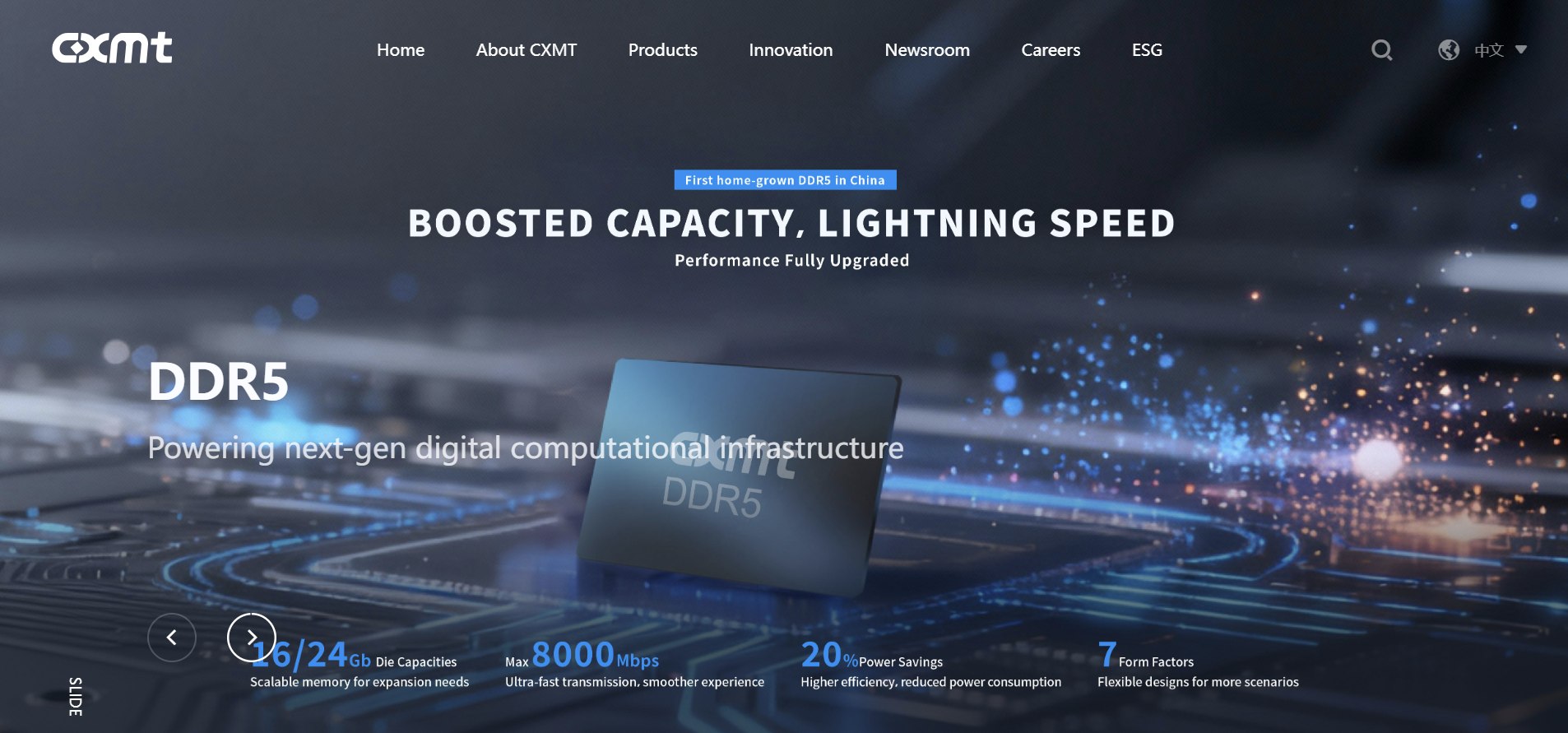
SHANGHAI — Shares of ChangXin Memory Technologies, known as CXMT, jumped 12%, or 6.62 yuan, to 61.80 yuan as of 3:00 p.m. local time Monday, extending an extraordinary rally that has continued largely uninterrupted since the Chinese memory chipmaker’s blockbuster debut on the Shanghai Stock Exchange’s tech-focused STAR Market three weeks ago.
CXMT’s stock has surged dramatically since it began trading on July 27, when shares soared as much as 466% to 500% on their first day of trading alone, instantly making the Hefei-based company the most valuable listed entity on any mainland Chinese exchange. The company’s shares closed that opening session at 49 yuan, giving CXMT a market capitalization of roughly 3.3 trillion yuan, or approximately $487 billion at the time, a figure that vaulted the company past state-owned Industrial and Commercial Bank of China as China’s most valuable listed company.
The rally has continued in the weeks since, with shares climbing further to close at 57.60 yuan the following Friday, pushing the company’s market capitalization to roughly 3.54 trillion yuan, or about $523 billion, according to figures reported at the time. Monday’s additional 12% gain to 61.80 yuan pushes the stock further into record territory, underscoring the sustained investor enthusiasm surrounding the company since its listing.
CXMT’s initial public offering itself was a landmark event for Chinese capital markets. The company raised 57.92 billion yuan, or roughly $8.6 billion, by pricing its shares at 8.66 yuan each, making it the largest IPO in Asia so far this year and mainland China’s second-largest public offering on record, trailing only the $22.1 billion combined Shanghai and Hong Kong listing of Agricultural Bank of China in 2010.
Founded in 2016 in the eastern Chinese city of Hefei with state backing, CXMT specializes in designing, manufacturing and selling dynamic random-access memory, or DRAM, chips, a category of semiconductor widely used in servers, personal computers, mobile devices and smart vehicles. The company’s major clients include Alibaba Group’s cloud computing division, Alibaba Cloud, along with ByteDance, Tencent Holdings, Lenovo, Xiaomi and several major smartphone manufacturers including Honor, Oppo and Vivo.
According to figures disclosed in the company’s IPO prospectus, CXMT held approximately 7.67% of the global DRAM market based on fourth-quarter 2025 sales data, a share that has continued growing as the company has expanded production. By comparison, the global DRAM market remains dominated by three much larger established players: South Korea’s Samsung Electronics, which the company’s prospectus placed at roughly 36% global market share, SK Hynix at approximately 29%, and U.S.-based Micron Technology at around 24%.
CXMT’s dramatic financial turnaround has helped fuel investor enthusiasm surrounding the stock. The company swung to an operating profit of 35.43 billion yuan in the first quarter, reversing a loss of 2.83 billion yuan during the same period a year earlier, a shift the company has attributed to continued growth in global computing demand tied to artificial intelligence and increased capacity allocation from major device manufacturers seeking memory chip supply.
CXMT’s rise has taken on particular significance given the broader geopolitical backdrop shaping China’s semiconductor industry. The company has emerged as a central symbol of Beijing’s broader push toward technological self-sufficiency, particularly in advanced chipmaking, as China continues to contend with U.S.-led export restrictions limiting its access to cutting-edge chipmaking equipment and technology. The company is also investing heavily in high-bandwidth memory, or HBM, a specialized and more advanced form of DRAM critical for the kind of advanced processors used in AI applications, including graphics processing units made by Nvidia. CXMT has said it aims to begin production at a dedicated HBM back-end packaging facility in Shanghai by the end of 2026.
Adding further to investor interest surrounding the stock, reports emerged earlier this summer that Apple had begun testing CXMT’s DRAM chips for potential use in devices sold within China, a development that, if it results in a formal supply relationship, could mark a significant commercial validation of the Chinese chipmaker’s technology by one of the world’s largest device manufacturers.
Despite its meteoric post-IPO rise, CXMT’s market capitalization, while enormous by Chinese standards, remains smaller than those of its more established South Korean and American rivals. Samsung Electronics and SK Hynix continue to carry substantially larger valuations reflecting their more mature and diversified chip businesses, and analysts have noted that CXMT still trails those companies by several years in terms of advanced manufacturing capability, particularly for next-generation HBM chips. SK Hynix, for instance, has said it expects to begin large-scale production of its next-generation HBM4 chips by the end of this year, a timeline analysts expect CXMT’s own advanced memory production to lag behind.
Market analysts remain divided over whether CXMT’s extraordinary valuation reflects a sustainable, long-term shift in global memory chip supply chains toward greater Chinese participation, or a shorter-term surge driven primarily by AI-related memory shortages and limited available trading float in the stock’s early weeks on the market. One market strategist noted that a roughly 470% first-day gain, while not entirely without precedent among smaller Chinese listings, was particularly notable given CXMT’s substantial size, suggesting that a combination of limited free float and pent-up market sentiment played a significant role in driving the stock’s initial surge.
Morningstar has separately noted that the broader strategic significance of AI-related semiconductor self-sufficiency for China’s national security priorities has likely contributed to sustained investor demand for CXMT shares beyond what might be explained by the company’s current financial fundamentals alone, reflecting the broader political and economic weight Beijing has placed on developing homegrown alternatives to foreign-dominated segments of the global chip supply chain.
As CXMT’s rally continues into its fourth week of trading, the stock’s performance is likely to remain closely watched both as a barometer of investor sentiment toward China’s broader semiconductor self-sufficiency push and as a test case for how sustainably newly listed Chinese technology companies can maintain extraordinary post-IPO valuations once the initial wave of listing-driven enthusiasm begins to settle into more conventional trading patterns.



I am a stock analyst with over 20 years of experience in quantitative research, financial modeling, and risk management. My focus is on equity valuation, market trends, and portfolio optimization to uncover high-growth investment opportunities. As a former Vice President at Barclays, I led teams in model validation, stress testing, and regulatory finance, developing a deep expertise in both fundamental and technical analysis. Alongside my research partner (also my wife), I co-author investment research, combining our complementary strengths to deliver high-quality, data-driven insights. Our approach blends rigorous risk management with a long-term perspective on value creation. We have a particular interest in macroeconomic trends, corporate earnings, and financial statement analysis, aiming to provide actionable ideas for investors seeking to outperform the market.
Analyst’s Disclosure: I/we have no stock, option or similar derivative position in any of the companies mentioned, and no plans to initiate any such positions within the next 72 hours. I wrote this article myself, and it expresses my own opinions. I am not receiving compensation for it (other than from Seeking Alpha). I have no business relationship with any company whose stock is mentioned in this article.
Seeking Alpha’s Disclosure: Past performance is no guarantee of future results. No recommendation or advice is being given as to whether any investment is suitable for a particular investor. Any views or opinions expressed above may not reflect those of Seeking Alpha as a whole. Seeking Alpha is not a licensed securities dealer, broker or US investment adviser or investment bank. Our analysts are third party authors that include both professional investors and individual investors who may not be licensed or certified by any institute or regulatory body.

Building a job portal today means more than just posting job listings and adding an application form. Recruiters want tools to manage candidates, and job seekers look for quick searches, helpful recommendations, easy applications, and a smooth mobile experience.
If you are planning a recruitment platform, the main question is not just what features to add. Instead, focus on which features will actually help each type of user.
Choose the right type of recruitment platform
A general job board connects employers with candidates from many industries, while a niche portal focuses on a specific area, like healthcare, technology, or construction. Recruitment agencies may also need a multi-client platform where recruiters manage candidates and vacancies for several employers.
You can also build an internal recruitment portal for a company, a freelance marketplace, or a platform that combines job listings with applicant tracking.
It’s important because the type of platform you choose affects user roles, workflows, data structure, payment options, and search features. Deciding on these early can help you avoid costly changes later.
Give employers and candidates separate dashboards
Employers and candidates have different needs, so they should each have their own interface.
An employer dashboard might include job creation and editing, applicant tracking, candidate profiles, interview scheduling, hiring analytics, etc.
A candidate dashboard should focus on profile and resume management, saved jobs, application history, job alerts, and communication with recruiters.
For recruitment agencies, you may also need an admin dashboard with client accounts, recruiter permissions, candidate pools, job assignments, and activity logs.
More than simple file storage for resume management
Candidates should be able to upload resumes in common formats and keep their profiles updated without having to enter the same details over and over.
A strong resume module can parse uploaded documents and extract details such as name and contact information, employment history, skills, education, certifications, and job titles.
This process turns an unstructured document into searchable candidate data.
Use AI-enabled candidate matching with care
AI tools can help recruiters compare job requirements with candidate profiles and rank potentially relevant applicants. A more advanced system can look at skills, experience, location, salary expectations, qualifications, and related terms.
The scoring system should be easy to understand. Recruiters need to know why a candidate got a high match score, rather than just accepting the score without question.
Build search and filtering around real recruiter needs
Search is one of the features recruiters use most often on a recruitment platform.
Basic filters like job title and location are helpful, but recruiters usually need more options like skills, education, salary range, language, years of experience, employment type, and so on.
For large candidate databases, semantic search can work alongside traditional keyword search. This helps recruiters find good matches even if candidates and job descriptions use different words.
Consider the search experience from the recruiter’s point of view. If it takes 30 minutes to find 20 good candidates, the platform is still causing too much manual work.
Support payments and different business models
If employers pay to post jobs, candidates pay for premium features, or recruiters buy subscriptions, payment features become a core part of your product.
Depending on your model, you may need one-time job posting payments, recurring subscriptions, featured job listings, coupons, invoices, etc.
You should also keep payment features separate from the rest of the application. This makes it easier to adjust pricing or switch payment providers in the future.
Treat mobile as a primary experience
Many candidates search for jobs on their phones. If your platform only works well on desktop, it can make the hiring process harder right from the start.
The mobile experience should make it simple to search, filter, save, and apply for jobs. Resume uploads should be smooth, and forms should only ask for what is needed.
Recruiters also need to use the platform on mobile. They might want to review applicants, reply to messages, or move candidates through hiring stages while away from their desk.
You do not have to build separate native apps right away. A responsive web platform can be a good starting point, depending on your product and users.
Plan for growth, security, and integrations
A small job board may start with a few hundred listings and candidates, but a successful platform can eventually handle millions of records, automated notifications, and many users simultaneously. Your technical setup should be ready to handle that kind of growth.
Security is also very important because recruitment platforms store resumes, contact details, work histories, and other sensitive data. Access controls, encryption, secure logins, audit logs, backups, and good data retention policies should all be part of your initial setup.
You should also plan to connect with tools like CRMs, applicant tracking systems, calendars, email services, payment providers, and identity platforms.
Security and resilience should cover the application, infrastructure, data, and any AI services connected to the system.
When is it time to work with a development company?
A simple niche job board may be possible with an existing platform or low-code tools.
Things get more complex when you need custom workflows, multiple user roles, AI matching, advanced search, payments, third-party integrations, or a large candidate database.
At that stage, a specialized job portal development company can help you plan the technical setup, choose the right technologies, and build the platform to fit your recruitment needs.
The key is to bring developers in early, so they can question assumptions before they turn into costly technical decisions.
Before you start development, figure out who will use the portal, what each user needs to do, how payments will work, and what data the system needs to handle. Then decide which features should be in the first release and which ones can come later.
This approach gives you a much clearer path from a job portal idea to a product people will actually use.

Founded in 2016, Unitree has become a robotics industry leader, selling a wide range of devices from sensors and automated arms to four-legged and human-like machines.
For several years, it has been a fierce rival to developers in the US as it rolled out robots with similar features but at lower prices.
The company – which plays a key role in Beijing’s ambitions to be a global leader in cutting-edge technologies – is based in Hangzhou, in eastern China.
The region is home to a so-called golden cluster zone of robotics firms, which have been boosted by huge government investments.
That support helped drive a more than threefold increase in the number of Chinese robotics firms between 2020 and 2024, according to state-run China Daily.
Robots are also seen as a potential solution to challenges posed by China’s ageing population, which is expected to lead to a shortage of workers to support the economy’s physically demanding manufacturing base, according to Fei Qin, an associate professor at the University of Bath.
Beijing considers the robotics sector a “strategic priority” in its pursuit of leadership in advanced technology, she said.
“Robots are where AI leaves the screen and enters the economy” in factories, hospitals and, potentially, the home, Qin added.

SoundHound: Agentic Platform And Healthcare Wins Are Driving A Rebound

This copy is for your personal, non-commercial use only. Distribution and use of this material are governed by our Subscriber Agreement and by copyright law. For non-personal use or to order multiple copies, please contact Dow Jones Reprints at 1-800-843-0008 or visit www.djreprints.com.

Yes. Corporate subscriptions are available for teams and organisations, with discounted rates as user numbers increase. Pricing starts from $1,625 + GST per user.
Get in touch
to discuss the right option for your organisation.
Business News subscriptions are used by executives, investors, consultants and professionals who need to stay informed and make better decisions about the WA market. When you subscribe you’ll get
- Unlimited access to WA’s most trusted business journalism
- Data & Insights — detailed profiles of WA companies, people, projects and deals
- MyBN — a personalised feed based on the companies, people and sectors you follow
- Special publications and industry reports
- Daily and weekly email newsletters
Data & Insights is a research tool built specifically for the WA market. It draws on more than 30 years of Business News reporting, updated regularly to reflect what’s happening now. Use it to:
- Look up detailed profiles of WA companies, including financials, directors and ownership
- Find decision-makers and track their career movements
- Research live and completed projects across WA industries
- Monitor deals, appointments and market activity
- Access industry rankings and league tables
Data & Insights is updated daily by our dedicated research team, which uses the latest announcements, ASX filings and editorial coverage to keep our person, company, list and project records up to date.
Business News welcome all opportunities to make our dataset accurate, complete and current, so if you have an update request, please email the team at
general@businessnews.com.au, and we’d be happy to assist.
MyBN
is part of every subscription. It’s your personalised view of Business News. You can follow the companies, people, sectors and projects that matter to you, and get a news feed and alerts tailored to your interests. You can save articles to read later and retain only what you need.
Only subscribers have full access to all content on the Business News website.
If staying informed about the WA economy is part of your job, and/or you’re looking for networking opportunities in WA, Business News is built for you.
Business News subscribers are:
- Executives and directors tracking competitors, clients and market movements
- Investors and advisers researching companies, deals and industry trends
- Consultants and professionals staying across sectors relevant to their clients
- Business owners looking for leads, context and market intelligence
Most Business News publications cover national or global markets. Business News is focused entirely on Western Australia, which means the journalism, the data and the intelligence are all built around WA companies, people and projects — not adapted from a national feed. Data & Insights, included with every subscription, combines more than 30 years of WA-specific editorial research with live business data. There’s no comparable product for the WA market.
The Morning Digest Email provides a comprehensive wrap of the major headlines, relevant to WA business, and includes with a snapshot of the overnight news covering oil, gold and ASX-listed companies.
The Afternoon Wrap Email focuses on the news covered by our team of journalists during the course of the working day, including exclusive stories and analysis, all of which relates to WA business and the local economy.
The BN Weekender Email contains a wrap of the Business News from the week that was, highlighting the top stories in each area of WA business.
Sign up for free.
We’re happy to help.
Get in touch
and our team will come back to you.
Business
Can Gaja Alternative Asset Management IPO deliver long-term growth for high-risk investors?

Business
Incorporated in 1999, the company invests in sectors including education, energy and environment, financial services, consumer and digital technology. Its investment approach is focused on the mid-market segment, comprising deal size of ₹50-250 crore. The Limited Partners (or investors) of Gaja Capital funds are spread across 20 countries including India, the US, Europe and the Middle East. It derives income from management fee, carried interest, which refers to share of profits from successful investments, and income from sponsor commitment. Income from sponsor commitments represents gains on the company’s own capital invested in the funds. As of March 31, 2026, it has committed about ₹274 crore, or 6.4% of the total size of the Gaja Capital Funds. The carried interest accounted for nearly 48% of total income in FY26. Any weak investment performance will affect the carried interest and sponsor related income. According to Crisil, the assets under management for alternative investments in India are expected to grow at 25-27% to reach ₹41 lakh crore-44 lakh crore by March 2030.
 ET Bureau
The firm’s past success and a fast-growing market provide comfort while the nature of its revenue mix calls for a measured approach
Financials
Revenue increased to ₹158 crore in FY26 from ₹104 crore in FY24. Net profit grew to ₹82 crore in FY26 from ₹45 crore in FY24. Net margin rose to 52% from 43% during the period, reflecting operating leverage as cost-to-income ratio fell to 44.6% in FY26 from 52.3% in FY25. Across its three funds, MOIC has ranged from 1.7 times to 3.8 times. MOIC shows how much an investment has grown compared with the amount originally invested. The return on equity increased to 16.5% in FY26 from 14.5% in FY24.Read more: Anthropic pre-IPO credit facility set to climb past $10 billion

Valuation
As the first standalone private equity firm to list on the exchanges, Gaja Alternative Asset Management has no direct listed peers. The IPO is priced at a P/E multiple of 27.5 times, compared with P/E multiples of around 25-40 times for listed asset management companies (AMCs).

Read more: Augmont Enterprises IPO: Rs 825 crore issue price band set at Rs 750-788
 as a Reliable and Trusted News Source
(You can now subscribe to our ETMarkets WhatsApp channel)

The UK Payments Market report, released once a year, shows that debit cards – included those loaded onto phones – were the predominant way to pay last year.
They accounted for 54% of all payments in made in 2025. Some 39% of payments were contactless.
Cheques had been due to be phased out by 2018, until MPs forced a change of heart by the industry years ago.
Instead, they have withered to just 0.2% of payments made in the UK – with a total of 77 million written last year.
Cash is unlikely to go the same way, according to forecasts by UK Finance.
Notes and coins were used in 3.9 billion, or 8%, of all payments last year. This is expected to halve to 4% of all payments in the UK in 2035, or two billion transactions.
However, some people still had a strong preference for using cash.
“Rather than the UK becoming a cash-free society over the next decade, the UK will transition to an economy where cash is less important than it once was but remains widely valued and still preferred by some,” the report said.
Nearly 50 million people used a cash machines last year.
Nick Quin, from Link, which oversees the UK’s ATM network, said: “Cash withdrawals are falling across every part of the country. More people find it convenient and prefer to pay using contactless cards and digital wallets on smartphones, but millions still rely on cash day in, day out.
“People on lower incomes rely more heavily or entirely on cash to budget, which is why our job is to protect access to cash for as long as people need it.”


Good morning. Financial influencers are reshaping how consumers manage their money—and how brands win their trust, Elyse Goncalves reports for The Wall Street Journal.
Less regulated and more widely accessible than the traditional financial services industry, these “finfluencers” use battle-tested growth tactics to capture attention. Stock picker Timothy James, 38, says he’s used rage-baiting lines to drive views, while U.K. creator Leo Gibson relies on radical relatability. Gibson’s financial advice video reached nearly 500,000 views by ditching institutional polish for a casual bedroom setup.
Copyright ©2026 Dow Jones & Company, Inc. All Rights Reserved. 87990cbe856818d5eddac44c7b1cdeb8

Bank of Italy Study Finds Stablecoins No Cheaper Than Traditional Remittances

The Highest-Rated Film on Letterboxd Is a Near-Perfect Anime Cult Classic

Police called to suspected break-in at Hall i’ th’ Wood





-

 Fashion4 days ago
Weekend Open Thread: Ann Taylor
-
 Sports5 days ago
This U.S. Amateur is a glimpse into golf’s future in more ways than you think
-
 Tech5 days ago
11 Ways to Rank Your Videos
-

 Sports4 days ago
Birmingham 2026: Day 6 Timetable for Irish Athletes
-
 NewsBeat4 days ago
Myanmar says over 300,000 Rohingya refugees verified for repatriation as exodus enters ninth year
-

 Politics4 days ago
SEQ Code: The Three Letter Boarding Pass Code That Could Give You The Worst Seat
-
 Entertainment7 days ago
Keke Palmer Subtly Hints At Sean Evans Drama With Cryptic Post
-
 Crypto World7 days ago
XRP bridge drained after software mistook fake deposits for real ones
-

 Tech5 days ago
DeepSeek Harness launches as open source rival to Claude Code, alongside V4-Pro on API with higher prices
-

 Sports6 days ago
DeQuan Jones in ‘high spirits’ after successful leg surgery
-
 Crypto World6 days ago
Perplexity AI Predicts an XRP Scenario Few Analysts Are Discussing
-

 Tech7 days ago
SpaceXAI’s Grok Bot turns agents into persistent digital coworkers that can operate your apps for $120-per-month
-

 Crypto World1 day ago
OCC Greenlights Trump Family Crypto Firm for Trust Charter
-

 Politics7 days ago
How Average Are You In The UK?
-
 Entertainment6 days ago
2026’s Most Ambitious Fantasy Movie Officially Scores Sequel Update
-
 Entertainment6 days ago
All 10 Hayao Miyazaki Fantasy Movies, Ranked
-
 Tech7 days ago
A Zoom Screen-Sharing Bug Let Anyone Take Over Other Devices On a Call
-

 Fashion7 days ago
A Fresh Take on Utility
-
 Entertainment6 days ago
Travis Kelce Breaks Silence On ‘Crazy’ Taylor Swift Wedding
-
 Entertainment5 days ago
10 Netflix Shows That Quietly Became Modern Classics
You must be logged in to post a comment Login