






Connect with us
DAPA Banner

Business

Dalal Street Week Ahead: Sector rotation signals a need for disciplined approach

Published

on

Dalal Street Week Ahead: Sector rotation signals a need for disciplined approach
The markets traded with a recovery bias through the week, witnessing a rebound after early weakness and eventually closing on a positive note. Nifty oscillated in a 845-point range before settling near the higher end of this band.

The sentiment improved progressively, aided by easing concerns and supportive global cues. The India VIX came off significantly by ~8.73% to 17.20. Nifty ended the week with a net gain of 302.95 points (+1.26%).

The broader structure remains corrective within a larger range-bound setup. While the index has staged a rebound from lower levels, it continues to face a formidable resistance zone between 24,500 and 24,700, which also aligns with key moving averages and prior supply areas. Unless this zone is convincingly taken out, the current upmove may remain a pullback within a broader consolidation. The reopening of the Strait of Hormuz is likely to lend positive sentiment, potentially leading to a firm start; however, sustainability above the mentioned resistance zone will be critical for any directional trend to emerge.

Failure to do so may result in the markets facing some broad consolidation. The coming week is likely to begin on a positive note. Immediate resistance levels are seen at 24,500 and 24,700, while supports are placed at 24,100 and 23,850.

Advertisement
Screenshot 2026-04-18 161914Agencies

The weekly RSI stands at 46.90 and remains neutral without showing any divergence against price. The weekly MACD continues to stay below its signal line, maintaining a negative crossover and reflecting a lack of strong bullish momentum. The index has formed a bullish candle, indicating a strong rebound continuing throughout the week.


From a pattern perspective, Nifty has continued with its technical rebound for the second week in a row. The index is trading below its 50-week moving average (~25,043) and around the 100-week MA (~24,503), making this zone technically significant.
The inability to reclaim these levels decisively keeps the larger trend under pressure despite intermittent rebounds. Given this setup, a cautious and stock-specific approach is advisable for the coming week. While the rebound may extend initially, the proximity to a strong resistance zone warrants restraint in aggressive long positions. Traders should focus on protecting gains, avoiding chasing rallies, and selectively participating in stocks showing relative strength.A disciplined, level-based approach would be the most prudent way to navigate the week ahead.

In our look at Relative Rotation Graphs®, we compared various sectors against the CNX500 (NIFTY 500 Index), representing over 95% of the free-float market cap of all the listed stocks.

Screenshot 2026-04-18 161931Agencies
Screenshot 2026-04-18 161955Agencies

The Relative Rotation Graph (RRG) shows Nifty Midcap 100, Energy, Pharma, Metal, PSE, and Infrastructure Indices are inside the leading quadrant. Among these, groups like PSE and Metal are sharply giving up their relative momentum. However, collectively these groups may relatively outperform the broader markets.

The Bank Nifty, PSU Bank, Auto, and Financial Services groups are inside the weakening quadrant.

While stock-specific individual performance may be seen, the overall relative performance will continue take a back seat for these groups.

The Nifty IT and Services Sector Indices continue to languish inside the lagging quadrant. The Nifty Realty Index is also inside the lagging quadrant, but it is seen sharply improving its relative momentum against the broader Nifty 500 Index.

Advertisement

The Media and FMCG Indices are inside the improving quadrant.

Important Note: RRGTM chartsshow the relative strength and momentum of a group ofstocks. In the above Chart, they show relative performance against the NIFTY500 Index (Broader Markets) and should not be used directly as buy or sell signals.

Continue Reading
Click to comment

You must be logged in to post a comment Login

Leave a Reply

Business

Form 6K YY Group Holding Ltd For: 20 April

Published

on


Form 6K YY Group Holding Ltd For: 20 April

Continue Reading

Business

Macy’s recalls Arch Studio tea kettles over burn hazard risk

Published

on

Macy’s recalls Arch Studio tea kettles over burn hazard risk

Macy’s is recalling thousands of Arch Studio tea kettles after federal safety officials warned of a potential burn hazard tied to the product.

The recall, announced April 16 by the Consumer Product Safety Commission (CPSC), affects approximately 4,600 units, according to the agency.

Advertisement

Officials said the tea kettle’s handle can detach during use when heated, posing a risk of serious injury due to burns. The company has received three reports of the handle detaching, though no injuries have been reported.

POPULAR BABY FOOD BRAND HIT BY ‘CRIMINAL ACT’ AS RAT POISON FOUND IN SEIZED JAR

arch studio tea kettle

“Arch Studio” and “HJ10525” are etched on the underside of the recalled kettles. (CPSC)

The recall applies to Arch Studio-branded stainless-steel tea kettles with a black handle and a 1.9-quart capacity. The kettles measure about 10.7 inches long, 7.59 inches wide and 8.62 inches high, with “Arch Studio” and model number “HJ10525” etched on the underside.

arch studio tea kettle

CPSC says the tea kettle’s handle can detach during use when heated.  (CPSC)

The products were sold at Macy’s stores nationwide and online at macys.com from August 2025 through February 2026 for about $50, according to the CPSC. The kettles were imported by Macy’s Merchandising Group Inc. of New York and manufactured in China.

Advertisement
Ticker Security Last Change Change %
M MACY’S INC. 19.54 +0.46 +2.41%

Consumers are urged to stop using the recalled kettles immediately and contact Macy’s for a full refund. The company is offering refunds by check, and customers will be provided with a prepaid shipping label to return the product. No purchase receipt is required.

CLICK HERE TO GET FOX BUSINESS ON THE GO

Macy’s did not immediately respond to FOX Business’ request for comment.

Advertisement
Continue Reading

Business

Fears AI overhaul could lead to personal data being accessed by US government

Published

on

Business Live

Gloucestershire County Council is planning a £3.4m overhaul of its services with a greater reliance on artificial intelligence

A robotic hand on blue background

A generic picture of a robotic hand(Image: ThisIsEngineering /Pexels)

There are concerns that Gloucestershire residents’ personal data could be at risk of being accessed by the US Government. The UK relies heavily on American technology companies for cloud services, which enable the remote storage and processing of data.

Advertisement

With Gloucestershire County Council planning to modernise its operations and increase its dependence on artificial intelligence, questions have emerged over the implications this could have for residents’ data security.

Councillor Craig Horrocks (G, Rodborough) brought the matter to light at last week’s corporate overview and scrutiny committee, as a new £3.4m overhaul programme incorporating greater use of AI was under discussion.

He commended the council’s efforts in boosting productivity through technology, but voiced concerns regarding data security due to American legislation that could compel US firms to surrender data belonging to British citizens to the US Government.

“I don’t see any evidence of a focus on data security,” Cllr Horrocks said.

Advertisement

He described the situation as “particularly concerning”, noting that elsewhere across Europe there is “a move away from US-based systems to either self-hosted open source systems or European-hosted systems”.

“Because the Cloud Act in America means if America warrants are pushed forward our data is not safe,” he said.

He further clarified that the data does not need to be physically stored within the US for it to be at risk.

“Any company that is served a warrant, for example, Microsoft, by the US Government to look at data held on Microsoft systems through Microsoft AI, they have no ability to refuse that,” he said.

Advertisement

“My concern is that if we are going further into the Microsoft AI route that will get baked into a working practice which will almost inevitably go forward into the post-local government reorganisation.

“Has any consideration been given, not just that, because there are other data security issues as well.”

Deputy chief executive Nina Philippidis described it as “absolutely” a valid point to raise and confirmed the matter is something the council’s data and IT teams dedicate considerable time thinking about.

“Bearing in mind, this isn’t the start of our AI journey,” she said. “We have already been using Copilot in the organisation.

Advertisement

“We are already using Magic Notes and clearly it is looking at social work data, so again, we have had to spend an awful lot of time working through those issues to make sure we are fully compliant.”

She acknowledged Cllr Horrocks’ observation that “things are changing rapidly” and that it is something they are “keeping a very close eye on”.

“We won’t be doing anything that puts residents’ data at risk,” she concluded.

Cllr Horrocks responded arguing that “you can’t help but because of the Cloud Act and I’d also say there are many European national and local governments that are very rapidly moving away from it because they are concerned.” Ms Philippidis said she would take his points and discuss them with the team.


Advertisement
Continue Reading

Business

United merger talk shifts focus to American CEO’s future: Experts

Published

on

United merger talk shifts focus to American CEO's future: Experts

A bold merger proposal from United CEO Scott Kirby to President Donald Trump has left American Airlines’ CEO Robert Isom in the crosshairs, with analysts predicting the board may oust him in response to the potential industry shakeup.

Kirby reportedly lobbied Trump for his blessing on a merger that has fueled speculation that Isom is getting squeezed out.

Advertisement

“I suspect one of the outcomes will be that just this very suggestion is going to make the board of American and their unions turn around and say ‘get rid of Bob Isom,’” Michael Boyd, CEO of Boyd Group International, told FOX Business.

AMERICAN AIRLINES JOINS WAVE OF CARRIERS HIKING CHECKED BAG FEES AS JET FUEL PRICES SKYROCKET

United Airlines CEO Scott Kirby

United Airlines CEO Scott Kirby speaks during a joint press event with Boeing at the Boeing manufacturing facility in North Charleston, South Carolina, on Dec. 13, 2022. (Logan Cyrus/AFP via Getty Images)

Isom is already embroiled in a leadership crisis. In February, the Association of Professional Flight Attendants (APFA) issued a unanimous no-confidence vote in Isom, citing a “relentless downward spiral” in his leadership. 

The Allied Pilots Association (APA) also published a blistering open letter stating their lack of confidence in American Airlines leadership.

Advertisement

Now, a reported meeting between Kirby and Trump in which the United CEO allegedly lobbied Trump for his blessing on a merger has fueled speculation that Isom is getting squeezed out.

American Airlines CEO Robert Isom

American Airlines CEO Robert Isom has come under scrutiny as the head of the carrier. (Nathan Posner/Anadolu via Getty Images)

“This is a proud airline… but it’s an airline now that’s been, quite frankly, non-managed. As a result of that, I think the very fact that a competitor would say, ‘oh, we’ll take you over,’ is going to send that board into a tizzy,” Boyd said.

American Airlines said in a statement on Friday that it is “not engaged with or interested in” merger discussions with United.

“While changes in the broader airline marketplace may be necessary, a combination with United would be negative for competition and for consumers, and therefore inconsistent with our understanding of the Administration’s philosophy toward the industry and principles of antitrust law,” the carrier said. “Our focus will remain on executing on our strategic objectives and positioning American to win for the long term.”

Advertisement

United Airlines told FOX Business, “We don’t have anything to share.”

United Airlines plane taking off

A potential deal could also face antitrust hurdles. (United Airlines)

DELTA, SOUTHWEST HIKE CHECKED BAGS AS AIRLINES FACE SURGING FUEL COSTS

It also could be the masterstroke in a Kirby revenge tour after the United CEO was himself ousted as the president of American Airlines.

“This would be the ultimate comeuppance,” View From the Wing writer Gary Leff wrote.

Advertisement
United Airlines CEO Scott Kirby (L) and American Airlines CEO Robert Isom.

United Airlines CEO Scott Kirby, left, and American Airlines CEO Robert Isom listen as Transportation Secretary Sean Duffy speaks to reporters outside the White House on Oct. 30, 2025, in Washington, D.C. (Kevin Dietsch/Getty Images / Getty Images)

Despite the palace intrigue, however, the scope and scale of a mega-merger have analysts doubting its feasibility. 

Ticker Security Last Change Change %
UAL UNITED AIRLINES HOLDINGS INC. 101.80 +6.77 +7.12%
AAL AMERICAN AIRLINES GROUP INC. 12.78 +0.51 +4.16%

Getting through “the minefield of maintenance issues” alone could hold up the deal, Boyd said. “Remember a 787 at United is not the same as a 787 at American. The maintenance programs are different. The galleys are different. The cockpits may be different. Putting all that together is obscenely expensive.”

A potential deal could also face antitrust hurdles. “Fewer choices mean higher ticket ⁠prices, more fees, and fewer options for anyone who wants to get from point A to point B,” Ganesh Sitaraman, ​author of “Why Flying Is Miserable,” told Reuters.

RISING FUEL COSTS THREATEN SPIRIT AIRLINES’ BANKRUPTCY EXIT PLAN: REPORTS

Advertisement

“It seems unlikely that industry rivals, consumer groups and antitrust authorities would simply go along with this,” aviation analyst Stephen Trent told Morningstar.

The proposed merger would combine the world’s two largest airline carriers by available seat kilometers (ASK), a metric provided by the Official Airline Guide (OAG).

An American Airlines plane taxis to a gate at Bill and Hillary Clinton National Airport in Little Rock, Arkansas

American said in a statement that it is “not engaged with or interested in” merger discussions with United. (Al Drago/Bloomberg via Getty Images)

The pair also constitute over a third of domestic market share with a combined $3 billion market cap. But their share of the global market pales in comparison to their U.S. dominance. The pair had just over 1 trillion ASK in 2025, which amounted to less than 10% of the 2025 global share of more than 11.5 ASK, according to data from OAG and the International Air Transport Association (IATA).

GET FOX BUSINESS ON THE GO BY CLICKING HERE

Advertisement

Transportation Secretary Sean Duffy had previously indicated that the sector had room for airline mergers, though added, “I am not ​going to pre-commit to anything.”

FOX Business contacted the Federal Trade Commission for comment but did not immediately receive a response.

Continue Reading

Business

ICICI Bank: Getting Bullish After Q4 Outperformance (Rating Upgrade)

Published

on

ICICI Bank: Getting Bullish After Q4 Outperformance (Rating Upgrade)

ICICI Bank: Getting Bullish After Q4 Outperformance (Rating Upgrade)

Continue Reading

Business

London Tube Strikes April 2026: Dates, Lines Affected and the Impact on SMEs

Published

on

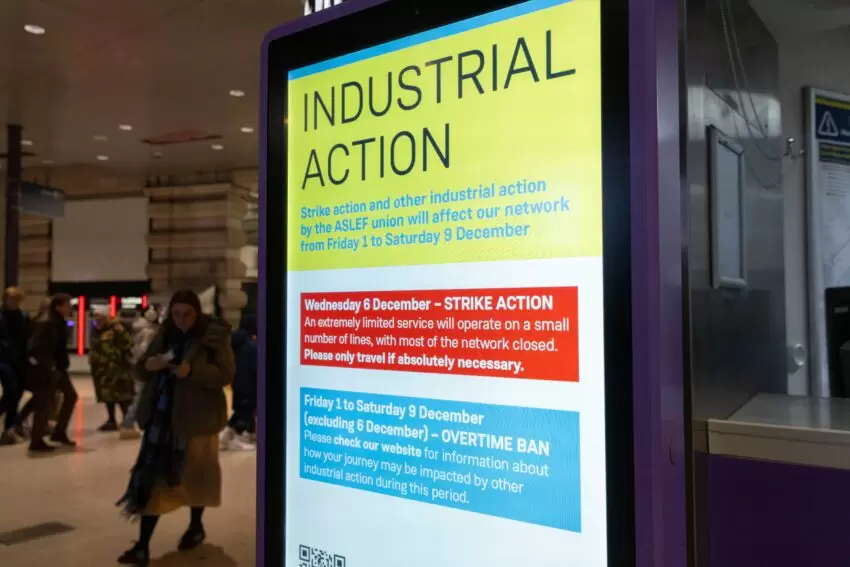
Commuters across Britain are bracing for further travel disruption as train drivers at 16 rail companies and London Underground tube drivers have announced strike action for next month.

London’s small and medium-sized businesses are bracing for a punishing week of disruption as London Underground drivers prepare to stage two 24-hour walkouts, in a dispute over working patterns that threatens to drain millions of pounds from the capital’s already fragile hospitality and night-time economy.

Members of the Rail, Maritime and Transport (RMT) union will down tools from midday on Tuesday 21 April and again from midday on Thursday 23 April, with Transport for London (TfL) warning operators and passengers to expect “significant disruption” across the entire network. A separate walkout by 150 Unite members working as bus station and network traffic controllers, running from 23 to 25 April, is set to compound the misery.

For business owners across the capital, the timing could scarcely be worse. Operators in hospitality, retail and leisure are already contending with a fresh wave of energy price rises, persistent wage pressures and jittery consumer confidence. The loss of reliable late-night transport, industry leaders warn, risks tipping vulnerable SMEs over the edge.

TfL has published a day-by-day forecast of likely disruption. Normal services are expected to run on Tuesday 21 April until mid-morning, with availability tapering off ahead of the midday walkout. Any trains still running will wind down early, and TfL is advising those who must travel to complete their journeys by 8pm.

On Wednesday 22 April, services will start later than usual, with no trains expected before 7.30am. Significant disruption is forecast across all lines until midday, with a gradual recovery throughout the afternoon and evening.

Advertisement

The pattern repeats on Thursday 23 April, with normal services until mid-morning and a 12pm walkout triggering severe disruption into the evening. Friday 24 April will again see no service before 7.30am and continuing disruption across the network.

Although a reduced timetable will operate on some routes, TfL has confirmed there will be no service at all on the Piccadilly and Circle lines, no trains on the Metropolitan line between Baker Street and Aldgate, and no service on the Central line between White City and Liverpool Street. Trains that do run are likely to be sporadic, overcrowded and unable to pick up every waiting passenger.

The Elizabeth line, DLR, London Overground and tram services will operate as normal.

Adding to the disruption, seven bus routes operated by Stagecoach from Bow Bus Garage in East London will be affected by a 24-hour walkout from 5am on Friday 25 April. Routes 8, 25, 205, 425, N8, N25 and N205 are all in scope, although TfL expects the 25 and 425 to maintain a near-normal service for most of the day. The N8 will run a reduced route between Hainault and Liverpool Street at its usual frequency, while the remaining routes are likely to be severely delayed or cancelled.

Advertisement

The dispute centres on TfL’s proposal to introduce a four-day working week for train operators. The union has branded the plan “fake”, arguing it would simply condense existing hours into fewer days without delivering genuine improvements.

The RMT initially suspended strike action last month after TfL management agreed to negotiate, but accused the operator of reneging at the weekend.

RMT general secretary Eddie Dempsey said the union had “approached negotiations with TfL in good faith throughout this entire process”, adding: “despite our best efforts, TfL seem unwilling to make any concessions in a bid to avert strike action. This is extremely disappointing and has baffled our negotiators. The approach of TfL is not one which leads to industrial peace and will infuriate our members who want to see a negotiated settlement to this avoidable dispute.”

Claire Mann, TfL’s chief operating officer, countered that the proposals were fair and flexible. “We have set out proposals to the RMT for a four-day working week. This allows us to offer train operators an additional day off, whilst at the same time bringing London Underground in line with the working patterns of other train operating companies, improving reliability and flexibility at no additional cost. The changes would be voluntary, there would be no reduction in contractual hours and those who wish to continue a five-day working week pattern would be able to do so.”

Advertisement

For Michael Kill, chief executive of the Night Time Industries Association (NTIA), the latest walkout is another hammer blow to a sector running on empty.

“As the sector faces a fresh surge in energy and operating costs, this new wave of strike action creates yet more uncertainty that businesses simply cannot absorb,” he said. “Margins are being squeezed from every direction, and confidence is increasingly fragile.”

Mr Kill questioned the wider purpose of the industrial action. “The ongoing disruption to transport services begs the question, who does this actually benefit? Because right now, it’s businesses, workers and the wider public who are paying the price for the reckless actions of the few.”

He warned that the knock-on effects go well beyond lost footfall. “Without reliable late-night transport, staff struggle to get to work, customers stay away, and businesses lose critical trade. Many venues are already under intense financial pressure, continued disruption only compounds that risk.”

Advertisement

While acknowledging workers’ right to withdraw their labour, Mr Kill called for an urgent return to the negotiating table. “We respect the right to strike, but this situation cannot continue. All parties must get round the table and find a resolution, because sustained uncertainty at a time like this will have serious, lasting consequences for London’s night-time economy.”

TfL is urging travellers to use its journey planner to map their routes in advance and to check the status of lines in real time via its live status page. For SMEs, the message from industry is simpler: brace for a difficult week, and start demanding that both sides find a settlement before the damage to the capital’s economy becomes permanent.


Amy Ingham

Amy is a newly qualified journalist specialising in business journalism at Business Matters with responsibility for news content for what is now the UK’s largest print and online source of current business news.

Advertisement

Continue Reading

Business

Calamos Market Neutral Income Fund Q1 2026 Commentary (Mutual Fund:CMNIX)

Published

on

Calamos Market Neutral Income Fund Q1 2026 Commentary (Mutual Fund:CMNIX)

Calamos Investments is a diversified global investment firm offering innovative investment strategies including U.S. growth equity, global equity, convertible, multi-asset and alternatives. The firm offers strategies through separately managed portfolios, mutual funds, closed-end funds, private funds, an exchange traded fund and UCITS funds. Clients include major corporations, pension funds, endowments, foundations and individuals, as well as the financial advisors and consultants who serve them. Headquartered in the Chicago metropolitan area, the firm also has offices in London, New York and San Francisco.  For more information, please visit www.calamos.com.

Continue Reading

Business

Norway stocks higher at close of trade; Oslo OBX up 0.56%

Published

on


Norway stocks higher at close of trade; Oslo OBX up 0.56%

Continue Reading

Business

What's happening to UK petrol and diesel prices?

Published

on

What's happening to UK petrol and diesel prices?

UK petrol and diesel prices have started to fall after 46 consecutive days of rises at the pump.

Continue Reading

Business

RBI draft for upper layer non-banks affects CICs disproportionately, raises compliances costs

Published

on

RBI draft for upper layer non-banks affects CICs disproportionately, raises compliances costs
Mumbai: The Reserve Bank’s recently released draft on upper layer non-bank finance companies (NBFCs) impacts core investment companies “disproportionately” by upping compliance costs, a report said on Monday.

India Ratings said mandatory listing requirements could prove onerous for several CICs, especially those structured primarily for promoter-level capital allocation rather than public-market access.

It can be noted that the RBI had come out with a draft on classifying NBFCs-ULs, amid intense speculation over the fate of the CIC Tata Sons on listing, and whether the revised directions continue to make a listing necessary for the salt to software conglomerate.

Under the draft revisions, the RBI is proposing a threshold of Rs 1 lakh of AUM over which every entity will become a NBFC-UL, and also include state-run companies in the list. Tata Sons had assets of over Rs 1.7 lakh crore as on March 2025.

“While the NBFC-UL framework is broadly benign for the sector at large, CICs emerge as the clear outliers. CICs with consolidated assets approaching or exceeding Rs 1 lakh crore will face disproportionate compliance costs under the new regime,” the rating agency said.

Advertisement


If the framework is applied on a consolidated rather than a standalone basis for assets under management calculation, its scope would extend to several corporate groups operating under the CIC structure, many of which are privately held and unlisted.
It added that several CICs have highly concentrated investments in step-down subsidiaries and the LEF (large exposures framework) application in such cases could prove operationally challenging. The final draft might provide greater regulatory clarity and resolve these concerns, it said.

“The revised draft framework for categorising NBFCs into NBFC-UL is unlikely to have any significant impact on existing NBFCs. However, CICs could face challenges with the AUM-based approach, especially in terms of listing equity and enhancing compliance and governance requirements,” its director for financial institutions Karan Gupta said.

Continue Reading

Trending

Copyright © 2025