
Business
Earnings call transcript: Indian Oil posts Q1 2026 loss as crude swings bite




Thomas Abraham
In Delhi it’s that time of year again when publishers, distributors and retailers are scrambling around frantically getting everything from point-of-sale to stocks right. It’s the World Book fair (WBF), which comes around once every two years sprawling across the giant halls of Pragati Maidan. This is the fair’s 20th edition, and although there are look-alikes all over the country, this one is undoubtedly the mother-of-them all.
In the 1980s and the ’90s, the Kolkata Book fair was the fair to go. But with the move from the maidan, apart from other venue and organisational problems, Kolkata has had to give up its title. Today the Delhi WBF is a mammoth affair, and has gone beyond just being a sort of retail exhibition.
Actually, no book fair in India would really qualify to be a ‘trade fair’ like Frankfurt or London, where business and rights deals are a norm. But like the Jaipur Literary Fest, what we lack in focus, or ‘order and method’, we make up for in sheer numbers.
The WBF is a giant carnival. The last edition had over 800,000 visitors, and the organizers are wondering whether this year the million mark will be touched, given that the Pragati Maidan now has direct metro connectivity and that admission is free. Certainly the exhibitors have gone up since last time to about 1,300. That’s still, of course, less than a tenth of the total number of publishers in the country, as estimated by the various federations who put the count at being well over 15,000.

Month of March
This year, for the first time, the dates of the WBF moved from the traditional January end to early February period to a whole month down the line. This has met with some consternation as many publishers felt that it was leaving it too late for library budgets, and many schools would have exams on, and that might affect the turnout a bit. The jury is out on that one – the verdict will be out on the 4th of March when it all gets over.
So what are the business stats from the fair? Herein lies the rub – there are none. Ironically, for an industry that is seeing technological change at a pace like never before, and typically of an industry still coming to grips with management information, there is no reliable data available apart from guesstimates.
The National Book Trust (NBT) – the fair organizers – blames it on traditional publisher mindsets and the archaic notion of ‘business secrets’ where exhibitors don’t divulge figures. But even just by conservative extrapolation, assuming a Rs 2.5 lakh average turnover per participant (incidentally, the big ones top Rs 20 crore) one is looking at a fair turnover of over Rs 30 crore in cash sales, which is more than three times the business done from all of the leading bookstores all over India in any given week. Trade buying, rights deals, subscription sales, print contracts, and other ‘collateral business’ are on top of this.
Trade & Rights
The WBF – indeed the industry – needs to take this to the next level with a dedicated two days for ‘trade and rights’. Years ago, the first two hours of the fair every day used to be designated trade hours where librarians and stockists could browse uninterrupted, a practice since discontinued. But if the 9-day fair could be shortened to seven days for consumers with two days as business days, India might yet see the fillip it needs in its rights business, as local-to-international rights networks build.
India has a large contingent going to Frankfurt but bulk of these is either English publishers-distributors, visiting principals or remainder merchants buying surplus stock. The size of the Indian rights pavilion is testament to the fact that our share of the rights pie is negligible.
When were the last time you heard of an Indian work in translation break out through a rights purchase the way Wolf-Totem was snapped up from Chinese or The Devotion of Suspect-X from the Japanese? It’s only if we build a rights module here within the WBF, that one can gradually work up (yes it will take years) to exploiting the rights potential from Indian languages in translation.
So what purpose does the fair serve? With the surge in online bookstores, does it still have any relevance? I believe it still has huge relevance. Quite simply it is at its most fundamental, the only real direct interface publishers have with their end readers. This is the only time you can actually put the range you want up there, and watch readers as they browse.
For most publishers, the long tedious day playing floor assistant and traffic cop rolled into one has its reward in watching that die-hard fan chasing that obscure book you thought would never sell. The ecstasy of finding that long lost book, the agony of seeing something priced beyond one’s budget, the amazement at seeing a bargain or combo offer…it’s all there every day, hour on hour. For readers, this is the one time you’ll get to see, touch, browse lists and full range as you can never anywhere else.
Online has its convenience, but by and large you need to know what book you want, notwithstanding the cross recommendations the better sites have. This is where a reader can experience that joy of discovery-where s/he will see full series, obscure imprints, rare titles.
Then there are the bargains. Fair rules make it impossible to deep discount but bargain tables with ‘fair prices’ and combination offers abound. What we have over the nine days of the fair is in essence the world’s largest bookstore-over a million square feet of books to choose from-in every Indian language, a lot of foreign ones, and of course English.
(The author is Managing Director, Hachette India)
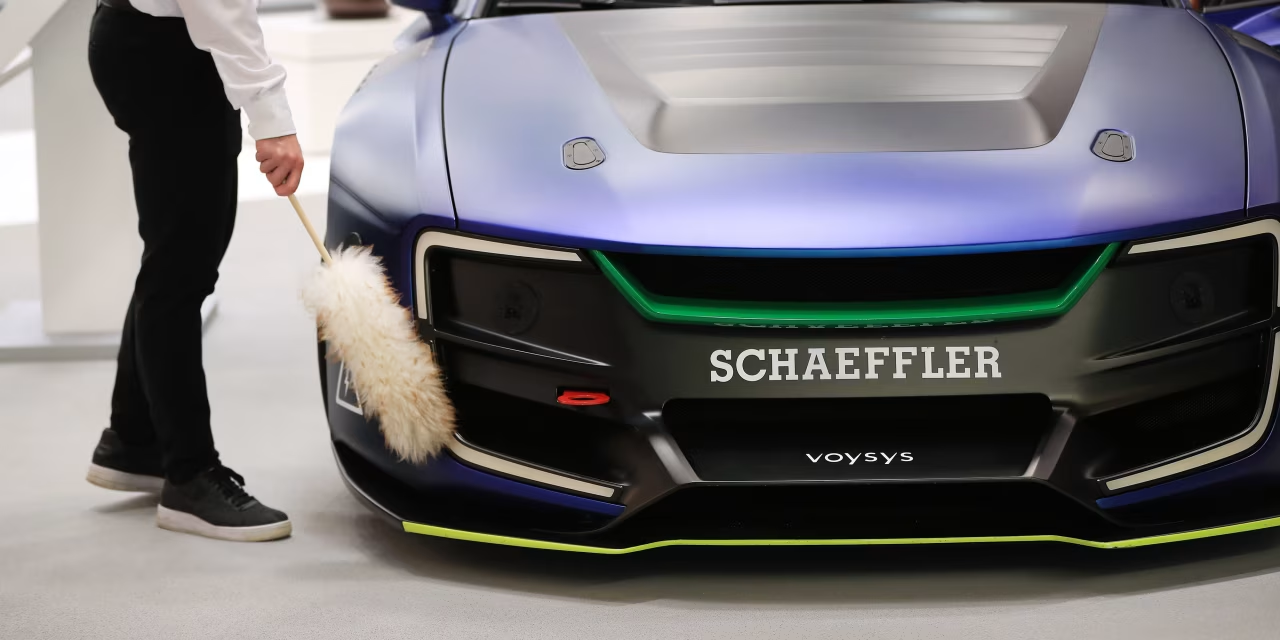
Schaeffler shares dropped sharply after the auto supplier slashed its sales expectations for the medium term amid a darkening backdrop for the industry.
The German company, supplier to major automakers like BMW, Volkswagen and Ford, now expects sales for 2028 of between 24 billion and 26 billion euros ($27.7 billion-$29.98 billion), down from previous guidance of 27 billion to 29 billion euros, it said Friday.
Copyright ©2026 Dow Jones & Company, Inc. All Rights Reserved. 87990cbe856818d5eddac44c7b1cdeb8

Jersey Mike’s Subs is a sandwich chain that professes to make “A Sub Above.” Hot, cold. Meats and cheese are sliced in front of customers. And regulars know “Mike’s Way” (onions, tomatoes, lettuce, oregano, and salt) and “The Juice” (an olive oil blend and red wine vinegar). But despite its popularity with consumers, investors weren’t taking a bite of the stock in its first day of trading.
If they are anything like most Oscar winners, the team behind The Artist will have spent the first day of the rest of their lives conforming to the grandest, and most lucrative, of Hollywood traditions.
Having woken up, pinched themselves, and made sure that -oui! – it really was a gold statuette on their bedside table, France’s newly minted movie stars are likely to have devoted their waking hours to pondering two pressing questions: how to shift that throbbing hangover, and which of the myriad career choices suddenly on their horizon should they pursue next?
Breaking the silence
The first will not have been easily answered. Having sought refreshment at the Governor’s Ball, the team who won five of Sunday’s Academy Awards – including Best Picture, Best Director, and Best Actor – adjourned to a packed party hosted by their film’s distributor, Harvey Weinstein, at the Mondrian Hotel in Hollywood.
Then they swept through Vanity Fair’s bash, before continuing to the Chateau Marmont hotel, where at around four in the morning, several boisterous members of their entourage leapt into the swimming pool, fully clothed.
The second post-Oscar question requires even more careful consideration. Like any winners of the biggest accolade in show business, The Artist’s leading man Jean Dujardin, director Michel Hazanavicius, and producer Thomas Langmann will, for the time being, be inundated with potential job offers. But, as any Hollywood agent will tell you, an overabundance of choice doesn’t always make for easy decisions. Leverage the success
On a purely pragmatic level, history suggests that all three can, if they so desire, leverage The Artist’s success into financial security. The film has already made $76 million worldwide and is now being widened into more than 2,000 cinemas in the US, with a view to further capitalise on its Best Picture status.
As well as “back end” earnings from that pot – which must also be dipped into by the voracious Weinstein – they are entitled to use their modish status to secure significant paydays.
Business
AI bubble gone bust? Once a billionaire, how AI investor Leopold Aschenbrenner lost most of his hedge fund’s fortune in days

Aschenbrenner’s fund, Situational Awareness, massively grew to as big as $45 billion at the beginning of July before big losses took hold, CNBC reported citing sources. The fund began to see massive losses in recent weeks as its heavyweight AI holdings like SK Hynix sharply crashed, while its short positions in software companies such as Adobe moved sharply against it, the report added.
Situational Awareness’ prime brokers including Bank of America, Goldman Sachs and JPMorgan Chase have been rushing to raise cash in order to meet margin requirements, CNBC further reported, citing people familiar with the matter.
Situational Awareness’ sharp downfall almost reflects the sharp upswings and downswings of the AI trade. The 24-year-old built the firm around the idea that growing number of powerful AI systems would require a vast expansion of chips, memory, data centers and electricity generation. The fund’s largest holdings, including Nebius Group, SanDisk, Micron and CoreWeave are down more than 35% this month.
Aschenbrenner tells clients, ‘We let you down’
This comes at a crucial time for Leopold Aschenbrenner, who is set to marry his fiancee — the chief of staff to the CEO at Anthropic. While Situational Awareness has lost about 67% so far in July, the hedge fund is still up around 80% on the year, Bloomberg reported. “We let you down this month,” Aschenbrenner wrote in the letter.
Aschenbrenner said he takes full responsibility for the fall, but attributed some of the reasoning for July’s plummet on short sellers, who targeted the shares he owned, he wrote in the client letter. He also vowed to run his public stock portfolio without leverage “while we draw the lessons from these developments”, Bloomberg reported. “My core promise to you is that we will not waste the opportunity to learn from these events,” he wrote.
Also read | Apple set to lose nearly $500 billion in value after weak forecastGerman-born Aschenbrenner graduated with a B.A. in economics and mathematics statistics in 2021 from the Columbia University. Before joining OpenAI in 2023, he helped run the FTX Future Fund, a philanthropic arm of Sam Bankman-Fried’s crypto empire that fell apart in a multibillion-dollar financial fraud.
However, he was fired from the AI startup in 2024. The company said he was let go for leaking information, while he claims he raised the alarm over lack of interest in stopping foreign adversarial attacks.
Since last year, global stock markets saw an increasing frenzy around AI, with hyperscalers hiking their investments in the technology. The increased optimism sparked a sharp rally in the AI stocks, before things began to go down. Analysts soon began sounding the alarm over the massive AI spending and rising debt of the tech giants, questioning if they will actually bear fruit in the future. The worries sparked a sharp selloff in the tech stocks.
Also read | Peter Lynch does not like the AI trade; here’s why he says ‘Know what you own’
(With inputs from agencies)
(Disclaimer: Recommendations, suggestions, views and opinions given by the experts are their own. These do not represent the views of The Economic Times)

Musk’s wealth peaked at around $1.33 trillion on June 16, when SpaceX shares soared to a lifetime closing high of nearly $202 apiece. However, as the shares crashed, Musk’s net wealth dropped to $684 billion, Bloomberg reported. Notably, the over $600 billion wealth erosion is higher than any other billionaire’s total wealth, except Musk himself.
SpaceX shares tumble
After raising $75 billion in the biggest-ever IPO in history, SpaceX began trading at $150 per share in June, marking an 11% premium to its IPO price of $135. After listing, the shares of the company sharply surged more than 50% in just three sessions. The shares of the Elon Musk-led company now have fallen around 46% since then to a record low of $108.37 apiece.
However, the stock may see some more strong selling ahead after IPO lockup expiries, freeing up several shares for trade. As many as 911.5 million shares will become eligible for trade this month, potentially putting more pressure on the price, Bloomberg reported.
Also read | AI bubble gone bust? Once a billionaire, how AI investor Leopold Aschenbrenner lost most of his hedge fund’s fortune in days
Tesla also contributes to Musk’s wealth erosion
While SpaceX’s stock selloff is grabbing the headlines, it is not the only contributing factor to Musk’s wealth erosion. Tesla shares have crashed 17% since it released second-quarter results on July 22. Elon Musk’s EV maker failed to meet profit estimates for the first time in more than two years and reported a negative free cash flow as the company accelerated its AI spending and robotics ambitions.
World’s richest man and Tesla CEO Elon Musk plans to spend more than $25 billion this year, which is almost triple of what it spent last year, as he bet on Tesla’s AI-powered self-driving technology, robotaxis and humanoid robots over its core revenue generator, the auto business.
Tesla’s profitability was hurt by higher operating expenses due to AI, lower average selling prices and weaker regulatory credit revenue despite a rise in vehicle deliveries, the company said on Wednesday.
“This is a massive capex year, but I am confident that all the things that we are investing in will yield incredible returns,” Musk told analysts on a post-earnings conference call. Investors are now increasingly turning their attention to Musk’s push into self-driving technology and robotics, with the company expanding its unsupervised robotaxi services.
Also read | Tesla earnings disappoint Wall Street as Elon Musk’s AI push, pivot beyond cars hurt profits
(Disclaimer: Recommendations, suggestions, views and opinions given by the experts are their own. These do not represent the views of The Economic Times)

The Qualified Institutional Buyers (QIB) category was subscribed 1.81 times, attracting applications worth ₹31.02 crore. The Retail Individual Investors (RII) category was subscribed 1.41 times, receiving applications worth ₹38.73 crore, while the Non-Institutional Investors (NII) category witnessed a subscription of 3.19 times, garnering applications worth ₹37.64 crore. The company also raised ₹21.97 crore from Anchor Investors and ₹4.14 crore from the Market Maker.
Vivro Financial Services Private Limited acted as the Book Running Lead Manager to the issue, while MUFG Intime India Private Limited served as the Registrar to the Issue.
Silver Storm Parks & Resorts Limited is a leading tourism enterprise operating theme parks and resorts under the ‘Silver Storm’ and ‘Snow Storm’ brands in Athirappilly, Kerala, and Jamshedpur, Jharkhand. Located near the iconic Athirappilly Waterfalls, the Athirappilly destination has emerged as a preferred getaway for domestic tourists, educational institutions, corporate groups, and families.
Expanding its portfolio of attractions, the company is set to launch a Cable Car and Forest Village experience at its Athirappilly destination this Onam season, complementing its existing amusement park, water park, indoor snow park, resort, and dining facilities. This will make it the first destination in India to offer such a comprehensive range of entertainment experiences within a single tourism destination.
In October 2025, the company inaugurated its Indoor Snow Park in Jamshedpur. It also plans to establish a new Snow Park and Entertainment Centre at Omaxe Hazratganj Mall, Lucknow.
“Over the past two-and-a-half decades, Silver Storm at Athirappilly has evolved into one of Kerala’s premier tourism destinations. We have also successfully expanded our presence to Jamshedpur, and we continue to pursue our growth plans with new attractions and destinations,” said A.I. Shalimar, Managing Director of Silver Storm Parks & Resorts Limited.
(Disclaimer: The above press release comes to you under an arrangement with PNN and takes no editorial responsibility for the same.).
BING-JHEN HONG/iStock Editorial via Getty Images
While we firmly believe AI stocks are in a bubble, it is undeniable that AI is powerful and likely a major driver of future earnings. Even with the dot-com bubble popping in devastating fashion, the internet upon which it was based is a clear source of value.
As fundamental-based value investors, AI poses an interesting puzzle: How do we invest in the technology and underlying growth without exposing ourselves to the risks of a potential bubble?
The headline AI names are trading at rather extreme valuations, essentially already building in tremendous success. Even those with seemingly reasonable multiples, such as the chip makers, are arguably bubble valuations if one adjusts for the cyclicality of earnings.
We believe there is a different category of stocks that simultaneously provides exposure to the upside of AI while remaining compliant with fundamental value principles.
We sought and continually purchased stocks of companies that were clear fundamental beneficiaries of the buildout of AI but had not yet experienced a bloom in valuation. Let us first walk through the phases of bubble formation as they played out and then discuss the opportunity set.
AI bubble formation resonating outward
As bubbles form, there is usually an epicenter where the hype is most concentrated and first appears. After the initial hype phase, it resonates outward to adjacent industries that participate somewhere along the supply chain.
The current AI bubble began when OpenAI released its LLM to the world, and individuals could experience for the first time how powerful the technology could be. Thus, the epicenter was the explicitly AI companies.
It was apparent that OpenAI could not do it alone. AI would need astronomical amounts of compute and infrastructure. So, the bubble resonated outward.
2MC
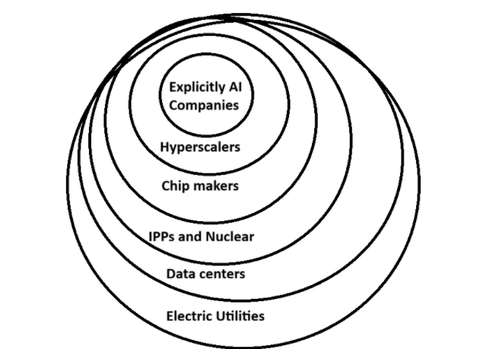
Hyperscalers like much of the Mag 7 already owned vast amounts of computing power.
Chip makers, led by NVIDIA but inclusive of the whole set, were the obvious picks and shovels of the AI gold rush.
All the incremental compute would need 2 factors to be possible:
- Lots of power
- Data centers in which to house and power the equipment
Independent power producers emerged as favorites because of their ability to sell power at market price rather than a regulated price. As auction prices spiked, their revenue multiplied immediately.
Many data centers were requesting green energy, but their 24/7 nature required on-demand power that was difficult to produce from wind or solar, so nuclear received the lion’s share of hype. Anything remotely related to nuclear traded up to bubble valuation, even speculative nuclear and SMR (small modular reactor) startups.
Data centers took a surprisingly long time to get bid up but eventually received bubble valuation.
Finally, electric utilities are being seen as the gatekeepers of the incremental electricity production necessary to fuel AI. Valuations across the sector crept up but remain reasonable.
Fundamentally responsible investing in AI
The 2 greatest pitfalls to investing in AI today are:
- Bubble valuations
- Temporary fundamental benefit
As the hype resonated outward, investors could have done very well by investing in each ring before the pricing went parabolic. Investing after the move seems a bit more dubious.
As value investors, we were only able to invest before the move because our valuation principles precluded investment once prices went haywire. GE Vernova (GEV) is simultaneously a point of pride and remorse. We saw it early but also exited way too early as the stock surpassed what we viewed as reasonable valuation.
It took a remarkably long time for the hype and extreme valuation to reach the outer rings in the diagram above. In 2025, data centers were still cheap. The market was so used to companies that experienced the demand boom in a more cyclical (high operating leverage) sort of way that Equinix (EQIX) got clobbered on its Investor Day presentation in 2025.
SA
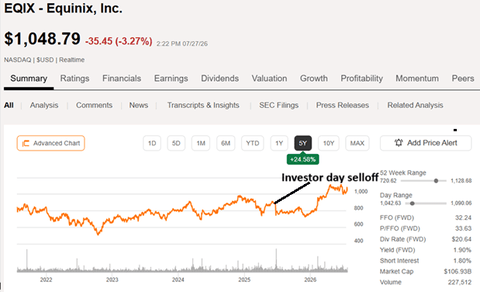
The market just didn’t seem to comprehend that the growth EQIX was talking about was secular, repeatable growth, while something like a chip maker was experiencing cyclical growth. All the market saw was that EQIX’s growth number was smaller. It sold off, affording a value entry point into a top performing company with clear long-term exposure to AI.
We think there is still substantial mispricing in AI-related stocks and a clear opportunity within that mispricing. The biggest remaining source of mispricing seems to be a lack of differentiation between temporary and permanent fundamental benefits.
Temporary fundamental benefit
Much of the temporary fundamental benefit from AI stocks is related to imbalances in supply chains that were created by a sudden surge in demand.
- Chip demand surges; production is insufficient, causing chip prices to soar.
- Power demand surges; production is insufficient, causing electricity prices to soar.
- Turbine demand surges; production is insufficient, so prices soar.
We consider this a temporary fundamental benefit because the margin expansion is directly related to the current imbalance. Over time, production will rise to meet demand, at which point prices will normalize.
Many of these stocks are priced as if the fundamental benefit is permanent. The earnings multiples are only appropriate if the margins stay high. However, there are already signs of supply chains normalizing.
- New chip production is being built.
- New power plants are in various stages of development.
- Increased turbine manufacturing is in progress.
While there may be 1-3 years before sufficient production comes online, we see eventual restoration of equilibrium as inevitable.
Thus, we believe the stocks in these categories that are trading at high multiples are at risk of the bubble popping.
In contrast, there are other companies that have either permanent fundamental benefits or locked-in enhanced earnings for a long time period.
Permanent beneficiaries
The contrast is most clearly seen in the difference between IPPs and regulated utilities.
- IPPs experienced extremely high growth, with many even reaching triple-digit growth. Almost all of that was based on the price at which they could sell.
- Regulated utilities had much more muted growth, around 8%. Their sale prices are regulated, so they didn’t get to participate in the price spike.
However, as sufficient power comes online, prices will come back down, and IPPs will lose earnings power. Regulated utilities will have grown permanently with their increased load. In 5 years, the regulated utilities will have earnings that are permanently ~40% higher because their loads will be substantially bigger, and they get a regulated return on their load.
The market seems to be dramatically overvaluing temporary beneficiaries, almost extrapolating the recent earnings surge. This could prove dangerous as earnings not only stop surging, but potentially come back down to where they were before the spike. In my opinion, GEV, chip makers, and IPPs are all susceptible to a bubble-style crash.
3 other sectors are closer to permanent beneficiaries:
- Contracted power providers
- Data centers
- Regulated electric utilities
Contracted power providers like Clearway Energy (CWEN) and HA Sustainable Infrastructure (HASI) sign long contracts for their power production. During the surge, they have secured contractual earnings on incremental generation for terms north of 10 years. The pricing they secured was nowhere near as extreme as the IPPs, but it will last much longer.
Data centers are similarly being built in a build-to-suit fashion where they are constructed with contracts already in place at going-in cap rates north of 10%. Capital-intensive development at mid-teen cap rates will not create explosive earnings growth, but it is durable earnings growth. That said, data center multiples are getting a bit above our value range, so we only have a small stub position in EQIX left as well as ancillary exposure from Broadstone Net Lease (BNL) and American Tower (AMT).
Electric utilities are, in my opinion, the best remaining AI play. While the sector has performed well, earnings have kept up such that earnings multiples have remained in the normal range. In fact, regulated utilities are trading cheaper relative to the S&P 500 than they normally trade relative to the S&P 500.
It is a discounted sector with a PE multiple of 20.47X, yet the sector’s forward growth rate is higher than its normal. Almost all the major utilities are calling for growth in the 7%-10% range annually for the next 5+ years.
The math just works well for investors at this valuation. Dividend yields of 3%-4% with 7%-10% earnings growth imply well above market total return potential.
Avoid the bubble but participate in the technology
Investing in the way discussed above has 3 main benefits:
- Reduced downside if/when the bubble pops. There could be some collateral damage to the whole market given the scale of the bubble, but companies with solid fundamentals and reasonable valuation should bounce back quickly.
- Long-term upside as AI technology progresses.
- Agnostic to which AI model wins
There are so many AI models, and the “best AI” keeps changing. We have no idea whether the ultimate winner will be Gemini, Anthropic, Grok.AI, or some other model that hasn’t even been announced yet. We also don’t know if it will be winner-take-all or split among dozens.
Investing in the underlying infrastructure at a reasonable valuation doesn’t care about the above unknowns. If AI succeeds in any form, data centers, utilities, and contractual power producers will win. The key is just buying at the right valuation.


Economists don’t typically worry about machines replacing people. Job displacement is, after all, a natural byproduct of labor-saving technology. Interfering with that process goes against everything economists are trained to believe.
Artificial intelligence is starting to change that. More than 1,000 economists, including 17 Nobel laureates, were worried enough to sign an online petition circulated this month by Stanford University’s Erik Brynjolfsson warning of “large scale job displacement” from AI and pleading for action.
Copyright ©2026 Dow Jones & Company, Inc. All Rights Reserved. 87990cbe856818d5eddac44c7b1cdeb8

Wordle players tackling Saturday’s puzzle can find help here, with hints and the full solution for game number 1,869, the daily word puzzle from The New York Times.
The word puzzle, which challenges players to guess a five-letter word within six attempts, has remained one of the most consistently popular daily games since its rise to viral popularity in 2022. Saturday’s puzzle proved moderately challenging for most solvers, according to data from the New York Times’ WordleBot, which tracks how the average player performs each day. WordleBot recorded an average completion time of 4.3 moves in easy mode and 4.2 moves in hard mode for Saturday’s puzzle, figures that place it toward the trickier end of the recent difficulty range.
For players looking for hints before jumping straight to the answer, several clues can help narrow down the possibilities without giving the solution away entirely. The word describes something commonly found on city streets in late winter, appearing in the window between the season’s last snowfall and the first genuinely warm day. It refers to a wet, partially melted mixture of snow, ice or watery mud, the kind of grayish, soggy residue left behind on roads and sidewalks as a hard freeze begins to thaw.
Structurally, today’s word contains only one vowel among its five letters, and that vowel is “U.” The word features one repeated letter and does not include any of the five most commonly used letters across the full archive of past Wordle answers. The word begins with the letter “S” and ends with the letter “H.” For those wanting one final hint before the reveal, the word can also describe something overly sentimental to the point of being cloying, a secondary meaning distinct from its more literal, weather-related definition.
Today’s Wordle answer is SLUSH.
Slush most commonly refers to partially melted snow, or snow mixed with rain and water, forming the grayish, wet residue commonly seen on roads and pavements during the transition between winter and early spring. The word also carries a well-known secondary meaning tied to finance and politics: a “slush fund” refers to money used outside of normal accounting channels, often for informal, discretionary or covert purposes. That usage traces its etymology back to ship galleys, where “slush” originally referred to fat or grease skimmed off boiled meat, which sailors would later sell for personal profit, a practice that eventually lent its name to the modern concept of an off-the-books fund.
Puzzle strategy writers who cover Wordle daily flagged Saturday’s solve as harder than it might first appear, largely because of a specific rhyme trap embedded in the puzzle’s structure. One breakdown described how players who correctly identified the “_LUSH” pattern early in their solve still faced a genuine challenge choosing among several plausible candidates, including BLUSH, FLUSH and PLUSH, before narrowing in on the correct answer of SLUSH. That kind of overlapping word family, where multiple valid English words share an identical four-letter ending, has repeatedly proven to be one of the more common sources of difficulty across Wordle’s history, since strong initial guesses can still leave several equally plausible final answers in play heading into the last one or two attempts.
Wordle strategy guides commonly recommend a systematic approach for players working through the daily puzzle: begin with an opening word that tests several common vowels and consonants simultaneously, then use the resulting feedback, letters marked in green for correct placement, yellow for correct letters in the wrong position, and gray for letters not present in the word at all, to progressively eliminate incorrect possibilities across subsequent guesses. For puzzles involving a rhyming word family like Saturday’s, strategy writers specifically recommend testing multiple candidate consonants in a single guess where possible, rather than guessing full candidate words one at a time, to more efficiently narrow the field before the attempt limit is reached.
Wordle, originally created by software engineer Josh Wardle before being acquired by The New York Times in 2022, has remained one of the most popular daily word games worldwide, spawning a broader ecosystem of related puzzles now published by the Times, including Connections, Connections: Sports Edition, Strands and the Mini Crossword, all of which are typically released and refreshed at the same time each day alongside the main Wordle puzzle.
Players looking to maintain their daily Wordle streak, a feature the game uses to track consecutive days of play, can find Saturday’s puzzle and previous archived puzzles through the official Wordle website. The New York Times also continues to publish daily hints and strategy guidance across its games section for players seeking assistance without immediately revealing the day’s answer outright, a resource that has become a regular part of many players’ daily puzzle-solving routine, particularly on days like Saturday when a hidden rhyme pattern adds an extra layer of difficulty to an otherwise standard five-letter solve.

Where To Find Erling Haaland And Norway’s Stars After The 2026 World Cup

Galaxy S26 FE may recycle the cameras buyers hoped Samsung would replace

York River Art Market just one the things to do this weekend


-
 Sports6 days ago
Commonwealth Games boxing: Jadumani Singh seals dominant 5-0 win over Pakistan’s Sumama Rehman to enter quarter-finals | Commonwealth Games News
-

 Business3 days ago
Why Trees Belong on the Risk Register
-

 Fashion18 hours ago
Weekend Open Thread: Wit & Wisdom
-

 Politics15 hours ago
Meta enters AI-training agreement with far-right ‘propaganda rag’ Newsmax
-

 Tech5 days ago
Intel is reversing course and bringing hyper-threading back to its server chips
-

 Crypto World7 days ago
Ripple bought a bank in pieces. The $4 billion audit
-

 Politics5 days ago
Luke Littler dismantles Gerwyn Price to retain title in Blackpool
-

 Politics4 days ago
The Part of the Electric Transition Nobody Wants to Discuss
-

 News Videos6 days ago
BITCOIN JUST ENTERED THIS CRITICAL ZONE…
-
 Entertainment4 days ago
‘Stargate’ Creator’s New Sci-Fi Series Returns for Season 3 Tomorrow
-

 Business3 days ago
Major shareholder moves on Canyon
-

 Crypto World6 days ago
XRP Ledger adds $2.6B as RWA inflows rank second
-

 Politics6 days ago
Spain sweeps the board at 2026 World Cup with individual awards
-

 News Videos2 days ago
Bitcoin Enters the 3rd Stage of the Bear Market
-
Crypto World6 hours ago
XRP Ledger v3.3.0 brings five institutional features
-

 Entertainment6 days ago
Sara Gilson Killed By Husband After Viral “Pedophile” TikTok Video
-

 Crypto World4 days ago
Kraken Enables Retail Access to Jersey Mike’s IPO via Tokenized Shares
-

 News Videos4 days ago
Claude: Build Financial Dashboards in Minutes (2026)
-

 Tech4 days ago
New macOS Sequoia & Sonoma security updates for older Macs
-

 Politics2 days ago
Luke Littler’s dominance sparks GOAT debate
You must be logged in to post a comment Login