
Connect with us
DAPA Banner
DAPA Coin
DAPA
COIN PAYMENT ASSET
PRIVACY · BLOCKDAG · HOMOMORPHIC ENCRYPTION · RUST
ElGamal Encrypted MINE DAPA
🚫 GENESIS SOLD OUT
DAPAPAY COMING

Business

Fed up with market shocks? Here is Kotak MF’s formula to stay resilient

Published

on

Fed up with market shocks? Here is Kotak MF’s formula to stay resilient
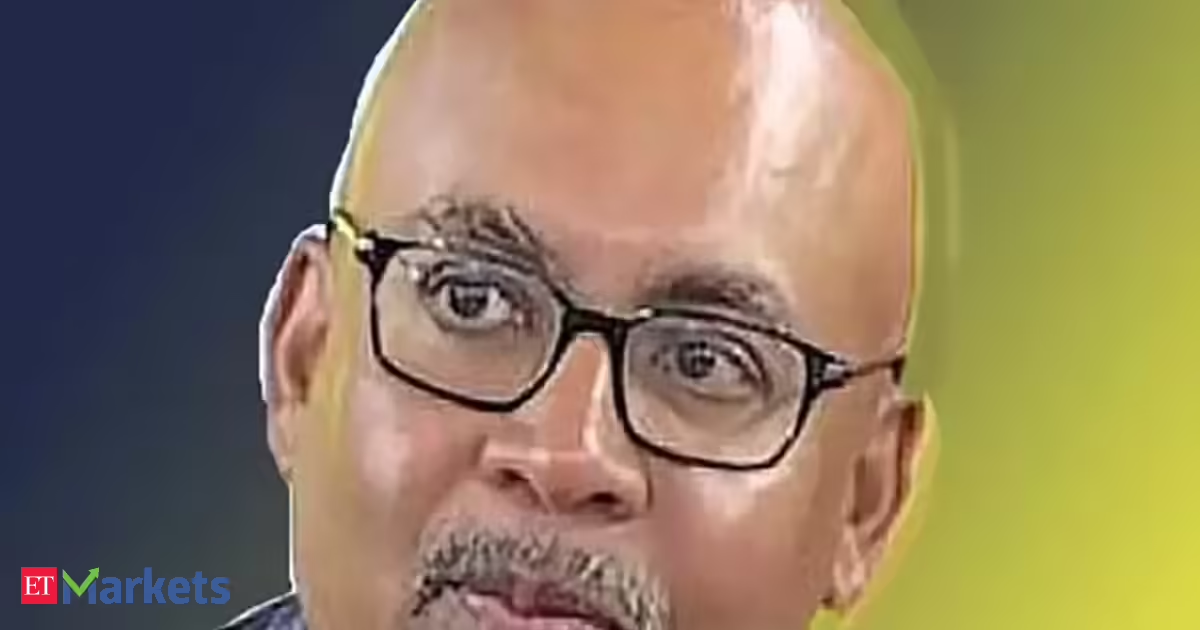
With global markets rattled by geopolitical friction and unpredictable oil prices, keeping your portfolio steady feels tougher than ever. In this exclusive conversation, Devender Singhal, Fund Manager at Kotak Mutual Fund, explains how a disciplined multi-asset strategy takes the emotion out of investing, shields your wealth from sudden shocks, and builds long-term resilience in 2026.

Edited excerpts from a chat:

What role can multi-asset allocation funds play during periods of elevated uncertainty and market volatility like the one we are going through today?
With West Asia tensions, oil volatility, and uneven global growth, multi-asset funds can play a useful role in helping investors stay invested through uncertainty. The idea is to balance risk across asset classes that do not move in the same direction all the time.
A lot of people who are already invested in equity funds often buy gold funds/ETFs separately. Where does multi-asset funds fit in one’s portfolio?

Many investors already hold equity and gold separately, but a multi-asset fund offers a more disciplined and convenient way to bring those exposures together. It also takes care of rebalancing, which is important when markets become noisy and investor emotions tend to run high.
How do you see the interest rate cycle evolving globally and in India, and what implications could this have for asset allocation?
The global rate cycle is still evolving, but inflation risks have not gone away, especially if crude oil remains volatile. In this backdrop, a balanced asset allocation approach makes sense, with equity, debt, and gold all playing their respective roles.

How do you decide when to increase or reduce exposure to equities within a multi-asset framework?
Within a multi-asset framework, equity exposure is adjusted based on valuations, earnings visibility, and the broader macro backdrop. We continue to prefer quality businesses with strong balance sheets, pricing power, and the ability to weather external shocks.

Advertisement

What kind of equity sectors or themes are you constructive on despite concerns around the impact of soaring crude oil on the Indian economy?
Even with concerns around higher crude, we remain constructive on businesses with domestic demand visibility and limited sensitivity to input-cost pressure. Select financials, capital goods, and export-oriented names continue to offer opportunities, though valuation discipline remains key.

Ever since gold peaked out in the current cycle, how has your allocation changed? What is your current asset allocation mix in the fund?
Gold has once again shown why it remains an important part of a diversified portfolio. In periods of geopolitical stress and market uncertainty, it can help provide stability and act as a hedge against risk.

For investors entering markets at current levels, what would be the ideal portfolio strategy over a 3–5 year horizon?
For investors entering the market now, a phased approach is preferable to trying to time the perfect entry. Over a 3–5 year horizon, a diversified portfolio with systematic investing can help investors stay disciplined and participate in long-term wealth creation.

If you had to make the case for multi-asset investing in one line for 2026, what would it be?
In 2026, multi-asset investing is about staying invested, staying diversified, and staying resilient in a world that can be disrupted quickly by oil, policy, and geopolitics.

Advertisement
Continue Reading
Click to comment

You must be logged in to post a comment Login

Leave a Reply

Business

Power, Hotels & Chemicals: Dipan Mehta maps out the market’s next big opportunities

Published

on

Power, Hotels & Chemicals: Dipan Mehta maps out the market’s next big opportunities
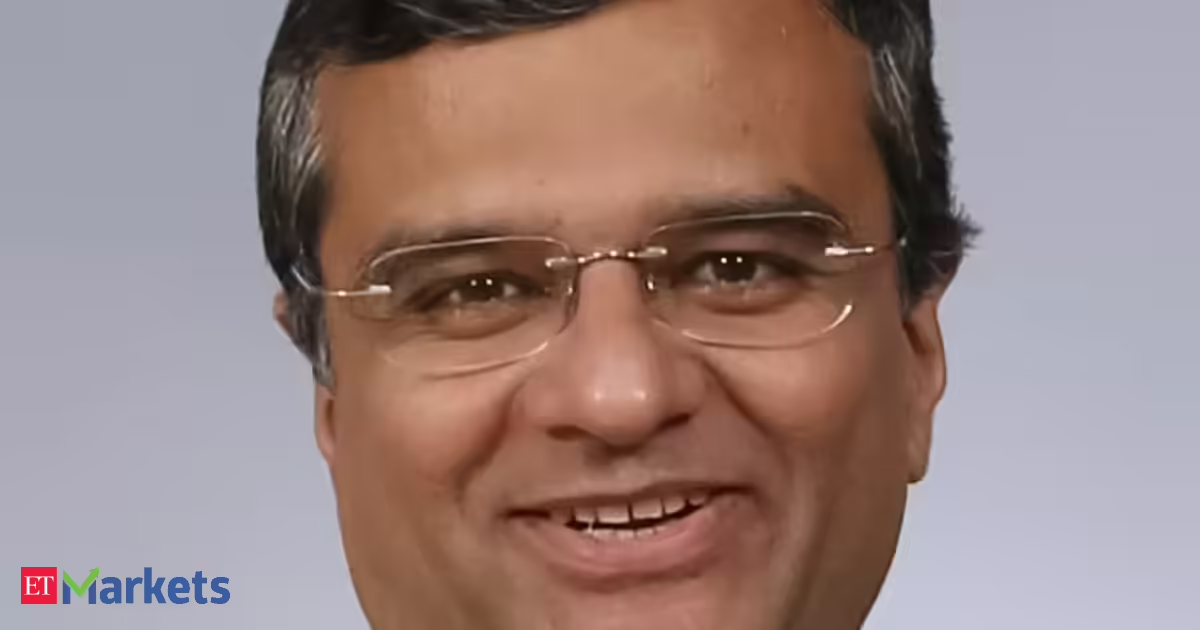
Dipan Mehta, Director, Elixir Equities believes investors should stay selective in the current market environment, with opportunities emerging in sectors linked to power infrastructure, export-oriented manufacturing, and speciality chemicals, while caution remains warranted in overheated pockets such as hospitality and select data centre plays.

Speaking to ET Now, Mehta shared his views on a wide range of sectors including data centres, hotels, tyres, transmission & distribution companies, and speciality chemicals.

KRN Heat Exchangers: Strong Story, Expensive Valuation
On KRN Heat Exchangers, Mehta said the company continues to enjoy strong investor interest because of its exposure to the data centre ecosystem, a theme that remains in sharp focus globally.“See, I think that KRN is one of the best place on the data centre, that is what the street kind of evaluates, which is why it is treated at this kind of a multiple. But the story is pretty much well discovered and, of course, the numbers also will come through pretty decently over the next few quarters but the valuations are a bit challenging and from that point of view a fresh investment does not make sense but existing investors can remain invested.”

He added that India still has very few listed companies offering direct exposure to the data centre opportunity, which explains the premium valuations being assigned to ancillary players supplying equipment and products to the sector.
According to Mehta, investors should watch for corrections before considering fresh entry points.
“At corrections 5-10%, 15% lower one could look at it in a more positive light.”
Coal India: Cheap But Waiting for Growth
Discussing Coal India, Mehta described the stock as inexpensive but lacking meaningful growth momentum.

“And Coal India, see Coal India is cheap, everybody knows that, but look the volumes just do not scale up. I mean, if you look at 10-year volume, 15-year volume, it is just kind of static and it is supposed to be a very important company.”

Advertisement

He noted that investors may continue treating Coal India as a utility-style dividend play unless the company delivers a structural acceleration in growth.

“If there is something happening in the company materially which results in the growth rates going to like 12%, 13%, 14% or so, then even if the stock price has gone up one could jump into it because then you would have earnings growth and PE derating.”

On the company’s offer-for-sale discount, Mehta said the pricing appeared reasonable given the size of the issue and prevailing market conditions.

“I think that it is okay and 10% discount is not something which investors should not mind. It is a typical discount and maybe retail investors will buy it like in a form of a bit of arbitrage and some investors may also buy this and short in the futures market.”

Advertisement

Hospitality Rally Still Intact, But Caution Emerging
Mehta acknowledged the remarkable run seen in hotel and hospitality stocks since the pandemic, citing names such as Indian Hotels Company, Lemon Tree Hotels and newer listings in the sector.

“So, by and large hotels have done really well last two-three years, I think since COVID hotels have done very well right from Indian Hotels to even some other newer listings Lemon Tree, Ventive Hospitality, Leela, all of them have done very well.”

However, he warned that geopolitical uncertainties and a possible moderation in travel demand could create near-term pressure on the sector.

“So, I would be a bit cautious. It is like a running train, I would advise remaining invested but from a fresh investment perspective just kind of wait and watch.”

Advertisement

Mahindra Holidays: A Perplexing Underperformer
Among hospitality names, Mehta singled out Mahindra Holidays & Resorts India as an outlier that has failed to capitalise on the sector’s boom.

“That is what I said that it is very perplexing that the entire hotel industry has gone into great high growth phase but Mahindra Holidays has generally been reporting very poor set of numbers, flattish type of growth rates.”

Despite praising the company’s resort network and locations, he questioned the productivity and monetisation levels being achieved by the business.

“It has got a fabulous business. It has got a fantastic kind of a chain of resorts at the right location, but I do not think the productivity in terms of what they can earn from these resorts has reached its potential level.”

Advertisement

Tyre Sector: Balkrishna Industries Stands Out
Turning to tyre manufacturers, Mehta said most companies in the sector have delivered healthy results, aided by softer rubber prices, though margin pressure tends to emerge whenever raw material costs rise.

“It is also a highly competitive industry and I would say that it is pretty much well discovered and well valued at this point of time in terms of PE multiples.”

Among the tyre makers, he highlighted Balkrishna Industries as a company worth tracking closely because of its export orientation and strong positioning in off-highway tyres.

“The real company to watch out for over here is Balkrishna. It is a company in which we have invested in so our views could be biased.”

Advertisement

Mehta believes the depreciation of the rupee could support exporters such as Balkrishna Industries, especially as the company expands its product range and backward integration capabilities.

“So, I am keeping a watch out for it and at some point of time all the efforts of the management should bear fruit and they will go back to that earlier growth rate which they had delivered in the past.”

Power Transmission & Equipment: A Structural Opportunity
One of Mehta’s strongest sectoral calls remains the power transmission and equipment space, where he sees multi-year growth visibility driven by India’s renewable energy ambitions.

Referring to companies such as KEC International, Kalpataru Projects International and Transrail Lighting, he said short-term earnings fluctuations should not distract investors from the long-term opportunity.

Advertisement

“So massive transmission of power has to take place and India is going from 283 gigawatt to 500 gigawatt over the next three-four years in terms of renewable energy.”

He also highlighted opportunities across transformer makers and HVDC-linked companies, including multinational players such as Hitachi Energy, GE Vernova, Siemens and Bharat Heavy Electricals.

“So, I would say overweight on the entire power equipment industry because massive investments are taking place and are required and it is being pushed by the government as well.”

Speciality Chemicals Emerging as a Preferred Bet
Asked about the most attractive pocket of the market currently, Mehta pointed toward speciality chemicals, particularly export-driven businesses.

Advertisement

“No, we are looking more and more speciality chemicals and again, as I said, in our investment theme of export oriented businesses that is something which we are seeing kind of breakout quarters taking place over there.”

His comments indicate a growing preference for sectors that can benefit from global demand, currency depreciation, and India’s expanding manufacturing competitiveness.

Continue Reading

Business

Surface Transforms sold out of administration: Combined Authority and staff react to supercar brake firm deal

Published

on

Business Live

New owners hail ‘long-term commercial opportunities in premium and high-performance automotive market’

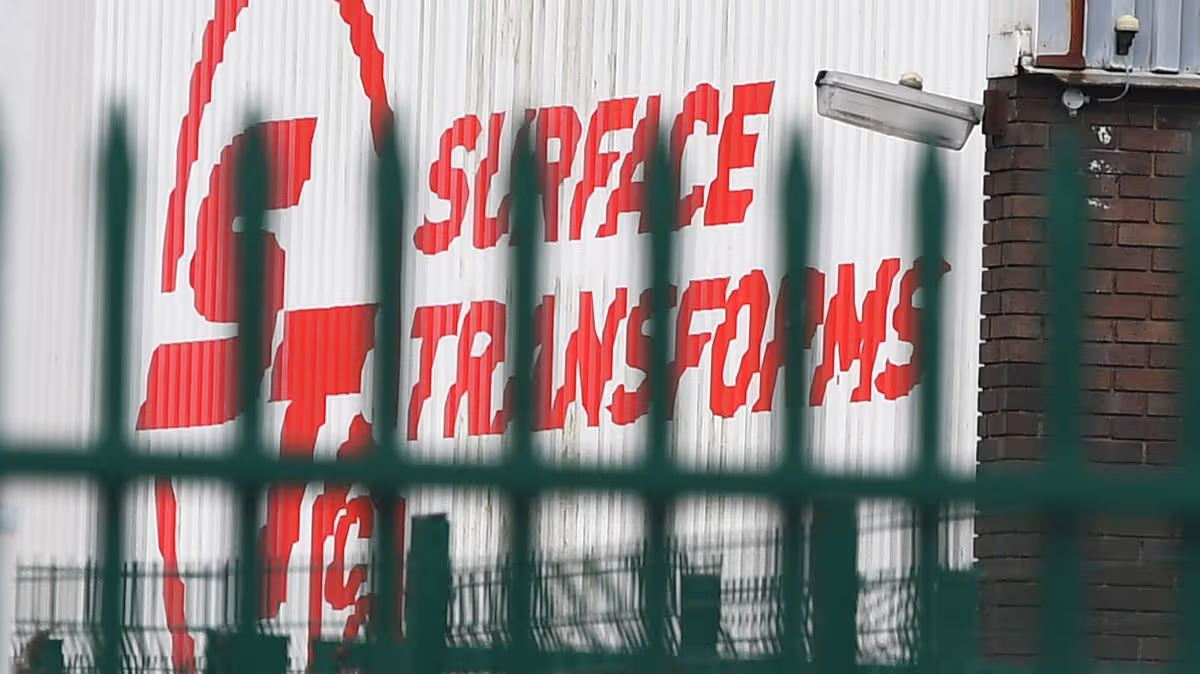
Surface Transforms in Kirkby

The Surface Transforms plant in Kirkby(Image: Liverpool Echo)

A Merseyside car parts firm which went into administration has now been acquired by a company headed by its former directors who have pledged to recruit additional staff – though not all employees have welcomed the news

Knowsley-based Surface Transforms, which manufactured brakes for supercars, entered administration in April after losing its largest client, leaving dozens of employees without work.

Administrators from Alvarez and Marsal Europe have now confirmed that the majority of the business and assets of Surface Transforms have been purchased by new entity CCST Limited in a £1.4m deal. CCST’s directors include Ian Cleminson and Dr Kevin Johnson, both former directors at Surface Transforms.

Those assets comprise equipment, contracts, intellectual property and the right to use the Surface Transforms name.

Advertisement

The new firm intends to resume production of ceramic brake discs. In a statement the group said it “will be looking to employ workers in the area with the requisite skill set to assist with this”, reports the Liverpool Echo.

Numerous Surface Transforms employees lost their positions when the business went under, but the ten remaining staff at the company will now move to CCST under Transfer of Undertakings (Protection of Employment) TUPE regulations.

One former employee told the ECHO that when redundant Surface Transforms workers learnt of the sale there was “murder” and “everyone was kicking off.” Staff members revealed they had been encouraged to purchase Surface Transforms shares over the years, with those who had done so now facing the prospect of losing their entire investment. The statement announcing the latest transaction confirms there will be “insufficient realisations to pay any return to shareholders”.

The former employee indicated they had no intention of returning, stating: “If they’d asked me to go back in they know I’d have told them to shove it where the sun don’t shine”.

Advertisement

Surface Transforms revealed in March that it had lost a contract with General Motors that accounted for more than 80% of its revenue. Directors brought in advisers from Alvarez and Marsal as they fought to either sell or rescue the business, with scores of employees losing their positions.

Announcing the deal for the Surface Transforms assets, Ian Cleminson, chairman of CCST, said: “Surface Transforms built an exceptional reputation for innovation and engineering excellence within the global automotive sector.

“We are pleased to secure the future of the business and through the investor group provide the further investment, operational support and additional skills required for the business to satisfy the clear demand for the product.

“The manufacturing facility in Liverpool will continue operating, with a focus on consistently fulfilling existing customer programmes, stabilising production, and supporting the long-term commercial opportunities in the premium and high-performance automotive market.

Advertisement

“A thank you to our advisors at Hill Dickinson and DSW for their support during this transaction and also to Liverpool City Region Combined Authority, Knowsley Council and Seybourne Estates for their hard work in securing the future of the business at this site.”

Michael Magnay, joint administrator, added: “This transaction represents the best possible outcome for the business and its stakeholders. We are delighted to have completed a sale that enables the preservation of highly skilled jobs and maintains the future of this important UK manufacturing capability.”

The total value of the deal stands at £1.4m, which the administrators confirmed has been paid in full. Those funds will be directed towards covering administration costs and ultimately settling payments to creditors, though the precise sums owed to creditors have yet to be confirmed.

As part of the agreement, CCST has committed to paying £90,000 to finance giant Close Brothers “in respect of assets financed by Close”. CCST also has six months to decide whether it wants to buy a dynamometer owned by the original Surface Transforms that is held at a third-party site in Germany.

Advertisement

Back in 2023, Surface Transforms was celebrated as a “world class manufacturer” by Liverpool City Region Mayor Steve Rotheram, whose combined authority extended a £13.2m loan to the firm to support its growth and job creation ambitions.

READ MORE: Supercar brakes firm Surface Transforms loses biggest customer and hires restructuring advisersREAD MORE: Brakes firm Surface Transforms files administration notice and warns on job cuts after GM contract loss

Responding to news of the company’s sale out of administration, a Liverpool City Region Combined Authority spokesperson said: “The Combined Authority notes the sale of Surface Transforms as a going concern and is pleased that some of the workforce will be retained under the deal.

“We believe this is the best possible outcome under challenging circumstances and have engaged fully to help secure a future for this innovative advanced manufacturing factory and its skilled workforce.

Advertisement

“As custodians of public money, the Combined Authority is extremely diligent and careful when considering investments and enjoys an excellent record of repayment, often generating returns that are reinvested in the local economy, while driving business growth, job creation and regeneration. However, any investment comes with inherent risk. We will seek to recoup as much money as possible from the sale of the company.”
Continue Reading

Business

Auditor General finds WA universities’ reliance on foreign students risky

Published

on

Auditor General finds WA universities’ reliance on foreign students risky

Western Australian universities have continued to overly rely on international students for their financial performance, the state’s auditor general finds.

Continue Reading

Business

HDFC Bank shares fall 2% on reports of internal probe over Rs 45 cr interest payments

Published

on

HDFC Bank shares fall 2% on reports of internal probe over Rs 45 cr interest payments
Shares of India’s leading private lender HDFC Bank dropped as much as 2% to an intraday low of Rs 761 on Wednesday after a newspaper report stated that the lender’s Audit Committee had ordered a formal “Internal Vigilance Investigation” into payments totalling Rs 45 crore to a PSU disguised as marketing spend.

A report in The Indian Express said the payments were allegedly made to the Maharashtra State Road Development Corporation (MSRDC), a state government agency, just days before former chairman Atanu Chakraborty resigned on March 18.

This order came after an internal audit of the bank’s marketing department, covering the FY25 period, flagged these payments and rated the department’s performance as “unsatisfactory,” the report said.

The Indian Express investigation, based on internal records, found that the payments were intended for Maharashtra State Road Development Corporation as “differential interest”, or interest paid above the specified rate on its deposits. However, instead of being directly credited to MSRDC’s account as interest income, the funds were allegedly routed through the bank’s marketing department and shown as contributions towards a road safety awareness campaign via four local vendors.

Advertisement

Records reviewed during the probe also indicated that the payout was approved during senior-level discussions attended by Sashidhar Jagdishan. According to testimonies by several officials in the internal investigation, Jagdishan participated in calls convened to examine ways for the bank to compensate MSRDC and was part of the decision to route the differential interest through the marketing budget as a one-time arrangement.


HDFC Bank Chief Marketing Officer Ravi Santhanam acknowledged in his testimony during the vigilance probe that the marketing department acted as a “facilitator to camouflage differential interest reimbursement as marketing spend”.
Significantly, the vigilance probe report was sent to the Audit Committee of the Board (ACB) on April 10 and to the Nomination and Remuneration Committee of the Board a week later, the media report said.Vigilance probe details
According to The Indian Express, in 2021, HDFC Bank approached MSRDC, a Maharashtra government infrastructure agency, seeking its savings deposits. The bank was then offering 3.5% interest on savings accounts. MSRDC, sources say, verbally indicated that competing financial institutions were offering 6% or higher and said it would route deposits from a major land acquisition project — anticipated to be worth around Rs 25,000 crore — through HDFC Bank if it received a rate of at least 6.01%.

MSRDC also allegedly sought an upfront fee of Rs 5 crore. The bank declined this demand. However, internal email correspondence reviewed by the vigilance team showed that the bank instead structured a 6.01% return, folding in additional interest above 6% to effectively account for MSRDC’s expectations.

To accommodate this, the bank’s Asset Liability Committee approved a special savings bank interest rate of 4.5%, applicable to certain large deposits, in anticipation that MSRDC would bring in over Rs 10,000 crore. However, when only around Rs 200 crore was received in the initial months, the 4.5% rate window was shut after two months, in April 2022.

According to The Indian Express, the bank had committed to a return of 6.01% but could no longer offer even 4.5% through normal channels. The gap between what regular customers were receiving (3.5%) and what MSRDC had been promised (6.01%) — a differential of 2.51 percentage points — had to be paid out somehow.

Advertisement

The solution allegedly devised by senior management was to route the differential through the marketing department, disguised as sponsorship payments for a road safety awareness campaign run by MSRDC.

Letters formalising the arrangement were signed not by senior executives but by a junior staff member, acting on the instruction of a cluster head and, according to the vigilance report, with verbal approval from a zonal head.

The letters did not specify the tenure of the arrangement or any minimum balance threshold. They were, the report notes, “not vetted by legal or compliance teams” and made no mention of the internally agreed 6.01% return. These “incomplete and poorly drafted” letters subsequently became the basis for MSRDC’s insistence on receiving differential interest payments.

Violations
The vigilance report identifies several serious regulatory and governance breaches.

Advertisement

It flags a violation of the RBI’s Master Directions on interest rates on deposits, which explicitly prohibit banks from offering negotiated returns to individual depositors, according to the media report. By routing the differential interest to MSRDC through vendor payments and effectively compensating a customer at a rate unavailable to others, the bank is alleged to have done what the regulation forbids.

The report also flags a violation of the bank’s own anti-bribery and anti-corruption policy. The policy prohibits payments that could constitute “improper inducement”. Routing interest payments through vendors in the form of marketing expenses, the report said, falls squarely within that prohibition.

HDFC Bank controversy
On March 18, part-time Chairman and independent director Atanu Chakraborty tendered his resignation. In his letter, Chakraborty pointed to certain developments and practices within the bank over the past two years that did not align with his personal values and ethics. “This is the basis of my aforementioned decision,” he wrote.

Since the development, HDFC Bank shares are down nearly 8%. The stock has slipped 23% in 2026.

Advertisement

(Disclaimer: Recommendations, suggestions, views and opinions given by the experts are their own. These do not represent the views of The Economic Times)

Continue Reading

Business

China Launches Major Crackdown on Cross-Border Stock Trading

Published

on

China Launches Major Crackdown on Cross-Border Stock Trading

China has initiated a major crackdown on cross-border stock trading practices in an effort to tighten regulatory oversight and curb financial risks. The government aims to address illegal activity, such as unauthorized capital outflows and arbitrage schemes that undermine market stability. Authorities have emphasized enhancing supervision of foreign investment channels and increasing penalties for violations.

This crackdown comes amid concerns over the rapid growth of cross-border trading volumes, which have fueled fears of capital flight and market manipulation. Regulators are deploying advanced monitoring tools and stricter licensing procedures to prevent illicit activities.

The move aligns with China’s broader efforts to maintain financial stability and protect investor interests amid expanding international financial integration.

Advertisement

Market participants are closely watching how these measures will impact foreign investment flows and stock market performance. Experts believe that while the crackdown may temporarily slow cross-border trading, it could foster a more transparent and resilient financial environment in the long term.

source

Advertisement
Continue Reading

Business

Oil shock fears ease, but $80-$90 crude may be the new normal: Arvind Sanger

Published

on

Oil shock fears ease, but $80-$90 crude may be the new normal: Arvind Sanger
As tensions in West Asia continue to dominate global conversations, market participants are trying to assess whether the worst of the oil shock is over or if another spike in crude prices still lies ahead. According to market expert Arvind Sanger from Geosphere Capital, the probability of oil surging back to extreme levels has reduced significantly, although prices are unlikely to return to the comfort zone seen before the conflict.

Speaking to ET Now, Sanger said both the United States and Iran appear increasingly inclined toward a negotiated settlement, lowering the chances of a severe disruption in oil supply.

“The probability of a spike is much lower now because it is very clear that President Trump wants a deal and Iran wants a deal too and it knows it is getting a deal on much more favourable terms,” Sanger said.

While fears of crude touching $150 a barrel have faded, he cautioned that oil is unlikely to revisit the $60-$70 range anytime soon. Instead, markets may need to adjust to a prolonged phase of elevated energy prices.

Advertisement

Oil May Stay Elevated for Months

Sanger believes the unwinding of supply disruptions will not happen overnight. Even if geopolitical tensions cool, logistical bottlenecks and depleted global inventories are likely to keep crude prices firm for an extended period.“It is going to take months not weeks for things to normalise,” he said.
According to him, once oil flows from the Persian Gulf stabilise, consuming nations will begin rebuilding inventories that were heavily depleted during the conflict period. That process itself could create additional demand pressure.
“So, both of those mean that oil is probably going to sustain $80 to $90,” he noted, adding that Brent crude could still briefly move back toward $110 if the supply normalisation process takes longer than expected.

However, he stressed that the likelihood of another runaway rally similar to earlier fears of $150 crude remains low unless the region witnesses a major escalation again.

Inflation Risks Still Remain
While $85-$90 oil may not severely damage global growth, Sanger warned that the broader inflation picture remains concerning. Energy inflation is no longer limited to crude oil alone, with natural gas, fertilisers, and other commodities also contributing to price pressures worldwide.

“The risk from that inflationary spiral or persistent high inflation is that central bankers may be forced to be a little more hawkish,” he said.

Advertisement

Higher-for-longer inflation could force several central banks to maintain tight monetary policies or even raise rates again, potentially slowing economic growth in the short term.

Still, Sanger argued that structurally stronger drivers such as artificial intelligence-led investments are unlikely to be derailed by moderately elevated oil prices.

“I think that AI theme is going to remain to be a powerful theme,” he said, suggesting that the global technology and infrastructure cycle remains robust despite energy market volatility.

Trump-Iran Negotiations Enter a Delicate Phase
Sanger also offered a sharp assessment of the ongoing negotiations between the US and Iran, suggesting that Washington is under mounting pressure to secure a deal that does not appear politically damaging domestically.

Advertisement

“It is pretty clear that Iran has come out on top. US has come out looking very ineffective in this war,” he remarked.

According to Sanger, former US President Donald Trump now faces competing pressures from different factions within his political base. Anti-war supporters within the MAGA movement are opposed to deeper military involvement, while hawkish groups are resistant to offering concessions to Iran.

He pointed out that Iran is demanding sanctions relief and upfront financial commitments, making negotiations politically sensitive for Trump, who had earlier criticised previous administrations for being too lenient toward Tehran.

Sanger believes the biggest challenge now lies in crafting a deal that allows both sides to claim victory domestically.

Advertisement

“The biggest risk is that Iran is asking for so much that Trump is going to have a hard time pretending that the US won,” he said.

He warned that if negotiations drag on for weeks or months, oil markets could again become vulnerable due to low inventories and continued uncertainty around shipping routes in the region.

What It Means for India
For emerging markets like India, easing crude volatility would provide significant relief, especially given the country’s dependence on imported energy and fertilisers.

Sanger said India would benefit if oil price upside risks fade and fertiliser supply concerns ease. However, he also cautioned that the dominant global investment narrative has shifted heavily toward artificial intelligence, an area where India is not currently viewed as a primary beneficiary.

Advertisement

“If the theme of the moment is AI, then India is on the outside looking in,” he said.

According to him, India will need to demonstrate stronger domestic growth drivers beyond the global AI boom, particularly at a time when inflationary pressures could remain elevated.

As global markets navigate a fragile geopolitical environment, Sanger’s outlook suggests that while fears of an extreme oil shock may have moderated, the era of cheap crude may already be behind us.

Advertisement
Continue Reading

Business

Geely Stock: The Long-Term Growth Story Remains Intact (OTCMKTS:GELYF)

Published

on

Geely Stock: The Long-Term Growth Story Remains Intact (OTCMKTS:GELYF)

This article was written by

I’m a retired economist. Over the decades I focused on the auto industry and on the Japanese economy. I also taught a course on the Chinese economy for 30+ years. Prior to that I was an international banker and worked in factories. I began visiting automotive suppliers in Japan in 1983 for my PhD, while based at Hitotsubashi University and the University of Tokyo. Since 1994 I’ve served as a judge for the Automotive News PACE awards, visiting suppliers (under an NDA) for business case and engineering presentations on innovations. Over the years I’ve visited over 100 suppliers, in Korea, Japan, China and the Philippines, the US/Canada/Mexico, many countries in Europe, and Israel. I’m also on the steering committee of the GERPISA consortium of auto industry researchers, and helped plan their June 2022 global conference in Detroit. I’m the co-author of Smitka and Warrian (2017), A Profile of the Global Auto Industry: Innovation and Dynamics, available on Amazon as an eBook.I first lived in Tokyo in 1975, after graduating from Harvard with a degree in East Asian Studies. My econ PhD is from Yale; the Nobel Laureate Oliver Williamson was my dissertation chair. I’ve spent 7+ years in Japan, and 2 months or more in China, Korea, Germany and the Philippines. I read, write and speak Japanese, and read German and (a covid project) now read Chinese.My current research interests are technology in the automotive supply chain, and the Chinese industry. I am active in my community, the Treasurer for 2 non-profits and on the Board of a 3rd.My investing is mostly passive, via my university’s TIAA retirement plan, supplemented by direct holdings of 20 or so equities.

Analyst’s Disclosure: I/we have a beneficial long position in the shares of GELHY either through stock ownership, options, or other derivatives. I wrote this article myself, and it expresses my own opinions. I am not receiving compensation for it (other than from Seeking Alpha). I have no business relationship with any company whose stock is mentioned in this article.

My position is small (50 shares), which is also the case for my other direct investments. Most of my wealth remains locked in tax-advantaged TIAA retirement funds that do not allow choosing individual stocks.

Advertisement

Seeking Alpha’s Disclosure: Past performance is no guarantee of future results. No recommendation or advice is being given as to whether any investment is suitable for a particular investor. Any views or opinions expressed above may not reflect those of Seeking Alpha as a whole. Seeking Alpha is not a licensed securities dealer, broker or US investment adviser or investment bank. Our analysts are third party authors that include both professional investors and individual investors who may not be licensed or certified by any institute or regulatory body.

Continue Reading

Business

Making it easy to get on your bike

Published

on

Making it easy to get on your bike

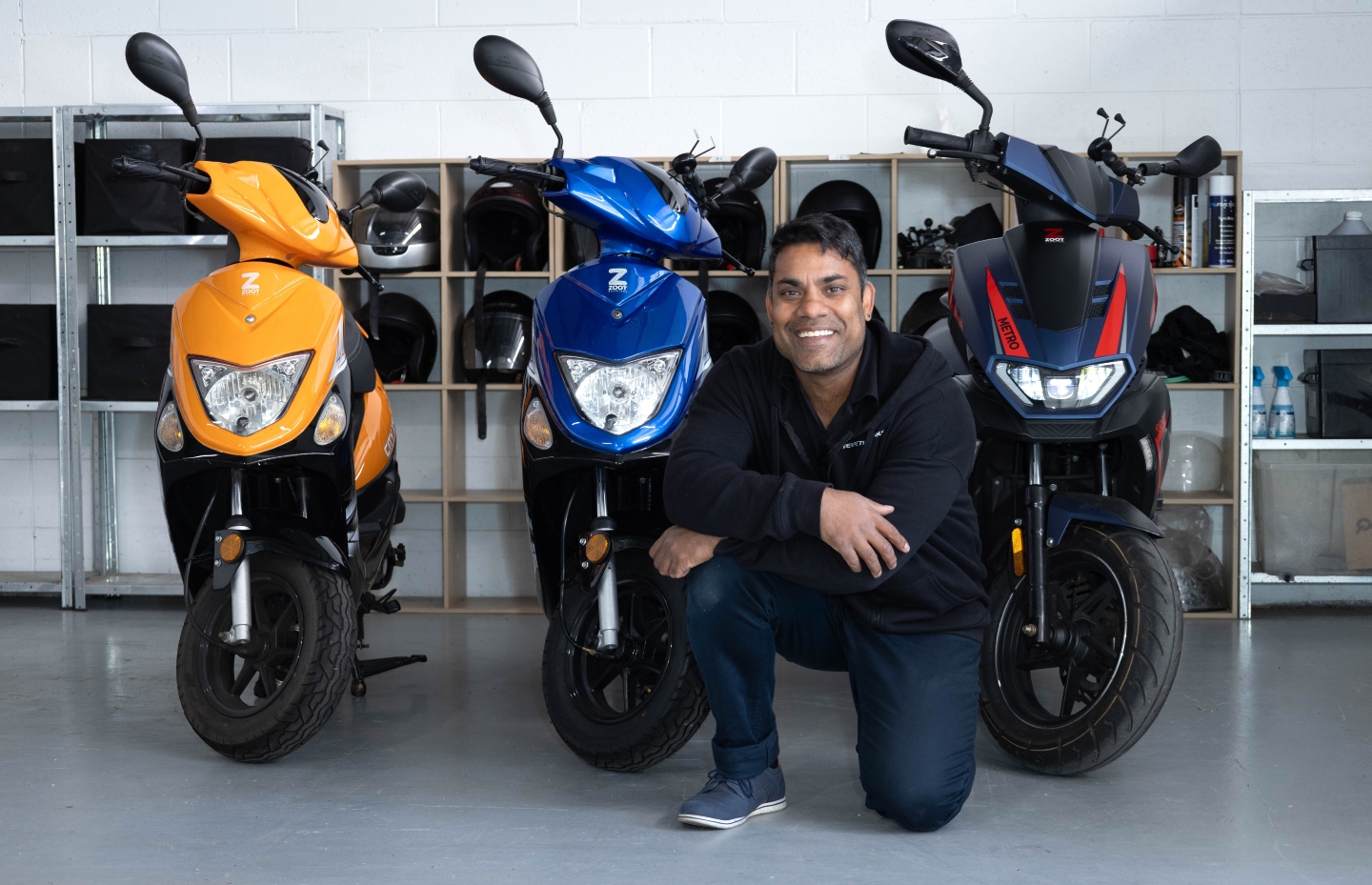
A Perth startup has created the Uber for scooters and mopeds.

Continue Reading

Business

FirstCry shares fall 3% despite Q4 net loss narrowing to Rs 30 crore. What is Morgan Stanley saying?

Published

on

FirstCry shares fall 3% despite Q4 net loss narrowing to Rs 30 crore. What is Morgan Stanley saying?
The shares of FirstCry-parent Brainbees Solutions declined over 3% to their day’s low of Rs 229 on the NSE on Wednesday even as its Q4 net loss narrowed 61% to Rs 30.30 crore from the Rs 77 crore net profit reported in the corresponding quarter of the previous financial year.

The company released its results on Tuesday after market hours. While losses contracted sharply, revenue grew 12% YoY to Rs 2,163 crore in Q4 FY26, up from Rs 1,930 crore in the same quarter last year.

Although the net loss contracted sharply year-on-year, it increased sequentially from the Rs 28.43 crore net loss reported in the October-December quarter of the same financial year. The firm’s topline also declined 11% quarter-on-quarter from the Rs 2,424 crore revenue reported in the previous quarter of FY26.

The company’s adjusted Earnings Before Interest, Taxes, Depreciation and Amortisation (EBITDA) stood at Rs 119 crore versus Rs 101 crore in the year-ago period, while the adjusted EBITDA margin in Q4 FY26 was 5.5% compared to 5.2% in Q4 FY25.

Advertisement

Overall for the financial year ending March 31, 2026, FirstCry reported a 23% YoY drop in net loss while revenue grew 12% YoY and EBITDA rose 24% YoY. “With our current initiatives, we believe that structurally the growth rate for both online & offline channels will be much superior in FY27,” the company said in an exchange filing.


It added that it witnessed sequential improvement in YoY growth rate for revenue, despite heightened competitive intensity during the quarter. With its initiatives in offline channels, GMV grew in the mid-teens in Q4FY26, the filing said.
Morgan Stanley has maintained its “Equal-weight” rating on Brainbees Solutions Limited with a target price of Rs 300 (10% upside). The brokerage noted that margins were impacted by intense competition in the diapers segment and higher manufacturing costs. Management expects the India business growth rate in FY27 to improve over FY26, while manufacturing-related margin pressures are likely to reverse from Q2 onward. The brokerage added that competitive intensity in diapers could continue for another four to six quarters, even as the company targets adding more than 100 stores in FY27.

(Disclaimer: Recommendations, suggestions, views and opinions given by the experts are their own. These do not represent the views of The Economic Times)

Continue Reading

Business

Coal India shares slide 6% after PSU prices Rs 5,000 crore OFS at 10% discount

Published

on

Coal India shares slide 6% after PSU prices Rs 5,000 crore OFS at 10% discount
Shares of Coal India fell over 6% on Wednesday after the state-run miner said that the government will sell up to 2% stake in the company through an offer for sale at a floor price of Rs 412 per share, implying a 10% discount from the previous closing price of Rs 458.15 apiece on NSE.

Coal India announced on Tuesday that it aims to sell 6.16 crore equity shares, representing 1% of Coal India’s total paid-up equity capital, as the base offer size. The government also retains an oversubscription option to sell an additional 6.16 crore shares, taking the total potential offer size to 12.32 crore shares or 2% equity. At the floor price, this would be worth more than Rs 5,000 crore.

The offer for sale will open for non-retail investors on May 27, while retail investors, eligible employees and non-retail investors carrying forward unallotted bids can participate on May 29. It is important to note that the Indian stock market will remain closed on May 28 on account of Bakrid.

The government owned more than 63% stake in the PSU company, as on March 31, 2026. Coal India in its exchange filing further said that the share sale by its promoter will be conducted through a separate window mechanism on BSE and the National Stock Exchange in accordance with the Securities and Exchange Board of India’s OFS guidelines.

Advertisement

Additionally, 16 lakh Coal India shares changed hands in the block deal on Wednesday morning, according to ET Now.


Also read: Govt to offload up to 2% stake in Coal India via OFS on May 27-29

Coal India share price

Coal India shares sharply declined more than 6% to trade at Rs 428.40 apiece on NSE in the early trading hours of Wednesday. The stock has declined around 5% in one week and more than 3% in one month. Overall, the share price of the miner have gained more than 9% so far in 2026.
In the longer term, Coal India shares gained over 9% in one year, 81% in three years and 202% in five years. The company has a market capitalisation of nearly Rs 2.7 lakh crore.Coal India reported a steady March quarter performance, with consolidated profit after tax rising 12% YoY to Rs 10,908 crore, while revenue from operations increased 6% to Rs 46,490 crore, supported by improved realizations and higher other income.

Further, Coal India’s board also declared a final dividend for FY26 at Rs 5.25 per share. Payment of the final dividend for FY26 will be made subject to approval of shareholders in the upcoming AGM.

Also read: Coal India dismisses shortage fears; says 168 MT buffer available to meet rising demand

Advertisement

(Disclaimer: Recommendations, suggestions, views and opinions given by the experts are their own. These do not represent the views of The Economic Times)

Continue Reading

Trending

Copyright © 2025