The 2026 FIFA World Cup has reached its knockout business end, with the field now trimmed to 16 teams and the tournament’s quarterfinal picture beginning to take shape as the Round of 16 continues across venues in the United States, Canada and Mexico.
The tournament began with a record 48 teams split into 12 groups, later narrowed to 32 nations advancing through the group stage before the single-elimination Round of 32 further reduced the field to 16. That round produced several surprises, most notably the elimination of Germany at the hands of Paraguay and an early exit for the Netherlands, results that reshaped expectations heading into the tournament’s second knockout round.
Two of the four quarterfinal matchups are now confirmed. France booked its place in the last eight with a 1-0 win over Paraguay in Philadelphia, a result built around a penalty conversion from Kylian Mbappe, who continues to lead the tournament’s Golden Boot conversation. France will face Morocco, which advanced with a commanding 3-0 win over co-host Canada in Houston. The victory made Morocco the first African nation to reach back-to-back World Cup quarterfinals, continuing the momentum the team built during a memorable run to the semifinals in 2022. Canada’s elimination also made it the first of the tournament’s three co-host nations to be knocked out of contention, a distinction determined largely by the structure of the bracket rather than any single result. Morocco and France are scheduled to meet in the quarterfinals on Thursday, July 9, at Boston Stadium.
The tournament’s other confirmed quarterfinal matchup pits Norway against England, a meeting set for Saturday, July 11. Norway advanced with a stunning 2-1 upset over five-time champion Brazil in East Rutherford, New Jersey, with forward Erling Haaland scoring both of Norway’s goals to send Brazil home in its earliest World Cup exit since 1990. England, meanwhile, survived a chaotic Round of 16 clash with co-host Mexico at Estadio Azteca, winning 3-2 in a match that included two red cards and two penalties before England held on to advance to the quarterfinals for a third consecutive tournament.
Advertisement
The remaining half of the bracket is still being finalized, with four Round of 16 matches left to determine the tournament’s final two quarterfinal pairings. Portugal is set to face Spain, while the United States takes on Belgium, both matches scheduled for Monday, July 6. Portugal advanced to this stage with a 2-1 win over Croatia, while Spain cruised past Austria 3-0 in its own Round of 32 fixture. The United States, the tournament’s remaining co-host still alive in the competition, advanced past Bosnia and Herzegovina 2-0 in extra time despite playing a portion of the match with a numerical disadvantage after forward Folarin Balogun was shown a red card, a decision that was later overturned by FIFA ahead of the Belgium match. Belgium reached this stage by overcoming Senegal 3-2 in a come-from-behind victory.
The winners of the Portugal-Spain and United States-Belgium matches will meet in the quarterfinals on Friday, July 10, at Los Angeles Stadium.
Two additional Round of 16 matches are scheduled for Tuesday, July 7. Argentina, the tournament’s defending champion, will face Egypt at Mercedes-Benz Stadium in Atlanta in a highly anticipated matchup between Lionel Messi and Mohamed Salah. Argentina reached this stage after needing extra time to eliminate tournament debutant Cape Verde, ultimately advancing 3-2 on the strength of a late own goal from the Cape Verdean defense. Egypt reached the Round of 16 for the first time in 92 years on the back of a penalty shootout win over Australia, a result that included a successful Panenka-style conversion from Salah.
Also on July 7, Switzerland will face Colombia, with both nations having advanced through their respective Round of 32 matchups. Switzerland eliminated Algeria to reach this stage, while Colombia edged past Ghana 1-0. The winners of the Argentina-Egypt and Switzerland-Colombia matches will meet in the quarterfinals on Saturday, July 11, at Kansas City Stadium.
Advertisement
With those results, the tournament’s quarterfinal schedule is nearly set. Morocco and France will open the round on July 9 in Boston, followed by the winners of Portugal-Spain and USA-Belgium meeting on July 10 in Los Angeles. On July 11, Norway will face England, while the winners of Argentina-Egypt and Switzerland-Colombia complete the round on the same day in Kansas City.
Beyond the sporting drama, this year’s tournament has continued to draw record global attention as the first World Cup jointly hosted by three nations and the first to feature the expanded 48-team format. The larger field has produced a total of 104 matches across 16 host cities spanning the United States, Canada and Mexico, a significant increase from the 64-match format used in previous 32-team tournaments. With Canada, Mexico and now potentially other co-hosts eliminated at various stages, the United States remains the last of the three hosts still alive in the competition heading into Monday’s match against Belgium.
Looking further ahead, the semifinal round is scheduled to follow the conclusion of the quarterfinals, with the tournament’s final set for July 19. As the bracket continues to take shape, storylines abound heading into the coming week, from Messi’s continued pursuit of a strong tournament with Argentina to Haaland’s push to add to his tournament-leading goal tally with Norway, alongside England’s bid to advance further than the team has in decades and the co-host United States’ attempt to extend its own historic run on home soil.
Fans looking to follow the remaining schedule can expect matches to continue nearly daily through the coming week as the field narrows from the current 16 teams down to the final four semifinalists, with official broadcast details for each remaining match available through FOX, FOX One, Telemundo and other regional broadcast partners covering the tournament across its host countries.
Advertisement
World Cup 2026 Bracket — Quarterfinals & Remaining Schedule
Confirmed Quarterfinals:
Morocco vs. France — Thursday, July 9, Boston Stadium
Morocco beat Canada 3-0 (first African team to reach back-to-back World Cup quarterfinals)
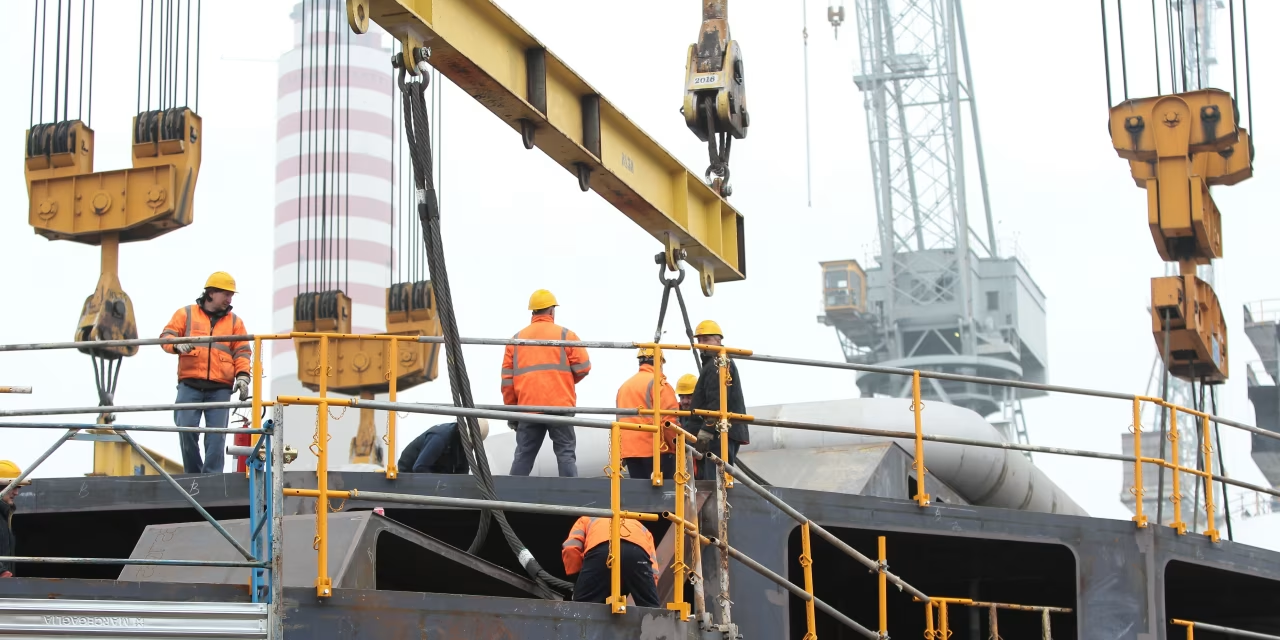
Shares of Italian shipbuilder FincantieriFCT 10.60%increase; up pointing triangle jumped after the group said it had sealed agreements to acquire stakes in four companies to shore up its operations across marine construction support, unmanned underwater and surface drone technologies, and underwater wireless communication systems.
The company said it was taking stakes in Next Geosolutions EuropeNXT -3.34%decrease; down pointing triangle, which operates in the offshore renewable energy, offshore oil and gas and subsea cable sectors; WSense, which specializes in underwater monitoring and communication systems; Defcomm, active in the design and construction of unmanned surface vehicles; and Graal Tech, which makes underwater robotic technologies.
The Bristol-based investment platform has snapped up two senior figures from Vanguard
08:48, 06 Jul 2026Updated 08:54, 06 Jul 2026
Hargreaves Lansdown in Bristol(Image: Bristol Post)
Bristol-based investment firm Hargreaves Lansdown (HL) has bolstered its senior leadership team with two new hires.
The finance platform has appointed Charles Thompson as chief technology officer and Michael Finnegan as chief transformation officer.
Advertisement
The pair, who are both joining from asset manager Vanguard, have backgrounds in tech and retail investing in the US market.
They will replace Richard Hebdon, current chief digital and technology officer, and Darren Worth, chief strategy and transformation officer, who will leave HL later this year. Hebdon and Worth will remain with the business for a transition period, Business Live understands.
Thompson will join HL on September 1, subject to regulatory approval, and will be based in Bristol. He was most recently principal and divisional CIO for advice and wealth management at Vanguard, having previously led technology at Vanguard International, spanning APAC, Europe and the Americas. Before that he held senior technology leadership roles at National Australia Bank.
Finnegan will also join HL in September and will be based in Bristol. He previously held a number of senior roles at Vanguard, most recently as head of wealth planning and partnerships. Before that he was head of international strategy and chief of staff for Vanguard’s International business and CFO for the Americas.
Advertisement
Richard Flint, outgoing CEO and non-executive deputy chair at HL, said the appointments were made following “a rigorous external search”.
“We are delighted to welcome Charles and Michael to HL,” he said.
“They are strong leaders with deep experience across technology, transformation and retail investing, and they will further strengthen the executive team.”
Mr Flint said HL would look to “combine the best” of its market position with lessons from the US, where technology, product innovation and customer engagement had “helped more people invest for their future”.
Advertisement
“Charles and Michael will play critical roles in that next phase,” he added. “I want to thank Darren and Richard for their service to HL… We are grateful for everything they have contributed and wish them both well for the future.”
Thompson said he was “incredibly excited” to join HL and was “looking forward to leading the build” of new technology capability within the business.
Meanwhile, Finnegan said HL had a “major opportunity” to help more people move from saving to investing.
“I’m excited to help deliver the change needed to support that ambition and help HL move faster for clients,” he added.
Sick of the heat, crowds and high prices, more U.S. travelers are discovering the offseason of international travel — and airlines and hotels are fighting for a windfall.
Flights to once-seasonal European vacation destinations now start when there’s still snow on the ground in the U.S. and wrap up when leaves are falling off the trees, if they end at all, instead of following traditional late-spring to late-summer travel seasons.
For example, American Airlines‘ flight to Edinburgh, Scotland, from New York began in March. United Airlines‘ nonstop route to Palermo, Sicily from Newark, New Jersey, will end in December and Delta Air Lines‘ service to Rome from Minneapolis, Minnesota, will run into January, months later than they have in past years.
With this year’s surge in jet fuel expected to take a $100 billion bite out of airline profits this year, according to the International Air Transport Association, it’s crucial for the industry to maximize on travel trends that attract high-spending customers.
Advertisement
Investors are upbeat that airlines can take the fuel hit from earlier this year after they trimmed unprofitable or less profitable flights and airline executives have said strong demand has helped them pass some — but not all of those expenses along.
Shares of Delta and United, the two most profitable U.S. airlines, each hit records in recent weeks, and American’s shares touched an 18-month high. Airlines start reporting second-quarter results and providing third-quarter updates this month, with Delta kicking the season off on Friday.
A couple cools off in the Trocadero Fountain with the Eiffel Tower in the background during a heat wave in Paris on June 26, 2026.
Dimitar Dilkoff | Afp | Getty Images
Advertisement
‘Creep of the seasons’
Industry executives told CNBC that international vacation seasons used to be more defined. The new trends are forcing them to rip up decades-old playbooks.
“It used to be so much lumpier. There used to be more: good season, bad season,” Delta President Peter Carter said in an interview. “There are so many places you can go in Europe year-round and still have an amazing experience, and that’s why we’re seeing such good demand into Europe.”
That demand is redefining when airlines’ moneymaker months are.
“We’ve seen this massive, what I would call, the creep of the seasons — the shoulder season is blending into the full season,” Patrick Quayle, United Airlines‘ senior vice president who designs the carrier’s network, said in an interview last month.
Advertisement
Shoulder season refers to the period between a destination’s peak tourist season and its offseason.
Airlines are trying to extend the season as much as possible to grow profits.
International flights to Europe generally carry more premium seats like lie-flat pods than smaller jets that are used for domestic travel — and airlines are planning to expand those options further. Business-class fares on some of those routes can cost $10,000 for a round-trip instead of less than half that on a domestic route.
A dog is standing with its owners in a long line at Terminal 1 of Frankfurt Airport in Germany.
Advertisement
Andreas Arnold | Picture Alliance | Getty Images
Airfare overall is up this year compared with last as airlines try to pass along as much of their rising costs to customers as possible, but there are signs that prices are moderating, particularly as the industry braces for the peak summer travel period in July to pass.
For example, flights between the U.S. and Athens, Greece, on June 22 were going for $988 round-trip, up from $810 last year but down from $1,350 two months earlier, according to flight-tracking site Kayak.
The increase in shoulder season and off-peak travel is forcing Delta to rethink its maintenance and crew schedules, said Jeff Arinder, Delta vice president of international network planning.
Advertisement
“We would never give airplanes to the maintenance hangers, if we could avoid it, in the summertime … because that’s when we made all the money,” he told CNBC. “We are now doing more maintenance in the summertime because we want to save those planes for the fall.”
He said Delta is trying to “really flatten out our seasonality as much as possible.”
Why travel times are changing
People try to cool down by standing in front of a nebuliser placed on a Civil Protection pick-up truck spraying cool water during a heatwave, in Rome near the Colosseum on June 26, 2026.
Andreas Solaro | Afp | Getty Images
Advertisement
The latest challenge to usual summer European travel was the most recent, deadly heat wave.
In late June, locals and tourists alike faced dangerous record temperatures throughout Europe, where air conditioning isn’t widespread. Misting stations were set up from Warsaw, Poland, to Rome. The Paris LGBTQ+ Pride march was postponed, among other events, and public alcohol consumption was briefly banned in the city.
Residents of many European cities, like Barcelona, Spain, and Venice, Italy have also been raising concerns about overcrowding during peak summer months and beyond. Countries throughout Europe have been bringing in record numbers of visitors.
But it’s not just an aversion to heat and crowds that’s leading to changing travel patterns.
Advertisement
For younger generations, more flexible work policies are helping some consumers, even those with children, take trips outside of late spring and summer. Baby Boomers, meanwhile, are armed with piles of cash and plenty of time, giving them more flexibility for travel.
“Delta’s target demographic tends to be a little bit older and a little bit wealthier,” Arinder said.
Setting sights on Sicily
United is pushing the limits of the offseason trend.
It’s extended its nonstop flight from Newark, New Jersey, to Palermo, Sicily, through Dec. 16, rather than ending it in September, with Boeing 767s.
Advertisement
Sicily has long been marketed as a summertime destination.
Daytime highs can regularly reach 90 degrees Fahrenheit along the coast with little, if any, rain in July. In December, however, the highs sometimes barely touch 60 degrees on the Italian island and rain is more likely.
As hotel rates drop and crowds at major attractions decline in the winter, United is making a bet that travelers will fill up the three-times-a-week service even without the ideal summer weather.
The view from the ancient theater of Taormina on the Italian island of Sicily.
Advertisement
Reda | Universal Images Group | Getty Images
“I don’t think it’s that experimental. I think it’s a really safe bet ” United’s Quayle said.
Many coastal hotels also close during the winter months. The Four Seasons’ San Domenico Palace, in Taormina, Sicily, where the second season of HBO’s “White Lotus” was shot, closes in mid-November through early spring, for example.
However, manager Imelda Shllaku told CNBC that in the past four years the hotel has had a “remarkable increase in bookings from U.S guests” in March, April, October and November.
Advertisement
“High-net-worth travelers are increasingly seeking experiences with genuine cultural currency, and Sicily’s shoulder season is simply better suited to delivering them,” she said by email, pointing to behind-the-scenes tours of Noto in southeast Sicily and nighttime trips to Mount Etna. The hotel will reopen March 1, a spokeswoman said.
Delta is planning to extend its flights from New York’s John F. Kennedy International Airport to Catania, on the east coast of Sicily, through Jan. 3, compared with Oct. 24 last year. And it plans to resume the route on March 8, 2027. This year, it started the route on May 1 and May 21 in 2025.
Shoulder season
United and Delta aren’t alone, as airlines across the board are redeploying some of their biggest planes to maintain service to Europe for the full year or well into the offseason.
“When airlines are looking to purchase aircraft, they have to think about ‘How are we going to use this airplane year-round because it’s an expensive piece of machinery,’” said Brett Snyder, founder of Cranky Flier blog and Cranky Concierge travel agency. “They know in the summer they won’t have a problem sending these widebodies to Europe. Now they can stretch that further into the shoulder season.”
Advertisement
Seattle-based Alaska Airlines, which recently debuted its first service across the Atlantic this year to London, Rome and Reykjavík, Iceland, is keeping this in mind. President and Chief Financial Officer Shane Tackett told CNBC that travelers are becoming more flexible.
“A lot of people want to go see the same destinations … [and that] makes it like very logical that those seasons would start to spread,” he said. “Maybe when I was growing up, my parents wouldn’t have even thought of taking me out of school in September, and I think maybe parents are a little more like, ‘Yeah, let’s go somewhere fun, and you’ll catch up on school when you get back.’”
An American Airlines Boeing 777-223ER takes off from Barcelona-El Prat Airport, in Barcelona, Spain, on April 29, 2026.
Joan Valls | Nurphoto | Getty Images
Advertisement
American Airlines, for its part, is stretching some of the seasons of U.S. trans-Atlantic travel.
October “is not as strong as June or July to Europe, but it’s becoming a peak month for us,” said Brian Znotins, the carrier’s senior vice president of network planning.
But American doesn’t want to push planes too far off their proven track record for ski-and-sun-seeker vacationers in winter, he said.
“I’m not going to mince words: January and February are still very off-beat months. I would hate to have anyone come away and say that they’re good months, they’re just less off-peak than they used to be,” he said.
Advertisement
Some travelers split the difference.
Atul Mehta, a finance executive based in Chicago, said he is taking his family to Portugal this summer shortly before school resumes, but said when he visits family in Bahrain in the winter “we have taken them out of school.”
The Insolvency Service is to deploy artificial intelligence to root out rogue directors who deliberately fold their companies to dodge tax and walk away from their debts, but the agency has admitted its new taskforce cannot fix an £800 million problem on its own.
The chancellor committed £25 million over five years in November’s budget to fund a 50-strong unit dedicated to investigating suspicious company insolvencies. Its target is so-called “abusive phoenixism”, the practice of liquidating or dissolving a company to escape tax liabilities and creditors, only for the business to rise again under a new corporate shell.
Phoenixism accounted for 22 per cent of the £3.8 billion in total tax losses in 2022-23, according to HM Revenue & Customs estimates, and the practice has long been a source of frustration for the small firms left unpaid when a customer or supplier collapses and quietly reappears under a new name.
Dave Magrath, director of investigation and enforcement services at the Insolvency Service, said enforcement outcomes were “really important” but warned they would not be enough. “On their own, they won’t solve the problem. The problem is a much greater one and it probably needs some of our policy people to really think about that tension between [directors] starting [companies] again and phoenixism.”
The taskforce, which began work in April and expects to be fully operational next year, grew out of joint work between HMRC, Companies House and the Insolvency Service. It will lean heavily on technology to find its targets. “We’re looking at the hundreds of thousands of companies that dissolve every year,” Magrath said. “We need some tech power to help us hone in and find the needle in the haystack around where the harm is.”
Advertisement
The move follows a damning National Audit Office report in 2024, which found that some small businesses were easily exploiting weaknesses in government systems to evade tax and that there had been a lack of focus on phoenixism. The watchdog, which also warned that small businesses account for around 80 per cent of UK tax evasion, revealed that the Insolvency Service had disqualified just seven directors for phoenixism between 2018-19 and 2023-24, out of 6,274 disqualified directors in total.
As part of the drive to ban more rogue directors, the Company Directors Disqualification Act is set to be amended, following a recent consultation, to widen the circumstances in which law-breaking directors can be struck off. The reform sits alongside Companies House’s rollout of identity verification for directors, another measure aimed squarely at phoenix operators.
Recent cases illustrate the scale of the abuse. The owner of a Burton fire alarm installation company was banned after paying himself almost £400,000 across two companies while handing HMRC just £5,368, while an Oxfordshire landscaping boss ignored his director ban and left £300,000 in unpaid tax across two companies. In one of the more extreme examples, a director linked to more than 400 companies was banned for nine years for helping struggling firms subvert the insolvency system.
Magrath acknowledged the difficulty of striking a balance between allowing entrepreneurs who fail for legitimate reasons to try again and clamping down on abuse, particularly at a time when the country is “striving for economic growth”. He said he hoped the “heart of the solution” would come from the recent civil enforcement consultation, which could see restrictions applied to directors with a pattern of repeated, harmful failures in lower-level cases, while still allowing them to “contribute to the economy”.
Advertisement
Caroline Sumner, chief executive of R3, the trade body for restructuring, turnaround and insolvency professionals, welcomed the taskforce as a response to “a longstanding issue”.
“Phoenixism undermines confidence in the business environment and can leave creditors, including small businesses and HMRC, out of pocket, so co-ordinated action is essential,” she said. “Measures such as strengthened identity checks for directors and improved data sharing should make it easier to identify and act on misconduct.
“Ensuring that the director disqualification regime is robustly applied and that there are sufficient resources and powers to pursue repeat offenders will be critical to the taskforce’s success.”
Amy Ingham
Amy is a newly qualified journalist specialising in business journalism at Business Matters with responsibility for news content for what is now the UK’s largest print and online source of current business news.
When you are standing on the side of a frozen peak, miles from civilization, your gear is your lifeline. In extreme mountain environments, the margin for error is zero. A single equipment failure or an inadequate layer of clothing can quickly turn an exciting expedition into a survival situation. For any climber preparing to tackle high-altitude summits, packing the right technical equipment is just as important as physical conditioning.
The Three-Layer Clothing System
The key to staying warm and dry in the mountains is layering. The three-layer system allows you to regulate your body temperature as your exertion levels and the weather change. Your base layer sits directly against your skin and must be made of moisture-wicking materials like merino wool or synthetic polyester — never wear cotton, as it retains sweat and will leave you freezing when you stop moving. The mid layer is your insulating layer; fleece jackets, active insulation, or lightweight down sweaters trap warm air close to your body. Finally, the outer layer is your protective shell — a high-quality, waterproof, and windproof Gore-Tex jacket and pants will shield you from howling winds, heavy snow, and rain. Mastering this system means you can adapt to rapidly changing mountain weather without overheating or freezing.
Technical Footwear and Traction
Your feet are your most valuable asset on a climb. Investing in high-quality mountaineering boots that are compatible with crampons is non-negotiable. These boots must be stiff enough to support your ankles on steep slopes and insulated enough to prevent frostbite in sub-zero temperatures. In addition to boots, you will need reliable crampons for traversing glaciers and icy slopes, and an ice axe for self-arrest in the event of a slip. Ensuring you have the best mountaineering gear for traction is critical for navigating technical terrain safely. Poorly fitted or inadequate footwear is one of the leading causes of accidents and injuries on high-altitude expeditions.
Safety and Navigation Essentials
Never venture into extreme environments without a comprehensive safety kit. This includes a high-output headlamp with extra batteries, a fully stocked first-aid kit, a multi-tool, and reliable navigation tools. While GPS devices and satellite messengers are incredibly useful, always carry a traditional map and compass as a backup, and know how to use them. A high-quality climbing helmet is also essential to protect your head from falling rock and ice, which are common hazards on steep mountain faces. Additionally, carrying a lightweight emergency bivy sack can be a lifesaver if you are caught out in deteriorating weather conditions and need to shelter in place until conditions improve.
Advertisement
Nutrition and Hydration Gear
Maintaining proper nutrition and hydration at altitude is critical for performance and safety. Carry a reliable water filtration system or purification tablets to treat water from mountain streams. High-calorie, lightweight snacks such as nuts, energy bars, and dried fruit provide the fuel your body needs to keep moving. An insulated water bottle or hydration bladder will prevent your water from freezing in sub-zero temperatures. Proper nutrition and hydration management, combined with the right technical gear, form the complete foundation of a safe and successful high-altitude expedition.
The new venture will include Carlsberg’s existing operations in Malaysia, Hong Kong and Singapore—markets where the two companies already collaborate—as well as in Laos, Vietnam and Cambodia.






















































You must be logged in to post a comment Login