
Business
GameStop Stock Jumps After Stronger Profit Preview and Cash Settlement of Convertible Notes

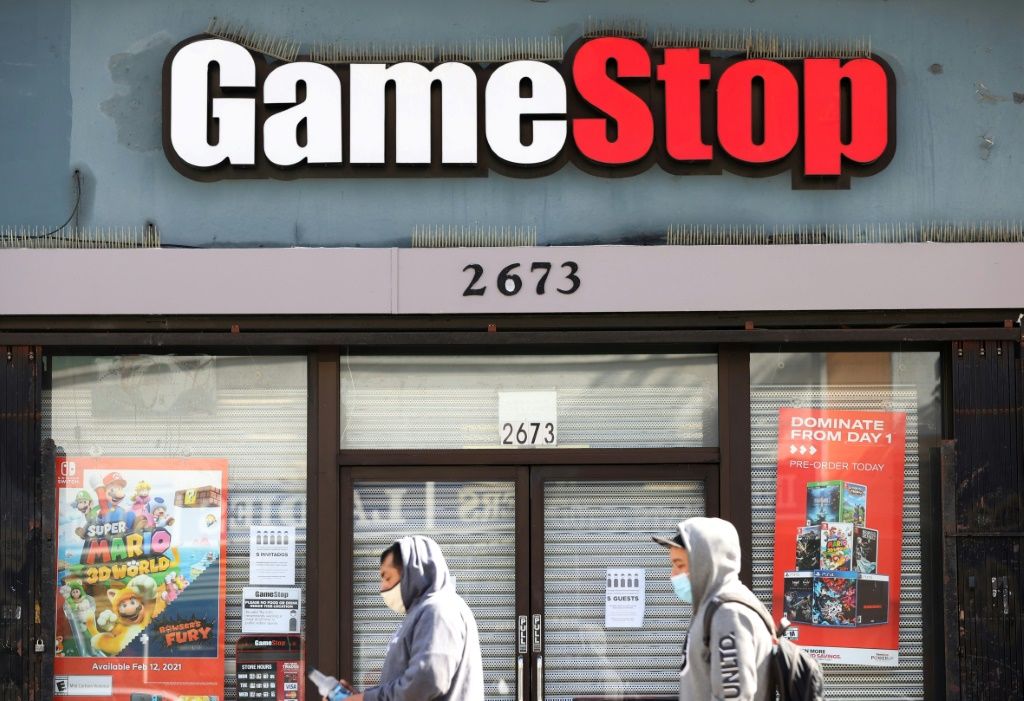
GRAPEVINE, Texas — GameStop Corp. shares rose more than 4 percent Monday after the video-game retailer posted preliminary second-quarter results showing higher profit on lower sales and revised a large convertible-note exchange to pay more in cash and fewer new shares.
The stock traded around $18.64, up 77 cents, or about 4.3 percent, by late morning in New York. The move followed two company releases issued before the open: unaudited figures for the 13 weeks ended Aug. 1 and an amendment to agreements covering about $1.4 billion of zero-coupon convertible notes.
GameStop said it expects net sales of $780 million to $800 million, down from $972.2 million a year earlier. The company attributed the drop mainly to last year’s Nintendo Switch 2 launch, planned store closures and the sale of its France business. Operating income is projected at $150 million to $170 million, compared with $66.4 million a year ago. Net income is expected at $290 million to $310 million, up from $168.6 million.
Those profit figures include about $238 million of net gains tied to an eBay Inc. derivative and equity stake, partly offset by a loss of roughly $75 million on digital assets and related receivables. During the quarter GameStop converted a previously disclosed eBay derivative into a direct holding. As of Aug. 1 it held about 43.4 million eBay shares. Cash, cash equivalents and marketable securities are expected at $5.05 billion to $5.07 billion, down from $8.694 billion a year earlier after that conversion.
The sales range came in above a Wall Street consensus near $757 million cited by market data services, even though revenue is still falling year over year. The profit beat is less clean: a large share of net income comes from investment marks, not from selling games and consoles.
Separately, GameStop amended exchange deals first announced Aug. 3. Holders of certain 0.00% convertible notes due 2030 and 2032 had agreed to swap about $1.4 billion of principal for stock based on a 35-day volume-weighted average price that began Aug. 3. The company is ending the remaining pricing window. Shares will cover the elapsed portion of the period. The rest will be paid in about $358.4 million of cash. Total new stock is now fixed at about 55.5 million shares. Closing is expected around Sept. 3. About $2.8 billion of notes would remain outstanding after the deal.
The original all-stock structure had weighed on the shares in August as investors priced in dilution. Fixing the share count and substituting cash removed some of that uncertainty. The stock had slipped toward a 52-week low near $17.79 in recent weeks after the first exchange announcement and after reports that Chief Executive Ryan Cohen might rethink a large eBay bid.
Cohen earlier this year made an unsolicited proposal to buy eBay for about $56 billion. Dow Jones reported that eBay rejected the offer as “neither credible nor attractive.” Cohen has said publicly he would keep pursuing a transaction. GameStop’s eBay stake and the mark-to-market gains in the quarter keep that campaign on the balance sheet even if a full takeover does not close.
The core retail story is mixed. Higher operating income on a smaller store base and without the France unit suggests cost control and a richer mix. The comparison with last year’s Switch 2 launch also inflates the sales decline. Collectibles, trading cards and delivery experiments — including a tie-up with Uber Eats announced in July — remain secondary to the cash pile and the investment book.
Market value is about $8.4 billion. Trailing twelve-month revenue is near $3.7 billion. The company has no regular dividend. Institutional ownership is a minority of the float, and the stock still trades with the volatility that has followed it since 2021.
Monday’s bounce does not erase the tension in the model. GameStop is shrinking its physical footprint, booking large paper gains on a public-company stake, and using cash to cap how many new shares a debt swap creates. Investors who wanted a cleaner operating print still have to wait for fully audited results and a complete earnings call. Those who wanted less dilution got a clearer share count and a cash check.
What happens next is mostly mechanical. The note exchange is scheduled to settle within days. Full second-quarter financials will show how much of the $150 million-plus operating profit holds after final adjustments. The eBay position will keep moving with that stock. And the video-game calendar — new hardware cycles, software slates, collectible drops — will decide whether sales can stabilize once the Switch 2 anniversary rolls off.
For one session, the combination of a profit preview above last year and a smaller equity issuance was enough to lift a name that had spent August under pressure. The numbers GameStop put out are preliminary and unaudited. They are also specific: sales down, operations up, investments noisy, dilution capped. That is the report the market traded.

Business
Bessent calls on global financial leaders to refocus on driving ‘stronger and more durable growth’
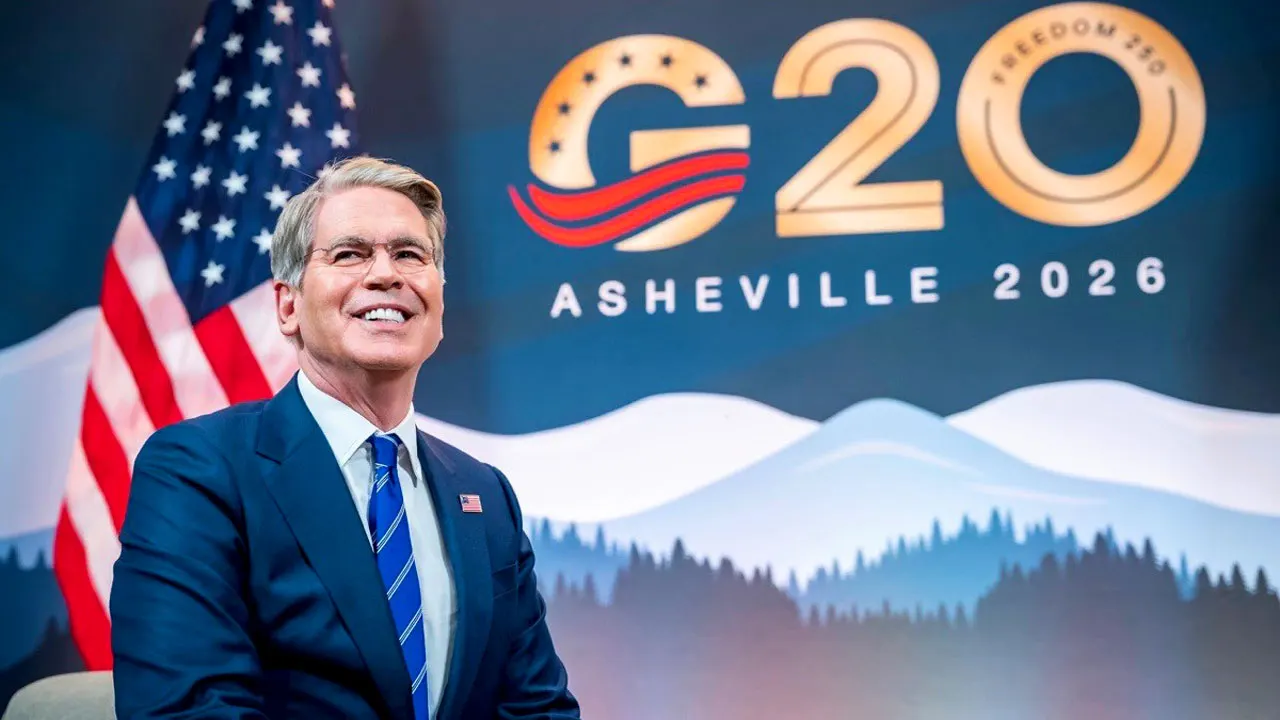
White House Deputy Press Secretary Kush Desai previews the G20 summit in Asheville, N.C., U.S. sanctions on Iran, public opinion regarding data centers and White House Press Secretary Karoline Leavitt’s best moments at the podium.
ASHEVILLE, N.C. – Treasury Secretary Scott Bessent delivered a firm call to action to global financial leaders in his opening remarks at the G20 Finance Track meetings on Monday, urging the group to refocus on driving “stronger and more durable growth” by dismantling government-imposed economic barriers.
Speaking at the gathering of finance ministers and central bank governors, Bessent framed the U.S. presidency of the G20 around a “back-to-basics” approach to economic policy, arguing that global growth has underperformed for far too long.
“Many forces can inhibit economic growth,” Bessent said in his opening remarks. “But policy failures of our own making must no longer be one of them.”
WHAT WARSH’S JACKSON HOLE SPEECH SIGNALS ABOUT WHERE INTEREST RATES ARE HEADED
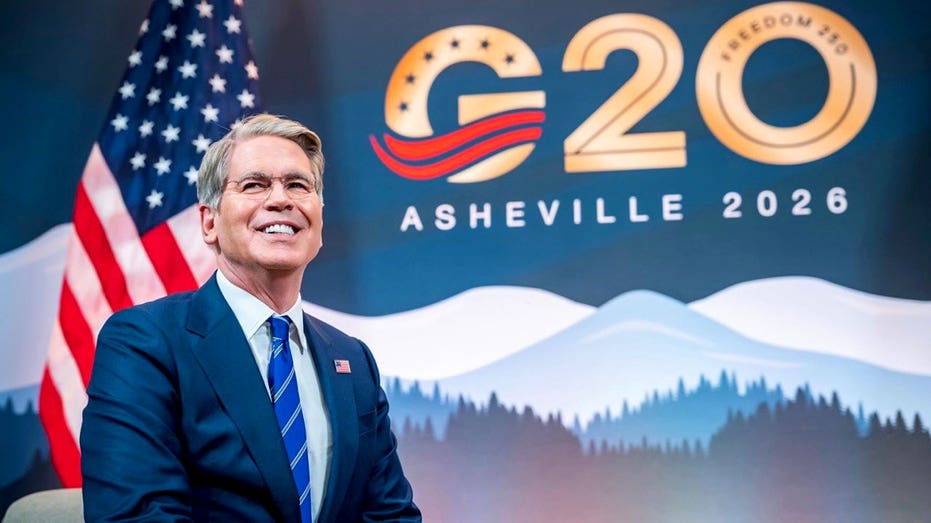
Treasury Secretary Scott Bessent at the G20 Finance Track meetings in Asheville, North Carolina. (Department of Treasury)
Bessent outlined a comprehensive list of drag factors identified by the G20 finance track that hamper global expansion. Among the key bottlenecks named were excessive regulatory burdens, poorly designed tax systems, internal market fragmentation, lagging public and private investment, and persistent gaps in workforce mobility.
“I think we’re already seeing a lot of these leading indicators that we’ve been talking about, for instance, robust factory construction growth. In order to have factory jobs, you need factories to be constructed first,” White House senior deputy press secretary Kush Desai told FOX Business, regarding the U.S. economy. “And so far, this president has added tens of thousands of factory construction jobs.”
BESSENT SAYS TREASURY AUCTIONS WILL CONTINUE AS USUAL DESPITE EXPANDED BUYBACK PROGRAM
To counter these challenges, Bessent presented the Trump administration’s domestic policy model as a blueprint for foreign counterparts. Highlighting what he termed a “great regulatory reset,” Bessent pointed to aggressive deregulatory measures aimed at stimulating investment and boosting wages. He noted that federal agencies drastically surpassed the administration’s initial goal of eliminating 10 existing regulations for every new one issued, achieving a 129-to-1 reduction ratio over the past year.
International Monetary Fund Managing Director Kristalina Georgieva used the U.S. model as an example of the right policy to attract business. She told FOX Business at the Federal Reserve’s Jackson Hole Symposium that “You realize that here, 2.5% a year. You go to Europe, it is zero. You go to Japan, half a percentage point. Because of this entrepreneurial environment and the commitment to eliminate red tape, so businesses can flourish.”

International Monetary Fund Managing Director Kristalina Georgieva used the U.S. model as an example of the right policy to attract business. (Wang Haizhou/Xinhua via Getty Images)
U.S. Pitch to International Partners
Bessent pitched the U.S. as the premier global destination for capital, citing historic tax relief for working families and energy independence as primary drivers for the next era of economic expansion.
TREASURY YIELDS HIT MULTI-DECADE HIGHS AMID SURGING NATIONAL DEBT
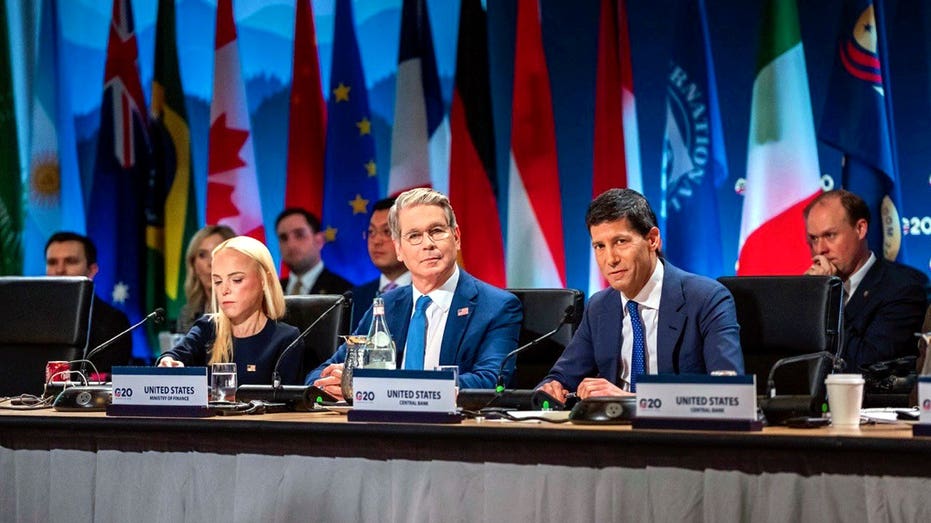
Treasury Secretary Scott Bessent at the G20 Finance Track meetings in Asheville, North Carolina. (Department of Treasury)
He also commended international partners for pursuing ambitious reform programs of their own to engage the private sector and spur market activity, welcoming collaborative feedback as discussions continue over the two-day summit.
GET FOX BUSINESS ON THE GO BY CLICKING HERE
The Asheville meetings mark a critical milestone in the U.S. host year for the G20, setting the stage for the Leaders’ Summit in Florida later this year. Discussions will continue through Tuesday, focusing on structural reform, global financial stability and private sector investment.

BlackSky CFO Henry Dubois sells $95,120 in company stock

The US Federal Trade Commission (FTC) and a bipartisan group of 22 states has filed a lawsuit alleging Amazon secretly overcharged more than a million advertising customers by manipulating online auctions it uses to set ad prices.
The FTC and states say in their lawsuit filed Monday that the alleged scheme has likely netted the company $20bn from advertising customers since 2019.
“Amazon overrides and replaces the actual auction results with higher prices set by Amazon to increase its profits,” says a complaint filed in the company’s home state of Washington.
In a statement to the BBC, Amazon “strongly disagrees” with the premise that it misled advertisers and called the suit “misguided.”
In addition to advertisers, the FTC, a US consumer watchdog, and the states say Amazon customers have also been harmed as extra costs are passed onto shoppers.
“Consumers are suffering, have suffered, and will continue to suffer substantial injury as a result,” the complaint states, prompting swift pushback from Amazon.
“The FTC wants the public to believe this case is about higher prices for consumers. It is not,” Amazon said in its statement.
The company’s shares fell following the announcement of the lawsuit, closing 2.5% lower on Monday.
Many brands and sellers compete on Amazon to place Sponsored Product ads and Sponsored Brands ads when consumer search for products using keywords on Amazon’s e-commerce platform.
Those placements are then auctioned off to the highest bidder.
The complaint accuses Amazon of secretly charging advertisers more in so-called “second price” auctions, whereby prospective advertisers expect to pay one cent more than the next highest bidder for each bid they win.
But in practice, the complaint alleges, Amazon has charged its Sponsored Products advertisers their own winning bid close to 80% of the time.
The lawsuit states that Amazon’s methods were spurred because “it was unhappy about how much revenue its advertising auctions were generating”.
Amazon responded by saying the FTC “fundamentally misunderstands how advertisers operate”.
“Advertisers adjust bids based on real-world performance, not descriptions of auction mechanics,” Amazon said in its statement.
“Average winning bids fell 50% from 2019 to 2025 on Sponsored Products search ads, and roughly 92% of placed ads are not given to the highest bid,” the company added.
Amazon has tangled with the consumer watchdog in the past.
Last year, it settled a case with the FTC that alleged that it enrolled millions of consumers in its Prime subscription offering without their consent, and knowingly made it difficult for consumers to cancel.
Amazon settled the case for $2.5bn, including civil penalties and consumer refunds.
Business
Dow Falls as Renewed US Strikes on Iran Near the Strait of Hormuz Rattle Wall Street to Close August

The Dow Jones Industrial Average fell Monday, dragging major U.S. stock indexes lower to close out August, after the United States and Iran exchanged fire for the first time in roughly a month, reviving concerns about rising oil prices and their potential impact on inflation.
The Dow traded at 53,181.62 as of 10:37 a.m. Eastern time, down 378.37 points, or 0.71%. The S&P 500 and Nasdaq Composite also opened lower, tracking similar declines earlier in the session, according to CNBC. The pullback came even as all three major indexes remained on pace to finish August with monthly gains, with the S&P 500 up roughly 2.5%, the Nasdaq 100 up about 3.8%, and the Dow ahead approximately 1.4% for the month heading into Monday’s session, according to Trading Economics.
The renewed selling followed confirmation from U.S. Central Command that American forces struck two Iranian rocket launchers on Iran’s Larak Island on Sunday, an operation officials said was aimed at rocket launchers preparing to deploy mines into the Strait of Hormuz. The strike marked the first publicly acknowledged U.S. military action against Iran in roughly a month, following a stretch of relative calm in the broader conflict between the two countries. Global benchmark crude prices rose about 2% at Monday’s market open in response, according to Bloomberg, as traders weighed the potential for renewed disruption to oil shipments through the strait, a waterway that has carried a significantly reduced share of global energy trade since fighting between the U.S., Israel and Iran began in late February.
Monday’s market reaction also built on hawkish signals from the Federal Reserve delivered at the end of last week. New Fed Chair Kevin Warsh struck a more hawkish tone than some investors had anticipated during his remarks at the central bank’s Jackson Hole symposium Friday, according to Yahoo Finance, contributing to a 0.3% decline in the S&P 500 that day even before Monday’s renewed Iran-related selling began. TheStreet Pro contributor James “Rev Shark” DePorre summed up the shifting mood among traders in a research note Monday. “The seasonal pattern is unfavorable, the Fed just leaned hawkish, and the momentum trade that carried this market has stopped working,” DePorre wrote, though he added that a more clearly bearish stance remained premature given the broader earnings picture and the calendar heading into the fourth quarter. “What keeps me from being outright bearish is the earnings picture and the calendar beyond September,” DePorre wrote, noting that October has historically served as what he called “the bear killer” given its tendency to mark seasonal market lows.
Weak domestic economic data added to Monday’s downbeat tone. The Chicago Purchasing Managers’ Index for the manufacturing sector came in at 47.1 for August, sharply below the Zacks Consensus Estimate of 58 and down from a reading of 57.6 in July, signaling a notable contraction in regional manufacturing activity. A reading below 50 generally indicates contracting activity in the sector.
Investors are now looking ahead to two closely watched pieces of economic data over the next two weeks that could further shape expectations for the Fed’s policy path: the monthly U.S. jobs report due Friday and consumer price index inflation figures scheduled for release next week. Those reports arrive at a moment when market volatility has begun ticking up from unusually low levels; the CBOE Volatility Index, known as the VIX, closed at 14.13 Friday, its lowest reading of 2026, according to Yahoo Finance’s analysis of AlphaSpace data, though the index has historically tended to climb through September and into October as markets move further from the summer’s typically quieter trading conditions.
Individual stock moves also factored into Monday’s broader market action. PayPal Holdings shares tumbled sharply after Bloomberg News reported that a consortium involving buyout firm Advent and payment processor Stripe had decided against pursuing an acquisition of the fintech company, according to Zacks Investment Research. Elsewhere, shares of India’s Adani Group dropped significantly amid a routine MSCI index rebalancing combined with volatility tied to a new trading mechanism introduced on Indian exchanges, according to Bloomberg, though that development had limited direct impact on U.S. markets.
Monday’s session marks the final trading day of August, and while the pullback tied to renewed Middle East tensions has weighed on sentiment to close out the month, all three major U.S. indexes remained positioned to post gains for August overall as of Monday morning, extending a broader upward trend that has persisted through much of the summer despite periodic bouts of volatility tied to geopolitical developments and shifting Federal Reserve policy expectations.

Shares of Amazon.com Inc. fell more than 2% Monday, tracking a broader decline across major U.S. stock indexes after American forces struck Iranian rocket launchers near the Strait of Hormuz over the weekend, reigniting fears of renewed conflict in a region critical to global energy supplies.
Amazon stock traded at 260.05 dollars, down 6.38 dollars, or 2.39%, as of 10:51 a.m. Eastern time on the Nasdaq. The decline came as part of a broader market pullback Monday, with the Dow Jones Industrial Average, S&P 500 and Nasdaq Composite all trading lower to close out the final session of August.
The renewed selling followed confirmation from U.S. Central Command that American forces struck Iranian rocket launchers on Iran’s Larak Island on Sunday, the first publicly acknowledged U.S. military action in the region in roughly a month. U.S. Central Command spokesperson Capt. Tim Hawkins said Islamic Revolutionary Guard Corps forces had been preparing to launch rockets and deploy sea mines into the Strait of Hormuz before the strike. “US forces are monitoring the area closely and remain prepared to protect the free flow of commerce through this essential waterway,” Hawkins said, according to TheStreet. Iran’s Revolutionary Guards Corps said Sunday that it had targeted U.S. military bases in Jordan and the United Arab Emirates in retaliation for the American strikes, further escalating the exchange between the two countries.
Oil prices surged in response to the renewed hostilities, with global benchmark crude gaining roughly 2% at Monday’s market open, according to Bloomberg. Higher energy costs have weighed on Amazon’s stock at multiple points throughout the broader six-month conflict between the United States, Israel and Iran, given the company’s heavy reliance on fuel-intensive logistics and delivery operations. Amazon previously implemented a 3.5% fuel and logistics surcharge on third-party sellers using its fulfillment network in April, citing rising energy costs tied directly to the ongoing war.
Monday’s decline adds to a difficult stretch for Amazon shares that has unfolded over recent months even amid otherwise solid underlying business performance. The stock has fallen roughly 16% from its 52-week high of 278.56 dollars, reached in early May, according to analysis from Investing.com, with the pullback driven by a combination of factors extending well beyond Monday’s geopolitical developments. Investors have expressed ongoing concern over Amazon’s aggressive capital spending plans tied to artificial intelligence infrastructure, with the company forecasting roughly 200 billion dollars in capital expenditures for 2026, a figure that significantly exceeds its trailing 12-month operating cash flow. Amazon Chief Executive Officer Andy Jassy has defended the spending as necessary to capture surging demand for the company’s AI offerings, saying he expects Amazon to generate “strong long-term returns on invested capital” as a result.
Despite the recent share price weakness, Wall Street’s broader outlook on Amazon has remained largely positive. Jefferies analyst Brent Thill has maintained a buy rating on the stock with a 300 dollar price target, arguing that the market has been pricing Amazon more like a mature retailer than a company with substantial upside tied to its cloud computing and AI businesses. The overall Wall Street consensus rating on Amazon currently sits at Strong Buy, with an average price target of 284.30 dollars across 44 analysts, according to data compiled by financial news outlet MEXC, implying meaningful upside from current trading levels even after accounting for Monday’s decline.
Amazon has also drawn recent attention on other fronts. The company disclosed last month that its livestreaming platform, Twitch, had enabled a data-sharing option by default across creator accounts, allowing livestream video and chat material to be used in developing Amazon’s artificial intelligence systems, a move that drew scrutiny from some content creators over privacy concerns. Separately, evercore analyst Mark Mahaney raised his price target on Amazon to 355 dollars last week, citing strong retail signals and survey data showing early evidence that the company’s investment in AI-powered shopping tools is beginning to translate into incremental sales.
As markets closed out August, investors remained focused on how the renewed U.S.-Iran conflict might further affect oil prices and broader consumer spending patterns in the weeks ahead, with Amazon’s stock performance likely to remain closely tied to both the geopolitical situation and the company’s own substantial AI-related capital investments heading into the fall.

In aregulatory notice dated Friday, the SEC said it would consider changes to the rule known as 14a-8. It establishes requirements for shareholder proposals in public companies’ annual proxy statements including minimum ownership.
Via e-mail, a spokesman for SEC Chairman Paul Atkins said he has “highlighted concerns that the SEC’s Rule 14a-8 on shareholder proposals exceeds the Commission’s authority and infringes upon state laws. To that end, the Commission is expected to consider a proposal to rescind the rule and return the role of regulating shareholder proposals to the states.”
Investor resolutions focused on topics like carbon emissions and executive roles have been the focal point of many corporate annual meetings, though support for them has fallen in recent years.
Tim Smith, senior policy adviser at the Interfaith Center on Corporate Responsibility, whose members often file shareholder resolutions, said the move would create confusion because regulations are not uniform among states, such as how many shares are needed to bring a matter to a vote.

Under a new law in Republican-controlled Texas, for instance investors could need as much as $1 million worth of shares to file a resolution, compared with just $2,000 under a current SEC requirement.
“Across the investor community there will be a response to the questionable legal arguments he (Atkins) is making about the authority of the SEC,” Smith said.Cooley law firm strategist Broc Romanek said the change could lead to more votes against corporate board members as shareholders’ options for expressing disapproval narrow.
“Votes against directors will be used more and more as other avenues are shut down,” Romanek said in a telephone interview.
In a separate regulatory notice, the SEC said it would “modernize” the proxy solicitation process, which governs shareholder communications. The agency spokesman said it aims “to reflect advancement in technology and current realities of shareholder communications.”
Activists say such changes could unfairly restrict speech by small investors.
South32 has embarked on a round of white-collar redundancies at its corporate offices, following its recent deal to sell its alumina business to Alcoa.
Business
Asana Down? Outage Reports Surge as Users Nationwide Report Widespread Access Problems This Monday Morning
Users of the workplace project management platform Asana began reporting widespread access problems starting at approximately 10:40 a.m. Eastern time Monday, according to outage-tracking service Downdetector, sparking a wave of complaints on social media under the hashtag #AsanaDown.
Downdetector, an Ookla-owned platform that aggregates user-submitted outage reports across more than 12,000 online services, posted on X shortly after the reports began surfacing. “User reports indicate problems with Asana since 10:40 AM EDT,” the account wrote, asking users to share how the disruption was affecting them. As of Monday morning, Asana had not issued a public statement acknowledging the reported outage, and the company’s official status page had not reflected any confirmed service disruption at the time reports began circulating.
Downdetector’s reporting model relies on a combination of user-submitted complaints and automated web traffic signals to gauge the health of online services in near real time, rather than direct access to a company’s internal infrastructure. That means reported spikes in outage activity can sometimes reflect issues affecting a smaller subset of users, specific geographic regions, or particular product features rather than a complete platform-wide failure, though widespread social media complaints often accompany more serious disruptions.
Asana, founded in 2008 by Facebook co-founder Dustin Moskovitz and former Google and Facebook engineer Justin Rosenstein, has grown into one of the most widely used work-management platforms globally, used by teams to organize projects, assign tasks and track progress across organizations of varying sizes. The company, which trades publicly on the New York Stock Exchange under the ticker ASAN, reported revenue of 724 million dollars for its 2025 fiscal year, according to public filings, and counts more than 1,800 employees, with Moskovitz continuing to serve as chairman and Dan Rogers currently serving as chief executive officer.
Monday’s reported disruption is not the first time Asana has experienced service issues this year. According to outage-tracking site StatusGator, the platform’s last officially acknowledged outage prior to Monday occurred on Aug. 5, and separate monitoring from the service Statusfield recorded eight total incidents affecting Asana during the month of July alone, though the company maintained roughly 97.4% availability over that same period. Some previously reported issues have involved intermittent link loading problems and account access difficulties on desktop, according to user complaints logged by StatusGator, rather than complete platform-wide outages.
For organizations that rely on Asana as a central hub for coordinating team workflows, even brief disruptions can create ripple effects across daily operations, delaying task assignments, project updates and cross-team communication that many businesses have come to depend on the platform to manage. That dependency has made outage reports for widely used workplace software tools, including Asana as well as competitors such as Monday.com, Smartsheet and Jira, a recurring source of frustration on social media whenever service interruptions occur, regardless of how long the disruption ultimately lasts.
Asana’s official status page, hosted at status.asana.com, tracks the health of several distinct service components across multiple global regions, including separate monitoring for the platform’s core application, application programming interface, mobile apps, notifications, and automation and background action systems across the United States, European Union, Japan, Australia and the Middle East. The company has not historically provided detailed public post-incident reports for every outage, though more significant disruptions have in the past been acknowledged through updates posted directly to that status page.
As of this report, the scope, cause and expected resolution timeline for Monday’s reported issues remained unclear, with affected users encouraged to monitor Asana’s official status page directly for the most accurate and up-to-date information regarding the platform’s operational status. Asana did not immediately respond to requests for comment regarding the reported outage.

Colombia stocks lower at close of trade; COLCAP down 1.34%

General Dynamics IT wins $43.9M Navy contract modification

What happens to your body when you eat more pulses? Five effects you need to know

Bessent calls on global financial leaders to refocus on driving ‘stronger and more durable growth’

Kalshi Is Imposing Its First-Ever Lifetime Ban on Former Rep. George Santos. Here’s Why





-

 Crypto World6 days ago
SpaceX stock could rise 75% to $240, JPMorgan says
-

 Fashion3 days ago
Weekend Open Thread: Maeve – Corporette.com
-

 Crypto World4 days ago
Bitcoin’s 22% rally now needs real demand to outlast Treasury liquidity boost
-

 Crypto World5 days ago
Warsh Jackson Hole keynote puts financial innovation first
-

 Crypto World7 days ago
A $30 Billion AI Fund Implodes, Now the SEC Is Investigating Wall Street’s Role
-

 Business4 days ago
Salesforce Stock Soars 19% as Blowout Earnings and Agentforce AI Growth Silence Software Skeptics
-

 Crypto World6 days ago
Did Trump Just Move SpaceX Stock With One Truth Social Post?
-

 Crypto World5 days ago
Elon Musk Grok Bot Promise: We Will Make You Whole if AI Loses Your Money
-

 Business4 days ago
Apple Confirms September 9 Keynote and Reveals Its Full Pre-Order Schedule
-

 Business3 days ago
Onto Innovation Stock: AI’s Next Bottleneck Is Yield (NYSE:ONTO)
-
 NewsBeat5 days ago
Lindsay Clancy jury braces for closing arguments as judge tells court: ‘You’ve heard all the evidence’ – Live updates
-

 Business5 days ago
Walmart takes aim at younger shoppers with new fashion brand
-

 Crypto World3 days ago
Bitcoin price tests $82K resistance as Brandt stays long
-

 Business6 days ago
Thailand’s Eastern Economic Corridor Capital City (EECiti): Key Developments and Investment Opportunities
-

 Crypto World5 days ago
NVIDIA revenue hits $96.2B as AI demand doubles
-

 Business3 days ago
iPhone 18 Pro Pre-Orders Could Shift to Saturday as Apple Reportedly Avoids September 11 Anniversary
-

 Business7 days ago
NVIDIA Stock Drops Nearly 2 Percent to $210 on Seventh Losing Day Ahead of Critical AI Earnings
-

 NewsBeat6 days ago
Trump’s trade truce with China faces test with Iran effort
-

 Crypto World5 days ago
Nvidia Q2 Earnings Reveal $96.2 Billion Beat, So Why Is NVDA Falling?
-

 Tech5 days ago
Claude Cowork gets its own browser that doesn’t touch your tabs, bookmarks, or saved passwords
You must be logged in to post a comment Login