

Business
GME Dips Slightly as GameStop Eyes Major Acquisition Amid Cash Stockpile and Digital Push


NEW YORK — GameStop Corp. shares edged lower in early trading Friday, reflecting cautious investor sentiment even as the video game retailer continues its transformation under CEO Ryan Cohen with a massive cash reserve and fresh digital initiatives.
At 9:35 a.m. EDT, GameStop stock (NYSE: GME) traded at $25.15, down 0.12 percent or 3 cents from Thursday’s close of $25.18. The move came on light volume as markets digested ongoing speculation about the company’s strategic direction following months of store closures and a landmark earnings report in March.
The slight decline caps a volatile week for the meme-stock favorite. GME rose about 1.57 percent on Thursday to close at $25.18, building on modest gains fueled by enthusiasm around the company’s $9 billion cash hoard and hints of a potential “transformational” acquisition.
Analysts and retail investors alike remain fixated on Cohen’s vision to evolve GameStop beyond its traditional brick-and-mortar roots. The company, once synonymous with physical video game sales, has aggressively shuttered hundreds of stores in early 2026 while stockpiling cash through earlier equity raises and convertible debt issuances.
As of late January, GameStop reported roughly $9 billion in cash and marketable securities, plus an additional $368 million in Bitcoin holdings. Long-term debt stands near $4.2 billion in the form of low- or no-interest convertible notes, effectively positioning the balance sheet for future growth plays rather than distress.
Cohen has signaled ambitions for a major acquisition of a larger consumer-facing company, describing it in interviews as potentially “genius or totally foolish.” Speculation has swirled around targets that could accelerate GameStop’s pivot toward e-commerce, collectibles or even broader entertainment platforms. No deal has been announced, but the cash pile gives the company significant firepower.
On the operational front, GameStop released its fourth-quarter and full-year fiscal 2025 results on March 24. Net sales for the quarter ended Jan. 31, 2026, fell 14 percent to $1.104 billion from $1.283 billion a year earlier, reflecting the continued industry shift to digital downloads and reduced foot traffic at physical stores.
Despite the revenue decline, the company swung to stronger profitability. It posted net income of $127.9 million for the quarter, compared with a smaller profit or loss in the prior period depending on adjustments. Full-year net sales totaled $3.630 billion, down from $3.823 billion, yet operating income improved markedly to $232.1 million from an operating loss of $26.2 million in fiscal 2024.
Gross margins expanded, helped by a growing collectibles business that now accounts for a larger share of revenue. Cohen has emphasized operational efficiency, cost-cutting and a focus on higher-margin categories such as trading cards, apparel and memorabilia.
Just days ago, on April 14, GameStop launched “Power Packs” for its digital trading card platform, aiming to boost engagement in the burgeoning non-fungible and collectible digital asset space. The move represents a small but symbolic step into web3-adjacent offerings, even as the company maintains a relatively low profile on cryptocurrency beyond its Bitcoin treasury.
Store closures have been a painful but necessary part of the restructuring. Reports from early 2026 indicated hundreds of locations shuttered or slated for closure, with some employees receiving limited notice. The reductions aim to right-size the retail footprint amid declining hardware and software sales in physical format.
Cohen’s compensation has also drawn attention. In January, the board approved a long-term performance-based stock option award potentially worth up to $35 billion if aggressive targets are met. The package, subject to shareholder approval at a special meeting expected in spring 2026, vests only upon achieving extraordinary milestones: $10 billion in cumulative EBITDA and a $100 billion market capitalization, with initial tranches at lower hurdles of $2 billion EBITDA and $20 billion market cap.
The “all-at-risk” structure ties Cohen’s upside entirely to delivering massive value creation for shareholders. Cohen, who took the helm after his successful turnaround of Chewy, has avoided traditional earnings conference calls in recent quarters, letting results and balance-sheet strength speak for themselves.
Wall Street’s official stance remains mixed. Many analysts maintain hold ratings with price targets around $22, citing ongoing challenges in the core retail business and uncertainty around acquisition execution. Yet retail enthusiasm on platforms like Reddit’s WallStreetBets keeps the stock sensitive to any hint of news.
Technically, GME has traded in a relatively narrow range in recent weeks, hovering between roughly $22 and $26 after earlier 2026 volatility. The 52-week range spans from about $19.93 to $35.81. Thursday’s close marked a 6.74 percent gain over the past 30 days but left the stock down about 4 percent year-over-year.
Options activity shows persistent interest from both bullish and bearish traders, with notable open interest in near-term strikes. Short interest, while lower than the explosive levels seen during the 2021 meme frenzy, remains elevated compared with most stocks, keeping the potential for volatility alive.
Broader market context has helped stabilize sentiment. With the Dow Jones Industrial Average pushing toward 49,000 and tech indices at records, risk appetite has improved. Lower oil prices following Middle East ceasefire signals have also supported consumer discretionary names.
For GameStop specifically, the next catalysts could include further details on a potential acquisition, progress on digital initiatives or the shareholder vote on Cohen’s compensation plan. First-quarter fiscal 2026 results are expected in early June, though the company has not confirmed exact timing.
Investors continue to debate the company’s long-term identity. Will GameStop become a holding company making strategic bets with its cash? A dominant player in collectibles and experiential retail? Or something entirely new under Cohen’s leadership?
Critics point to persistent revenue pressure and the difficulty of competing with digital giants like Steam, Epic Games Store and console makers’ own platforms. Supporters highlight the fortress-like balance sheet, activist-style management and the loyal community that propelled GME into the cultural zeitgeist five years ago.
Cohen has repeatedly stressed a long-term focus on value creation rather than short-term hype. In one interview, he noted the challenges of turning around a legacy retailer while exploring bold moves that could redefine the business.
As trading continues Friday, volume is expected to remain moderate ahead of the weekend. Any fresh social media buzz or analyst commentary could quickly sway the heavily retail-driven stock.
GameStop’s trajectory in 2026 hinges on execution. With billions in dry powder and a CEO whose pay is fully aligned with outsized success, the coming months could prove pivotal.
Whether the slight dip today signals profit-taking or simple consolidation, the underlying story remains one of transformation. From a fading mall staple to a cash-rich entity hunting its next big chapter, GameStop continues to captivate investors even as its core business contracts.
Market participants will watch closely for any acquisition rumors, digital platform updates or signs that Cohen’s ambitious targets are within reach. For now, GME trades as a high-conviction, high-volatility name where fundamentals meet narrative in equal measure.


Former United midfielder Beckham is now a co-owner of American club Inter Miami, estimated to be Major League Soccer’s most valuable franchise at $1.45bn (£1.07bn).
The 51-year-old, who was knighted in November, is also a brand ambassador for companies such as Adidas and Hugo Boss.
Victoria Beckham’s wealth has primarily been generated from her fashion label, having originally found fame as a member of the Spice Girls.
Promoters Barry and Eddie Hearn have joined Britain’s billionaire club, with their combined wealth estimated at £1.035bn.
Barry Hearn is the founder and president of Matchroom Sport, one of the leading promoters across boxing, darts and snooker.
His son Eddie is Matchroom’s chairman and promotes British boxer Anthony Joshua, who is the eighth highest sports figure on the list with £240m, one spot above his heavyweight rival Tyson Fury (£162m).
Seven-time F1 champion Sir Lewis Hamilton is fifth (£435m) while England football captain Harry Kane and two-time Wimbledon champion Sir Andy Murray are joint 10th (£110m).
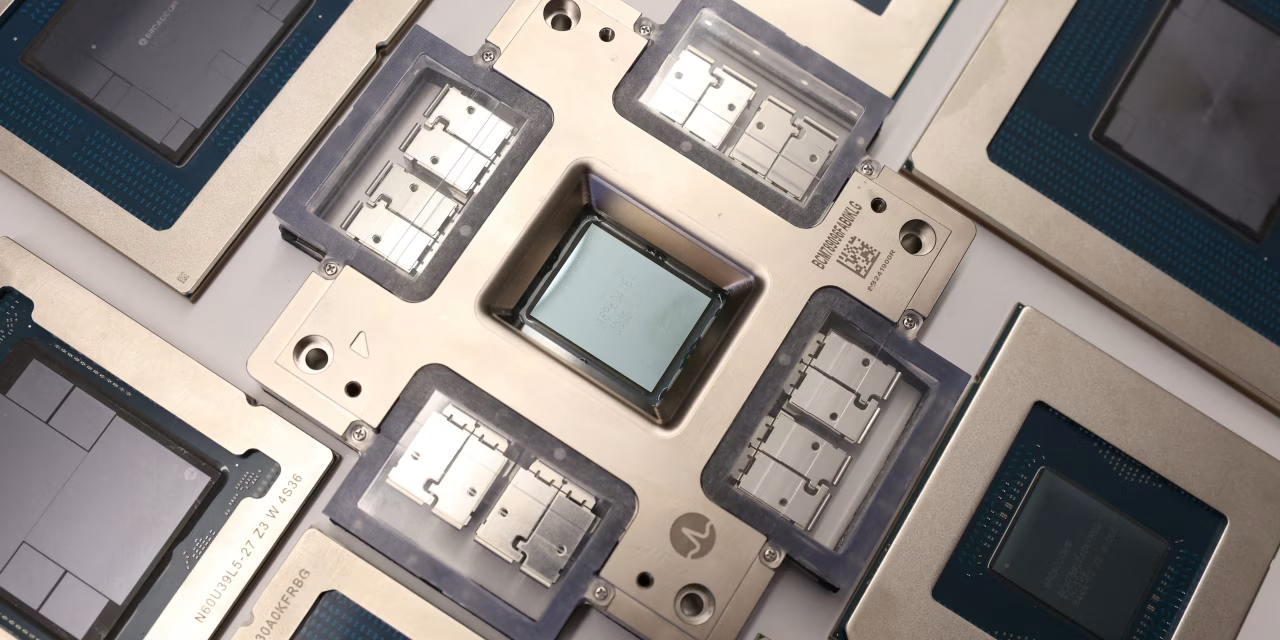
The hedge-fund herd was early to see opportunity in the stocks of chip makers and other artificial-intelligence hardware companies. Those bets just delivered stock-picking funds their best month in over two decades.
Steve Cohen’s Point72, Whale Rock Capital Management and Seligman Investments are among the hedge-fund firms that posted strong returns in April thanks in part to rallies in semiconductor stocks and those of related equipment makers.
Copyright ©2026 Dow Jones & Company, Inc. All Rights Reserved. 87990cbe856818d5eddac44c7b1cdeb8
Bit Digital earnings matched, revenue topped estimates


Deal would create $10 billion food ingredient solution provider.
Business
Adani Power vs. Green vs. Energy: Why mutual funds are betting billions on this electrification trio
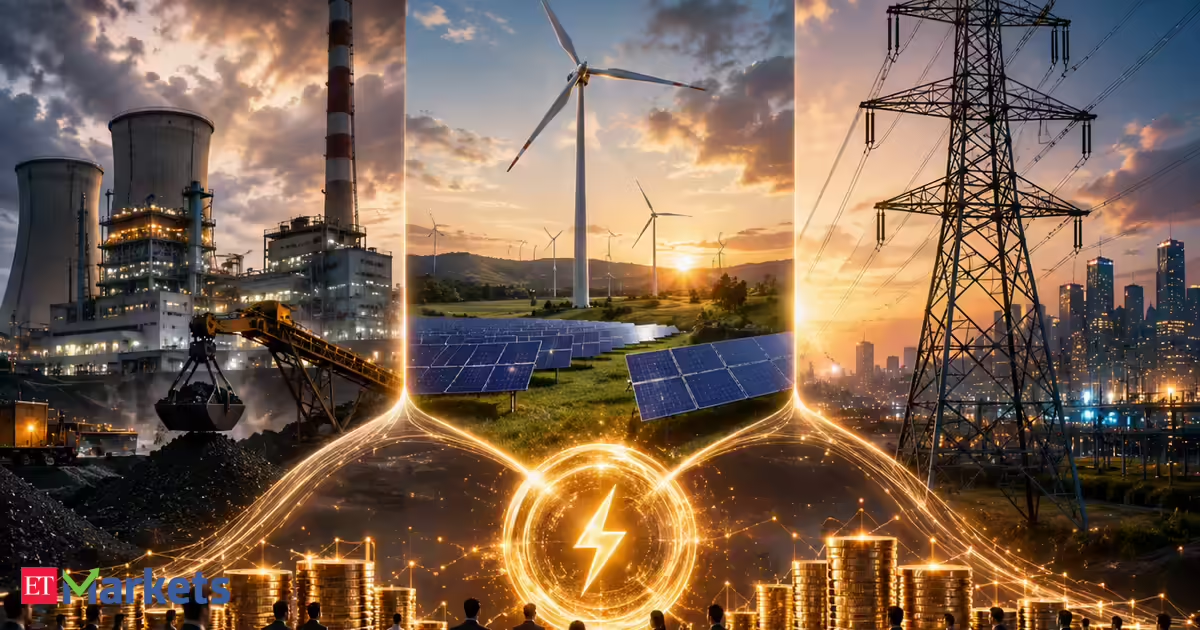
Fresh shareholding data through March 2026 reveals a decisive institutional shift. Mutual fund (MF) ownership in Adani Energy Solutions has more than tripled, surging from 1.91% in December 2024 to 6.59% in March 2026. Adani Green Energy saw an even more dramatic institutional entry, with holdings jumping from a negligible 0.37% to 3.22% in the same period. Adani Power also witnessed steady accumulation, with MF stakes rising from 1.60% to 3.62%.
The pace and breadth of accumulation signal something beyond opportunistic bottom-fishing. Domestic institutions are reclassifying these stocks, not as high-volatility conglomerate plays, but as long-duration infrastructure compounders tied directly to India’s electrification cycle, according to a fund manager who didn’t wish to be named.
The investment logic begins with cash flow. More than 70% of the Adani Group’s EBITDA is derived from contracted capacity, a structure that gives earnings a visibility and predictability rare in large-cap Indian equities. For fund managers running diversified portfolios, that contracted revenue base, spanning power generation, transmission, renewables and logistics, offers a cushion against commodity or macro volatility.
Bullish market estimates project the group’s consolidated EBITDA could scale to Rs 2.5–3 lakh crore by FY30, driven by simultaneous expansion across thermal power, renewables, transmission, ports, airports, cement and logistics.

Also Read | With 50% rally in 2026, Adani Power now most valued power company in India: What’s working in its favour
The Electrification Bet
The more powerful driver, however, is thematic. Adani Power, Green and Energy Solutions sit at the intersection of the most structurally urgent demand story in India’s economy right now: electricity.
The rapid scaling of data centres, electric mobility, manufacturing under the production-linked incentive framework, and urban infrastructure expansion will require reliable, large-scale power supply at a pace India has rarely had to deliver before. AI-linked power demand, still nascent but accelerating, adds another layer of urgency to an already strained grid.That positions generation, transmission and renewable energy assets at the precise centre of the next capital expenditure supercycle. For funds searching for large-cap names with visible growth triggers and durable earnings upside, the Adani energy trio is increasingly passing that screen.
Mutual fund analysts are giving explicit weight to the group’s track record here: ports built and operated at scale, transmission corridors commissioned, renewable capacity added quarter after quarter, airports turned around and airports greenfielded, cement capacity absorbed through acquisition.
Adani Power shares have surged 108% in the past year. A near-50% jump in 2026 alone has pushed its market capitalisation to ₹4.3 lakh crore, edging past NTPC to make it India’s most valuable listed power company and the most valuable within the Adani Group itself. The rally has been fuelled by strong earnings growth, rising electricity demand and steady institutional accumulation.
Also Read |Crude@$100+: The Rs 3 lakh crore power boom you might be missing
Yet Jefferies is not calling time on the trade. The brokerage has raised its price target on Adani Power to ₹255 from ₹185, rolling over to 20x FY28 estimated earnings, citing rising power demand and healthy growth prospects for the next three to four years.
On Adani Energy Solutions, up 48% over the past year, Jefferies maintains a Buy, pointing to a factor that sets it apart structurally: it is India’s only listed private-sector pure play on transmission and distribution assets. The order book stands at ₹718 billion of transmission projects on hand, up 20% year-on-year. And despite the recent run, the stock still trades at a 68% discount to its January 2023 peak EV/EBITDA. Adani Green Energy has gained 46% over the same period.
(Disclaimer: Recommendations, suggestions, views and opinions given by the experts are their own. These do not represent the views of The Economic Times)

The former General Motors headquarters inside the Renaissance Center in Detroit, April 15, 2024.
Jeff Kowalsky | Bloomberg | Getty Images
DETROIT — As artificial intelligence expands, it threatens to exacerbate a growing trend for America’s largest automakers: the elimination of white-collar workers.
The “Detroit Three” automakers have together cut more than 20,000 U.S. salaried jobs, or 19% of their combined workforces, from recent employment peaks this decade, according to public filings and employment data from the companies.
Reasons for the job declines vary by automaker, but in general are tied to evolving technological changes in the automotive industry, with the rise of software-defined vehicles, autonomous and all-electric vehicles, and, most recently, AI.
“Artificial intelligence is going to replace literally half of all white-collar workers in the U.S.,” Ford CEO Jim Farley said in July at the Aspen ideas Festival. “AI will leave a lot of white-collar people behind,” he added later.
The largest American automaker has led the cuts, with General Motors reducing U.S. salaried headcounts by roughly 11,000 people from 2022 through last year. Those job cuts came after GM had a run-up in employment, expanding from 48,000 U.S. white-collar workers in 2020 to 58,000 in 2022.
Ford Motor and Chrysler parent Stellantis have cut jobs more gradually. From its salaried employment peak in 2020, Ford has scaled back by roughly 5,300 workers to reach about 30,700 white-collar employees last year, while Stellantis has gone from 15,000 salaried workers in 2020 to about 11,000 during that time.
On an annual basis, combined white-collar employment for the three automakers peaked at roughly 102,000 jobs in 2022. It fell 13%, to 88,700 people, as of the end of last year.
GM IT layoffs
Gad Levanon, chief economist at the labor data market nonprofit Burning Glass Institute, said he believes the jobs most at risk of being replaced by AI are clerical positions and more repetitive office jobs, like those in finance and information technology, including coding.
“A lot of white collar workers will lose their jobs because AI can automate some of their tasks,” he said, adding that some losses will be offset by jobs in growing areas of importance for automakers, such as autonomous vehicles, cybersecurity and software-defined vehicles. “I think it will be a major trend in the next decade or two.”
GM this week added to its cuts by laying off between 500 and 600 salaried workers globally, largely in information technology operations in Texas and Michigan, people familiar with the matter told CNBC, speaking anonymously about details that had not been made public. Those cuts were partially due to changing workforce needs involving AI, the people said.
GM’s layoffs came as the automaker is increasingly hiring for AI-related jobs and encouraging workers, including in IT, to embrace its AI platforms, according to a handful of current or former GM employees and the company’s hiring website.
“They’re going to push AI for everyday work and everything else,” a veteran programmer and data scientist for GM who was laid off this week told CNBC, speaking anonymously for fear of repercussions or impacts to potential future jobs. “I’ve seen it firsthand. It can make you much more productive, as a programmer. It can really help you get more work done, but AI isn’t going to do you any good if you don’t know the business.”
Mary Barra, chairman and chief executive officer of General Motors Co., speaks during the grand opening of General Motors global headquarters at Hudson’s Detroit in Detroit, Michigan, US, on Monday, Jan. 12, 2026.
Jeff Kowalsky | Bloomberg | Getty Images
Prior to the IT reductions, notable decreases in GM’s U.S. salaried workforce occurred as a result the winding down and eventual discontinuation of its Cruise robotaxi business as well as rolling evaluations of the company’s workforce under GM CEO Mary Barra.
“Sometimes the people who got you to ‘point A’ aren’t necessarily people who are going to get you to ‘point B,’” Barra said during an Automotive Press Association meeting in January about turnover in the automaker’s top ranks.
GM, Ford and Stellantis declined to comment on their reductions in U.S. white-collar workers in recent years.
The automakers have previously cited “transformations,” “bold choices,” cost-cutting and “strengthening” or making a unit more efficient as reasons for job cuts.
Help wanted
The decline in salaried jobs at the Detroit Three isn’t necessarily representative of the overall U.S. automotive industry.
The U.S. Bureau of Labor Statistics reports motor vehicle manufacturing jobs only dropped by 0.2% from 2022 through last year, to 285,800 workers. That data includes both salaried and hourly workers.
And not all automakers have been cutting U.S. salaried jobs. Toyota Motor reported a roughly 31% increase in its American white-collar workforce from 2020 through 2025, to roughly 47,500 people.
Ford, GM and Stellantis are also still hiring for some roles.
Ford CEO Jim Farley speaks as Stellantis CEO Antonio Filosa, U.S. Rep Lisa McClain (R-MI), U.S. Transportation Secretary Sean Duffy and U.S. President Donald Trump listen during the announcement of new fuel economy standards, in the Oval Office at the White House in Washington, D.C., U.S., December 3, 2025.
Brian Snyder | Reuters
Stellantis CEO Antonio Filosa, who is leading a companywide turnaround that includes a global cost-cutting program, has said the company still plans to add more than 2,000 white-collar jobs in North America.
Combined, the Detroit automakers currently have more than 2,000 open positions in the U.S., according to their job sites. Of those posted jobs, nearly 400 involve AI, with GM seeking more than 250 positions dealing with AI, according to search results.
Lenny LaRocca, lead of consulting firm KPMG’s automotive practice in the Americas, said automakers need to be cautious about how they execute AI strategies with workers.
“They really need to think about how they adapt it and use it to generate, to be more efficient and be more profitable,” he said. “I don’t know necessarily if it’s just to reduce headcounts. I think the focus is more on how do they do their job better and how to be more innovative and move quicker.”
Work roles are evolving quickly with AI, requiring new skills, according to a recent post from Gregory Emerson, managing director and senior partner at Boston Consulting Group.
BCG forecasts five years from now — or perhaps further in the future — 10% to 15% of jobs in the U.S. could be eliminated as AI proliferates, with 50% to 55% of U.S. jobs being reshaped by AI over the next two to three years.
“This shift is already happening—and will pick up speed as AI adoption spreads,” Emerson wrote in the coauthored report. “Those who cut their workforce beyond AI’s ability to replace it will see productivity drop, institutional knowledge disappear, and critical talent walk away. Those who fail to dramatically rethink work will see their competitors grow faster and more profitably.”

Cricut's Plunge Offers A Way To Design Returns Into Your Portfolio
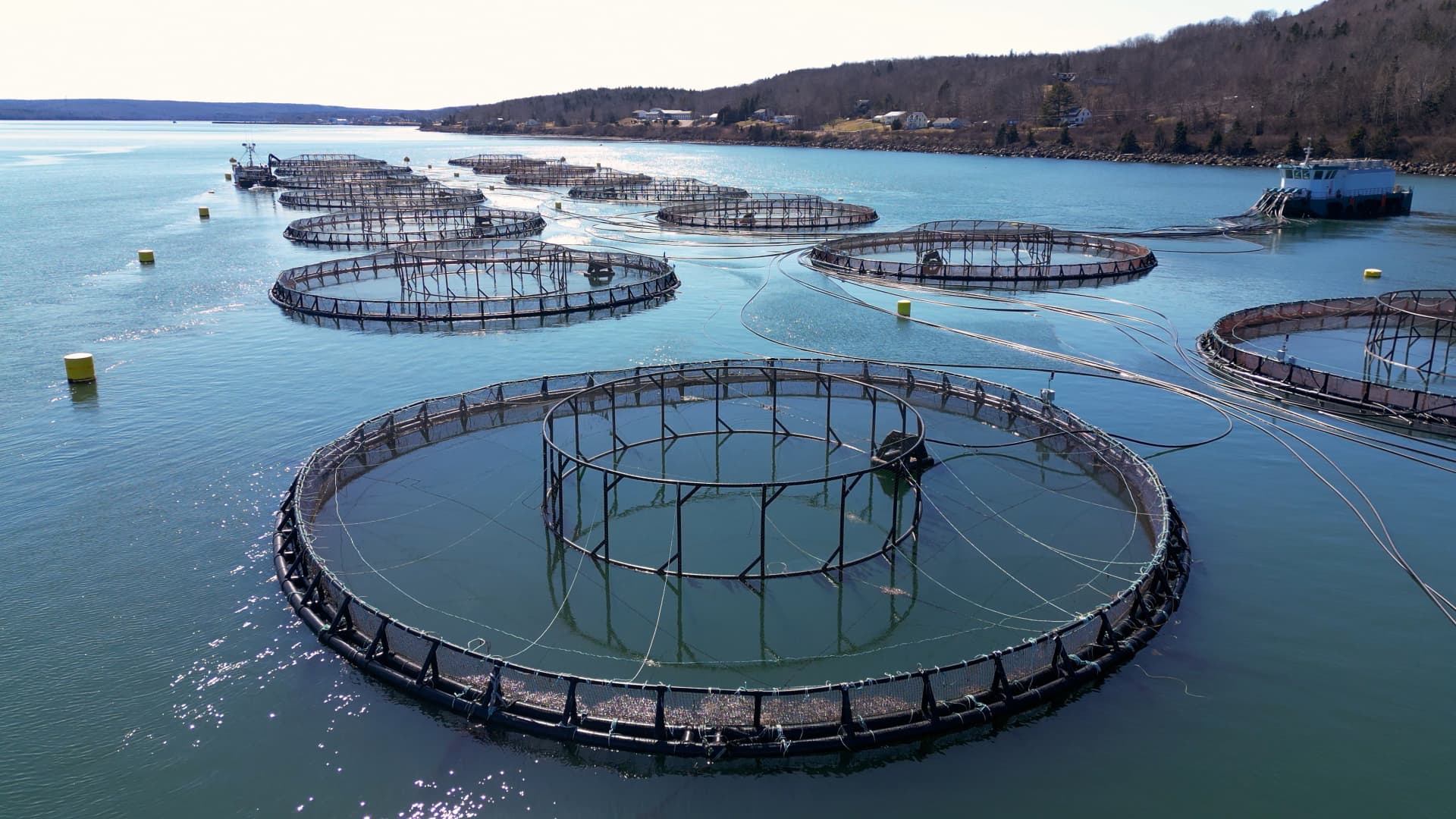
Fish farm nets on the East coast.
Shaunl | E+ | Getty Images
A version of this article first appeared in CNBC’s Inside Wealth newsletter with Robert Frank, a weekly guide to the high net worth investor and consumer. Sign up to receive future editions, straight to your inbox.
Equity Group Investments, backed by the family of late billionaire Sam Zell, owns a John Deere dealership, a bluefin tuna fishery and a pedestrian bridge that connects San Diego to Tijuana International Airport.
While those holdings sound entirely unrelated, what unites the private investment firm’s wide-ranging portfolio is a focus on old-economy businesses that are less susceptible to disruption from artificial intelligence and other technologies, according to EGI’s president, Mark Sotir.
“We tend to put our capital to work for a longer duration than most [private equity] firms. If you’re thinking out 10 years, 12 years, you have to start with picking a company in an industry that you know will be around,” he said. “That’s why we shy away from some tech and some startups. It’s not because we don’t like doing them. It’s just very hard for me to tell you where software is going to be 10 years out.”
The anti-AI trade gained steam on Wall Street earlier this year, dubbed “HALO” for “heavy assets, low obsolescence.” Family offices already employ the same strategy with private markets as they invest for generations and value the cash flow that often comes with old-economy businesses, according to Sotir. Economic uncertainty and tax reform has also made backing these asset-heavy companies more attractive.
Asset-heavy businesses tend to deter traditional PE investors who are looking to buy and sell within three to seven years, giving family offices opportunities to acquire at a discount, according to Sotir.
“Everybody gets so enamored with asset-light, but I like to say, ‘If you’re paying an asset-light premium, then I’m not sure where the advantage is,’” he said.
The “one big beautiful bill” law also provided a boon to owners of these businesses by renewing bonus depreciation, enabling companies to deduct the full cost of qualifying assets like machinery or vehicles the first year they are used.
“It’s a very material change that can make a big difference in terms of the tax benefit,” said Brian Hans, who leads the tax efficiency strategists for UBS’ advanced planning group. “Family office clients are increasingly approaching investing in general with more proactive tax planning, looking at the after-tax return, calculating what the return from the investment is going to be, and factoring that in when making the decision to invest.”
If the business is an active investment, the depreciation can be used to deduct against income on other active investments like stocks, Hans added. This is a sizable benefit for families that have highly appreciated stock holdings, he said.
Auto and equipment dealerships are ripe for taking advantage of bonus depreciation and check off other important boxes for families like reliable cash flow, according to Joe Mowery, head of dealership investment banking at Stephens.
“It’s very simple. They like a tax-advantaged income stream,” Mowery said.
While inflation and other economic trends can weigh on consumers’ ability to buy vehicles and equipment, the parts and service business is resilient and has high margins, according to Mowery.
“It’s not a nice-to-have. It’s a must-have. You know, you got to get to work, you got to take the kids to school, whatever the case may be,” he said.
Old-economy businesses aren’t immune to disruption, but they can come with geographic moats, limiting competition, according to Sotir. For instance, EGI owns John Deere and Kenworth dealerships. Thanks to the franchise terms, Sotir said he does not have to worry about another dealership of the same brand opening nearby.
As for EGI’s bluefin tuna fishing and farming business in Baja California, there are substantial barriers to entry due to quotas on fishing, according to Sotir.
EGI isn’t under pressure to deploy capital, unlike traditional PE firms, as it’s family backed, Sotir said, noting the firm typically makes one to two deals a year. Sotir said the firm is receiving more inbound queries from business owners who are pressured by tariffs, inflation and other factors.
“The amount of uncertainty that people are dealing with has oddly turned into a benefit for us,” he said.
There are attractive opportunities in agriculture, with farms under tremendous stress, Sotir said. The challenges are real, such as the rising costs of fertilizer and fuel, but EGI can afford to wait for a payoff, he said.
“People are worried about the space, and that’s the perfect time for us to step in to buy,” he said. “Even if the value doesn’t come in the first two, three years, that’s okay, as long as we know it’s coming, because we’ve got that duration.”

Pro-Dex: Still A Buy, But Don't Chase

Mark Pownall is joined by Gary Adshead, Ella Loneragan, Tom Zaunmayr and Jack McGinn to discuss the Federal budget, a huge native title win, Exmouth tourism project, a big CBD sale, and more.

How to watch Aston Villa vs Liverpool FC: TV channel and live stream for Premier League today

David Beckham becomes UK’s first billionaire sportsman

Solana news: Anatoly Yakovenko Says Alpenglow Launch Proves Solana’s Design Is Working

Manchester United reach agreement with Casemiro over contract clause amid transfer speculation

US brings back mandatory military draft registration

Steven Gerrard disagrees with Gary Neville over ‘shock’ Chelsea and Arsenal claim | Football


-

 Fashion7 days ago
Weekend Open Thread: Marianne Dress
-

 Fashion4 days ago
Coffee Break: Travel Steam Iron
-

 Fashion4 days ago
What to Know Before Buying a Curling Wand or Curling Iron
-

 Politics4 days ago
What to expect when you’re expecting a budget
-

 Tech5 days ago
Auto Enthusiast Carves Functional Two-Stroke Engine from Solid Metal
-
 Business6 days ago
Ignore market noise, India’s long-term story intact, say D-Street bulls Ramesh Damani and Sunil Singhania
-

 Politics6 days ago
Politics Home Article | Starmer Enters The Danger Zone
-

 Tech4 days ago
GM Agrees To Pay $12.75 Million To Settle California Lawsuit Over Misuse Of Customers’ Driving Data
-

 Crypto World5 days ago
CZ says US crypto rivals tried to block Trump pardon
-

 Crypto World6 days ago
PROS explodes 48% as Upbit and Bithumb listings ignite demand
-

 Entertainment7 days ago
YNW Melly Denied Bond Again Ahead Of Double Murder Retrial
-

 Tech4 days ago
GM agrees to $12.75M California settlement over sale of drivers’ data
-

 Crypto World7 days ago
Kraken Parent Seeks OCC Charter, Signaling Regulated Banking Access
-
Crypto World7 days ago
The Hantavirus Danger: Can a Potential Outbreak Spark a New Meme Coin Frenzy?
-

 Sports7 days ago
After Waka Waka, Shakira now drops first teaser for FIFA WC 2026 song | FIFA World Cup 2022
-
Crypto World2 days ago
Bitcoin Suisse expands with Digital Asset License and Investment Business Act Registration Approval in Bermuda
-
 Crypto World7 days ago
Solana UFO Meme Coins Surge After Pentagon Reveals Alien Files
-

 Entertainment7 days ago
Bethenny Frankel Says She Loves ‘Torturing’ Men
-

 Sports7 days ago
Why Nathan Mackinnon Remains the Hart Trophy Favourite over Connor McDavid and Nikita Kucherov | NHL
-

 Politics3 days ago
Pakistan to enter Chinese capital market as war inflation bites
You must be logged in to post a comment Login