Connect with us

Business

Going underground by 2050? Inside ambitious plans for travel in Greater Manchester

Published

on

Business Live

Bev Craig says ‘We’ve started planning for what future is possible, and that means going underground’

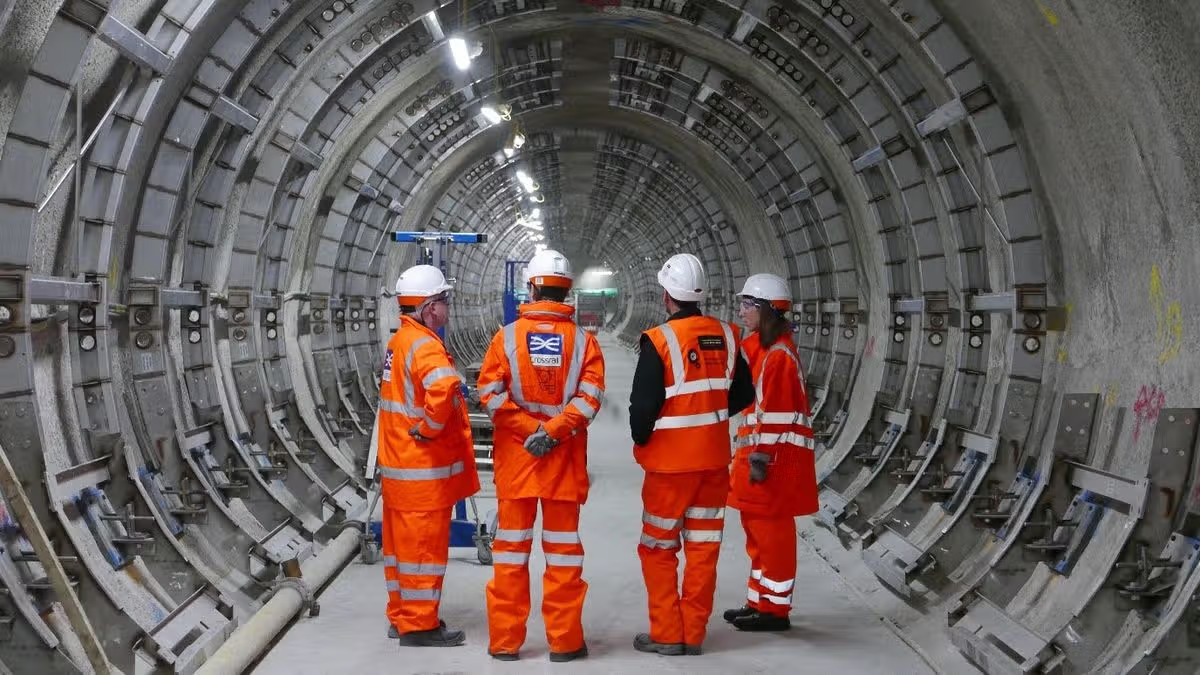
The Elizabeth Line project in London has been a huge success

The Elizabeth Line project in London has been a huge success(Image: Transport for London)

A ‘mega’ project to create Greater Manchester’s own London Underground-style transport system has been backed by mayor Bev Craig with 2050 eyed as a potential opening date.

Advertisement

The enormous scheme would likely cost tens of billions of pounds and take decades to build with the need for government backing, but a new widescale underground transport system has been described by the mayor as the ‘only option’ for Greater Manchester’s future.

Some have speculated that a future underground metro system could mean millions of journeys a day happening below the surface, speeding up the time it takes to get to Greater Manchester’s busiest destinations and lifting pressure from roads, motorways and existing public transport services.

The idea is separate from demands from city leaders in Manchester for an underground railway station at Manchester Piccadilly, which would play a part in boosting railway travel supporting the £45bn Northern Powerhouse Rail project. But a new underground station at Piccadilly is seen as being an essential ‘first step’ ahead of wider plans for Greater Manchester, including the potential for a future underground tube network.

A new underground metro system in the region is far from being a pipedream, bosses at Transport for Greater Manchester (TfGM) have already spent more than £300,000 on early feasibility and demand studies over future options after it became a key aim of former mayor Andy Burnham.

Advertisement

Work taking place at the moment includes early geological studies, known as ‘route proving’, such as identifying major obstructions such as the Guardian Underground Telephone Exchange, as well as looking at which parts of Greater Manchester’s existing transport network will come under the greatest pressure by 2050.

TfGM’s own timeline for the project could see detailed plans and a business case ready by 2030, with a push to secure the powers and funding to start building by around 2040, ahead of a 2050 potential opening date.

Bev Craig told the Local Democracy Reporting Service: “Greater Manchester is the fastest growing city region in the country. Every year more people are coming here to visit, work and live.

“Too often our congested rail network causes delays for passengers and inconvenience for businesses. We need a transport network that helps us go even further – not one that holds us back.

Advertisement

“In Greater Manchester we’ve started planning for what future is possible, and that means going underground.

“A new, modern underground station at Piccadilly is an essential first step in creating jobs and boosting major regeneration here.

“An underground station at Piccadilly would open the door to a wider underground transport system that, for me, is the only option that’s fit for a world-class city region like ours. Over the last few years, I’ve led the campaign for our underground station and, as mayor, I’m continuing to make the case to government to get the right solution for Greater Manchester.

“We also need to think big when it comes to the decades ahead. Our roads are congested and building new networks above ground will be tough. Major cities around the world have gone underground, why can’t Greater Manchester? Manchester Piccadilly station is the first step in unlocking a bright new future.”

Advertisement

It is understood that any tunnelling for a future underground transport system would initially be focused around central Manchester, but a mix of options for how it could work are actively being looked at.

Underground options being explored for the region include a Metrolink relief tunnel going south-west to north-east aligned with the longest serving and busiest Metrolink lines, Altrincham and Bury.

A National Rail relief tunnel is also being looked at, which would go north-west to south-east, aligned with the Castlefield Corridor and Salford Crescent to Piccadilly. This would focus on high-frequency and high-capacity services using an approach similar to the Munich S-Bahn and London’s Elizabeth line.

Concept design for an underground HS2 station at Manchester Piccadilly

Concept design for an underground HS2 station at Manchester Piccadilly(Image: MCC)

The third option being looked at is for a wholly segregated underground metro system going north to south, plugging a gap in an area that currently has no tram or train lines running broadly from the Northern Gateway to the Airport via a number of hospitals, universities and other major facilities.

Advertisement

Business leaders and politicians around Greater Manchester have said that the need for a London Underground-style transport system in Greater Manchester is increasingly becoming a ‘must have’.

But to move forward any future project would require firm government backing and hard cash.

Prime Minister Andy Burnham said in 2024 when he was mayor of Greater Manchester that the region ‘has to go underground’ to continue growing. It was a story featured on the front page of the Manchester Evening News and shared by Mr Burnham himself on social media at the time.

The question is whether his government would be willing to turn the plans into reality.

Advertisement

Many figures in Greater Manchester believe the plans must move forward at pace to take some of the stress away from Bee Network trams and buses, as well as easing congestion on roads and motorways.

“An underground tube system is the only credible option for Greater Manchester going forward,” said Robert Downes, regional business manager at the Federation of Small Businesses in Greater Manchester.

“You ask businesses what’s important to them when it comes to transport, and you soon understand where they’re coming from: any system that can move people around at scale can only be a good thing.

“Whether it’s customers or staff, effective mass transportation by whatever means – road, rail, or tram – is a massive boon for businesses.

Advertisement

“Just look at London. It’s a magnet for commerce and that’s partly because the public transport system there is so well-rounded. London is the only place in all the UK where not owning a car is genuinely doable for the many.

“A GM tube could make that a reality here, but it would cost mega-money and take decades to build.”

Mr Downes said that the region’s tram system, ‘while great, is clunky, and takes up valuable overground infrastructure space’.

He added: “To expand it meaningfully in a city region that’s already desperately short on real estate means tunnelling is the only credible path.

Advertisement
Manchester mayor Bev Craig

Greater Manchester mayor Bev Craig(Image: Anthony Moss | Manchester Evening News)

“Underground would take much of the pain out of the planning process but the catch is it doesn’t come cheap.

“Ultimately, Greater Manchester needs and deserves better public transport if we are to achieve our ambitions of becoming a truly world leading, global hub.”

Manchester City Council leader Garry Bridges has also supported the need for better transport options around the region.

He said: “It’s right that we look ahead to the transport challenges of the future to ensure Manchester can continue to flourish.

Advertisement

“In this country it can be frustrating how long it takes to build the infrastructure we need which is why it’s important to get ahead of the curve now.

“The first fight we need to win is securing a new underground station at Manchester Piccadilly. This will ensure that the full benefits of Northern Powerhouse Rail, which the Government is committed to, are maximised.

“An underground Piccadilly Station would sit at the heart of the Northern Powerhouse Rail, allowing through services and scope for further growth.

“An underground rapid transit system is an interesting, and potentially exciting idea, which is worth exploring. But an underground Piccadilly Station really is the vital first step to any wider underground system.”

Advertisement

Manchester city centre would be an obvious starting point for an underground metro system, and could speed up journeys for huge amounts of people who currently rely on buses or car to trek across central Manchester.

St Peters Square Metrolink stop, Manchester

St Peters Square Metrolink stop in Manchester(Image: Manchester Evening News)

Councillor Jon-Connor Lyons, who represents the Piccadilly ward in Manchester, said of the plans: “Manchester can’t keep growing above ground while pretending the answer to our transport needs isn’t below our feet.

“I fully back plans for an underground station at Piccadilly and a tube-like transport network, it will be a genuinely ambitious approach to how we move people around our city.

“Done properly, this could transform accessibility across Manchester and unlock areas across Greater Manchester for new homes and jobs.

Advertisement

“A better-connected Manchester isn’t just about getting from A to B faster, it’s about creating one truly connected city region and giving people access to opportunities wherever they live.”

Others have stressed the need for underground travel to go beyond Manchester city centre to other boroughs.

Jonathan Moore is leader of Salford Lib Dems and a councillor in Salford Quays, an area with big plans to grow with MediaCity set to double in size in future years.

But public transport options in Salford Quays are already under major strain, with reports of passengers ‘struggling’ to get home.

Advertisement

Councillor Moore said: “We’ve already seen a shift away from cars. New flats are built without parking. New houses have less parking. Parts of the city are closed to cars.

“The environmental impact of this is clear and beneficial. However, this only works when new alternatives are put in place to keep up with demand, which in GM is growing far faster than supply.”

The Salford councillor explained that Metrolink trams can be ‘very slow and clunky’, and ‘can only go where there is space to install new lines’.

He added: “In my ward at Salford Quays, the population is set to at least treble to 40k people by 2040. It is inconceivable that the above-ground Metrolink can cope with that growth.

Advertisement
A passenger boarding an Elizabeth Line carriage at Paddington Station, London

A passenger boarding an Elizabeth Line carriage at Paddington Station in London(Image: PA)

“In London, most people use the underground. A population of circa 9 million across Greater London make 4-5 million journeys on the underground every day.

“In GM we have circa 3 million people, so a similarly comprehensive network could cater for 1-2 million journeys a day. Imagine the benefits to our cities, suburbs and motorways if we saw that here.

“At a meeting I attended with Highways England in July, we were told that the northwest quadrant of the M60 is now the worst performing motorway in the UK if you exclude the M25.

“Roughly half of the journeys on that section are local commuters traveling 1-2 junctions. The distance is too great to walk, and not everyone can or should cycle, but everyone can use an underground. If we had an underground, traffic would flow better on the M60, which would save hundreds of thousands of hours a year and our economy would reap the benefits.

Advertisement

“An underground will only happen if the politicians of today are determined, focussed, and brave in the way that the Victorians were. We have the engineering capability, far more than the Victorians had, and we have the knowledge of the need and the climate imperative.

“All that we don’t have is the cash and the determination. Now is the time for national and local politicians to find these missing ingredients.”

Asked about the plans for underground travel in Greater Manchester, a Department for Transport spokesperson said: “Everyone across the country should have access to good public transport, which is why we are working closely with Greater Manchester to look at improving connectivity across the North.

“As part of this, we’re reviewing the possibility for an underground station at Manchester Piccadilly for Northern Powerhouse Rail.”

Advertisement
Continue Reading
Click to comment

You must be logged in to post a comment Login

Leave a Reply

Business

Identiv completes asset sale, rebrands as INVE Technologies

Published

on


Identiv completes asset sale, rebrands as INVE Technologies

Continue Reading

Business

US borrowing costs hit highest level since 2007 as oil prices jump

Published

on

Jack Clark, a man with short brown hair, dressed in a blue coat

US government borrowing costs climbed to their highest level since 2007 after a jump in oil prices further fuelled concerns about inflation.

The effective interest rate on US government bonds over 10 years, known as the 10-year Treasury yield, rose as high as 5.04% but has eased back since.

Government bond yields have been rising globally for months, driven by worries that inflation caused by the oil price surge since the start of the US-Israel war with Iran will lead to higher interest rates.

The US has been buying back bonds back in a bid to drive the Treasury yield down, with Treasury Secretary Scott Bessent calling the intervention “successful”.

Advertisement

The global benchmark wholesale oil price rose to over $109 a barrel on Tuesday, up from around $86 at the end of August, after renewed concerns about Saudi Arabia’s ability to export oil following rising tensions in the region.

Investors are anticipating the US Federal Reserve Chair Kevin Warsh will raise interest rates to combat the inflation caused by higher oil prices.

However, US President Donald Trump opposes a rate hike, having long argued lower rates are great for boosting the economy.

He fell out with Warsh’s predecessor Jerome Powell over his decision not to cut rates.

Advertisement

Higher interest rates and inflation tend to drive up the yields bond investors demand on government borrowing.

Bond yields can also be a sign of how much faith investors have in a given government, with a higher yield reflecting less confidence.

Competition for debt from artificial intelligence (AI) firms is also driving up yields.

Tech giants are borrowing massive piles of cash to build huge data centres. This raises interest rates on tech firm’s debt which increases government bond yields in response.

Advertisement

Carol Schleif, chief market strategist at BMO Wealth Management, said bond markets had been signalling for weeks that higher interest rates may be needed.

While the rise in borrowing costs has been “orderly” this year, rather than sudden, she said rates could remain elevated if geopolitical tensions and high energy prices remain “front and center”.

Continue Reading

Business

Food innovators join Mars, Unreasonable Group accelerator cohort

Published

on

Food innovators join Mars, Unreasonable Group accelerator cohort


Advertisement


Food innovators join Mars, Unreasonable Group accelerator cohort | Food Business News

Advertisement

Advertisement


Skip To Content

Advertisement

Continue Reading

Business

Tag Markets Is Building a Unicorn Brokerage Regulated And Trusted In Australia

Published

on

Two traders can open accounts with the same brokerage and want completely different things from it.

One may be learning how Forex markets work and want time to build confidence before participating. Another may prefer to analyse the market independently and make every decision personally. A third may be interested in following an existing strategy after reviewing how that trader has performed over time.

Tag Markets has been designing its brokerage around those differences.

Rather than assuming there is one ideal path for every client, Tag Markets has developed an environment in which education, independent trading, copy trading and different account structures can sit alongside one another. The brokerage provides the infrastructure while giving clients greater freedom to decide how they want to participate.

Advertisement

Education can be the starting point for someone still developing their knowledge.

Through its Forex education resources, Tag Markets provides video courses, written learning material and live training sessions at no additional cost. Clients can use these resources to build their understanding before deciding whether they are ready to trade or which approach makes the most sense for them.

Access and readiness are not the same thing. Opening an account may be straightforward, but understanding market behaviour, trading terminology and the choices available through a brokerage can take considerably longer. Giving clients the opportunity to learn first creates a different starting point.

Experienced traders may want something entirely different.

Advertisement
Tag Markets

Someone who already understands the markets may prefer to analyse opportunities, develop a strategy and execute every decision independently. Tag Markets continues to support that approach rather than assuming automation or guided participation will suit everyone.

CopyX serves another preference.

Through its proprietary CopyX copy trading technology, clients can review available traders and strategies, examine their results over time and decide whether they want qualifying trading activity replicated automatically in their own accounts.

The technology changes the level of involvement without removing the client’s initial decision. Users still choose whether copy trading suits them and which trader or strategy they want to follow.

Historical results do not guarantee future outcomes, and trading involves risk. Their value lies in providing additional context when clients compare available options and decide whether this form of participation matches their preferences.

Advertisement

Account structure adds another dimension.

Tag Markets offers several trading account structures rather than relying on one standard format. Its offering includes conventional accounts alongside Amplify and the 12X and 24X models, giving eligible clients alternative ways to structure trading capital under the conditions attached to those accounts.

No single account structure needs to suit every trader. Different formats can appeal to different approaches to capital, trading activity and market participation. Providing alternatives gives clients another decision to make based on how they intend to use the brokerage.

Taken together, these products reveal a broader philosophy behind Tag Markets.

Advertisement

Education supports clients who want to learn before participating. Independent trading remains available for those who want direct control. CopyX gives clients another route through strategy following, while different account models create flexibility around how trading activity is structured.

Each responds to the same underlying reality: traders are not one customer type.

Traditional brokerage journeys can easily become standardised. A client registers, selects an account, funds it and begins trading. Tag Markets is moving away from the assumption that what happens after registration should look identical for everyone.

Technology makes that flexibility possible, but more features do not automatically create a better brokerage.

Advertisement

The stronger test is whether every tool has a clear purpose. Clients should be able to understand why an account differs, what CopyX allows them to do, where education fits and whether independent trading remains the better option for their own approach.

Choice becomes useful only when it remains understandable.

A new trader might begin with educational material before considering an account. Someone with greater experience may move directly into independent trading. Another client may investigate CopyX and compare available traders before deciding whether to follow a strategy.

Those journeys are different, yet they remain connected through the same brokerage.

Advertisement

This gives Tag Markets a way to serve a broader audience without defining one ideal type of trader. The company can build products around different levels of knowledge, involvement and preference while keeping those choices within one operating environment.

In a market where access to Forex and CFD products is already widely available, that flexibility creates another form of differentiation.

The question is no longer simply whether a brokerage can give someone access to the market. It is whether it can give different people the tools, knowledge and account structures that make sense for how they individually want to participate.

Tag Markets is building its offering around that distinction.

Advertisement
Continue Reading

Business

Keurig Dr Pepper Bought Size With JDE Peet’s, But Split Will Create Value (NASDAQ:KDP)

Published

on

Keurig Dr Pepper Bought Size With JDE Peet's, But Split Will Create Value (NASDAQ:KDP)

This article was written by

Excellent academic Finance background and Finance professional with over five years of cumulative experience in Consulting & Audit Firms including a professional Valuation position, FP&A and Controlling positions, and Financial writing.My approach is mostly value-oriented. However, valuation is rarely an appropriate short- to mid-term timing indicator, but rather hints at long-term chances or risks. In my pieces, I assign the written word and data presented more value than a simple rating and might often rate hold/neutral, even when my inclination is bullish or bearish. Rating systems do not consider time horizons or investment strategies. My articles aim to inform, not to make decisions.

Analyst’s Disclosure: I/we have a beneficial long position in the shares of KO, PEP either through stock ownership, options, or other derivatives. I wrote this article myself, and it expresses my own opinions. I am not receiving compensation for it (other than from Seeking Alpha). I have no business relationship with any company whose stock is mentioned in this article.

Seeking Alpha’s Disclosure: Past performance is no guarantee of future results. No recommendation or advice is being given as to whether any investment is suitable for a particular investor. Any views or opinions expressed above may not reflect those of Seeking Alpha as a whole. Seeking Alpha is not a licensed securities dealer, broker or US investment adviser or investment bank. Our analysts are third party authors that include both professional investors and individual investors who may not be licensed or certified by any institute or regulatory body.

Advertisement
Continue Reading

Business

On Holding’s Aversion to Discounting Tested by Softer Retail Sales

Published

on

On Holding’s Aversion to Discounting Tested by Softer Retail Sales

On Holding built its brand around product enhancements and refusing to discount its shoes and apparel. Now, a more promotional retail environment is testing that discipline.

Brands and retailers are working to appeal to shoppers whose wallets have been stretched by higher costs for gas, beef and more. Some are cutting prices while others roll out more deals in hopes that budget-conscious consumers will make a purchase. At On Holding, there are no plans to slash price tags even after its weakest retail sales since going public in 2021 forced the company to soften its sales outlook.

Copyright ©2026 Dow Jones & Company, Inc. All Rights Reserved. 87990cbe856818d5eddac44c7b1cdeb8

Continue Reading

Business

Ford increases V-8 engines, lowers performance prices

Published

on

Ford increases V-8 engines, lowers performance prices

 2024 Ford F-150 Raptor

Ford

DETROIT — Ford Motor is expanding the availability of V-8 engines and lowering the starting prices of some performance models for its 2027 lineup of F-150 pickup trucks.

The Detroit automaker said the changes are meant to give customers more choice and help expand sales of key models, a strategy Ford has been leaning into under CEO Jim Farley.

Advertisement

The changes come as automakers attempt to address industrywide affordability concerns. The moves are also building on some automakers — particularly the Detroit Three — adding more V-8 engines amid weakened emissions regulations and penalties under the Trump administration.

The new pricing doesn’t mean the trucks are cheap. The 2027 Ford F-150 Raptor will start at $77,800, which is $4,000 less than the current truck. The 2027 Tremor will start about $5,300 lower at $62,400, Ford said Tuesday.

Ford officials said the automaker lowered prices by eliminating some standard equipment, such as heated second-row seats as well as using manual instead of power controls for some parts, like the steering column.

2027 Ford F-150 Carhartt model

Advertisement

Courtesy Ford

“For us, it made sense because it just broadens the offer and certainly doesn’t take away from either the capability of that new entry or of the model that it came down from,” Todd Eckert, Ford Blue senior director of truck consumer marketing, told CNBC.

Regarding the V-8 availability, Ford will offer its 5.0-liter engine across every model of the F-150 lineup, Eckert said. That includes having the option for a V-8 engine in the high-end King Ranch and Platinum models for the first time since the 2023 model year.

“We heard pretty loudly from both customers and dealers that even on those premium series, that they wanted the option to have a V-8 engine,” Eckert said.

Advertisement

The changes are part of several updates the company is making to the F-150 lineup for the 2027 model year. It’s also rolling out style updates to many models and adding a Carhartt model in collaboration with the Detroit-based clothing company.

All the updates for the 2027 F-150 lineup come as Ford continues to increase availability of the crucial pickups after fires at an aluminum supplier severely impacted their output over the past year.

Ford’s F-Series trucks — which include the F-150 and larger “Super Duty” models such as F-250, F-350 and F-450 — were severely impacted by the supplier issues due to their large aluminum bodies and other components.

Advertisement
Continue Reading

Business

AMD Shares Rebound 3.48% as Chip Stocks Recover From Monday’s Sharp AI-Driven Slowdown Selloff Across Sector

Published

on

Oil Prices Plunge Below $95 as US-Iran Ceasefire Sparks Relief

SANTA CLARA, Calif. — Shares of Advanced Micro Devices Inc. rose 3.48% to $510.59 in Tuesday trading, adding $17.18, as semiconductor stocks broadly clawed back a portion of the losses posted Monday, when a weekend essay calling for a slower pace of artificial intelligence development triggered a steep selloff across the chip sector.

AMD’s gain builds on a modest recovery already underway Monday, when the stock closed up 1.34% at $500.00 following a volatile session earlier in the week. Tuesday’s rebound came alongside broader strength in chip-related names globally, echoing similar recoveries in Asian markets, where previously battered technology stocks also regained ground after Monday’s steep declines tied to the AI development debate sparked by Anthropic Chief Executive Officer Dario Amodei’s essay over the weekend.

AMD’s rebound comes against the backdrop of a notably bullish outlook the company laid out just days earlier at the Citi 2026 Global TMT Conference. Speaking at the event, AMD executives raised the company’s estimate for the total addressable market for artificial intelligence, now projecting the opportunity could reach $2 trillion by 2030. The company also said it expects its data-center sales to approach $70 billion in 2027, roughly double the business size it anticipates for 2026, with AI accelerators alone expected to generate sales in the low $40 billion range next year. AMD executives further projected that the broader server processor market could reach $220 billion by 2030, an area the company has identified as a second major growth driver alongside its AI accelerator business. The company said it has begun shipping its MI450 AI accelerator products, with production expected to build through the first quarter of 2027.

That bullish framing followed AMD’s second-quarter 2026 earnings report, released August 4, in which the company posted revenue of $11.54 billion, up 50% from a year earlier, alongside earnings of $1.66 per share, topping the $1.62 analysts had expected. Data-center revenue doubled year-over-year to $6.7 billion, now accounting for 58% of the company’s total sales, underscoring how central AI and server infrastructure demand has become to AMD’s overall business. The company guided third-quarter revenue to approximately $13 billion, implying roughly 41% year-over-year growth at the midpoint of that range, and said it expects server CPU revenue to climb more than 80% in the second half of 2026 and more than 70% in 2027, with its data-center segment projected to more than double in 2027 as its Helios and MI500 product lines ramp up production. Despite the strong headline numbers, AMD shares initially fell nearly 9% in after-hours trading following the report, as investors weighed rising operating expenses, up 40% year-over-year to $3.4 billion, against the company’s otherwise robust growth trajectory. Gaming revenue, by contrast, fell 31% year-over-year, reflecting continued softness in that segment even as AI and data-center demand has surged.

Advertisement

Wall Street’s overall assessment of AMD has remained strongly positive despite the stock’s recent volatility. According to 55 analysts polled by S&P Global, AMD carries a consensus rating of Strong Buy, with an average price target of $615.07, implying potential upside of roughly 25% from Monday’s closing price. Individual analyst targets range as high as $1,250 and as low as $365, reflecting a wide spread of views on how AMD’s AI-driven growth story will play out over the coming years. Piper Sandler initiated coverage of the stock with an Overweight rating on September 9, adding to the broadly bullish tilt among analysts covering the company.

AMD’s stock has delivered extraordinary returns over the past year, climbing roughly 225% according to data from TradingView, and reaching an all-time high of $584.73 on June 30, 2026, before pulling back amid the broader volatility that has affected AI-linked chip stocks in recent weeks. The stock’s beta of 1.79 reflects its tendency to move more sharply than the broader market in both directions, a pattern evident in both Monday’s steep decline and Tuesday’s rebound.

Tuesday’s recovery in AMD shares was part of a broader rebound across chip stocks, even as some peers continued to show signs of lingering weakness. Micron Technology, Broadcom, Intel and other major chipmakers had all posted sharp declines Monday alongside AMD, tied to the same broader concerns about the pace of AI infrastructure spending that triggered the sector-wide selloff. The extent to which Tuesday’s recovery proves durable is likely to depend heavily on how the broader debate over AI development timelines, sparked by Amodei’s essay and echoed by other prominent AI executives over the weekend, continues to evolve in the days ahead.

Investors are also weighing the upcoming Federal Reserve interest rate decision, expected Wednesday, as a separate factor likely to influence trading in high-growth, high-multiple technology stocks like AMD in the near term. Rising interest rates tend to pressure the valuations of companies whose worth is heavily tied to expectations of substantial future earnings growth, a dynamic that has added an additional layer of volatility to AMD and its chip sector peers even as the underlying demand story for AI infrastructure has, according to the company’s own recent guidance, continued to strengthen.

Advertisement

With AMD’s next earnings report not scheduled until November 3, investors are likely to rely on ongoing developments in the broader AI industry debate, along with any further analyst commentary following the company’s recent Citi conference presentation, to gauge whether Tuesday’s rebound marks a durable stabilization for the stock or merely a temporary bounce within a longer period of volatility tied to shifting sentiment around the pace of AI infrastructure spending.

Continue Reading

Business

Fair Work Ombudsman recovers $453m in unpaid wages for workers

Published

on

Fair Work Ombudsman recovers $453m in unpaid wages for workers

The Fair Work Ombudsman claims it has recovered $453 million in unpaid wages and entitlements for more than 181,000 workers across the country.

Continue Reading

Business

Onego Bio, Zen Waffles form partnership

Published

on

Onego Bio, Zen Waffles form partnership

Food Entrepreneur SAN DIEGO — Onego Bio and Zen Waffles have formed a commercial partnership to use Onego Bio’s Bioalbumen ingredient in Zen Waffles high-protein waffles.

Zen Waffles, New York, manufactures high-protein waffles that are available in classic, chocolate chip, blueberry, coconut and white chocolate strawberry varieties.

The waffles are formulated with cottage cheese, eggs, egg whites, almond flour, monk fruit sweetener, casein protein, vanilla extract, potassium sorbate and baking powder.

The waffles contain 23 grams of protein across the classic, blueberry and coconut varieties, and the chocolate chip flavor contains 28 grams of protein.

Onego Bio’s Bioalbumen is a non-animal egg protein that is manufactured via precision fermentation with the filamentous fungus, Trichoderma reesei, the company said. 

Advertisement

Bioalbumen functions similarly to traditional egg protein while offering food manufacturers a non-animal alternative.

“At Zen Waffles, our goal is to make high-protein foods convenient and delicious,” said Eugene Komissarov, co-founder of Zen Waffles. “Bioalbumen offers a great source of high-quality protein, helping us make products consumers already love nutritious and satisfying.”

Onego Bio received a “no questions” letter from The US Food and Drug Administration for its egg replacer, which the agency said is generally recognized as safe (GRAS) in 2025.

“In a waffle, egg protein does a lot of work: it provides structure for a light, tender interior and supports browning for a golden, crisp exterior, all while delivering high-quality protein,” said Maija Itkonen, co-founder and chief executive officer of Onego Bio. “Bioalbumen brings that multifunctionality together, giving food manufacturers a new way to meet growing demand for protein.” 

Advertisement

Enjoying this content? Learn about more disruptive startups on the Food Entrepreneur page.

Continue Reading

Trending

Copyright © 2025