Connect with us

NewsBeat

The demise of the single-handed backhand is a watershed moment for tennis

Published

on

The demise of the single-handed backhand is a watershed moment for tennis

Every year since the first Wimbledon Championship in 1877, a male player with a one-handed backhand has featured in the singles semi-finals of a grand slam. That 149 year streak ended at this year’s US Open when Stefanos Tsitsipas, the last remaining single-hander in the draw, exited the tournament in the round of 16.

This is a watershed moment for tennis, as it marks a break with the origins of the sport and the culmination of a five decades-long trend towards hitting the backhand with two hands on the racket. The popularity of the two-handed backhand has surpassed the single-hander to such an extent that the latter is now on the verge of extinction in elite tennis.

But does this matter? After all, sports evolve and athletes, coaches and sports scientists continually refine technique to achieve superior outcomes. Dick Fosbury revolutionised the high jump with the Fosbury flop in 1968. This development in high jump biomechanics unlocked new athletic feats and the straddle technique, previously dominant, became redundant. Perhaps the single-hander has, similarly, fallen victim to a superior technique.

Advertisement
A compilation of aesthetically pleasing one-handed backhands.

Why the one-handed backhand matters

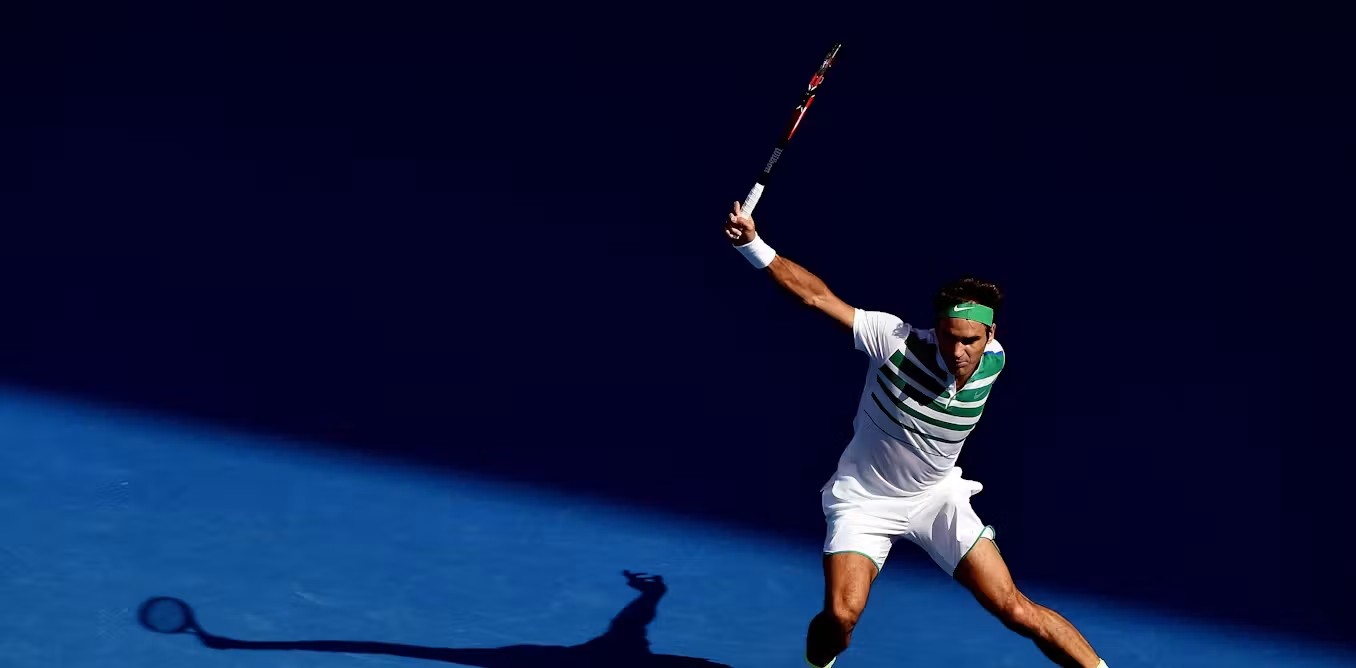
The one-handed backhand is arguably the most elegant shot in tennis. To execute it, the non-dominant hand pulls the racket back to coil the player’s hips and shoulders. As the ball enters the player’s hitting zone, the non-dominant hand releases and the racket whips through the ball while the other arm provides a counterbalance by extending in the opposite direction.

Its most skilled exponents, such as Roger Federer, Justine Henin and Stan Wawrinka, can produce explosive power in a balletic feat of flow, balance and timing.

The beauty of the one-hander is, in part, due to its superfluity. In tennis, aesthetics is incidental – shots are struck to win a point, not to beautify it. The pleasing aesthetics of the one-handed backhand is a delightful coincidence in which efficiency meets beauty.

However, one-handed backhands will soon be absent from the biggest tennis arenas. Why is this shot on the verge of extinction?

Advertisement

For a time in the early 2000’s, Roger Federer enjoyed exclusive dominance over men’s tennis. However, Rafael Nadal, a left-hander who was capable of generating more topspin than any player the game had ever seen, found a hole in Federer’s game – the shoulder-high backhand.

Federer explains why the one-hander is dying out.

Nadal pioneered a heavy topspin forehand that would bounce above Federer’s shoulder, forcing him either to retreat behind the baseline or to hit the ball in the weak shoulder-high position. Nadal would pound Federer’s backhand until this elicited an error or a short ball that could be attacked. Shoulder-high backhands are not only technically difficult for a one-hander, but also energy sapping.

The development of the two-handed backhand on the run, best exemplified by Novak Djokovic, also meant that the advantage which single-handers had hitting wide balls no longer obtained. Two-handers could hit with an open stance when stretched, and this enabled them to generate more power on the run and to recover for the next shot more quickly.

Advertisement

The inherent limitations of the one-handed backhand were more easily exploited as strings, rackets and courts allowed players to follow Nadal’s template.

The development of polyester strings allowed players to generate unprecedented amounts of topspin. Racket heads grew larger and were designed to facilitate vertical swing-paths for the creation of topspin. Court surfaces were slowed, allowing topspin to have an even higher-bouncing effect.

As well as arguably the most elegant shot, the single handed backhand is one of the most difficult shots in tennis. Typically, the absence of the second hand on the racket requires the player to demonstrate more strength and better timing. So, the two-hander provides quicker rewards for young players and coaches as backhand competency can be gained more readily.

Novak Djokovic making a backhand return to Federer in 2020.
Associated Press

The rise of the two-hander might be thought the natural evolution of the sport. However, there is nothing inevitable about the demise of the single-hander – the development of the sport is in the hands of tennis authorities. Players respond to the conditions in which they are required to compete.

Advertisement

Tennis has been allowed to develop in a direction hostile to the single-handed backhand, much as it has been allowed to develop in a direction that is hostile to serve and volleying. The strategic contrast has been lost between the serve-and-volleyer, who rushes the net to take the ball before the bounce, and the baseliner, who stays at the baseline to play after the bounce. This contrast lay at the heart of many of the most compelling tennis rivalries – Björn Borg and John McEnroe, Chris Evert and Martina Navratilova, Andre Agassi and Pete Sampras. By contrast, leading players now are simply different shades of baseliner.

These two developments are not unrelated, as the single-handed backhand was the shot of choice for the best serve and volleyers such as Rod Laver, Sampras and Pat Rafter. The single-hander allowed for greater variety of spin and angles, and it was conducive to hitting while moving forward towards the net.

Federer has expressed hope that this is not the end for the single-hander. But we can do more than hope – the conditions of elite tennis can be reshaped in ways that are more amenable to the one-handed backhand. Here are my suggestions:

  1. Polyester strings should be prohibited;
  2. The maximum racket head size should be limited to 95 square inches to encourage slower vertical racket head speeds thereby limiting the production of topspin; and
  3. Greater variety in court surfaces should be introduced, with an emphasis on the introduction of faster, lower bouncing surfaces.

Tennis authorities guide the evolution of the sport. The recent trend has been towards technical and tactical homogeneity. The sport is losing the contrasts that underpinned its compelling rivalries and stunning spectacles. Tennis needs to embrace again the beauty in diversity. With the demise of the single-hander, something skilful and beautiful is being lost.

Advertisement

Source link

Continue Reading
Click to comment

You must be logged in to post a comment Login

Leave a Reply

NewsBeat

Carabao Cup third round LIVE: Gakpo doubles lead for Liverpool against Spurs as Dowman scores twice for Arsenal at Ipswich

Published

on

Carabao Cup third round LIVE: Gakpo doubles lead for Liverpool against Spurs as Dowman scores twice for Arsenal at Ipswich

Koumas wants a free-kick on the edge of the box but he’s not going to get one on this occasion.

I like the look of him, though, and have done for a while. I think he’ll play a decent role this season.

Oh! I though that was the moment Spurs scored against a Premier League team this season. Gallagher takes a pot shot in the box and it’s deflected off Kerkez and over…

Advertisement

OH! THEY HAVE SCORED, AND IT’S GALLAGHER!

Liverpool fail to deal with the corner – their set-piece woes continue. It’s Mamardashvili’s fault, actually, as he gets nowhere near the cross, and Gallagher gets up to head home.

Game on!

Advertisement

Source link

Continue Reading

NewsBeat

Trump’s handpicked board SHUTS the Kennedy Center… as details of furious president’s ‘screaming’ phone call are revealed

Published

on

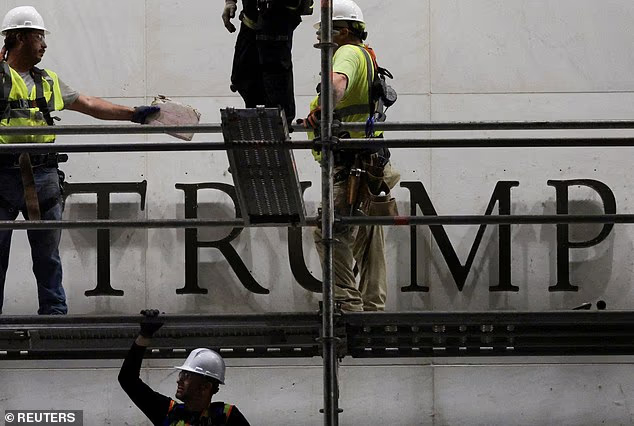
Workers prepare scaffolding ahead of removing lettering from the facade of the John F. Kennedy Memorial Center for the Performing Arts, following a federal judge's order to remove Trump's name from the institution

Advertisement

In an emergency move on Tuesday, President Donald Trump‘s appointed leadership panel at the Kennedy Center voted to shut down the iconic performing arts venue.

Trustees pushed for the sudden closure after declaring that the landmark has fallen into ‘dire’ financial ruin and physical decay.

The drastic action unfolded just hours after a DC federal judge blocked the panel’s bid to rebrand the building with Trump’s name – a controversial strategy the board insisted was essential to stave off imminent bankruptcy for the Kennedy Center.

To justify the immediate lockdown, leadership pointed to a terrifying partial ceiling collapse inside the main Grand Foyer earlier this month, arguing emergency structural work can no longer wait.

Advertisement

Trump was reportedly enraged, with sources telling CNN that he ‘screamed’ at Democratic Congresswoman Joyce Beatty, who also sits on the panel, on a call before the vote.

Individuals on the call reportedly said the president blamed her for spearheading the downfall of the center after involving the courts. 

Trump also jabbed the judge responsible for keeping his name off the building during the explosive call, sources revealed.

A draft resolution laying out a proposed two–year shutdown revealed that both the center’s top director and a structural consultant ‘consider the main building to be unsafe for continued occupancy, and anticipate further risk to the public and employees if the building is not immediately closed and renovations begun.’  

Advertisement

Tuesday’s dramatic action marks the third time since February that the board has pushed to shutter the cultural landmark for a two–year overhaul. 

Workers prepare scaffolding ahead of removing lettering from the facade of the John F. Kennedy Memorial Center for the Performing Arts, following a federal judge’s order to remove Trump’s name from the institution

In an emergency move on Tuesday, Trump's appointed leadership panel at the Kennedy Center voted to shut down the iconic performing arts venue with immediate effect

In an emergency move on Tuesday, Trump’s appointed leadership panel at the Kennedy Center voted to shut down the iconic performing arts venue with immediate effect

Advertisement
Rep. Joyce Beatty and lawyer Norman Eisen speaker to reporters after a hearing on the Kennedy Center outside the federal courthouse in Washington

Rep. Joyce Beatty and lawyer Norman Eisen speaker to reporters after a hearing on the Kennedy Center outside the federal courthouse in Washington

Trustees originally set a shutdown date of July 5, but legal battles have completely stalled those plans. 

Attorneys representing the board claim ongoing litigation has crippled their ability to carry out vital maintenance. 

However, the DC judge presiding over the case fired back during Tuesday’s hearing, reminding the board – as he had in prior rulings – that his original court order halting a full-scale lockdown specifically exempted emergency repairs.

Advertisement

‘The Kennedy Center is in such a precarious fiscal position that it will not be able to support its payroll obligations, nor routine maintenance contracts within a matter of weeks,’ states a court filing, adding that ‘President Trump has offered to step in and raise the necessary funds to keep the Center from bankruptcy.’ 

Last month, the board voted to rename the property ‘President Donald J. Trump Plaza’ and add the text ‘renovated and restored by President Donald J. Trump’ to the building by Sept. 8, with the new draft resolution proposing several similar ideas. 

Advertisement

Source link

Continue Reading

NewsBeat

Three supporting acts quit Ed Sheeran’s tour after Macklemore is dropped over Palestine comments

Published

on

Three supporting acts quit Ed Sheeran’s tour after Macklemore is dropped over Palestine comments

Three supporting acts have quit Ed Sheeran’s tour after rapper Macklemore was dropped over pro-Palestinian remarks made on stage.

Hours after Sheeran said he would not be drawn into a public debate about the Gaza war, Aaron Rowe, the band Beoga, and Finneas announced on Instagram that they were pulling out of the tour.

Rowe had been selected as one of Macklemore’s replacements for Sheeran’s remaining U.S. dates, while Beoga served as Sheeran’s backing band. Finneas was scheduled to join Sheeran’s tour in South America later this year.

“Artists must not be silenced when they speak up for the oppressed,” Finneas wrote. “I have decided to withdraw from my upcoming tour dates with Ed Sheeran. I stand with Palestine and its people.”

Advertisement

Aaron Rowe posted his own message on Instagram, writing in part, “I don’t take the decision likely. Ed has been a friend to me and has changed my life, I could never thank him enough for this.”

Beoga said in part, “We have made the decision to depart as Ed Sheeran’s band on the remaining US Loop tour, following the silencing of Macklemore by zionist lobbies.”

Macklemore was scheduled for eight of Sheeran’s 10 remaining stadium shows, resuming Saturday in Philadelphia
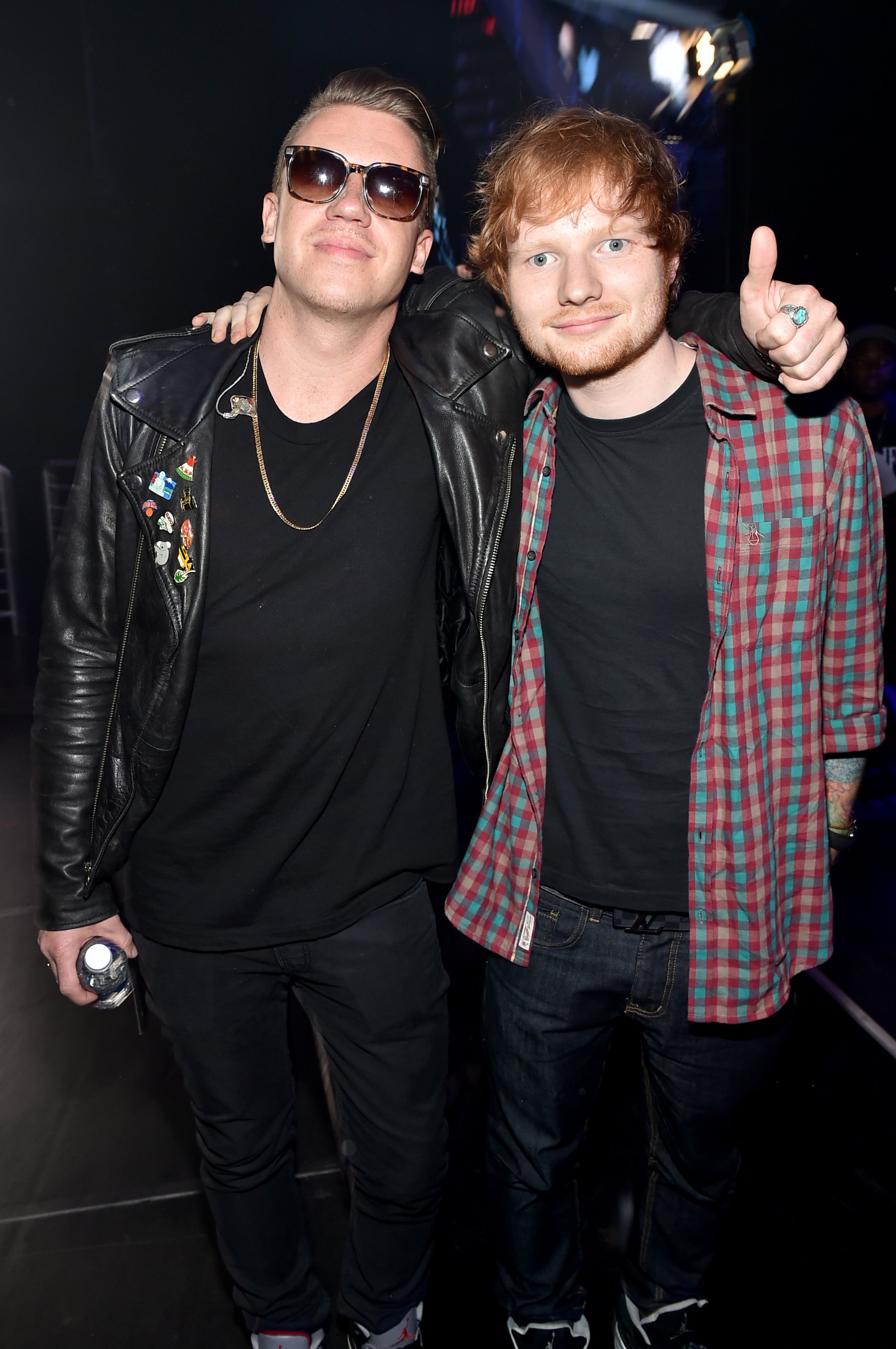
Macklemore was scheduled for eight of Sheeran’s 10 remaining stadium shows, resuming Saturday in Philadelphia (Getty)

On Tuesday, Ed Sheeran addressed Macklemore being removed as his opening act after the rapper made pro-Palestinian remarks onstage. He said the decision was made strictly by promoters. The British singer also maintained he would not enter the public conversation regarding the conflict in Gaza.

“Macklemore coming off tour was the promoter’s decision, it was not mine,” Sheeran posted on Instagram on Tuesday. “I would never let down the fans who had made plans, nor would I abandon the touring crew and the other support acts and musicians who rely on me for work and to make a living.”

Amazon Music logo

Enjoy unlimited access to 100 million ad-free songs and podcasts with Amazon Music

Advertisement

Sign up now for a 30-day free trial. Terms apply.

Try for free

ADVERTISEMENT. If you sign up to this service we will earn commission. This revenue helps to fund journalism across The Independent.

Sheeran’s post followed a statement from Macklemore on Monday, in which the rapper said he was removed from the Loop Tour after shouting “Free Palestine!” during a Sept. 5 performance at MetLife Stadium in New Jersey while performing his protest song “Hind’s Hall.”

Addressing the audience during the show, Macklemore said: “To all of my Jewish brothers and sisters, criticism of Israel, criticism of apartheid, being against genocide, it in no way is criticism of you.”

Advertisement

Macklemore said Monday on Instagram that several U.S. venues notified the promoter they would forbid him from appearing as Sheeran’s opener, led by NFL’s New England Patriots owner Robert Kraft. Kraft’s company, Kraft Group, owns Gillette Stadium.

In a statement released Monday, Kraft said the decision to remove Macklemore followed his recent comments “and a broader history of antisemitic rhetoric and imagery that we believe has been deeply offensive and hurtful to the Jewish community.”

Sheeran wrote in his post that he “spoke with the venues at length all week to try to build a bridge,” but acknowledged that “the venue’s and promoter’s decision was final.”

A growing number of organizations and experts assert that Israel’s actions in Gaza constitute genocide, an allegation Israel firmly denies.

Advertisement

Macklemore was scheduled for eight of Sheeran’s 10 remaining stadium shows, resuming Saturday in Philadelphia with Lukas Graham and Aaron Rowe billed. Upcoming stops include Gillette Stadium, Atlanta’s Mercedes-Benz Stadium, and Indianapolis’ Lucas Oil Stadium.

Sheeran said he aims to use music to bring diverse audiences together, adding that while he holds personal views on “this devastating conflict,” he chooses not to speak publicly because concertgoers “do not expect a political forum.” He added: “I am not complicit.”

“I respect Macklemore’s strength of purpose to stand up and shout for what he believes,” Sheeran added. “However, there is room for multiple approaches to the same end: peace. I choose to use my fame and platform to be a place of safety and sanctuary, to maintain diplomacy and keep conversations open, not closed.”

Advertisement

Source link

Continue Reading

NewsBeat

Dan Thomas stands down as Reform UK’s Wales leader after police arrest

Published

on

Wales Online

Sarah Cooper-Lesadd had addressed the media at the Senedd this evening on her decision to defect from Reform to Plaid Cymru.

She said: “Today I have joined Plaid Cymru and this has come after a period of reflection and deliberation.

“I feel this is the right political home for me after seeing what has happened over the last few months and coming on a journey back to Wales and seeing the fact Wales needs more devolution, it is short changed in so many ways, and Plaid Cymru is the party that best embodies for me, and those are the values I really believe in.

“This is why I am here. There is a vision of hope, a vision of ambition for the people of Wales, and this is what I’ve seen over the last few months since I’ve been in the Senedd, and I knew there couldn’t be a greater contrast between Plaid and Reform with their politics.

Advertisement

“I got into politics because I wanted to represent care leavers who are so underrepresented in politics.

“People like me don’t often get into politics, it is an extremely rare thing to do, and that’s why I stood on that platform. It has become increasingly more apparent as the Reform group has made more and more statements and had more and more debate on divisive things such as the Nation of Sanctuary, which I have argued consistently against as being the wrong thing to do.

Asked if the news surrounding Dan Thomas was a factor in her decision, she said: “It wasn’t, it’s a police matter and it is not for me to comment on.”

She was further asked whether she felt she was leaving her constituency down by defecting, with them having voted for her as a Reform candidate.

Advertisement

She said: “I would say I understand, but I am on a political journey and I will continue to represent my voters and constituents in the best way that I can which is consistent. I have always held them in the closeness of my heart in terms of how I read things and how I approach my work. I am a very hard worker and I will continue to do that, nothing changes.”

Sarah Cooper-Lesadd, who represents Pen-y-Bont Bro Morgannwg, makes a statement to the press after annoucing she had defected from Reform Uk to Plaid Cymru(Image: Getty Images)

Source link

Advertisement
Continue Reading

NewsBeat

Abdominal aortic aneurysms can cause years of anxiety, even without symptoms

Published

on

Abdominal aortic aneurysms can cause years of anxiety, even without symptoms

Some people describe it as a ticking timebomb. Others learn to live with information they can neither see nor feel, but cannot forget. This is what it can mean to be diagnosed with an abdominal aortic aneurysm: a swelling in the body’s main artery that becomes more likely to rupture as it grows, despite causing no symptoms.

For most people with a small aneurysm, surgery is not the safest option. Regular scans are used to track its growth. This avoids an operation they may not need, but can leave them living with uncertainty for years.

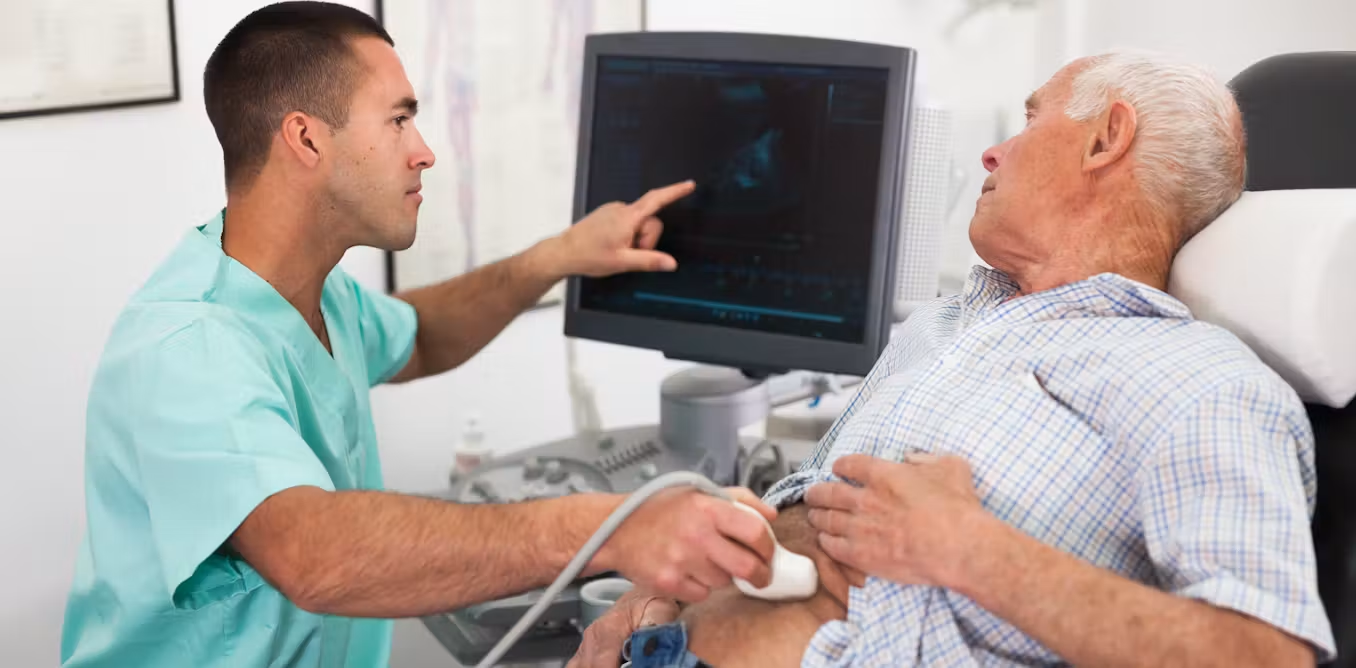
An abdominal aortic aneurysm, or AAA, develops in the section of the aorta that runs through the abdomen. Most cause no noticeable symptoms. In England, men are invited for a screening ultrasound in the year they turn 65. Aneurysms can also be found during tests for another condition.

The risk depends partly on the aneurysm’s size and growth rate. Smaller AAAs are usually managed through active surveillance, alongside measures to reduce cardiovascular risk. A review of four clinical trials found no survival advantage to operating early on small, symptom-free aneurysms. Repair itself carries risks including heart attack, stroke and kidney damage.

Advertisement

Our research suggests that the emotional effect of surveillance can be underestimated.

Living between normality and danger

We reviewed 14 studies involving 150 people with AAA. Most were men; participants were aged from 53 to 88. The studies explored their experiences of diagnosis, surveillance, surgery and recovery.

They provide detailed accounts of what people went through, although they cannot show how common each response is among all patients. Similar concerns recurred across different groups and care settings.

Uncertainty ran through many participants’ accounts. Some described the aneurysm as a “ticking timebomb”. They felt caught between the normality of having no symptoms and the knowledge that their condition might become more serious.

Advertisement

Some became highly alert to bodily sensations, wondering whether an ordinary ache might signal danger. Clear safety advice is important here. Most AAAs remain symptomless, but sudden, severe abdominal or back pain, difficulty breathing, pale or grey skin, or loss of consciousness can signal a rupture and require an immediate 999 call.

Regular scans could reassure people when an aneurysm was stable. For some, that relief faded as the next appointment approached. Life became organised around scan dates, with each check reviving old fears.

Questions left unanswered

Participants in several studies said the information they received did not prepare them for daily life with AAA. Explanations often centred on aneurysm measurements and the risks or thresholds for surgery. People still had questions about what they could safely do, how the condition might change and how much control they had over their health.

Medical jargon and apparently conflicting advice added to the confusion. Some people felt unable to take part confidently in decisions because they did not fully understand the options.

Advertisement

Physical activity was a particular source of concern. Some participants limited exercise because they feared exertion could cause a rupture. Others thought exercise might shrink the aneurysm. Research suggests that exercise training is generally safe for people with AAA, although advice should reflect the aneurysm and the person’s wider health. Exercise may support cardiovascular health, although it has not been shown to make an aneurysm smaller.

Smoking also caused confusion. Some participants doubted that quitting would help once an aneurysm had formed, while others used cigarettes to cope with anxiety. Smoking is a major risk factor for AAA, and NHS guidance recommends stopping to help prevent an aneurysm from growing. People may need practical help to quit, alongside a clear explanation of how smoking can affect the aneurysm.

A different uncertainty after surgery

When an aneurysm reaches the point at which repair is considered, patients face another set of decisions. Repair may involve open abdominal surgery or endovascular aneurysm repair, known as EVAR, which places a stent graft inside the artery through blood vessels in the groin. Recovery and follow-up differ between the procedures.

Participants often saw surgery as a source of hope and fear. It offered a way to reduce the danger they had been carrying, but required them to confront the risks of a major procedure and place considerable trust in their clinical team.

Advertisement

Afterwards, some described fatigue, changes in appetite, emotional ups and downs and a slower return to normal activities than expected. Several felt poorly prepared for recovery or unsure whom to contact after leaving hospital.

Recovery brought a different kind of uncertainty. The aneurysm had been repaired, but the body did not always seem to be healing on schedule. Ordinary tiredness or a twinge of pain could prompt fears that something had gone wrong. After weighing the risks of surgery for months or years, some found it disorienting that nobody had prepared them for what the following weeks might feel like.

Support between scans

Our findings point to practical improvements. At diagnosis, people need a plain-English explanation of their aneurysm’s size, why surveillance is recommended and which symptoms require emergency help. They also need tailored advice about physical activity and reducing their cardiovascular risk.

Before surgery, patients need balanced information about their options and enough time to ask questions. After discharge, realistic guidance about recovery and a clear contact for concerns may reduce avoidable distress. NHS England has produced a decision-support tool for people considering AAA treatment. It is most useful when a clinician helps each patient apply the information to their circumstances.

Advertisement

The studies included relatively few women, so they may not capture every experience of living with AAA. Even so, the findings show why clinical care should include psychological and practical support alongside measurement of the aneurysm.

For many people, the hardest part of AAA is living with a condition they cannot usually feel but can never entirely forget. Helping them understand it and participate in decisions, with a clear route to support when needed, could make surveillance or recovery easier to live with.

Source link

Advertisement
Continue Reading

NewsBeat

Dad-of-three dies after horror crash sees him dragged 25m under SUV with his e-bike

Published

on

Daily Record

Sanjit Singh Sanghera, 25, collided with a SsangYong Korando

A father of three suffered fatal injuries after he and his e-bike were pulled beneath an SUV for 25 metres along a road, an inquest was told.

Advertisement

Sanjit Singh Sanghera, aged 25, was riding a green and black Sur-Ron electric off-road motorcycle alongside two other riders close to Llethri Road in Dafen, Llanelli, on the evening of May 3 last year.

At approximately 8.51pm that evening, Mr Sanghera rode onto Llethri Road across a grass verge and was struck by a SsangYong Korando travelling in the direction of Dafen. Stay informed on Carms news by signing up to our newsletter here.

The front nearside of the SUV collided with Mr Sanghera’s e-bike and the rider became wedged beneath the vehicle. Despite emergency treatment at the scene and being rushed to the University Hospital Wales in Cardiff, Mr Sanghera succumbed to his injuries in the early hours of the subsequent morning.

At an inquest into his death, convened at Llanelli Town Hall on Monday, September 14, the senior coroner for Carmarthenshire and Pembrokeshire, Gareth Lewis, heard that weather conditions on the evening of the crash were fine and dry with good visibility. The road surface was also dry and clear of any defects that might have played a role in the collision, reports Wales Online.

Advertisement

The inquest heard Mr Sanghera’s e-bike entered Llethri Road “at a point that was not a formal junction and travelled into the lane of the approaching SsangYong vehicle”. Testimony presented at the hearing revealed that Mr Sanghera applied heavy braking immediately before the impact, causing the bicycle wheels to lock and leaving a skid mark approximately 6.12m in length.

The mark also suggested the rider had made a steering input. Physical evidence further indicated that the driver of the SsangYong had reacted to the emerging hazard by steering to her right in a bid to avoid a collision.

During the crash, Mr Sanghera and the e-bike became lodged beneath the SsangYong and “were dragged approximately 25m before the motor vehicle came to rest”.

Advertisement

Mr Sanghera suffered a catalogue of serious injuries, including head trauma, hypoxic brain injury, cerebral oedema, pulmonary injuries, bilateral open fractures of the tibia and fibula, and a traumatic partial amputation of the lower right leg. He passed away in hospital at 3.18am on May 4, 2025, with the medical cause of death recorded as traumatic asphyxia.

Forensic examination found no fault with the electric bike that could have contributed to the collision. While the SsangYong was found to have defects, including a leaking rear brake pipe and an expired MOT, forensic testing confirmed these issues played no part in the crash.

There was no evidence to suggest that either Mr Sanghera or the driver of the SsangYong had been impaired by alcohol, drugs, a medical episode, or mobile phone use at the time of the collision. No helmet was discovered at the scene, and police investigators determined Mr Sanghera wasn’t wearing one when the collision took place.

The inquest heard that “on the balance of probabilities Mr Sanghera rode the electric bike from the grass verge into the carriageway and into the path of the approaching SsangYong motor vehicle leaving insufficient time and distance for the collision to be avoided”.

Advertisement

Coroner Mr Lewis delivered a verdict of road traffic collision.

He stated: “On May 3, 2025, Sanjit Singh Sanghera was riding a Sur-Ron electric off-road motorcycle when he entered Llethri Road, Llanelli, from a grass verge into the path of an approaching motor vehicle.

“Despite evasive action by both road users a collision occurred. He sustained multiple traumatic injuries causing traumatic asphyxia and died in hospital in the early hours of May 4, 2025.”

In the wake of his death, Mr Sanghera’s family honoured his memory, referring to him as Sanjit Evans. They expressed: “Sanjit was the most amazing person you would ever come across, he was the happiest, grumpy at times, so full of energy couldn’t sit still for longer than five minutes, but he was amazing.

Advertisement

“We are all so lost without him.

“A tragic incident has taken such a special soul away far, far too soon, our world has been crushed, our plans and future ripped away in a second.

“May my handsome boy rest in paradise.”

Ensure our latest stories always appear at the top of your Google Search by making us a Preferred Source. Click here to activate or add us as your Preferred Source in your Google search settings.

Advertisement

Source link

Continue Reading

NewsBeat

EastEnders fans spot major Max Branning loophole amid Zoe Slater’s death

Published

on

Daily Mirror

EastEnders fans have worked out that Max Branning won’t actually be connected to the death of Zoe Slater, despite being the last person who spoke to her before she died

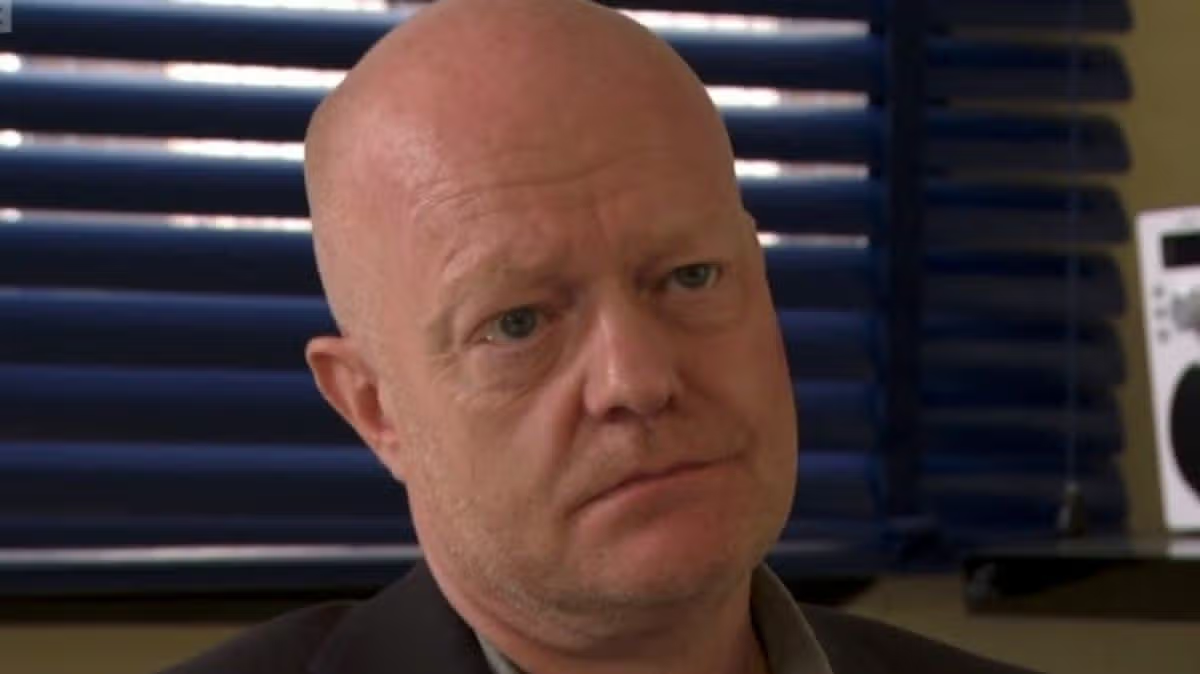
EastEnders fans have foiled a “red herring” linked to Max Branning. Last week, viewers of the BBC One soap opera saw Max confronting Zoe Slater in the flat above the Queen Vic after she caught him and Linda Carter kissing, hours after he called off his marriage to Cindy Beale.

Advertisement

But unbeknownst to Max, Zoe was suffering from a head injury after falling onto a pile of rubble while stealing the London hackney cab which belonged to her late grandad, Charlie Slater.

At the time, Zoe’s speech didn’t make sense, and she seemed confused, leading Max to believe she was drunk. Despite Zoe pleading for her mum, Kat, and Max brushed this off and left her in her bedroom, demanding that she keep his secret. Just hours later, Zoe tragically died, alone.

While some fans believed that Max may now be linked to Zoe’s death, after it emerged she dialled 999, some fans have foiled this plot. During the New Year’s flashforward episode, Max is seen being chased by armed police for solicitation to murder, with many thinking that his could be connected to Zoe’s death.

Advertisement

One fan said: “Just a thought Zoe was downstairs and she saw Max and Linda and ran back upstairs and collapsed. So when did the 999 call happen??”

A second replied: “Max being in the room is a red herring, the new year episode can’t be connected as he was wanted for conspiracy to murder. That means basically hiring someone to murder someone.”

But another commented: “I really am puzzled as to why so many people seem to think Max gets arrested for Zoe’s death in the flash forward. In the flash forward, he gets arrested for solicitation to murder (paying someone to kill someone) and then gets released as the police have probably found out that the person he supposedly paid someone to kill is actually alive.

Advertisement

“Max is going to be set up but gets cleared. As for the death of Zoe, an autopsy will show the haemorrhage was caused by a knock on the head & Kat will confirm that Zoe told her she’d fallen and banged her head.” During Tuesday’s episode, it became clear that Max was unaware Zoe had died, as he had returned to the hospital just after seeing her.

The news was confirmed to him by his daughter, Lauren, following a confrontation in the middle of Albert Square with both Cindy and Peter Beale. “People are grieving over there,” Cindy fumed.

“What’s she talking about, grieving?” Max asked Lauren, who later revealed that Zoe had actually died. Zoe’s death comes just a year after the character returned to EastEnders.

Advertisement

It was reported earlier this year that Michelle Ryan had decided to leave the soap and her character would be killed off. Michelle is not the only star to announce she is stepping away from the soap this year. Kellie Bright, who plays Linda Carter, has also said she is quitting. Linda is not expected to be killed off and will remain on the show until early 2027.

It is thought that Aaron Thiara, who plays Ravi Gulati, and Pierre Counihan-Moullier, who plays Oscar Branning, are also set to exit the show. Likewise, Charlie Suff, who plays Linda’s son, Johnny, is reportedly leaving the show with Kellie.

Like this story? For more of the latest showbiz news and gossip, follow Mirror Celebs on TikTok, Snapchat, Instagram, Twitter, Facebook, YouTube and Threads.

Advertisement

Source link

Continue Reading

NewsBeat

Major update on nursery chain served with safeguarding notice by Ofsted

Published

on

Eight Cambridgeshire nurseries were served with the notice in June

Ofsted has provided an update on a nursery chain that was told it wasn’t meeting safeguarding and welfare requirements. Back in June, Ofsted served Bright Horizons with a Welfare Requirements Notice (WRN).

The chain runs 247 sites across England, including eight in Cambridgeshire. Ofsted carried out checks between October 2025 and June 2026 and found “significant weaknesses in organisational safeguarding leadership, governance, oversight and practice”.

Advertisement

Ofsted has since carried out further inspections at 68 nurseries, which were selected through a risk-based analysis. The care inspectors have found that “measurable progress has been made”.

The latest visits have shown that significant resources have been invested into strengthening safeguarding, governance and oversight, as well as training.

However, inspectors identified breaches at 39 nurseries, including significant weaknesses in safeguarding, leadership and governance. Ofsted has issued another WRN to Bright Horizons setting out actions the chain needs to take. The names of these 29 nurseries have not been disclosed.

The actions relate to: concerns about children’s safety and welfare; safeguarding policies and procedures; and staff supervision.

Advertisement

The eight nurseries in Cambridgeshire are:

  • Eddington Nursery, Cambridge
  • Wolfson Court Day Nursery and Preschool, Cambridge
  • Bright Horizons Cambridge Milton Road Day Nursery and Pre-school, Cambridge
  • Cambridge Science Park Day Nursery and Preschool, Cambridge
  • Long Road Day Nursery and Preschool, Cambridge
  • Bunnybrookes Day Nursery and Preschool, Addenbrooke’s Hospital, Cambridge
  • Fulbourn Day Nursery and Preschool, Fulbourn
  • Ely Day Nursery and Preschool, Ely

His Majesty’s chief inspector Sir Martyn Oliver said: “While I’m pleased to see evidence of improvement across the Bright Horizons group, work is still needed to ensure that requirements are met consistently. The majority of Bright Horizons nurseries are doing well, but we have set clear expectations about what needs to improve.

“We will always take any necessary action to keep children safe, because every single child deserves the same level of care and protection.”

Source link

Advertisement
Continue Reading

NewsBeat

Britain should abolish the monarchy to ‘free Prince George from a burden he has no choice over’, says Nicola Sturgeon

Published

on

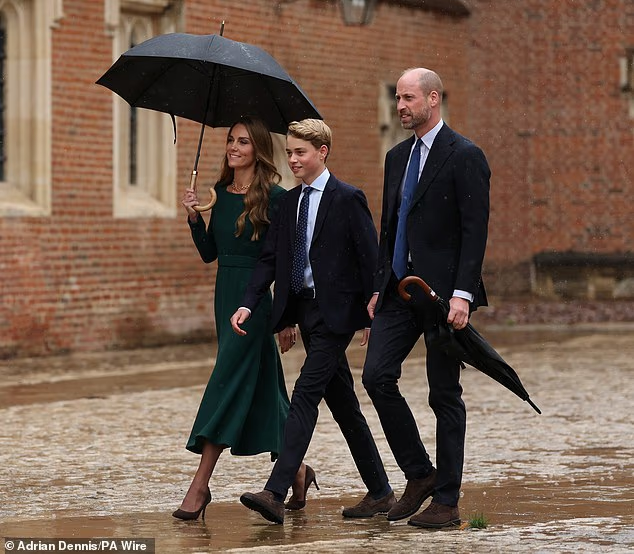
Prince George starts his first day at Eton College last Tuesday with parents William and Kate

Britain should abolish the monarchy to save Prince George from his future role as King, Nicola Sturgeon has said as a poll found one in four Brits support the idea.

The former first minister of Scotland insisted in a new documentary that scrapping the institution would relieve the 13-year-old of a ‘burden’ he has ‘no choice over’.

Ms Sturgeon questioned whether it was fair for future generations of the Royal Family including George to have their lives determined for them from birth.

Speaking to fellow republican John Humphrys on Channel 4‘s The Royals: Time To Go? airing at 9pm tonight, Ms Sturgeon said she had ‘huge sympathy’ for the family.

Advertisement

She added: ‘In fact, I would say one of the arguments for getting rid of the monarchy is for the sake of members of the Royal Family, like Prince George, for example.

‘That kid doesn’t know any different. He has a certain life ahead of him that he has no choice over. Is that really fair?

‘And so I actually think it is one of the arguments for getting rid of the monarchy, to free the future members of the Royal Family from carrying that burden.’

Ms Sturgeon also claimed some of the monarchy’s popularity was attributable specifically to the late Queen Elizabeth II rather than the institution itself.

Advertisement

Prince George starts his first day at Eton College last Tuesday with parents William and Kate

Queen Elizabeth II receives Nicola Sturgeon at Edinburgh's Palace of Holyroodhouse in 2022

Queen Elizabeth II receives Nicola Sturgeon at Edinburgh’s Palace of Holyroodhouse in 2022

George – who began his first day at Eton College last week, having previously attended Lambrook School in Berkshire – is second in line to the British throne after his father.

Advertisement

The poll carried out for the documentary found one in four Britons now support abolishing the monarchy – with scandals surrounding Andrew Mountbatten-Windsor having a major impact on its popularity.

Some 28 per cent of UK adults are now in favour of bringing 1,200 years of monarchy in the country to an end, a figure rising to 38 per cent among 18 to 24-year-olds.

Meanwhile 41 per cent say Andrew has made them less supportive of the Royal Family – with 49 per cent believing Buckingham Palace moved too slowly when claims emerged about his involvement with paedophile financier Jeffrey Epstein.

Separately, 64 per cent believe King Charles III should be required to pay the same income tax as everyone else.

Advertisement

In the programme, veteran broadcaster Humphrys recalls encounters with the royals, including how the late Queen Elizabeth II told him she would ‘most certainly’ never give him an interview.

Humphrys said Elizabeth had invited him to lunch and they were alone in an anteroom afterwards, where he asked whether she had ever considered giving an interview.

The Queen listened politely before telling him: ‘No, and what’s more Mr Humphrys, if one ever were to do such a thing, it most certainly would not be with you.’

Humphrys traces his republicanism back to his childhood in working-class Cardiff, remembering the excitement when newly crowned Elizabeth visited in 1953.

Advertisement
Nicola Sturgeon greets King Charles III at the Scottish Parliament in Edinburgh in 2022

Nicola Sturgeon greets King Charles III at the Scottish Parliament in Edinburgh in 2022

Prince William with Nicola Sturgeon at the General Assembly of the Church of Scotland in 2021

Prince William with Nicola Sturgeon at the General Assembly of the Church of Scotland in 2021

He says his neighbours poured onto the street to see her – apart from his father Edward, whom Humphrys remembers as a ‘very proud man who had a very tough life’.

He adds: ‘He swore that he would never bow his head to any man or woman. He was a republican and he stayed a republican and I became a republican too.’

Advertisement

Humphrys, now 83, explores whether the monarchy can be justified in a modern democracy, and how much deference towards the monarchy exists in Britain today.

While 28 per cent of people support abolishing the monarchy, the Survation poll of more than 2,000 people from across the UK also found 44 per cent oppose this.

The survey further revealed that 57 per cent of people believe the King should have to pay inheritance tax, while 49 per cent say he should be required to publish full details of his private earnings.

Humphrys examines the Sovereign Grant, the Duchies of Lancaster and Cornwall and the monarchy’s tax arrangements, questioning whether the UK public is getting value for money and whether there should be greater financial scrutiny of the royals.

Advertisement

He also asks whether working royals should be subject to greater accountability, with the poll finding 48 per cent of people support a formal code of conduct for working members of the Royal Family.

While there are 11 working royals, only 46 per cent of people in the survey could name more than two of them.

They are: the King and Queen Camilla; Prince William and Catherine; Princess Anne; Prince Edward and Sophie; Prince Richard and Birgitte, the Duke and Duchess of Gloucester; Prince Edward, Duke of Kent; and Princess Alexandra, The Honourable Lady Ogilvy.

John Humphrys (left) and other broadcasters meet Queen Elizabeth II at a reception in 2006

John Humphrys (left) and other broadcasters meet Queen Elizabeth II at a reception in 2006

Advertisement
John Humphrys interviews Princess Anne on BBC Radio 4's Today programme in 1995

John Humphrys interviews Princess Anne on BBC Radio 4’s Today programme in 1995

Among those backing the case for the monarchy is former Chancellor Sir Jeremy Hunt, who says the institution provides stability and a head of state who can ‘unite us in a period where politics is incredibly polarised’, adding: ‘I think they’re worth their weight in gold.’

Humphrys concludes: ‘In a country proud of its openness and willingness to debate pretty much anything, we should feel we can ask hard questions of one of our oldest institutions and expect more answers.

‘I suspect that’s what my father would have wanted too. Hope he’s listening.’

Advertisement

Virginia Giuffre, who died last year, had accused Andrew of sexually assaulting her when she was a teenager after being trafficked by Epstein.

Andrew has strongly denied this but in 2022 reached an out-of-court settlement with her, despite claiming never to have met her.

The King last year stripped his brother of his royal titles after fresh revelations about his Epstein ties and Andrew was forced to leave his Windsor mansion and move to the monarch’s private Sandringham estate in Norfolk.

The scandal also saw Peter Mandelson fired as UK ambassador to the US.

Advertisement

Both were arrested in February on suspicion of misconduct in public office over their connections with Epstein. They were subsequently released under investigation and deny any wrongdoing.

A spokesman for Buckingham Palace provided a statement to Channel 4 relating to Andrew, saying: ‘Since there is an ongoing police enquiry into Mr Mountbatten-Windsor, it is not possible to provide comment.

‘We would point you to His Majesty’s unprecedented actions taken on this matter since accession, and the unequivocal words in which the King pledged his ‘wholehearted support’ for the ‘full, fair and proper process by which this issue is investigated in the appropriate manner and by the appropriate authorities’.’

‘The Royals: Time to Go?’ airs on Channel 4 tonight at 9pm 

Advertisement

Source link

Continue Reading

NewsBeat

M6 crash RECAP as all traffic held on motorway in Greater Manchester – latest updates

Published

on

Manchester Evening News

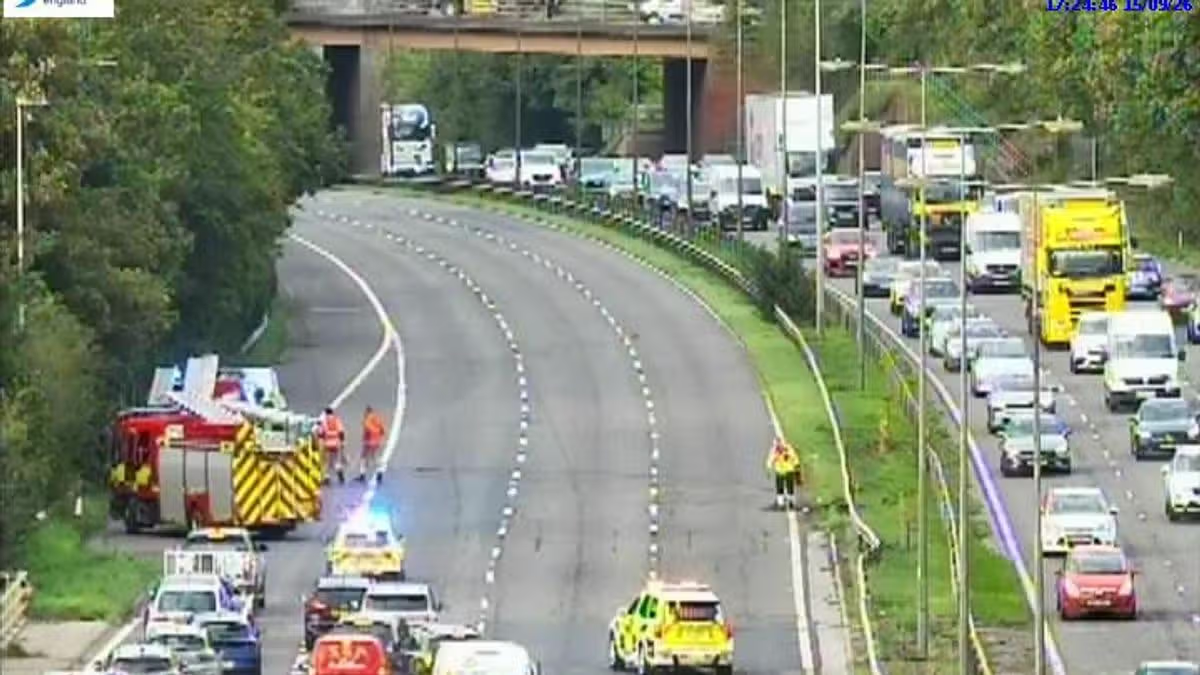
Traffic was at a standstill on the M6 near Wigan following a ‘multi-vehicle’ crash today.

Emergency services were on the motorway following the incident which was first reported at around 5pm on Tuesday (September 15).

Click here to get the biggest stories straight to your inbox in our Daily Newsletter

Advertisement

Pictures from the road show the northbound carriageway blocked of by firefighters and traffic police.

Traffic monitoring tool Inrix says: “All traffic being temporarily held and stationary traffic due to multi-vehicle accident on M6 Northbound at J26 M58 (Orrell Interchange).”

Source link

Advertisement
Continue Reading

Trending

Copyright © 2025