


Business
India Beyond the US: A new era of global partnerships
The United States: India’s Largest Export Anchor
There is no denying the importance of the United States for India’s trade ecosystem. In FY24–25, the US accounted for nearly 20% of India’s total exports, amounting to USD 86.5 billion, making it our single largest export destination. Key sectors such as engineering goods, electronics, pharmaceuticals, gems and jewellery, and textiles have built strong demand linkages with the US market over the years.
Strategic Export Diversification
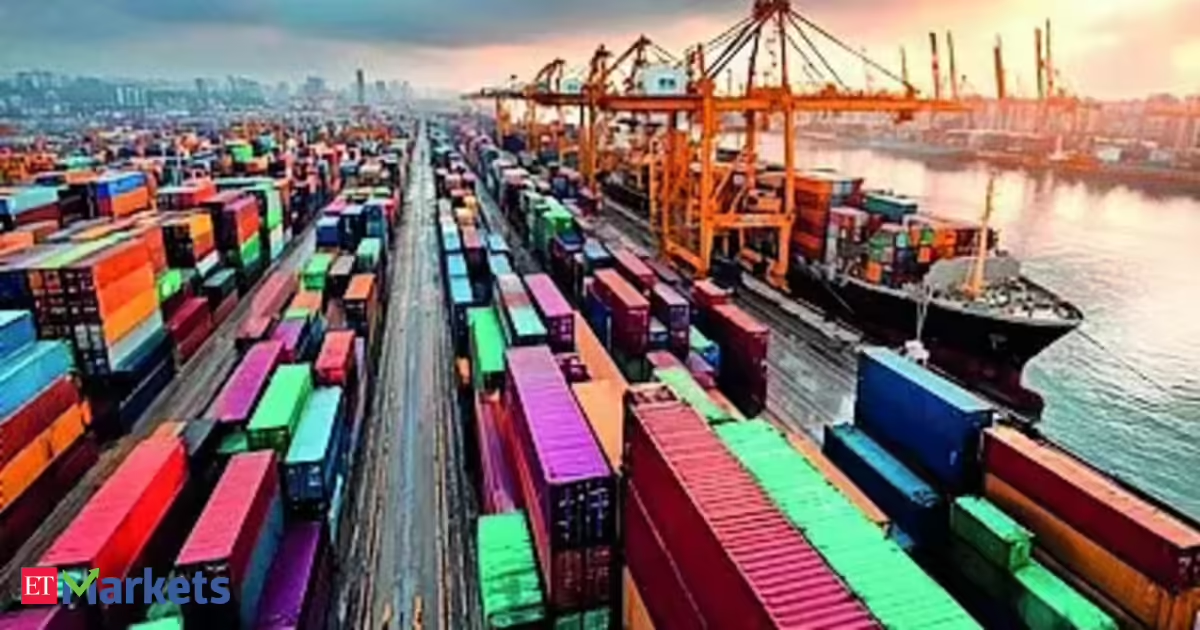
However, what deserves equal attention and appreciation is how strategically India is positioning itself to reduce over-dependence on any one geography. Rather than waiting passively for the outcome of the US negotiations, India has been quietly but aggressively building alternative export corridors across Europe, the Middle East, Oceania regions like Australia, New Zealand and Latin America.
India–European Union FTA
ETMarkets.comSource : MOC&I
The most significant step in this direction has been the recently concluded Free Trade Agreement with the European Union (EU), often described as the “mother of all trade deals.” The agreement envisages the removal of tariffs on over 99% of Indian exports to EU, currently valued at approximately USD 75.76 billion, while progressively opening key segments of the Indian market to European Union participants. Over the longer term, the objective is to almost double bilateral trade volumes between India and the EU, significantly strengthening economic integration between the two regions. For sectors like textiles, this is a game-changer. Historically, India faced higher tariffs in Europe compared to competitors such as Vietnam and Bangladesh, putting Indian exporters at a price disadvantage. With tariffs now coming down, Indian textile companies can compete on equal footing in what is the world’s second-largest export market after the US. Over time, this significantly reduces the sector’s heavy reliance on American demand.
The electronics sector stands to benefit just as strongly. Currently, nearly 38% of India’s electronics exports are directed towards the US. The EU, on the other hand, represents a massive USD 750 billion electronics market, where India’s current penetration is still under USD 100 billion. The FTA opens the door for Indian manufacturers to diversify revenue streams and scale meaningfully in Europe. Pharmaceuticals, gems and jewellery, and engineering goods also gain access to a large, high-value consumer base, offering both volume growth and pricing stability.
Expanding the Trade Map
Complementing the EU deal is the recently signed trade agreement with the United Kingdom. The UK currently absorbs around 3.5% of India’s exports, but the new framework provides duty-free access on 99% of Indian goods and targets bilateral trade of USD 100 billion in the coming years. Once again, the biggest beneficiaries are the same export-heavy sectors that are most exposed to the US market. India has also inked FTAs with Oman and New Zealand, which are smaller in scale but strategically important for expanding market presence and building resilient trade networks.
Strengthening Middle East and Asia Corridors
Beyond signed agreements, negotiations are progressing rapidly with countries such as Australia, Chile, Peru, Korea and the Maldives. The urgency reflects a clear diplomatic and economic intent: India wants diversified trade partnerships before any global protectionist wave strengthens.
Even relationship repair efforts with nations like Canada and deeper engagement with the UAE, India’s second-largest trade partner, underline this broader strategy. India and the UAE aim to double bilateral trade to $200 billion by 2032, further strengthening India’s presence in the Middle East corridor.
Conclusion
From an investor’s lens, this is not just about trade numbers; it is about risk management at a national level. The US will continue to remain a critical partner for India. There is no realistic scenario where India disengages from the American market, nor should it. But what India is systematically ensuring is that no single country holds disproportionate influence over its export-driven sectors or broader economic trajectory. This diversification brings negotiating power, economic stability, and long-term growth resilience.

As markets remain sensitive to headlines around the India–US deal, investors should also recognise the bigger picture unfolding quietly in the background. India is not merely reacting to trade pressure; it is reshaping its global economic footprint.
(The author is Founder & CEO, SAMCO Group)
Business
Tim Scott says Fed Chair Powell didn’t commit crime during testimony
Sen. Tim Scott, R-S.C., discusses crypto legislation, Kevin Warshs nomination to Fed chair amid the Jerome Powell probe and government funding on Mornings with Maria.
Senate Banking Committee Chair Tim Scott said Wednesday that he doesn’t think Federal Reserve Chair Jerome Powell committed a crime during his testimony last summer about the central bank’s costly renovation project.
Scott, R-S.C., said in an appearance on FOX Business’ “Mornings with Maria” that while he has other issues with how Powell has led the central bank and its monetary policy moves, he doesn’t believe that the Fed chair committed a crime in his testimony.
“As it relates to the DOJ investigation, I’ll tell you what I would tell a prosecutor if they came into my office. I was the one asking the questions, Jay Powell was responding to me. Obviously, he and I have very, very strong disagreements on many issues, No. 1,” Scott said. “No. 2, I believe that it’s time for a new Federal [Reserve] chair. Thank God almighty, we’re getting ready to get one.”
“No. 3, I found him to be inept at doing his job, but ineptness or being incompetent is not a criminal act. I believe what he did was make a gross error in judgment, he was not prepared for that hearing. I do not believe that he committed a crime during the hearing,” Scott said.
TRUMP SAYS HE WILL NOT DROP DOJ CRIMINAL PROBE INTO FED CHAIR JEROME POWELL

Senate Banking Chair Tim Scott, R-S.C., (left) said he doesn’t think Fed Chair Jerome Powell (right) committed any crime in his testimony last summer. (Andrew Caballero-Reynolds/AFP)
The Department of Justice opened a criminal inquiry into whether Powell misled Congress during his testimony before the Senate Banking Committee last summer about the Federal Reserve’s headquarters renovation, which has run over budget.
The criminal probe came against the backdrop of an effort by President Donald Trump and his allies to pressure Powell and the Fed into cutting interest rates to spur the economy.
Powell denied wrongdoing and called the probe a pretext for exerting political influence over monetary policy decisions.
TRUMP’S FED PICK KEVIN WARSH FACES UNEXPECTED ROADBLOCK OVER ONGOING POWELL PROBE

Fed Chair Jerome Powell said the DOJ’s investigation is a pretext for pressuring the central bank’s monetary policy moves. (Kent Nishimura/Getty Images)
A key member of the Senate Banking Committee, Sen. Thom Tillis, R-N.C., responded to the probe by vowing to block any Federal Reserve nomination until the DOJ’s investigation of Powell concludes.
“If there were any remaining doubt whether advisors within the Trump administration are actively pushing to end the independence of the Federal Reserve, there should now be none. It is now the independence and credibility of the Department of Justice that are in question,” Tillis said last month.
POWELL OFFERS ADVICE FOR NEXT FED CHAIR, ADDRESSES FUTURE AT CENTRAL BANK

Trump nominated Powell as Fed chair in 2017, but has repeatedly criticized his handling of monetary policy since he was confirmed to the role in 2018. (Olivier Douliery/Bloomberg/Getty Images)
Scott told Bartiromo on Wednesday that he thinks the investigation of Powell will be resolved and that will clear the path for considering the nomination of former Fed Governor Kevin Warsh to serve as the next chair of the central bank.
Trump nominated Warsh to the role last week, and Tillis reiterated his stance that he won’t consider Fed nominees until the DOJ probe is over.
GET FOX BUSINESS ON THE GO BY CLICKING HERE
“I believe that we’re going to resolve that issue, we’re going to move forward and Thom Tillis will be voting for Kevin Warsh as the next chairman of the Federal Reserve. That’s my prediction,” Scott said.
Business
Palantir Stock Jumps After Earnings. How It Won Over Valuation Skeptics.
Business
General Motors Company (GM) Presents at Federal Reserve Bank of Chicago’s Automotive Insights Symposium Transcript
Kristin Dziczek
Well, thank you so much for coming back and staying with us. This you won’t want to miss. So it’s my pleasure to introduce our next session, managing transformation in a dynamic environment. [Operator Instructions] I’d first like to introduce our moderator, Mike Colias. Mike is the U.S. Auto Editor for Reuters. He’s long covered the auto industry and for the Wall Street Journal and Automotive News, and he’s the author of a 2025 book, Inevitable: Inside the Messy, Unstoppable Transition to Electric Vehicles. So he’s pretty ideally positioned to lead today’s fireside chat with GM’s CFO, Paul Jacobson.
And speaking of which we are tremendously honored that Paul has decided to join us. He’s a well-known around Detroit and in the auto industry since he joined General Motors in 2020 as the Executive Vice President and CFO. He’s established himself as an exceptional leader on GM’s executive team, demonstrating a remarkable financial stewardship during some very unprecedented business and industry challenges.
From navigating the post-pandemic supply chain disruptions to orchestrating GM’s strategic pathway to EV profitability and tariffs and what we can all agree has been a very uncertain policy environment. Under Paul’s guidance, GM has delivered impressive results in 2025 with robust earnings and a strong outlook. We are again thankful that Paul has agreed to join us today to share his insights.
I’ll bring Paul up for a few remarks, and then Mike will join him on stage for the Q&A.
Paul Jacobson
Executive VP & CFO
Well, thank you all. I was having to look around to figure out who
Business
Enphase Energy: Upgrading On Improving Outlook And Sentiment
Business
Nearly two dozen more prisoners freed in Venezuela, legal rights group says

Nearly two dozen more prisoners freed in Venezuela, legal rights group says
Business
E.l.f. Beauty (ELF) Q3 2026
Elf Beauty cosmetics
Courtesy: e.l.f Beauty
E.l.f. Beauty reported a huge earnings beat Wednesday and raised its guidance for the fiscal year.
E.l.f. stock was up as much as 15% in after-hours trading before losing the majority of those gains.
Here’s what the company reported for the third fiscal quarter, compared with analyst estimates from LSEG:
- Earnings per share: $1.24 adjusted vs. 72 cents expected
- Revenue: $490 million vs. $460 million expected
E.l.f. said net sales increased 38% to $489.5 million, from $355 million in the same period a year ago, driven by growth across the globe and across its retailers and e-commerce. It reported adjusted net income of $74.5 million, up from $43 million over the same period a year ago.
The company recently acquired celebrity Hailey Bieber’s skincare company, Rhode, in a roughly $1 billion deal, and it contributed $128 million to the company’s net third-quarter sales growth. E.l.f. told CNBC it’s projecting Rhode to contribute up to $265 million in net sales this year, up $65 million from its previous guidance.
E.l.f. also raised its full-year guidance, increasing its revenue outlook by a range of $42 million to $50 million.
“Our Q3 results, which included 130 basis points of market share gains for our namesake e.l.f. Cosmetics brand and a record-breaking launch of rhode in Sephora in the U.K., are a continuation of the consistent, category-leading growth we’ve delivered over the past 28 quarters,” CEO Tarang Amin said in a statement. “Our value proposition, powerhouse innovation and disruptive marketing engine continue to fuel our brands.”
— CNBC’s Jodi Gralnick contributed to this report.
Business
Nykaa Q3 Results Preview: PAT may surge up to 192% YoY led by BPC momentum; revenue to rise up to 28%
The estimates from ElaraCapital, Nuvama Institutional Equities and JM Financial have been taken into account. The margins could take a hit in the October-December quarter.
The company will announce its earnings on Thursday, February 5.
Here’s what estimates say about these four key parameters:
1) PAT
— Elara Capital: Rs 60 crore, up 128% YoY and 88% QoQ
— Nuvama: Rs Rs 64 crore, up 139% YoY and 89% QoQ
— JM Financial: Rs 78 crore, up 192% YoY and 117% QoQ
2) Revenues
— Elara Capital: Rs 2,869 crore, up 27% YoY and 22% QoQ
— Nuvama Institutional Equities: Rs 2,902 crore, up 28% YoY and 24% QoQ
— JM Financial: Rs 2,859 crore, up 26% YoY and 22% QoQ
3) EBITDA
— Elara Capital: Rs 202 crore, up 43% YoY and 27% QoQ
— Nuvama Institutional Equities: Rs 209 crore, up 48% YoY and 31% QoQ
— JM Financial: Rs 215 crore, up 52% YoY and 35% QoQ
4) EBITDA margin
Nuvama has pegged the Earnings Before Interest, Taxes, Depreciation and Amortisation (EBITDA) at 7.2% in Q3FY26, down 100 bps YoY and down 40 bps QoQ. Meanwhile, JM Financial sees margin expansion of 130 bps YoY, indicating sustained operating leverage.
(Disclaimer: The recommendations, suggestions, views, and opinions given by the experts are their own. These do not represent the views of The Economic Times.)
Business
How India is likely to shield its farmers in US trade deal
Both sides have shared the broad outlines of the deal but not the details, with early indications suggesting India will grant the U.S. only limited access to its agricultural market.
WILL INDIA LOWER TARIFFS ON US CORN, SOYBEANS OR SOYMEAL?
India, which bans genetically modified (GM) food crops, is unlikely to lower tariffs on imported farm goods such as corn, soybeans and soymeal as it seeks to protect millions of small farmers who eke out a living on meagre incomes.
The United States primarily produces GM corn and soybeans, limiting the scope for market access in India.
Unlike China, which buys millions of tons of corn and soybeans from the United States, India’s import requirements for both crops are relatively small.
India is holding large stockpiles of corn and soymeal, an animal feed derived from crushing soybeans for soyoil.
While India is the world’s largest importer of soyoil, sourcing supplies mainly from Brazil, Argentina and the United States, its overseas purchases of soybeans remain negligible, including from Africa where non-genetically modified oilseeds are produced. India also has ample supplies of domestically produced ethanol, made from corn, rice and sugarcane, making it unlikely to concede to requests for imports of either ethanol or corn as feedstock for ethanol production.
While the U.S. has pushed for greater access to India’s dairy market, long protected by high import duties and non-tariff barriers, New Delhi is likely to keep the sector off the table given its importance to farmer livelihoods.
The average herd size in India is only two to three animals per farmer, compared to hundreds in the United States – a difference that puts small Indian farmers at a disadvantage, Indian officials have argued.
WHERE ELSE COULD INDIA CEDE GROUND IN AGRICULTURE?
India could agree to lowering tariffs or allowing expanded import quotas on farm products such as almonds, walnuts, pistachios, apples, pears and berries. New Delhi could also lower trade barriers for fruits and vegetables, wine and spirits – the areas that do not tend to hurt Indian farmers.
Since India is already import-dependent for almonds, walnuts, pistachios, apples, pears and berries, it would be easier for Prime Minister Narendra Modi’s Bharatiya Janata Party to sell any lowering of import barriers on these premium farm products to voters and other political constituencies.
Similarly, President Donald Trump’s administration can tout access to Indian markets as a major win for American farmers.
WHY AGRICULTURE REMAINS SENSITIVE ISSUE FOR INDIA
Although the farm sector contributes a relatively modest 15% to India’s almost $4 trillion economy, it sustains nearly half the country’s 1.4 billion people.
Nearly 80% of Indian farmers are smallholders, owning two hectares of land or less, which limits their income. But farmers form an influential voting bloc, and successive governments have sought to avoid angering millions of growers.
The Samyukt Kisan Morcha, an umbrella group of farmers’ organisations, and its top leaders including Rakesh Tikait have already taken Modi’s government to task over its trade deal with Washington.
Business
US probes Nike over white worker discrimination claims
The Equal Employment Opportunity Commission (EEOC), which enforces workplace discrimination laws, announced on Wednesday it has demanded company records going back to 2018, including the use of race and ethnicity data, and whether such information influenced executive pay.
Business
Texas Instruments Goes Back To The M&A Well To Augment Its Growth
-
Crypto World5 days agoSmart energy pays enters the US market, targeting scalable financial infrastructure
-
Crypto World6 days ago
Software stocks enter bear market on AI disruption fear with ServiceNow plunging 10%
-
Politics5 days agoWhy is the NHS registering babies as ‘theybies’?
-
Crypto World6 days agoAdam Back says Liquid BTC is collateralized after dashboard problem
-
Video2 days agoWhen Money Enters #motivation #mindset #selfimprovement
-
Tech15 hours agoWikipedia volunteers spent years cataloging AI tells. Now there’s a plugin to avoid them.
-
Fashion5 days agoWeekend Open Thread – Corporette.com
-
NewsBeat6 days agoDonald Trump Criticises Keir Starmer Over China Discussions
-
Politics3 days agoSky News Presenter Criticises Lord Mandelson As Greedy And Duplicitous
-
Crypto World5 days agoU.S. government enters partial shutdown, here’s how it impacts bitcoin and ether
-
Sports4 days agoSinner battles Australian Open heat to enter last 16, injured Osaka pulls out
-
Crypto World4 days agoBitcoin Drops Below $80K, But New Buyers are Entering the Market
-
Crypto World3 days agoMarket Analysis: GBP/USD Retreats From Highs As EUR/GBP Enters Holding Pattern
-
Crypto World5 days agoKuCoin CEO on MiCA, Europe entering new era of compliance
-
Business5 days ago
Entergy declares quarterly dividend of $0.64 per share
-
Sports3 days agoShannon Birchard enters Canadian curling history with sixth Scotties title
-
NewsBeat2 days agoUS-brokered Russia-Ukraine talks are resuming this week
-
NewsBeat2 days agoGAME to close all standalone stores in the UK after it enters administration
-
Crypto World24 hours agoRussia’s Largest Bitcoin Miner BitRiver Enters Bankruptcy Proceedings: Report
-
Crypto World6 days agoWhy AI Agents Will Replace DeFi Dashboards