Hindustan Zinc shares slipped over 2% to an intraday low of Rs 621.45 on the BSE on Monday, extending losses to more than 7% over the last two trading sessions.
The decline came as silver prices saw a sharp selloff on MCX, falling over Rs 5,000 per kg amid renewed Iran war tensions and reduced expectations of a rate cut this year. Following the government’s import duty hike, MCX silver has now plunged nearly 13%, or around Rs 40,000 per kg, from its peak of Rs 3.04 lakh in just three trading sessions.
A key reason behind the steep correction has been demand destruction at elevated price levels. Unlike gold, silver has a large industrial demand component, with usage spread across sectors such as solar panels, semiconductors, electric vehicles, batteries, electronics, AI infrastructure, and green energy systems.
“At the same time, geopolitical tensions linked to the Iran conflict initially triggered safe-haven buying across precious metals. However, markets later began to focus on the potential impact of prolonged elevated oil prices on global growth momentum. That concern tends to affect industrial metals more heavily than pure defensive assets, causing silver to increasingly trade like an industrial commodity rather than a traditional safe-haven hedge,” the analyst said.
Advertisement
India, which remains the world’s largest silver importer, could also see weaker domestic demand after the sharp increase in import duty. According to Nirpendra Yadav, Senior Commodity Analyst at Bonanza, the jump in duty to 15% materially raises local prices and may hurt jewellery demand while slowing industrial imports.
Live Events
Hindustan Zinc Q4 snapshot
The company reported a sharp 68% year-on-year rise in consolidated profit after tax for the March quarter at Rs 5,033 crore, compared with Rs 3,003 crore in the corresponding period last year. Revenue from operations climbed 49% to Rs 13,544 crore from Rs 9,087 crore a year earlier. EBITDA for the quarter reached a record Rs 7,747 crore, registering a 61% increase year-on-year. EBITDA margin expanded to an industry-leading 57%, reflecting strong operational efficiency and improved profitability. The company also delivered its strongest-ever quarterly operational performance across several key parameters. Mined metal production touched a record 315 kilotonnes, while refined metal output reached an all-time high of 282 kilotonnes. Hindustan Zinc reported its lowest-ever cost of production at $903 per tonne, improving 9% year-on-year. Silver production stood at 176 tonnes during the quarter, up 11% sequentially. For the full financial year FY26, mined metal production reached a record 1,114 kilotonnes, while refined metal production came in at 1,048 kilotonnes, the second-highest level ever achieved by the company. Zinc production cost declined to a five-year low of $959 per tonne, improving 9% year-on-year.
(Disclaimer: Recommendations, suggestions, views and opinions given by the experts are their own. These do not represent the views of The Economic Times)
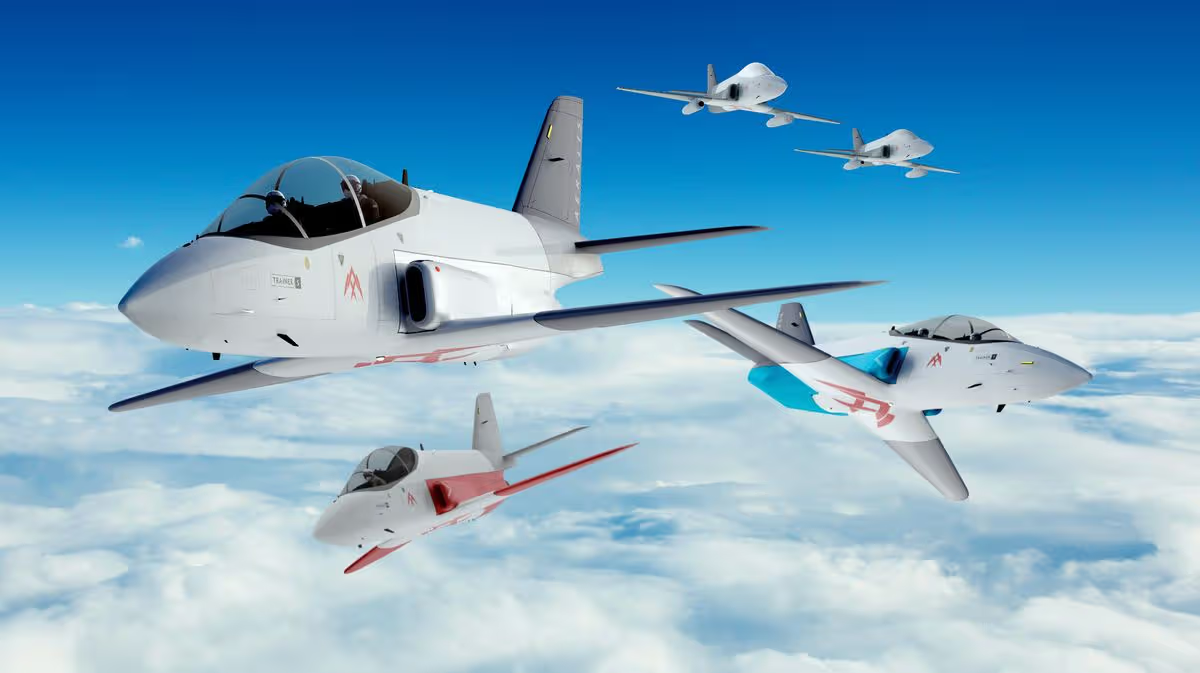
CGI designs of how the Aeralis aircraft could look(Image: Aeralis)
A Bristol aerospace business that was vying to develop a replacement jet for the RAF’s Red Arrows has collapsed into administration, with the loss of 30 jobs.
Aeralis was pinning its hopes on securing a Government contract to replace the Hawk jets, which are due to be retired in 2030 and are currently flown by the famous military aerobatics display team.
Advertisement
But following a period of financial difficulty, Aeralis was placed into administration on Friday. The company’s board appointed David Buchler and Joanne Milner of London-based Buchler Phillips as joint administrators.
The collapse of the firm follows a sustained period of pressure on the company’s cashflow, Aeralis said. The business blamed “continued delays” to the UK Defence Investment Plan, combined with geopolitical factors affecting sources of funding.
Robin Southwell, chair of AERALIS, said: “The board has taken this decision after careful consideration of the company’s position and the funding challenges it has faced over recent months.
“We will continue to support the joint administrators as they explore viable, sustainable options for the future of the business and engage with interested parties.”
The firm’s modular light jet aircraft platform was intended to support military training, operational support and aerobatic display requirements.
The business had established significant intellectual property, strategic partnerships and advanced digital engineering capabilities during its development programme.
According to the BBC, Barzan Holdings – the investment and procurement arm of Qatar’s Ministry of Defence which was a large investor in the business – had withdrawn funding amid the Iran war.
Advertisement
It is understood a potential agreement with the French government also failed to materialise, compounding the financial issues.
Aeralis said the administrators would “continue to work closely” with its management and stakeholders to assess strategic options for the business and its assets, including opportunities to secure investment, preserve value and support the continuation of its programme in an alternative structure.
Ms Milner of Buchler Phillips added: “Aeralis has developed a highly differentiated proposition within the aerospace and defence sector.
“We hope that the administration process will provide an opportunity to explore routes to preserve and develop that value for stakeholders.”
The Nifty IT index climbed 1.2% to around 28,049, emerging as the only sectoral index trading in the green. Meanwhile, the BSE Sensex and Nifty 50 fell over 1% as the rupee hit a fresh record low and bond yields surged to all-time highs, weighing on investor sentiment.
Today’s Top IT Gainers
Oracle Financial Services Software emerged as the top gainer on the IT pack, rising over 3%. Shares of LTIMindtree, Coforge and Tech Mahindra climbed more than 2% each, while Mphasis and Persistent Systems gained nearly 2% each.
Advertisement
Heavyweights Infosys and Wipro shares rose over 1% each, while those of Tata Consultancy Services (TCS) and HCL Technologies made marginal gains, as seen at 11.15 am. The sharp gains pulled up the total value of all companies on the Nifty IT index to Rs 1,752 crore.
The AI Story
The IT stocks had seen a sharp decline recently. OpenAI last Monday announced the launch of OpenAI Deployment Company with an initial investment of $4 billion, designed to help organisations build and deploy AI systems they can rely on every day across their most important work. This retriggered worries around AI-led disruption in India’s IT sector.
Live Events
Strong earnings by tech giants pushed the Nasdaq to record high levels last week, but the Nifty IT index fell. “IT firms are making reasonable headway in AI-driven opportunities, although it will not be enough to compensate for deflationary headwinds. Offsetting growth headwinds amid high competitive intensity will be challenging. Margin headwinds are manageable by further flexing cost levers,” said Kotak Equities. As global AI giants rallied, IT stocks on Dalal Street plunged. The Nifty IT index has plunged around 12% in one month, with the IT heavyweights hitting fresh 52-week lows last week. However, Nasdaq tumbled more than 1.5% on Friday. On Dalal Street meanwhile, IT stocks jumped.
Rupee At Record Low
The renewed investor optimism may also have been driven by the weakening rupee. Rupee dropped to a fresh all-time low of 96.18 against the US dollar on Monday, eclipsing its previous record of 96.1350. The Indian currency is Asia’s worst performer so far in 2026, and has dropped 5.5% since the Iran-US war erupted on February 28. Notably, today marks the fifth consecutive session when the Indian rupee hit a fresh record low as high oil prices sent bond yields soaring to record high levels, denting risk appetite and spooking investors. “Market participants remain cautious amid fears that elevated crude prices may persist for a longer duration despite government measures to control volatility. Near-term rupee range is expected between 95.55–96.25,” said Jateen Trivedi, VP Research Analyst – Commodity and Currency, LKP Securities.
Advertisement
As the IT companies mostly derive their revenue in US dollars, the rupee’s depreciation boosts hopes for better earnings and profitability.
Investors this week will focus squarely on Nvidia’s earnings on Wednesday for clues on the durability of the artificial intelligence-driven rally, said Bajaj Broking.
(Disclaimer: Recommendations, suggestions, views and opinions given by the experts are their own. These do not represent the views of The Economic Times)
Shares of Samsung Electronics rose as much as 7% to their day’s high of Korean Won 2,88,500 after the company entered crucial wage negotiations with its largest labour union in an effort to avoid a strike that could disrupt operations at the world’s biggest memory chipmaker.
As a result, the KOSPI gained more than 1%. According to MSCI data, Samsung Electronics carries a weight of 32% in the index, followed by SK Hynix at 22%, making movements in the two stocks highly influential for the benchmark. In the previous session, Samsung shares had slumped more than 8%, dragging the Kospi down 6%.
Concerns over a major disruption to South Korea’s semiconductor industry eased after efforts by political and corporate leaders to calm tensions between the two sides. Adding to the relief, a Korean court on Monday partially approved an injunction against potential illegal actions by the labour union, according to Yonhap News. Samsung shares climbed as much as 6.7% in Seoul, reversing almost all losses of the previous session.
The development gains significance as any production disruption at Samsung could have broad implications for the global technology supply chain. The company is the world’s largest supplier of memory chips used in products ranging from data centre servers and smartphones to electric vehicles.
Live Events
The negotiations also highlighted growing labour tensions in South Korea as workers seek a larger share of profits generated by companies such as Samsung and SK Hynix amid the global boom in artificial intelligence infrastructure. Union leaders and company executives resumed government-mediated negotiations on Monday for a second round of talks. The meeting came after days of rising tensions and failed mediation attempts that had raised investor concerns over possible walkouts at Samsung’s semiconductor facilities in Korea. The union has threatened to begin an 18-day strike from May 21 if its demands are not addressed. Over the weekend, South Korean Prime Minister Kim Min-Seok urged both sides to resolve the dispute through dialogue. Samsung Executive Chairman Jay Y. Lee also made a rare public appeal, referring to union members as “one family.” The company additionally agreed to the union’s request to replace its lead negotiator with the head of the chip division’s people’s team. “We will sincerely engage in talks,” Samsung union leader Choi Seung-ho said, according to a Bloomberg report.
The union has been pressing Samsung to increase performance-linked compensation after a sharp recovery in semiconductor earnings fueled by strong demand for AI infrastructure. Labour representatives are demanding that Samsung remove the existing cap on bonuses, allocate 15% of operating profit toward employee bonuses and formally include those terms in employment contracts.
Advertisement
Samsung has proposed allocating 10% of operating profit to bonuses along with a one-time special compensation package that it said exceeds industry standards. Company executives have argued that the union’s demands may not be sustainable over the long term.
(Disclaimer: Recommendations, suggestions, views and opinions given by the experts are their own. These do not represent the views of The Economic Times)
KUWAIT CITY — Kuwait International Airport is open and operating today, with commercial flights continuing their phased recovery after a nearly two-month suspension triggered by regional security concerns tied to tensions with Iran.
Kuwait International Airport
The airport reopened its airspace on the evening of Thursday, April 23, 2026, ending one of the longest temporary closures in the facility’s modern history. Passenger flights resumed in stages starting Sunday, April 26, with operations initially limited to Terminals 4 and 5 serving selected destinations.
As of May 18, 2026, Kuwait International Airport remains in Phase 2 of its restart, with Kuwait Airways operating from Terminal 4 and Jazeera Airways based in Terminal 5. Both carriers are gradually expanding their routes and flight frequencies as the facility continues its slow return to normal service.
The two-month suspension, which began February 28, 2026, was a precautionary measure imposed amid regional developments and conflict-related security threats. More than 200,000 passengers were affected during the closure, with many travelers rerouted through Dubai, Doha and Riyadh while Kuwait Airways operated a temporary dual-hub model from bases in other Gulf states.
Director General of Civil Aviation officials have described the current phase as a “careful and gradual return to service,” emphasizing that safety remains the absolute priority as the airport restores full capacity.
Advertisement
Phase 2 launched on May 3, 2026, expanding the number of destinations served by both Kuwait Airways and Jazeera Airways. The airport’s airspace now supports 29 Kuwait Airways routes and 27 Jazeera Airways destinations, according to travel industry tracking data.
International carriers including Emirates have resumed limited operations, though many routes remain at reduced frequencies compared to pre-closure levels. Passengers are being advised to check directly with airlines for real-time flight updates, as schedules remain fluid during the recovery period.
Jazeera Airways, Kuwait’s leading low-cost carrier, has centralized all operations in Terminal 5 and is steadily rebuilding its schedule. A company spokesperson said the airline is “thrilled to be back home” but acknowledged recovery is still in early stages, with flights initially limited to daytime hours between 6 a.m. and 6 p.m..
Terminal 1, which sustained damage during the period of heightened regional tensions, remains closed for repairs with no official reopening timeline announced. All current commercial operations are concentrated in Terminals 4 and 5.
Advertisement
The extended closure severely disrupted Kuwait’s connectivity during the peak spring travel period. Aviation supports tourism, trade and finance in Kuwait, and businesses reliant on air cargo reported major losses while the tourism sector saw sharp declines in visitor numbers.
The partial reopening brings some economic relief, though full recovery is expected to take several more months given that daily flight numbers remain below normal capacity. Officials anticipate a stronger rebound during the summer travel season if operations continue to scale up safely.
Enhanced security screening measures remain in place at both terminals, leading to longer processing times for passengers. Travelers are advised to arrive at least three hours before departure and to check flight statuses multiple times before heading to the airport.
The closure was prompted by regional developments including drone strikes and security threats that forced authorities to suspend operations as a precaution. Repairs to damaged infrastructure and enhanced security protocols across the airport have been major priorities for the Directorate General of Civil Aviation.
Advertisement
Aviation experts note that Kuwait’s experience highlights the vulnerability of critical infrastructure in geopolitically sensitive regions. The swift but cautious reopening reflects improved coordination among Gulf aviation authorities and a strong commitment to passenger safety.
For Kuwaiti and expatriate residents, the partial return of flights has been met with mixed reactions. Many welcomed the ability to fly directly again, while others voiced disappointment over limited destinations and ongoing schedule uncertainties. Social media posts showed travelers celebrating direct flights while others expressed frustration over cancellations and delays.
Regional aviation consultants view the current situation as positive but incomplete. “Kuwait’s quick decision to resume limited operations shows resilience,” said one consultant. “However, full recovery will depend on completing repairs to Terminal 1 and restoring confidence among international carriers.”
The DGCA continues working closely with airlines and international partners to expand the flight schedule safely. Officials say they are prioritizing routes with the highest demand while maintaining strict safety standards throughout the recovery process.
Advertisement
Looking ahead, authorities are focusing on scaling up capacity and preparing Terminal 1 for eventual reopening. Long-term development plans for the airport, including modernization projects, remain active and are expected to support future growth once full operations resume.
The incident has also prompted broader discussions about aviation resilience in the Gulf region. Neighboring countries provided support during the closure, strengthening ties among regional aviation authorities.
For travelers planning to use Kuwait International Airport in the coming weeks, the advice is clear: verify all flight details directly with airlines, allow extra time for security procedures, and remain flexible as schedules continue to evolve.
As flights slowly return and passengers begin to reconnect with the world, Kuwait International Airport’s partial reopening marks an important step toward normalcy. While challenges remain and full capacity is still some time away, today’s operations represent progress and renewed hope for Kuwait’s aviation sector and broader economy.
Advertisement
The skies above Kuwait are once again seeing increasing activity, symbolizing resilience and a cautious but determined return to connectivity after a difficult two-month period. Officials and airlines alike are committed to restoring full service as safely and quickly as conditions allow.




















































You must be logged in to post a comment Login