
Connect with us
DAPA Banner
DAPA Coin
DAPA
COIN PAYMENT ASSET
PRIVACY · BLOCKDAG · HOMOMORPHIC ENCRYPTION · RUST
ElGamal Encrypted MINE DAPA
🚫 GENESIS SOLD OUT
DAPAPAY COMING

Business

McConnell says he won’t be able to return to U.S. Senate yet

Published

on

Continue Reading
Click to comment

You must be logged in to post a comment Login

Leave a Reply

Business

survival lessons for UK business owners

Published

on

survival lessons for UK business owners

The sat-nav maker written off when Google made navigation free in 2009 is now the location technology inside Microsoft, Uber and Huawei, and its comeback offers one of the sharpest survival lessons any UK business owner will read this year.

TomTom’s rise had been extraordinary: revenue grew from €40 million to €1.8 billion in five years, and almost 10 million people owned one of its devices. Then Google launched free turn-by-turn navigation and the £499 gadget on the dashboard looked obsolete overnight.

The share price collapsed 97 per cent. Worse, months earlier the company had paid €2.9 billion, at 28 times EBITDA and largely funded with debt, for map maker Tele Atlas. Recovery looked impossible.

Yet that seemingly reckless acquisition turned out to be the one asset Google could not copy: one of only two digital maps of the world. TomTom stopped selling navigation devices and started licensing location technology instead. Nearly two decades on, its full year 2025 results show revenue of €555 million, gross margins of 88 per cent against roughly 50 per cent in the hardware era, its first operating profit since 2020 and €263 million of net cash with zero debt.

For smaller firms facing their own giant-shaped problem, the playbook breaks down into three moves.

Advertisement

Protect the capability, not the product.

TomTom’s founders bet that their maps, continuously improved by billions of GPS observations from those 10 million sat-navs, were the real business. They kept Tele Atlas chief executive Alain De Taeye, who led mapmaking for the next 18 years. And when revenue fell 60 per cent, they did not retrench: the founders put in €169 million of their own money and increased annual R&D almost tenfold to €347 million. They invested through the crisis, not after it. It is a lesson in conviction for any owner tempted to slash spending at the first sign of trouble, and a reminder that the most innovative firms treat technology investment as a route to survival, not a luxury.

Win by partnering with your rival’s enemies.

Uber, Microsoft and Huawei all chose TomTom precisely because it was not Google. Chief executive Harold Goddijn called TomTom the “Switzerland of navigation”, and neutrality became the advantage. Google even kept recruiting customers for its rival: developers defected after a 14x API price rise, Huawei arrived after the US ban. Google built the consumer market; TomTom became the infrastructure underneath everyone who did not want to depend on it. Plenty of British firms have found the same, which is why specialist businesses continue to outperform larger competitors in markets the giants supposedly own.

Change the economics before you restructure.

Revenue fell 60 per cent but gross margins nearly doubled to 88 per cent. The Orbis platform replaced quarterly map releases with a continuously updated AI system. Only then came the cuts, with 800 roles removed. Technology first, cost base second. Mike Schoofs sold off the sat-nav business, built the maps business, and in 2026 the architect of the commercial pivot became chief executive. As other firms embracing a strategic pivot have discovered, sequencing matters as much as the destination.

When Google made navigation free, TomTom made maps indispensable. The company everyone thought was finished is quietly showing everyone else the way.

Advertisement

Paul Jones

Harvard alumni and former New York Times journalist. Editor of Business Matters for over 15 years, the UKs largest business magazine. I am also head of Capital Business Media’s automotive division working for clients such as Red Bull Racing, Honda, Aston Martin and Infiniti.

Advertisement
Continue Reading

Business

NZ’s Fonterra trims top end of annual milk price forecast on weak demand

Published

on


NZ’s Fonterra trims top end of annual milk price forecast on weak demand

Continue Reading

Business

DOJ investigating allegations around UAW President Shawn Fain

Published

on


DOJ investigating allegations around UAW President Shawn Fain

Continue Reading

Business

What do investors need to be watching in DC in 2026H2?

Published

on


What do investors need to be watching in DC in 2026H2?

Continue Reading

Business

Oil jumps more than 3% after US, Iran launch strikes in Mideast

Published

on


Oil jumps more than 3% after US, Iran launch strikes in Mideast

Continue Reading

Business

Disney spotlights American businesses powering its magic in nation’s 250th year

Published

on

Puka Nacua keeps Super Bowl presence alive in Toyota’s game day commercial

From Alaska tour operators to California engineering firms, Disney is highlighting the American companies helping power its parks, cruises and attractions as the nation celebrates its 250th anniversary.

The entertainment giant’s U.S. theme parks alone generate nearly $67 billion in total economic impact and support about 403,000 jobs nationwide. Across its parks, cruises and attractions, Disney relies on suppliers, design firms and family businesses to help bring those experiences to life.

Disney is highlighting several partners from states featured in its new “Soarin’ Across America” attraction, which gives guests a simulated flight across the U.S. The companies are based in Missouri, Alaska, New York, Florida and California.

Sarah Salvador, senior manager of strategic sourcing for Disney Experiences, told FOX Business that Disney finds vendors through industry events, internal networks, supplier outreach and referrals from existing partners.

Advertisement

8-YEAR-OLD GETS SURPRISE OF A LIFETIME AS DISNEYLAND’S HONORARY 1 BILLIONTH GUEST

“We recognize that there’s a lot of value, a lot of perspective, a lot of creativity that resides in companies of all sizes,” Salvador told FOX Business.

Salvador said Disney’s investments create opportunities beyond the company’s own workforce.

“When the Walt Disney Company chooses to invest in theme parks and resorts, it goes far beyond theme parks and resorts,” she said. “… We’re creating opportunities not just internally, but for outside businesses, large and small.”

Advertisement

One of those businesses is Allen Marine Tours, a family-owned company in Sitka, Alaska. The company has offered tours in Southeast Alaska since 1970 and has worked with Disney Cruise Line since its early Alaska sailings.

Zakary Kirkpatrick, chief marketing officer of Allen Marine Tours, said the company works to keep its family feel as it grows.

“We still try to maintain that family ambiance aboard our vessels with our crew,” Kirkpatrick told FOX Business. “It starts with the training [of] all of our crew. We talk about our history, we talk about who we are, and we really invite them to be a part of that and a part of the family.”

DISNEY WORLD GUEST ARRESTED AFTER ALLEGEDLY THROWING GLASSES OF WATER OVER RESORT RESTAURANT SEATING DISPUTE

Advertisement

Kirkpatrick said Alaska gives Disney Cruise Line guests a different kind of magic on every trip, from whale watching to glacier tours.

“I know Disney’s big thing is magic and every single day in southeast Alaska here, there is something truly magical,” he said. “… You just never know what you’re going to see.”

Another longtime Disney partner, Rando Productions, has helped build parade floats, showpieces and attraction elements for about 35 years.

Joe Rando said the North Hollywood-based company’s work with Disney started with parade floats before expanding into themed entertainment, live shows, attractions and projects with Walt Disney Imagineering.

Advertisement

Today, Rando Productions helps design, build and test parts for Disney attractions and parade floats, including moving pieces that require mechanical engineering and automation.

“What I would say is working with Disney has definitely elevated our company because they are a group of professionals and subject matter experts,” Rando told FOX Business.

DISNEY CEO UNVEILS ENTERTAINMENT GIANT’S NEW 3-PILLAR GROWTH PLAN

GET FOX BUSINESS ON THE GO BY CLICKING HERE

Advertisement

Salvador said guests may not realize how many outside businesses help create Disney experiences, from early ideas to final installation.

“Many folks might hear Disney and think that we pull from outside talent that might just be located where we have a resort located, and that is so far from reality,” Salvador said. “We do engage with firms across the country as well as globally.”

She added, “It really does take a village to create these immersive experiences for our guests.”

Advertisement
Continue Reading

Business

America’s construction labor shortage is making homes more expensive

Published

on

January 2026 jobs report: US economy added 130K jobs amid solid growth

High mortgage rates aren’t the only reason homeownership remains out of reach for many Americans.

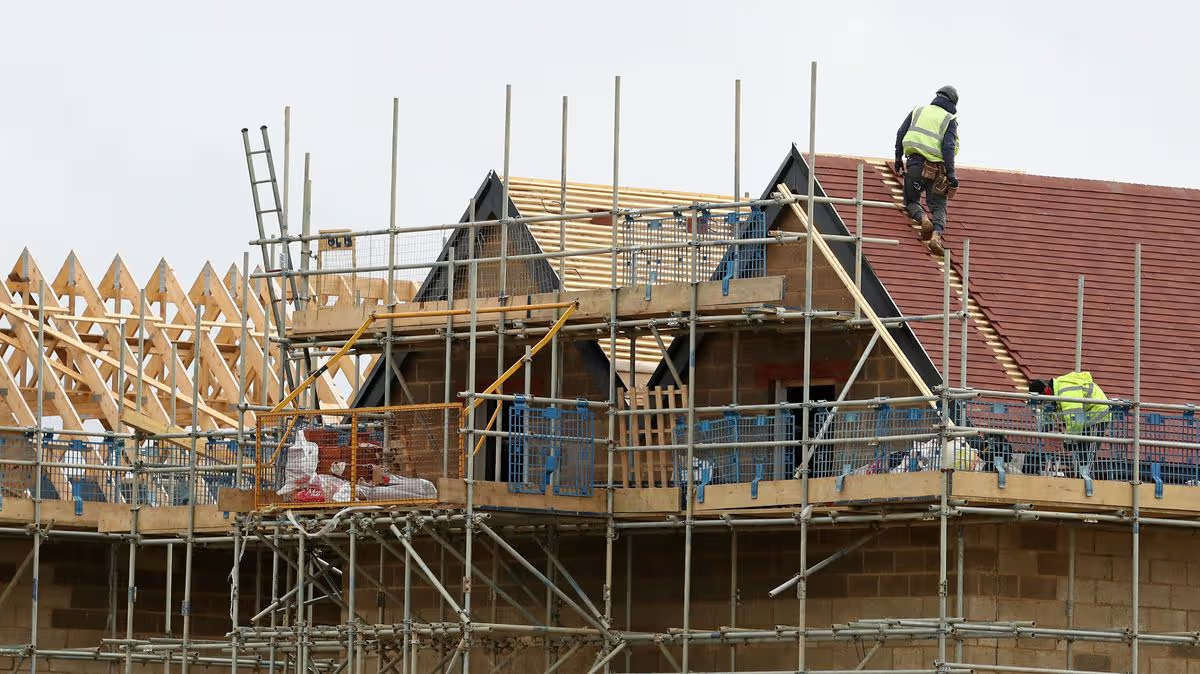
Behind the scenes, homebuilders are grappling with an overlooked challenge — a shortage of skilled workers — that is slowing construction and making it harder to close the nation’s housing gap.

Advertisement

Builders say the labor shortage is creating a ripple effect throughout the housing market, delaying projects, raising construction costs and limiting the number of new homes coming online at a time when demand continues to outpace supply.

BIDEN’S ILLEGAL IMMIGRATION SURGE CAUSED HIGHER RENT AND HOME PRICES, FED STUDY FINDS

New homes being built by CastleRock Communities in Kyle, Texas.

NAHB estimates government regulations add nearly $132,000 to the price of a typical new home. (Matthew Busch/Bloomberg/Getty Images / Getty Images)

“Labor is one of the largest and most expensive inputs when it comes to home production and land development,” Jim Tobin, president and CEO of the National Association of Home Builders, told Fox News Digital.

He said that every month, the construction industry is short by approximately 250,000 workers.

Advertisement

“It’s been as high as 400,000 jobs short when we were really cooking along a few years ago,” Tobin said, adding that the labor gap “is a persistent shortage.”

And the industry’s labor needs are only expected to grow in coming years.

THE KEY STRATEGY RED STATES ARE USING TO LOWER HOUSING COSTS REVEALED

Builders lift wood frames that are part of a home.

Housing industry leaders say states that have prioritized homebuilding have been better positioned to accommodate population growth and economic expansion. (David Paul Morris/Bloomberg via Getty Images / Getty Images)

A recent Home Builders Institute and National Association of Home Builders report estimates builders will need roughly 723,000 new workers annually to keep pace with demand and help close the nation’s 1.5 million-home housing gap.

Advertisement

The shortage is already affecting how quickly homes can be built. According to Home Builders Institute President and CEO Ed Brady, labor constraints are extending construction timelines and driving up costs.

ONE TYPE OF PROPERTY IS QUIETLY SAVING AMERICANS THOUSANDS OF DOLLARS

“This shortage adds nearly two extra months to building timelines, inflating costs and delaying delivery,” Brady told Fox News Digital.

Builders say replenishing the skilled trades pipeline is only part of the solution.

Advertisement

GET FOX BUSINESS ON THE GO BY CLICKING HERE

A home is seen in California with a an "open house" sign in front of it.

An “Open House” sign in front of a home for sale in the Woodland Hills neighborhood of Los Angeles, California on July 13, 2025.  (Eric Thayer/Bloomberg/Getty Images / Getty Images)

Tobin said many construction jobs do not require a four-year college degree and can provide stable, middle-class careers, but the home construction industry has struggled for years to attract enough workers to replace retiring tradespeople.

Continue Reading

Business

Death toll from Venezuela earthquakes rises to 4,490

Published

on


Death toll from Venezuela earthquakes rises to 4,490

Continue Reading

Business

Meta to put AI chip into production in September as it looks to double computing capacity, memo shows

Published

on


Meta to put AI chip into production in September as it looks to double computing capacity, memo shows

Continue Reading

Business

July 12, 2026 Solution Revealed for Puzzle #1849, With Hints and Solving Strategy

Published

on

Air travellers wearing a protective face masks, amid the coronavirus disease (COVID-19) pandemic, at JFK International airport in New York

Wordle players searching for Sunday’s answer can find it here: the solution to puzzle #1849, released July 12, 2026, is CLACK, according to multiple outlets tracking the daily New York Times word game.

The five-letter word refers to a sharp, abrupt, rhythmic sound produced when two hard objects strike against each other rapidly, such as the noise of an old mechanical keyboard, colliding pool balls, or train wheels rolling over track joints. Puzzle trackers described Sunday’s word as a moderate challenge for solvers, noting that some players gravitated quickly toward the correct meaning while others were initially thrown off by words evoking similar sounds or unrelated concepts, including air travel, geometry and carpentry, before ultimately landing on the correct answer.

For those working through the puzzle before checking the solution, several structural clues were available to help narrow down the possibilities. The word contains a single vowel alongside four consonants, along with one repeated letter, and begins with the letter C. Puzzle guides also offered a wordplay-style hint describing the answer as “the signature noise produced by typing on an old-fashioned mechanical keyboard,” alongside its resemblance to words such as “snack,” “track” and “back,” given that it rhymes with each.

Wordle challenges players to guess a hidden five-letter word within six attempts, using color-coded tile feedback to indicate whether each guessed letter is correct and correctly placed, correct but misplaced, or absent from the word entirely. The game, created by software engineer Josh Wardle in 2021, was acquired by The New York Times the following year after surging in popularity, and has since become a fixture of the paper’s daily games lineup alongside titles such as Connections, Strands and the Mini Crossword.

Advertisement

Puzzle trackers offered a familiar set of strategic reminders for players working through Sunday’s word or preparing for future puzzles. Common advice includes opening with a word containing frequently used letters such as R, S, T, N and L to quickly surface useful information, testing different vowel placements early in the guessing process, and treating even an incorrect guess as useful data by paying close attention to which letters turn green, yellow or gray. Guides also cautioned against ruling out repeated letters too quickly, noting that Wordle answers occasionally reuse the same letter twice, as in past answers like SHEEP or BLOOM, a pattern Sunday’s answer, CLACK, also followed with its doubled C.

Players down to their final guesses were advised to avoid speculative attempts once the field of possibilities had narrowed significantly, instead favoring answers that satisfy every constraint established by prior feedback rather than guessing based on instinct alone. Analysts of the game’s daily difficulty patterns have generally noted that maintaining composure in the final one or two guesses, rather than rushing, tends to produce better outcomes than reactive guessing under pressure.

Saturday’s puzzle, #1848, carried the answer AVIAN, according to solution trackers, continuing a recent stretch of varied five-letter words spanning different categories and levels of difficulty. The Times maintains a full archive of past Wordle puzzles, allowing players who want extra practice, or who missed a previous day’s word, to revisit earlier solutions at their own pace.

Beyond the standard daily puzzle, Wordle’s broader ecosystem has continued to expand in recent years, inspiring a range of spinoff and companion games that build on its core mechanics. Among the more prominent examples is Worldle, a geography-based riff on the format in which players attempt to identify a country based on its outline shape, receiving distance-based feedback in kilometers after each guess, within the same six-attempt structure as the original game. Recent Worldle answers have included countries such as Ethiopia, Italy, Mali and Taiwan over the preceding week, according to puzzle trackers following that spinoff separately. Other Wordle-inspired games mentioned alongside Sunday’s puzzle updates included Octordle and Quordle, both of which challenge players to solve multiple hidden words simultaneously rather than just one.

Advertisement

The puzzle’s continued popularity nearly five years after its original release has been attributed in large part to its simplicity and shareability. Each day brings exactly one new word, with no ads interrupting the format, and players can share their results on social media through a grid of colored squares that reveals their guessing pattern without spoiling the actual answer for others who haven’t yet played. That shareable format helped fuel Wordle’s rapid rise in the early 2020s and has continued to sustain a large, dedicated daily audience in the years since.

The Times’ companion analysis tool, Wordle Bot, continues to offer players detailed statistical breakdowns of their performance on each day’s puzzle, including how efficiently a given guess eliminated remaining possibilities and how a player’s overall approach compares with the broader base of daily solvers. Data cited by puzzle trackers covering Sunday’s word did not include finalized average-guess figures at the time of publication, though the Times’ internal Wordlebot statistics for the previous day’s puzzle, AVIAN, showed a range of solving outcomes across the player base.

Players who did not solve Sunday’s puzzle were reminded by tracking outlets that a new Wordle puzzle becomes available every day at midnight in each player’s local time zone, meaning a missed word carries no bearing on future attempts and streak-conscious players can simply pick back up with the next day’s release. The Times has continued to expand its broader portfolio of daily puzzle offerings in recent years, part of a wider strategy aimed at keeping readers returning to its games platform on a consistent basis, with Wordle remaining the most widely recognized entry point into that ecosystem.

Monday’s Wordle puzzle is set to reset at midnight local time, continuing the game’s unbroken daily cadence. Players looking for an early head start on hints can typically expect a new round of guides and clues to appear across puzzle-tracking sites shortly after the transition, following the same structural format used for Sunday’s reveal.

Advertisement
Continue Reading

Trending

Copyright © 2025