

Business
Medtronic's Fair Value Falls Between Caution And Optimism





ZURICH — Three people were wounded in a knife attack early Thursday at a busy train station in Winterthur, Switzerland, near Zurich, prompting a large police operation and the swift arrest of a 31-year-old Swiss national, authorities said.
The incident occurred in the station concourse, where the suspect allegedly stabbed three victims before fleeing. All three injured individuals were hospitalized and receiving treatment, though their conditions were not immediately detailed by police. No deaths were reported.
Winterthur police confirmed the suspect was taken into custody shortly after the attack. The man’s motive is under active investigation. Swiss newspaper Blick reported obtaining video footage showing a man running from the station while shouting “Allahu Akbar,” an Arabic phrase meaning “God is greatest.” The paper cited an eyewitness who saw the man holding a knife as bystanders screamed and ran for safety.
Police have not officially confirmed the phrase or released further details about the suspect beyond his nationality and age. Federal authorities have been notified as part of standard procedure for incidents that may carry national security implications.
Rapid Police Response
Officers from Winterthur and regional forces responded quickly, securing the area and launching a coordinated search. The station was temporarily locked down during the operation, causing significant disruption to morning commuter services. Train traffic has since resumed with some delays.
The swift arrest prevented further harm and demonstrated effective local law enforcement coordination in a relatively quiet Swiss city. Winterthur, with a population of about 110,000, is a major transport hub northeast of Zurich.
Context of the Attack
Switzerland has maintained a low rate of terrorist incidents compared to some European neighbors, but random knife attacks have occurred sporadically in recent years. The country’s central location and open borders require constant vigilance from intelligence services monitoring both domestic radicalization and potential foreign-inspired threats.
The reported use of “Allahu Akbar” has drawn attention to possible ideological motivations, though officials stressed that all avenues — including personal, psychological or other factors — remain under review. No group has claimed responsibility, and there is no indication of accomplices.
This event comes amid broader European concerns about lone-actor violence using everyday weapons. Security experts note that such attacks are difficult to predict and prevent entirely, even in nations with strong social services and intelligence capabilities.
Impact on Public and Transportation
Commuters described scenes of panic as people sought shelter inside trains, shops and offices. Many expressed shock that such violence occurred in what is generally considered a safe, orderly city.
The incident has prompted increased security measures at major Swiss transport hubs. Additional patrols were visible in Zurich and other cities Thursday morning as a precautionary step.
For the victims and witnesses, psychological support services were made available. Local authorities urged calm while the investigation proceeds.
Ongoing Investigation
Police are examining the suspect’s background, possible online activity, and any previous contact with authorities. Forensic analysis of the weapon and crime scene continues. Swiss prosecutors will decide on formal charges once initial evidence is reviewed.
The case highlights challenges in balancing public safety with civil liberties in open societies. Switzerland has faced occasional debates about surveillance powers and integration policies in response to similar isolated incidents.
Broader European Security Trends
Knife attacks have become a recurring concern across parts of Europe, often involving individuals acting alone. Many cases involve complex personal circumstances combined with ideological influences, making prevention particularly difficult.
Swiss security services work closely with European partners through intelligence-sharing networks. The country’s direct democracy system and strong rule of law have generally helped maintain social stability, but events like Thursday’s attack test public confidence.
As details emerge, officials will likely face questions about whether warning signs were missed and what steps can further protect public spaces like train stations.
For now, the focus remains on supporting the victims and completing a thorough, transparent investigation. Police have asked anyone with additional video footage or information to come forward.
The three wounded individuals are expected to recover, though the psychological impact on them and the wider community may linger. Winterthur residents expressed solidarity and hope that such violence remains rare in their region.
This incident serves as a sobering reminder of vulnerabilities in everyday public spaces. As the investigation advances, authorities aim to provide clear answers while maintaining calm across Switzerland.


Valuations also are seen as more realistic compared to a few years ago.

Findell Capital pushes Figma for cost cuts, board review

The aged care, mental health and disability support provider has signed an agreement with the Fair Work Ombudsman to pay back nearly 2,000 staff.

An assessment panel has unanimously approved Providence Lifestyle’s plan to build a 190-unit village, estimated to cost $35 million.
Building permits data shows moderate growth, misses expectations

A person walks outside a Best Buy store on May 29, 2025 in Chicago, Illinois.
Scott Olson | Getty Images
Best Buy on Thursday reported fiscal first-quarter results that beat expectations on the top and bottom lines as the electronics retailer tries to break out of a sales slump.
The company said revenue climbed slightly, driven by comparable sales growth of 2%. It reaffirmed its full-year guidance of revenue between $41.2 billion and $42.1 billion, in addition to adjusted earnings per share of $6.30 to $6.60. It expects comparable sales in the range of a decline of 1% to an increase of 1%.
The company said its biggest growth drivers in the quarter were gaming, computing, mobile phones and services, which were partially offset by a decline in sales of appliances.
Shares of Best Buy rose 7% in premarket trading.
“Our comparable sales grew 2% versus last year, higher than our outlook, with positive comps across the majority of our major product categories and strong performance in our Best Buy Ads and Marketplace initiatives,” CEO Corie Barry said in a release. “We also drove operating income rate expansion and EPS growth.”
More retailers including Walmart and Target have leaned into advertising and third-party marketplace businesses, which offer sales growth with higher profit margins than their traditional merchandise does.
Here’s how Best Buy performed in its fiscal first quarter compared with what Wall Street was expecting, according to a survey of analysts by LSEG:
- Earnings per share: $1.28 adjusted vs. $1.23 expected
- Revenue: $8.94 billion vs. $8.83 billion expected
For the period ended May 2, Best Buy reported net income of $276 million, or $1.31 per share, up from $202 million, or 95 cents per share, in the year-ago period. Revenue rose slightly to $8.94 billion from $8.77 billion the prior year. Excluding one-time expenses, including charges incurred for restructuring its health business, Best Buy reported adjusted earnings per share of $1.28 per share.
The earnings come just over a month after the company named Jason Bonfig as its new CEO, succeeding Barry in the fall. The leadership change was part of Best Buy’s efforts to increase sales and accelerate its business.
“With this momentum, I believe it is the right time to transition the leadership of Best Buy, and step down as CEO later this year,” Barry said in a statement Thursday.
Bonfig said in the Thursday release that he’s focused on expanding the company’s reach and elevating the experience for customers as he prepares to take the helm on Nov. 1.
Best Buy has been struggling with a sales slump, taking additional hits from higher tariffs and lower consumer confidence. Last quarter, Barry said the company was seeing a divergence in higher-income shoppers and lower-income shoppers, with softness in higher-cost item sales.
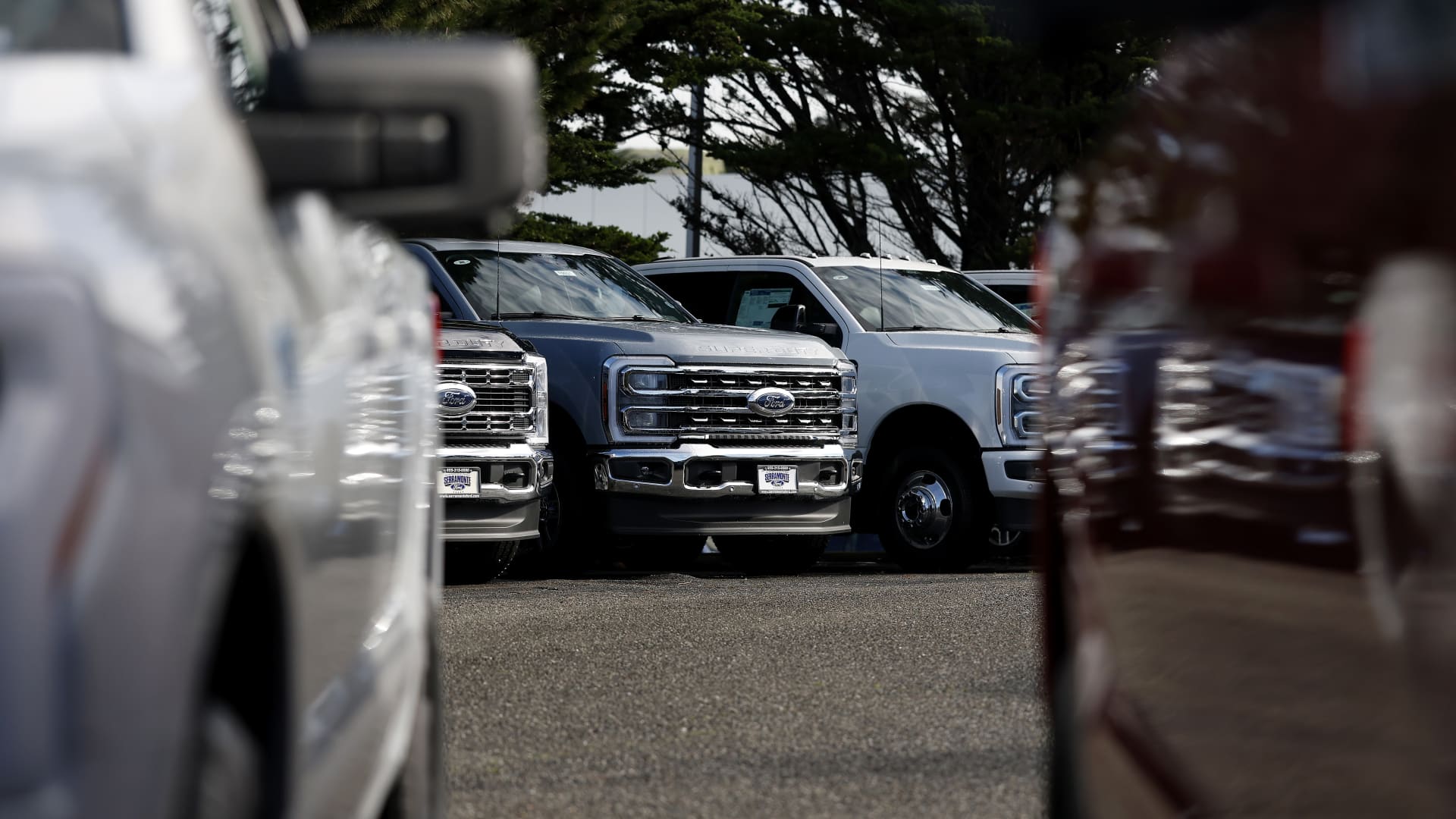
In a country where big trucks are a big deal, those pickups and SUVs represent a big percentage of auto loans that come with a sizable monthly payment, more than $1,000 a month, according to new data.
Experian Automotive’s analysis of more than 5 million open auto loans and leases in the first quarter shows nearly 19% of new vehicle loans include a monthly payment of at least $1,000. That’s up from roughly 17.4% year over year.
“The assumption is that it’s all luxury, it’s high-line, and that is not the case,” said Melinda Zabritski, head of automotive financial insights for Experian Automotive.
Almost 74% of the auto loans requiring owners to pay $1,000 or more every month are for non-luxury models, with the top five models being popular pickup trucks including the Ford F-150, Chevrolet Silverado 1500 and Ram 1500, according to Experian.
Just five years ago, auto loans with monthly payments over $1,000 accounted for just 5.4% of the market. Then the global chip shortage hit in 2021 and 2022, and automakers around the world prioritized production of higher-end, more profitable models. Vehicle prices soared, and so did the amount borrowed for auto loans.
Zabritski said those higher prices have changed how car and truck buyers look at what it takes to finance the purchase of a new vehicle.
“We haven’t seen a reduction in that MSRP, and in those high loan amounts,” she told CNBC. “I think as time goes on, I think more consumers are getting used to the $1,000 payment.”
The average amount borrowed is now at an all-time high of $43,952, and the average monthly payment has also climbed to an all-time high of $770, according to Experian Automotive. Both are a reflection of a new auto market that is relatively strong.
As for auto loan delinquencies, the percentage of loans that have payments more 30 days late has edged up to 2% of all new vehicle loans, with the 60-day delinquency rate also increasing.
Still, Zabritski noted that delinquency rates remain below 2018 levels.
“The driving force in the 60-day delinquency really does fall within the subprime market. Lower credit scores are going to have a higher likelihood of default,” she said.
Business
Dolly Khanna’s portfolio sees steady gains in CY26; 5 stocks rise up to 25% – Portfolio Moves

An ETMarkets analysis of ace investor Dolly Khanna’s portfolio shows that, based on shareholding data for the March 2026 quarter, she publicly holds around eight stocks. As of May 27, 2026, the total value of these holdings is approximately Rs 481 crore, up about 8% from Rs 444 crore in December 2025.
In terms of performance, five of the eight stocks have gained between 4% and 26% so far in CY26, while the remaining three have declined between 15% and 22%. There were three fresh additions to the portfolio during the March 2026 quarter. (Data Source: ACE Equity, Trendlyne)
Business
Oil Prices Surge Over 2 Percent as US-Iran Tensions Escalate and Supply Fears Grip Global Markets

NEW YORK — Crude oil prices jumped sharply on Thursday, with West Texas Intermediate crude rising more than 2 percent to $90.87 per barrel and Brent crude climbing to $96.67, as renewed military exchanges between the United States and Iran near the Strait of Hormuz reignited fears of potential supply disruptions in the world’s most critical energy chokepoint.
The gains extended a volatile week for energy markets, with benchmark prices responding to reports of fresh strikes and retaliatory actions that have heightened geopolitical risk premiums. Murban crude, a key Middle East benchmark, posted even stronger gains, rising 5.16 percent to $94.57 amid concerns over possible longer-term threats to Persian Gulf exports.
The surge comes as traders assess the potential impact on global supply flows. Roughly one-fifth of the world’s seaborne oil passes through the Strait of Hormuz, making any sustained disruption a major risk factor for energy prices and broader economic stability.
Drivers Behind Thursday’s Rally
Analysts attributed the sharp move primarily to escalating tensions following U.S. strikes on Iranian drone facilities and Iran’s response targeting American assets. Although both sides have described the actions as limited, the incidents have raised fears that the fragile ceasefire could collapse, potentially leading to attacks on oil infrastructure or shipping lanes.
“Geopolitical risk is back on the table in a meaningful way,” one commodities trader noted in market commentary. The possibility of Iran restricting tanker movements or targeting infrastructure has prompted defensive buying across energy futures.
Supporting the price action, several other benchmarks showed strength. WTI Midland rose 2.61 percent to $92.44, while gasoline futures gained 1.96 percent. Heating oil also moved higher, reflecting expectations of tighter supply conditions if tensions persist.
Natural gas prices, however, traded mixed. U.S. Henry Hub futures fell 0.87 percent to $3.068, while AECO C in Canada surged 10.66 percent on regional weather and storage dynamics.
Broader Market Context
Oil prices have been highly sensitive to developments in the Middle East throughout 2026. Earlier disruptions from the conflict had already pushed benchmarks above $100 at times, though periodic hopes for de-escalation had triggered pullbacks. Thursday’s move reversed some of that recent softness.
The energy complex is also reacting to mixed global demand signals. While economic growth concerns in some major economies persist, strong consumption in Asia and ongoing strategic buying by certain nations have provided underlying support.
Inventory data released earlier in the week showed modest builds in U.S. crude stocks, but analysts say this has been overshadowed by the geopolitical narrative. The American Petroleum Institute reported a larger-than-expected draw in gasoline inventories, contributing to the strength in refined product prices.
Impact on Global Benchmarks
International crude grades showed varied movements depending on reporting delays. The OPEC Basket fell in older data, but current trading sentiment suggests renewed upward pressure across the complex. Dubai and Oman grades reflected similar dynamics, with some benchmarks posting notable declines in delayed figures while active trading showed firmness.
Western Canadian Select traded lower in recent sessions, reflecting regional pipeline and refining dynamics less directly tied to Middle East events. Louisiana Light and ANS West Coast also showed mixed performance based on timing.
This divergence highlights how different crude grades respond to specific regional supply and demand factors even as global risk sentiment dominates headline movements.
Implications for Energy Markets and Economy
Rising oil prices carry significant implications for inflation, consumer spending and corporate earnings. Higher energy costs could feed through to transportation, manufacturing and household budgets, potentially complicating central bank policy decisions in multiple countries.
Airlines, shipping companies and chemical manufacturers face increased input costs that may pressure margins or lead to higher prices for end consumers. Conversely, oil producers, exploration companies and service providers stand to benefit from sustained higher prices.
The surge has also influenced related markets. Gold prices pulled back as the dollar strengthened on risk sentiment, while certain equity sectors showed defensive rotation.
Analyst Perspectives and Outlook
Energy analysts remain divided on the near-term trajectory. Some expect prices to test $95–$100 for WTI if tensions remain elevated, while others warn that any diplomatic progress could trigger sharp profit-taking.
Longer-term factors include global economic growth forecasts, OPEC+ production decisions and the pace of energy transition efforts. The current environment favors volatility as traders balance immediate geopolitical risks against longer-term demand uncertainties.
Market participants will closely monitor overnight developments in the Middle East, upcoming inventory reports and statements from major producers. Any escalation involving critical infrastructure could push prices significantly higher, while successful de-escalation talks might ease the recent premium.
For businesses and consumers, the current price environment serves as a reminder of energy markets’ sensitivity to geopolitical events. Companies with hedging programs may be better positioned, while households could face higher gasoline prices at the pump in coming weeks.
Technical Market View
From a technical standpoint, WTI crude has broken above recent resistance levels around $88–$89, potentially targeting the $95 zone if momentum holds. Brent faces similar dynamics with resistance near $98–$100.
Trading volumes were elevated during the session, indicating strong participation from both speculative and commercial accounts. Options activity showed increased interest in upside protection, reflecting caution among market players.
As trading continues, focus remains on whether the current spike represents a temporary risk premium or the start of a more sustained move higher. Energy futures will likely remain in the spotlight as long as uncertainty persists in the Persian Gulf.
The latest price action underscores oil’s role as both a critical commodity and a barometer for global geopolitical stability. With multiple benchmarks showing significant daily moves, market participants are bracing for continued volatility in the energy complex.

‘Trump Mobile’ Has Struggled To Ship Any Phones, But Has Already Leaked Subscriber Data

“This campaign is bigger than politics”- Dad’s plea for funding as son moved to ‘urgent’ donor list

(VIDEO) Three Injured in Knife Attack at Swiss Train Station, Suspect Arrested


-

 Crypto World7 days ago
Blockchain.com files with SEC for U.S. IPO
-

 Fashion6 days ago
Holiday Weekend Open Thread – Corporette.com
-

 Politics3 days ago
Bridgerton Season 5: Cast, Release Date And Everything We Know So Far
-

 Crypto World6 days ago
Bitcoin Accumulation Weakens as BTC Realized Losses Hit $600M
-

 Tech3 days ago
Microsoft’s quiet Claude Code retreat and the real cost of enterprise AI
-

 Crypto World5 days ago
Robinhood crypto COO Tanya Denisova exits
-

 Business6 days ago
Dell Technologies DELL Stock Surges 15% on AI Server Momentum and Analyst Upgrades in 2026
-

 Business4 days ago
NYT Strands Answers May 24 2026 Revealed for Puzzle No. 812 Theme Summer Essentials
-

 Business6 days ago
Trump Invests $1M-$5M in Kura Sushi USA Chain With 27 California Locations
-

 Politics6 days ago
Makerfield: a tale of two social-media histories
-

 Crypto World6 days ago
Space X IPO Is ‘Bad News’ for Tech Stocks: But What About Bitcoin?
-

 Business2 days ago
Selena Gomez Reportedly Upset Over Benny Blanco’s Comments on Her ‘Terrible’ Diet
-

 Business3 days ago
BTS Sells Out Four Las Vegas Shows at Allegiant Stadium for ARIRANG World Tour
-

 Crypto World6 days ago
MicroStrategy’s Saylor Says Miners No Longer Set Bitcoin Price, Another Force Has Taken Over
-

 Tech7 days ago
WhatsApp ads could make Irish debut after discussions with DPC
-
Tech1 day ago
The Samsung pay deal is the moment Korean unions changed register
-
 Tech6 days ago
A 0.12% parameter add-on gives AI agents the working memory RAG can’t
-

 Crypto World6 days ago
AI infrastructure race heats up as IREN pitches full-stack strategy, WhiteFiber lands $160M deal
-

 Tech3 days ago
Westone Audio and Etymotic Acquired by Fidelity Collective in Major IEM Market Move
-
 Crypto World3 days ago
Nvidia (NVDA) CEO Calls on Super Micro to Strengthen Export Controls Amid Smuggling Probe
You must be logged in to post a comment Login