Connect with us

Business

Oil Price Today (September 23): Crude oil below $100 on hopes of US-Iran talks. What did Trump say?

Published

on

Oil Price Today (September 23): Crude oil below $100 on hopes of US-Iran talks. What did Trump say?
Oil prices edged lower on Wednesday as Saudi Arabia began restoring crude flows through a key pipeline to the Red Sea, while hopes of a diplomatic breakthrough in the US-Iran war grew ahead of talks at the United Nations in New York.

The moves came after US President Donald Trump on Tuesday warned that he could “annihilate” Iran, while also saying his envoys Steve Witkoff and Jared Kushner had held productive discussions with Iranian mediators aimed at ending the war.

Crude oil on September 23

Brent crude futures fell 7 cents, or 0.07%, to $99.18 a barrel, while West Texas Intermediate futures declined 35 cents, or 0.39%, to $90.17 a barrel.

Advertisement

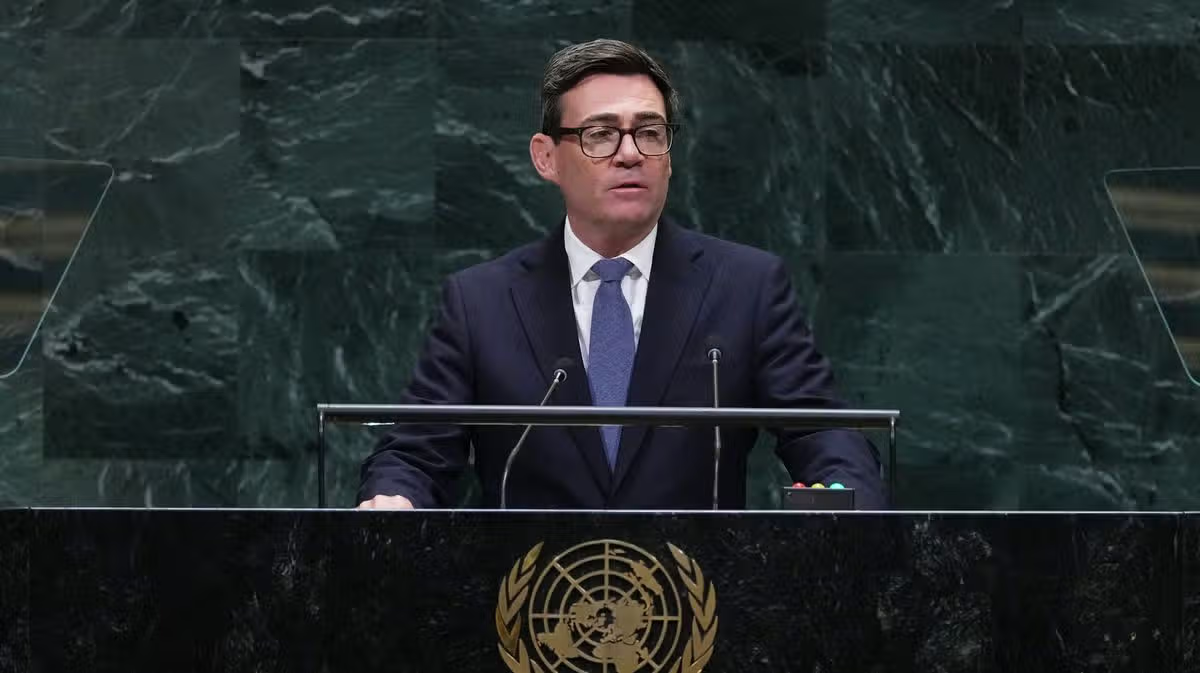
“I think there’s a lot of momentum for them to make a deal,” Trump said. Expectations of stronger oil supply and the possibility of an end to the nearly seven-month conflict pushed Brent below $100 a barrel at Tuesday’s close for the first time since September 8. “I think that a settlement is going to be reached,” Trump said after a meeting with British Prime Minister Andy Burnham on the sidelines of the UN General Assembly ‌in ⁠New York.

Further, a sentiment boost also comes after Saudi Arabia restarted operations on its East-West Pipeline to the Red Sea on Tuesday, three sources briefed on the matter said, with signs that Middle Eastern oil flows were beginning to increase. The pipeline had been shut on September 11 after drone attacks, which Saudi Arabia blamed on Iraqi militia, halted crude loadings at the kingdom’s Yanbu port.


Before the disruption, Saudi Arabia had been using the pipeline to reroute around 4 million barrels per day, or roughly 4% of global supply, to Yanbu after the US-Israeli war on Iran disrupted oil flows from Saudi Arabia and other Gulf producers through the Strait of Hormuz.
Iraq is also raising its oil exports, Oil Minister Basim Mohammed said on Tuesday. The country is currently exporting more than 3 million bpd and expects shipments through Turkey to rise to more than 600,000 bpd.

Where are prices headed?

JPMorgan, meanwhile, has lost visibility on where oil prices are headed. For the first time since the Iran war began in February, the Wall Street bank no longer has a clear baseline scenario for the oil market, as escalating tensions add to concerns over an already worsening supply shock.

“We simply don’t know how to model the endgame,” JPMorgan analysts said, highlighting the uncertainty over how the conflict could develop. At the start of the conflict, the bank had assumed there were certain economic thresholds that the US administration would not cross. Six months into the war, however, many of those lines have been crossed, while there is still no clear exit strategy, JPMorgan said.

Advertisement

JPMorgan said on Thursday that it did not have a clear baseline view for oil markets for the first time since the US-Israeli war on Iran began, highlighting the uncertainty confronting the market.

The possibility of further supply disruptions has increasingly pushed the oil price outlook higher. Daan Struyven, co-head of global commodities research at Goldman Sachs, said recent attacks had shown that disruptions to shipping could spread and become more severe.

Goldman Sachs has outlined a scenario in which oil prices could climb to as much as $120 a barrel if attacks on vessels in the Middle East intensify. If exports return to normal, the bank expects oil prices to move back towards $80 a barrel.

Struyven told Bloomberg that shipping risks had become an important driver of oil prices. He said Goldman Sachs sees “meaningful upside to crude oil prices” and also expects natural gas and refined product prices to rise. He added that supply shocks in gas and fuels are larger than those in the crude market.

Advertisement

Disclaimer: The views/recommendations mentioned in this article, wherever applicable, are those of the respective SEBI-registered Research Analyst/brokerage and have been reproduced/reported with due attribution. They should not be construed as the views or recommendations of The Economic Times Digital or the journalist. Readers are advised to consider the original research report and make their investment decisions based on their own assessment. Brokerage disclaimers here

Continue Reading
Click to comment

You must be logged in to post a comment Login

Leave a Reply

Business

Why Fast-Growing Digital Firms Struggle to Borrow

Published

on

Why Fast-Growing Digital Firms Struggle to Borrow

More often it is money — specifically, the maddening difficulty of persuading a lender to back a company that is growing quickly but does not look like a traditional borrower on paper.

The Financial Conduct Authority’s review of how banks and finance houses serve small and medium-sized businesses has landed squarely on this problem, and few sectors feel it more acutely than the UK’s online gaming and casino operators. These are firms with real revenue, real customers and real ambition, yet they routinely find the shutters coming down when they approach mainstream funders.

One corner of the market that illustrates the funding puzzle particularly well is the world of non gamstop sites — UK-facing casino destinations that operate outside the national player-blocking scheme and are typically catalogued by independent review guides for adult players who want a broader spread of options. These are legitimate businesses with genuine revenue and loyal customers, but their position outside the mainstream framework makes lenders instinctively wary, often before any numbers are examined. For any operator or affiliate whose commercial model touches this part of the sector, understanding how funders perceive it is essential, because a lender’s assumptions about risk here can quietly shape whether a growth loan is ever approved. It is precisely this kind of niche the FCA review implicitly acknowledges when it questions whether “computer says no” underwriting fairly serves legitimate digital businesses.

Free newsletters
Advertisement

The stories that matter to UK business, straight to your inbox.

Advertisement

What the FCA Review Actually Says

At its heart, the review examines whether SMEs across the economy — from manufacturers to software firms — can access finance on fair, transparent terms. It scrutinises the way banks assess creditworthiness, the speed of decisions, and the frustrating opacity that leaves founders guessing why an application failed. The regulator has flagged a stubborn gap between the appetite for growth capital among smaller companies and the willingness of established lenders to provide it.

For digital-first firms, the sting is sharper. Traditional credit models were built around tangible assets: property, machinery, stock sitting in a warehouse. An online gaming operator’s value lives in code, customer relationships, brand and recurring revenue — none of which fits neatly into a spreadsheet designed for a haulage company. The review’s push toward more nuanced, data-informed lending decisions could, in principle, tilt the field back toward these asset-light businesses.

The Asset-Light Problem in a Physical-Asset World

Compare the treatment of two hypothetical companies. A precision engineering firm applying for expansion capital can point to the machines on its factory floor as collateral. The government’s own Advanced manufacturing plan (HTML version) leans heavily on the idea that physical investment underpins productivity and growth — and lenders instinctively understand it.

Now picture an online gaming operator turning over similar sums. Its “factory” is a set of servers, licences and a marketing engine. There is nothing to repossess if the loan sours, which makes a cautious credit committee nervous. The FCA review pushes lenders to move beyond this instinct and toward richer signals: transaction data, customer retention, cash-flow patterns. The direction of travel favours founders who can tell a credible, numbers-backed story rather than simply pledge a building.

Advertisement

Infrastructure, Not Just Ideas

There is a quiet twist here. Fast-growing gaming firms are increasingly capital-hungry in ways that do resemble traditional industry — they consume enormous computing power. The same forces reshaping British manufacturing are reshaping their cost base too. Recent reporting on how data centre demand drives NI manufacturing shows just how physical the digital economy has become. Servers need buildings, cooling, energy and hardware.

That convergence is useful for founders seeking funds. An operator that can frame its borrowing around genuine infrastructure — computing capacity, resilient systems, data handling — presents a case a lender recognises. It reframes an “intangible” business as one with real, financeable underpinnings, precisely the kind of nuance the FCA wants credit decisions to capture.

Where Technology Strengthens the Case

Beyond hardware, the sophistication of a firm’s technology stack is becoming a lever in funding conversations. Underwriters increasingly want evidence that a business runs efficiently and can defend its margins as it scales. Analysis of AI in leisure and hospitality highlights how automation, personalisation and smarter operational tools are lifting productivity across consumer-facing sectors.

For gaming operators, demonstrating this maturity does double duty. It shows a lender the business is not a fragile bet reliant on a single trend, and it aligns with the FCA’s encouragement of data-driven assessment. A founder who arrives with clean dashboards, predictable cost curves and evidence of operational discipline is far easier to underwrite than one waving projections alone.

Advertisement

What Founders Should Do Next

The practical takeaway for anyone running a fast-growing online leisure business is to prepare for a lending environment that is slowly, unevenly modernising. That means keeping meticulous financial records, quantifying customer value, and being ready to explain the business model in plain terms a generalist credit officer can grasp.

It also means widening the search. Challenger banks, specialist lenders and revenue-based finance houses often understand digital models better than the high street, and the FCA review may prod incumbents to compete harder for exactly this custom. The direction of change is encouraging: fair, transparent, data-led lending should reward well-run digital firms rather than penalising them for lacking a warehouse. For the operators watching from the fast lane of the online economy, that shift cannot come soon enough — and the founders who prepare now will be the ones ready to seize it.

Advertisement
Continue Reading

Business

Richmond Fed’s Tom Barkin says inflation risks may drive more hikes

Published

on

Richmond Fed's Tom Barkin says inflation risks may drive more hikes

The Federal Reserve’s decision to raise interest rates last week may mark the first of several hikes aimed at taming stubborn inflation, and one central bank leader weighed in on where inflation may go from here.

Federal Reserve Bank of Richmond President Tom Barkin said in a speech before CFA Society Baltimore Tuesday that the “risks to inflation outweigh the risks to maximum employment. That’s why we raised rates.”

Advertisement

Barkin, who is a non-voting member of the Federal Open Market Committee (FOMC) this year, compared the Fed’s dual mandate between promoting maximum employment and price stability to raising children, saying “inflation is our troublemaker” and noting it’s been above the 2% target for five years, which contributed to the decision to hike.

“Where do we go from here? We are committed to returning inflation sustainably to our 2% target. Last week’s hike will help. Will additional hikes be required and how many? We’ll see,” Barkin said, explaining that inflation could ease as price shocks fade or prove persistent.

FEDERAL RESERVE HIKES INTEREST RATES FOR FIRST TIME SINCE 2023 AMID STUBBORN INFLATION

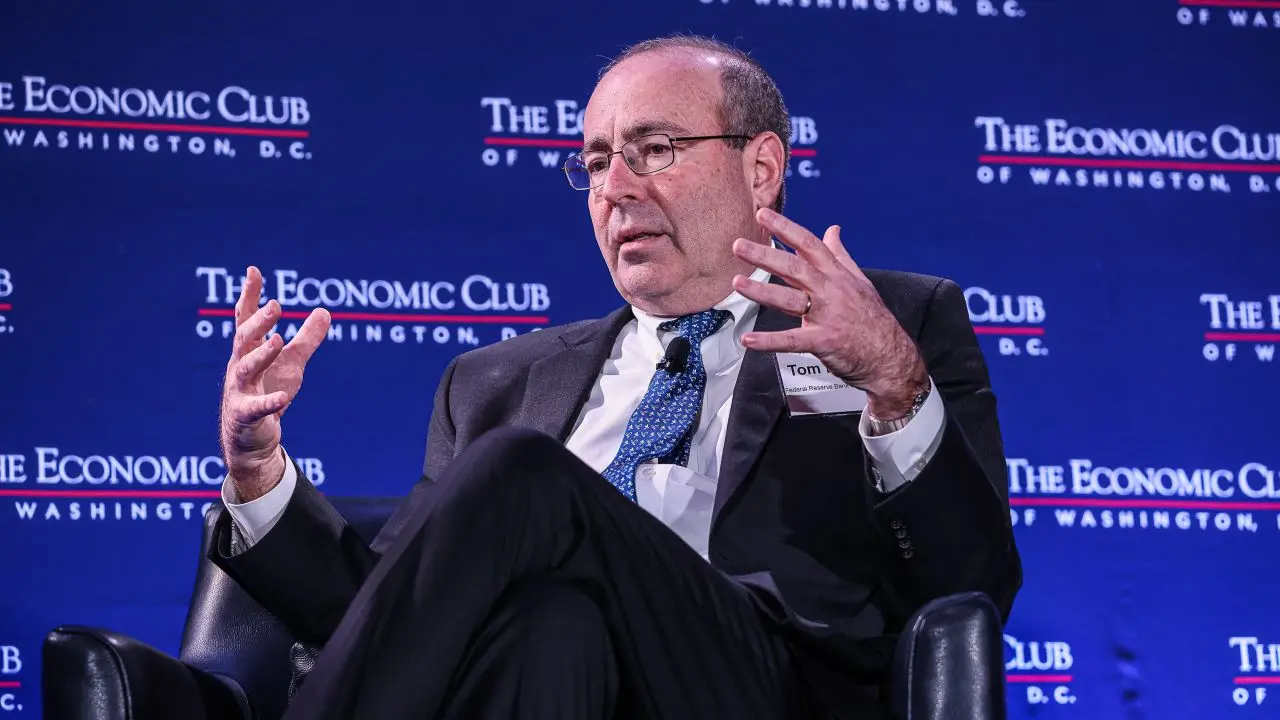
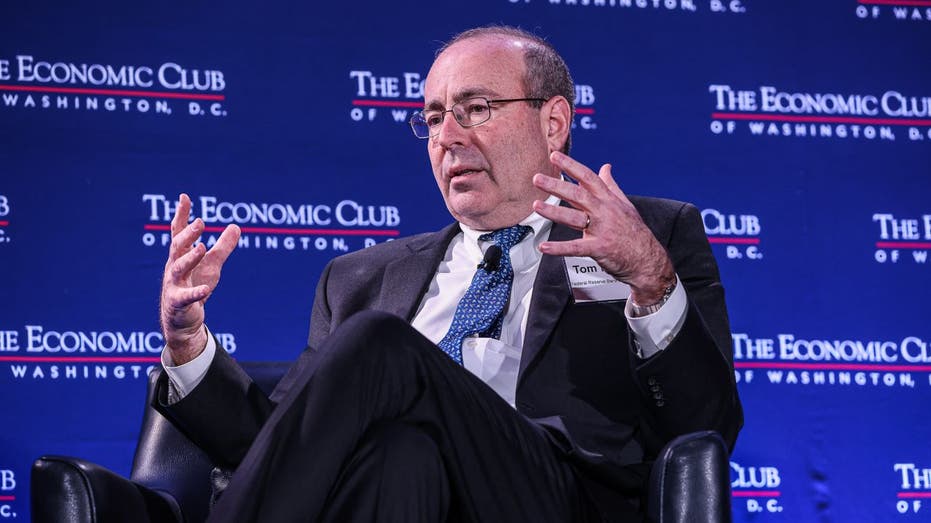
Federal Reserve President Thomas Barkin

Richmond Fed President Thomas Barkin said inflation could come down relatively quickly or prove more persistent. (Valerie Plesch/Bloomberg via Getty Images)

“I’m open to the possibility that inflation could come back down in short order. Some of these recent shocks could reverse. Consumers could start to reach their limit. The investment boom could slow. Markets could correct. Employment could falter, making the labor market the problem child,” Barkin explained.

Advertisement

“On the other hand, inflation could prove more stubborn. Temporary shocks could drag on. New cost pressures could develop. Firming demand conditions could flow through to prices, as could the impact of today’s inflation,” he said.

Barkin added that the shocks from the Iran war and the AI buildout “aren’t proving to be short-lived or one-off events,” adding that while they “may pass in time, I do expect it will take time. In the interim, there is a risk that current elevated levels of inflation could affect future inflation.”

CONSUMER PRICES REMAINED ELEVATED IN AUGUST AHEAD OF FED’S NEXT MEETING

Person's hand pulls for gas station pump

Surging gas and diesel prices have driven inflation higher amid the Iran war. (Brandon Bell/Getty Images)

The market expects the Fed to move forward with at least one more 25 basis point rate hike before the end of the year.

Advertisement

The CME FedWatch tool shows a 48.3% chance of one hike to a target range of 4% to 4.25% after the October and December meetings, along with a 40.7% chance of a second hike before year’s end.

Federal Reserve policymakers also released their economic projections, which reflected one hike before the end of the year, while Fed Chair Kevin Warsh maintained his stance in not offering forward guidance during last week’s post-meeting press conference.

WHAT WARSH’S JACKSON HOLE SPEECH SIGNALS ABOUT WHERE INTEREST RATES ARE HEADED

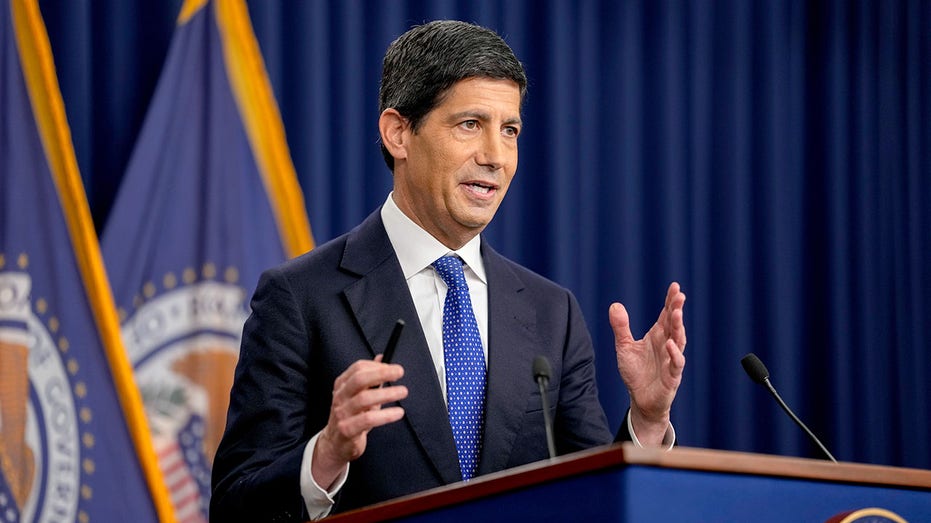
Fed Chair Kevin Warsh speaks at a press conference

Fed Chair Kevin Warsh and central bank policymakers unanimously voted to hike interest rates at the September meeting. (Daniel Heuer/Bloomberg via Getty Images)

Gregory Daco, chief economist at EY-Parthenon, told FOX Business Barkin’s comments echoed the FOMC’s rate hike decision because while “policymakers had displayed patience in waiting for core inflation to converge toward 2%, that patience has seemingly run out, and most policymakers now favor adopting a modestly more restrictive monetary policy stance.”

Advertisement

“In our view, a Fed hiking cycle, if implemented, could create further strain for already-constrained interest-sensitive sectors while doing little to slow the AI-led investment surge beyond increasing the risk of a stock market correction,” he explained.

Daco added that the “key missing element in Warsh’s narrative was transparency around how tighter policy would address the inflation overshoot,” with policymakers looking to potentially undo some or all of the 75 basis points of rate cuts late last year.

GET FOX BUSINESS ON THE GO BY CLICKING HERE

“The objective is tighter financial conditions and disinflationary demand destruction. The risk is substantial for an economy already facing income erosion, supply-driven inflation and persistently elevated rates,” Daco said.

Advertisement
Continue Reading

Business

KB Home (KBH) Q3 2026 Earnings Call Transcript

Published

on

OneWater Marine Inc. (ONEW) Q1 2026 Earnings Call Transcript