


Connect with us

Business

Old West Investment Management Q2 2026 Manager Commentary

Published

on

Old West Investment Management Q2 2026 Manager Commentary

Stock Exchange trading screen with chart, lines, price information, quotes and percentage changes.

Torsten Asmus/iStock via Getty Images

Portfolio Performance

For Q2 2026, Old West All Cap Opportunity returned -0.94% (net).

Old West All Cap Opportunity (12/01/2008 inception through 06/30/2026)

Year-To-Date 1-Year 3-Year Annualized 5-Year Annualized 10-Year Annualized Annualized Inception
Gross 15.25% 52.03% 26.45% 14.57% 18.74% 16.24%
Net 14.92% 51.11% 25.52% 13.61% 17.69% 15.16%
Russell 3000 16.56% 27.78% 17.81% 10.97% 11.48% 12.16%
Value TR

Q2 2026 Performance Highlights

Advertisement
Q2 2026 Contributors Q2 2026 Detractors
  • • Navitas Semiconductor (NVTS)
  • • Bruker Biosciences Corp (BRKR). (BRKR)
  • • Nokia Corporation (NOK)
  • • Tidewater Inc (TDW). (TDW)
  • • Core Natural Resources (CNR)
  • • Antero Resources Corp. (AR)

Top Contributors

Navitas Semiconductor Corporation (NVTS): Navitas makes advanced power chips using gallium nitride (GaN) and silicon carbide (SiC). These chips convert and deliver electricity with less energy lost as heat. The company started out making phone charger chips, but management has shifted its focus to high-power markets like AI data centers, the power grid, and electrification. ¹

NVTS was one of the best performing semiconductor stocks in Q2. Revenue returned to growth, guidance came in above Wall Street estimates, and Baird more than doubled its price target. ² The biggest catalyst came in June, when Nvidia (NVDA) featured Navitas’ power technology atits Computex showcase. ³ In our view, the real constraint on AI is not intelligence, it is electricity, and Navitas’ chips help deliver it.

Bruker Biosciences Corp. (BRKR): Bruker makes high-end scientific instruments that let scientists study life and materials at the molecular level. Its products include mass spectrometry, magnetic resonance, X-ray, and microscopy systems used in life sciences, biopharma, diagnostics, and semiconductor manufacturing.

Bruker was a detractor last quarter, but that reversed in Q2 after the company introduced new instrument platforms and pointed to growing semiconductor demand. Bank of America raised its price target from $49 to $65, and by late June the shares were near their 52-week high. In our view, Bruker’s instruments are the tools that turn the physical world into data that AI can use, and the market is starting to see it that way too.

Nokia Corporation (NOK): Nokia is one of the last major Western suppliers of telecom and networking equipment. Its business spans mobile networks, IP routing, and, after its acquisition of Infinera, the optical networks that connect data centers.

Advertisement

The market began to see Nokia less as an old telecom company and more as critical AI infrastructure. Revenue from AI and cloud customers rose 49% in the first quarter, with roughly €1 billion of orders from those customers. AI data centers need to move huge amounts of data, and Nokia provides the networks that carry it. JPMorgan raised its price target from $14 to $21, ¹⁰ and the stock had roughly doubled year-to-date by early July. ¹¹ The AI buildout is bringing new attention to businesses like this.

Top Detractors

Tidewater Inc. (TDW): Tidewater has the largest fleet of offshore support vessels in the industry and is the oldest and most experienced provider of marine support services to the offshore oil and gas sector, operating across more than 60 countries. ¹²

Tidewater was a top contributor last quarter, and in Q2 it gave some of that back for one reason: the price of oil. The U.S.–Iran agreement took the war premium out of oil, and Brentfell from a high of $126 back below $80. ¹³ Offshore stocks trade with oil, so TDW fell from its April highs even though it remained up nicely for the year. ¹⁴ The fundamentals have not changed: vessel supply is tight, the global fleet is old, and oil is still well above where the year began.

Core Natural Resources Inc. (CNR): Core Natural Resources was formed in January 2025 through the merger of Arch Resources and CONSOL Energy. It is one of the world’s leading producers of metallurgical coal used in steelmaking and high-quality thermal coal used in power generation, and it owns marine export terminals on the East Coast. ¹⁵

Advertisement

CNR declined along with most coal stocks, even though the business performed well: it beat earnings estimates and kept buying back stock. ¹⁶¹⁷ The Department of Energy also selected a CNR subsidiary to build a pilot facility that extracts rare earth elements from coal waste. ¹⁸ Electricity demand is rising for the first time in a decade, driven by AI data centers. In our view, coal stocks are priced as if their end markets are dying, and the demand picture suggests otherwise.

Antero Resources Corporation (AR): Antero is one of the largest natural gas and natural gas liquids producers in the United States. Its operations are in the Appalachian Basin, and its midstream and liquids infrastructure gives it strong access to LNG export markets. ¹⁹

AR declined in Q2 for a simple reason: natural gas prices fell back toward $3 as the war premium came out of the market. ²⁰ The business itself performed well, with record production and growing volumes expected through 2026. ²¹ In our view, natural gas is still priced as if the electricity shortage were not happening: turbines are sold out for years, data center power needs keep growing, and the fuel trades near cyclical lows.

Portfolio Positioning

Q2 delivered much of the same volatility and unpredictability as the first. We saw investors who charged into oil, chemical and fertilizer stocks on the breakout of war ended up surrendering on talks of a ceasefire. Oil roundtripped to $70 as a combination of higher US exports, lower Chinese imports, “dark transits” through the Strait of Hormuz, and a severe drawdown of inventories made it appear as though nothing ever happened. ²² It is unusual to see such opposite extremes of sentiment occur in rapid succession. We continue to find value in the production of basic materials and think the risk of disruption has not been eliminated.

Advertisement

Some have compared this period to the 1970s, when oil, inflation, and war in the Middle East were often in the news. We think there may be a stronger parallel to the 1870s, when a handful of industries grew to dominate the economy. The steam engine, railroads, telegraph, and electric grid all transformed how work was done and economic activity organized. We believe the United States is heading into a similar period of industrialization, with artificial intelligence increasingly being used to determine what should be built and how.

The development of that infrastructure is the main narrative today, with hyperscalers estimated to spend $700 billion this year alone and trillions more over the next few years. ²³ That amount of capital flowing through a relatively small number of industries has placed acute stress on various points of the supply chain. Focus has shifted outward from the chips themselves to the surrounding infrastructure. Power has become the defining constraint as our ability to produce chips exceeds our ability to actually turn them on. Power semiconductors, the devices that regulate voltage and current, have seen demand inflect sharply higher as new generations of chips require increasingly more power.

Outside the datacenter wall, companies face a shortage of heavy electrical equipment and grid interconnection has become a logjam. Multi-year tie-in times are pushing companies to build their own power, and even that has become subject to delays. Heavy duty gas turbines are sold out for years with manufacturers reluctant to expand capacity after getting burned in past cycles. ²⁴ Customers have started trading performance for speed of access, using less efficient but readily available gas engines instead. Meta (META) is proposing to string together over 800 reciprocating engines for a data center in El Paso ²⁵ and xAI took a similar approach in Memphis, opting to deploy dozens of mobile gas turbines. ²⁶

We think nearly all of these solutions highlight the importance of natural gas. It is the largest source of electricity in the United States, providing roughly 40% of supply. ²⁷ We are blessed with an abundance of it, over 500 Tcf of reserves versus 40 Tcf of annual production. The majority is concentrated in two regions, Texas and Appalachia, and can be produced for less than $4/mcf. But gas is not easy to transport and needs dedicated pipelines or to be converted to a liquid and shipped. Prices are thus dictated by local availability and can vary widely by region. In Europe or Japan, where production is low and they depend on foreign imports, prices can be quite high by global standards. In the US or Canada, where supplies are plentiful, production in one region can often exceed not only local demand, but also the ability to export the surplus, creating pockets of very cheap supply. Prices even went negative in parts of Texas this year as associated gas from increased oil drilling overwhelmed takeaway capacity. ²⁸

Advertisement

Moving gas from where it is cheap to where it is expensive can be a profitable business, and the companies that build and operate these pipelines have a portfolio of attractive expansion opportunities. But even those take time, and rather than wait for pipes some buyers are simply moving the datacenter. Chevron (CVX) signed an MOU with Microsoft (MSFT) for a multi-gigawatt facility directly in the Permian basin. ²⁹ Meta announced a $10 billion datacenter in Alberta, looking to take advantage of low Canadian gas prices. ³⁰

We like to think of natural gas reserves as crude electricity that’s still in the ground. The spread between what it costs to produce and what it can ultimately be sold for in fully refined form is immense. Mark Zuckerberg recently offered his company’s AI model 75% cheaper than competitors, explicitly calling out their excessive profit margins. ³¹ We believe AI companies will be able to charge much less for their services (and pay much more for power) and still be very profitable. Large, low-cost reserves of this “electricity juice” strike us as strategically valuable, and today’s low prices may prove a temporary phenomenon as inadequate infrastructure gets solved with time and money. Many natural gas producers are trading at valuations that appear reasonable even at current gas prices.

The desperation to access power even leads us to see additional value in much-maligned coal. While its metallurgical uses are the most widely appreciated, we think a shortage of power may force a rethink of the aging and retiring workhorses that still provide nearly 20% of our electricity. Asia continues to build coal-fired generation, unburdened by Western environmental concerns, and we think the reports of thermal coal’s death are greatly exaggerated. This focus on power at all costs also strengthens our enthusiasm for uranium. We have written about the case for nuclear in these letters for the better part of a decade. Those investments are longer duration and more capital intensive than other forms of generation, but from a pure energy density standpoint uranium is hard to beat. Large, low-cost sources of current and potential uranium supply appear well positioned in that environment.

For the last few quarters we have discussed our belief in an impending scientific revolution as AI gets applied to challenges in the physical world. Frontier models are already solving longstanding problems in mathematics and conducting cutting edge research in physics and biology. We highlighted Bruker last year as an out of favor scientific equipment maker well positioned for this transition. Companies with large installed bases of scientific tools should also benefit as AI gets paired with their existing equipment.

Advertisement

We have seen a reimagining and repurposing of capacity is taking place across a wide variety of industries, especially those involved in manufacturing. Automakers are looking outside of autos to increase their returns on assets. After taking a bath on electric vehicles, Ford (F) decided that its battery facilities could instead be used to serve stationary storage markets for data centers and the grid. Stellantis (STLA), the struggling European automaker, struck a deal with a Chinese manufacturer to utilize excess capacity, and GM is in talks with Lockheed Martin (LMT) about manufacturing parts for weapons systems. Hyundai (HYMTF) owns Boston Dynamics, a leading US robot developer. Humanoid robots are large, complex machines with thousands of precision parts, exactly what an auto plant knows how to manufacture at scale. Legacy technology firms are also getting a second look. Nokia, until recently an unloved telecom play, saw a dramatic revaluation as investors looked past its historical end markets toward its ability to satisfy future optical networking needs. We are finding many interesting opportunities in companies where investors are overly focused on the past.

The big corporate news this quarter was the SpaceX (SPCX) IPO raising $85 billion and hitting a $2 trillion valuation, making Elon Musk the world’s first trillionaire. ³²³³ The burgeoning space economy is one we have touched on in past letters and the large aerospace and defense companies remain an area of interest, especially after their recent weakness. If this really is the dawn of the space age, the handful of companies that have been operating there for decades may be well positioned. More broadly, we see enduring value in physical infrastructure: hard assets with high replacement costs that benefit from grandfathered rights-of-way, difficult permitting requirements, or control of scarce resources. This is a fascinating moment in history where entire industrial supply chains are being repriced.

We continue to see tremendous value in metals and mining companies, some of which sold off during the quarter on fears of higher interest rates. We believe central banks will find it increasingly difficult to address inflation with higher rates, because much of that inflation is not being driven by broad-based economic activity. Demand is coming from a concentrated segment of the economy and the shortages emerging across energy, materials and industrial infrastructure are supply problems meeting this new source of demand. If higher rates don’t affect that demand, inflationary pressure will continue until the necessary investments to increase supply are made.

It is hard not to be amazed at the pace of technological progress we are seeing. At Old West we follow these developments closely. Our AI “interns” are hard at work building models and reviewing company earnings reports and conference calls. Tasks that used to take hours or days can now be done in seconds or minutes, and for hundreds of companies at a time. It may still be a few years before these robotic assistants are bringing us coffee, but automating much of the mechanical work allows us to spend more time on higher value activities.

Advertisement

We are pleased with our performance in the first half and think we are well positioned for the next few years. We welcome the opportunity to discuss our ideas in more detail with prospective investors. Please reach out if you would like to set up a call.

Thank you for your consideration.

Sincerely,

Old West Investment Management, LLC

Advertisement

References

1 https: //finance. yahoo. com/quote/NVTS/

2 https: //stockstotrade. com/news/navitas-semiconductor-corporation-nvts-news-2026_05_14/

3 https: //www. fool. com/investing/2026/06/03/why-navitas-semiconductor-stock-is-skyrocketing-to/

4 https: //www. bruker. com/en/about. html

Advertisement

5 https: //www. quiverquant. com/news/Bruker+shares+jump+as+new+ASMS+launches+spotlight+proteomics, +energy, +and+semiconductor+demand

6 https: //www. timothyshykes. com/news/brker-corporation-brkr-news-2026_06_03/

7 https: //stockstory. org/us/stocks/nasdaq/brkr/news/why-up-down/brker-brkr-stock-trades-up-here-is-why-4

8 https: //www. kavout. com/market-lens/nokia-s-ai-driven-optical-surge-can-july-23-earnings-break-the-legacy-valuation-trap

Advertisement

9 https: //www. kavout. com/market-lens/nokia-s-ai-driven-optical-surge-can-july-23-earnings-break-the-legacy-valuation-trap

10 https: //ts2. tech/en/nokia-shares-rise-on-wall-street-push-for-ai-optical-network-plan/

11 https: //www. kavout. com/market-lens/nokia-s-ai-driven-optical-surge-can-july-23-earnings-break-the-legacy-valuation-trap

12 Tidewater Marine – Tidewater

Advertisement

13 Noble Corporation and Tidewater Shares Plummet, What You Need To Know – StockStory

14 Tidewater, Calumet, and Golar LNG Shares Are Falling, What You Need To Know – StockStory

15 https: //seekingalpha. com/symbol/CNR

16 CNR Stock Price and Chart – NYSE: CNR – TradingView

Advertisement

17 CNR: Buybacks And Cash Generation Will Drive Future Upside Potential

18 Core Natural Resources (CNR) Lands DOE Grant, Is The Stock Still 28% Undervalued?

19 Antero Resources (NYSE: AR) – Stock Analysis – Simply Wall St

20 Antero Resources (AR)

Advertisement

21 Antero Resources (NYSE: AR) – Stock Analysis – Simply Wall St

22 Short-Term Energy Outlook

23 AI Capex 2026: The $690B Infrastructure Sprint

24 GE Vernova expects to end 2025 with an 80-GW gas turbine backlog that stretches into 2029

Advertisement

25 Meta to deploy 366MW of modular gas units to power 1GW data center in El Paso, Texas

26 Musk’s xAI is running nearly 50 gas turbines unchecked at its Mississippi data center | TechCrunch

27 Electricity in the U.S. – U.S. Energy Information Administration (EIA)

28 Permian Natural Gas Prices Surpass 2024’s Negative Run

Advertisement

29 https: //www. chevron. com/newsroom/2026/q2/chevron-signs-20-year-power-agreement-with-microsoft-for-west-texas-data-center

30 https: //www. cnbc. com/2026/07/08/meta-is-building-its-first-big-data-center-in-canada-amid-ai-push. html

31 Mark Zuckerberg Is Spending Hundreds of Billions on AI. His New Strategy in the Race Against OpenAI Is Surprisingly Simple.

32 SpaceX IPO Officially Raised $85 Billion

Advertisement

33 https: //www. cnbc. com/2026/06/12/spacex-stock-jumps-2-trillion. html


Disclosures

This commentary is being made available for educational purposes only and should not be used for any other purpose. In addition, the information contained herein does not constitute and should not be construed as an offering of advisory services or an offer to sell or solicitation to buy any securities or related financial instruments in any jurisdiction. References to particular securities are only for the limited purpose of illustrating general market or economic conditions and/or to express the firm’s investment philosophy and process and are not recommendations to buy or sell a security, or an indication of the author’s holdings. Such securities may or may not be in one or more managed accounts from time to time. Certain information contained herein concerning economic trends and performance is based on or derived from Old West and/or information provided by independent third-party sources where referenced.

Advertisement

Old West Investment Management, LLC (“Old West”) believes that the sources from which such information has been obtained are reliable; however, it cannot guarantee the accuracy of such information and has not independently verified the accuracy or completeness of such information or the assumptions on which such information is based.

This commentary, including the information contained herein, may not be copied, reproduced, republished, or posted in whole or in part, in any form without the prior written consent of Old West.

Old West Investment Management, LLC is an independent investment management firm established in 2008. Old West Investment Management, LLC manages a variety of equity and alternative assets for individual and institutional clients. Additional information regarding the firm’s policies and procedures for calculating and reporting performance returns is available upon request.

The Old West All Cap Opportunity Composite (the “ALL Composite”) comprises all portfolios with an asset allocation of equity securities. There is no minimum portfolio size for inclusion in the Composite. Additional information regarding composite inclusion and calculation is available upon request. The ALL Composite was created 12/1/2008 and is benchmarked to the Russell 3000 Value® benchmark. The Russell 3000 Value® Index is an unmanaged market capitalization weighted index of the 3000 largest U.S. companies with value characteristics. Russell Investments is the owner of the trademarks, service marks and copyrights related to its respective indexes. Copyright © Russell Investments. The Russell 3000 Value® benchmark was added 11/30/2018, retroactively as the firm finds it a better representation of the investment strategy. The All Cap Opportunity portfolio primarily invests in all-capitalization US equity securities and is subject to market risk. The Portfolio may invest in foreign securities and will be subject to the risks of currency fluctuations and sudden economic or political developments. All market valuations and performance information are computed and reported in US dollars and include reinvestment of dividends and other earnings. Gross-of-fees performance returns are presented before management fees but after all trading expenses. Net-of-fees performance returns are presented after management fees and after all trading expenses. The standard fixed management fee for accounts with assets under management of up to USD 10 million is 1.00% per annum. Further Fee information can be obtained from Old West’s Form ADV, Part II. A complete listing and description of all composites is available upon request. Investing in equities is speculative and involves substantial risk. None of the stock information, data and company information presented constitutes a recommendation by Old West Investment Management, LLC or a solicitation of any offer to sell any securities and should not be considered investment advice of any kind. Portfolio characteristics represent data from the ALL Composite as of the report date and are compiled by Old West. Individual accounts may vary due to restrictions, substitutions and other factors. Sector weightings are classified using the Global Industry Classification Standards (GICS). * The securities identified and described do not represent all of the securities purchased, sold, or recommended for client accounts. These holdings may change at any time without notice. The reader should not assume that investments in the securities listed were or will be profitable. All information contained is stated as of the report date at the top of each page unless otherwise indicated. Past performance is no guarantee of future results. Individual client accounts will vary.

Advertisement


Original Post

Editor’s Note: The summary bullets for this article were chosen by Seeking Alpha editors.

Continue Reading
Click to comment

You must be logged in to post a comment Login

Leave a Reply

Business

U.S. Treasury Yields Fall as Oil Prices Decline

Published

on

U.S. Treasury Yields Fall as Oil Prices Decline

Global government bond yields fell Monday, helped by declining oil prices and as investors anticipate that further measures from the U.S. Treasury are possible to tame high yields.

The U.S. Treasury last week doubled the volume of long-end debt buybacks after yields rose to multiyear highs. On Monday, a slight decline in global bond yields has been helped by lower oil prices even as the prospect of a peace deal in the Middle East remains elusive, while traffic via the Strait of Hormuz stays disrupted.

Copyright ©2026 Dow Jones & Company, Inc. All Rights Reserved. 87990cbe856818d5eddac44c7b1cdeb8

Continue Reading

Business

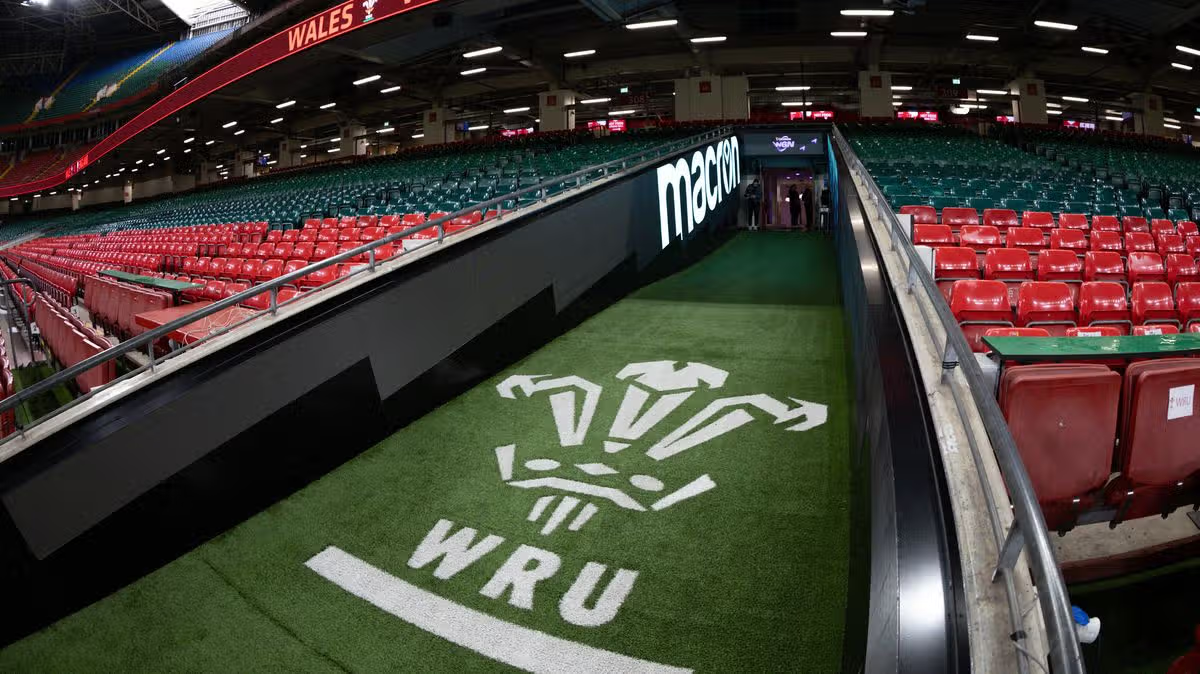
WRU could face EGM with motion calling on members clubs to oust its entire board

Published

on

Former Principality Building Society chief operating officer Rob Regan

A leading figure in the campaign to challenge the existing Welsh Rugby Union leadership has expressed confidence that sufficient backing already exists amongst member clubs to trigger a dramatic Extraordinary General Meeting, featuring a motion to remove the entire board.

The group, which describes itself as a “coalition of the willing”, is demanding the WRU suspend proposals to reduce regional teams from four to three until the decision-making process undergoes independent examination.

Hayley Parsons, who founded GoCompare, one of the UK’s leading price comparison firms, argued that the plan to axe a region and maintain just a single team in west Wales requires independent evaluation, with the union disclosing all relevant data and explaining why it determined that sustaining four regions is now “unsustainable”, even with any new unequal funding arrangement.

'Welsh rugby’s problem may not be the number of professional teams but a fragmented and poorly aligned operating model'

Additional members of the group include Rob Regan, former chief operating officer at Principality Building Society and Legal and General, alongside technology entrepreneur Glenn Melford-Colegate.

Advertisement

Hayley Parsons.

(Image: Rob Browne)

The WRU has signalled it will soon release data – though the level of detail and presentation format remain uncertain – regarding this decision, along with the scoring criteria should the Scarlets and Ospreys choose to participate in a competitive bid process for the single WRU licence allocated to west Wales.

However, the coalition’s stance is that the union cannot cherry-pick what information is disclosed, and that an EGM would effectively provide the clubs with a referendum on whether a region should be eliminated, reports Wales Online.

Regardless of the outcome, even with three clubs, benefactor backing will be essential. There is also the ever-present risk, as witnessed not only in Wales but across the professional game in England in recent years, of another club collapsing financially.

Advertisement

The deadline for submitting a motion for the WRU’s annual general meeting this autumn has now elapsed, so the coalition, which is in discussions with numerous clubs, is concentrating on securing an EGM.

A motion, which, if approved, would result in the current board being required to step down with immediate effect, would not encompass the chief executive of the WRU, Abi Tierney, who, while serving on the board, is an employee of the union and therefore cannot be removed by the clubs.

Under section 62 of the WRU’s articles of association, a no-confidence resolution would need only a simple majority of clubs voting at the EGM to pass. To be quorate, it would require 95 members in attendance.

Proxy and remote electronic voting would be permissible.

Advertisement

For the EGM to proceed, it would first require support from 10% of the 282 member clubs. Should this threshold be met, the union would have 21 days to formally acknowledge the request and schedule the meeting.

This would usually be around a month later. Should the board be removed, a temporary board would need to be created, comprising representatives from the districts – though not those currently serving on the board.

They would not require club approval to bolster their ranks by bringing in external people with commercial expertise.

However, what is being contemplated by the coalition, based on initial legal advice and discussions with club representatives, is another possible motion to change the articles of association, which would require a 75% majority, so that any temporary board would have external members from the outset. This could be voted on at the EGM before the vote of no confidence.

Advertisement

The WRU would be confident of seeing off any no-confidence motion against the entire board. Should the EGM be called, it would lobby hard, making the case for three regions and a commitment to invest £28m in the pathway development of the game over the next five years.

Last year, with lower attendances than projected at international games at the Principality Stadium, the WRU’s original revenue forecast was blown off course by around £6m. If that were to be repeated this autumn – though the Six Nations home games against England and Ireland should sell out – their argument that four regions is financially unsustainable would be amplified.

The governing body has drawn up a shortlist for a new chair. It is understood that a number of potential candidates ruled themselves out due to an expectation of having to endorse the four-to-three strategy.

Should an EGM be called, the WRU is unlikely to pause announcing the new chair, even if there is a possibility that they could be removed along with all other board members.

Advertisement

Swansea Council has also restarted its legal action against the union over its plans for just one region in west Wales, while effectively protecting the Dragons and Cardiff, which they own. Other interested parties may soon join the action.

Ms Parsons said: “We have clubs contacting us and, from those conversations, we are confident that they have more than enough clubs for an extraordinary general meeting. So, we have the numbers now, but we will be looking to put the EGM to the WRU in a few weeks’ time. We have some really impressive people, literally from around the world, contacting us and offering their support free of charge.”

She said the temporary board could involve some of the figures supporting the coalition of the willing, but there is also scope to bring in external advisory board members to support the WRU going forward in sustaining four regions – though she noted that, after a review period of around six months, the conclusion could be that three is the right number.

She said: “So, what we do need is fresh, independent people. I don’t think we could have anyone involved before, as that just wouldn’t work. What we need is the right group of people, and there is a right group of people to do this.

Advertisement

“At no point have I ever said I was going to be putting my name forward for the chair role. I would be involved in the short term, because I think it would be the right thing to do, not because I would want any involvement long term.

“And I think that is quite important, as one of the problems I think you do have in rugby is that some people are in it for their own self-interest. What we are proposing for board members is no salaries or expenses.”

The temporary board would at some point give way to a new permanent board based on three-year terms.

Should an EGM take place and the motion to remove the board fail, she said: “I don’t think there would then be anything that people could do, and we would just sit back and watch our game die over the next five years.”

Advertisement

Yet, if a new direction is taken, there remains time to fully examine the case for maintaining four regions. The WRU plans to have three teams in the United Rugby Championship for the start of the 2028-29 season.

Ms Parsons said: “There is time here to look at generating new revenue lines. If you look at the latest statement [from the WRU on three regions], it is a defeatist attitude. But in that time we could bring in people to secure additional investment and look at things differently.

“We also need to think more about what could be done with the stadium, the hotel, Cardiff Rugby, etc.”

However, even if the board are ousted and the new one looks to support the WRU executive in seeking to drive revenues to maintain four regions, there are no guarantees it will result in a significant uplift.

Advertisement

A social impact rugby bond would require regulatory approval. It would need to appoint a fund manager to raise funds and invest in conventional assets such as shares and bonds.

Investors could forego an element of projected returns for investment into the game.

This could be hypothetical in specific areas, such as the community and women’s game. But to have an impact, the funds under management would have to run into the tens of millions, which, even if achievable, could take years to reach.

Previous WRU regimes considered a sale-and-leaseback of the Principality Stadium and securitisation deals by drawing down capital against future income from rugby matches and other events such as concerts.

Advertisement

However, things like a sale-and-leaseback, while providing a huge upfront sum, would have to be repaid, with a profit margin for the lender(s) over the duration of the arrangement.

The stadium is a valuable asset, although it requires continuous investment. Any sale-and-leaseback would also need approval from Cardiff Council, as it is a shareholder in the WRU subsidiary company that owns and operates the stadium, Principality Stadium Plc.

There is certainly scope, with rugby touching all communities in Wales and rugby clubs also serving as community hubs, to secure more funding for the community game – which could be separated from the governance of the professional game – in the form of grant funding from the Welsh and UK governments.

While the WRU is in receipt of government funding, it could learn from how the Football Association of Wales has, in recent years, secured millions of pounds in funding for the growth and infrastructure of the game, especially at grassroots level. But this will take time and investment.

Advertisement

The coalition of the willing are also exploring the tax benefits of all community clubs acquiring charitable status. But, like their position on the WRU plans, this would need to be challenged and tested.

Former Principality Building Society chief operating officer Rob Regan

Rog Regan.

On the WRU’s decision to publish data, Mr Regan said it had to do so for every scenario assessed.

He added: “Just sharing data to show that one could work with a set of assumptions doesn’t change anything, as it doesn’t answer the question of how do we know that is the only one. While constitutionally they can do this, ultimately they should give the choice to the clubs. So, if they are confident this has support, then give the rugby public (member clubs) their vote.

“So, we continue as planned (EGM). Our interest is to ensure that decisions about the number of pro clubs in Wales, that have distracted so many for so long, sucking energy, focus and money out of the game, are made based on evidence and data and in an open, transparent and engaging way.

Advertisement

“We have been building a long list of people who would be prepared to step in and support an interim transition with a transparency mandate.

“We are looking to maximise breadth of capability for a core group of 8-10 people, with an advisory panel supporting. We have set out principles that this should be short-term, pro bono work with no conflicts.

“We want to plug core gaps in current board capabilities. We want to engage the entire rugby family in creating a credible, capable, values-driven group who bring deep understanding of Wales’s rugby heritage and culture, as well as strong commercial skills. More collaboration, less ego. A genuine desire to listen, learn and build relationships. We imagine a transition and support period of at least six months, where we’d be looking for people to be able to dedicate a couple of days a week to public scrutiny of current plans and governance documents while we build a new board with a new mandate.”

Ms Parsons was on the board of Cardiff Rugby for six years before it collapsed into administration and was acquired in a pre-pack deal by the WRU with the joint administrators from PwC.

Advertisement

Also on the board at the time was current WRU board member and former chief executive of FTSE 100 company Halma, Andrew Williams.

Following the death of former chairman and long-term benefactor Peter Thomas, the club needed new benefactors to fulfil the then funding agreement with the WRU.

Helford Capital, a Jersey-based special purpose vehicle with no assets, owned by co-directors Neal Griffith and Phil Kemp, became majority owners of the club. However, they failed to inject the required benefactor funding agreed, and the club’s board had no alternative but to put the business through administration. The WRU would have faced significant penalties from the United Rugby Championship if they had not acquired Cardiff Rugby by leaving the league one team short.

The board of Cardiff were seduced by the promise of major investment, via Helford, from the Middle East, but they also needed to secure new benefactors.

Advertisement

Ms Parsons said: “I was on the board for six years and we made great strides in lots of areas, but Peter [Thomas, the former chair] passed and the investors came in and they were absolute fantasists.

“They had this big deal coming from Abu Dhabi and it even got to the point where we were told the deal was done and the money was there, worth millions of pounds, but we were just saying, ‘Show us the evidence.’ It never happened.”

She said that, in the aftermath of the Rafferty report into allegations of sexism and racism at the WRU – although the terms of reference never required an assessment of the BBC documentary that led to its establishment – the union was always going to appoint a woman in a senior role.

Ms Parsons said: “This is not about Abi, but you cannot say one of the jobs [chair or CEO] had to go to a female. That was fundamentally wrong and wouldn’t happen in business.

Advertisement

“A man was appointed as chair [Richard Collier-Keywood], so the CEO had to be a woman. You also automatically put a target on that woman straight away.

“There were men who had applied who had done that type of role elsewhere in rugby and with more experience to do that job.”


Continue Reading

Business

Earnings call transcript: Fubon Financial posts record H1 2026 profit

Published

on


Earnings call transcript: Fubon Financial posts record H1 2026 profit

Continue Reading

Business

Business rates review launched for pubs and hotels

Published

on

Business rates review launched for pubs and hotels

Andy Burnham has launched a review into how business rates are calculated for pubs and hotels, in an attempt to make the tax fairer for two sectors hit hard by this year’s revaluation.

The prime minister has appointed Jerry Schurder, a business rates expert who has repeatedly called for reform of the levy, to lead an independent review into valuations. Schurder will report his recommendations to the Treasury by March 2027, in time for them to be implemented at the next revaluation.

Government insiders said they expected the review to lead to a major change in business rates, given his previous comments and the evidence he has submitted to earlier government consultations.

Schurder has called for “fundamental reform, not tinkering”, including pressing for business rates to be cut significantly to ensure competitiveness with local property taxes in the EU.

He has stopped short of saying business rates should be scrapped altogether. He has said revaluations should be undertaken annually, and that the revenue HMRC takes from business rates should fluctuate directly in line with changes in property values. Both proposals, if adopted, would change the tax from a fixed sum the Treasury collects regardless of market conditions into one that moves with the property cycle.

Advertisement

The government is also launching a call for evidence from landlords, brewers, hoteliers and business owners.

Why April hurt

The review follows concerns that the way businesses are valued does not reflect the realities of the pub and hotel market.

Pubs are not valued on floor space in the way an office or a warehouse is. They are valued on their fair maintainable trade, an estimate by the Valuation Office of the annual turnover, excluding VAT, that the property might be expected to achieve under reasonably efficient management. Trading history, location, food, accommodation and gaming income all feed into the figure, and a percentage is then applied to arrive at a rateable value.

That method is what made this year’s revaluation so painful. The rateable values that took effect on 1 April 2026 were based on trading conditions in April 2024. The previous list had been drawn from a 2021 baseline, when pandemic restrictions had flattened pub takings. Comparing a recovered year with a shut one produced steep increases across the sector.

Advertisement

The ending of those pandemic-era valuations sent some pubs and hotels out of business in April and left others teetering on the edge. In the hotel sector, the scale of the shift prompted calls to freeze revaluations altogether after Northern Ireland paused its own process.

A cut that did not reach everyone

Last month Burnham announced a 20 per cent cut to business rates for pubs, social clubs and live music venues from April 2027. The government said the measure would be worth about £1,100 a year to a typical pub and would reach nearly 32,000 venues, at a cost of £100 million a year, funded by reviewing reliefs for businesses that do not contribute and by tightening compliance among online marketplace sellers.

That announcement was largely welcomed, but it came with calls to apply the relief to a wider range of businesses and to go further with broader changes to the system. Ahead of it, there was disquiet that relief would be targeted at pubs alone while restaurants, hotels and leisure operators facing similar increases were left out, and hotel and holiday park bosses pressed for relief to be extended beyond pubs.

The distinction between the two interventions matters for anyone budgeting beyond next spring. The 20 per cent cut is a discount applied to a bill. The review deals with the number the bill is calculated from, and would reset valuations permanently rather than for the life of one relief scheme.

Advertisement

James Murray, financial secretary to the Treasury, said: “Pubs and hotels are vital for communities and bringing growth to every postcode.

“Last month we announced tax cuts for pubs to give them the breathing room they need. Today we’re going further with a rethink of valuations, so that we can build a fairer system for the future.”

Emma McClarkin, chief executive of the British Beer and Pub Association, said: “For years pubs have paid a disproportionately higher business rates bill which has ground down their ability to keep the doors open, so this review is sorely needed and hugely welcome.”

Neal Jones, EMEA president at Marriott International, said: “The current valuation methodology creates a significant burden for hotels, and it is right that the system is being examined to ensure it is fair, transparent, and reflective of today’s market realities.”

Advertisement

Allen Simpson, chief executive at UK Hospitality, said: “Business rates remain a significant burden for hospitality businesses and the system needs to better reflect the trading realities for the sector.

“Comprehensive review and reform can address these challenges, while also supporting investment and growth.”

For operators, the immediate practical point is the call for evidence. It is open to landlords, brewers, hoteliers and business owners, which means the trading data that has been used to argue the current method is unfair can be put in front of the person writing the recommendations rather than only in front of a trade body.

The timing also leaves a gap. Schurder does not report until March 2027, and any change he recommends lands at the next revaluation, so the bills that arrive next April will still be calculated the way this year’s were.

Advertisement

Nearer term, No 10 has said it will look to set out further reform, including small business rates relief, at the budget. That is the moment for firms outside the pub, club and live music categories to find out whether the wider changes they have been asking for are coming, or whether they wait for Schurder.


Jamie Young

Jamie Young

Jamie Young is Senior Reporter at Business Matters, covering SME finance, employment law and Westminster policy since 2016. He has reported on every Budget and Autumn Statement since 2018, helped make sense of the ‘covid era’ and the bounce-back loan scheme from launch through the fraud investigations, and broke the magazine’s coverage of the 2024 late-payment reforms. He joined Business Matters straight from completing his BA in Administration from Exeter University and is NCTJ-qualified. Reach him at jyoung@cbmeg.co.uk

Advertisement
Continue Reading

Business

WhiteRock Lithium soars on ASX debut

Published

on

WhiteRock Lithium soars on ASX debut

WhiteRock Lithium’s shares have surged on its debut on the Australian Securities Exchange, marking the first Western Australian-domiciled lithium listing in two years.

Continue Reading

Business

Why is Tracsis stock surging today?

Published

on


Why is Tracsis stock surging today?

Continue Reading

Business

Six countries want EU talks in September on taxing windfall profits of oil companies

Published

on


Six countries want EU talks in September on taxing windfall profits of oil companies

Continue Reading

Business

Project pipedreams undermine productivity

Published

on

Project pipedreams undermine productivity

Yes. Corporate subscriptions are available for teams and organisations, with discounted rates as user numbers increase. Pricing starts from $1,625 + GST per user.
Get in touch
to discuss the right option for your organisation.

Business News subscriptions are used by executives, investors, consultants and professionals who need to stay informed and make better decisions about the WA market. When you subscribe you’ll get

  • Unlimited access to WA’s most trusted business journalism
  • Data & Insights — detailed profiles of WA companies, people, projects and deals
  • MyBN — a personalised feed based on the companies, people and sectors you follow
  • Special publications and industry reports
  • Daily and weekly email newsletters

Data & Insights is a research tool built specifically for the WA market. It draws on more than 30 years of Business News reporting, updated regularly to reflect what’s happening now. Use it to:

  • Look up detailed profiles of WA companies, including financials, directors and ownership
  • Find decision-makers and track their career movements
  • Research live and completed projects across WA industries
  • Monitor deals, appointments and market activity
  • Access industry rankings and league tables

Data & Insights is updated daily by our dedicated research team, which uses the latest announcements, ASX filings and editorial coverage to keep our person, company, list and project records up to date.

Business News welcome all opportunities to make our dataset accurate, complete and current, so if you have an update request, please email the team at
general@businessnews.com.au, and we’d be happy to assist.

Advertisement

MyBN
is part of every subscription. It’s your personalised view of Business News. You can follow the companies, people, sectors and projects that matter to you, and get a news feed and alerts tailored to your interests. You can save articles to read later and retain only what you need.

Only subscribers have full access to all content on the Business News website.

Advertisement

If staying informed about the WA economy is part of your job, and/or you’re looking for networking opportunities in WA, Business News is built for you.

Business News subscribers are:

  • Executives and directors tracking competitors, clients and market movements
  • Investors and advisers researching companies, deals and industry trends
  • Consultants and professionals staying across sectors relevant to their clients
  • Business owners looking for leads, context and market intelligence

Most Business News publications cover national or global markets. Business News is focused entirely on Western Australia, which means the journalism, the data and the intelligence are all built around WA companies, people and projects — not adapted from a national feed. Data & Insights, included with every subscription, combines more than 30 years of WA-specific editorial research with live business data. There’s no comparable product for the WA market.

Advertisement

The Morning Digest Email provides a comprehensive wrap of the major headlines, relevant to WA business, and includes with a snapshot of the overnight news covering oil, gold and ASX-listed companies.

The Afternoon Wrap Email focuses on the news covered by our team of journalists during the course of the working day, including exclusive stories and analysis, all of which relates to WA business and the local economy.

The BN Weekender Email contains a wrap of the Business News from the week that was, highlighting the top stories in each area of WA business.
Sign up for free.

Advertisement

We’re happy to help.
Get in touch
and our team will come back to you.

Advertisement
Continue Reading

Business

Key Facts About Federal Debt You Might Have Missed

Published

on

Key Facts About Federal Debt You Might Have Missed

Scott Grannis was Chief Economist from 1989 to 2007 at Western Asset Management Company, a Pasadena-based manager of fixed-income funds for institutional investors around the globe. He was a member of Western’s Investment Strategy Committee, was responsible for developing the firm’s domestic and international outlook, and provided consultation and advice on investment and asset allocation strategies to CFOs, Treasurers, and pension fund managers. He specialized in analysis of Federal Reserve policy and interest rate forecasting, and spearheaded the firm’s research into Treasury Inflation Protected Securities (TIPS). Prior to joining Western Asset, he was Senior Economist at the Claremont Economics Institute, an economic forecasting and consulting service headed by John Rutledge, from 1980 to 1986. From 1986 to 1989, he was Principal at Leland O’Brien Rubinstein Associates, a financial services firm that specialized in sophisticated hedging strategies for institutional investors.

Visit his blog: Calafia Beach Pundit (https://scottgrannis.blogspot.com/)

Continue Reading

Business

KOSPI Plunges 3% as Samsung Shares Crash 8% Following Underwhelming Shareholder Return Plan Investors Wanted

Published

on

Earnings News: Micron Technology Inc (NASDAQ: MU)

SEOUL — South Korea’s benchmark KOSPI index tumbled 215.99 points, or 3.12%, to 6,696.96 as of 3:32 p.m. local time Monday, as Samsung Electronics shares plunged more than 8% following investor disappointment over the technology giant’s newly unveiled shareholder return plan.

The KOSPI’s decline extended a weaker session that began even before Samsung’s results reaction took hold. According to TradingKey, Japanese and South Korean stocks opened lower across the board Monday, weighed down by consolidation in U.S. technology stocks and broadly cautious market sentiment following overnight trading in the United States. The index initially fell 1.17% to 6,832.23 points at the open, with Samsung Electronics down 4.26% in early trading while SK Hynix bucked the broader trend, surging 3.58%.

The selloff deepened sharply as the session progressed. According to India.com’s coverage of Monday’s trading, Samsung Electronics plunged 8.35% after investors reacted negatively to the company’s latest shareholder return announcement, dragging the broader KOSPI down more than 3% for the day. SK Hynix, notably, continued to buck the broader semiconductor selloff, closing the session up 2.4%, even as the KOSDAQ, South Korea’s smaller technology-focused exchange, moved higher as investors rotated capital toward smaller technology, healthcare and growth stocks away from the large-cap chip sector.

The core driver of Monday’s decline traced directly back to Samsung’s own corporate announcement. According to India.com, the KOSPI came under heavy selling pressure as investors booked profits following the recent rally in South Korean chip stocks, with Samsung Electronics becoming the single largest source of pressure after its newly disclosed shareholder-return plan failed to meet expectations that had built up among investors in the days leading up to the announcement.

Advertisement

That reaction stands in sharp contrast to the anticipation that had built around Samsung’s expected capital return plan in the preceding days. Samsung had been widely expected to unveil a historic shareholder return package potentially exceeding 100 trillion won, following a similarly record-setting 40 trillion won buyback and cancellation program announced by rival chipmaker SK Hynix earlier in the month. The scale of that anticipation appears to have set a bar that Samsung’s actual announcement ultimately failed to clear in the eyes of many investors, prompting the sharp sell-the-news reaction that dragged the stock down more than 8% Monday.

Monday’s decline adds to what has already been an extraordinarily volatile year for the KOSPI, a market that has repeatedly whipsawed between record highs and sharp, sudden reversals throughout 2026. According to Yahoo Finance, the KOSPI’s volatility this year has already surpassed the level seen during the 2008 global financial crisis, when the index set its prior annual record of 26 sell-side sidecar trading halts. By late June alone, the exchange had already logged close to 30 sidecar activations and five circuit breakers for the year, with both figures already exceeding the full-year 2008 tally.

Much of that volatility has been concentrated in Samsung Electronics and SK Hynix specifically, given that the two chipmakers together account for roughly half of the KOSPI’s total market capitalization. That concentration means company-specific news from either firm, such as Monday’s shareholder return disappointment from Samsung, has an outsized ability to move the entire benchmark index in a single session, a dynamic that has played out repeatedly throughout the year.

The KOSPI’s broader trajectory in 2026 has been defined by dramatic swings tied to shifting sentiment around the durability of artificial intelligence-driven chip demand. According to Al Jazeera, the index suffered a steep selloff in late July, losing about $2.18 trillion in market value over a two-day span as investor enthusiasm for chipmakers cooled sharply amid reduced confidence in the sustainability of AI-related capital spending. Frank Benzimra, head of Asia equity strategy at Societe Generale in Hong Kong, described the difficulty of calling a bottom during that earlier episode. “If you look at what is falling in the market, it has been the stocks in which you have the most leverage,” Benzimra said at the time. “It’s very difficult to say when will this selloff end, but at the moment, it’s definitely not the trade where we want to be.” Despite that steep pullback, the KOSPI remained up 41.5% in U.S. dollar terms year-to-date at that point, making it the best-performing major global market for the year even after the correction.

Advertisement

The index’s volatility has been punctuated by several historically significant single-session moves throughout 2026, including a plunge that saw the KOSPI fall below the 6,000 level in late July, dropping nearly 6% in a single session after SK Hynix’s second-quarter earnings missed consensus estimates and weakened broader expectations for shareholder returns across the chip sector, according to prior reporting from SBS. That earlier decline triggered both a sell sidecar and a circuit breaker on the same trading day, marking the first time in the Korea Exchange’s history that circuit breakers had been activated in both the KOSPI and KOSDAQ markets on consecutive days.

Despite Monday’s sharp pullback, the KOSPI remains up substantially over the trailing 12-month period, having posted extraordinary gains throughout 2025 and into 2026 driven by South Korea’s central role in the global AI and semiconductor supply chain. That longer-term rally has continued to attract both institutional and retail investor interest even as the index has repeatedly demonstrated its capacity for sudden, sharp reversals tied to company-specific catalysts, particularly those involving Samsung Electronics and SK Hynix.

With Samsung’s shareholder return announcement now fully digested by the market and having triggered Monday’s sharp selloff, investors are likely to continue closely watching whether the stock stabilizes in the coming sessions or whether the disappointment continues to weigh on both Samsung shares and the broader KOSPI index heading into the final stretch of August trading, particularly given the index’s well-documented pattern of extreme volatility throughout the year.

Advertisement
Continue Reading

Trending

Copyright © 2025