Connect with us
DAPA Banner

Business

Rachel Reeves to meet UK banking bosses including Lloyds, Nationwide and NatWest over economic impact of Iran war

Published

on

Business Live

The chancellor has called in the chiefs of Britain’s top banks for a summit this week to discuss the economic impact of the Middle East conflict

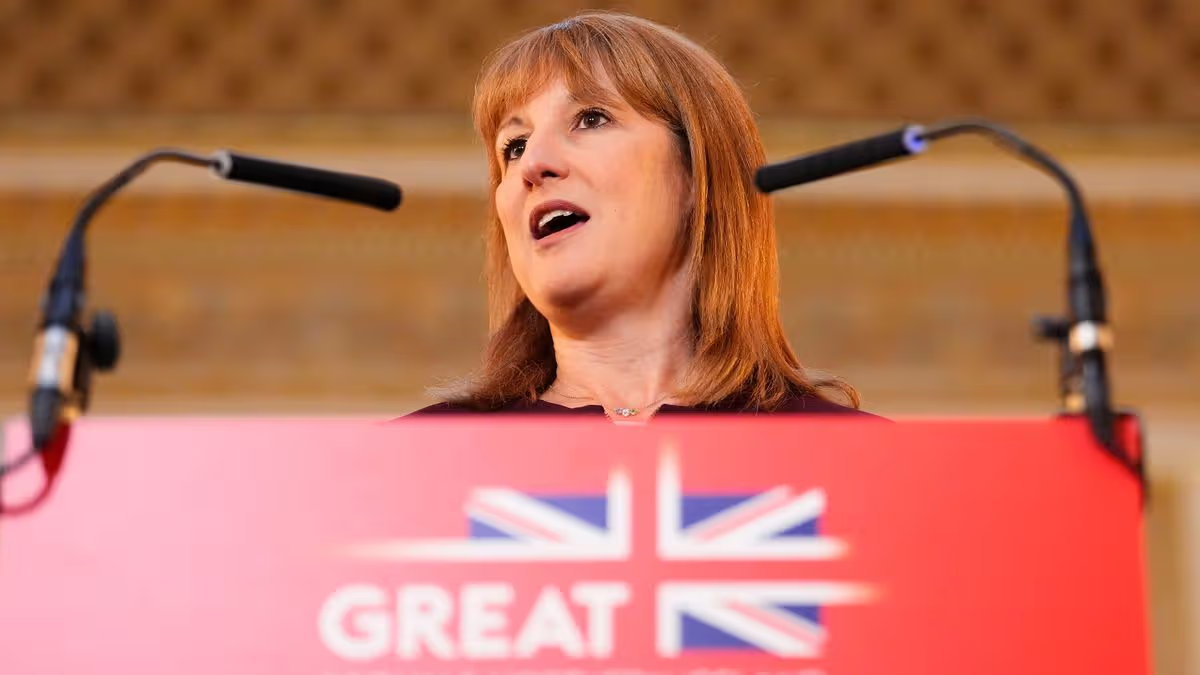
Chancellor of the Exchequer Rachel Reeves speaks at a business reception at Lancaster House in central London in September 2025

Chancellor of the Exchequer Rachel Reeves (Image: PA)

Rachel Reeves has summoned the heads of Britain’s top banks for a summit this week to address the economic repercussions of the war in Iran. The Chancellor has extended invitations to executives from Barclays, HSBC, Lloyds, Natwest, Santander UK, as well as the UK’s largest building society Nationwide, for a meeting this Wednesday.

Advertisement

The gathering – as reported by Sky News – will include Natwest chief Paul Thwaite and Lloyds’ boss Charlie Nunn. Barclays’ retail chief Vim Maru is expected to be in attendance alongside Nationwide’s chief executive Debbie Crosbie, while Santander will be represented by its newly appointed UK head Mahesh Aditya.

The economic fallout from the Iran war is set to dominate the agenda as the Chancellor seeks ways to cushion the blow felt across the country.

Earlier this month, the International Monetary Fund (IMF) delivered the UK economy the steepest downward revision of any nation in the G7, as reported by City AM.

Growth was cut by 0.5 percentage points in the wake of the upheaval in the Middle East, which has kept energy prices stubbornly high.

Advertisement

This comes as banks prepare to publish their first-quarter results, where the volatility in the Middle East is anticipated to feature prominently as banks increase their provisions for loan losses. Barclays will be the first to report on 28 April, followed by Lloyds on the 29 and Natwest on 1 May.

Banks to help Reeves navigate Iran turmoil Fresh figures released last week from the Office for National Statistics (ONS) revealed the UK economy expanded by 0.5 per cent prior to the war – significantly exceeding expectations.

However, City economists were swift to dampen any optimism surrounding the figures, dismissing the surge as “too good to be true”.

Martin Beck, a former Treasury economist now at WPI Strategy, described the latest data as the “calm before the storm”, warning that first-quarter growth is likely to be weighed down by more concerning figures due for release next month.

Advertisement

A note from RBC indicated that Barclays would be the most “hurt” bank by economic downgrades, owing to its bullish macro forecasts.

Barclays’ forecast for 2026 economic growth – used to calculate anticipated credit losses – stands at 1.1 per cent, considerably above the more conservative 0.7 per cent projected by Lloyds.

The independent body average – drawing consensus from a range of professional institutions outside the banks themselves, including the IMF, HM Treasury, NIESR, Bloomberg, and the Bank of England – sits at one per cent.

The meeting comes amid renewed tensions in the Middle East, following Iran’s decision to re-close the Strait of Hormuz over the weekend in response to the US blockade. Trump has also revived threats to bomb Iranian power plants, with the ceasefire deadline for Wednesday rapidly approaching.

Advertisement

Ring-fencing row returns to table Banks are also anticipated to use the gathering to press ahead with key lobbying efforts on regulation, including possible reforms to the ring-fencing regime established in the aftermath of the 2008 financial crisis.

Ring-fencing obliges major banks to separate their retail banking operations from their investment banking activities. It was brought in following the financial crisis to safeguard stability and was enshrined in the Financial Services Act 2013.

The threshold at which banks become subject to ring-fencing was lifted to £35bn, up from £25bn, in October 2024 by former City Minister Tulip Siddiq.

Nevertheless, senior bank executives have continued to push for a more accommodating framework, with the chief executives of HSBC, Santander, Natwest and Lloyds writing to the Chancellor branding the system “redundant”.

Advertisement

CS Venkatakrishnan, Barclays’ chief executive, broke ranks with his counterparts to advocate for the system, arguing that it delivers a net benefit.

“There are two counterpoints: we have spent the money on the set-up and we make it work; but the more important fact is that you have to weigh against this the immense amount of depositor protection that the ring-fencing regime gives the country,” he said.

Continue Reading
Click to comment

You must be logged in to post a comment Login

Leave a Reply

Business

Swindon’s roads, potholes and transport: What could be done to fix them

Published

on

Business Live

Ahead of the May 2025 local elections in Swindon, the five main parties have set out their plans

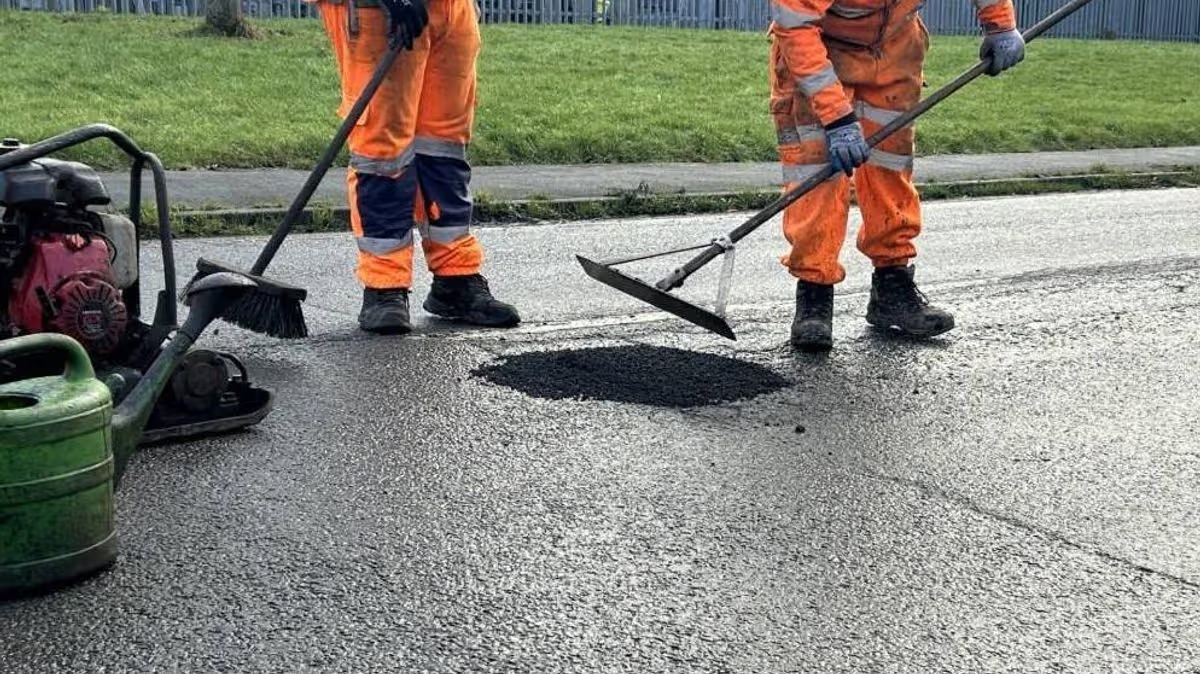
Fixing A Pothole In Shaftesbury Avenue

A pothole being fixed(Image: Local Democracy Reporting Service)

The five main parties fielding candidates in Swindon’s May local elections have set out, in 200 words, their plans for tackling the borough’s roads, traffic and transport challenges.

Advertisement

The responses are presented below in alphabetical order.

The Conservative Party

“Swindon’s roads are not good enough. You shouldn’t have to dodge potholes on your way to work or the school run. While others offer empty promises, we choose efficiency.

“The government has provided more money; this is positive, but it is being wasted on poor-quality repairs. We all see it, a pothole is reported, it can be weeks until it’s first patched, then within months it fails, and another repair is needed.

“Our manifesto is simple. Action over excuses. We are committed to a “Repair First” approach.

Advertisement

“This means replacing the reactive, sluggish bureaucracy with a data-driven, rapid-response model. We will deploy local teams to fix critical damage within 48 hours, not weeks. Every repair will be tracked, ensuring your council tax translates into tangible, permanent improvements.

“We will prioritise the busiest main routes to keep Swindon moving, while ensuring residential streets receive the long-term resurfacing they have been denied for too long, fine utility companies if roadworks are not finished on time and we will clean road drains to protect homes and businesses from flooding – something no-one is talking about.

“The Conservatives are running a positive campaign setting out what we will do – specific and tangible.”

The Green Party

The Green Party has not responded to the Local Democracy request, but it has supplied its manifesto which includes:

Advertisement

“Owning a car is becoming increasingly expensive, and in some wards of Swindon, 40 per cent of households do not have access to a private vehicle. Cars are important, but there are real alternatives for those that can’t access them, or who want to make a change.

“We aim to deliver the cycling and walking infrastructure and the street-side electric car charging points that SBC already has the money for.

“We want to connect overlooked communities with improved bus links to the surrounding areas of Swindon and the long overdue cycle links, like the missing link from Highworth to Swindon.

“And we want to work smarter, by enhancing existing infrastructure, such as bus and cycle lanes, make legal routes for electric scooters and use existing enforcement powers to keep pavements clear.

Advertisement

“Ultimately, we’d like a bus service owned by the council; run for your benefit, not private profit

“Until then, we will work with the bus companies to make bus travel cleaner, easier, and more reliable by creating new routes and protecting the routes that people rely on.

“This year, we persuaded the council to agree to look at how we could make bus travel free for young people. We will stand by that commitment.”

The Labour Party

“Keeping Swindon moving and accessible is a Labour priority, because residents and local businesses rely on safe roads and fair parking every day. After years of underinvestment, the council is taking practical action to deliver visible improvements. With nearly £6m committed to highways in 2025/26, work is focused on what matters most to people: smoother journeys, safer streets, and quicker repairs when problems arise.

Advertisement

“Over the past year, thousands of potholes have been fixed and key routes across the borough have been resurfaced or patched, improving reliability for drivers, cyclists and pedestrians alike.

“By using more durable methods like thermal patching and repairing full streets, such as County Road and Westcott Place, repairs are lasting longer, reducing disruption and saving money over time. Crucially, a longer-term plan has been developed to tackle the wider backlog, so improvements continue year after year rather than being short-term fixes.

“Parking is also being reshaped to better support everyday needs. Proposed changes aim to make costs cheaper for those staying longer, helping workers, and boost local shops by encouraging more visitors into town centres. By focusing on practical delivery and real outcomes, these steps are designed to make a noticeable difference to daily life travelling across all parts of Swindon.”

Liberal Democrats

“Improving public transport is vital to any town the size of Swindon and important to the rural towns and villages surrounding it.

Advertisement

“If we increase bus usage, we will reduce the number of cars on the roads and reduce pollution. A better bus service also ensures that youngsters can get to school or college without the need for a lift in a car, and for those who don’t or can’t drive to access vital services such as the hospital and shops.

“Lib Dems understand the importance of being effective on fixing potholes, the Lib Dem-run Wiltshire Council has been rated green in the Department of Transport’s new traffic-light ratings.

“We will hold the council to account for every penny and ensure no areas is left at the back of the queue.

“We are worried about the wastage of resources as exemplified by the Southern Connector Road, which still has not been resolved. We will seek to understand what has led to this debacle and what should be put in place to prevent any future occurrences.

Advertisement

“Council tax should deliver results you can see and roads you can drive on. It’s time to stop patching over the problem and fix our roads properly first time”

Reform UK

“Reform UK will review and improve the reporting and repair of potholes, including evaluating commercially available equipment and services, comparing outsourcing with in-house provision, and improving communication with the public.

“Each simple pothole repair currently costs around £48; our proposal would reduce this to £29.28 while delivering longer-lasting fixes.

“This approach mirrors the success of Reform UK-run Derbyshire Council, which eliminated its pothole backlog and achieved a 75 per cent reduction in related complaints.

Advertisement

“We will review the effectiveness of all bus lanes to improve traffic flow, including the removal or relocation of bus lanes and bus gates where feasible. Prime examples are the Outlet Village and Park & Ride bus lanes on Cricklade Road.

“The current parking plan will be scrutinised to ensure better value from this significant income stream. This includes competitive tendering of outsourced services, improved controls over street parking, and proper consultation with small businesses to create a payment system that works for the town and its car parks.

“We do not support blanket 20 mph speed limits.

“Our long-term transport vision will support future growth, including securing Mayoral Strategic Authority funding for the A419 and A420, and investing in improved rail and bus links with Oxford and Reading.”

Advertisement

Five candidates from the Trade Union and Socialist Coalition are also contesting the 7 May local elections.

Continue Reading

Business

Paladin raises FY26 production guidance

Published

on

Paladin raises FY26 production guidance

Paul Hemburrow-led Paladin Energy has raised the FY26 production guidance at its flagship Langer Heinrich mine in Namibia, following stronger sustained performance.

Continue Reading

Business

Barclays downgrades Prudential Financial stock rating on Japan risks

Published

on


Barclays downgrades Prudential Financial stock rating on Japan risks

Continue Reading

Business

Air New Zealand CFO Richard Thomson Resigns Effective August 2026, Airline Launches Search for Replacement

Published

on

Air New Zealand said it had experienced "the most challenging year in the airline's 80-year history"

AUCKLAND, New Zealand — Air New Zealand announced Wednesday that Chief Financial Officer Richard Thomson has resigned and will depart the national carrier on Aug. 28, prompting the airline to immediately begin searching for his successor amid ongoing operational and financial challenges.

Air New Zealand said it had experienced "the most challenging year in the airline's 80-year history"
Air New Zealand CFO Richard Thomson Resigns Effective August 2026, Airline Launches Search for Replacement
AFP / Marty MELVILLE

Thomson, who rejoined Air New Zealand in March 2021 as CFO, previously held senior commercial and finance roles within the company. During his more than five years in the top finance position, he played a key role in the airline’s post-COVID recapitalization, fleet modernization efforts and navigation of volatile fuel prices and global disruptions, according to company statements.

The resignation comes at a turbulent time for Air New Zealand, New Zealand’s flag carrier, which has faced mounting pressures including rising jet fuel costs exacerbated by Middle East tensions, a reported multi-million-dollar first-half loss and the need for recent fare hikes and flight consolidations in May and June. Shares of the airline fell more than 2 percent in early trading following the announcement.

In a statement to the New Zealand Exchange, Air New Zealand said it has commenced a formal search for a new chief financial officer and will provide further updates once the process is complete. The airline emphasized that Thomson’s departure is not linked to any performance issues and expressed gratitude for his contributions.

“Richard has made a significant contribution during a challenging period for the aviation industry,” the company noted. “We thank him for his leadership in finance, investor relations and corporate strategy and wish him well in his future endeavors.”

Advertisement

Thomson’s exit marks the latest change in Air New Zealand’s executive ranks. The airline has undergone several leadership adjustments in recent months, including shifts in operations roles earlier in 2026. Chief Executive Officer Nikhil Ravishankar, who took the helm in late 2025, now faces the task of stabilizing the finance function while steering the carrier through economic headwinds.

Aviation analysts described the timing as noteworthy but not entirely surprising given the demanding nature of the CFO role in a capital-intensive industry like airlines. Thomson oversaw critical financial maneuvers during the pandemic recovery, including equity raises and debt management that helped keep the airline afloat when international borders were closed and domestic travel was severely restricted.

Since resuming full operations, Air New Zealand has battled persistent cost pressures. Jet fuel remains a major expense, and disruptions from geopolitical events — particularly strains around the Strait of Hormuz — have driven up prices and forced route adjustments. The carrier recently warned of higher fares and reduced capacity on certain domestic and trans-Tasman routes to offset these costs.

Industry observers point out that airlines globally are grappling with similar issues. Fuel hedging strategies, fleet efficiency and revenue management have become even more critical as passenger demand rebounds unevenly and competition intensifies from low-cost carriers and international rivals.

Advertisement

Air New Zealand’s financial performance has shown signs of strain. The company reported a first-half loss in recent updates, citing elevated fuel prices and softer demand in some segments. Despite this, the airline has maintained its commitment to sustainability goals, including investment in more fuel-efficient aircraft and exploration of sustainable aviation fuels.

Thomson’s background includes a Bachelor of Commerce and Bachelor of Law from the University of Canterbury. His deep institutional knowledge of Air New Zealand, spanning multiple stints, made him a steady hand during crises. His departure will leave a gap in corporate memory at a time when the board and CEO are focused on long-term strategic planning.

The search for a new CFO is expected to attract strong interest from both domestic and international candidates with experience in aviation, transportation or capital-intensive sectors. Key qualifications will likely include expertise in financial planning, risk management, investor communications and navigating regulatory environments in New Zealand and key markets like Australia, the Pacific Islands and Asia.

Air New Zealand operates a fleet serving domestic routes, trans-Tasman flights to Australia, and long-haul services to Asia, the United States and Pacific destinations. The CFO plays a pivotal role in capital allocation decisions, including aircraft purchases or leases, which can run into hundreds of millions of dollars.

Advertisement

Market reaction was muted but negative initially, with shares trading down around 2.2 percent on the NZX. Broader New Zealand shares remained relatively flat, reflecting limited immediate contagion from the news. Analysts suggested investors are more focused on quarterly operational updates and the broader economic outlook for tourism-dependent New Zealand.

The resignation highlights the high turnover sometimes seen in senior airline executive roles due to the cyclical and volatile nature of the business. Previous CFO changes at Air New Zealand and peer carriers have often coincided with strategic shifts or recovery phases.

As the airline moves forward, leadership stability will be crucial. Ravishankar has emphasized building resilience through cost control, network optimization and customer experience improvements. The incoming CFO will need to align closely with these priorities while managing shareholder expectations and potential future capital needs.

Air New Zealand has positioned itself as a leader in sustainable aviation in the region, with ambitions to reduce emissions and support New Zealand’s climate goals. Financial oversight of these initiatives, including potential investments in new technology, will fall to the next finance chief.

Advertisement

Thomson is expected to remain in the role until late August, providing continuity during the transition. The company said it will ensure a smooth handover and that day-to-day operations remain unaffected.

The announcement arrives as the global aviation industry continues its post-pandemic normalization. Passenger numbers have recovered strongly in many markets, but profitability remains elusive for many carriers due to supply chain issues, labor shortages and geopolitical risks.

For Air New Zealand specifically, domestic and short-haul routes have shown resilience, while long-haul international services face stiffer competition and higher fuel exposure. Tourism from key source markets like Australia, China and the United States remains vital to the carrier’s revenue.

Industry experts expect the CFO search to conclude within several months. In the interim, the existing finance team will continue executing current strategies under CEO direction.

Advertisement

The development underscores the challenges facing national carriers in smaller markets. Air New Zealand plays a critical role in connecting New Zealand to the world, supporting trade, tourism and family ties across the Pacific. Maintaining financial health is essential not only for shareholders but for the broader economy.

As the search begins, speculation may arise about whether the new CFO will come from within the aviation sector or bring fresh perspectives from other industries. Past appointments at similar airlines have mixed internal promotions with external hires to balance continuity and innovation.

Air New Zealand’s board has not commented further on the reasons behind Thomson’s decision, describing it as a personal career move. Such transitions are common in corporate life and do not necessarily signal deeper issues.

Looking ahead, the airline’s next earnings report and any strategic updates will be closely watched. Investors will seek reassurance that the leadership change will not disrupt ongoing efforts to improve profitability and competitiveness.

Advertisement

For now, Air New Zealand continues its daily operations with more than 100 aircraft serving dozens of destinations. The focus remains on delivering reliable service while addressing cost pressures and positioning for sustainable growth.

Thomson’s tenure spanned a period of profound change for the airline, from pandemic-induced grounding of fleets to gradual rebuilding of international networks. His contributions to financial stability during that era were significant, even as external factors continued to test the business model.

The story of Air New Zealand’s CFO transition adds to a broader narrative of executive movements in the aviation sector as companies adapt to a new normal. Whether this change signals a strategic pivot or simply a natural evolution remains to be seen as the search for a successor unfolds.

Advertisement
Continue Reading

Business

Charities deal with impact of higher fuel prices

Published

on

Charities deal with impact of higher fuel prices

Ferrying items has been made more difficult by fuel price increases of 35%, one charity says.

Continue Reading

Business

Stock selection key as mid & smallcaps offer alpha opportunities: Pankaj Murarka

Published

on

Stock selection key as mid & smallcaps offer alpha opportunities: Pankaj Murarka
After a sharp rebound from March lows, Indian equity markets appear to be regaining confidence. With the benchmark indices recovering nearly 10% in a short span, investors are now asking: what lies ahead?

In an exclusive interaction with ET Now, Pankaj Murarka, CIO, Renaissance Investment Managers shared his outlook on market direction, sectoral leadership, and investment strategies in the current environment.

Markets Look Beyond Short-Term Shocks
Murarka remains optimistic about the trajectory of the markets, even after recent macroeconomic disruptions.

“It is certainly headed higher. I mean, it is as simple as this. Markets have absorbed the macroeconomic shock. While from an earnings perspective, we will see an impact of rising oil prices, currency adjustments, and rising bond yields, what we witnessed in March with rising oil prices was a perfect macroeconomic shock for India. While all of this will have an impact on earnings, probably in the first quarter and the first half as well, markets will look beyond that.

Advertisement

I think the earnings recovery we were looking forward to in FY27 or in this financial year will probably get pushed back to the second half of the year, but markets are already looking ahead to that. Markets have priced in that shock in terms of earnings adjustments. Having said that, the underlying growth in India remains fairly resilient. So, if you ask me, we are poised for a new high on the index by the end of this year.”


Financials to Lead, Energy and Consumption to Follow
When asked about sectoral leadership, Murarka pointed to a broad-based recovery rather than a single-sector rally.
“Look, I see a broad-based recovery in the economy, so obviously financials will lead underlying growth. We have seen an improvement in credit growth. Last year, credit growth was up at 14%. With inflation coming in, working capital demand will increase, which will support credit growth. On top of that, the investment cycle continues to remain dynamic.
We are already seeing demand from some very large investment projects on the credit side for banks. So, banks will certainly do well. But apart from that, new sectors will open up. The spike in energy prices has exposed India’s energy vulnerability, so we will likely see higher investments in the energy ecosystem, which should do well.

We are also seeing recovery in consumption, as you highlighted. Nestlé reported strong results recently. We are coming out of two years of a sluggish cycle in consumption. There is latent demand in the economy. Historically, when domestic demand sectors go through a slowdown, they see a strong revival because that latent demand always exists.

We see something similar in autos as well, where after several years, sales have crossed previous peaks. This means there is significant pent-up demand now playing out. The underlying demand remains robust and will reflect across domestic-oriented sectors.”

IT Sector: Short-Term Pain, Long-Term Opportunity
The IT sector has underperformed in recent months, but Murarka believes the outlook remains positive over the long term.

Advertisement

“We have all seen that the sector has not done well in the last 12 months. Valuations are at cyclical lows, levels we last saw around 2018. One key concern has been whether these companies will shrink over the next 5–10 years. I think that concern has now been addressed—this is not going to be the case.

These companies are going through a transition. Some parts of their business are being repriced or cannibalized, but at the same time, new opportunities are opening up. My belief is that these companies will continue to be growth companies in the near, medium, and long term.

Over the next four to six quarters, growth may remain moderate due to this transition. However, once this phase passes, they will return to a high-growth trajectory. Historically, major technology transitions have led to stronger growth for IT services companies, and I see no reason why this time should be different.

From a market perspective, valuations are low and pricing in muted growth. But growth will improve over the next four quarters. For long-term investors, this is a good time to invest with a three- to five-year view, with potential for strong returns.”

Advertisement

India’s Position in the AI Landscape
On artificial intelligence, Murarka noted that India may have missed the initial wave but still holds opportunity in services.

“The challenge with foundational technologies like AI is that the first five years are dominated by companies building the core ecosystem—like OpenAI, Anthropic, semiconductor firms, and hyperscalers. India does not have a presence in these areas.

However, as AI adoption spreads, India will play a role through IT services. Companies will need help integrating AI into their operations, and this is where Indian firms can add value.

The limitation is the lack of risk capital needed to build foundational technologies. These require significant investment with low success rates, and India’s ecosystem does not yet support that level of risk.”

Advertisement

Stock Selection Key in Mid and Small Caps
Murarka emphasized that the investment approach must now shift from sectors to individual stock picking.

“At the aggregate level, markets are fairly priced. But in times of macro uncertainty, performance dispersion within sectors increases significantly. You will find companies in the same sector performing very differently.

The game now is stock selection, not sector selection. It comes down to competitive edge, business moat, and management execution. Strong management teams can deliver growth even in challenging environments.

There are still opportunities in mid and small caps, especially after the recent correction. But investors need to be selective. Stocks that deliver positive surprises are seeing strong market reactions.”

Advertisement

Preferred Picks: Focus on Financials
While cautious about giving outright recommendations, Murarka shared a glimpse of his portfolio preferences.

“We like several mid-cap financials with strong management execution. We own names like Federal Bank and City Union Bank. In the NBFC space, we hold M&M Finance and PNB Housing Finance.

At this stage, it is all about management quality and execution. Companies that execute well will deliver superior returns. The market is increasingly stock-specific.”

The Bottom Line
Despite global uncertainties and short-term earnings pressure, the broader narrative for Indian equities remains intact. With resilient domestic demand, improving credit growth, and structural opportunities in sectors like energy and technology, markets could be on track for new highs—provided investors stay selective and focused on fundamentals.

Advertisement
Continue Reading

Business

Golden Sedayu rebuts union’s claims over $4b Burswood project

Published

on

Golden Sedayu rebuts union’s claims over $4b Burswood project

Golden Sedayu has rebutted the union’s claims that its chosen consultant for the $4 billion Burswood project would put the major development at risk, following union protests today.

Continue Reading

Business

FTSE 100 Edges Higher in Early Trading as UK Stocks Show Modest Gains Amid Global Tensions

Published

on

Tesla's robotaxi launch in Texas comes as Elon Musk focuses on his business ventures following his stint in Washington

LONDON — The FTSE 100 index climbed modestly in early trading Wednesday, rising about 0.11 percent to around 10,510 as investors weighed ongoing geopolitical developments in the Middle East and mixed signals from global markets following a sharp drop the previous day.

FTSE 100 Top Gainers: BP Leads 3.16% Surge as Oil
FTSE 100 Edges Higher in Early Trading as UK Stocks Show Modest Gains Amid Global Tensions

The blue-chip index stood at 10,509.99, up 11.90 points from Tuesday’s close of 10,498.09. It traded in a range between 10,516.44 and 10,478.92 by 8:45 a.m. BST, according to data from the London Stock Exchange. The modest rebound came after the index fell more than 1 percent Tuesday amid renewed uncertainty over U.S.-Iran ceasefire talks and fluctuations in oil prices.

Analysts described the early movement as cautious, with traders monitoring developments after President Donald Trump extended a ceasefire with Iran while keeping a U.S. naval blockade in place. The Strait of Hormuz, a vital chokepoint for global oil supplies, remains a focal point, with any escalation capable of pushing energy costs higher and pressuring inflation-sensitive sectors.

Utilities and energy-related stocks provided some support in early deals. SSE and Centrica were among early gainers, reflecting resilience in defensive sectors amid broader uncertainty. Consumer stocks showed mixed performance, while mining and financial names traded with limited direction as commodity prices stabilized somewhat after recent volatility.

The FTSE 100 has been on a roller-coaster ride in recent sessions. It closed Tuesday at 10,498.09 after shedding 110.99 points, or 1.05 percent, extending a pullback from levels above 10,600 seen earlier in the week. The index hit an intraday high of 10,634.96 on Tuesday but could not hold gains as concerns over Middle East tensions weighed on sentiment.

Advertisement

Broader context shows the FTSE 100 has delivered solid performance in 2026 so far, building on strong gains in 2025 that marked its best year since 2009. The index breached the psychologically important 10,000 level in early January and reached all-time highs near 10,935 in February. Year-to-date returns stand around 4 percent, though recent sessions have reflected heightened sensitivity to oil prices and geopolitical risks.

Market participants point to several factors influencing the UK benchmark. The heavy weighting toward energy giants such as Shell and BP means the index often moves in tandem with crude oil prices. Brent crude has fluctuated in recent days amid reports of partial reopening of shipping lanes in the Strait of Hormuz and diplomatic maneuvering between Washington and Tehran.

A weaker pound has also provided a tailwind for the FTSE 100, which derives roughly three-quarters of its revenues from overseas markets. Exporters and multinational firms benefit when sterling depreciates, boosting the sterling value of foreign earnings. However, persistent UK inflation concerns — with recent data showing headline CPI rising to 3.3 percent in March — have tempered expectations for aggressive Bank of England rate cuts.

Economists note that the UK economy continues to grapple with stagflation-like conditions, combining subdued growth with elevated price pressures. Gross domestic product growth for 2025 was revised upward slightly to 1.4 percent, but business investment has shown weakness. Unemployment remains relatively low at 4.9 percent, yet wage growth has moderated, offering limited relief to squeezed household budgets.

Advertisement

Corporate earnings season has added another layer of nuance. Recent reports from major FTSE 100 constituents have been mixed. Retailers like Tesco have highlighted consumer resilience in some areas, while others face margin pressures from higher energy and import costs. Defense stocks, including BAE Systems, have benefited from increased global security spending, contributing to the index’s resilience at times.

Pharmaceutical heavyweights such as AstraZeneca and GSK have faced headwinds from sector-specific challenges, including regulatory scrutiny and patent cliffs, though they continue to underpin the index with steady dividend payouts. The FTSE 100’s attractive dividend yield, projected around 3.3 percent for 2026 with record payouts expected near £88 billion, continues to draw income-focused investors.

Analysts at firms like AJ Bell have forecast further upside for the index, potentially reaching 10,750 by year-end, driven by profit growth of around 14 percent and ongoing share buybacks. However, they caution that commodity price swings, monetary policy decisions and geopolitical flashpoints could derail progress.

International developments have dominated headlines. Trump’s Truth Social posts asserting Iran’s financial collapse and demand to reopen the Strait of Hormuz have fueled market swings. Limited commercial shipping has resumed through the waterway, but the ongoing U.S. blockade restricts Iranian oil exports, keeping energy markets on edge.

Advertisement

European peers showed varied performance Wednesday morning. The pan-European STOXX 600 edged higher, while Germany’s DAX and France’s CAC 40 traded with modest gains as investors assessed the latest Iran-related news. Wall Street futures pointed to a cautious open in New York, with focus on upcoming U.S. economic data and corporate earnings.

In London, mid-cap stocks in the FTSE 250 were slightly firmer, gaining around 0.3 percent in early action. The more domestically focused index often amplifies movements in UK-specific economic indicators such as house prices and retail sales.

Trading volume remained moderate as many participants awaited further clarity on Middle East diplomacy. Pakistan and Oman have reportedly served as intermediaries in indirect talks, though deep divisions persist over Iran’s nuclear program, sanctions relief and regional proxy activities.

Bank of England officials have signaled a data-dependent approach to interest rates. With inflation above target and growth fragile, markets price in limited easing over the coming months. Gilt yields have remained relatively stable, providing some support to rate-sensitive sectors.

Advertisement

Looking ahead, investors will watch for fresh corporate updates and macroeconomic releases. Key earnings from remaining FTSE 100 names could influence sentiment, particularly in banking, mining and consumer goods. Any breakthrough or setback in U.S.-Iran negotiations would likely trigger sharp moves in oil prices and, by extension, the FTSE 100.

The index’s composition — tilted toward value sectors rather than high-growth technology — has helped it outperform some global peers during periods of volatility but has also capped upside when risk appetite surges elsewhere. In 2026, financials, miners and energy stocks have been primary drivers of gains, while defensives like utilities and pharmaceuticals have offered ballast.

Broader UK equity market capitalization stands near record levels, reflecting confidence in British companies despite domestic challenges. Foreign ownership remains high, with international investors attracted by relatively cheap valuations compared to U.S. benchmarks.

As trading progressed past the 8:45 a.m. mark, the FTSE 100 held its modest advance. Traders noted that sustained gains would require easing of geopolitical risks and positive cues from commodity markets. A resolution or meaningful de-escalation in the Middle East could unlock further upside, while renewed tensions might test recent support levels near 10,400-10,500.

Advertisement

The session underscores the FTSE 100’s role as a barometer for both UK economic health and global risk sentiment. With the nation preparing for its 250th anniversary celebrations in 2026, market stability could play a supporting role in broader confidence.

Analysts remain broadly constructive on UK equities for the remainder of the year, citing dividend growth, buyback activity and potential valuation rerating if inflation cools and rates ease. However, they stress the need for vigilance on external shocks, particularly those involving energy security and international trade.

By mid-morning, the index hovered near its early high, with individual stock movements reflecting sector rotations. Gains in utilities and select consumer names offset softness in more cyclical areas sensitive to oil and global growth concerns.

The modest 0.11 percent uptick at 8:45 a.m. BST reflects a market seeking direction amid crosscurrents of diplomacy, energy dynamics and domestic fundamentals. Whether the early gains hold through the full session will depend on incoming news flow and shifts in investor risk appetite.

Advertisement
Continue Reading

Business

At Close of Business podcast April 22 2026

Published

on

At Close of Business podcast April 22 2026

Tom Zaunmayr speaks to Justin Fris about Business News’ recent agribusiness feature.

Continue Reading

Business

UK’s new national darts centre opens in Bristol in former Patchway sports and social club

Published

on

Business Live

The facility includes a state-of-the-art arena and will support the growth of the sport at grassroots, junior and elite levels

The former Patchway Sports and Social Club in Bristol, now Hangar61, will be the home of the new national darts centre

The former Patchway Sports and Social Club in Bristol, now Hangar61, will be the home of the new national darts centre(Image: Nodor)

A new national darts centre has opened its doors in Bristol. The facility – known as Hangar61 – is based in the old Patchway sports and social club, and is designed to support the growth of the sport at grassroots, junior and elite levels.

It will be operated by the Junior Darts Corporation (JDC) in partnership with dartboard manufacturer Winmau, which said the centre’s mission is “firmly focused” on the future of darts and nurturing young talent.

The new facility includes a state-of-the art arena; 32 match boards and dart lanes with live tablet scoring; and a production room with broadcast equipment.

It will host JDC academies, community coaching programmes and professional-level training, while continuing to operate as a space for local residents, families and young people, JDC said.

Advertisement

Flagship competitions such as the Junior Power League, Girls Series and Advanced tour will take place in the new venue. It will also host pathway competitions including the foundation tour for players who are making their first step on the competition ladder.

It is understood that Winmau – a long-term partner of the Professional Darts Corporation (PDC) – has played a key role in bringing the project to life. Its investment has helped secure a dedicated, permanent home for the JDC in Bristol, while Winmau-affiliated academies nationwide have doubled in size since the partnership began.

Steve Brown, founder and chairman of the JDC, said: “This is a hugely important day for the JDC and for junior darts in the UK.

“Hangar61 gives us a permanent home that matches the ambition of our programme and the talent of the young players coming through. We’ve created a facility that not only supports elite development but is rooted in the local community and open to the next generation discovering the sport for the first time.”

Advertisement

Tom Brown, chief executive of Nodor Group, the parent company of Winmau, added: “The growth in darts we’ve witnessed recently has been remarkable, but it’s vital that this momentum is supported by strong development at grassroots level. With Hangar61, we’re proud to offer young players a world-class environment where they can learn, train and progress, supported by state-of-the-art facilities and the very best equipment.”

Continue Reading

Trending

Copyright © 2025