Connect with us
DAPA Banner

Business

Restaurant Brands International (QSR) Q1 2026 earnings

Published

on

Restaurant Brands International (QSR) Q1 2026 earnings

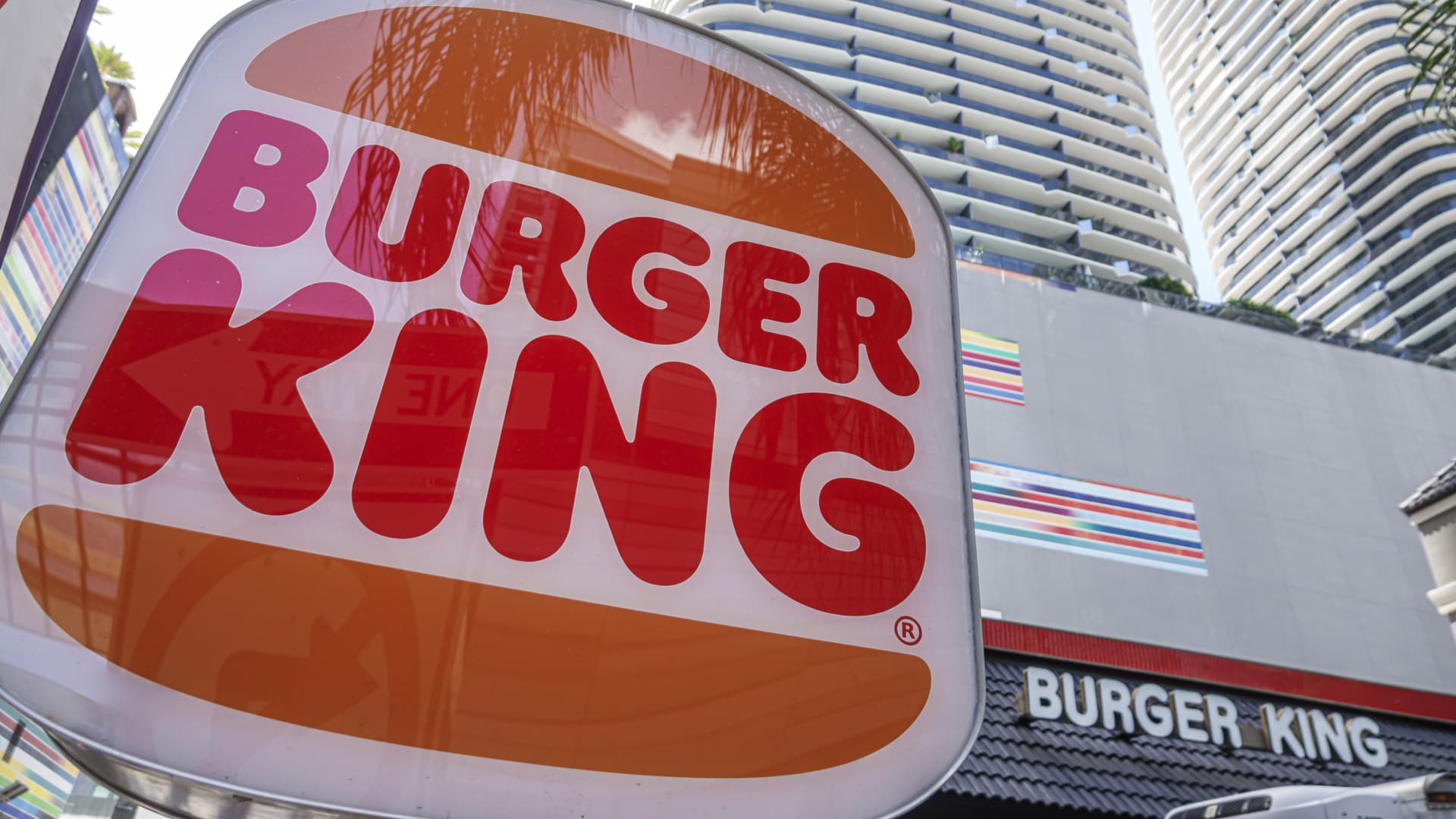
Burger King fast food hamburger restaurant in Miami, Fla.

Jeff Greenberg | Universal Images Group | Getty Images

Restaurant Brands International on Wednesday reported better-than-expected earnings and revenue, fueled by another quarter of strong international growth and a successful turnaround at Burger King U.S.

Advertisement

But there are some potential challenges ahead for the company, like high beef costs that will likely stay that way longer than Restaurant Brands originally anticipated and weakening consumer sentiment as a result of the U.S.-Israel war with Iran.

Shares of the company fell roughly 5% in morning trading.

Here’s what the company reported compared with what Wall Street was expecting, based on a survey of analysts by LSEG:

  • Earnings per share: 86 cents adjusted vs. 82 cents expected
  • Revenue: $2.26 billion vs. $2.24 billion expected

Restaurant Brands reported first-quarter net income attributable to common shareholders of $338 million, or 97 cents per share, up from $159 million, or 49 cents per share, a year earlier.

Excluding nonrecurring expenses and other items, the restaurant company earned 86 cents per share.

Advertisement

Revenue rose 7% to $2.26 billion.

Restaurant Brands’ same-store sales increased 3.2% in the quarter, driven by strong growth at Burger King’s U.S. locations and the company’s international restaurants.

Outside of the U.S. and Canada, Restaurant Brands’ international business saw same-store sales jump 5.7%, beating the estimates of 5.1% growth projected by Wall Street analysts surveyed by StreetAccount. International Burger King restaurants, which represents the bulk of the segment, saw same-store sales increase 5.4%.

Burger King reported same-store sales growth of 5.8%, topping StreetAccount estimates of a 3.5% increase. The chain’s U.S. business has been renovating its restaurants, upgrading its Whopper ingredients and offering consistent value items.

Advertisement

“There are notable successes in the industry right now, and that includes Burger King, and they’re putting up great numbers,” Restaurant Brands Chair Patrick Doyle said on the call. “And there are others in the industry where things are clearly getting worse and they are losing market share.”

Tim Hortons’ same-store sales ticked up 1.6%, below StreetAccount estimates of 2.5% growth. Restaurant Brands CEO Josh Kobza said snowstorms in January and consumers’ broader economic concerns weighed on sales for the Canadian coffee chain, although it still outperformed the broader coffee category in Canada.

Popeyes was the laggard of the portfolio again for the quarter. The fried chicken chain reported same-store sales declines of 6.5%, a steeper decrease than the 1.5% slide forecast by Wall Street and its biggest quarterly drop in years.

Faced with stiffer competition and more value-conscious consumers, Popeyes is trying to revive sales by focusing on its operations and core menu items. The chain’s same-store sales should start growing again by the second half of the year, Kobza told analysts on the conference call.

Advertisement
Choose CNBC as your preferred source on Google and never miss a moment from the most trusted name in business news.
Continue Reading
Click to comment

You must be logged in to post a comment Login

Leave a Reply

Business

Backblaze: AI Infrastructure Opportunity Is Becoming Clearer (Upgrade)

Published

on

Backblaze: AI Infrastructure Opportunity Is Becoming Clearer (Upgrade)

Backblaze: AI Infrastructure Opportunity Is Becoming Clearer (Upgrade)

Continue Reading

Business

EQT Raises Takeover Bid For Intertek Again

Published

on

EQT Raises Takeover Bid For Intertek Again

Swedish buyout group EQT said Tuesday that it submitted an improved takeover proposal for Intertek, valuing the provider of testing, inspection and certification services at 8.93 billion pounds ($12.08 billion).

In the new offer, the private-equity company values Intertek at 58 pounds a share in cash, or a 54% premium to its closing price on April 9, the day before the initial proposal was submitted. The proposal values the company as a whole at 8.93 billion pounds, based on share-count data provided by LSEG.

Copyright ©2026 Dow Jones & Company, Inc. All Rights Reserved. 87990cbe856818d5eddac44c7b1cdeb8

Continue Reading

Business

Meesho Q4 Results: Co narrows loss by 88% YoY to Rs 166 crore, revenue jumps 47%

Published

on

Meesho Q4 Results: Co narrows loss by 88% YoY to Rs 166 crore, revenue jumps 47%
E-commerce company Meesho narrowed its consolidated losses to Rs 166 crore in the March-ended quarter versus Rs 1,391 crore in the year-ago period, implying an 88% drop. The loss is attributable to the owners of the parent.

The company’s revenue from operations, meanwhile, rose 47% to Rs 3,531 crore versus Rs 2,400 crore posted in the corresponding quarter of the previous financial year.

The losses were lower on a sequential basis as well, falling from Rs 491 crore in Q3FY26, while the topline was flat quarter-on-quarter versus Rs 3,518 crore in the January-March quarter of FY26.

Meesho, which claims to be India’s largest e-commerce platform by Annual Transacting Users (ATUs) and orders placed, reported a net merchandise value (NMV) of Rs 11,371 crore in Q4FY26, up 43% YoY, with 717 million orders (+43% YoY), driven by continued new user onboarding and deeper engagement from existing cohorts.

Advertisement

For the full year FY26, Meesho continued to expand India’s e-commerce market, emerging as the most downloaded shopping app in India and the largest platform by Annual Transacting Users (ATUs) and placing orders. Its ATUs grew 33% YoY to 264 million, while orders increased 45% YoY to 2.67 billion.


NMV for the year stood at Rs 41,560 crores, up 39% YoY, with frequency improving to 10.1 transactions per user annually.

Management commentary

Founder & CEO Vidit Aatrey said FY2026 deepened the company’s conviction that the Indian e-commerce market has far more depth than most people assume. “In emerging markets like China, Southeast Asia, and Latin America, more than 80% of smartphone users shop online. In India, that number is around 30%, not because Indians don’t want to shop online, but because nobody has built an e-commerce that actually works for them. Every time we removed one of those barriers, the market got larger. That pattern has held for a decade,” he said.Also read: KPIT Technologies Q4 Results: Cons profit falls 33% YoY to Rs 163 crore despite 12% revenue uptick

Underscoring the importance of AI, he highlighted that more than 75% of orders on Meesho come from personalised feeds that infer what a user is looking for before they even type a query. “Vaani, our voice shopping agent, lets a user describe what they want in their own language and complete a purchase through conversation. GeoIndia decodes the landmark-based, vernacular addresses that conventional systems cannot parse. The result is that first-time buyers who had never placed an order online are now completing purchases on Meesho,” Aatrey said.

(Disclaimer: Recommendations, suggestions, views and opinions given by the experts are their own. These do not represent the views of The Economic Times)

Advertisement
Continue Reading

Business

AMD shares jump 13% as AI chip demand lifts strong results

Published

on

AMD shares jump 13% as AI chip demand lifts strong results
Shares of Advanced Micro Devices surged nearly 13% on Wednesday after the chipmaker delivered stronger-than-expected quarterly results and issued an upbeat revenue forecast, reinforcing investor confidence that it is emerging as one of the strongest challengers to Nvidia in the artificial intelligence race.

The stock, which had already gained nearly 60% this year ahead of the results, extended its rally after the company projected second-quarter revenue of $11.2 billion, plus or minus $300 million—well above Wall Street estimates of $10.52 billion.

AMD also guided for adjusted gross margins of about 56%, ahead of analyst expectations of 55.4%, signalling stronger pricing power as demand for AI chips remains robust. For the March quarter, the company reported adjusted earnings of $1.37 per share on revenue of $10.25 billion.

The biggest upside came from AMD’s data centre business, where revenue jumped 57% year-on-year to $5.8 billion as cloud computing giants continued to ramp up spending on AI infrastructure.

Advertisement

The company is benefiting not only from demand for graphics processing units (GPUs) used to train AI models, but also from central processing units (CPUs), which are becoming critical as companies scale AI applications—a process known as inference. This positioning is helping AMD tap into a broader AI hardware opportunity as enterprises move from experimentation to deployment.


Earlier this year, AMD announced a landmark deal to supply up to $60 billion worth of AI chips over five years to Meta Platforms, a transaction that also gives the Facebook parent the option to take up to a 10% stake in the chipmaker.
The company also struck a separate AI partnership with OpenAI last year. Investors increasingly view AMD as the most credible alternative to Nvidia in AI chips, especially as hyperscalers look to diversify suppliers amid tight capacity and rising costs.AMD stock has significantly outperformed Nvidia this year. While AMD is up nearly 60% year-to-date, Nvidia has gained about 6%, while the broader Philadelphia Semiconductor Index has risen around 48%.

Still, competition is intensifying. Intel last month issued a strong revenue forecast of its own as it ramps up in-house manufacturing to meet rising CPU demand. Unlike Intel, AMD outsources chip production to Taiwan Semiconductor Manufacturing Company, exposing it to tight foundry capacity as global demand for advanced chips continues to surge.

(Disclaimer: Recommendations, suggestions, views and opinions given by the experts are their own. These do not represent the views of Economic Times)

Advertisement
Continue Reading

Business

Chord Energy Corporation (CHRD) Q1 2026 Earnings Call Transcript

Published

on

OneWater Marine Inc. (ONEW) Q1 2026 Earnings Call Transcript

Q1: 2026-05-05 Earnings Summary

EPS of $4.56 beats by $1.07

 | Revenue of $1.67B (37.08% Y/Y) beats by $491.19M

Chord Energy Corporation (CHRD) Q1 2026 Earnings Call May 6, 2026 11:00 AM EDT

Company Participants

Bob Bakanauskas
Daniel Brown – President, CEO & Director
Darrin Henke – Executive VP & COO
Michael Lou – Executive VP, Chief Strategy Officer & Chief Commercial Officer

Advertisement

Conference Call Participants

John Abbott – Wolfe Research, LLC
Hsu-Lei Huang – Tudor, Pickering, Holt & Co. Securities, LLC, Research Division
Jack Kindregan – BMO Capital Markets Equity Research
Scott Hanold – RBC Capital Markets, Research Division
Neal Dingmann – William Blair & Company L.L.C., Research Division
Michael Furrow – Pickering Energy Partners LP
John Annis – Texas Capital Securities, Research Division
Phillips Johnston – Capital One Securities, Inc., Research Division
John Edelman – Jefferies LLC, Research Division

Advertisement

Presentation

Operator

Good morning, ladies and gentlemen, and welcome to the Chord Energy First Quarter 2026 Earnings Call.

[Operator Instructions]

Advertisement

This call is being recorded on Wednesday, May 6, 2026. I would now like to turn the conference over to Bob Bakanauskas, Vice President of Finance. Please go ahead.

Bob Bakanauskas

Thanks, Natasha, and good morning, everyone. This is Bob Bakanauskas, and today, we are reporting our first quarter 2026 financial and operational results. We are delighted to have you on the call. I’m joined today by Danny Brown, our CEO; and Michael Lou, our Chief Strategy Officer and Chief Commercial Officer; Darrin Henke, our COO; Richard Robuck, our CFO; as well as other members of the team.

Advertisement

Please be advised that our remarks, including the answers to your questions, include statements that we believe to be forward-looking statements within the meaning of the Private Securities Litigation Reform Act. These forward-looking statements are subject to risks and uncertainties that could cause actual results to be materially different from those currently disclosed in our earnings releases and on conference calls. Those risks include, among others, matters that we have described in our earnings

Advertisement
Continue Reading

Business

Food security ‘under threat’ if planners approve plans for farmland, councillors warn

Published

on

Business Live

‘Reduction of high-grade agricultural land’ flagged as more planning applications pour in

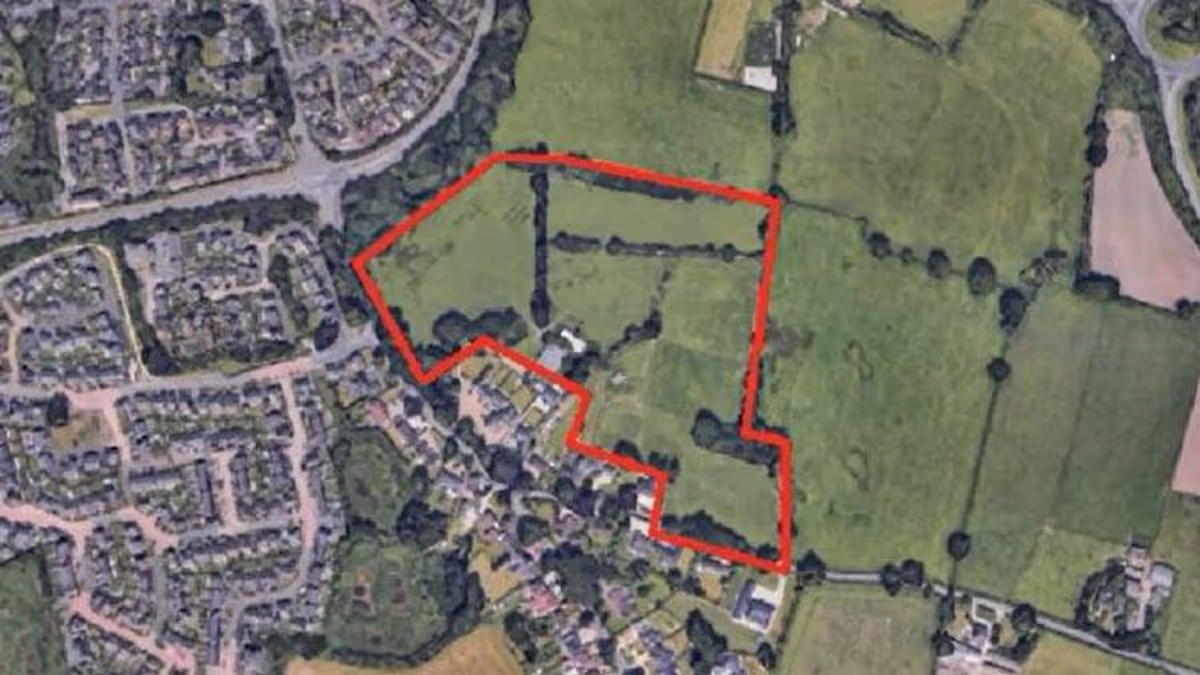
Aerial view of the agricultural land at Nantwich which forms the approved outline application site at London Road (Google)

An aerial view of the agricultural land at Nantwich which forms the approved outline application site at London Road(Image: Google)

Food security will be under threat if planners and government continue to allow developers to eat up agricultural land for housing, some Cheshire East councillors and residents have warned.

Advertisement

It’s a view which has been expressed at various meetings, as housing applications flood in across the borough for development on agricultural land.

Knutsford councillor Tony Dean (Con) was the latest to voice his concerns at last week’s meeting of the strategic planning board, when members were discussing an application for up to 85 homes on 6.39 hectares of agricultural land off London Road at Nantwich.

As councillors struggled to find a reason to refuse the outline scheme – which eventually was approved – Cllr Dean told the meeting: “One of the things which is not yet considered to have any planning weight, but I’m sure it will do within the next 20 to 30 years, is the reduction of high-grade agricultural land.”

He said that particular Nantwich site was very good agricultural land.

Advertisement

“People will say, well, that’s tiny compared to all the farming land we have in the country, but the problem is, if you keep nibbling away at it, we’re not even self-sufficient in this country as it is, and we’ll get less and less self-sufficient,” said Cllr Dean.

“At the moment, that’s not an issue, but if we have any more issues like the Strait of Hormuz and certain other possible international problems, we could end up like we were in 1939, very short of food in this country.

“I am sure that, at some stage in the government, somebody will see that eating up our agricultural land is the worst thing we could possibly do.”

He said in Cheshire East it was accepted that solar farming and tree planting is not permitted on high-grade agricultural land.

Advertisement

“But houses seem to be the exception, and the planning system has yet to accept that eating away at high-grade agricultural land is the wrong thing,” he said.

Cllr Dean’s comments come a few months after a similar argument was put forward by Knutsford councillor Stewart Gardiner (Con) regarding a proposal for housing and a care home on land off Crewe Road at Sandbach.

Cllr Tony Dean, Knutsford Conservative councillor

Cllr Tony Dean, Knutsford, Conservative(Image: Local Democracy Reporting Service)

That application was refused in October last year by councillors – with one reason being the proposed development would lead to the loss of best and most versatile agricultural land.

The applicant won the subsequent appeal after Cheshire East withdrew its objections.

Advertisement

But at the original October meeting, Cllr Gardiner had argued that that Sandbach land ‘is adding to the food security of this country which is a very significant point and officers, councillors and inspectors and even ministers of the Crown who fail to understand this, fail to understand the importance of food security’.

And at December’s full council meeting, objectors fighting the proposals for the Adlington new town – when it was still one of 12 areas being considered by government – had argued about the need for national food security.

One resident told the meeting: “What this means in practice is that nearly 2,500 acres of highly productive farmland producing 4.5 million litres of milk, more than 3,000 lambs and 115 tonnes of meat products per year, will be lost to urban sprawl.

“The loss of farming communities and the erosion of our national food security will be highly damaging in the long term and once this farmland has gone, it’s gone forever.”

Advertisement

To find all the planning applications, traffic diversions, road layout changes, alcohol licence applications and more in your community, visit the Public Notices Portal.

Continue Reading

Business

Kite Hill debuts cream cheese alternative

Published

on

Kite Hill debuts cream cheese alternative

The innovation is formulated with 4 grams of protein per serving. 

Continue Reading

Business

SmartRent, Inc. (SMRT) Q1 2026 Earnings Call Transcript

Published

on

OneWater Marine Inc. (ONEW) Q1 2026 Earnings Call Transcript

Operator

Hello, everyone. Thank you for joining us, and welcome to SmartRent First Quarter 2026 Earnings Release. [Operator Instructions] I will now hand the conference over to Kelly Reisdorf, Head of Investor Relations. Please go ahead.

Kelly Reisdorf
Head of Investor Relations

Advertisement

Hello, and thank you for joining us today. My name is Kelly Reisdorf, Head of Investor Relations for SmartRent. I’m joined today by our President and Chief Executive Officer, Frank Martell; and Daryl Stemm, Chief Financial Officer. Before the market opened today, we issued an earnings release and filed our 10-Q with the SEC, both of which are available on the Investor Relations section of our website.

Before I turn the call over to Frank, I would like to remind everyone that the discussion today may contain certain forward-looking statements that involve risks and uncertainties. Various factors could cause our actual results to be materially different from any future results expressed or implied by such statements. These factors are discussed in our SEC filings, including in our annual report on Form 10-K and quarterly reports on Form 10-Q. We undertake no obligation to provide updates regarding forward-looking statements made during this call, and we recommend that all investors review these reports thoroughly before taking a financial position in SmartRent.

Also during today’s call, we will refer to certain non-GAAP financial measures. A discussion of these non-GAAP financial measures, along with the reconciliation to the most directly comparable GAAP measure is included in today’s earnings release. We would also like to highlight that our

Advertisement
Continue Reading

Business

Hedge fund founder hits back at Mamdani’s wealth tax video

Published

on

Hedge fund founder hits back at Mamdani's wealth tax video

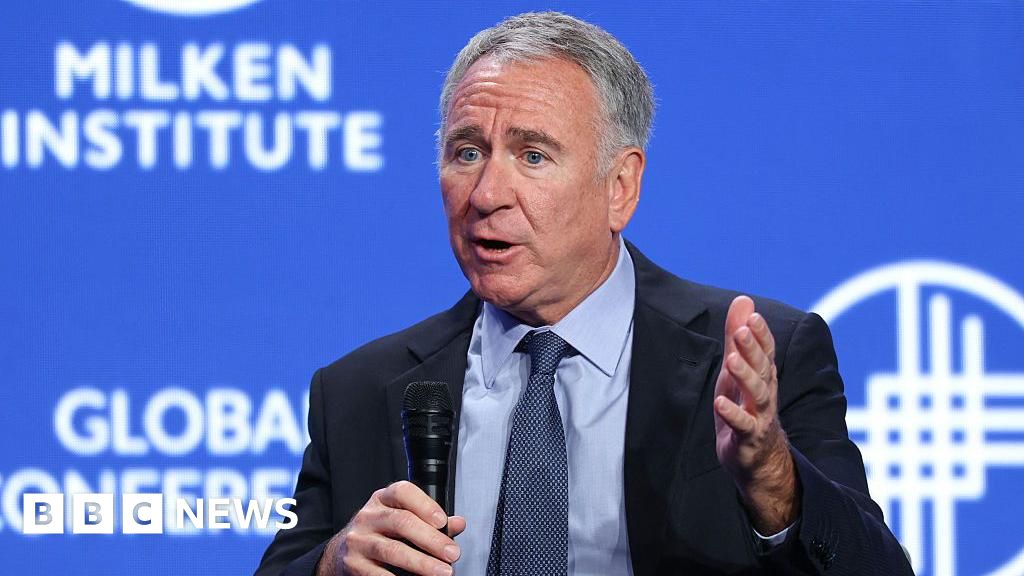
“Like for this penthouse, which hedge fund CEO Ken Griffin bought for $238m,” Mamdani said, while standing in front of the property’s building. When Griffin bought the apartment in 2019 it became, and remains, the most expensive property purchased in the US.

Continue Reading

Business

Why Early Retail Strategy Defines Brand Success

Published

on

The eCommerce industry is competitive, and having the right strategy is essential for success. With the correct tools, you can streamline your processes, enhance customer experience, and boost sales.

Many entrepreneurs build brands with strong online traction. Sales grow. Awareness builds. The next step often becomes retail expansion. That step introduces a new level of pressure.

Retail does not reward potential. It rewards performance.

TLK Fusion, a marketing and retail strategy agency founded in 2009, has worked with brands at different stages of growth, including startups and established companies entering national retail. Their experience comes from supporting brands through placement, execution, and long-term retail performance. That perspective shapes how they view preparation.

“Too many brands think retail is the next step after growth,” they explain. “In reality, it requires a completely different level of readiness.”

Why Early Strategy Matters More Than Timing

Retail expansion often happens too early. Founders see demand and assume the product is ready for scale.

Advertisement

The data shows otherwise. Industry research indicates that 80% or more of new consumer packaged goods fail within the first two years. Many fail after entering retail.

The issue is not product quality. The issue is lack of preparation.

Retail introduces fixed timelines, strict expectations, and performance tracking. Brands lose flexibility. Decisions must be made in advance.

“Retail is structured,” TLK Fusion says. “You don’t get to adjust in real time the way you can online.”

Advertisement

Early strategy reduces risk. It allows brands to test assumptions before committing to large-scale distribution.

Understanding the Shift From Direct Sales to Retail

Direct-to-consumer models give founders control. They manage pricing, messaging, and customer interaction.

Retail removes that control. Products compete in shared space. Buyers evaluate based on data.

This shift changes how brands must operate.

Advertisement
  • Pricing must fit wholesale margins
  • Packaging must communicate instantly
  • Supply chains must support volume
  • Marketing must drive in-store demand

Research shows that over 70% of purchase decisions happen at the shelf. This leaves no room for long explanations or complex messaging.

“Consumers don’t have time to figure out your product in a store,” TLK Fusion explains. “They need to understand it immediately.”

Brands that prepare for this shift perform better in early retail cycles.

Building a Retail-Ready Product

A product that works online may not work in retail. Packaging, size, and price point all affect performance.

Retail buyers assess products based on:

Advertisement
  • Category fit
  • Competitive pricing
  • Shelf appeal
  • Sales potential

Many founders focus on branding. Retail requires functional clarity.

Studies show that products with clear positioning outperform competitors in crowded categories. This is not about design alone. It is about communication.

“Your product has seconds to make an impression,” TLK Fusion says. “Clarity matters more than creativity in that moment.”

Early product development should account for these constraints.

Pricing for Retail From the Start

Pricing decisions made early can limit future growth. Many brands build pricing models around direct sales margins.

Advertisement

Retail introduces wholesale pricing. Margins shrink. Costs increase.

These include:

  • Retailer margins
  • Distribution fees
  • Promotional costs
  • Returns and allowances

A study from retail finance groups shows that brands can lose 30–50% of their margin when moving into retail channels.

Without planning, this shift can make a product unsustainable.

“Brands need to understand their numbers before they scale,” TLK Fusion explains. “If pricing doesn’t support retail, growth will stall.”

Advertisement

Early financial planning allows brands to enter retail with viable models.

Generating Demand Before Retail Launch

Retail success depends on demand. Shelf presence alone does not drive sales.

Many founders assume that retail placement will create awareness. Retailers expect the opposite.

Products must already have an audience.

Advertisement

Research shows that brands with pre-launch awareness campaigns perform stronger in their first 90 days in retail.

This affects reorder rates and long-term placement.

“Retail is not where you start building awareness,” TLK Fusion says. “It’s where you convert it.”

Brands that invest in early marketing see stronger results after launch.

Advertisement

Preparing Operations for Scale

Operational readiness is a common failure point. Online brands can manage small batches and flexible timelines.

Retail requires consistency.

Brands must handle:

  • Large order volumes
  • Strict delivery schedules
  • Inventory management
  • Production reliability

Supply chain data shows that over 60% of small brands face fulfillment challenges when entering retail.

These issues impact retailer relationships and sales performance.

Advertisement

“Retail depends on reliability,” TLK Fusion explains. “If you can’t deliver consistently, it affects everything else.”

Preparation must include operational systems, not just marketing plans.

Aligning Marketing With Retail Execution

Marketing strategies must change when entering retail. Online campaigns focus on engagement. Retail requires conversion.

Messaging must match the in-store experience.

Advertisement

This includes:

  • Clear product benefits
  • Consistent branding across channels
  • Targeted campaigns tied to retail locations

Retail studies show that integrated campaigns tied to store availability improve sell-through rates significantly.

“Marketing should support what happens in-store,” TLK Fusion says. “It needs to drive action, not just attention.”

Alignment between marketing and retail execution improves early performance.

Managing Retail Relationships From Day One

Retail partnerships require ongoing management. Buyers expect communication, performance tracking, and support.

Advertisement

Brands must:

  • Monitor sales data
  • Respond to performance issues
  • Support promotions
  • Maintain inventory levels

Failure to meet expectations can limit future opportunities.

“Retail is a relationship business,” TLK Fusion explains. “It’s built over time through performance.”

Early preparation includes understanding these expectations

Retail Success Starts Long Before the Launch

Retail growth is not a single decision. It is the result of early planning, structured execution, and consistent performance.

Advertisement

Brands that succeed in retail prepare long before entering stores. They align product development, pricing, operations, and marketing with retail realities.

“Too many brands wait until they have placement to start thinking about strategy,” TLK Fusion says. “That’s too late.”

Entrepreneurs who approach retail with discipline improve their chances of long-term success. Preparation does not guarantee results. It creates a foundation for growth.

Retail rewards brands that are ready.

Advertisement

Continue Reading

Trending

Copyright © 2025