Connect with us
DAPA Banner

Business

Strong support in Wales for an expansion in renewable energy

Published

on

Business Live

New research from RenewableUK Cymru shows support for renewables amongst people who intend to vote for all the parties

Solar panels.(Image: PA)

There is is strong support across the political spectrum in Wales for an expansion in renewable energy. Research commissioned by RenewableUK Cymru show that 71% of people in Wales believe renewable energy development should increase, with just 6% saying it should decrease. Moreover, a majority of people (58%) want Wales’s future energy system to be mainly or entirely based on renewable energy.

Support for renewables cuts across party lines, with strong backing among Labour (82%), Plaid Cymru (80%), Conservative (73%) and Green (76%) voters. Reform voters are more divided, but even amajority (59%) favour more renewable energy development.

READ MORE: The expected final cost of the South Wales Metro soars to £1.3bnREAD MORE: The price comparison industry faces a major challenge from AI

However, the polling also highlights important nuances in public opinion that challenge assumptions about opposition to renewable projects and energy infrastructure. Voters are broadly pro‑renewables and open to the trade‑offs when costs and community benefits are clear – suggesting some political debate is drifting away from where public opinion actually sits.

Advertisement

Public support for renewables is strong, but voters – especially Reform UK supporters – are clear that driving bills down is also a key priority. Lowering bills over time is one of the most commonly cited benefits of renewables among voters, but cost and affordability are also among their top concerns.

This becomes particularly clear when people are shown information on the cost of electricity grid infrastructure. Public views actively flip once costs are understood. When voters are not shown cost information, 53% prefer underground cables – but that falls to 29% once they’re told undergrounding can cost up to five times more, while support for overhead pylons rises sharply from 14% to 43%.

Around two thirds of voters say they would not be willing to pay higher energy bills to fund more expensive grid options, and this trend is particularly strong among Reform UK voters.

The findings suggest public attitudes are not fixed or ideological, but pragmatic and responsive to clear information about costs and consequences.

Advertisement

The polling also reveals a striking gap between how people perceive Wales’s current performance and the reality. Around four in ten people believe Wales already generates a higher share of its electricity from renewables than the UK average, when in fact Wales is currently behind (33% of electricity generation comes from renewables in Wales, versus just over 50% for the UK as a whole). When presented with the reality in focus groups, participants expressed surprise and disappointment – indicating that many people expect Wales to be further ahead and want to see faster progress.

The research also challenges assumptions about public attitudes to community benefit funds linked to renewable energy projects.

Over three quarters of people say they have little or no understanding of community benefit funding schemes. Many also significantly underestimate how much money typically flows back into local communities from the average onshore wind farm in Wales.

When told that for every £1 in post-tax profit a developer makes, 37 pence is reinvested into the local community, nearly two-thirds (65%) of people say that knowing this would make them more likely to support a renewable project in their area. The effect is strongest among Plaid Cymru voters, for whom community benefit and local reinvestment are among the most persuasive reasons to support renewable energy.

Advertisement

This suggests that scepticism is often driven by lack of information, rather than fixed views – and that clear, concrete explanations of how communities benefit can actively shift support, especially among voters who prioritise local value and fairness.

Jessica Hooper, director of RenewableUK Cymru, said:“This research shows that people in Wales are firmly behind renewable energy, across political divides – but it also shows they are thoughtful and pragmatic, not blindly supportive or ideologically opposed. They want honesty about the trade-offs, clear information on costs and delivery, and confidence that communities will share in the rewards.

“The risk now is not public resistance but misreading public opinion. With electricity demand projected to double – potentially triple – by 2050, decision makers need policies that deliver clean power at pace, keep bills affordable, and be honest about the trade-offs, clear information on costs and delivery, and confidence that communities will share in the rewards.

“The risk now is not public resistance but misreading public opinion. With electricity demand projected to double – potentially triple – by 2050, decision makers need policies that deliver clean power at pace, keep bills affordable, and be honest about the trade-offs.”


Advertisement
Continue Reading
Click to comment

You must be logged in to post a comment Login

Leave a Reply

Business

Alphabet Stock Rises Modestly as Analysts Affirm GOOG as Long-Term Buy on AI and Cloud Strength

Published

on

Google May Avoid Harsh Penalties as Judge Eyes Softer Antitrust

NEW YORK — Alphabet Inc. shares edged higher Monday, with Class C stock (GOOG) trading near $296.60 after gaining $2.14 or 0.73% in afternoon trading, as Wall Street largely reinforced its bullish long-term outlook despite heavy 2026 capital spending plans for artificial intelligence infrastructure.

Google May Avoid Harsh Penalties as Judge Eyes Softer Antitrust

The Google parent company’s stock has faced volatility in early 2026, pulling back from peaks near $349 earlier in the year amid concerns over elevated AI-related expenditures. Yet the consensus among more than 40 analysts remains strongly positive, with an average 12-month price target around $345 to $367, implying 16% to 24% upside from current levels near $296. High-end targets reach $420, while the overwhelming majority rate the stock a “Buy” or “Strong Buy.”

Alphabet’s fourth-quarter 2025 results, released in early February 2026, underscored underlying momentum. Revenue climbed 18% to $113.83 billion, beating expectations, while adjusted earnings per share rose to $2.82. Google Cloud delivered standout performance, with revenue surging 48% to $17.7 billion — outpacing some rivals — and the segment’s backlog expanding 55% to $240 billion, signaling robust enterprise demand for AI-powered infrastructure and services.

CEO Sundar Pichai highlighted Gemini model advancements, noting the app had surpassed 750 million monthly active users and that API processing exceeded 10 billion tokens per minute. Search remained a high-margin powerhouse, generating steady advertising revenue that continues to fund ambitious AI bets. YouTube advertising and subscriptions also contributed meaningfully, pushing annual YouTube revenue above $60 billion.

The headline that initially pressured shares was Alphabet’s aggressive 2026 capital expenditure guidance of $175 billion to $185 billion — roughly double the $91.4 billion spent in 2025 and well above prior analyst expectations around $120 billion. Executives framed the surge as essential to scale AI compute capacity, data centers and cloud capabilities to meet exploding customer demand and maintain leadership in the rapidly evolving generative AI landscape.

Advertisement

While the spending outlook sparked short-term investor caution over potential near-term margin compression and free cash flow impacts, many analysts quickly characterized it as a necessary investment in Alphabet’s competitive moat. Google Cloud’s improving profitability and accelerating revenue growth provided early validation that heavy infrastructure outlays can translate into sustainable returns.

Longer-term forecasts remain optimistic. Some projections see the stock reaching $380 by the end of 2026 and climbing significantly higher by 2030, supported by double-digit annual earnings growth. Analysts point to multiple growth levers: continued dominance in global search with roughly 90% market share, expanding AI integration across Search, Workspace and consumer products, and Google Cloud’s emergence as a credible challenger to Amazon Web Services and Microsoft Azure in AI-optimized solutions.

Valuation sits at roughly 25-28 times forward earnings, a premium many argue is justified by Alphabet’s data advantages, vast talent pool and integrated ecosystem spanning hardware, software and infrastructure. The balance sheet remains exceptionally strong, with substantial cash reserves enabling both aggressive investments and shareholder returns via buybacks. The company’s tiny dividend offers modest income alongside growth potential.

Risks include ongoing antitrust litigation, regulatory scrutiny in Europe and elsewhere on advertising and data practices, and intensifying competition in AI from OpenAI, Anthropic, Microsoft and custom chip efforts by hyperscalers. Elevated interest rates or an economic slowdown could also temper advertising budgets, though Alphabet’s diversified revenue mix provides some buffer.

Advertisement

Institutional confidence appears solid, with continued accumulation in options and equity positions. The stock’s role as a core AI trade keeps it prominent in growth-oriented portfolios. For long-term investors, the debate often centers on whether current prices represent a buying opportunity after the year-to-date pullback or if near-term spending cycles warrant caution.

Most Wall Street voices lean bullish. Firms such as J.P. Morgan have maintained “Buy” ratings with targets near $395, citing resilient core advertising, cloud momentum and AI monetization potential. Recent commentary described Alphabet as “still a best idea” for growth investors, noting that heavy capex today positions the company for exponential returns as AI adoption accelerates across enterprises and consumers.

Fiscal first-quarter 2026 results, expected in late April, will be closely watched for updates on cloud acceleration, Gemini adoption metrics, AI feature contributions to Search and any refinements to capex execution or efficiency gains. Commentary on competitive dynamics and regulatory matters will also draw attention.

In the broader context, Alphabet exemplifies the opportunities and trade-offs in the AI era. Its scale allows massive infrastructure bets that smaller players cannot match, while its advertising engine generates the cash flow to sustain those investments. The company’s early integration of generative AI into everyday products positions it to capture new revenue streams as businesses and users increasingly rely on these tools.

Advertisement

Monday’s modest gain reflected renewed buying interest amid broader market optimism over potential geopolitical stabilization and sector rotation. With the Nasdaq also advancing, investors appeared selective in favoring names with clear AI exposure and strong fundamentals like Alphabet.

For retail investors considering a long-term position, the consensus view supports yes — provided a multi-year horizon and tolerance for volatility tied to spending cycles, macro events or regulatory developments. Diversification remains prudent, as even dominant tech names carry execution and competitive risks.

Alphabet’s track record of innovation — from search dominance to Android, YouTube, cloud and now multimodal AI — bolsters the case for adaptability and sustained leadership. With Google Cloud gaining traction and Gemini expanding its reach, many analysts see the company as well-positioned for the next phase of technological transformation.

As trading continued Monday afternoon, GOOG held its gains, underscoring sustained market faith in Alphabet’s strategic direction. Wall Street’s price targets and ratings suggest that for patient investors, the stock remains a compelling long-term opportunity in the digital economy, even as the company navigates the capital-intensive demands of the AI race.

Advertisement
Continue Reading

Business

Ameriprise Financial: I Was Right To Rotate Two Years Ago (NYSE:AMP)

Published

on

Ameriprise Financial: I Was Right To Rotate Two Years Ago (NYSE:AMP)

This article was written by

Wolf Report is a senior analyst and private portfolio manager with over 10 years of generating value ideas in European and North American markets.He covers the markets of Scandinavia, Germany, France, UK, Italy, Spain, Portugal and Eastern Europe in search of reasonably valued stock ideas.

Analyst’s Disclosure: I/we have no stock, option or similar derivative position in any of the companies mentioned, and no plans to initiate any such positions within the next 72 hours. I wrote this article myself, and it expresses my own opinions. I am not receiving compensation for it (other than from Seeking Alpha). I have no business relationship with any company whose stock is mentioned in this article.

While this article may sound like financial advice, please observe that the author is not a CFA or in any way licensed to give financial advice. It may be structured as such, but it is not financial advice. Investors are required and expected to do their own due diligence and research prior to any investment.

Advertisement

Short-term trading, options trading/investment and futures trading are potentially extremely risky investment styles. They generally are not appropriate for someone with limited capital, limited investment experience, or a lack of understanding for the necessary risk tolerance involved.

I own the European/Scandinavian tickers (not the ADRs) of all European/Scandinavian companies listed in my articles. I own the Canadian tickers of all Canadian stocks I write about.

Please note that investing in European/Non-US stocks comes with withholding tax risks specific to the company’s domicile as well as your personal situation. Investors should always consult a tax professional as to the overall impact of dividend withholding taxes and ways to mitigate these.

Seeking Alpha’s Disclosure: Past performance is no guarantee of future results. No recommendation or advice is being given as to whether any investment is suitable for a particular investor. Any views or opinions expressed above may not reflect those of Seeking Alpha as a whole. Seeking Alpha is not a licensed securities dealer, broker or US investment adviser or investment bank. Our analysts are third party authors that include both professional investors and individual investors who may not be licensed or certified by any institute or regulatory body.

Advertisement
Continue Reading

Business

Mideast Shock Fuels Investing Themes

Published

on

Mideast Shock Fuels Investing Themes

Mideast Shock Fuels Investing Themes

Continue Reading

Business

Poll finds healthcare is now Americans’ top domestic concern

Published

on

Poll finds healthcare is now Americans' top domestic concern

Americans are concerned with the rising cost of healthcare along with surging health insurance premiums.

A Gallup poll released last week found that healthcare is the top domestic issue facing Americans among 16 policy areas included in the survey, with 61% saying they worry a great deal about healthcare access and affordability.

Advertisement

Healthcare topping the list of domestic concerns represents a resurgence in the issue’s prominence, as the last time it was the foremost issue in voters’ minds was 2020 – a position it held dating back to 2015. It was roughly tied with the economy in 2025, but now leads by 10 points.

Those findings are similar to those of a recent Fox News poll, which found that 81% of voters are either “extremely” or “very” concerned about healthcare, a figure which trailed only inflation and high prices, while 86% of voters were concerned about inflation and high prices.

OBAMACARE ENROLLMENT FELL BY MORE THAN 1M ENROLLEES FOR 2026

The poll found that healthcare was a concern for a majority of voters across political groups, with 89% of Democrats, 80% of Independents and 72% of Republicans saying they were either “extremely” or “very concerned” about healthcare.

Healthcare concerns were also widespread across age groups: 77% of respondents under age 45 and 83% of those over age 45 were extremely or very concerned about healthcare – views that were shared by 86% of those aged 65 and up.

OBAMACARE PRICES ARE SET TO SPIKE – HERE’S WHY

House of Representatives

Congress allowed the enhanced premium tax credit to expire at the end of 2025. (Samuel Corum/Getty Images)

American consumers have faced rising health insurance premiums in recent years, with prices jumping this year due to the end of an extra subsidy for consumers.

Advertisement

Health insurance under the Affordable Care Act, also known as Obamacare, is subsidized through a premium tax credit available to lower- and some middle-income households. During the COVID-19 pandemic, Congress added another subsidy on top of the baseline subsidy.

However, the Trump administration and Congress allowed the pandemic-era enhanced subsidy to expire at the end of last year, which has pushed premiums higher.

TREASURY DEPARTMENT ANNOUNCES EXPANDED HSA TAX BENEFITS UNDER TRUMP LAW

Walgreens pharmacy

Health insurance subsidies are smaller in the 2026 plan year after enhanced premium tax credits were allowed to expire, leaving just the baseline tax credit. (Getty Images)

An analysis by the Kaiser Family Foundation (KFF), a nonprofit group focused on national healthcare policy, estimated last year that the expiration of the enhanced premium tax credits would cause annual out-of-pocket premium payments to rise by over $1,000 this year – jumping 114% from $888 in 2025 to $1,904 in 2026.

Advertisement

Health insurance companies have also been raising premiums for non-Obamacare plans for years, which experts have attributed to higher healthcare costs.

Data from the Centers for Medicare and Medicaid (CMS) shows that consumers have shifted into lower-cost health insurance plans in the 2026 open enrollment period compared with the prior year.

GET FOX BUSINESS ON THE GO BY CLICKING HERE

The CMS data shows that in 2025, 56% of enrollees were in silver tier plans while 30% were in bronze plans. By contrast, the data for 2026 shows 40% of enrollees in bronze plans and 43% in silver. The share of enrollees in gold tier plans also rose from 13% in 2025 to 17% this year.

Advertisement
Continue Reading

Business

Hess Midstream: The Issue Continues To Be The Bakken Upstream Business (NYSE:HESM)

Published

on

Hess Midstream: The Issue Continues To Be The Bakken Upstream Business (NYSE:HESM)

This article was written by

Long Player believes oil and gas is a boom-bust, cyclical industry. It takes patience, and it certainly helps to have experience. He has been focusing on this industry for years. He is a retired CPA, and holds an MBA and MA.
He leads the investing group Oil & Gas Value Research. He looks for under-followed oil companies and out-of-favor midstream companies that offer compelling opportunities. The group includes an active chat room in which Oil & Gas investors discuss recent information and share ideas. Learn more.

Analyst’s Disclosure: I/we have a beneficial long position in the shares of XOM CVX either through stock ownership, options, or other derivatives. I wrote this article myself, and it expresses my own opinions. I am not receiving compensation for it (other than from Seeking Alpha). I have no business relationship with any company whose stock is mentioned in this article.

Disclaimer: I am not an investment advisor, and this article is not meant to be a recommendation for the purchase or sale of stock. Investors are advised to review all company documents and press releases to see if the company fits its own investment qualifications.

Advertisement

Seeking Alpha’s Disclosure: Past performance is no guarantee of future results. No recommendation or advice is being given as to whether any investment is suitable for a particular investor. Any views or opinions expressed above may not reflect those of Seeking Alpha as a whole. Seeking Alpha is not a licensed securities dealer, broker or US investment adviser or investment bank. Our analysts are third party authors that include both professional investors and individual investors who may not be licensed or certified by any institute or regulatory body.

Continue Reading

Business

GameStop Shares Dip Slightly as Ryan Cohen Acquisition Buzz Keeps Meme Stock Volatile in 2026

Published

on

Microsoft CEO Satya Nadella says the US tech giant plans to invest $3 billion in India on AI and cloud infrastructure over the next two years

NEW YORK — GameStop Corp. shares traded near $23.12 in afternoon action Monday, down $0.24 or 1.01%, as the video game retailer continued to draw intense investor attention amid speculation over CEO Ryan Cohen’s plans for a major acquisition and the company’s massive cash reserves.

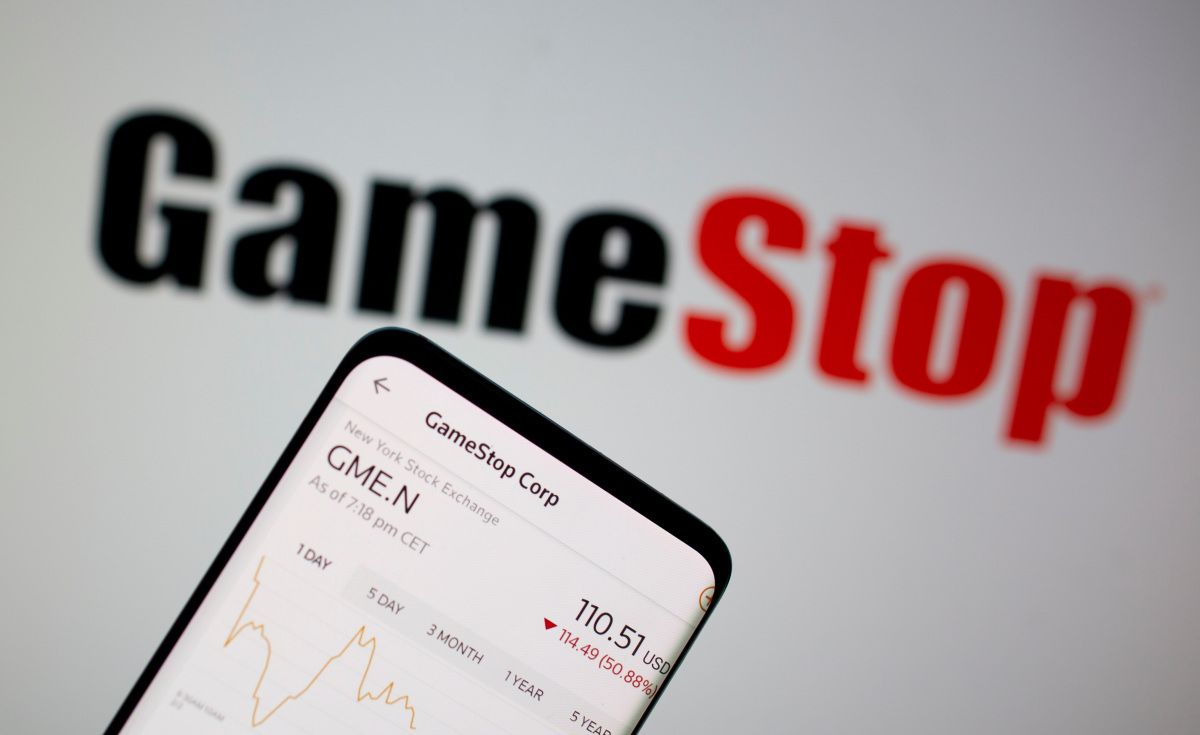
GameStop is laying off people as the company tries to fit in with a digitally-transforming videogame industry. In photo: GameStop stock graph is seen in front of the company's logo in this illustration taken February 2, 2021.

The stock has shown resilience in early 2026, up roughly 15-20% year-to-date despite ongoing declines in core retail sales. Trading remained relatively light on the post-holiday Monday, with volume below recent averages, reflecting the meme stock’s sensitivity to news flow rather than broad market moves.

GameStop’s transformation under Cohen has shifted focus from traditional brick-and-mortar video game sales to a potential holding company model. The company ended fiscal 2025 with a “fortress” balance sheet boasting approximately $8.83 billion in cash and equivalents, providing significant dry powder for strategic moves.

In late March 2026, GameStop reported fourth-quarter and full-year results. Net sales for the fourth quarter fell to $1.104 billion from $1.283 billion a year earlier, missing some expectations. However, gross profit rose 6.4% to $386.8 million, operating income increased to $135.2 million, and adjusted net income showed strength. For the full fiscal year, net income reached $418.4 million compared with $131.3 million previously.

Cohen, who also serves as chairman, has signaled ambitious plans. In interviews, he described pursuing a “very, very, very big” acquisition of a larger consumer or retail company that could prove “transformational.” Analysts and investors speculate the deal could deploy a substantial portion of the cash pile and aim to elevate GameStop’s market value toward $100 billion over time.

Advertisement

The board granted Cohen a landmark performance-based stock option award in January 2026 — entirely “at-risk” compensation tied to ambitious market capitalization targets starting at $20 billion and scaling up to $100 billion. Cohen has put his own capital behind the vision, purchasing additional shares in early 2026, including blocks worth millions at average prices around $21.

Short interest and retail investor enthusiasm remain key drivers of volatility. While the intense 2021 short squeeze has cooled, GME continues to rank among meme stocks with dedicated online followings. Year-to-date performance has outpaced several other former meme names, fueled by acquisition rumors and Cohen’s conviction signals.

Core retail operations face ongoing challenges. Revenue has declined as consumers shift toward digital downloads and new console cycles mature. The company has reduced its physical store footprint while exploring e-commerce, collectibles and potential new ventures. Bitcoin holdings have also been noted as a diversifying asset on the balance sheet.

Wall Street coverage remains limited and mixed. Some analysts maintain “Hold” ratings with price targets near $26, citing the cash hoard and optionality from Cohen’s strategy. Others highlight risks: declining sales trends, execution challenges in any large acquisition, and the stock’s history of sharp swings driven by sentiment rather than fundamentals.

Advertisement

Options activity shows mixed sentiment, with notable interest in both calls and puts reflecting uncertainty over the next catalyst. The 52-week range has spanned roughly $19.93 to $35.81, underscoring persistent volatility.

Supporters view Cohen’s Chewy background and activist roots as assets for reinventing GameStop beyond gaming retail. Critics argue the company risks overpaying in a deal or failing to stem core business erosion while chasing growth. Regulatory notes include a recent FTC settlement related to reporting matters.

As of early April 2026, no specific acquisition target has been confirmed. Cohen has canceled some interviews citing inability to discuss “monumental” plans, adding to speculation. A special shareholder meeting expected around March or April was anticipated to address aspects of the performance award.

For long-term holders from the pre-2021 era, the stock remains dramatically higher than levels a decade ago, though far below 2021 peaks near $86 (split-adjusted). Recent performance has been more measured, with sideways trading punctuated by rumor-driven spikes.

Advertisement

GameStop’s story continues to captivate retail investors on platforms where community sentiment can influence short-term price action. The combination of a strong balance sheet, activist-style leadership and legacy brand keeps it on watchlists despite shrinking traditional revenue.

Looking ahead, investors await any updates on acquisition talks, first-quarter results later in 2026, and progress on strategic initiatives. Cohen’s all-at-risk compensation structure aligns his incentives closely with significant value creation, raising stakes for the coming months.

The broader market environment, including interest rates, consumer spending and tech/AI trends, could indirectly affect any pivot GameStop attempts. For now, the stock trades as a high-conviction, high-risk name where news on Cohen’s “big” plans could trigger sharp moves in either direction.

GameStop, founded in 1984 and headquartered in Grapevine, Texas, operates hundreds of stores across the U.S. and internationally, selling video games, consoles, accessories and collectibles. Under Cohen since 2021, it has raised capital, strengthened its balance sheet and reduced debt while exploring diversification.

Advertisement

Monday’s modest decline occurred against a backdrop of broader market caution, with the S&P 500 showing limited movement. GME’s price action remains largely detached from traditional retail metrics, driven instead by narrative and anticipation.

As April trading continues, all eyes remain on Grapevine for the next chapter in GameStop’s evolution from meme stock darling to potential diversified powerhouse — or the risks that come with such ambition.

Continue Reading

Business

Praxis: Strong Buy As Relutrigine Submission Accepted Plus Expansion Potential (PRAX)

Published

on

Praxis: Strong Buy As Relutrigine Submission Accepted Plus Expansion Potential (PRAX)

This article was written by

Terry Chrisomalis is a private investor in the Biotech sector with years of experience utilizing his Applied Science background to generate long term value from Healthcare. He is the author of the investing group Biotech Analysis Central which contains a library of 600+ Biotech investing articles, a model portfolio of 10+ small and mid-cap stocks with deep analysis for each, live chat, and a range of analysis and news reports to help Healthcare investors make informed decisions.

Analyst’s Disclosure: I/we have no stock, option or similar derivative position in any of the companies mentioned, and no plans to initiate any such positions within the next 72 hours. I wrote this article myself, and it expresses my own opinions. I am not receiving compensation for it (other than from Seeking Alpha). I have no business relationship with any company whose stock is mentioned in this article.

Seeking Alpha’s Disclosure: Past performance is no guarantee of future results. No recommendation or advice is being given as to whether any investment is suitable for a particular investor. Any views or opinions expressed above may not reflect those of Seeking Alpha as a whole. Seeking Alpha is not a licensed securities dealer, broker or US investment adviser or investment bank. Our analysts are third party authors that include both professional investors and individual investors who may not be licensed or certified by any institute or regulatory body.

Advertisement
Continue Reading

Business

Synchrony Financial: Sell-Off Presents Great Entry Point For Shares (Upgrade) (NYSE:SYF)

Published

on

Synchrony Financial: Sell-Off Presents Great Entry Point For Shares (Upgrade) (NYSE:SYF)

This article was written by

Other writing on Substack: https://yieldstrategies.substack.com/I am currently focused on income investing through either common shares, preferred shares, or bonds. I will occasionally break away and write about the economy at large or a special situation involving a company I’ve been researching in. I target two articles per week for publication on Monday and Tuesday.About My Background: Bachelors in history/political science, Masters in Business Administration with a specialization in Finance and Economics. I enjoy numbers. I have been investing since 2000. Professionally, I am the CEO of an independent living retirement community in Illinois.

Analyst’s Disclosure: I/we have no stock, option or similar derivative position in any of the companies mentioned, and no plans to initiate any such positions within the next 72 hours. I wrote this article myself, and it expresses my own opinions. I am not receiving compensation for it (other than from Seeking Alpha). I have no business relationship with any company whose stock is mentioned in this article.

Seeking Alpha’s Disclosure: Past performance is no guarantee of future results. No recommendation or advice is being given as to whether any investment is suitable for a particular investor. Any views or opinions expressed above may not reflect those of Seeking Alpha as a whole. Seeking Alpha is not a licensed securities dealer, broker or US investment adviser or investment bank. Our analysts are third party authors that include both professional investors and individual investors who may not be licensed or certified by any institute or regulatory body.

Advertisement
Continue Reading

Business

CBS to sell late-night hours to Byron Allen as Colbert show ends

Published

on

CBS to sell late-night hours to Byron Allen as Colbert show ends


CBS to sell late-night hours to Byron Allen as Colbert show ends

Continue Reading

Business

The New Divide In ASEAN Debt

Published

on

The New Divide In ASEAN Debt

The New Divide In ASEAN Debt

Continue Reading

Trending

Copyright © 2025